Results by title
660 books match the query 'Texas' and 189 start with t
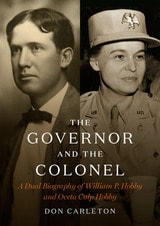
The Governor and the Colonel
A Dual Biography of William P. Hobby and Oveta Culp HobbyBy Don Carleton
University of Texas Press, 2020
William P. “Will” Hobby Sr. and Oveta Culp Hobby were one of the most influential couples in Texas history. Both were major public figures, with Will serving as governor of Texas and Oveta as the first commander of the Women’s Army Corps and later as the second woman to serve in a presidential cabinet. Together, they built a pioneering media empire centered on the Houston Post and their broadcast properties, and they played a significant role in the transformation of Houston into the fourth largest city in the United States. Don Carleton’s dual biography details their personal and professional relationship—defined by a shared dedication to public service—and the important roles they each played in local, state, and national events throughout the twentieth century.
This deeply researched book not only details this historically significant partnership, but also explores the close relationships between the Hobbys and key figures in twentieth-century history, from Texas legends such as LBJ, Sam Rayburn, and Jesse Jones, to national icons, including the Roosevelts, President Eisenhower, and the Rockefellers. Carleton's chronicle reveals the undeniable impact of the Hobbys on journalistic and political history in the United States.

The Governor's Hounds
The Texas State Police, 1870–1873By Barry A. Crouch and Donaly E. Brice
University of Texas Press, 2011
In the tumultuous years following the Civil War, violence and lawlessness plagued the state of Texas, often overwhelming the ability of local law enforcement to maintain order. In response, Reconstruction-era governor Edmund J. Davis created a statewide police force that could be mobilized whenever and wherever local authorities were unable or unwilling to control lawlessness. During its three years (1870–1873) of existence, however, the Texas State Police was reviled as an arm of the Radical Republican party and widely condemned for being oppressive, arrogant, staffed with criminals and African Americans, and expensive to maintain, as well as for enforcing the new and unpopular laws that protected the rights of freed slaves.
Drawing extensively on the wealth of previously untouched records in the Texas State Archives, as well as other contemporary sources, Barry A. Crouch and Donaly E. Brice here offer the first major objective assessment of the Texas State Police and its role in maintaining law and order in Reconstruction Texas. Examining the activities of the force throughout its tenure and across the state, the authors find that the Texas State Police actually did much to solve the problem of violence in a largely lawless state. While acknowledging that much of the criticism the agency received was merited, the authors make a convincing case that the state police performed many of the same duties that the Texas Rangers later assumed and fulfilled the same need for a mobile, statewide law enforcement agency.

The Great Texas Stamp Collection
How Some Stubborn Texas Confederate Postmasters, a Handful of Determined Texas Stamp Collectors, and a Few of the World's Greatest Philatelists Created, Discovered, and Preserved Some of the World's Most Valuable Postage StampsBy Charles W. Deaton
University of Texas Press, 2012
Among the many difficulties the newly formed Confederate States of America endured in the summer of 1861 was the failure of its post office department to provide sufficient numbers of that item most crucial to its service: the postage stamp. Faced with the resulting din of customer complaints, a handful of industrious Texas postmasters solved the problem by simply making their own homemade stamps.
In this thoroughly researched history of these rare and highly coveted stamps, The Great Texas Stamp Collection traces their journey from creation through their rediscovery years later by local, and then international, stamp collectors—a journey that culminated in the sale of a few pieces at a recent auction in New York that fetched more than $250,000. Weaving the larger contexts of Texas and U.S. postal history together with individual tales of greed, intrigue, forgery, and discovery, Deaton’s book is rich with characters from European royalty to early stamp dealers to common criminals, while also providing detailed examinations of the stamps themselves, including a complete census of the stamps now known as the Texas Confederate Postmasters’ Provisionals.
Appealing at once to devoted philatelists, Texas and U.S. history buffs, and amateur collectors of all kinds, The Great Texas Stamp Collection offers a unique vantage point from which to view our history as well as the very nature of collecting.
The Great Texas Wind Rush
How George Bush, Ann Richards, and a Bunch of Tinkerers Helped the Oil and Gas State Win the Race to Wind PowerBy Kate Galbraith and Asher Price
University of Texas Press, 2013
In the late 1990s, West Texas was full of rundown towns and pumpjacks, aging reminders of the oil rush of an earlier era. Today, the towns are thriving as 300-foot-tall wind turbines tower above those pumpjacks. Wind energy has become Texas’s latest boom, with the Lone Star State now leading the nation. How did this dramatic transformation happen in a place that fights federal environmental policies at every turn? In The Great Texas Wind Rush, environmental reporters Kate Galbraith and Asher Price tell the compelling story of a group of unlikely dreamers and innovators, politicos and profiteers.
The tale spans a generation and more, and it begins with the early wind pioneers, precocious idealists who saw opportunity after the 1970s oil crisis. Operating in an economy accustomed to exploiting natural resources and always looking for the next big thing, their ideas eventually led to surprising partnerships between entrepreneurs and environmentalists, as everyone from Enron executives to T. Boone Pickens, as well as Ann Richards, George W. Bush and Rick Perry, ended up backing the new technology. In this down-to-earth account, the authors explain the policies and science that propelled the “windcatters” to reap the great harvest of Texas wind. They also explore what the future holds for this relentless resource that is changing the face of Texas energy.
The Guadalupe Mountains of Texas
Photographs and drawings by Michael Allender, Text by Alan Tennant
University of Texas Press, 1997
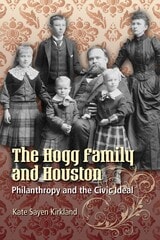
The Hogg Family and Houston
Philanthropy and the Civic IdealBy Kate Sayen Kirkland
University of Texas Press, 2009
Progressive former governor James Stephen Hogg moved his business headquarters to Houston in 1905. For seven decades, his children Will, Ima, and Mike Hogg used their political ties, social position, and family fortune to improve the lives of fellow Houstonians.
As civic activists, they espoused contested causes like city planning and mental health care. As volunteers, they inspired others to support social service, educational, and cultural programs. As philanthropic entrepreneurs, they built institutions that have long outlived them: the Houston Symphony, the Museum of Fine Arts, Memorial Park, and the Hogg Foundation. The Hoggs had a vision of Houston as a great city—a place that supports access to parklands, music, and art; nurtures knowledge of the "American heritage which unites us"; and provides social service and mental health care assistance. This vision links them to generations of American idealists who advanced a moral response to change.
Based on extensive archival sources, The Hogg Family and Houston explains the impact of Hogg family philanthropy for the first time. This study explores how individual ideals and actions influence community development and nurture humanitarian values. It examines how philanthropists and volunteers mold Houston's traditions and mobilize allies to meet civic goals. It argues that Houston's generous citizens have long believed that innovative cultural achievement must balance aggressive economic expansion.
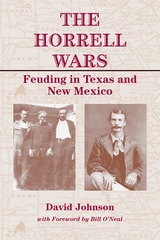
The Horrell Wars
Feuding in Texas and New MexicoDavid Johnson
University of North Texas Press, 2014

The House Will Come To Order
How the Texas Speaker Became a Power in State and National PoliticsBy Patrick L. Cox and Michael Phillips
University of Texas Press, 2010
In a state assumed to have a constitutionally weak governor, the Speaker of the Texas House wields enormous power, with the ability to almost single-handedly dictate the legislative agenda. The House Will Come to Order charts the evolution of the Speaker's role from a relatively obscure office to one of the most powerful in the state. This fascinating account, drawn from the Briscoe Center's oral history project on the former Speakers, is the story of transition, modernization, and power struggles.
Weaving a compelling story of scandal, service, and opportunity, Patrick Cox and Michael Phillips describe the divisions within the traditional Democratic Party, the ascendance of Republicans, and how Texas business, agriculture, and media shaped perceptions of officeholders. While the governor and lieutenant governor wielded their power, the authors show how the modern Texas House Speaker built an office of equal power as the state became more complex and diverse. The authors also explore how race, class, and gender affected this transition as they explain the importance of the office in Texas and the impact the state's Speakers have had on national politics.
At the apex of its power, the Texas House Speaker's role at last receives the critical consideration it deserves.
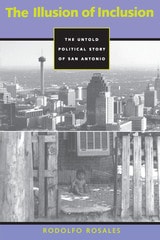
The Illusion of Inclusion
The Untold Political Story of San AntonioBy Rodolfo Rosales
University of Texas Press, 2000
To many observers, the 1981 election of Henry Cisneros as mayor of San Antonio, Texas, represented the culminating victory in the Chicano community's decades-long struggle for inclusion in the city's political life. Yet, nearly twenty years later, inclusion is still largely an illusion for many working-class and poor Chicanas and Chicanos, since business interests continue to set the city's political and economic priorities.
In this book, Rodolfo Rosales offers the first in-depth history of the Chicano community's struggle for inclusion in the political life of San Antonio during the years 1951 to 1991, drawn from interviews with key participants as well as archival research. He focuses on the political and organizational activities of the Chicano middle class in the context of post-World War II municipal reform and how it led ultimately to independent political representation for the Chicano community. Of special interest is his extended discussion of the role of Chicana middle-class women as they gained greater political visibility in the 1980s.
The Impact of Global Warming on Texas
Second editionEdited by Jurgen Schmandt, Gerald R. North, and Judith Clarkson
University of Texas Press, 2011
When The Impact of Global Warming on Texas was first published in 1995, it discussed climate change as a likely future phenomenon, predicted by scientific studies. This entirely rewritten second edition presents evidence that early climate change impacts can now be observed and identifies the threats climate change will pose to Texas through the year 2050. It also offers the hopeful message that corrective action, if taken now, can avert unmanageable consequences.
The book begins with a discussion of climate science and modeling and the information that can be derived from these sources for Texas. The authors follow this with an analysis of actual climate trends in the various Texas climate regions, including a predicted rise in temperatures of 5.4 degrees F (plus or minus 1.8 F) by the end of the century. This could lead to less rainfall and higher evaporation, especially in regions that are already dry. Other important effects include possible changes in El Niño (climate variability) patterns and hurricane behaviors. Taking into account projected population growth, subsequent chapters explore likely trends with respect to water availability, coastal impacts, and biodiversity.
The authors then look at the issues from a policy perspective, focusing on Texas's importance to the national economy as an energy producer, particularly of oil and gas. They recommend that Texas develop its own climate change policy to serve the goals of reducing greenhouse gas emissions, increasing energy independence, ensuring regional security, and improving management of water, air, land, and wildlife.
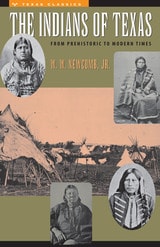
The Indians of Texas
From Prehistoric to Modern TimesBy William W. Newcomb, Jr.
University of Texas Press, 1961
The Informal and Underground Economy of the South Texas Border
By Chad Richardson and Michael J. Pisani
University of Texas Press, 2012
Much has been debated about the presence of undocumented workers along the South Texas border, but these debates often overlook the more complete dimension: the region’s longstanding, undocumented economies as a whole. Borderlands commerce that evades government scrutiny can be categorized into informal economies (the unreported exchange of legal goods and services) or underground economies (criminal economic activities that, obviously, occur without government oversight). Examining long-term study, observation, and participation in the border region, with the assistance of hundreds of locally embedded informants, The Informal and Underground Economy of the South Texas Border presents unique insights into the causes and ramifications of these economic channels.
The third volume in UT–Pan American’s Borderlife Project, this eye-opening investigation draws on vivid ethnographic interviews, bolstered by decades of supplemental data, to reveal a culture where divided loyalties, paired with a lack of access to protection under the law and other forms of state-sponsored recourse, have given rise to social spectra that often defy stereotypes. A cornerstone of the authors’ findings is that these economic activities increase when citizens perceive the state’s intervention as illegitimate, whether in the form of fees, taxes, or regulation. From living conditions in the impoverished colonias to President Felipe Calderón’s futile attempts to eradicate police corruption in Mexico, this book is a riveting portrait of benefit versus risk in the wake of a “no-man’s-land” legacy.

The Johnson-Sims Feud
Romeo and Juliet, West Texas StyleBill O'Neal
University of North Texas Press, 2010
The Karankawa Indians of Texas
An Ecological Study of Cultural Tradition and ChangeBy Robert A. Ricklis
University of Texas Press, 1996
Popular lore has long depicted the Karankawa Indians as primitive scavengers (perhaps even cannibals) who eked out a meager subsistence from fishing, hunting and gathering on the Texas coastal plains. That caricature, according to Robert Ricklis, hides the reality of a people who were well-adapted to their environment, skillful in using its resources, and successful in maintaining their culture until the arrival of Anglo-American settlers.
The Karankawa Indians of Texas is the first modern, well-researched history of the Karankawa from prehistoric times until their extinction in the nineteenth century. Blending archaeological and ethnohistorical data into a lively narrative history, Ricklis reveals the basic lifeway of the Karankawa, a seasonal pattern that took them from large coastal fishing camps in winter to small, dispersed hunting and gathering parties in summer. In a most important finding, he shows how, after initial hostilities, the Karankawa incorporated the Spanish missions into their subsistence pattern during the colonial period and coexisted peacefully with Euroamericans until the arrival of Anglo settlers in the 1820s and 1830s. These findings will be of wide interest to everyone studying the interactions of Native American and European peoples.
The Laws of Slavery in Texas
Historical Documents and EssaysEdited by Randolph B. Campbell
University of Texas Press, 2010
The laws that governed the institution of slavery in early Texas were enacted over a fifty-year period in which Texas moved through incarnations as a Spanish colony, a Mexican state, an independent republic, a part of the United States, and a Confederate state. This unusual legal heritage sets Texas apart from the other slave-holding states and provides a unique opportunity to examine how slave laws were enacted and upheld as political and legal structures changed. The Laws of Slavery in Texas makes that examination possible by combining seminal historical essays with excerpts from key legal documents from the slave period and tying them together with interpretive commentary by the foremost scholar on the subject, Randolph B. Campbell.
Campbell's commentary focuses on an aspect of slave law that was particularly evident in the evolving legal system of early Texas: the dilemma that arose when human beings were treated as property. As Campbell points out, defining slaves as moveable property, or chattel, presented a serious difficulty to those who wrote and interpreted the law because, unlike any other form of property, slaves were sentient beings. They were held responsible for their crimes, and in numerous other ways statute and case law dealing with slavery recognized the humanness of the enslaved. Attempts to protect the property rights of slave owners led to increasingly restrictive laws—including laws concerning free blacks—that were difficult to uphold. The documents in this collection reveal both the roots of the dilemma and its inevitable outcome.

The Legumes of Texas
By B. L. Turner
University of Texas Press, 1959

The Light Crust Doughboys Are on the Air
Celebrating Seventy Years of Texas MusicJohn Mark Dempsey
University of North Texas Press, 2002
The Making of a Chicano Militant
Lessons from CristalJose Angel Gutierrez
University of Wisconsin Press, 1999
Texas, for years, was a one-party state controlled by white democrats. In 1962, a young eighteen-year-old heard the first rumblings of Chicano community organization in the barrios of Cristal. The rumor in the town was that five Mexican Americans were going to run for all five seats on the city council. But first, poor citizens had to find a way to pay the $1.75 poll tax. Money had to be raised—through bake sales of tamales, cake walks, and dances. So began the political activism of José Angel Gutiérrez.
Gutiérrez's autobiography, The Making of a Chicano Militant, is the first insider's view of the important political and social events within the Mexican American communities in South Texas during the 1960s and 1970s. A controversial and dynamic political figure during the height of the Chicano movement, Gutiérrez offers an absorbing personal account of his life at the forefront of the Mexican-American civil rights movement—first as a Chicano and then as a militant.
Gutiérrez traces the racial, ethnic, economic, and social prejudices facing Chicanos with powerful scenes from his own life: his first summer job as a tortilla maker at the age of eleven, his racially motivated kidnapping as a teenager, and his coming of age in the face of discrimination as a radical organizer in college and graduate school. When Gutiérrez finally returned to Cristal, he helped form the Mexican American Youth Organization and, subsequently the Raza Unida Party to confront issues of ethnic intolerance in his community. His story is soon to be a classic in the developing literature of Mexican American leaders.
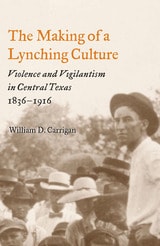
The Making of a Lynching Culture
Violence and Vigilantism in Central Texas, 1836-1916William D. Carrigan
University of Illinois Press, 2006
How a culture of violence legitimized lynching among ordinary people
On May 15, 1916, a crowd of fifteen thousand witnessed the lynching of an eighteen-year-old black farm worker named Jesse Washington. Most central Texans of the time failed to call for the punishment of the mob’s leaders. In The Making of a Lynching Culture, now in paperback, William D. Carrigan seeks to explain not how a fiendish mob could lynch one man but how a culture of violence that nourished this practice could form and endure for so long among ordinary people.
Beginning with the 1836 independence of Texas, The Making of a Lynching Culture reexamines traditional explanations of lynching, including the role of the frontier, economic tensions, and political conflicts. Using a voluminous body of court records, newspaper accounts, oral histories, and other sources, Carrigan shows how notions of justice and historical memory were shaped to glorify violence and foster a culture that legitimized lynching.
The Making of a Mexican American Mayor
Mario Garcia
University of Arizona Press, 1999
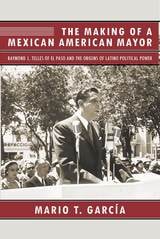
The Making of a Mexican American Mayor
Raymond L. Telles of El Paso and the Origins of Latino Political PowerMario T. García
University of Arizona Press, 2018
In the border metropolis of El Paso, more than half the population is Mexican American, yet this group had been denied effective political representation. Mexican Americans broke this barrier and achieved the “politics of status” through Telles’s stunning 1957 victory. This book captures the excitement of that long-awaited election.
The Making of a Mexican American Mayor also examines Telles’s story as a microcosm of the history of Mexican Americans before and after World War II—the Mexican American Generation. As mayor and ambassador, Telles symbolized this generation’s striving for political participation, and his legacy is evident in the growing number of Latinas/os holding office today.

The Mammals of Texas
By David J. Schmidly and Robert D. Bradley
University of Texas Press, 2016
From reviews of previous editions:
“This is the standard reference about Texas mammals.” —Wildlife Activist
“A must for anyone seriously interested in the wildlife of Texas.” —Texas Outdoor Writers Association News
“[This book] easily fills the role of both a field guide and a desk reference, and is written in a style that appeals to the professional biologist and amateur naturalist alike. . . . [It] should prove useful to anyone with an interest in the mammal fauna of Texas or the southern Great Plains.” —Prairie Naturalist
The Mammals of Texas has been the standard reference since the first edition was coauthored by William B. Davis and Walter P. Taylor in 1947. Revised several times over the succeeding decades, it remains the most authoritative source of information on the mammalian wildlife of Texas, with physical descriptions and life histories for 202 species, abundant photographs and drawings, and distribution maps.
In this new edition, David J. Schmidly is joined by one of the most active researchers on Texas mammals, Robert D. Bradley, to provide a thorough update of the taxonomy, distribution, and natural history of all species of wild mammals that inhabit Texas today. Using the most recent advances in molecular biology and in wildlife ecology and management, the authors include the most current information about the scientific nomenclature, taxonomy, and identification of species, while also covering significant advances in natural history and conservation.
The Mason County "Hoo Doo" War, 1874-1902
David Johnson
University of North Texas Press, 2006
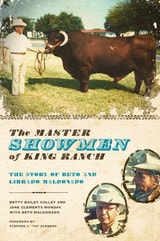
The Master Showmen of King Ranch
The Story of Beto and Librado MaldonadoBy Betty Bailey Colley and Jane Clements Monday, with Beto Maldonado
University of Texas Press, 2009
Winner, San Antonio Conservation Society Citation, 2011
Texas's King Ranch has become legendary for a long list of innovations, the most enduring of which is the development of the first official cattle breed in the Americas, the Santa Gertrudis. Among those who played a crucial role in the breed's success were Librado and Alberto "Beto" Maldonado, master showmen of the King Ranch. A true "bull whisperer," Librado Maldonado developed a method for gentling and training cattle that allowed him and his son Beto to show the Santa Gertrudis to their best advantage at venues ranging from the famous King Ranch auctions to a Chicago television studio to the Dallas–Fort Worth airport. They even boarded a plane with the cattle en route to the International Fair in Casablanca, Morocco, where they introduced the Santa Gertrudis to the African continent.
In The Master Showmen of King Ranch, Beto Maldonado recalls an eventful life of training and showing King Ranch Santa Gertrudis. He engagingly describes the process of teaching two-thousand-pound bulls to behave "like gentlemen" in the show ring, as well as the significant logistical challenges of transporting them to various high-profile venues around the world. His reminiscences, which span more than seventy years of King Ranch history, combine with quotes from other Maldonado family members, co-workers, and ranch owners to shed light on many aspects of ranch life, including day-to-day work routines, family relations, women's roles, annual celebrations, and the enduring ties between King Ranch owners and the vaquero families who worked on the ranch through several generations.
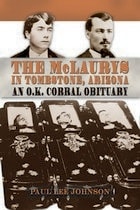
The McLaurys in Tombstone, Arizona
An O.K. Corral ObituaryPaul Lee Johnson
University of North Texas Press, 2012
The Mexican American Experience in Texas
Citizenship, Segregation, and the Struggle for EqualityBy Martha Menchaca
University of Texas Press, 2022
A historical overview of Mexican Americans' social and economic experiences in Texas
For hundreds of years, Mexican Americans in Texas have fought against political oppression and exclusion—in courtrooms, in schools, at the ballot box, and beyond. Through a detailed exploration of this long battle for equality, this book illuminates critical moments of both struggle and triumph in the Mexican American experience.
Martha Menchaca begins with the Spanish settlement of Texas, exploring how Mexican Americans’ racial heritage limited their incorporation into society after the territory’s annexation. She then illustrates their political struggles in the nineteenth century as they tried to assert their legal rights of citizenship and retain possession of their land, and goes on to explore their fight, in the twentieth century, against educational segregation, jury exclusion, and housing covenants. It was only in 1967, she shows, that the collective pressure placed on the state government by Mexican American and African American activists led to the beginning of desegregation. Menchaca concludes with a look at the crucial roles that Mexican Americans have played in national politics, education, philanthropy, and culture, while acknowledging the important work remaining to be done in the struggle for equality.

The Native Americans of the Texas Edwards Plateau, 1582-1799
By Maria F. Wade
University of Texas Press, 2003
2003 – Texas Old Missions and Forts Restoration Association Book Award Winner – Texas Catholic Historical Society
2004 – Finalist: Friends of the Dallas Public Library Award for Book Making the Most Significant Contribution to Knowledge – Texas Institute of Letters
The region that now encompasses Central Texas and northern Coahuila, Mexico, was once inhabited by numerous Native hunter-gather groups whose identities and lifeways we are only now learning through archaeological discoveries and painstaking research into Spanish and French colonial records. From these key sources, Maria F. Wade has compiled this first comprehensive ethnohistory of the Native groups that inhabited the Texas Edwards Plateau and surrounding areas during most of the Spanish colonial era.
Much of the book deals with events that took place late in the seventeenth century, when Native groups and Europeans began to have their first sustained contact in the region. Wade identifies twenty-one Native groups, including the Jumano, who inhabited the Edwards Plateau at that time. She offers evidence that the groups had sophisticated social and cultural mechanisms, including extensive information networks, ladino cultural brokers, broad-based coalitions, and individuals with dual-ethnic status. She also tracks the eastern movement of Spanish colonizers into the Edwards Plateau region, explores the relationships among Native groups and between those groups and European colonizers, and develops a timeline that places isolated events and singular individuals within broad historical processes.

The New Metropolis
Power, Place, and Inequality in Twenty-First-Century AmericaMargaret Weir
University of Chicago Press, 2027
A path-breaking investigation of changing patterns of inequality and contestation in America’s metropolises.
Since 1990, a new political geography of winners and losers has emerged in metros across America. This new metropolis looks nothing like the old. In many exurbs, suburban mansions abut declining towns and distressed communities. In historic central cities, African American communities reel from institutional stripping, even as gentrification and immigration revitalize once forgotten neighborhoods. The New Metropolis considers why, despite all the changes over the past four decades, we have recreated a metropolis that makes it harder for low-income Americans—especially low-income Americans of color—to thrive and why some efforts to promote equitable opportunity succeed against the odds.
With a focus on Chicago, Atlanta, and Houston, The New Metropolis shows how multi-level political actors and translocal networks build power across political boundaries to determine the pool of local public resources and the scope of local powers. Weir demonstrates how the timing of urbanization set up distinct conflicts over the public sector in Frostbelt versus Sunbelt metropolises, explaining how partisan divisions now supercharge these conflicts.
The New Metropolis shows why the battle over the metropolis sits at the center of American politics. It determines the shape of the public arenas where we make decisions and, ultimately, the kinds of connections Americans have with one another.
The Open-Ended City
David Dillon on Texas ArchitectureBy Kathryn E. Holliday; foreword by Robert Decherd
University of Texas Press, 2019
Texas Historical Commission Award of Excellence in Media Achievement, Texas Historical Commission
In 1980, David Dillon launched his career as an architectural critic with a provocative article that asked “Why Is Dallas Architecture So Bad?” Over the next quarter century, he offered readers of the Dallas Morning News a vision of how good architecture and planning could improve quality of life, combatting the negative effects of urban sprawl, civic fragmentation, and rapacious real estate development typical in Texas cities. The Open-Ended City gathers more than sixty key articles that helped establish Dillon’s national reputation as a witty and acerbic critic, showing readers why architecture matters and how it can enrich their lives.Kathryn E. Holliday discusses how Dillon connected culture, commerce, history, and public life in ways that few columnists and reporters ever get the opportunity to do. The articles she includes touch on major themes that animated Dillon’s writing: downtown redevelopment, suburban sprawl, arts and culture, historic preservation, and the necessity of aesthetic quality in architecture as a baseline for thriving communities. While the specifics of these articles will resonate with those who care about Dallas, Fort Worth, and other Texas cities, they are also deeply relevant to all architects, urbanists, and citizens who engage in the public life and planning of cities. As a collection, The Open-Ended City persuasively demonstrates how a discerning critic helped to shape a landmark city by shaping the conversation about its architecture.
The Path to a Modern South
Northeast Texas between Reconstruction and the Great DepressionBy Walter L. Buenger
University of Texas Press, 2001
The forces that turned Northeast Texas from a poverty-stricken region into a more economically prosperous area.
Winner, Texas State Historical Association Coral H. Tullis Memorial Award for best book on Texas history, 2001
Federal New Deal programs of the 1930s and World War II are often credited for transforming the South, including Texas, from a poverty-stricken region mired in Confederate mythology into a more modern and economically prosperous part of the United States. By contrast, this history of Northeast Texas, one of the most culturally southern areas of the state, offers persuasive evidence that political, economic, and social modernization began long before the 1930s and prepared Texans to take advantage of the opportunities presented by the New Deal and World War II.
Walter L. Buenger draws on extensive primary research to tell the story of change in Northeast Texas from 1887 to 1930. Moving beyond previous, more narrowly focused studies of the South, he traces and interconnects the significant changes that occurred in politics, race relations, business and the economy, and women's roles. He also reveals how altered memories of the past and the emergence of a stronger identification with Texas history affected all facets of life in Northeast Texas.
The People’s Party in Texas
A Study in Third Party PoliticsBy Roscoe Martin
University of Texas Press, 1970
Roscoe Martin's study of the People's Party in Texas was a pioneering analysis of the state populist movements and long considered one of the best. The People's Party was an influential force in United States politics in the last decade of the nineteenth century, especially in the western and southern states. Martin's study of third-party politics in Texas, as well as being an important work in Texas history, provides much insight into the national radical movement of the 1890s.
The Power of the Texas Governor
Connally to BushBy Brian McCall
University of Texas Press, 2009
George W. Bush called it "the best job in the world," yet many would argue that the Texas governorship is a weak office. Given few enumerated powers by the Texas Constitution, the governor must build a successful relationship with the state legislature—sometimes led by a powerful lieutenant governor or speaker of the opposing party—to advance his or her policy agenda. Yet despite the limitations on the office and the power of the legislative branch, many governors have had a significant impact on major aspects of Texas's public life—government, economic development, education, and insurance reform among them. How do Texas governors gain the power to govern effectively?
The Power of the Texas Governor takes a fresh look at the state's chief executives, from John Connally to George W. Bush, to discover how various governors have overcome the institutional limitations of the office. Delving into the governors' election campaigns and successes and failures in office, Brian McCall makes a convincing case that the strength of a governor's personality—in particular, his or her highly developed social skills—can translate into real political power. He shows, for example, how governors such as Ann Richards and George W. Bush forged personal relationships with individual legislators to achieve their policy goals. Filled with revealing insights and anecdotes from key players in each administration, The Power of the Texas Governor offers new perspectives on leadership and valuable lessons on the use of power.

The Ranger Ideal Volume 1
Texas Rangers in the Hall of Fame, 1823-1861Darren L. Ivey
University of North Texas Press, 2017
The Ranger Ideal Volume 2
Texas Rangers in the Hall of Fame, 1874-1930Darren L. Ivey
University of North Texas Press, 2018
The Ranger Ideal Volume 3
Texas Rangers in the Hall of Fame, 1898-1987Darren L. Ivey
University of North Texas Press, 2021
The Regional Vocabulary of Texas
By E. Bagby Atwood
University of Texas Press, 1962
The vocabulary of Texas, and of the Southwest, has a character that sets it apart from all others. It is to some extent an amalgamation of words brought from other sections. A more important ingredient, however, has been a large group of words that initially grew into usage in Texas itself.
Utilizing a thorough knowledge of language and a remarkable insight into linguistics, E. Bagby Atwood has compiled a reference book for scholars, writers, and laypeople whose interests involve the use of this vocabulary. It is a well-balanced book, designed to present to the reader not only the actual vocabulary in use but also the area involved, topical surveys of words used, their backgrounds, and geographical aspects of their usage. Easterners and Westerners alike will relish the unique flavor of the Southwestern vocabulary.

The Republic of Football
Legends of the Texas High School GameChad S. Conine
University of Texas Press, 2016
Anywhere football is played, Texas is the force to reckon with. Its powerhouse programs produce the best football players in America. In The Republic of Football, Chad S. Conine vividly captures Texas’s impact on the game with action-filled stories about legendary high school players, coaches, and teams from around the state and across seven decades.
Drawing on dozens of interviews, Conine offers rare glimpses of the early days of some of football’s biggest stars. He reveals that some players took time to achieve greatness—LaDainian Tomlinson wasn’t even the featured running back on his high school team until a breakthrough game in his senior season vaulted him to the highest level of the sport—while others, like Colt McCoy, showed their first flashes of brilliance in middle school. In telling these and many other stories of players and coaches, including Hayden Fry, Spike Dykes, Bob McQueen, Lovie Smith, Art Briles, Lawrence Elkins, Warren McVea, Ray Rhodes, Dat Nguyen, Zach Thomas, Drew Brees, and Adrian Peterson, Conine spotlights the decisive moments when players caught fire and teams such as Celina, Southlake Carroll, and Converse Judson turned into Texas dynasties. Packed with never-before-told anecdotes, as well as fresh takes on the games everyone remembers, The Republic of Football is a must-read for all fans of Friday night lights.
The Republican Party of Texas
A Political HistoryBy Wayne Thorburn
University of Texas Press, 2021
On July 4, 1867, a group of men assembled in Houston to establish the Republican Party of Texas. Combatting entrenched statewide support for the Democratic Party and their own internal divisions, Republicans struggled to gain a foothold in the Lone Star State, which had sided with the Confederacy and aligned with the Democratic platform. In The Republican Party of Texas, Wayne Thorburn, former executive director of the Texas GOP, chronicles over one hundred and fifty years of the defeats and victories of the party that became the dominant political force in Texas in the modern era.
Thorburn documents the organizational structure of the Texas GOP, drawing attention to prominent names, such as Harry Wurzbach and George W. Bush, alongside lesser-known community leaders who bolstered local support. The 1960s and 1970s proved a watershed era for Texas Republicans as they shored up ideological divides and elected the first Republican governor and more state senators and congressional representatives than ever before. From decisions about candidates and shifting allegiances and political stances, to race-based divisions and strategic cooperation with leaders in the Democratic Party, Thorburn unearths the development of the GOP in Texas to understand the unique Texan conservatism that prevails today.

The Road to Spindletop
Economic Change in Texas, 1875–1901By John Stricklin Spratt; drawings by Ed Bearden
University of Texas Press, 1955
This book is an economic history of Texas at the end of the nineteenth century. In 1875, Texas was an agrarian state with limited industry. A generation later, agriculture was heavily commercialized, thousands of miles of railroads carried people and goods around the state, and urban populations increased rapidly. Even before the Spindletop gusher that irrevocably changed the state’s future, Texas had already moved far from its days as a Mexican and American frontier.

The Royal Air Force in Texas
Training British Pilots in Terrell during World War IITom Killebrew
University of North Texas Press, 2003
The San Antonio Missions and their System of Land Tenure
By Félix D. Almaráz, Jr.
University of Texas Press, 1989
San Antonio, Texas, is unique among North American cities in having five former Spanish missions: San Antonio de Valero (The Alamo; founded in 1718), San José y San Miguel de Aguayo (1720), Nuestra Señora de la Purísima Concepción de Acuña (1731), San Juan Capistrano (1731), and San Francisco de la Espada (1731). These missions attract a good deal of popular interest but, until this book, they had received surprisingly little scholarly study. The San Antonio Missions and Their System of Land Tenure, a winner in the Presidio La Bahía Award competition, looks at one previously unexamined aspect of mission history—the changes in landownership as the missions passed from sacred to secular owners in the late eighteenth and early nineteenth centuries.
Drawing on exhaustive research in San Antonio and Bexar County archives, Félix Almaráz has reconstructed the land tenure system that began with the Spaniards' jurisprudential right of discovery and progressed through colonial development, culminating with ownership of the mission properties under successive civic jurisdictions (independent Mexico, Republic of Texas, State of Texas, Bexar County, and City of San Antonio). Several broad questions served as focus points for the research. What were the legal bases for the Franciscan missions as instruments of the Spanish Empire? What was the extent of the initial land grants at the time of their establishment in the eighteenth century? How were the missions' agricultural and pastoral lands configured? And, finally, what impact has urbanization had upon the former Franciscan foundations?
The findings in this study will be valuable for scholars of Texas borderlands and Hispanic New World history. Additionally, genealogists and people with roots in the San Antonio missions area may find useful clues to family history in this extensive study of landownership along the banks of the Río San Antonio.
The Seventh Star of the Confederacy
Texas during the Civil WarKenneth W. Howell
University of North Texas Press, 2009
The Silver Cradle
Las Posadas, Los Pastores, and Other Mexican American TraditionsBy Julia Nott Waugh
University of Texas Press, 1955
Originally published in 1955, The Silver Cradle is the story of a year in the life of the Mexican American people of San Antonio, Texas. During the 1950s, Julia Nott Waugh recorded the performances of such seasonal and religious traditions as Las Posadas, Los Pastores, Las Calaveras, the Blessing of the Animals, the liturgical observances of Holy Week, and festivities of el diez y seis de septiembre (Mexican Independence Day), among others.
Although years have passed and many of the details of observances have changed, the festival calendar and the joy and sincerity of the Mexican American people in honoring its customs and obligations have not disappeared. Now, in fact, a much wider population shares and appreciates the pageantry preserved for us by people like Graciana Reyes, in whose prized silver cradle the Christ Child slept every year at Christmas, and like Doroteo Domínguez, whose annual devotion to presenting a thousand-year-old pastoral epic in his back yard was legendary.
Waugh has done much more than just open a window onto a charming past. She has captured for us one of the true gifts of our Mexican American heritage—the willingness to ritually celebrate the passage of time and to embellish the occasions with sensitivity and fervor. This book will appeal to the general reader as well as to those interested in folk traditions and Mexican American culture.
The Sports Revolution
How Texas Changed the Culture of American AthleticsBy Frank Andre Guridy
University of Texas Press, 2021
The story of Texas’s impact on American sports culture during the civil rights and second-wave feminist movements, this book offers a new understanding of sports and society in the state and the nation as a whole.
In the 1960s and 1970s, America experienced a sports revolution. New professional sports franchises and leagues were established, new stadiums were built, football and basketball grew in popularity, and the proliferation of television enabled people across the country to support their favorite teams and athletes from the comfort of their homes. At the same time, the civil rights and feminist movements were reshaping the nation, broadening the boundaries of social and political participation. The Sports Revolution tells how these forces came together in the Lone Star State.
Tracing events from the end of Jim Crow to the 1980s, Frank Guridy chronicles the unlikely alliances that integrated professional and collegiate sports and launched women’s tennis. He explores the new forms of inclusion and exclusion that emerged during the era, including the role the Dallas Cowboys Cheerleaders played in defining womanhood in the age of second-wave feminism. Guridy explains how the sexual revolution, desegregation, and changing demographics played out both on and off the field as he recounts how the Washington Senators became the Texas Rangers and how Mexican American fans and their support for the Spurs fostered a revival of professional basketball in San Antonio. Guridy argues that the catalysts for these changes were undone by the same forces of commercialization that set them in motion and reveals that, for better and for worse, Texas was at the center of America’s expanding political, economic, and emotional investments in sport.
The Starting Line
Latina/o Children, Texas Schools, and National Debates on Early EducationBy Robert Crosnoe
University of Texas Press, 2020
How can we create high-quality learning environments for children from socially, politically, and economically marginalized groups? How do early childhood programs help to overcome the challenges created by poverty? Seeking to answer these questions, The Starting Line delves into the ups and downs of early education programs serving Latinas/os in Texas, using the state as a window into broader debates about academic opportunity and the changing demographics of the United States.
Immersing readers in the day-to-day activities of Texas's early childhood education programs, Robert Crosnoe illuminates how significant obstacles can stymie the best intentions. Crosnoe pays particular attention to the complex connections among classrooms, schools, families, and communities, as well as the frequently unfolding interplay of educational philosophies. The result is a story highlighting the promises of early childhood education, the perils faced in attempting to fulfill them, and the degree to which Texas stands at the forefront of some larger movements and lags behind in others.
Giving voice to bilingual educators and low-income Latina/o families, this book is a timely exploration of the strengths and needs of what will soon be the largest share of the US child population.

The State Library and Archives of Texas
A History, 1835-1962By David B. Gracy II
University of Texas Press, 2010
The Texas State Library and Archives Commission celebrated its centennial in 2009. To honor that milestone, former State Archivist David Gracy has taken a retrospective look at the agency's colorful and sometimes contentious history as Texas's official information provider and record keeper. In this book, he chronicles more than a century of efforts by dedicated librarians and archivists to deliver the essential, nonpartisan library and archival functions of government within a political environment in which legislators and governors usually agreed that libraries and archives were good and needed—but they disagreed about whatever expenditure was being proposed at the moment.
Gracy recounts the stories of persevering, sometimes controversial state librarians and archivists, and commission members, including Ernest Winkler, Elizabeth West (the first female agency head in Texas government), Fannie Wilcox, Virginia Gambrell, and Louis Kemp, who worked to provide Texans the vital services of the state library and archives—developing public library service statewide, maintaining state and federal records for use by the public and lawmakers, running summer reading programs for children, providing services for the visually impaired, and preserving the historically significant records of Texas as a colony, province, republic, and state. Gracy explains how the agency has struggled to balance its differing library and archival functions and, most of all, to be treated as a full-range information provider, and not just as a collection of disparate services.
The State University
Addresses Delivered at a Conference Held in the Seventy-fifth Year of the University of TexasEdited by Logan Wilson
University of Texas Press, 1959
This collection of essays by five of the nation’s most eminent educators contains forthright discussions of the major issues that the state university faced at its 75th anniversary in 1958—relationships with other colleges and universities, undergraduate instruction, graduate education and research, public service, and the challenge of the future.
The contributors are David D. Henry, President of the University of Illinois, 1955–1971; Charles E. Odegaard, President of the University of Washington, 1958–1973; Sanford S. Atwood, Provost of Cornell University, 1955–1963; O. Meredith Wilson, President of the University of Oregon, 1954–1960; and Logan Wilson, President of the University of Texas, 1953–1960.
The Sutton-Taylor Feud
The Deadliest Blood Feud in TexasChuck Parsons
University of North Texas Press, 2009

The Swimming Holes of Texas
By Julie Wernersbach and Carolyn Tracy; photography by Carolyn Tracy
University of Texas Press, 2020
Nothing beats a natural swimming hole for cooling off on a scorching summer day in Texas. Cold, clear spring water, big old shade trees, and a quiet stretch of beach or lawn offer the perfect excuse to pack a cooler and head out with family and friends to the nearest natural oasis. Whether you’re looking for a quick getaway or an unforgettable summer vacation, let The Swimming Holes of Texas be your guide.
Julie Wernersbach and Carolyn Tracy highlight one hundred natural swimming spots across the entire state. The book is organized by geographic regions, so you can quickly find local places to swim—or plan a trip to a more distant spot you’d like to explore. Each swimming hole is illustrated with an inviting color photo and a description of what it’s like to swim there, as well as the site’s history, ecology, and conservation. The authors include all the pertinent info about admission fees and hours, parking, and on-site amenities such as showers and restrooms. They also offer tips for planning your trips and lists of the swimming holes that are most welcoming to families and pets.
So when the temperature tops 100 and there’s nothing but traffic in sight, take a detour down the backroads and swim, sunbathe, revel, and relax in the swimming holes of Texas.

The Swimming Holes of Texas
By Julie Wernersbach and Carolyn Tracy; photography by Carolyn Tracy
University of Texas Press, 2017