Results by title
331 books match the query 'World Literature' and 118 start with t
The Valet
Thorvald Steen
Seagull Books, 2026
The year is 1204. Stripped of his power and held captive, Massimo Gasparino, once the most trusted aide to the Doge of Venice, pens a desperate secret letter to Pope Innocent III. His confession? He has witnessed the most egregious crime in human history: the deliberate diversion of the Fourth Crusade from Jerusalem to the heart of Christian Europe, Constantinople. As the city is ruthlessly plundered and its treasures shipped to Venice, Gasparino’s letter exposes the Doge’s shocking betrayal, a sin that irrevocably alters the course of history. But with his life and the fate of this explosive truth hanging precariously in the balance, can he get his message to Pope Innocent III before the Doge silences him forever?
The Valet is a tense, intimate drama of ambition, guilt, and the enduring shadows of a war that still resonates in today’s world.
The Visoko Chronicle
Ivan Tavcar
Central European University Press, 2022
This historical novel—Visoška kronika in the Slovene original—is about two generations of the owners of the Visoko estate in the Duchy of Carniola, a predominantly Slovene province of the Habsburg Empire, in the seventeenth century. The events of the estate and the fate of its owners are affected by witchcraft persecutions, the mistreatment of Protestants, and the Thirty Years’ War. These themes are key to the construction of a Slovene national identity, which was going through a decisive phase as Tavčar was writing. By the time the novel was released in 1919, his nation had left the Habsburg Crown for the new Kingdom of Serbs, Croats, and Slovenes.
The work is both romantic and realistic. The deeply romantic motive of crime, repentance, and punishment intertwines the lives of father and son. The very acquisition of the estate is connected to a murder, which casts a long shadow over the next generation. Tavčar insists on the principle of man’s full responsibility for his acts, which can be repaired with action and determination. The author’s bleak realistic description of the farm life at Visoko reflects his polemical view of the Slovene farmer of his time.
The Waiting List
An Iraqi Woman's Tales of AlienationBy Daisy Al-Amir
University of Texas Press, 1994
Daisy Al-Amir is one of the more visible figures in women's fiction in the Arab world today. This collection of stories, originally published in Lebanon as Ala La'ihat al-Intizar, is the most recent of her five publications. Her stories intimately reflect women's experiences in the chaotic worlds of the Lebanese civil war and the rise of Saadam Hussain as Iraq's leader. Set in Iraq, Cyprus, and Lebanon, the stories shed light on an unusual Middle East refugee experience—that of a cultural refugee, a divorced woman who is educated, affluent, and alone.
Al-Amir is also a poet and novelist, whose sensual prose grows out of a long tradition of Iraqi poetry. But one also finds existential themes in her works, as Al-Amir tries to balance what seems fated and what seems arbitrary in the turbulent world she inhabits. She deals with time and space in a minimalist, surreal style, while studying the disappointments of life through the subjective lens of memory. Honestly facing the absence of family and the instability of place, Al-Amir gives lifelike qualities to the inanimate objects of her rapidly changing world.
In addition to the stories, two examples of the author's experimental poems are included. In her introduction, Mona Mikhail places these stories and poems in the context of contemporary Islamic literature and gender studies.
The Wall Jumper
A Berlin StoryPeter Schneider
University of Chicago Press, 1998
When the Berlin Wall was still the most tangible representation of the Cold War, Peter Schneider made this political and ideological symbol into something personal, that could be perceived on a human level, from more than one side. In Schneider's Berlin, real people cross the Wall not to defect but to quarrel with their lovers, see Hollywood movies, and sometimes just because they can't help themselves—the Wall has divided their emotions as much as it has their country. This unforgettable novel, originally published in 1982, takes us back to a time when the Cold War seemed to have no end in sight and the Wall loomed over everyday life on both sides of Berlin.
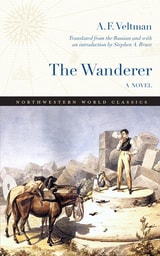
The Wanderer
A NovelAlexander Veltman, Stephen A. Bruce
Northwestern University Press, 2026
An unnamed narrator embarks on a rambling journey across the diverse borderlands of the Russian and Ottoman Empires—all without leaving his divan. Drawing on his own experiences in Bessarabia during the Russo-Turkish War of 1828–29, A. F. Veltman describes our Romantic narrator poring over a map and traversing distant, contested regions—at once imperial backwaters and cosmopolitan crossroads—where Romanians, Ruthenians, Jews, Bulgarians, Germans, and Turks comingle.
Meandering and motley in form and language, this lost classic of the early nineteenth century deploys metafictional innovations that anticipate postmodernist literature. The novel is speckled with dictionary entries, multiplication tables, philosophical digressions, and love poetry as Veltman swings from Gothic horror to antiquarian commentary to burlesque comedy. Past, present, and fantasy blend together, as Alexander the Great, Ovid, and Augustus join the narrator on his daydreamed journey of self-discovery.
Hugely popular in its day, The Wanderer is a remarkable tale that depicts the extraordinary places and peoples that met along the fault lines of once-great empires.
The War of the Fatties and Other Stories from Aztec History
By Salvador Novo
University of Texas Press, 1993
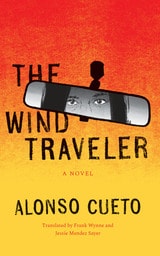
The Wind Traveler
A NovelBy Alonso Cueto; translated by Frank Wynne and Jessie Mendez Sayer
University of Texas Press, 2020
The Wind Traveler showcases the mesmerizing storytelling of Alonso Cueto at the top of his career. At the heart of his latest work is a seemingly ordinary man named Ángel, who sells kitchenware at a store in Lima. In the early 1990s, he had served as an army soldier, engaging in brutal acts whose aftermath still reverberates. He is forced to reckon with his past when a woman he was instructed to kill enters the store and buys a few items. How can she still be alive? What's more, how can she not recognize Ángel? Remarkably, she asks him to deliver her purchases to her house. From this moment, Ángel feels compelled to make amends through any means necessary, even if it requires sacrificing his life of quiet retirement.
A stirring tribute to the wounded souls who yearn to make peace with the past, The Wind Traveler offers a new vision of the fragile human connections that sustain a deeply fractured world.
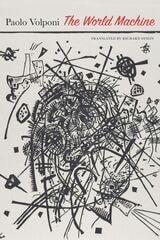
The World Machine
Paolo Volponi
Seagull Books, 2024
A small-time farmer living in central Italy in the 1960s is the keeper of a great truth: that people are machines built by other beings who are machines themselves. Our true destiny is to build ever better machines so that society can become a techno-utopia in which friendship can be established among all people on earth. These ideas bring him into conflict with everyone, especially his wife, against whom he is accused of ill-treatment. His quest takes him to Rome, where he presents his truth, hoping it will bring him worldwide recognition. Behind his poetical reveries and unfathomable scientific notions lies the disturbing fragility of a lone, paranoid, and deluded man in conflict with everyone, including himself.
Paolo Volponi’s unique novel The World Machine examines the relationship between rural life and the modern city, as well as the subversive idealism of a society still firmly anchored in the past, dominated by the Church, and unable to grasp the need for change.
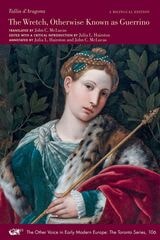
The Wretch, Otherwise Known as Guerrino
A Bilingual EditionTullia d'Aragona
Iter Press, 2024
This is an unabridged bilingual, fully annotated edition of Tullia d’Aragona’s epic poem The Wretch. This mid-century epic reflects the many historical and religious changes taking place in the first half of the sixteenth century in Europe and the burgeoning literary debates following the publication of another Italian epic poem, Ariosto’s Orlando Furioso. The Wretch recounts the adventures of Guerrino, a nobleman captured by pirates as an infant and sold into slavery. His famous quest in search of his parents and his identity involves abductions, same-sex seductions, and skirmishes with fantastical beasts as he travels through Europe, Turkey, Africa, India, Arabia, and the Purgatory of St. Patrick. The poem occupies an important position in the development of the prestigious epic genre, the highest step on the ladder to literary recognition and fame, and Tullia’s work paved the way for the epics of other women writers in subsequent decades.
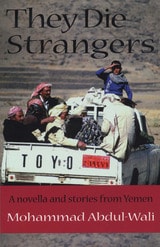
They Die Strangers
By Mohammad Abdul-Wali
University of Texas Press, 2002
They Die Strangers, a novella and thirteen short stories, is the first full-length work of the distinguished Yemeni writer Mohammad Abdul-Wali to appear in English. Abdul-Wali died tragically in an aviation accident, and his stories were collected after his death by the translators Abubaker Bagader and Deborah Akers.
Abdul-Wali was born in Ethiopia of Arab Yemeni parents. His stories, filled with nostalgia and the bitterness of exile, deal with the common experiences of Yemenis like himself who are caught between cultures by the displacements of civil war or labor migration. His characters include women left behind, children raised without fathers, and men returning home after years of absence. He explores the human condition through the eyes of the oppressed and disenfranchised and is particularly sympathetic to the plight of women.
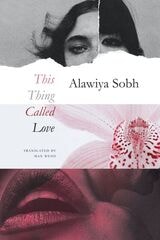
This Thing Called Love
Alawiya Sobh
Seagull Books, 2023
Just before the outbreak of the July 2006 war in Lebanon, a middle-aged woman named Nahla has gone missing. Distraught, besieged, and without any leads, Nahla’s dearest friends—Suad, Azizeh, Hoda, Nadine, and the narrator Alawiya—band together to console one another. They reminisce about the better days of their youth, lifetimes of romantic turmoil, the trouble with love, and their inescapable confrontation with death. Unsure whether Nahla has been killed in the fighting, fled the country, or disappeared into the oblivion of Alzheimer’s, Alawiya pieces together Nahla’s intimate past, simultaneously illuminating the jagged history of modern Lebanon. Through searching discussions with Nahla’s closest confidante Suad, tenacious investigation, and an imaginative effort to reconstruct the life of another, Alawiya might just find a way to bring Nahla back.
In This Thing Called Love, celebrated Lebanese novelist Alawiya Sobh takes the war between Israel and Hizballah as the backdrop for a heart-wrenching story about love, loss, sex, friendship between women, and the universal struggle to come to terms with mortality.
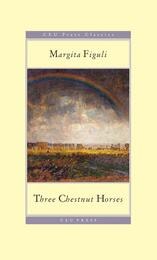
Three Chestnut Horses
Margita Figuli
Central European University Press, 2014
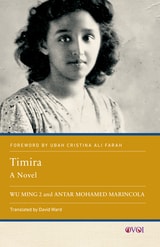
Timira
A NovelWu Ming Wu Ming 2
Rutgers University Press, 2027
Isabella Marincola lived between two cultures. The child of an Italian military officer father and a Somali mother, she was never fully part of either culture. In Somalia, she was seen as a child of the ruling colonizers, while in Italy her darker skin made her an object of both fascination and contempt. Even as she worked as an actress and model in postwar Italy, she was valued for her exotically beautiful body, not her keen mind or her captivating voice.
Titled after Isabella’s Somali name, Timira is a unique combination of novel, archival sources, and oral history. It finally gives her a chance to articulate her experiences of being a Black Italian woman in different epochs of Italian history, from Fascism to the 1990s, in all of which italianità was assumed to be exclusively white.
Cowritten by her son Antar Mohamed Marincola and a founding member of the Wu Ming writers’ collective, it is based on a series of writings and interviews Isabella gave towards the end of her long, eventful life. A compelling novel rooted in truth, Timira reflects on Italy’s colonial legacy and ingrained racism, while telling the story of a courageous woman and her struggles to assert herself in a nation unprepared to accommodate its Black citizens.
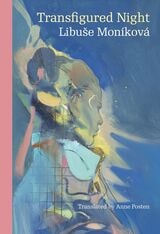
Transfigured Night
Libuše Moníková
Karolinum Press, 2023
In late 1992, three years after the Velvet Revolution and as Czechoslovakia is about to dissolve into the Czech Republic and Slovakia, choreographer and dancer Leonora Marty, who fled the Communist state decades earlier, has returned to Prague. Having wrapped up her ballet of The Makropulos Affair, the famous dancer meets old classmates, wanders the city through crowds of tourists, and visits the most obscure and unvisited museums. When she is approached by Thomas Asperger, a descendant of ethnic Germans driven from Czechoslovakia after World War II, she must confront three relationships—her relationship with the city of her youth, her homeland’s relationship with its past, and her new romance with this German admirer.
Written in German and published in 1995, by an author whose life mirrored her protagonist’s, the novel provides a cultural tour of Prague. Employing a style as influenced by the operas of Leoš Janácek as the novels of Thomas Pynchon, Transfigured Night is a masterpiece of Czech literature, showing that the culture of this nation comes in a variety of tongues.
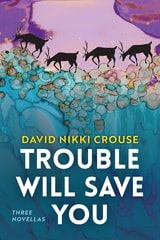
Trouble Will Save You
Three NovellasDavid Nikki Crouse
University of Alaska Press, 2023
While Crouse’s prize-winning collection of short fiction The Man Back There offered up insights into a kind of self-destructive masculinity, these novellas now sensitively and persuasively capture the inner landscapes of women struggling with grief and isolation. Trouble Will Save You is a unique and fully realized work from a keenly empathetic writer.
Praise for The Man Back There:
“In this virtuoso collection of stories, David Crouse guides us directly to where the shadow lies—the disorienting loss, the surprising heartache, the forgotten wound—those inevitable areas of the psyche we all share and through which only truth, illuminated with a such a light touch here, can deliver us; The Man Back There is the work of the real thing.”
—Andre Dubus III, author of House of Sand and Fog
“I chose these stories because they made me feel. I felt the characters like I would feel a stranger in a room or on a bus with me, with an irrational sympathy more animal than moral in its nature.”
—Mary Gaitskill, 2007 Mary McCarthy Prize judge
Tsing
David Albahari
Northwestern University Press, 1997
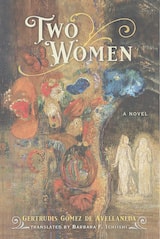
Two Women
A NovelBarbara F. Ichiishi
Bucknell University Press, 2022
This first English translation of the novel captures the lyrical romanticism of its prose and includes a scholarly introduction to the work and its author, Gertrudis Gómez de Avellaneda, a pioneering feminist and anti-slavery activist who based the character of Catalina on her own experience. Two Women is a searing indictment of the stern laws and customs governing marriage in the Hispanic world, brought to life in a spellbinding, tragic love story.
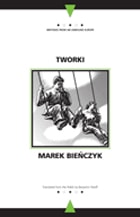
Tworki
Marek Bienczyk
Northwestern University Press, 2008
In Tworki, a village just southwest of Warsaw, there is a psychiatric hospital and in that hospital, the patients and their caretakers are hidden from the war just outside their iron gates. Our hero, Jurek, answers an ad in the paper for a job there and finds himself keeping the books alongside a knockout strawberry blonde named Sonia. They and their group of friends—vital young people like Marcel, an initial rival for Jurek; Olek, Sonia’s chosen love; and Janka, with whom Jurek becomes involved—do their jobs, picnic on the weekends, and dance in the gardens on the grounds of the hospital. Jurek speaks often of, and even in, verse, whether he is talking to his friends or in letters to a distant and admiring cousin. He and his friends live lives that defy the discord and destruction of the war in Europe, striving to rediscover or save whatever beauty they can. Much of this beauty is embodied by Sonia, who is beloved of all the friends and patients at the asylum. But the revitalizing spring they all hope will come for Poland is not to arrive this year. Despite the relative safety of their odd surroundings, the world and the war soon come for the friends. Olek’s absences are longer and unexplained. Marcel is not what he seems, and he and his wife mysteriously disappear, she says, to the gas. And the perfection that Sonia embodies cannot ultimately be kept, by the friends, by the nation, or even by Sonia herself.