Results by title
8812 books match the query 'Political Science' and 1911 start with t
Thirst for Growth
Water Agencies as Hidden Government in CaliforniaRobert Gottlieb
University of Arizona Press, 1991
Thirty Years of Radical History
The Long March, Volume 2001Van Gosse, ed.
Duke University Press, 0
Recognizing the creative power of pluralism, the RHR editors have marshalled a diverse troop of historical scholars in this issue. In “Forum on Radical History,” sixteen historians discuss how the notion of radicalism has affected the way they write, teach, and live, and in "A Conversation about the Radical History Review," past and present members of the editorial board zero in on the journal itself and the political and academic context in which it was born. Offering a more personal perspective, Mike Wallace, Pulitzer Prize winner and radical history founder, shares his thoughts on RHR and the movement. Other articles in this special issue tackle the state of radicalism today, analyzing the academic labor movement, the significance of physical space in Pinochet’s reign of terror, and the enduring symbolism of a particular statue in Prague.
This retrospective issue celebrates the journal’s past, but it also reflects on the present and looks forward to a future in which radicalism will continue to shape the landscape of historical and political discourse.
Contributors. Tani E. Barlow, Dan Bender, Paul Buhle, Gabriela Cano, Anna Clark, Martin Duberman, Ellen Carol DuBois, Ian Christopher Fletcher, Rob Gregg, Harry D. Harootunian, Winston James, Nikki R. Keddie, Dave Kinkela, Staughton Lynd, Teresa Meade, Joanne Pope Melish, Ellen Noonan, Enrique C. Ochoa, Gary Y. Okihiro, Cynthia Paces, Max Page, Vijay Prashad, David Price, David Roediger, Andor Skotnes, Mike Wallace

This America We Dream of
Rodo and "Ariel" One Hundred Years onEdited by Gustavo San Roman
University of London Press, 2001
This Contested Land
The Storied Past and Uncertain Future of America's National MonumentsMcKenzie Long
University of Minnesota Press, 2022
One woman’s enlightening trek through the natural histories, cultural stories, and present perils of thirteen national monuments, from Maine to Hawaii—now available in paperback
This land is your land. When it comes to national monuments, the sentiment could hardly be more fraught. Gold Butte in Nevada, Organ Mountains–Desert Peaks in New Mexico, Katahdin Woods and Waters in Maine, Cascade–Siskiyou in Oregon and California: these are among the thirteen natural sites McKenzie Long visits in This Contested Land, an eye-opening exploration of the stories these national monuments tell, the passions they stir, and the controversies surrounding them today.
Starting amid the fragrant sagebrush and red dirt of Bears Ears National Monument on the eve of the Trump Administration’s decision to reduce the site by 85 percent, Long climbs sandstone cliffs, is awed by Ancestral Pueblo cliff dwellings and is intrigued by 4,000-year-old petroglyphs. She hikes through remote pink canyons recently removed from the boundary of Grand Staircase–Escalante, skis to a backcountry hut in Maine to view a truly dark night sky, snorkels in warm Hawaiian waters to plumb the meaning of marine preserves, volunteers near the most contaminated nuclear site in the United States, and witnesses firsthand the diverse forms of devotion evoked by the Rio Grande. In essays both contemplative and resonant, This Contested Land confronts an unjust past and imagines a collaborative future that bears witness to these regions’ enduring Indigenous connections.
From hazardous climate change realities to volatile tensions between economic development and environmental conservation, practical and philosophical issues arise as Long seeks the complicated and often overlooked—or suppressed—stories of these incomparable places. Her journey, mindfully undertaken and movingly described, emphasizes in clear and urgent terms the unique significance of, and grave threats to, these contested lands.
This Is Not Civil Rights
Discovering Rights Talk in 1939 AmericaGeorge I. Lovell
University of Chicago Press, 2012
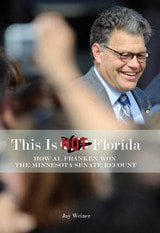
This Is Not Florida
How Al Franken Won the Minnesota Senate RecountJay Weiner
University of Minnesota Press, 2010
This Is Not Florida is the behind-the-scenes saga of the largest, longest, and most expensive election recount in American history. Reporter Jay Weiner covered the entire recount process-for which he was honored with Minnesota's most prestigious journalism award-following every bizarre twist and turn and its many colorful personalities. Based on daily reporting as well as interviews with more than forty campaign staffers and other participants in the recount, This Is Not Florida dives into the motivations of key players in the drama, including the exploits of Franken's lead attorney Marc Elias, some of the mistakes made by Coleman advisers, and how the Franken team's devotion to data collection helped Franken win the recount by a mere 312 votes.
In a fascinating, blow-by-blow account of the historic recount that captivated people nationwide, Jay Weiner gets inside campaign war rooms and judges' chambers and takes the reader from the uncertainties of Election Night 2008, through the controversial State Canvassing Board and a grueling eight-week trial, to an appeal to Minnesota's Supreme Court, and finally to Al Franken's long-awaited and emotional swearing-in.
This Is Not Florida presents an important and unforgettable moment in political history that proved that it's never really over until it's actually over
This Is Our Land
Grassroots Environmentalism in the Late Twentieth CenturyFerguson, Cody
Rutgers University Press, 2015
This Is a Place We Made
Disability History and Public LandEdited by Kathleen M. Brian
University of Illinois Press, 2027
Disability and place constitute one another. Disabled people make worlds through creativity, adaptability, and reciprocal care, while disability offers distinctive routes to understanding present, past, and future worlds. At the same time, places evoke memory, story, and meaning—however contested—and influence how people understand and live disability. Informed by cutting-edge theories and inventive methods, the contributors’ brief studies of particular places highlight this mutuality. Framing the essays are open-ended questions and abundant resources that invite specialist and non-specialist readers alike to join ongoing conversations.
Innovative and world-making, This Is a Place We Made models what is possible when historical practice is guided by an ethics of access, collaboration, and proximity.

This Little Kiddy Went to Market
The Corporate Capture of ChildhoodSharon Beder, Wendy Varney, and Richard Gosden
Pluto Press, 2009
This book investigates the way that corporations are strategically shaping children to be under-aged hyperconsumers as well as the submissive employees and uncritical citizens of the future.
Sharon Beder shows how marketers and advertisers are targeting ever younger children in a relentless campaign, transforming children's play into a commercial opportunity and taking advantage of childish anxieties.
Beder investigates the corporate relations and ideals that infiltrate every aspect of our lives. She presents an alarming picture of how a child's social development -- through education, health care and nutrition -- has become an ordered conveyor belt of consumerist conditioning. Focusing on education in particular, Beder explains how businesses are taking control of more and more aspects of schooling, not only for profit but to erode state schooling and promote business values. Similarly, she shows how 'difficult' children are taught from an early age that pharmaceuticals can be used to discipline them or to make them 'happy'.
This Machine Breeds Fascists / Mašina Koja Hrani Fašiste
Thompson—the Rock Star, the Collapse of Political Will, and the Resistance to Radicalization in Croatia / Thompson, Poraz Politike i Otpor Radikalizaciji HrvatskeBarbara Matejcic and Hrvoje Šimicevic, with an introduction by Matea Gnjec and Brian Willems
Disobedience Press, 2027
In this pair of essays, award-winning journalists Hrvoje Šimičević and Barbara Matejčić expose the turn in Croatia’s political trends, showing how “moderate” pro-European governments have opened the floodgates for far-right radicalism and fascism to transition from the societal fringes into the mainstream. Šimičević weaves these histories around a chilling turning point: a Thompson concert in which hundreds of thousands chanted the Ustaše salute. Matejčić then reveals the civic response and defiant resistance to the politics of fear and escalating attacks against Serbians and other minorities. At the heart of these texts is a struggle over the meaning of Croatia itself: will it belong to the loudest voices or to all who live there?
U ova dva eseja, nagrađivani novinari Hrvoje Šimičević i Barbara Matejčić opisuju političke promjene u Hrvatskoj, pokazujući kako su samozvane umjerene proeuropske vlade imale ključnu ulogu u pomicanju fašizma i krajnje desnog radikalizma s društvenih rubova u političku srednju struju. Šimičević plete povijest te pojave oko jezive prekretnice: Thompsonovog koncerta na kojem su stotine tisuća posjetitelja izvikivale ustaški pozdrav. Matejčić zatim prikazuje odgovor građana i prkosan otpor politici straha i eskalaciji napada na Srbe i druge manjine. U srži ovih tekstova leži borba za značenje Hrvatske: hoće li zemlja pripadati onima koji najglasnije viču ili svima koji u njoj žive?
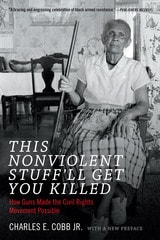
This Nonviolent Stuff'll Get You Killed
How Guns Made the Civil Rights Movement PossibleCharles E. Cobb Jr.
Duke University Press, 2015
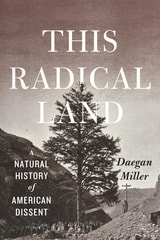
This Radical Land
A Natural History of American DissentDaegan Miller
University of Chicago Press, 2018
But if you know where to look, you can uncover a different history, one of vibrant resistance, one that’s been mostly forgotten. This Radical Land recovers that story. Daegan Miller is our guide on a beautifully written, revelatory trip across the continent during which we encounter radical thinkers, settlers, and artists who grounded their ideas of freedom, justice, and progress in the very landscapes around them, even as the runaway engine of capitalism sought to steamroll everything in its path. Here we meet Thoreau, the expert surveyor, drawing anticapitalist property maps. We visit a black antislavery community in the Adirondack wilderness of upstate New York. We discover how seemingly commercial photographs of the transcontinental railroad secretly sent subversive messages, and how a band of utopian anarchists among California’s sequoias imagined a greener, freer future. At every turn, everyday radicals looked to landscape for the language of their dissent—drawing crucial early links between the environment and social justice, links we’re still struggling to strengthen today.
Working in a tradition that stretches from Thoreau to Rebecca Solnit, Miller offers nothing less than a new way of seeing the American past—and of understanding what it can offer us for the present . . . and the future.
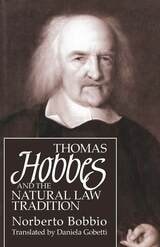
Thomas Hobbes and the Natural Law Tradition
Norberto Bobbio
University of Chicago Press, 1993
Tracing Hobbes's work through De Cive and Leviathan, Bobbio identifies the philosopher's relation to the tradition of natural law. That Hobbes must now be understood in both this tradition as well as in the seemingly contradictory positivist tradition becomes clear for the first time in Bobbio's account. Bobbio also demonstrates that Hobbes cannot be easily labelled "liberal" or "totalitarian"; in Bobbio's provocative analysis of Hobbes's justification of the state, Hobbes emerges as a true conservative.
Though his primary concern is to reconstruct the inner logic of Hobbes's thought, Bobbio is also attentive to the philosopher's biography and weaves into his analysis details of Hobbes's life and world—his exile in France, his relation with the Mersenne circle, his disputes with Anglican bishops, and accusations of heresy leveled against him. The result is a revealing, thoroughly new portrait of the first theorist of the modern state.
Thomas Holcroft’s Revolutionary Drama
Reception and AfterlivesAmy Garnai
Bucknell University Press, 2023

Thomas More on Statesmanship
Gerard Wegemer
Catholic University of America Press, 1996

Thomas Paine
A. J. Ayer
University of Chicago Press, 1990
"[An] exciting book about Paine's life and principles."—Christopher Hitchens, Newsday
Those Without A Country
The Political Culture of Italian American SyndicalistsMichael Miller Topp
University of Minnesota Press, 2001
In the first book-length history of the Italian American syndicalist movement—the Italian Socialist Federation—Michael Miller Topp presents a new way of understanding the Progressive Era labor movement in relation to migration, transnationalism, gender, and class identity. Those without a Country demonstrates that characterizations of "old" (pre-1960s) social movements as predominantly class-based are vastly oversimplified—and contribute to current debates about the implications of identity politics for the American Left and American culture generally.
Topp traces the rise and fall of the Italian American syndicalist movement from the turn of the twentieth century to the executions of Sacco and Vanzetti in 1927. His use of Italian-language sources, combined with his attention to transnationalism and masculinity, provides new vantage points on a range of related topics, including the 1912 Lawrence, Massachusetts, textile workers’ strike, the impact of World War I on this immigrant community, and the genesis of both fascism and antifascism. Those without a Country brings forward fascinating new material to revise and refine our views of not only Progressive Era radicalism but immigration, gender, and working-class history as well.
Thou Shalt Forget
Indigenous sovereignty, resistance and the production of cultural oblivion in CanadaPierrot Ross-Tremblay
University of London Press, 2019
Thoughts on Machiavelli
Leo Strauss
University of Chicago Press, 1958

Threatened Scholarship, Dynamics of Repression and Forms of Resistance
Towards Academic Freedom as a Transnational Human RightKerry Bystrom
Central European University Press, 2027
Threatening Anthropology
McCarthyism and the FBI’s Surveillance of Activist AnthropologistsDavid H. Price
Duke University Press, 2004
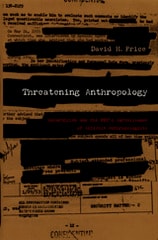
Price draws on extensive archival research including correspondence, oral histories, published sources, court hearings, and more than 30,000 pages of fbi and government memorandums released to him under the Freedom of Information Act. He describes government monitoring of activism and leftist thought on college campuses, the surveillance of specific anthropologists, and the disturbing failure of the academic community—including the American Anthropological Association—to challenge the witch hunts. Today the “war on terror” is invoked to license the government’s renewed monitoring of academic work, and it is increasingly difficult for researchers to access government documents, as Price reveals in the appendix describing his wrangling with Freedom of Information Act requests. A disquieting chronicle of censorship and its consequences in the past, Threatening Anthropology is an impassioned cautionary tale for the present.
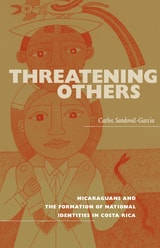
Threatening Others
Nicaraguans and the Formation of National Identities in Costa RicaCarlos Sandoval-Garcia
Ohio University Press, 2004
During the last two decades, a decline in public investment has undermined some of the national values and institutions of Costa Rica. The resulting sense of dislocation and loss is usually projected onto Nicaraguan “immigrants.”
Threatening Others: Nicaraguans and the Formation of National Identities in Costa Rica explores the representation of the Nicaraguan “other” in the Costa Rican imagery. It also seeks to address more generally why the sense of national belonging constitutes a crucial identification in contemporary societies. Interdisciplinary and based on extensive fieldwork, it looks critically at the “exceptionalism” that Costa Ricans take for granted and view as a part of their national identity.
Carlos Sandoval-García argues that Nicaraguan immigrants, once perceived as a “communist threat,” are now victims of an invigorated, racialized politics in which the Nicaraguan nationality has become an offense in itself.
Threatening Others is a deeply searching book that will interest scholars and students in Latin American studies and politics, cultural studies, and ethnic studies.
Three Capitals
St. Stephens, Huntsville, and Cahawba, 1818-1826William H. Brantley Jr
University of Alabama Press, 1976
"Three Capitals is an in-depth study of Alabama's first three seats of government--St. Stephens, Huntsville, and Cahawba.... The University of Alabama Press has reprinted the book in a handsome new edition with a pertinent introduction by Malcolm C. McMillan. Brantley's study is a tribute to the accomplishments of an amateur historian and contains a wealth of useful information."
--Bulletin of the History of the Early American Republic

Three Civilizations, Two Cultures, One State
Canada's Political TraditionsDouglas Verney
Duke University Press, 1986
Three Discourses
A Critical Modern Edition of Newly Identified Work of the Young HobbesThomas Hobbes
University of Chicago Press, 1995
Saxonhouse and Reynolds present the complete texts of the discourse with full annotations and modernized spellings. These are followed by a lengthy essay analyzing the pieces' significance for Hobbes's intellectual development and modern political thought more generally. The discourses provide the strongest evidence to date for the profound influences of Bacon and Machiavelli on the young Hobbes, and they add a new dimension to the much-debated impact of the scientific method on his thought. The book also contains both introductory and in-depth explanations of statistical "wordprinting."
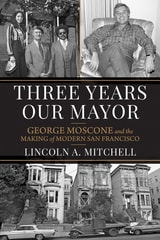
Three Years Our Mayor
George Moscone and the Making of Modern San FranciscoLincoln A. Mitchell
University of Nevada Press, 2025
Moscone was also a very colorful character who, in addition to being a successful politician, was a charming and charismatic bon vivant who was deeply embedded in the fabric and culture of San Francisco. He grew up the only son of a single mother in Cow Hollow when it was a working class, largely Italian American neighborhood, and he became the kind of politician who knew bartenders, playground attendants, small business owners, and neighborhood activists in every corner of the city. Moscone’s life and the history of San Francisco during the middle half of the twentieth century are deeply intertwined.
Through illustrating the life of Moscone, author Lincoln A. Mitchell explores how today’s San Francisco came into being. Moscone—through his work in the State Senate, victory in the very divisive 1975 mayor’s race, and brief tenure as mayor—was a key figure in the city’s evolution. The politics surrounding Moscone’s election as mayor, governance of the city, and tragic death are still relevant issues. Moscone was a groundbreaking politician whose life was cut short, but his influence on San Francisco can still be felt today.
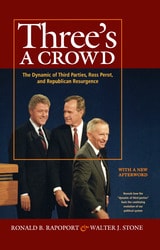
Three's a Crowd
The Dynamic of Third Parties, Ross Perot, and Republican ResurgenceRonald B. Rapoport and Walter J. Stone
University of Michigan Press, 2011
---Paul Herrnson, Director, Center for American Politics and Citizenship Professor, Department of Government and Politics, University of Maryland
"Powerfully persuasive in its exhaustive research, Three's a Crowd may surprise many by revealing the long- ignored but pivotal impact of Perot voters on every national election since 1992."
---Clay Mulford, Jones Day and General Counsel to the 1992 Perot Presidential Campaign and to the Reform Party.
"Rapaport and Stone have written an engaging and important book. They bring fresh perspectives, interesting data, and much good sense to this project. Three's a Crowd is fundamentally about political change, which will, in turn, change how scholars and pundits think of Ross Perot in particular, and third parties in general."
---John G. Geer, Professor of Political Science at Vanderbilt University and Editor of The Journal of Politics
"The definitive analysis of the Perot movement, its role in the 1994 GOP victory, and the emergence of an enduring governing majority."
---L. Sandy Maisel, Director, Goldfarb Center for Public Affairs, Colby College
Three's a Crowd begins with the simple insight that third parties are creatures of the American two-party system, and derive their support from the failures of the Democratic and Republican parties.
While third parties flash briefly in the gaps left by those failures, they nevertheless follow a familiar pattern: a sensation in one election, a disappointment in the next. Rapoport and Stone conclude that this steep arc results from one or both major parties successfully absorbing the third party's constituency. In the first election, the third party raises new issues and defines new constituencies; in the second, the major parties move in on the new territory. But in appropriating the third party's constituents, the major parties open themselves up to change. This is what the authors call the "dynamic of third parties."
The Perot campaign exemplified this effect in 1992 and 1996. Political observers of contemporary electoral politics missed the significance of Perot's independent campaign for the presidency in 1992. Rapoport and Stone, who had unfettered-and unparalleled-access to the Perot political machine, show how his run perfectly embodies the third-party dynamic. Yet until now no one has considered the aftermath of the Perot movement through that lens.
For anyone who seeks to understand the workings of our stubbornly two-party structure, this eagerly awaited and definitive analysis will shed new light on the role of third parties in the American political system.

Three-Way Street
Strategic Reciprocity in World PoliticsJoshua S. Goldstein and John R. Freeman
University of Chicago Press, 1990
The authors demonstrate that three major schools of international relations theory—all game-theoretic, psychological, and quantitative-empirical approaches—have all advocated a strategy that employs cooperative initiatives and reciprocal responses in order to elicit cooperation from other countries. Critics have questioned whether such approaches can model how countries actually behave, but Goldstein and Freeman provide a wealth of detailed empirical evidence showing the existence and effectiveness of strategic reciprocity among the three countries between 1948 and 1989. Specifically, they establish that relations among the three countries have improved in recent decades through a "two steps forward, one step back" pattern. Their innovative and remarkably accessible synthesis of leading theoretical perspectives brilliantly illuminates the nature and workings of international cooperation.

Threshold
How Smart Homes Change Us Inside and OutHeather Suzanne Woods
University of Alabama Press, 2024
An urgent and cautionary examination of the totalizing effect of smart home technology on the lives of those who live in them—and those who don’t
Smart homes are here—domestic spaces bristling with networked technologies that appear to enhance work, entertainment, logistics, health, and security. But these technologies may also extract a cost in attention, money, and privacy. In Threshold, communication and technology expert Heather Suzanne Woods applies rhetorical theory to answer the urgent question of how swiftly proliferating smart homes alter those who inhabit them.
Building on extensive research into smart homes in the United States, Woods recounts how smart homes arose and predicts the trajectory of their future form. She pulls back the curtain on the technology, probes who is in control, and questions whether a home can be too smart. She reveals how smart homes incentivize ubiquitous computing as a daily practice, priming smart home occupants for permanent transactional existence largely controlled by corporate interests.
Woods suggests a dynamic cultural framework for understanding smart homes that takes into account sociotechnical variables such as gender, class, income, race, criminal justice, and more through which smart homes shape human life. Woods’s framework reveals how smart homes both reflect social norms about technology as well as whet consumer appetites for an ever more totalizing relationship with technology. She argues that this progression leads to “living in digitality,” a cultural state of constant use and reliance on technology.
Written for homeowners, policymakers, technology enthusiasts, and scholars, Threshold interweaves meticulously researched critical analysis with matter-of-fact graphics that map relationships between digital tools and social life. Readers will appreciate this bracing assessment of smart technologies that empowers smart home users to make informed decisions about their dwellings.
Through the Grapevine
Socially Transmitted Information and Distorted DemocracyTaylor N. Carlson
University of Chicago Press, 2024
An enlightening examination of what it means when Americans rely on family and friends to stay on top of politics.
Accurate information is at the heart of democratic functioning. For decades, researchers interested in how information is disseminated have focused on mass media, but the reality is that many Americans today do not learn about politics from direct engagement with the news. Rather, about one-third of Americans learn chiefly from information shared by their peers in conversation or on social media. How does this socially transmitted information differ from that communicated by traditional media? What are the consequences for political attitudes and behavior?
Drawing on evidence from experiments, surveys, and social media, Taylor N. Carlson finds that, as information flows first from the media then person to person, it becomes sparse, more biased, less accurate, and more mobilizing. The result is what Carlson calls distorted democracy. Although socially transmitted information does not necessarily render democracy dysfunctional, Through the Grapevine shows how it contributes to a public that is at once underinformed, polarized, and engaged.
Thucydides’s Trap?
Historical Interpretation, Logic of Inquiry, and the Future of Sino-American RelationsSteve Chan
University of Michigan Press, 2020
The Peloponnesian War (431–404 BCE) ostensibly arose because of the fear that a rising Athens would threaten Sparta’s power in the Mediterranean. The idea of Thucydides’ Trap warns that all rising powers threaten established powers. As China increases its power relative to the United States, the theory argues, the two nations are inevitably set on a collision course toward war. How enlightening is an analogy based on the ancient Greek world of 2,500 years ago for understanding contemporary international relations? How accurate is the depiction of the history of other large armed conflicts, such as the two world wars, as a challenge mounted by a rising power to displace an incumbent hegemon?Thucydides’s Trap?: Historical Interpretation, Logic of Inquiry, and the Future of Sino-American Relations offers a critique of the claims of Thucydides’s Trap and power-transition theory. It examines past instances of peaceful accommodation to uncover lessons that can ease the frictions in ongoing Sino-American relations.
Thunder Cross
Fascist Antisemitism in Twentieth-Century LatviaPaula A. Oppermann
University of Wisconsin Press, 2025
Thunder Cross is the most comprehensive study of Latvia’s fascist movement in English to date, and the only work that investigates the often neglected continuities of fascist antisemitism after World War II. Formulated as an empirical case study, this book draws on international and interdisciplinary secondary literature and sources in seven languages to broaden our understanding of fascism, antisemitism, and mass violence from Germany and Italy to the larger European context.
Time Matters
On Theory and MethodAndrew Abbott
University of Chicago Press, 2001
Time Matters focuses particularly on questions of time, events, and causality. Abbott grounds each essay in straightforward examinations of actual social scientific analyses. Throughout, he demonstrates the crucial assumptions we make about causes and events, about actors and interaction and about time and meaning every time we employ methods of social analysis, whether in academic disciplines, market research, public opinion polling, or even evaluation research. Turning current assumptions on their heads, Abbott not only outlines the theoretical orthodoxies of empirical social science, he sketches new alternatives, laying down foundations for a new body of social theory.

Time and Chance
Gerald Ford's Appointment with HistoryJames Cannon
University of Michigan Press, 1998
"James Cannon, formerly national affairs editor at Newsweek and Ford's domestic policy advisor, has written a superbly provocative and arresting biography that traces Ford's life from his July 4, 1913, birth in Omaha, Nebraska, to his September 8,1974, decision to pardon Nixon of the Watergate conspiracy." --Washington Post Book World
James M. Cannon is a journalist and was Domestic Policy Adviser to President Ford and Chief of Staff to Senate Majority Leader Howard Baker.
Timing and Turnout
How Off-Cycle Elections Favor Organized GroupsSarah F. Anzia
University of Chicago Press, 2013
The low turnout for off-cycle elections, Anzia argues, increases the influence of organized interest groups like teachers’ unions and municipal workers. While such groups tend to vote at high rates regardless of when the election is held, the low turnout in off-cycle years enhances the effectiveness of their mobilization efforts and makes them a proportionately larger bloc. Throughout American history, the issue of election timing has been a contentious one. Anzia’s book traces efforts by interest groups and political parties to change the timing of elections to their advantage, resulting in the electoral structures we have today. Ultimately, what might seem at first glance to be mundane matters of scheduling are better understood as tactics designed to distribute political power, determining who has an advantage in the electoral process and who will control government at the municipal, county, and state levels.
Tiny Publics
A Theory of Group Action and CultureGary Alan Fine
Russell Sage Foundation, 2012
Tippecanoe and Tyler Too
Famous Slogans and Catchphrases in American HistoryJan R. Van Meter
University of Chicago Press, 2008
“By necessity, by proclivity, by delight,” Ralph Waldo Emerson said in 1876, “we all quote.” But often the phrases that fall most readily from our collective lips—like “fire when ready,” “speak softly and carry a big stick,” or “nice guys finish last”—are those whose origins and true meanings we have ceased to consider. Restoring three-dimensionality to more than fifty of these American sayings, Tippecanoe and Tyler Too turns clichés back into history by telling the life stories of the words that have served as our most powerful battle cries, rallying points, laments, and inspirations.
In individual entries on slogans and catchphrases from the early seventeenth to the late twentieth century, Jan Van Meter reveals that each one is a living, malleable entity that has profoundly shaped and continues to influence our public culture. From John Winthrop’s “We shall be as a city upon a hill” and the 1840 Log Cabin Campaign’s “Tippecanoe and Tyler Too” to Martin Luther King Jr.’s “I have a dream” and Ronald Reagan’s “Mr. Gorbachev, tear down this wall,” each of Van Meter’s selections emerges as a memory device for a larger political or cultural story. Taken together in Van Meter’s able hands, these famous slogans and catchphrases give voice to our common history even as we argue about where it should lead us.
“As Van Meter argues, these are important ‘memory devices for a larger story.’ . . . The author has thoroughly researched all the catchphrases . . . . This book would make delightful in-flight reading or a nice gift for a trivia buff. Recommended.”—Choice
Tissue Economies
Blood, Organs, and Cell Lines in Late CapitalismCatherine Waldby and Robert Mitchell
Duke University Press, 2006
Waldby and Mitchell pull together a prodigious amount of research—involving policy reports and scientific papers, operating manuals, legal decisions, interviews, journalism, and Congressional testimony—to offer a series of case studies based on particular forms of tissue exchange. They examine the effect of threats of contamination—from HIV and other pathogens—on blood banks’ understandings of the gift/commodity relationship; the growth of autologous economies, in which individuals bank their tissues for their own use; the creation of the United Kingdom’s Stem Cell bank, which facilitates the donation of embryos for stem cell development; and the legal and financial repercussions of designating some tissues “hospital waste.” They also consider the impact of different models of biotechnology patents on tissue economies and the relationship between experimental therapies to regenerate damaged or degenerated tissues and calls for a legal, for-profit market in organs. Ultimately, Waldby and Mitchell conclude that scientific technologies, the globalization of tissue exchange, and recent anthropological, sociological, and legal thinking have blurred any strict line separating donations from the incursion of market values into tissue economies.
Titles, Conflict, and Land Use
The Development of Property Rights and Land Reform on the Brazilian Amazon FrontierLee J. Alston, Gary D. Libecap, and Bernardo Mueller
University of Michigan Press, 1999
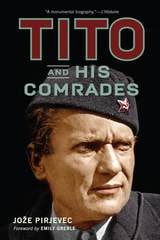
Tito and His Comrades
Jože Pirjevec, Foreword by Emily Greble
University of Wisconsin Press, 2018
With his Partisans he fought Hitler during World War II, and after the war he shrewdly resisted the Soviet Union's grasp. A leader of the non-aligned nations, he long enjoyed a reputation in the West as "the only good Communist" despite a dubious human rights record at home. Jože Pirjevec employs impressive research from archives in eight languages to offer this illuminating, definitive portrait of a complex man in turbulent times.
Pirjevec recounts how Tito, with little schooling but an astute intellect and driving ambition, rose through Communist Party ranks to shape and rule the Yugoslav federation. Surviving multiple assassination attempts by Nazis, Soviet spies, and others, Tito boldly threatened Stalin in return and may have, Pirjevec reveals, contrived Stalin's death. The narrative follows Tito's personal and political life into old age, as the specter of a Soviet invasion haunted him until his death at age eighty-seven. Available in English for the first time, this edition includes new material from Pirjevec and a foreword by Emily Greble.
To Agree or Not to Agree
Leadership, Bargaining, and Arms ControlLisa A. Baglione
University of Michigan Press, 1999
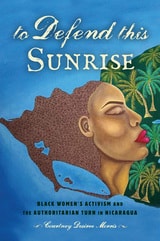
To Defend This Sunrise
Black Women’s Activism and the Authoritarian Turn in NicaraguaCourtney Desiree Morris
Rutgers University Press, 2023
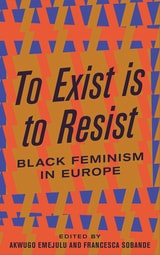
To Exist is to Resist
Black Feminism in EuropeEdited by Akwugo Emejulu and Francesca Sobande
Pluto Press, 2019
Deeply aware that they are constructed as 'Others' living in a racialised and hierarchical continent, the contibutors explore gender, class, sexuality and legal status to show that they are both invisible - presumed to be absent from and irrelevant to European societies - and hyper-visible - assumed to be passive and sexualised, angry and irrational.
Through imagining a future outside the neocolonial frames and practices of contemporary Europe, this book explores a variety of critical spaces including motherhood and the home, friendships and intimate relationships, activism and community, and literature, dance and film.
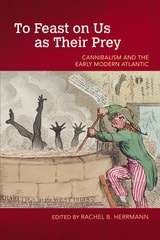
To Feast on Us as Their Prey
Cannibalism and the Early Modern AtlanticRachel B. Herrmann
University of Arkansas Press, 2019
Winner, 2020 Association for the Study of Food and Society Book Award, Edited Volume
Long before the founding of the Jamestown, Virginia, colony and its Starving Time of 1609–1610—one of the most famous cannibalism narratives in North American colonial history—cannibalism played an important role in shaping the human relationship to food, hunger, and moral outrage. Why did colonial invaders go out of their way to accuse women of cannibalism? What challenges did Spaniards face in trying to explain Eucharist rites to Native peoples? What roles did preconceived notions about non-Europeans play in inflating accounts of cannibalism in Christopher Columbus’s reports as they moved through Italian merchant circles?
Asking questions such as these and exploring what it meant to accuse someone of eating people as well as how cannibalism rumors facilitated slavery and the rise of empires, To Feast on Us as Their Prey posits that it is impossible to separate histories of cannibalism from the role food and hunger have played in the colonization efforts that shaped our modern world.
To Keep the Republic
Thinking, Talking, and Acting Like a Democratic CitizenElizabeth C. Matto
Rutgers University Press, 2024
To Keep the Republic is a wake-up call about the responsibilities that come with being a citizen in a participatory democracy. It describes the many ways that individuals can make a difference on both local and national levels—and explains why they matter. Political scientist Elizabeth C. Matto highlights the multiple facets of democratic citizenship, identifies American democracy’s sometimes competing values and ideals, and explains how civic engagement can take various forms, including political conversation. Combining political philosophy with concrete suggestions for how to become a more engaged citizen, To Keep the Republic reminds us that democracy is not a spectator sport; it only works when we get off the sidelines and enter the political arena to make our voices heard.

To Kill a Spy
Everyday Nationalism and Political Violence in Fin-de-Siecle EuropeZachary Mazur
Central European University Press, 2026
How does an ordinary, working-class man transform into a political executioner? And how does a society reach the tipping point where premeditated murder is celebrated as a civic duty?
This gripping historical investigation unravels the environment and conditions of radicalization in fin-de-siècle Europe. Societal shifts, mass political movements, the popular press and espionage paranoia all contributed to a fearful community, wary of outsiders and ready to do anything to defend itself.
To Live Here, You Have to Fight
How Women Led Appalachian Movements for Social JusticeJessica Wilkerson
University of Illinois Press, 2019
Jessica Wilkerson tells their stories within the larger drama of efforts to enact change in the 1960s and 1970s. She shows white Appalachian women acting as leaders and soldiers in a grassroots war on poverty--shaping and sustaining programs, engaging in ideological debates, offering fresh visions of democratic participation, and facing personal political struggles. Their insistence that caregiving was valuable labor clashed with entrenched attitudes and rising criticisms of welfare. Their persistence, meanwhile, brought them into unlikely coalitions with black women, disabled miners, and others to fight for causes that ranged from poor people's rights to community health to unionization.
Inspiring yet sobering, To Live Here, You Have to Fight reveals Appalachian women as the indomitable caregivers of a region--and overlooked actors in the movements that defined their time.
To Live and Die in America
Class, Power, Health and HealthcareRobert Chernomas and Ian Hudson
Pluto Press, 2013
To Live and Die in America details how the United States has among the worst indicators of health in the industrialised world and at the same time spends significantly more on its health care system than any other industrial nation.
Robert Chernomas and Ian Hudson explain this contradictory phenomenon as the product of the unique brand of capitalism that has developed in the US. It is this particular form of capitalism that created both the social and economic conditions that largely influence health outcomes and the inefficient, unpopular and inaccessible health care system that is incapable of dealing with them.
The authors argue that improving health in America requires a change in the conditions in which people live and work as well as a restructured health care system.
To Make the Earth Bear Fruit
Ethnographic Essays on Fertility, Work and Gender in Highland BoliviaOlivia Harris
University of London Press, 1999