Results by title
18284 books match the query 'United States' and 3764 start with t
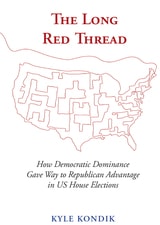
The Long Red Thread
How Democratic Dominance Gave Way to Republican Advantage in US House ElectionsKyle Kondik
Ohio University Press, 2021
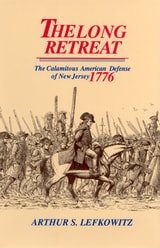
The Long Retreat
The Calamitous Defense of New Jersey, 1776Lefkowitz, Arthur S
Rutgers University Press, 1999
On the morning of November 20, 1776, General Charles Cornwallis overran patriot positions at Fort Lee, on the New Jersey side of the Hudson River. The attack threw George Washington's army into turmoil. Thus began an American retreat across the state, which ended only after the battered rebels crossed the Delaware river at Trenton on December 7. It was a three-week campaign that marked the most dramatic and desperate period of the War for Independence. In The Long Retreat, Arthur Lefkowitz has written the first book-length study of this critical campaign. He adds compelling new detail to the narrative, and offers the most comprehensive account in the literature of the American retreat to the Delaware and of the British pursuit. What emerges is a history misconceptions about the movements of the armies, the intentions of their leaders, and the choices available to rebel commanders and their British counterparts. Lefkowitz presents a patriot military pounded into desperate straights by the forces of the Crown, but in the end more resilient and wily than most previous scholarship has allowed. If brought low over November and December of 1776, Washington's battalions were still a force to reckon with as they pulled away from the advancing British. Despite serious losses in material and personnel, Washington managed to keep his units operational; and even while making mistakes, he sought to consolidate patriot regiments and longed for a chance to counterattack. The Christmas night riposte at Trenton, a dramatic reversal of fortune in any case, stemmed from measures the rebel Commander-in-Chief had initiated even as he completed his retrograde across New Jersey. How all of this came about emerges and crisp narrative of The Long Retreat. It is the definitive book on a crucial chapter in the history of American Arms.
The Long Shadow of Lincoln's Gettysburg Address
Jared Peatman
Southern Illinois University Press, 2013
The Long Shadow of Little Rock
A MemoirDaisy Bates
University of Arkansas Press, 2007

The Long War on Drugs
Anne L. Foster
Duke University Press, 2023
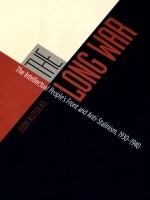
The Long War
The Intellectual People’s Front and Anti-Stalinism, 1930–1940Judy Kutulas
Duke University Press, 1994
Judy Kutulas takes us into the debates and outright fights between and within the ranks of organizations such as the League of American Writers, the John Reed Clubs, the Committee for Cultural Freedom, the American Civil Liberties Union, and the National Committee for the Defense of Political Prisoners. Showing how extremist views about the nature and value of communism triumphed over more moderate ones, she traces the transfer of the left’s leadership from one generation to the next. She describes how supporters of the People’s Front were discredited by the time of the Nazi-Soviet Pact and how this opened the way for a new generation of leaders better known as the New York intellectuals. In this shift, Kutulas identifies the beginnings of the liberal anti-communism that would follow World War II.
A book for students and scholars of the intersection of politics and culture, The Long War offers a new, informed perspective on the intellectual maneuvers of the American left of the 1930s and leads to a reinterpretation of the time and its complex legacy.
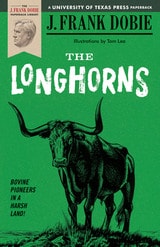
The Longhorns
By J. Frank Dobie
University of Texas Press, 1980
The Texas Longhorn made more history than any other breed of cattle the world has known. These wiry, intractable beasts were themselves pioneers in a harsh land, moving elementally with drouth, grass, Arctic blizzards, and burning winds. Their story is the bedrock on which the history of the cow country of America is founded.
J. Frank Dobie was a tale spinner who appreciated the proper place of legend and folklore in history. In The Longhorns, he tells of the Spanish conquistadors, who brought their cattle with them; of ranching in the turbulent colonial times; of the cowboy, whose abandon, energy, insolence, and pride epitomized the booming West. He writes of terrifying stampedes, titantic bull fights on the range, ghost steers, and encounters with Indians.
A tireless prospector of the history and legends of the Southwest, Dobie spent most of his life preparing to write this book. He was born in the Texas brush country where the Longhorns made their last stand; he back-trailed them into Mexico; he pursued the vivid lore of Texas cowboys and Mexican vaqueros. No historian or naturalist has ever so related an animal to the land, its people, and its history.
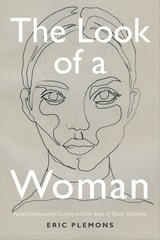
The Look of a Woman
Facial Feminization Surgery and the Aims of Trans- MedicineEric Plemons
Duke University Press, 2017

The Look of the 1960s
Barbarella and Pulp Pop ComicsJan Baetens and Hugo Frey
University of Texas Press, 2026
How the classic aesthetic of 1960s pulp comics influenced art, culture, and politics.
As a form of visual art, comic books rely on a distinct and eye-catching aesthetic. This is especially true of the iconic comics, graphic novels, and illustrations of the 1960s and 1970s. The Look of the 1960s explores the sources of inspiration that influenced the world of comics, beginning with the well-known French comics series Barbarella.
Noted comics scholars Jan Baetens and Hugo Frey analyze the impacts of the often-provocative images featured in the comics of the 1960s, which pushed back against French censorship in a politically tense time, and detail how women resisted their objectification in the comic book industry. Barbarella left its mark on the world and gained international attention, inspiring a movie adaptation and changing the look and content of other popular comics. The “Pulp Pop” movement remains relevant today, continuing to influence the art and political world. With new information about artists and an astute analysis of sociopolitical influence, The Look of the 1960s offers deep insights, making it a must read for comics fans all over the world.

The Loop
The “L” Tracks That Shaped and Saved ChicagoPatrick T. Reardon
Southern Illinois University Press, 2021
Every day Chicagoans rely on the loop of elevated train tracks to get to their jobs, classrooms, or homes in the city’s downtown. But how much do they know about the single most important structure in the history of the Windy City? In engagingly brisk prose, Patrick T. Reardon unfolds the fascinating story about how Chicago’s elevated Loop was built, gave its name to the downtown, helped unify the city, saved the city’s economy, and was itself saved from destruction in the 1970s.
This unique volume combines urban history, biography, engineering, architecture, transportation, culture, and politics to explore the elevated Loop’s impact on the city’s development and economy and on the way Chicagoans see themselves. The Loop rooted Chicago’s downtown in a way unknown in other cities, and it protected that area—and the city itself—from the full effects of suburbanization during the second half of the twentieth century. Masses of data underlie new insights into what has made Chicago’s downtown, and the city as a whole, tick.
The Loop features a cast of colorful Chicagoans, such as legendary lawyer Clarence Darrow, poet Edgar Lee Masters, mayor Richard J. Daley, and the notorious Gray Wolves of the Chicago City Council. Charles T. Yerkes, an often-demonized figure, is shown as a visionary urban planner, and engineer John Alexander Low Waddell, a world-renowned bridge creator, is introduced to Chicagoans as the designer of their urban railway.
This fascinating exploration of how one human-built structure reshaped the social and economic landscape of Chicago is the definitive book on Chicago’s elevated Loop.
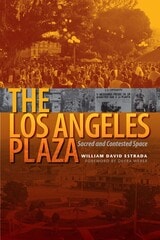
The Los Angeles Plaza
Sacred and Contested SpaceBy William David Estrada
University of Texas Press, 2008
2008 — Gold Award in Californiana – California Book Awards – Commonwealth Club of California
2010 — NACCS Book Award – National Association for Chicana and Chicano Studies
City plazas worldwide are centers of cultural expression and artistic display. They are settings for everyday urban life where daily interactions, economic exchanges, and informal conversations occur, thereby creating a socially meaningful place at the core of a city.
At the heart of historic Los Angeles, the Plaza represents a quintessential public space where real and imagined narratives overlap and provide as many questions as answers about the development of the city and what it means to be an Angeleno. The author, a social and cultural historian who specializes in nineteenth- and early twentieth-century Los Angeles, is well suited to explore the complex history and modern-day relevance of the Los Angeles Plaza. From its indigenous and colonial origins to the present day, Estrada explores the subject from an interdisciplinary and multiethnic perspective, delving into the pages of local newspapers, diaries and letters, and the personal memories of former and present Plaza residents, in order to examine the spatial and social dimensions of the Plaza over an extended period of time.
The author contributes to the growing historiography of Los Angeles by providing a groundbreaking analysis of the original core of the city that covers a long span of time, space, and social relations. He examines the impact of change on the lives of ordinary people in a specific place, and how this change reflects the larger story of the city.
The Lost Art of Declaring War
Brien Hallett
University of Illinois Press, 1998
Historically, it has been assumed that war is violence and declarations of war are simply public announcements that serve to initiate combat. Brien Hallett denies both assumptions and claims that war is policy, not violence.
The Lost Art of Declaring War analyzes the crucial differences between combat and war and convincingly argues that the power to "declare" war is in actuality the power to compose a text, draft a document, write a denunciation. Once written, the declaration then serves three functions: to articulate the political purposes of the war, to guide and direct military operations, and to establish the boundary between justified combat and unjustified devastation.
Hallett sounds a clarion call urging the people and their representatives to take up the challenge and write fully reasoned declarations of war. Then, and only then, can a civilized nation like the United States lay claim to being fully democratic, not only in peacetime, but in wartime as well.
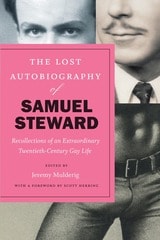
The Lost Autobiography of Samuel Steward
Recollections of an Extraordinary Twentieth-Century Gay LifeSamuel Steward
University of Chicago Press, 2018
The story of this life would undoubtedly have been a sensation if it had reached publication. But after finishing a 110,000-word draft in 1979, Steward lost interest in the project and subsequently published only a slim volume of selections from his manuscript.
In The Lost Autobiography of Samuel Steward, Jeremy Mulderig has integrated Steward’s truncated published text with the text of the original manuscript to create the first extended version of Steward’s autobiography to appear in print—the first sensational, fascinating, and ultimately enlightening story of his many lives told in his own words. The product of a rigorous line-by-line comparison of these two sources and a thoughtful editing of their contents, Mulderig’s thoroughly annotated text is more complete and coherent than either source alone while also remaining faithful to Steward’s style and voice, to his engaging self-deprecation and his droll sense of humor. Compellingly readable and often unexpectedly funny, this newly discovered story of a gay life full of wildly improbable—but nonetheless true—events is destined to become a landmark queer autobiography from the twentieth century.
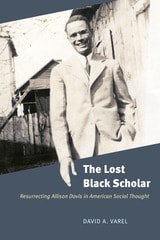
The Lost Black Scholar
Resurrecting Allison Davis in American Social ThoughtDavid A. Varel
University of Chicago Press, 2018
In The Lost Black Scholar, David A. Varel tells Davis’s compelling story, showing how a combination of institutional racism, disciplinary eclecticism, and iconoclastic thinking effectively sidelined him as an intellectual. A close look at Davis’s career sheds light not only on the racial politics of the academy but also the costs of being an innovator outside of the mainstream. Equally important, Varel argues that Davis exemplifies how black scholars led the way in advancing American social thought. Even though he was rarely acknowledged for it, Davis refuted scientific racism and laid bare the environmental roots of human difference more deftly than most of his white peers, by pushing social science in bold new directions. Varel shows how Davis effectively helped to lay the groundwork for the civil rights movement.
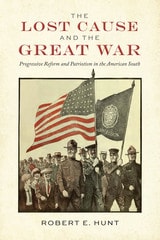
The Lost Cause and the Great War
Progressive Reform and Patriotism in the American SouthRobert E. Hunt
University of Alabama Press, 2025
How Tennessee reformers reconciled Southern heritage with rising nationalism, weaving the Lost Cause into the fabric of American progress and identity.
The Lost Cause and the Great War tells the stories of central Tennessee Progressive-era reformers to illustrate the fascinating broader issue of how Southerners steeped in Lost Cause Civil War mythologies simultaneously developed patriotic American fervor. Focusing on Luke Lea, a prominent politician and American army officer who attempted to capture Kaiser Wilhelm II during World War I, the book reveals the intricate interplay between three competing ideas: attachment to the memory of the Confederacy, intense American nationalism, and advocacy for progressive reforms.
Hunt shows that Lea and his contemporaries sought either to harmonize these competing loyalties or to compartmentalize them to use when needed. Through insightful accounts of Tennessee’s 1928 presidential campaign, the American Legion’s response to cuts to veteran benefits in 1933, and the redefinition of America’s global role post–World War II, Hunt shows how these reformers achieved a balance that held until the Civil Rights movement disrupted this delicate consensus.
Hunt’s rich account reveals how Lea and others like him wove national patriotism and Southern collective memory into a cohesive narrative that supported their broader Progressive goals. The book offers much to readers interested in Southern history, the Gilded Age, Prohibition, World War I, World War II, and the beginnings of the Civil Rights movement. It provides vivid examples of how collective memory and narratives shape social and political movements. General readers will discover how white Southerners who remained devoted to vindicating the Confederacy nonetheless became fervent supporters of America's growing nationalism in the early twentieth century.
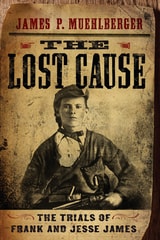
The Lost Cause
The Trials of Frank and Jesse JamesJames P. Muehlberger
Westholme Publishing, 2013
On a dreary December 7, 1869, two strangers entered the Daviess County Savings and Loan in Gallatin, Missouri. One of the men asked the cashier for change and then unexpectedly raised a revolver and shot him at point-blank range. Until now, this crime has been considered the first of a string of bank and train robberies committed by Jesse James, his brother Frank, and other gang members. But a story has circulated for more than a century that the case was actually brought to trial by a young Missouri lawyer—and it was through this case that twenty-two-year-old Jesse was first identified as a criminal to the country. But until recently no evidence for such an action could be found. After years of painstaking searches through dusty court archives across Missouri, defense attorney James P. Muehlberger finally discovered the historic documents in 2007. These fascinating and important records reveal that the gunmen were forced to leave behind a magnificent thoroughbred that linked James to the murder and, more intriguing, that the attack was not a bank robbery at all, but a calculated assassination in retribution for a Civil War killing.
The Lost Cause: The Trials of Frank and Jesse James is a thoroughly researched, thrilling account of the rise, pursuit, and prosecution of the legendary outlaw gang. Beginning with the newfound evidence of the Gallatin bank teller murder, the author explains how Jesse James attempted to avenge the death of his Confederate partisan leader, “Bloody Bill” Anderson, but shot the wrong man. Having lost his thoroughbred, Jesse stole another horse. Newly minted lawyer Henry McDougal brashly sued Jesse and Frank James for the loss of property, which would hang the murder on their heads. While Jesse professed his innocence and remained at large, his case was taken up by John Newman Edwards, editor of the Kansas City Times. Through Edwards’s pen, the James brothers were transformed from petty criminals to noble outlaws still fighting for Southern honor—the “Lost Cause.” Not fooled by Edwards’s rhetoric and populist appeal, McDougal and others, including Pinkerton detectives and the governor of Missouri, led a behind-the-scenes fight to bring down the gang. As the author explains, they first prosecuted lesser gang members, and by infiltrating the group, the authorities slowly unraveled the gang, with Jesse being shot by a paid informant in 1882. Frank James gave himself up, and in what was called the “trial of the century,” he was exonerated on all charges and retired to become a notable horse racing official until his death in 1915. Combining true crime, western adventure, and the transformation of America into a modern nation, The Lost Cause is engaging, entertaining history.
The Lost Chance in China and the Rise of Cold War Populism
Stephen J. Hartnett
Michigan State University Press, 2025
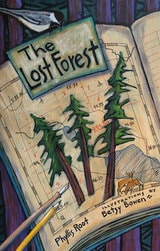
The Lost Forest
Phyllis Root
University of Minnesota Press, 2019
The story of a forest “lost” by a surveying error—and all the flora and fauna to be found there
A forest, of course, doesn’t need a map to know where to grow. But people need a map to find it. And in 1882 when surveyors set out to map a part of Minnesota, they got confused, or tired and cold (it was November), and somehow mapped a great swath of ancient trees as a lake. For more than seventy-five years, the mistake stayed on the map, and the forest remained safe from logging—no lumber baron expects to find timber in a lake, after all.
The Lost Forest tells the story of this lucky error and of the 144 acres of old-growth red and white pine it preserved. With gentle humor, Phyllis Root introduces readers to the men at their daunting task, trekking across Minnesota, measuring and marking the vast land into townships and sections and quarters. She takes us deep into a stand of virgin pine, one of the last and largest in the state, where U.S. history and natural history meet. With the help of Betsy Bowen’s finely observed and beautiful illustrations, she shows us all the life that can be found in the Lost Forest.
Accompanying the story is a wealth of information about the Cadastral Survey and about the plants and animals that inhabit forests—making the book a valuable guide for readers who might want to look even deeper into the history of Minnesota, the flora and fauna of old-growth forests, and the apportioning of land in America.
The Lost History of the New Madrid Earthquakes
Conevery Bolton Valencius
University of Chicago Press, 2013
The Lost Promise of Patriotism
Debating American Identity, 1890-1920Jonathan M. Hansen
University of Chicago Press, 2003
Intellectuals such as William James, John Dewey, Jane Addams, Eugene V. Debs, and W. E. B. Du Bois repudiated liberalism's association with acquisitive individualism and laissez-faire economics, advocating a model of liberal citizenship whose virtues and commitments amount to what Hansen calls cosmopolitan patriotism. Rooted not in war but in dedication to social equity, cosmopolitan patriotism favored the fight against sexism, racism, and political corruption in the United States over battles against foreign foes. Its adherents held the domestic and foreign policy of the United States to its own democratic ideals and maintained that promoting democracy universally constituted the ultimate form of self-defense. Perhaps most important, the cosmopolitan patriots regarded critical engagement with one's country as the essence of patriotism, thereby justifying scrutiny of American militarism in wartime.
The Lost Promise
American Universities in the 1960sEllen Schrecker
University of Chicago Press, 2021
The 1950s through the early 1970s are widely seen as American academia’s golden age, when universities—well-funded and viewed as essential for national security, economic growth, and social mobility—embraced an egalitarian mission. Swelling in size, schools attracted new types of students and professors, including radicals who challenged their institutions’ calcified traditions. But that halcyon moment soon came to a painful and confusing end, with consequences that still afflict the halls of ivy. In The Lost Promise, Ellen Schrecker—our foremost historian of both the McCarthy era and the modern American university—delivers a far-reaching examination of how and why it happened.
Schrecker illuminates how US universities’ explosive growth intersected with the turmoil of the 1960s, fomenting an unprecedented crisis where dissent over racial inequality and the Vietnam War erupted into direct action. Torn by internal power struggles and demonized by conservative voices, higher education never fully recovered, resulting in decades of underfunding and today’s woefully inequitable system. As Schrecker’s magisterial history makes blazingly clear, the complex blend of troubles that disrupted the university in that pivotal period haunts the ivory tower to this day.
The Lost Region
Toward a Revival of Midwestern HistoryJon K. Lauck
University of Iowa Press, 2013
In addition to outlining the centrality of the Midwest to crucial moments in American history, Jon K. Lauck resurrects the long-forgotten stories of the institutions founded by an earlier generation of midwestern historians, from state historical societies to the Mississippi Valley Historical Association. Their strong commitment to local and regional communities rooted their work in place and gave it an audience outside the academy. He also explores the works of these scholars, showing that they researched a broad range of themes and topics, often pioneering fields that remain vital today.
The Lost Region demonstrates the importance of the Midwest, the depth of historical work once written about the region, the continuing insights that can be gleaned from this body of knowledge, and the lessons that can be learned from some of its prominent historians, all with the intent of once again finding the forgotten center of the nation and developing a robust historiography of the Midwest.
The Lost Soul of American Politics
Virtue, Self-Interest, and the Foundations of LiberalismJohn Patrick Diggins
University of Chicago Press, 1986
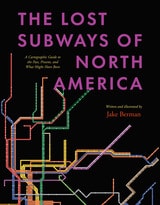
The Lost Subways of North America
A Cartographic Guide to the Past, Present, and What Might Have BeenJake Berman
University of Chicago Press, 2023
A visual exploration of the transit histories of twenty-three US and Canadian cities.
Every driver in North America shares one miserable, soul-sucking universal experience—being stuck in traffic. But things weren’t always like this. Why is it that the mass transit systems of most cities in the United States and Canada are now utterly inadequate?
The Lost Subways of North America offers a new way to consider this eternal question, with a strikingly visual—and fun—journey through past, present, and unbuilt urban transit. Using meticulous archival research, cartographer and artist Jake Berman has successfully plotted maps of old train networks covering twenty-three North American metropolises, ranging from New York City’s Civil War–era plan for a steam-powered subway under Fifth Avenue to the ultramodern automated Vancouver SkyTrain and the thousand-mile electric railway system of pre–World War II Los Angeles. He takes us through colorful maps of old, often forgotten streetcar lines, lost ideas for never-built transit, and modern rail systems—drawing us into the captivating transit histories of US and Canadian cities.
Berman combines vintage styling with modern printing technology to create a sweeping visual history of North American public transit and urban development. With more than one hundred original maps, accompanied by essays on each city’s urban development, this book presents a fascinating look at North American rapid transit systems.

The Lost World of John Witherspoon
Unravelling the Snodgrass affair, 1762 to 1776Ronald Lyndsey Crawford
Aberdeen University Press, 2015
The Lost World of Thomas Jefferson
Daniel J. Boorstin
University of Chicago Press, 1993
"The volume is too subtle, too rich in ideas for anyone to do justice to it in brief summary, too heavily documented and too carefully wrought for anyone to dismiss its thesis. . . . It is a major contribution not only to Jefferson studies but to American intellectual history. . . . All who work in the history of ideas will find themselves in Mr. Boorstin's debt."—Richard Hofstadter, South Atlantic Monthly
The Lowell Experiment
Public History in a Postindustrial CityCathy Stanton
University of Massachusetts Press, 2006
In the early nineteenth century, Lowell, Massachusetts, was widely studied and emulated as a model for capitalist industrial development. One of the first cities in the United States to experience the ravages of deindustrialization, it was also among the first places in the world to turn to its own industrial and ethnic history as a tool for reinventing itself in the emerging postindustrial economy. The Lowell Experiment explores how history and culture have been used to remake Lowell and how historians have played a crucial yet ambiguous role in that process.
The book focuses on Lowell National Historical Park, the flagship project of Lowell's new cultural economy. When it was created in 1978, the park broke new ground with its sweeping reinterpretations of labor, immigrant, and women's history. It served as a test site for the ideas of practitioners in the new field of public history—a field that links the work of professionally trained historians with many different kinds of projects in the public realm.
The Lowell Experiment takes an anthropological approach to public history in Lowell, showing it as a complex cultural performance shaped by local memory, the imperatives of economic redevelopment, and tourist rituals—all serving to locate the park's audiences and workers more securely within a changing and uncertain new economy characterized by growing inequalities and new exclusions.
The paradoxical dual role of Lowell's public historians as both interpreters of and contributors to that new economy raises important questions about the challenges and limitations facing academically trained scholars in contemporary American culture. As a long-standing and well-known example of “culture-led re-development,” Lowell offers an outstanding site for exploring questions of concern to those in the fields of public and urban history, urban planning, and tourism studies.
The Lower Mississippi Valley Expeditions of Clarence Bloomfield Moore
Clarence Bloomfield Moore
University of Alabama Press, 1998
A Dan Josselyn Memorial Publication
C. B. Moore's investigations of the Lower Mississippi Valley are here collected in a one-volume facsimile edition.
Like many other natural scientists from the Victorian era, Clarence Bloomfield Moore (1852-1917) lived several lives—adventurer, paper company executive, archaeologist; however, Moore is chiefly remembered for the twenty-five years he spent investigating and documenting archaeological sites along every navigable waterway in the southeastern United States.
Moore's surveys were and are impressive, and he earned lasting respect from archaeological researchers in the South by publishing, mostly at his own expense, all of the data he recovered. This volume includes works that describe data from Moore's expeditions that were key to the early recognition and preservation of major archaeological sites—Toltec, Parkin, Mound City, and Wicklife, among them—in the lower Mississippi River Valley. This and companion volumes stand today as the defining database for every area in which he worked.
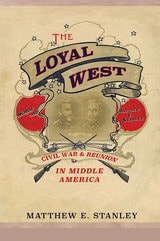
The Loyal West
Civil War and Reunion in Middle AmericaMatthew E. Stanley
University of Illinois Press, 2017
Matthew E. Stanley's intimate study explores the Civil War, Reconstruction, and sectional reunion in this bellwether region. Using the lives of area soldiers and officers as a lens, Stanley reveals a place and a strain of collective memory that was anti-rebel, anti-eastern, and anti-black in its attitudes--one that came to be at the forefront of the northern retreat from Reconstruction and toward white reunion. The Lower Middle West's embrace of black exclusion laws, origination of the Copperhead movement, backlash against liberalizing war measures, and rejection of Reconstruction were all pivotal to broader American politics. And the region's legacies of white supremacy--from racialized labor violence to sundown towns to lynching--found malignant expression nationwide, intersecting with how Loyal Westerners remembered the war.
A daring challenge to traditional narratives of section and commemoration, The Loyal West taps into a powerful and fascinating wellspring of Civil War identity and memory.
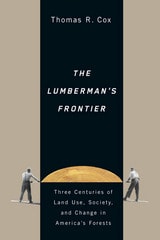
The Lumberman's Frontier
Three Centuries of Land Use, Society, and Change in America's ForestsThomas R. Cox
Oregon State University Press, 2010
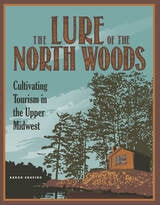
The Lure of the North Woods
Cultivating Tourism in the Upper MidwestAaron Shapiro
University of Minnesota Press, 2013
In the late nineteenth century, the North Woods offered people little in the way of a pleasant escape. Rather, it was a hub of production supplying industrial America with vast quantities of lumber and mineral ore. This book tells the story of how northern Minnesota, northern Wisconsin, and Michigan’s Upper Peninsula became a tourist paradise, turning a scarred countryside into the playground we know today.
Stripped of much of its timber and ore by the early 1900s, the North Woods experienced deindustrialization earlier than the Rust Belt cities that consumed its resources. In The Lure of the North Woods, Aaron Shapiro describes how residents and visitors reshaped the region from a landscape of exploitation to a vacationland. The rejuvenating North Woods profited in new ways by drawing on emerging connections between the urban and the rural, including improved transportation, promotion, recreational land use, and conservation initiatives. Shapiro demonstrates how this transformation helps explain the interwar origins of modern American environmentalism, when both the consumption of nature for pleasure and the work of the Civilian Conservation Corps in the North Woods and elsewhere led many Americans to cultivate a fresh perspective on the outdoors. At a time when travel and recreation are considered major economic forces, The Lure of the North Woods reveals how leisure—and tourism in particular—has shaped modern America.
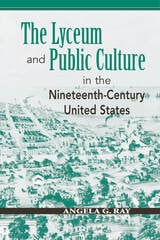
The Lyceum and Public Culture in the Nineteenth-Century United States
Angela G. Ray
Michigan State University Press, 2005
Angela Ray provides a refreshing new look at the lyceum lecture system as it developed in the United States from the 1820s to the 1880s. She argues that the lyceum contributed to the creation of an American "public" at a time when the country experienced a rapid change in land area, increasing immigration, and a revolution in transportation, communication technology, and social roles.
The history of the lyceum in the nineteenth century illustrates a process of expansion, diffusion, and eventual commercialization. In the late 1820s, a politically and economically dominant culture—the white Protestant northeastern middle class—institutionalized the practice of public debating and public lecturing for education and moral uplift. In the 1820s and 1830s, the lyceum was characterized by organized groups in cities and towns, particularly in the Northeast and the Old Northwest (now the Midwest). These groups were established to promote debate, to create a setting for study, and to provide a forum for members’ lecturing. By the 1840s and 1850s, however, most lyceums concentrated on the sponsorship of public lectures, presented for institutional profit as well as public instruction and entertainment. Eventually, lyceum lectures became a commercial enterprise and desirable platform for celebrities who wished to expand their incomes from lecturing.

The Machinery of Whiteness
Studies in the Structure of RacializationAuthored by Steve Martinot
Temple University Press, 2010
In this follow up to his book, The Rule of Racialization—which considered the way class structure is formed in the U.S.—Steve Martinot now examines how the structures of racialization reside at the core of all social, cultural, and political institutions in the U.S. In The Machinery of Whiteness, Martinot examines how race and racism are produced in the United States, analyzing the politics of racialization, and the preponderance of racial segregation and racial deprivation that have kept the U.S. a white dominated society throughout its history. Martinot dedicates this work to expunging white supremacy from the earth.
The Machinery of Whiteness investigates how “whiteness” came to be as foundational to the process that then produced the modern concept of race. Martinot addresses the instrumentalization of women as a necessary step in its formation, furthering the debates regarding the relationships of race and gender. And he addresses U.S. international interventionism, the anti-immigrant movements, and white racist populism to describe the political forms that white supremacy takes.
Martinot puts these together to analyze the underlying cultural structures of racialization that have driven and conditioned the resurgence of white supremacy and white entitlement in the wake of the Civil Rights movements. This book is a call to transform the cultural structures of the U.S. to make justice and democracy, which depend on inclusion and not segregation, possible.
The Madison Women
Gender, Higher Education, and Literacy in Nineteenth-Century AppalachiaAmanda E Hayes
West Virginia University Press, 2024
Incorporating captivating mini-biographies of women who attended Madison College and who went on to change their communities in ways large and small, this book reveals how the lives of its students impart lessons about history, regional culture, and how we can shape the Appalachia's future.
The Madness of Mary Lincoln
Jason Emerson
Southern Illinois University Press, 2007
WINNER, Russell P. Strange Memorial Book of the Year Award from the Illinois State Historical Society, 2007!
University Press Books for Public and Secondary Schools 2013 edition
In 2005, historian Jason Emerson discovered a steamer trunk formerly owned by Robert Todd Lincoln's lawyer and stowed in an attic for forty years. The trunk contained a rare find: twenty-five letters pertaining to Mary Todd Lincoln's life and insanity case, letters assumed long destroyed by the Lincoln family. Mary wrote twenty of the letters herself, more than half from the insane asylum to which her son Robert had her committed, and many in the months and years after.
The Madness of Mary Lincoln is the first examination of Mary Lincoln’s mental illness based on the lost letters, and the first new interpretation of the insanity case in twenty years. This compelling story of the purported insanity of one of America’s most tragic first ladies provides new and previously unpublished materials, including the psychiatric diagnosis of Mary’s mental illness and her lost will.
Emerson charts Mary Lincoln’s mental illness throughout her life and describes how a predisposition to psychiatric illness and a life of mental and emotional trauma led to her commitment to the asylum. The first to state unequivocally that Mary Lincoln suffered from bipolar disorder, Emerson offers a psychiatric perspective on the insanity case based on consultations with psychiatrist experts.
This book reveals Abraham Lincoln’s understanding of his wife’s mental illness and the degree to which he helped keep her stable. It also traces Mary’s life after her husband’s assassination, including her severe depression and physical ailments, the harsh public criticism she endured, the Old Clothes Scandal, and the death of her son Tad.
The Madness of Mary Lincoln is the story not only of Mary, but also of Robert. It details how he dealt with his mother’s increasing irrationality and why it embarrassed his Victorian sensibilities; it explains the reasons he had his mother committed, his response to her suicide attempt, and her plot to murder him. It also shows why and how he ultimately agreed to her release from the asylum eight months early, and what their relationship was like until Mary’s death.
This historical page-turner provides readers for the first time with the lost letters that historians had been in search of for eighty years.
The Magic Key
The Educational Journey of Mexican Americans from K-12 to College and BeyondEdited by Ruth Enid Zambrana and Sylvia Hurtado
University of Texas Press, 2015
Mexican Americans comprise the largest subgroup of Latina/os, and their path to education can be a difficult one. Yet just as this group is often marginalized, so are their stories, and relatively few studies have chronicled the educational trajectory of Mexican American men and women. In this interdisciplinary collection, editors Zambrana and Hurtado have brought together research studies that reveal new ways to understand how and why members of this subgroup have succeeded and how the facilitators of success in higher education have changed or remained the same.
The Magic Key’s four sections explain the context of Mexican American higher education issues, provide conceptual understandings, explore contemporary college experiences, and offer implications for educational policy and future practices. Using historical and contemporary data as well as new conceptual apparatuses, the authors in this collection create a comparative, nuanced approach that brings Mexican Americans’ lived experiences into the dominant discourse of social science and education. This diverse set of studies presents both quantitative and qualitative data by gender to examine trends of generations of Mexican American college students, provides information on perceptions of welcoming university climates, and proffers insights on emergent issues in the field of higher education for this population. Professors and students across disciplines will find this volume indispensable for its insights on the Mexican American educational experience, both past and present.
The Magic of Beverly Sills
Nancy Guy
University of Illinois Press, 2015

The Magic of Children's Gardens
Inspiring Through Creative DesignLolly Tai
Temple University Press, 2017
Children’s gardens are magical places where kids can interact with plants, see where food and fibers grow, and experience the role of birds, butterflies, and bees in nature. These gardens do more than just expose youngsters to outdoor environments, they also provide marvelous teaching opportunities for them to visit a small plot, care for vegetables and flowers, and interact in creative spaces designed to stimulate all five senses.
In The Magic of Children’s Gardens, landscape architect Lolly Tai provides the primary goals, concepts and key considerations for designing outdoor spaces that are attractive to and suitable for children especially in urban environments. Tai presents inspiring ideas for creating children’s green spaces by examining nearly twentycase studies, including the Chicago Botanic Gardens and Longwood Gardens in Kennett Square, PA.
The Magic of Children’s Gardens features hundreds of comprehensive drawings and gorgeous photographs of successful children’s outdoor environments, detailed explanations of the design process, and the criteria needed to create attractive and pleasing gardens for children to augment their physical, mental, and emotional development.
Exposing youth to well-planned outdoor environments promotes our next generation of environmental stewards. The Magic of Children's Gardens offers practitioners a guide to designing these valued spaces.
The Main Event
Boxing in Nevada from the Mining Camps to the Las Vegas StripRichard O. Davies
University of Nevada Press, 2014
As the twentieth century dawned, bare-knuckle prizefighting was transforming into the popular sport of boxing, yet simultaneously it was banned as immoral in many locales. Nevada was the first state to legalize it, in 1897, solely to stage the Corbett-Fitzsimmons world heavyweight championship in Carson City. Davies shows that the history of boxing in Nevada is integral to the growth of the sport in America. Promoters such as Tex Rickard brought in fighters like Jack Dempsey to the mining towns of Goldfield and Tonopah and presented the Johnson-Jeffries “Fight of the Century” in Reno in 1910. Prizefights sold tickets, hotel rooms, drinks, meals, and bets on the outcomes. It was boxing\--before gambling, prostitution, and easy divorce\--that first got Nevada called “America’s Disgrace” and the “Sin State.” The Main Event explores how boxing’s growth in Nevada relates to the state’s role as a social and cultural outlier. Starting in the Rat Pack era, organized gambling’s moguls built arenas outside the Vegas casinos to stage championships\--more than two hundred from 1960 to the present. Tourists and players came to see and bet on historic bouts featuring Sonny Liston, Muhammad Ali, George Foreman, Sugar Ray Leonard, Mike Tyson, and other legends of the ring.
From the celebrated referee Mills Lane to the challenge posed by mixed martial arts in contemporary Las Vegas, the story of boxing in Nevada is a prism for viewing the sport. Davies utilizes primary and secondary sources to analyze how boxing in the Silver State intersects with its tourist economy and libertarian values, paying special attention to issues of race, class, and gender. Written in an engaging style that shifts easily between narrative and analysis, The Main Event will be essential reading for sports fans and historians everywhere.
The Makers of Trinity Church in the City of Boston
James F. O'Gorman
University of Massachusetts Press, 2004
While critics often speak of the church as Richardson's creation, this collection of essays, written by leading scholars in the field, recognizes and assesses the individual contributions of the rector, Phillips Brooks; the chairman of the building committee, Robert Treat Paine; the builder, O. W. Norcross; and the decorator, John La Farge, as well as Richardson. The book includes the first study of the furnishings of the interior by the architect's office and features chapters on the stained glass designers Sarah Wyman Whitman and Margaret Redmond, as well as the architect Charles D. Maginnis, whose remodeling of the chancel in the 1930s brought the building to its full glory. These architectural collaborators are rarely given the recognition they receive here, although the absence of any one of them would have produced a very different result. Such omissions would have significantly diminished this towering landmark of America's cultural heritage.
In addition to the editor, contributors to the volume include Keith Bakker, David B. Chesebrough, Kathleen A. Curran, Erica Hirshler, Keith N. Morgan, Thomas M. Paine, Virginia Chieffo Raguin, Milda B. Richardson, Theodore E. Stebbins Jr., and Charles A. Vandersee.

The Making and Meaning of Hospital Policy in the United States and Canada
Terry Boychuk
University of Michigan Press, 1999
The Making and Unmaking of Whiteness
Birgit Brander Rasmussen, Eric Klinenberg, Irene J. Nexica, and Matt Wray, eds.
Duke University Press, 2001
With essays devoted to theories of racial domination, comparative global racisms, and transnational white identity, the geographical reach of the volume is significant and broad. Dalton Conley writes on “How I Learned to Be White.” Allan Bérubé discusses the intersection of gay identity and whiteness, and Mab Segrest describes the spiritual price white people pay for living in a system of white supremacy. Other pieces examine the utility of whiteness as a critical term for social analysis and contextualize different attempts at antiracist activism. In a razor-sharp introduction, the editors not only raise provocative questions about the intellectual, social, and political goals of those interested in the study of whiteness but assess several of the topic’s major recurrent themes: the visibility of whiteness (or the lack thereof); the “emptiness” of whiteness as a category of identification; and conceptions of whiteness as a structural privilege, a harbinger of violence, or an institutionalization of European imperialism.
Contributors. William Aal, Allan Bérubé, Birgit Brander Rasmussen, Dalton Conley, Troy Duster, Ruth Frankenberg, John Hartigan Jr., Eric Klinenberg, Eric Lott, Irene J. Nexica, Michael Omi, Jasbir Kaur Puar, Mab Segrest, Vron Ware, Howard Winant, Matt Wray
The Making of American Resorts
Saratoga Springs, Ballston Spa, and Lake GeorgeCorbett, Theodore
Rutgers University Press, 2001
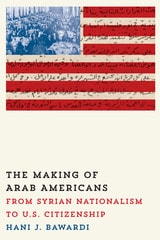
The Making of Arab Americans
From Syrian Nationalism to U.S. CitizenshipBy Hani J. Bawardi
University of Texas Press, 2014

The Making of Environmental Law
Richard J. Lazarus
University of Chicago Press, 2004
In The Making of Environmental Law, Richard J. Lazarus offers a new interpretation of the past three decades of this area of the law, examining the legal, political, cultural, and scientific factors that have shaped—and sometimes hindered—the creation of pollution controls and natural resource management laws. He argues that in the future, environmental law must forge a more nuanced understanding of the uncertainties and trade-offs, as well as the better-organized political opposition that currently dominates the federal government. Lazarus is especially well equipped to tell this story, given his active involvement in many of the most significant moments in the history of environmental law as a litigator for the Justice Department's Environment and Natural Resources Division, an assistant to the Solicitor General, and a member of advisory boards of the U.S. Environmental Protection Agency, the World Wildlife Fund, and the Environmental Defense Fund.
Ranging widely in his analysis, Lazarus not only explains why modern environmental law emerged when it did and how it has evolved, but also points to the ambiguities in our current situation. As the field of environmental law "grays" with middle age, Lazarus's discussions of its history, the lessons learned from past legal reforms, and the challenges facing future lawmakers are both timely and invigorating.

The Making of Environmental Law
Richard J. Lazarus
University of Chicago Press, 2022
How did environmental law first emerge in the United States? Why has it evolved in the ways that it has? And what are the unique challenges inherent to environmental lawmaking in general and in the United States in particular?
Since its first edition, The Making of Environmental Law has been foundational to our understanding of these questions. For the second edition, Richard J. Lazarus returns to his landmark book and takes stock of developments over the last two decades. Drawing on many years of experience on the frontlines of legal and policy battles, Lazarus provides a theoretical overview of the challenges that environmental protection poses for lawmaking, related to both the distinctive features of US lawmaking institutions and the spatial and temporal dimensions of ecological change. The book explains why environmental law emerged in the manner and form that it did in the 1970s and traces how it developed over sequent decades through key laws and controversies. New chapters, composing more than half of the second edition, examine a host of recent developments. These include how Congress dropped out of environmental lawmaking in the early twenty-first century; the shifting role of the judiciary; long-overdue efforts to provide environmental justice to disadvantaged communities; and the destabilization of environmental law that has resulted from the election of Presidents with dramatically clashing environmental policies.
As the nation’s partisan divide has grown deeper and the challenge of climate change has dramatically raised the perceived stakes for opposing interests, environmental law is facing its greatest challenges yet. This book is essential reading for understanding where we have been and what challenges and opportunities lie ahead.

The Making of Federal Coal Policy
Robert H. Nelson
Duke University Press, 1983
The Making of Lawyers' Careers
Inequality and Opportunity in the American Legal ProfessionRobert L. Nelson, Ronit Dinovitzer, Bryant G. Garth, Joyce S. Sterling, David B. Wilkins, Meghan Dawe, and Ethan Michelson
University of Chicago Press, 2023
An unprecedented account of social stratification within the US legal profession.
How do race, class, gender, and law school status condition the career trajectories of lawyers? And how do professionals then navigate these parameters?
The Making of Lawyers’ Careers provides an unprecedented account of the last two decades of the legal profession in the US, offering a data-backed look at the structure of the profession and the inequalities that early-career lawyers face across race, gender, and class distinctions. Starting in 2000, the authors collected over 10,000 survey responses from more than 5,000 lawyers, following these lawyers through the first twenty years of their careers. They also interviewed more than two hundred lawyers and drew insights from their individual stories, contextualizing data with theory and close attention to the features of a market-driven legal profession.
Their findings show that lawyers’ careers both reflect and reproduce inequalities within society writ large. They also reveal how individuals exercise agency despite these constraints.
The Making of Modern Nevada
Hal Rothman
University of Nevada Press, 2010
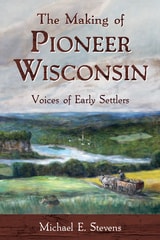
The Making of Pioneer Wisconsin
Voices of Early SettlersMichael E. Stevens
Wisconsin Historical Society Press, 2018
The Making of Pioneer Wisconsin provides a unique and intimate glimpse into the lives of these early settlers, as they describe what it felt like to be a teenager in a wagon heading west or an isolated young wife living far from her friends and family. Woven together with context provided by historian Michael E. Stevens, these first-person accounts form a fascinating narrative that deepens our ability to understand and empathize with Wisconsin’s early pioneers.