1563 books match the query 'African American & Black Studies' and 273 start with t

cover of The New Welfare Bureaucrats: Entanglements of Race, Class, and Policy Reform

The New Welfare Bureaucrats

Entanglements of Race, Class, and Policy Reform

Celeste Watkins-Hayes

University of Chicago Press, 2009

As the recession worsens, more and more Americans must turn to welfare to make ends meet. Once inside the agency, the newly jobless will face a bureaucracy that has undergone massive change since the advent of welfare reform in 1996. A behind-the-scenes look at bureaucracy’s human face, The New Welfare Bureaucrats is a compelling study of welfare officers and how they navigate the increasingly tangled political and emotional terrain of their jobs.

Celeste Watkins-Hayes here reveals how welfare reform engendered a shift in focus for caseworkers from simply providing monetary aid to the much more complex process of helping recipients find work. Now both more intimately involved in their clients’ lives and wielding greater power over their well-being, welfare officers’ racial, class, and professional identities have become increasingly important factors in their work. Based on the author’s extensive fieldwork in two very different communities in the northeast, The New Welfare Bureaucrats is a boon to anyone looking to understand the impact of the institutional and policy changes wrought by welfare reform as well as the subtle social dynamics that shape the way welfare is meted out at the individual level.
[more]
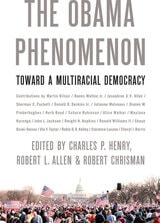
cover of The Obama Phenomenon: Toward a Multiracial Democracy

The Obama Phenomenon

Toward a Multiracial Democracy

Edited by Charles P. Henry, Robert L. Allen, and Robert Chrisman

University of Illinois Press, 2011
Barack Obama's campaign and electoral victory demonstrated the dynamic nature of American democracy. Beginning as a special issue of The Black Scholar, this probing collection illustrates the impact of "the Obama phenomenon" on the future of U.S. race relations through readings on Barack Obama's campaign as well as the idealism and pragmatism of the Obama administration. Some of the foremost scholars of African American politics and culture from an array of disciplines--including political science, theology, economics, history, journalism, sociology, cultural studies, and law--offer critical analyses of topics as diverse as Obama and the media, Obama’s connection with the hip hop community, the public's perception of first lady Michelle Obama, voter behavior, and the history of racial issues in presidential campaigns since the 1960s.
 
Contributors are Josephine A. V. Allen, Robert L. Allen, Herb Boyd, Donald R. Deskins Jr., Cheryl I. Harris, Charles P. Henry, Dwight N. Hopkins, John L. Jackson, Maulana Karenga, Robin D. G. Kelley, Martin Kilson, Clarence Lusane, Julianne Malveaux, Shaun Ossei-Owusu, Dianne M. Pinderhughes, Sherman C. Puckett, Scharn Robinson, Ula Y. Taylor, Alice Walker, Hanes Walton Jr., and Ronald Williams II.
[more]
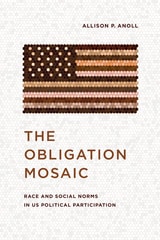
cover of The Obligation Mosaic: Race and Social Norms in US Political Participation

The Obligation Mosaic

Race and Social Norms in US Political Participation

Allison P. Anoll

University of Chicago Press, 2022

Many argue that “civic duty” explains why Americans engage in politics, but what does civic duty mean, and does it mean the same thing across communities? Why are people from marginalized social groups often more likely than their more privileged counterparts to participate in high-cost political activities? 
 
In The Obligation Mosaic, Allison P. Anoll shows that the obligations that bring people into the political world—or encourage them to stay away—vary systematically by race in the United States, with broad consequences for representation. Drawing on a rich mix of interviews, surveys, and experiments with Asian, Black, Latino, and White Americans, the book uncovers two common norms that centrally define concepts of obligation: honoring ancestors and helping those in need. Whether these norms lead different groups to politics depends on distinct racial histories and continued patterns of segregation. 
 
Anoll’s findings not only help to explain patterns of participation but also provide a window into opportunities for change, suggesting how activists and parties might better mobilize marginalized citizens. 
[more]
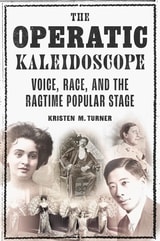
cover of The Operatic Kaleidoscope: Voice, Race, and the Ragtime Popular Stage

The Operatic Kaleidoscope

Voice, Race, and the Ragtime Popular Stage

Kristen M. Turner

University of Illinois Press, 2026

Opera and popular entertainment intersected at the turn of the twentieth century just as Americans debated the terms of citizenship. Kristen M. Turner disentangles the intertwined histories of race, class, gender, culture, and musical style to explain opera’s place in the mass culture of the ragtime era.

Turner examines performances ranging from Florenz Ziegfeld’s early Follies to Black vaudeville shows to musical comedies, including everything from celebrity vehicles to obscure productions and overlooked artists. She reveals how opera’s popularity in mass culture illuminates the effects of exclusionary immigration policies, pervasive racial and ethnic inequalities, debates over women’s suffrage, and the imposition of legalized segregation. Performers and creators from many communities—white immigrants, Jewish, Black, and Asian American—strategically deployed operatic allusions and the genre’s characteristic vocal timbre to assert their respectability, challenge stereotypes, and navigate oppressive social structures.

Nuanced and expansive, The Operatic Kaleidoscope explores opera’s role when popular culture grappled with questions of race and citizenship.
[more]
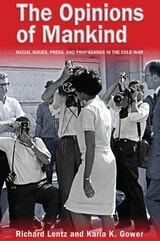
cover of The Opinions of Mankind: Racial Issues, Press, and Propaganda in the Cold War

The Opinions of Mankind

Racial Issues, Press, and Propaganda in the Cold War

Richard Lentz and Karla K. Gower

University of Missouri Press, 2011

During the Cold War, the Soviets were quick to publicize any incident of racial hostility in the United States. Since violence by white Americans against minorities was the perfect foil to America’s claim to be defenders of freedom, news of these occurrences was exploited to full advantage by the Russians. But how did the Soviets gain primary knowledge of race riots in small American towns? Certainly, the Soviets had reporters stationed stateside, in big cities like New York, but research reveals that the majority of their information came directly from U.S. media sources.

Throughout this period, the American press provided the foreign media with information about racially charged events in the United States. Such news coverage sometimes put Washington at a disadvantage, making it difficult for government officials to assuage foreign reactions to the injustices occurring on U.S. soil. Yet in other instances, the domestic press helped to promote favorable opinions abroad by articulating themes of racial progress. While still acknowledging racial abuses, these press spokesmen asserted that the situation in America was improving. Such paradoxical messages, both aiding and thwarting the efforts of the U.S. government, are the subject of The Opinions of Mankind: Racial Issues, Press, and Propaganda in the Cold War.

The study, by scholars Richard Lentz and Karla K. Gower, describes and analyzes the news discourse regarding U.S. racial issues from 1946 to 1965. The Opinions of Mankindnot only delves into the dissemination of race-related news to foreign outlets but also explores the impact foreign perceptions of domestic racism had on the U.S. government and its handling of foreign relations during the period. What emerges is an original, insightful contribution to Cold War studies. While other books examine race and foreign affairs during this period of American history, The Opinions of Mankind is the first to approach the subject from the standpoint of press coverage and its impact on world public opinion.

This exhaustively researched and compellingly written volume will appeal to media scholars, political historians, and general readers alike. By taking a unique approach to the study of this period, The Opinions of Mankind presents the workings behind the battles for public opinion that took place between 1946 and 1965.

[more]
cover of The Origins of the Dual City: Housing, Race, and Redevelopment in Twentieth-Century Chicago

The Origins of the Dual City

Housing, Race, and Redevelopment in Twentieth-Century Chicago

Joel Rast

University of Chicago Press, 2019
Chicago is celebrated for its rich diversity, but, even more than most US cities, it is also plagued by segregation and extreme inequality. More than ever, Chicago is a “dual city,” a condition taken for granted by many residents. In this book, Joel Rast reveals that today’s tacit acceptance of rising urban inequality is a marked departure from the past. For much of the twentieth century, a key goal for civic leaders was the total elimination of slums and blight. Yet over time, as anti-slum efforts faltered, leaders shifted the focus of their initiatives away from low-income areas and toward the upgrading of neighborhoods with greater economic promise. As misguided as postwar public housing and urban renewal programs were, they were born of a long-standing reformist impulse aimed at improving living conditions for people of all classes and colors across the city—something that can’t be said to be a true priority for many policymakers today. The Origins of the Dual City illuminates how we normalized and became resigned to living amid stark racial and economic divides.
 
[more]
cover of The Other Brahmins: Boston's Black Upper Class 1750-1950

The Other Brahmins

Boston's Black Upper Class 1750-1950

Adelaide Cromwell

University of Arkansas Press, 1995

Adelaide Cromwell’s pioneering work explores race and the social caste system in an atypical northern environment over a period of two centuries. Based on scholarly sources, interviews, and questionnaires, the study identifies those blacks in Boston who exercised political, economic, and social leadership from the end of the eighteenth century to the middle of the twentieth. The central focus is a comparison of black and white upper-class women in the 1940s.

This rare look at a black social microcosm not located in the South is seminal and timely. Because it concludes at a critical period in American history, The Other Brahmins paints a colorful backdrop for evaluating subsequent changes in urban sociology and stratification. In a groundbreaking study, Cromwell effectively challenges the simplistic notions of hierarchy as they pertain to race.
[more]
cover of The Other Side of Empathy

The Other Side of Empathy

Jade E. Davis

Duke University Press, 2023

In The Other Side of Empathy, Jade E. Davis contests the value of empathy as an affective or critical tool. Whether focusing on technology, colonialism, or racism, she shows how empathy can obscure relationships of dominance, control, submission, and victimization, arguing that these histories taint the whole concept of empathy. Drawing on digital archives of photographs, memoirs, newspapers, interviews, and advertisements regarding nineteenth-century ethnographic museums and human zoos, Davis shows how empathetic responses erase culpabilities from those institutions that commodify difference. She also contends that empathy’s mediation through digital technology cannot lead to more ethical actions, as technology only connects representations of people rather than the people themselves. In empathy’s place, Davis proposes mutual recognition as a way to see and experience others beyond colonial modes of empathy. Davis illustrates that moving beyond empathy allows for a more nuanced understanding of the colonial past and its ongoing impact while providing for a more meaningful affective engagement with the world.
[more]
cover of The Pandemic Divide: How COVID Increased Inequality in America

The Pandemic Divide

How COVID Increased Inequality in America

Gwendolyn L. Wright, Lucas Hubbard, and William A. Darrity, editors

Duke University Press, 2022

As COVID-19 made inroads in the United States in spring 2020, a common refrain rose above the din: “We’re all in this together.” However, the full picture was far more complicated—and far less equitable. Black and Latinx populations suffered illnesses, outbreaks, and deaths at much higher rates than the general populace. Those working in low-paid jobs and those living in confined housing or communities already disproportionately beset by health problems were particularly vulnerable. The contributors to The Pandemic Divide explain how these and other racial disparities came to the forefront in 2020. They explore COVID-19’s impact on multiple arenas of daily life—including wealth, health, housing, employment, and education—while highlighting what steps could have been taken to mitigate the full force of the pandemic. Most crucially, the contributors offer concrete public policy solutions that would allow the nation to respond effectively to future crises and improve the long-term well-being of all Americans.

Contributors. Fenaba Addo, Steve Amendum, Leslie Babinski, Sandra Barnes, Mary T. Bassett, Keisha Bentley-Edwards, Kisha Daniels, William A. Darity Jr., Melania DiPietro, Jane Dokko, Fiona Greig, Adam Hollowell, Lucas Hubbard, Damon Jones, Steve Knotek, Arvind Krishnamurthy, Henry Clay McKoy Jr., N. Joyce Payne, Erica Phillips, Eugene Richardson, Paul Robbins, Jung Sakong, Marta Sánchez, Melissa Scott, Kristen Stephens, Joe Trotter, Chris Wheat, Gwendolyn L. Wright
[more]
cover of The Past as Present in the Drama of August Wilson

The Past as Present in the Drama of August Wilson

Harry J. Elam, Jr.

University of Michigan Press, 2004

Pulitzer-prizewinning playwright August Wilson, author of Fences, Ma Rainey's Black Bottom, and The Piano Lesson, among other dramatic works, is one of the most well respected American playwrights on the contemporary stage. The founder of the Black Horizon Theater Company, his self-defined dramatic project is to review twentieth-century African American history by creating a play for each decade.
Theater scholar and critic Harry J. Elam examines Wilson's published plays within the context of contemporary African American literature and in relation to concepts of memory and history, culture and resistance, race and representation. Elam finds that each of Wilson's plays recaptures narratives lost, ignored, or avoided to create a new experience of the past that questions the historical categories of race and the meanings of blackness.
Harry J. Elam, Jr. is Professor of Drama at Stanford University and author of Taking It to the Streets: The Social Protest Theater of Luis Valdez and Amiri Baraka (The University of Michigan Press).
[more]
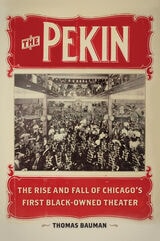
cover of The Pekin: The Rise and Fall of Chicago's First Black-Owned Theater

The Pekin

The Rise and Fall of Chicago's First Black-Owned Theater

Thomas Bauman

University of Illinois Press, 2014

In 1904, political operator and gambling boss Robert T. Motts opened the Pekin Theater in Chicago. Dubbed the "Temple of Music," the Pekin became one of the country's most prestigious African American cultural institutions, renowned for its all-black stock company and school for actors, an orchestra able to play ragtime and opera with equal brilliance, and a repertoire of original musical comedies.
 
A missing chapter in African American theatrical history, Bauman's saga presents how Motts used his entrepreneurial acumen to create a successful black-owned enterprise. Concentrating on institutional history, Bauman explores the Pekin's philosophy of hiring only African American staff, its embrace of multi-racial upper class audiences, and its ready assumption of roles as diverse as community center, social club, and fundraising instrument.
 
The Pekin's prestige and profitability faltered after Motts' death in 1911 as his heirs lacked his savvy, and African American elites turned away from pure entertainment in favor of spiritual uplift. But, as Bauman shows, the theater had already opened the door to a new dynamic of both intra- and inter-racial theater-going and showed the ways a success, like the Pekin, had a positive economic and social impact on the surrounding community.
[more]
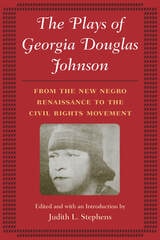
cover of The Plays of Georgia Douglas Johnson: From the New Negro Renaissance to the Civil Rights Movement

The Plays of Georgia Douglas Johnson

From the New Negro Renaissance to the Civil Rights Movement

Edited and with an Introduction by Judith L. Stephens

University of Illinois Press, 2006

Recovering the stage work of one of America's finest black female writers

This volume collects twelve of Georgia Douglas Johnson's one-act plays, including two never-before-published scripts found in the Library of Congress.  As an integral part of Washington, D.C.'s, thriving turn-of-the-century literary scene, Johnson hosted regular meetings with Harlem Renaissance writers and other artists, including Countee Cullen, Langston Hughes, May Miller, and Jean Toomer, and was herself considered among the finest writers of the time.  Johnson also worked for U.S. government agencies and actively supported women's and minorities' rights.

As a leading authority on Johnson, Judith L. Stephens provides a brief overview of Johnson's career and significance as a playwright; sections on the creative environment in which she worked; her S Street Salon; "The Saturday Nighters," and its significance to the New Negro Theatre; selected photographs; and a discussion of Johnson's genres, themes, and artistic techniques.

[more]
cover of The Pleasures of Exile

The Pleasures of Exile

George Lamming

University of Michigan Press, 1992

In The Pleasures of Exile, as in his other works, George Lamming embraces the intricate issues of colonization and decolonization with a canny combination of playfulness and seriousness, irony and commitment. “[It] is a reciprocal process,” Lamming observes, “to be a colonial is to be a man in a certain relation; and this relation is an example of exile.”
 
Through a series of interrelated essays, The Pleasures of Exile explores the cultural politics and relationships created in the crucible of colonization. Drawing on Shakespeare’s The Tempest and C. L. R. James’s The Black Jacobins, as well as his own fiction and poetry, Lamming deftly locates the reader in a specific intellectual and cultural domain while conjuring a rich and varied spectrum of physical, intellectual, psychological, and cultural responses to colonialism. “My subject,” he writes, “is the migration of the West Indian writer, as colonial and exile, from his native kingdom, once inhabited by Caliban, to the tempestuous island of Prospero’s and his language. This book is a report on one man’s way of seeing.”
 
[more]
cover of The Political Use of Racial Narratives: School Desegregation in Mobile, Alabama, 1954-97

The Political Use of Racial Narratives

School Desegregation in Mobile, Alabama, 1954-97

Richard A. Pride

University of Illinois Press, 2002

Arguing that politics is essentially a contest for meaning and that telling a story is an elemental political act, Richard A. Pride lays bare the history of school desegregation in Mobile, Alabama, to demonstrate the power of narrative in cultural and political change. This book describes the public, personal, and meta-narratives of racial inequality that have competed for dominance in Mobile. Pride begins with a white liberal's quest to desegregate the city's public schools in 1955 and traces which narratives--those of biological inferiority, white oppression, the behavior and values of blacks, and others--came to influence public policy and opinion over four decades. Drawing on contemporaneous sources, he reconstructs the stories of demonstrations, civic forums, court cases, and school board meetings as citizens of Mobile would have experienced them, inviting readers to trace the story of desegregation in Mobile through the voices of politicians, protestors, and journalists and to determine which narratives were indeed most powerful.

Exploring who benefits and who pays when different narratives are accepted as true, Pride offers a step-by-step account of how Mobile's culture changed each time a new and more forceful narrative was used to justify inequality. More than a retelling of Mobile's story of desegregation, The Political Use of Racial Narratives promotes the value of rhetorical and narrative analysis in the social sciences and history.
[more]
cover of The Politics of Belonging: Race, Public Opinion, and Immigration

The Politics of Belonging

Race, Public Opinion, and Immigration

Natalie Masuoka and Jane Junn

University of Chicago Press, 2013
The United States is once again experiencing a major influx of immigrants. Questions about who should be admitted and what benefits should be afforded to new members of the polity are among the most divisive and controversial contemporary political issues.

Using an impressive array of evidence from national surveys, The Politics of Belonging illuminates patterns of public opinion on immigration and explains why Americans hold the attitudes they do. Rather than simply characterizing Americans as either nativist or nonnativist, this book argues that controversies over immigration policy are best understood as questions over political membership and belonging to the nation. The relationship between citizenship, race, and immigration drive the politics of belonging in the United States and represents a dynamism central to understanding patterns of contemporary public opinion on immigration policy. Beginning with a historical analysis, this book documents why this is the case by tracing the development of immigration and naturalization law, institutional practices, and the formation of the American racial hierarchy. Then, through a comparative analysis of public opinion among white, black, Latino, and Asian Americans, it identifies and tests the critical moderating role of racial categorization and group identity on variation in public opinion on immigration.

[more]
cover of The Politics of Kinship: Race, Family, Governance

The Politics of Kinship

Race, Family, Governance

Mark Rifkin

Duke University Press, 2024

What if we understood the idea of family as central to representing alternative forms of governance as expressions of racial deviance? In The Politics of Kinship, Mark Rifkin shows how ideologies of family, including notions of kinship, recast Indigenous and other forms of collective self-organization and self-determination as disruptive racial tendencies in need of state containment and intervention. Centering work in Indigenous studies, Rifkin illustrates how conceptions of family and race work together as part of ongoing efforts to regulate, assault, and efface other political orders. The book examines the history of anthropology and its resonances in contemporary queer scholarship, contemporary Indian policy from the 1970s onward, the legal history of family formation and privacy in the United States, and the association of blackness with criminality across US history. In this way, Rifkin seeks to open new possibilities for envisioning what kinds of relations, networks, and formations can and should be seen as governance on lands claimed by the United States.
[more]
cover of The Politics of Public Health

The Politics of Public Health

Turshen, Meredeth

Rutgers University Press, 1989

In the progressive public health tradition, Meredeth Turshen criticizes conventional approaches to disease and offers an alternative framework based on the concept that health and illness are socially produced throughout the world. Using contemporary and historical accounts of great moments and great debates in public health, Turshen exposes the failure to improve health even when a specific program like smallpox vaccination succeeds. Her analyses incorporate theoretical contributions from Marxism and feminism.

The book is divided into four parts. Part 1 outlines current and alternative approaches to health, theories of disease causation, the policies and practices that follow from these theories, and issues of equity and access to health care. A chapter of women's health in three African countries illustrates these concepts. Part 2 describes limits to conventional public health, using case histories of plague control, dioxin decontamination, sanitary reform, and smallpox and malaria eradication. In Part 3, Turshen presents case histories of preventive medicine, nutrition and agribusiness, mental health, and AIDS in Africa to suggest new approaches based on an alternative model of social production. Part 4 looks to the future of public health. It examines basic issues in integrating public health research, training, and services, and concludes with an agenda for action.

[more]
cover of The Politics of Public Health

The Politics of Public Health

Turshen, Meredeth

Rutgers University Press, 1989

In the progressive public health tradition, Meredeth Turshen criticizes conventional approaches to disease and offers an alternative framework based on the concept that health and illness are socially produced throughout the world. Using contemporary and historical accounts of great moments and great debates in public health, Turshen exposes the failure to improve health even when a specific program like smallpox vaccination succeeds. Her analyses incorporate theoretical contributions from Marxism and feminism.

The book is divided into four parts. Part 1 outlines current and alternative approaches to health, theories of disease causation, the policies and practices that follow from these theories, and issues of equity and access to health care. A chapter of women's health in three African countries illustrates these concepts. Part 2 describes limits to conventional public health, using case histories of plague control, dioxin decontamination, sanitary reform, and smallpox and malaria eradication. In Part 3, Turshen presents case histories of preventive medicine, nutrition and agribusiness, mental health, and AIDS in Africa to suggest new approaches based on an alternative model of social production. Part 4 looks to the future of public health. It examines basic issues in integrating public health research, training, and services, and concludes with an agenda for action.
[more]
cover of The Politics of Skin Tone: African American Experiences, Identity, and Attitudes

The Politics of Skin Tone

African American Experiences, Identity, and Attitudes

Nicole D. Yadon

University of Chicago Press, 2025

A nuanced examination of the salience of skin tone within African American politics.

Research shows that skin tone is associated with significant differences in life experiences. On average, African Americans with darker skin earn lower wages, suffer worse health outcomes, and endure more negative criminal justice experiences than lighter-skinned African Americans. Nicole D. Yadon conceptualizes skin tone as one facet of the multidimensional construct of race that powerfully influences racialized experiences which, in turn, can influence political identities and attitudes.

Drawing on evidence from one hundred in-depth interviews, multiple surveys, and a survey experiment, The Politics of Skin Tone investigates the political associations of skin tone. Yadon finds that skin tone correlates with political attitudes, particularly on issues where color-based disparities are especially pronounced such as criminal justice. Moreover, a sizable number of African Americans adopt a skin tone-based identity. In an era of shifting racial boundaries and growing color-based discrimination, The Politics of Skin Tone examines the implications for both scholars and policymakers.

[more]
cover of The Possible Form of an Interlocution: W. E. B. Du Bois and Max Weber in Correspondence

The Possible Form of an Interlocution

W. E. B. Du Bois and Max Weber in Correspondence

Nahum Dimitri Chandler

Duke University Press, 2025
In The Possible Form of an Interlocution, Nahum Dimitri Chandler provides an epistemological and theoretical elaboration of the correspondence between W. E. B. Du Bois and Max Weber in 1904 and 1905. Their interlocution took place under the heading of Du Bois’s famous formulation “the problem of the color line.” This study takes as its incipient reference Weber’s statement to Du Bois that “I am absolutely convinced that the ‘color-line’ problem will be the paramount problem of the time to come, here and everywhere in the world.” Chandler provides a concise statement of Du Bois’s thought of “the problem of the color line” as a general formulation for understanding African American matters within modern historicity on a worldwide scale. He then examines Weber’s earliest writings to understand in just what way “the ‘color-line’ problem", served as a problematization for Weber in both his thought and itinerary, across the 1890s and through the time of their interlocution.
[more]
cover of The Power We Need Right Now: Black Sororities and Black Radical Movements of the 1970s

The Power We Need Right Now

Black Sororities and Black Radical Movements of the 1970s

Aisha A. Upton Azzam

Temple University Press, 2026

There is a long history of sororities such as Alpha Kappa Alpha (AKA) and Delta Sigma Theta (Delta) participating in activism and social justice efforts—from the Civil Rights Movement in the 1960s to Kamala Harris’s recent political campaigns. But radical movements like Black Lives Matter have posed more challenging questions for these organizations.

In The Power We Need Right Now, Aisha Upton Azzam investigates the legacies of AKA and Delta to understand the considerations that weigh on their engagement with present day Black movements. These organizations wield a significant amount of political power to mobilize in support of their causes. The response each sorority has had to movements fifty years apart is strikingly similar—even if their approaches are quite different.

Using a Black feminist theoretical framework, Upton Azzam brings context and meaning to the interactions of these sororities with Black radical movements. She highlights the costs communities bear from sororities’ adherence to respectability and racial uplift ideologies by tracing each sorority’s history and response to emerging Black feminist and Black Power movements during the tumultuous 1970s.

The Power We Need Right Now emphasizes that Black communities still have the ability to wield their political power and influence to further the struggle for Black liberation.
[more]
cover of The Power to Die: Slavery and Suicide in British North America

The Power to Die

Slavery and Suicide in British North America

Terri L. Snyder

University of Chicago Press, 2015

The history of slavery in early America is a history of suicide. On ships crossing the Atlantic, enslaved men and women refused to eat or leaped into the ocean. They strangled or hanged themselves. They tore open their own throats. In America, they jumped into rivers or out of windows, or even ran into burning buildings. Faced with the reality of enslavement, countless Africans chose death instead.

In The Power to Die, Terri L. Snyder excavates the history of slave suicide, returning it to its central place in early American history. How did people—traders, plantation owners, and, most importantly, enslaved men and women themselves—view and understand these deaths, and how did they affect understandings of the institution of slavery then and now? Snyder draws on ships’ logs, surgeons' journals, judicial and legislative records, newspaper accounts, abolitionist propaganda and slave narratives, and many other sources to build a grim picture of slavery’s toll and detail the ways in which suicide exposed the contradictions of slavery, serving as a powerful indictment that resonated throughout the Anglo-Atlantic world and continues to speak to historians today.

[more]
cover of The Powers of Dignity: The Black Political Philosophy of Frederick Douglass

The Powers of Dignity

The Black Political Philosophy of Frederick Douglass

Nick Bromell

Duke University Press, 2021
In The Powers of Dignity Nick Bromell unpacks Frederick Douglass's 1867 claim that he had “elaborated a political philosophy” from his own “slave experience.” Bromell shows that Douglass devised his philosophy because he found that antebellum Americans' liberal-republican understanding of democracy did not provide a sufficient principled basis on which to fight anti-Black racism. To remedy this deficiency, Douglass deployed insights from his distinctively Black experience and developed a Black philosophy of democracy. He began by contesting the founders' racist assumptions about humanity and advancing instead a more robust theory of “the human” as a collection of human “powers.” He asserted further that the conscious exercise of those powers is what confirms human dignity and that human rights and democracy come into being as ways to affirm and protect that dignity. Thus, by emphasizing the powers and the dignity of all citizens, deriving democratic rights from these, and promoting a remarkably activist, power-oriented model of citizenship, Douglass's Black political philosophy aimed to rectify two major failings of US democracy in his time and ours: its complacence and its racism.
[more]
cover of The Price of Racial Reconciliation

The Price of Racial Reconciliation

Ronald W. Walters

University of Michigan Press, 2008

“In The Price of Racial Reconciliation, Ronald Walters offers an abundance of riches. This book provides an extraordinarily comprehensive and persuasive set of arguments for reparations, and will be the lens through which meaningful opportunities for reconciliation are viewed in the future. If this book does not lead to the success of the reparations movement, nothing will.”

—Charles J. Ogletree, Jesse Climenko Professor of Law, Harvard Law School

“The Price of Racial Reconciliation is a seminal study of comparative histories and race(ism) in the formation of state structures that prefigure(d) socioeconomic positions of Black peoples in South Africa and the United States. The scholarship is meticulous in brilliantly constructed analysis of the politics of memory, reparations as an immutable principle of justice, imperative for nonracial(ist) democracy, and a regime of racial reconciliation.”

—James Turner, Professor of African and African American Studies and Founder, Africana Studies and Research Center, Cornell University

“A fascinating and pathbreaking analysis of the attempt at racial reconciliation in South Africa which asks if that model is relevant to the contemporary American racial dilemma. An engaging multidisciplinary approach relevant to philosophy, sociology, history, and political science.”

—William Strickland, Associate Professor of Political Science, W.E.B. Du Bois Department of Afro-American Studies, University of Massachusetts Amherst

The issue of reparations in America provokes a lot of interest, but the public debate usually occurs at the level of historical accounting: “Who owes what for slavery?” This book attempts to get past that question to address racial restitution within the framework of larger societal interests. For example, the answer to the “why reparations?” question is more than the moral of payment for an injustice done in the past. Ronald Walters suggests that, insofar as the impact of slavery is still very much with us today and has been reinforced by forms of postslavery oppression, the objective of racial harmony will be disrupted unless it is recognized with the solemnity and amelioration it deserves. The author concludes that the grand narrative of black oppression in the United States—which contains the past and present summary of the black experience—prevents racial reconciliation as long as some substantial form of racial restitution is not seriously considered. This is “the price” of reconciliation.

The method for achieving this finding is grounded in comparative politics, where the analyses of institutions and political behaviors are standard approaches. The author presents the conceptual difficulties involved in the project of racial reconciliation by comparing South African Truth and Reconciliation and the demand for reparations in the United States.

Ronald Walters is Distinguished Leadership Scholar and Director, African American Leadership Program and Professor of Government and Politics, University of Maryland.
[more]
cover of The Problem of Passing

The Problem of Passing

Sandra Harvey

Duke University Press, 2026
The Problem of Passing traces the continued relevance of Black racial passing for contemporary Black life, Black studies, philosophy, and narratives of passing more generally. In this critical and interdisciplinary journey through historical archives, literature, law, and conceptual art, Sandra Harvey argues that narratives of passing are at the core of past and present-day violence toward all Black subjects. She reframes passing as a set of reader relations at once cultural, discursive, aesthetic, and metaphysical. From antebellum slavery to modern genomics, each chapter traces how seemingly disparate institutional complexes, including law, science, and philosophy, are animated by logics of Black racegender passing that support the national project and the modern knowing subject. The Problem of Passing untangles the messy, unstable sites of encounter between subject and object, self and other, to bring to light the ways Black racial passing and its mythology are bound up in logics of settler colonialism, the nation-state, white sovereignty, and policing.
[more]
cover of The Problem of the Color[blind]: Racial Transgression and the Politics of Black Performance

The Problem of the Color[blind]

Racial Transgression and the Politics of Black Performance

Brandi Wilkins Catanese

University of Michigan Press, 2011

Are we a multicultural nation, or a colorblind one? The Problem of the Color[blind] examines this vexed question in American culture by focusing on black performance in theater, film, and television. The practice of colorblind casting---choosing actors without regard to race---assumes a performing body that is somehow race neutral. But where, exactly, is race neutrality located---in the eyes of the spectator, in the body of the performer, in the medium of the performance? In analyzing and theorizing such questions, Brandi Wilkins Catanese explores a range of engaging and provocative subjects, including the infamous debate between playwright August Wilson and drama critic Robert Brustein, the film career of Denzel Washington, Suzan-Lori Parks's play Venus, the phenomenon of postblackness (as represented in the Studio Museum in Harlem's "Freestyle" exhibition), the performer Ice Cube's transformation from icon of gangsta rap to family movie star, and the controversial reality television series Black. White. Concluding that ideologies of transcendence are ahistorical and therefore unenforceable, Catanese advances the concept of racial transgression---a process of acknowledging rather than ignoring the racialized histories of performance---as her chapters move between readings of dramatic texts, films, popular culture, and debates in critical race theory and the culture wars.
[more]
cover of The Problem of the Future World: W. E. B. Du Bois and the Race Concept at Midcentury

The Problem of the Future World

W. E. B. Du Bois and the Race Concept at Midcentury

Eric Porter

Duke University Press, 2010

The Problem of the Future World is a compelling reassessment of the later writings of the iconic African American activist and intellectual W. E. B. Du Bois. As Eric Porter points out, despite the outpouring of scholarship devoted to Du Bois, the broad range of writing he produced during the 1940s and early 1950s has not been thoroughly examined in its historical context, nor has sufficient attention been paid to the theoretical interventions he made during those years. Porter locates Du Bois’s later work in relation to what he calls “the first postracial moment.” He suggests that Du Bois’s midcentury writings are so distinctive and so relevant for contemporary scholarship because they were attuned to the shape-shifting character of modern racism, and in particular to the ways that discredited racial taxonomies remained embedded and in force in existing political-economic arrangements at both the local and global levels. Porter moves the conversation about Du Bois and race forward by building on existing work about the theorist, systematically examining his later writings, and looking at them from new perspectives, partly by drawing on recent scholarship on race, neoliberalism, and empire. The Problem of the Future World shows how Du Bois’s later writings help to address race and racism as protean, global phenomena in the present.
[more]
cover of The Problem of the Negro as a Problem for Gender

The Problem of the Negro as a Problem for Gender

Marquis Bey

University of Minnesota Press, 2020

A complex articulation of the ways blackness and nonnormative gender intersect—and a deeper understanding of how subjectivities are formed

A deep meditation on and expansion of the figure of the Negro and insurrectionary effects of the “X” as theorized by Nahum Chandler, The Problem of the Negro as a Problem for Gender thinks through the problematizing effects of blackness as, too, a problematizing of gender. Through the paraontological, the between, and the figure of the “X” (with its explicit contemporary link to nonbinary and trans genders) Marquis Bey presents a meditation on black feminism and gender nonnormativity. Chandler’s text serves as both an argumentative tool for rendering the “radical alternative” in and as blackness as well as demonstrating the necessarily trans/gendered valences of that radical alternative.

Forerunners is a thought-in-process series of breakthrough digital works. Written between fresh ideas and finished books, Forerunners draws on scholarly work initiated in notable blogs, social media, conference plenaries, journal articles, and the synergy of academic exchange. This is gray literature publishing: where intense thinking, change, and speculation take place in scholarship.
[more]
cover of The Pursuit of Happiness: Black Women, Diasporic Dreams, and the Politics of Emotional Transnationalism

The Pursuit of Happiness

Black Women, Diasporic Dreams, and the Politics of Emotional Transnationalism

Bianca C. Williams

Duke University Press, 2018

In The Pursuit of Happiness Bianca C. Williams traces the experiences of African American women as they travel to Jamaica, where they address the perils and disappointments of American racism by looking for intimacy, happiness, and a connection to their racial identities. Through their encounters with Jamaican online communities and their participation in trips organized by Girlfriend Tours International, the women construct notions of racial, sexual, and emotional belonging by forming relationships with Jamaican men and other "girlfriends." These relationships allow the women to exercise agency and find happiness in ways that resist the damaging intersections of racism and patriarchy in the United States. However, while the women require a spiritual and virtual connection to Jamaica in order to live happily in the United States, their notion of happiness relies on travel, which requires leveraging their national privilege as American citizens. Williams's theorization of "emotional transnationalism" and the construction of affect across diasporic distance attends to the connections between race, gender, and affect while highlighting how affective relationships mark nationalized and gendered power differentials within the African diaspora.
[more]
cover of The Quaker Community on Barbados: Challenging the Culture of the Planter Class

The Quaker Community on Barbados

Challenging the Culture of the Planter Class

Larry Gragg

University of Missouri Press, 2009

Prior to the Quakers’ large-scale migration to Pennsylvania, Barbados had more Quakers than any other English colony. But on this island of sugar plantations, Quakers confronted material temptations and had to temper founder George Fox’s admonitions regarding slavery with the demoralizing realities of daily life in a slave-based economy—one where even most Quakers owned slaves. In The Quaker Community on Barbados, Larry Gragg shows how the community dealt with these contradictions as it struggled to change the culture of the richest of England’s seventeenth-century colonies.

Gragg has conducted meticulous research on two continents to re-create the Barbados Quaker community. Drawing on wills, censuses, and levy books along with surviving letters, sermons, and journals, he tells how the Quakers sought to implement their beliefs in peace, simplicity, and equality in a place ruled by a planter class that had built its wealth on the backs of slaves. He reveals that Barbados Quakers were a critical part of a transatlantic network of Friends and explains how they established a “counterculture” on the island—one that challenged the practices of the planter class and the class’s dominance in island government, church, and economy.

In this compelling study, Gragg focuses primarily on the seventeenth century when the Quakers were most numerous and active on Barbados. He tells how Friends sought to convert slaves and improve their working and living conditions. He describes how Quakers refused to fund the Anglican Church, take oaths, participate in the militia, or pay taxes to maintain forts—and how they condemned Anglican clergymen, disrupted their services, and wrote papers critical of the established church. By the 1680s, Quakers were maintaining five meetinghouses and several cemeteries, paying for their own poor relief, and keeping their own records of births, deaths, and marriages. Gragg also tells of the severe challenges and penalties they faced for confronting and rejecting the dominant culture.

With their civil disobedience and stand on slavery, Quakers on Barbados played an important role in the early British Empire but have been largely neglected by scholars. Gragg’s work makes their contribution clear as it opens a new window on the seventeenth- and eighteenth-century Atlantic world.

[more]
cover of The Race of Sound: Listening, Timbre, and Vocality in African American Music

The Race of Sound

Listening, Timbre, and Vocality in African American Music

Nina Sun Eidsheim

Duke University Press, 2018

In The Race of Sound Nina Sun Eidsheim traces the ways in which sonic attributes that might seem natural, such as the voice and its qualities, are socially produced. Eidsheim illustrates how listeners measure race through sound and locate racial subjectivities in vocal timbre—the color or tone of a voice. Eidsheim examines singers Marian Anderson, Billie Holiday, and Jimmy Scott as well as the vocal synthesis technology Vocaloid to show how listeners carry a series of assumptions about the nature of the voice and to whom it belongs. Outlining how the voice is linked to ideas of racial essentialism and authenticity, Eidsheim untangles the relationship between race, gender, vocal technique, and timbre while addressing an undertheorized space of racial and ethnic performance. In so doing, she advances our knowledge of the cultural-historical formation of the timbral politics of difference and the ways that comprehending voice remains central to understanding human experience, all the while advocating for a form of listening that would allow us to hear singers in a self-reflexive, denaturalized way.
[more]
cover of The Racial Order

The Racial Order

Mustafa Emirbayer and Matthew Desmond

University of Chicago Press, 2015

Proceeding from the bold and provocative claim that there never has been a comprehensive and systematic theory of race, Mustafa Emirbayer and Matthew Desmond set out to reformulate how we think about this most difficult of topics in American life. In The Racial Order, they draw on Bourdieu, Durkheim, and Dewey to present a new theoretical framework for race scholarship. Animated by a deep and reflexive intelligence, the book engages the large and important issues of social theory today and, along the way, offers piercing insights into how race actually works in America. Emirbayer and Desmond set out to examine how the racial order is structured, how it is reproduced and sometimes transformed, and how it penetrates into the innermost reaches of our racialized selves. They also consider how—and toward what end—the racial order might be reconstructed. 
In the end, this project is not merely about race; it is a theoretical reconsideration of the fundamental problems of order, agency, power, and social justice. The Racial Order is a challenging work of social theory, institutional and cultural analysis, and normative inquiry.
[more]
cover of The Racial Order Of Things: Cultural Imaginaries Of The Post-Soul Era

The Racial Order Of Things

Cultural Imaginaries Of The Post-Soul Era

Roopali Mukherjee

University of Minnesota Press, 2006
Why did affirmative action programs implemented during the sixties and seventies suffer vicious assaults in the nineties? How were culturally resonant appeals to individualism and colorblindness turned around during the nineties to epitomize a “toxic system of quotas, preference, and set-asides”?In The Racial Order of Things, Roopali Mukherjee analyzes reversals and reinterpretations that mark the turn from the civil rights era of the sixties to the post-soul decade of the nineties. She begins by surveying a series of intractable disagreements over race- and gender-based social justice that have played out over the past decade, framed by the 1996 passage of California’s Proposition 209 and the 2003 Supreme Court decision on admissions criteria at the University of Michigan. Examining political campaigns for and against affirmative action as well as films about dilemmas of gender and race in the mythic meritocracy, the book exposes a remarkable discursive tug-of-war over antidiscrimination policies during the nineties.Highlighting the ways in which categories such as “blackness” and “women” have operated in these debates, Mukherjee sees the public policy process as a key site where cultural identities are formed, recognized, and discarded. Considering mainstream media, including Hollywood films like Disclosure, G.I. Jane, Courage under Fire, and The Contender, Mukherjee focuses on conflicts following the introduction of women and blacks into the workplace. She explores the politics of public memory about the civil rights era through the lens of feature film, documentary, and network news. Using newspaper articles and legislative records, Mukherjee provides a comparative reading of narratives and counternarratives of the debate surrounding the 1964 Civil Rights Act and anti–affirmative action campaigns of the neoliberal nineties.Balancing policy narrative, cinematic reading, and conceptual analysis, Mukherjee demonstrates a shifting and paradoxical racial order that explains how the cultural authority and political career of affirmative action remains in flux, thoroughly contested, and contradictory.Roopali Mukherjee is assistant professor of media studies at Queens College of the City University of New York.
[more]
cover of The Real Hiphop: Battling for Knowledge, Power, and Respect in the LA Underground

The Real Hiphop

Battling for Knowledge, Power, and Respect in the LA Underground

Marcyliena Morgan

Duke University Press, 2009

Project Blowed is a legendary hiphop workshop based in Los Angeles. It began in 1994 when a group of youths moved their already renowned open-mic nights from the Good Life, a Crenshaw district health food store, to the KAOS Network, an arts center in Leimert Park. The local freestyle of articulate, rapid-fire, extemporaneous delivery, the juxtaposition of meaningful words and sounds, and the way that MCs followed one another without missing a beat, quickly became known throughout the LA underground. Leimert Park has long been a center of African American culture and arts in Los Angeles, and Project Blowed inspired youth throughout the city to consider the neighborhood the epicenter of their own cultural movement. The Real Hiphop is an in-depth account of the language and culture of Project Blowed, based on the seven years Marcyliena Morgan spent observing the workshop and the KAOS Network. Morgan is a leading scholar of hiphop, and throughout the volume her ethnographic analysis of the LA underground opens up into a broader examination of the artistic and cultural value of hiphop.

Morgan intersperses her observations with excerpts from interviews and transcripts of freestyle lyrics. Providing a thorough linguistic interpretation of the music, she teases out the cultural antecedents and ideologies embedded in the language, emphases, and wordplay. She discusses the artistic skills and cultural knowledge MCs must acquire to rock the mic, the socialization of hiphop culture’s core and long-term members, and the persistent focus on skills, competition, and evaluation. She brings attention to adults who provided material and moral support to sustain underground hiphop, identifies the ways that women choose to participate in Project Blowed, and vividly renders the dynamics of the workshop’s famous lyrical battles.
[more]
cover of The Repeating Body: Slavery's Visual Resonance in the Contemporary

The Repeating Body

Slavery's Visual Resonance in the Contemporary

Kimberly Juanita Brown

Duke University Press, 2015
Haunted by representations of black women that resist the reality of the body's vulnerability, Kimberly Juanita Brown traces slavery's afterlife in black women's literary and visual cultural productions. Brown draws on black feminist theory, visual culture studies, literary criticism, and critical race theory to explore contemporary visual and literary representations of black women's bodies that embrace and foreground the body's vulnerability and slavery's inherent violence. She shows how writers such as Gayl Jones, Toni Morrison, Audre Lorde, and Jamaica Kincaid, along with visual artists Carrie Mae Weems and María Magdalena Campos-Pons, highlight the scarred and broken bodies of black women by repeating, passing down, and making visible the residues of slavery's existence and cruelty. Their work not only provides a corrective to those who refuse to acknowledge that vulnerability, but empowers black women to create their own subjectivities. In The Repeating Body, Brown returns black women to the center of discourses of slavery, thereby providing the means with which to more fully understand slavery's history and its penetrating reach into modern American life. 
 
[more]
cover of The Revolt of the Black Athlete: 50th Anniversary Edition

The Revolt of the Black Athlete

50th Anniversary Edition

Harry Edwards

University of Illinois Press, 2017
The Revolt of the Black Athlete hit sport and society like an Ali combination. This Fiftieth Anniversary edition of Harry Edwards's classic of activist scholarship arrives even as a new generation engages with the issues he explored. Edwards's new introduction and afterword revisit the revolts by athletes like Muhammad Ali, Kareem Abdul-Jabbar, Tommie Smith, and John Carlos. At the same time, he engages with the struggles of a present still rife with racism, double-standards, and economic injustice. Again relating the rebellion of black athletes to a larger spirit of revolt among black citizens, Edwards moves his story forward to our era of protests, boycotts, and the dramatic politicization of athletes by Black Lives Matter. Incisive yet ultimately hopeful, The Revolt of the Black Athlete is the still-essential study of the conflicts at the interface of sport, race, and society.
[more]
cover of The Revolution Has Come: Black Power, Gender, and the Black Panther Party in Oakland

The Revolution Has Come

Black Power, Gender, and the Black Panther Party in Oakland

Robyn C. Spencer

Duke University Press, 2016
In The Revolution Has Come Robyn C. Spencer traces the Black Panther Party's organizational evolution in Oakland, California, where hundreds of young people came to political awareness and journeyed to adulthood as members. Challenging the belief that the Panthers were a projection of the leadership, Spencer draws on interviews with rank-and-file members, FBI files, and archival materials to examine the impact the organization's internal politics and COINTELPRO's political repression had on its evolution and dissolution. She shows how the Panthers' members interpreted, implemented, and influenced party ideology and programs; initiated dialogues about gender politics; highlighted ambiguities in the Panthers' armed stance; and criticized organizational priorities. Spencer also centers gender politics and the experiences of women and their contributions to the Panthers and the Black Power movement as a whole. Providing a panoramic view of the party's organization over its sixteen-year history, The Revolution Has Come shows how the Black Panthers embodied Black Power through the party's international activism, interracial alliances, commitment to address state violence, and desire to foster self-determination in Oakland's black communities.
[more]
cover of The Revolution Will Be Improvised: The Intimacy of Cultural Activism

The Revolution Will Be Improvised

The Intimacy of Cultural Activism

Elizabeth Rodriguez Fielder

University of Michigan Press, 2024

The Revolution Will Be Improvised: The Intimacy of Cultural Activism traces intimate encounters between activists and local people of the civil rights movement through an archive of Black and Brown avant-gardism.  In the 1960s, Student Nonviolent Coordinating Committee (SNCC) activists engaged with people of color working in poor communities to experiment with creative approaches to liberation through theater, media, storytelling, and craft making. With a dearth of resources and an abundance of urgency, SNCC activists improvised new methods of engaging with communities that created possibilities for unexpected encounters through programs such as The Free Southern Theater, El Teatro Campesino, and the Poor People’s Corporation. 

Reading the output of these programs, Elizabeth Rodriguez Fielder argues that intimacy-making became an extension of participatory democracy. In doing so, Rodriguez Fielder supplants the success-failure binary for understanding social movements, focusing instead on how care work aligns with creative production. The Revolution Will Be Improvised returns to improvisation’s roots in economic and social necessity and locates it as a core tenet of the aesthetics of obligation, where a commitment to others drives the production and result of creative work. Thus, this book puts forward a methodology to explore the improvised, often ephemeral, works of art activism.
[more]
cover of The Rise and Fall of the Associated Negro Press: Claude Barnett's Pan-African News and the Jim Crow Paradox

The Rise and Fall of the Associated Negro Press

Claude Barnett's Pan-African News and the Jim Crow Paradox

Gerald Horne

University of Illinois Press, 2017

For nearly fifty years, the Chicago-based Associated Negro Press (ANP) fought racism at home and grew into an international news organization abroad. At its head stood founder Claude Barnett, one of the most influential African Americans of his day and a gifted, if unofficial, diplomat who forged links with figures as diverse as Jawaharlal Nehru, Zora Neale Hurston, and Richard Nixon.

Gerald Horne weaves Barnett's fascinating life story through a groundbreaking history of the ANP, including its deep dedication to Pan-Africanism. An activist force in journalism, Barnett also helped send doctors and teachers to Africa, advised African governments, gave priority to foreign newsgathering, and saw the African American struggle in global terms. Yet Horne also confronts Barnett's contradictions. A member of the African American elite, Barnett's sympathies with black aspirations often clashed with his ethics and a powerful desire to join the upper echelons of business and government. In the end, Barnett's activist success undid his work. Horne traces the dramatic story of the ANP's collapse as the mainstream press, retreating from Jim Crow, finally covered black issues and hired African American journalists.

Revelatory and entertaining, The Rise and Fall of the Associated Negro Press tells the story of a forgotten pioneer and the ambitious black institution he created.
[more]
cover of The Rise of Chicago's Black Metropolis, 1920-1929

The Rise of Chicago's Black Metropolis, 1920-1929

Christopher Robert Reed

University of Illinois Press, 2014
During the Roaring '20s, African Americans rapidly transformed their Chicago into a "black metropolis." In this book, Christopher Robert Reed describes the rise of African Americans in Chicago's political economy, bringing to life the fleeting vibrancy of this dynamic period of racial consciousness and solidarity.
 
Reed shows how African Americans rapidly transformed Chicago and achieved political and economic recognition by building on the massive population growth after the Great Migration from the South, the entry of a significant working class into the city's industrial work force, and the proliferation of black churches. Mapping out the labor issues and the struggle for control of black politics and black business, Reed offers an unromanticized view of the entrepreneurial efforts of black migrants, reassessing previous accounts such as St. Clair Drake and Horace R. Cayton's 1945 study Black Metropolis.
 
Utilizing a wide range of historical data, The Rise of Chicago's Black Metropolis, 1920–1929 delineates a web of dynamic social forces to shed light on black businesses and the establishment of a black professional class. The exquisitely researched volume draws on fictional and nonfictional accounts of the era, black community guides, mainstream and community newspapers, contemporary scholars and activists, and personal interviews.
[more]
cover of The Rise to Respectability: Race, Religion, and the Church of God in Christ

The Rise to Respectability

Race, Religion, and the Church of God in Christ

Calvin White

University of Arkansas Press, 2015
The Rise to Respectability documents the history of the Church of God in Christ (COGIC) and examines its cultural and religious impact on African Americans and on the history of the South. It explores the ways in which Charles Harrison Mason, the son of slaves and founder of COGIC, embraced a Pentecostal faith that celebrated charismatic forms of religious expression that many blacks had come to view as outdated, unsophisticated, and embarrassing. While examining the intersection of race, religion, and class, The Rise to Respectability details how the denomination dealt with the stringent standard of bourgeois behavior imposed on churchgoers as they moved from southern rural areas into the urban centers in both the South and North. Rooted in the hardships of slavery and coming of age during Jim Crow, COGIC's story is more than a religious debate. Rather, this book sees the history of the church as interwoven with the Great Migration, the struggle for modernity, class tension, and racial animosity--all representative parts of the African American experience.
[more]
cover of The Rural Face of White Supremacy: BEYOND JIM CROW

The Rural Face of White Supremacy

BEYOND JIM CROW

Mark Schultz

University of Illinois Press, 2007
Now in paperback, The Rural Face of White Supremacy presents a detailed study of the daily experiences of ordinary people in rural Hancock County, Georgia. Drawing on his own interviews with over two hundred black and white residents, Mark Schultz argues that the residents acted on the basis of personal rather than institutional relationships. As a result, Hancock County residents experienced more intimate face-to-face interactions, which made possible more black agency than their urban counterparts were allowed. While they were still firmly entrenched within an exploitive white supremacist culture, this relative freedom did create a space for a range of interracial relationships that included mixed housing, midwifery, church services, meals, and even common-law marriages.
[more]
cover of The Scene of Harlem Cabaret: Race, Sexuality, Performance

The Scene of Harlem Cabaret

Race, Sexuality, Performance

Shane Vogel

University of Chicago Press, 2009

Harlem’s nightclubs in the 1920s and ’30s were a crucible for testing society’s racial and sexual limits. Normally tacit divisions were there made spectacularly public in the vibrant, but often fraught, relationship between performer and audience. The cabaret scene, Shane Vogel contends, also played a key role in the Harlem Renaissance by offering an alternative to the politics of sexual respectability and racial uplift that sought to dictate the proper subject matter for black arts and letters. Individually and collectively, luminaries such as Duke Ellington, Lena Horne, Langston Hughes, Claude McKay, Wallace Thurman, and Ethel Waters expanded the possibilities of blackness and sexuality in America, resulting in a queer nightlife that flourished in music, in print, and on stage.

Deftly combining performance theory, literary criticism, historical research, and biographical study, The Scene of Harlem Cabaret brings this rich moment in history to life, while exploring the role of nightlife performance as a definitive touchstone for understanding the racial and sexual politics of the early twentieth century.

[more]
cover of The Science and Politics of Racial Research

The Science and Politics of Racial Research

William H. Tucker

University of Illinois Press, 1994

[more]
cover of The Second Battle for Africa: Garveyism, the US Heartland, and Global Black Freedom

The Second Battle for Africa

Garveyism, the US Heartland, and Global Black Freedom

Erik S. McDuffie

Duke University Press, 2024
In The Second Battle for Africa, Erik S. McDuffie establishes the importance of the US Midwest to twentieth-century global Black history, internationalism, and radicalism. McDuffie shows how cities like Chicago, Detroit, and Cleveland, as well as rural areas in the heartland, became central and enduring incubators of Marcus Garvey’s Black nationalist Universal Negro Improvement Association (UNIA) and its offshoots. Throughout the region, Black thinkers, activists, and cultural workers, like the Grenada-born activist Louise Little, championed Black freedom. McDuffie explores Garveyism and its changing facets from the 1920s onward, including the role of Black midwesterners during the emergence of fascism in the 1930s, the postwar US Black Freedom Movement and African decolonization, the rise of the Nation of Islam and Malcolm X in the 1950s and 1960s, and the continuing legacy of Garvey in today’s Black Midwest. Throughout, McDuffie evaluates the possibilities, limitations, and gendered contours of Black nationalism, radicalism, and internationalism in the UNIA and Garvey-inspired movements. In so doing, he unveils new histories of Black liberation and Global Africa.
[more]
cover of The Shadow and the Act: Black Intellectual Practice, Jazz Improvisation, and Philosophical Pragmatism

The Shadow and the Act

Black Intellectual Practice, Jazz Improvisation, and Philosophical Pragmatism

Walton M. Muyumba

University of Chicago Press, 2009

Though often thought of as rivals, Ralph Ellison, James Baldwin, and Amiri Baraka shared a range of  interests, especially a passion for music. Jazz, in particular, was a decisive influence on their thinking, and, as The Shadow and the Act reveals, they drew on their insights into the creative process of improvisation to analyze race and politics in the civil rights era. In this inspired study, Walton M. Muyumba situates them as a jazz trio, demonstrating how Ellison, Baraka, and Baldwin’s individual works form a series of calls and responses with each other.

Muyumba connects their writings on jazz to the philosophical tradition of pragmatism, particularly its support for more freedom for individuals and more democratic societies. He examines the way they responded to and elaborated on that lineage, showing how they significantly broadened it by addressing the African American experience, especially its aesthetics. Ultimately, Muyumba contends, the trio enacted pragmatist principles by effectively communicating the social and political benefits of African Americans fully entering society, thereby compelling America to move closer to its democratic ideals.
[more]
cover of The Shadow of Slavery: Peonage in the South, 1901-1969

The Shadow of Slavery

Peonage in the South, 1901-1969

Pete Daniel

University of Illinois Press, 1972

Whether peonage in the South grew out of slavery, a natural and perhaps unavoidable interlude between bondage and freedom, or whether employers distorted laws and customs to create debt servitude, most Southerners quietly accepted peonage. To the employer it was a way to control laborers; to the peon it was a bewildering system that could not be escaped without risk of imprisonment, beating, or death.
 
Pete Daniel's book is about this largely ignored form of twentieth-century slavery. It is in part "the record of an American failure, the inability of federal, state, and local law-enforcement officers to end peonage." In a series of case studies and histories, Daniel re-creates the neglected and frightening world of peonage, demanding, "If a form of slavery yet exists in the United States, as so much evidence suggests, then the relevant questions are why, and by whose irresponsibility?"
 
Peonage grew out of labor settlements following emancipation, when employers forbade croppers to leave plantations because of debt (often less than $30). At the turn of the century the federal government acknowledged that the "labyrinth of local customs and laws" binding men in debt was peonage. They outlawed debt servitude and slowly moved against it, but with no large success. Disappearing witnesses and acquitted employers characterized the cases that did go to court.
 
Daniel holds that peonage persists for many reasons: the corruption and apathy of law-enforcement, racist traditions in the South, and the impotence of the Justice Department in prosecuting this violation of federal law. He draws extensively on complaints and trial transcripts from the peonage records of the Justice Department.
 
[more]
cover of The Shadowed Country: Claude McKay and the Romance of the Victorians

The Shadowed Country

Claude McKay and the Romance of the Victorians

Gosciak, Josh

Rutgers University Press, 2006

One of the most important voices of the Harlem Renaissance, Claude McKay is largely recognized for his work during the 1920s, which includes a major collection of poems, Harlem Shadows, as well as a critically acclaimed novel, Home to Harlem. But McKay was never completely comfortable with his literary reputation during this period. Throughout his world travels, he saw himself as an English lyricist.

In this compelling examination of the life and works of this complex poet, novelist, journalist, and short story writer, Josh Gosciak sheds light on McKay’s literary contributions beyond his interactions with Harlem Renaissance artists and writers. Working within English literary traditions, McKay crafted a verse out of hybridity and diaspora. Gosciak shows how he reinvigorated a modern pastoral through his encounters with some of the major aesthetic and political movements of the late Victorian and early modern periods.

Exploring new archival material as well as many of McKay’s lesser known poetic works, TheShadowed Country provides a unique interpretation of the writings of this major author.
[more]
cover of The Sleeper Wakes: Harlem Renaissance Stories by Women

The Sleeper Wakes

Harlem Renaissance Stories by Women

Knopf-Newman, Marcy

Rutgers University Press, 1993

In recent years there has been an explosion of interest in the art and culture of the Harlem Renaissance. Yet this significant collection is the first definitive edition of Harlem Renaissance stories by women. The writers include Gwendolyn Bennett, Jessie Redmon Fauset, Angelina Weld Grimké, Zora Neale Hurston, Nella Larsen, Alice Dunbar-Nelson, and Dorothy West.

Published originally in periodicals such as The Crisis, Fire!!, and Opportunity, these twenty-seven stories have until now been virtually unavailable to readers. These stories are as compelling today as they were in the 1920s and 1930s. In them, we find the themes of black and white racial tension and misunderstanding, economic deprivation, passing, love across and within racial lines, and the attempt to maintain community and uplift the race.

Marcy Knopf's introduction surveys the history of the Harlem Renaissance, the periodicals and books it generated, and describes the rise to prominence of these women writers and their later fall from fame. She also includes a brief biography of each of the writers. Nellie Y. McKay's foreword analyzes the themes and concerns of the stories.

[more]
cover of The Slumbering Volcano: American Slave Ship Revolts and the Production of Rebellious Masculinity

The Slumbering Volcano

American Slave Ship Revolts and the Production of Rebellious Masculinity

Maggie Montesinos Sale

Duke University Press, 1997

In The Slumbering Volcano, Maggie Montesinos Sale investigates depictions of nineteenth-century slave ship revolts to explore the notion of rebellion in formulations of United States national identity. Analyzing how such revolts inspired citizens to debate whether political theory directed at free men could be extended toward blacks, Sale compares the reception of fictionalized versions of ship revolts published in the 1850s—Benito Cereno by Herman Melville and The Heroic Slave by Frederick Douglass—with the previous decade’s public accounts of actual rebellions by enslaved people on the ships Amistad and Creole.
This comparison of narrative response with written public reaction to the actual revolts allows Sale to investigate the precise manner in which public opinion regarding definitions of liberty evolved over this crucial period of time between the Revolutionary and Civil Wars. Mapping the ways in which unequally empowered groups claimed and transformed statements associated with the discourse of national identity, Sale succeeds in recovering a historically informed sense of the discursive and activist options available to people of another era.
In its demonstration of how the United States has been uniquely shaped by its dual status as both an imperial and a postcolonial power, this study on the discourse of natural rights and national identity in the pre-Civil War United States will interest students and scholars of American studies, African American studies, gender studies, and American history and literature.
[more]