Results by title
788 books match the query 'Caribbean & Latin American' and 157 start with t
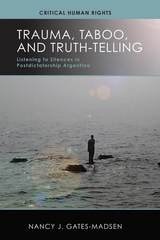
Trauma, Taboo, and Truth-Telling
Listening to Silences in Postdictatorship ArgentinaNancy J. Gates-Madsen
University of Wisconsin Press, 2018
Nancy J. Gates-Madsen reads between the lines of Argentine cultural texts (fiction, drama, testimonial narrative, telenovela, documentary film) to explore the fundamental role of silence—the unsaid—in the expression of trauma. Her careful examination of the interplay between textual and contextual silences illuminates public debate about the meaning of memory in Argentina—which stories are being told and, more important, which are being silenced. The imposition of silence is not limited to the military domain or its apologists, she shows; the human rights community also perpetuates and creates taboos.
Traveling Freely
EssaysRoberto Carlos Garcia
Northwestern University Press, 2025
A poet’s debut essay collection exploring American faults through the eyes of a Dominican American
In Traveling Freely: Essays, Roberto Carlos Garcia explores intersecting topics such as race, identity, American socioeconomic inequality, police violence, our inability to partake in our culture as innocents, and our complicity as Americans in all that’s wrong with the United States from the author’s specific vantage point as a Black Dominican American man. The voice in these essays is both clear and nuanced, and as readers move through the collection, the various themes cohere into a multilayered investigation of institutional racism and the inherent exploitations of capitalism.
In essays that are uniquely straightforward and accessible, Garcia insists that in order to resist state-sanctioned violence against marginalized bodies and populations, we must understand our shared history of oppression—so that we can rise against it effectively and find new paths forward.
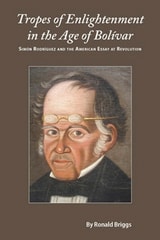
Tropes of Enlightenment in the Age of Bolivar
Simon Rodriguez and the American Essay at RevolutionRonald Briggs
Vanderbilt University Press, 2010
The book, released during the bicentennial of the early wars for Latin American independence, boldly places Rodriguez in the pantheon of important writers who influenced philosophical thought during the upheavals of the eighteenth and nineteenth centuries, including Ralph Waldo Emerson, Noah Webster, and Tom Paine. Beyond merely providing the first in-depth analysis of Rodriguez's writings and life work, Briggs also reveals an innovator of style as Rodriguez shaped the utility and vitality of the essay as an emerging form of argument.
Tropes of Enlightenment in the Age of Bolivar is an essential study of a unique and playful writer who is finally revealed as a foundational figure in Spanish American independence and an influential thinker in the larger field of hemispheric studies.
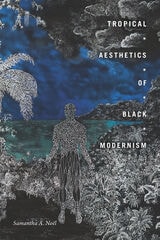
Tropical Aesthetics of Black Modernism
Samantha A. Noël
Duke University Press, 2021
Tropical Lung
exi(s)t(s)Roberto Harrison
Omnidawn, 2021
Tropical Lung shows how apocalypses can give us the keys to new futures and how aloneness and silence can lead us to live multidimensionally, beyond the boundaries of time and space. The screen makes itself known and offers a means of kinship, but it is also removed by song and born in the red of encounter and the dark of seven pupils. These wild visions coalesce into a fantastic vision of a future both technological and communal.
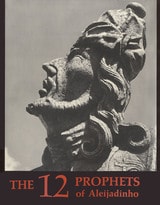
Twelve Prophets of Aleijadinho
Hans Mann
University of Texas Press, 1967
They stand on a hilltop in the mountains of Minas Gerais in Brazil—twelve dramatic figures, twelve Old Testament prophets soundlessly crying their warnings to mankind. There they have stood for over two centuries, masterpieces by that strange, unhappy sculptor, Antonio Francisco Lisboa—or, as he is better known, Aleijadinho, "The Little Cripple."
These figures, some mirroring in their faces the calm certainty of their prophesies and some reflecting the desperation of their warnings, have an impact upon the mind and the emotions of the modern viewer fully as great as their effect must have been upon those for whom they were originally carved—the adventurers of the lusty goldmining region which was eighteenth-century Minas Gerais. Their impact draws added depth from the realization that they bear also the mark of the anguish of their creator.
Aleijadinho, the mulatto son of a local builder, grew up untutored amid the building fever of the mining centers, grew up to endure throughout the last half of his long life the physical torment and the mental suffering of a painful and mutilating disease. Yet, developing his self-schooled talent, he stamped the hallmark of his creativity upon the religious art of the whole region.
In this volume the late artist photographer Hans Mann provides a sensitive pictorial study of the Twelve Prophets, of the six scenes of the Crucifixion which stand just below the Prophets on that windy hillside at Congonhas do Campo, and of other representative examples of the sculpture of Aleijadinho. A brief text by the photographer's wife, Graciela Mann, provides the information and background needed for the fullest enjoyment of the pictures.
The prose poem "When the Statues Speak," by Carlos Drummond de Andrade, sets the dramatic mood for the photographs of the Prophets themselves.
Twentieth-Century Spanish American Fiction
By Naomi Lindstrom
University of Texas Press, 1994
Spanish American fiction became a world phenomenon in the twentieth century through multilanguage translations of such novels as Gabriel Garcia Marquez's One Hundred Years of Solitude, Manuel Puig's Kiss of the Spider Woman, Octavio Paz's Labyrinth of Solitude, and Isabel Allende's House of the Spirits. Yet these "blockbusters" are only a tiny fraction of the total, rich outpouring of Spanish-language literature from Latin America.
In this book, Naomi Lindstrom offers English-language readers a comprehensive survey of the century's literary production in Latin America (excluding Brazil). Discussing movements and trends, she places the famous masterworks in historical perspective and highlights authors and works that deserve a wider readership. Her study begins with Rodó's famous essay Ariel and ends with Rigoberta Menchú's 1992 achievement of the Nobel Prize. Her selection of works is designed to draw attention, whenever possible, to works that are available in good English translations.
A special feature of the book is its treatment of the "postboom" period. In this important concluding section, Lindstrom discusses documentary narratives, the new interrelations between popular culture and literary writing, and underrepresented groups such as youth cultures, slum dwellers, gays and lesbians, and ethnic enclaves. Written in accessible, nonspecialized language, Twentieth-Century Spanish American Fiction will be equally useful for general readers as a broad overview of this vibrant literature and for scholars as a reliable reference work.