Results by title
1049 books match the query 'English, Irish, Scottish, Welsh' and 234 start with t
The Pooh Perplex
Frederick Crews
University of Chicago Press, 2003
The Pre-Raphaelites and Their Circle
Edited by Cecil Y. Lang
University of Chicago Press, 1975
Lang's Introduction describes briefly the founding of the Pre-Raphaelite Brotherhood, discusses each of the Pre-Raphaelite poets, both individually and in relation to the others, and grapples with the questions of definition of Pre-Raphaelitism and the similarities between its painting and poetry. The book is appropriately illustrated with thirty-two works by D. G. Rossetti, John Ruskin, William H. Hunt, and other Pre-Raphaelite artists.
This is the only anthology available that provides a representative selection of the work of these important poets. It will be indispensable to students of Victorian poetry and appreciated by readers interested in the Pre-Raphaelites.
The Printed Reader
Gender, Quixotism, and Textual Bodies in Eighteenth-Century BritainAmelia Dale
Bucknell University Press, 2019
The Printed Reader explores the transformative power of reading in the eighteenth century, and how this was expressed in the fascination with Don Quixote and in a proliferation of narratives about quixotic readers, readers who attempt to reproduce and embody their readings. Through intersecting readings of quixotic narratives, including work by Charlotte Lennox, Laurence Sterne, George Colman, Richard Graves, and Elizabeth Hamilton, Amelia Dale argues that literature was envisaged as imprinting—most crucially, in gendered terms—the reader’s mind, character, and body. The Printed Reader brings together key debates concerning quixotic narratives, print culture, sensibility, empiricism, book history, and the material text, connecting developments in print technology to gendered conceptualizations of quixotism. Tracing the meanings of quixotic readers’ bodies, The Printed Reader claims the social and political text that is the quixotic reader is structured by the experiential, affective, and sexual resonances of imprinting and impressions.
Published by Bucknell University Press. Distributed worldwide by Rutgers University Press.
The Professor and the Profession
Robert Bechtold Heilman
University of Missouri Press, 1999
Robert Bechtold Heilman is one of the last survivors of a remarkable generation of American critics that included such literary giants as Cleanth Brooks, Allen Tate, and Edmund Wilson, men to whom literary criticism was not a profession or an academic necessity but a calling. In a distinguished career that has spanned nearly six decades, Heilman has influenced generations of scholars and critics through his exquisitely written commentaries on subjects ranging from William Shakespeare to Thomas Hardy.
In The Professor and the Profession, Heilman looks back over his life and times from his perspective as both an academic and an American. Differing in theme and subject matter, the essays included in this collection are ultimately unified by the author himself. Whether the topic is football, Robert Penn Warren, or education, Heilman's generous and intelligent voice emerges on every page. Yet this collection is more than one academic's personal reminiscences; it is a reflection upon American literary history itself.
In the first section of essays, "The Self Displayed," Heilman reveals how he developed from a small-town boy into a distinguished critic and teacher, touching upon his participation in baseball and love of football along the way. "Writers Portrayed" and "Literary Types and Problems Inspected," the following sections, offer his opinions on the past and on the current state of American literary criticism, including personal portraits of such renowned friends as Eric Voegelin, Robert Penn Warren, Theodore Roethke, and Malcolm Cowley. The final section, "Education Examined," is an enlightening inquiry into the development of American universities in the twentieth century.
A fascinating chronicle of a significant academic life, The Professor and the Profession will appeal to a broad array of scholars, from young academics wanting to know where they came from to those of Heilman's generation who can appreciate this personal reminiscence into the world of letters.
The Proper Lady and the Woman Writer
Ideology as Style in the Works of Mary Wollstonecraft, Mary Shelley, and Jane AustenMary Poovey
University of Chicago Press, 1984
"The proper lady was a handy concept for a developing bourgeois patriarchy, since it deprived women of worldly power, relegating them to a sanctified domestic sphere that, in complex ways, nourished and sustained the harsh 'real' world of men. With care and subtle intelligence, Poovey examines this 'guardian and nemesis of the female self' through the ways it is implicated in the style and strategies of three very different writers."—Rachel M. Brownstein, The Nation
"The Proper Lady and the Woman Writer is a model of . . . creative discovery, providing a well-researched, illuminating history of women writers at the turn of the nineteenth century. [Poovey] creates sociologically and psychologically persuasive accounts of the writers: Wollstonecraft, who could never fully transcend the ideology of propriety she attacked; Shelley, who gradually assumed a mask of feminine propriety in her social and literary styles; and Austen, who was neither as critical of propriety as Wollstonecraft nor as accepting as Shelley ultimately became."—Deborah Kaplan, Novel
The Prophetess and the Patriarch
The Visions of an Anti-Regicide in Seventeenth-Century EnglandElizabeth Poole
Iter Press, 2023
In 1649, a seamstress named Elizabeth Poole appeared at the Whitehall debates in London to prophesy in front of Parliament’s army shortly after it had defeated the crown in the English civil wars. Invited to help deliberate the fate of Charles I, Poole advised the army to spare the king’s life but to put him on trial for tyranny and to enter into a new compact with the people. After her visions proved controversial, she was defamed as a prostitute and a witch. She retaliated by printing her prophecies, along with two new defenses of her original revelations. This collection publishes Poole’s pamphlets in full for the first time.
The Prose of Things
Transformations of Description in the Eighteenth CenturyCynthia Sundberg Wall
University of Chicago Press, 2006
In The Prose of Things, Wall analyzes literary works in the contexts of natural science, consumer culture, and philosophical change to show how and why the perception and representation of space in the eighteenth-century novel and other prose narratives became so textually visible. Wall examines maps, scientific publications, country house guides, and auction catalogs to highlight the thickening descriptions of domestic interiors. Considering the prose works of John Bunyan, Samuel Pepys, Aphra Behn, Daniel Defoe, Samuel Richardson, David Hume, Ann Radcliffe, and Sir Walter Scott, The Prose of Things is the first full account of the historic shift in the art of describing.
The Reformation of Emotions in the Age of Shakespeare
Steven Mullaney
University of Chicago Press, 2015
As Steven Mullaney shows in The Reformation of Emotions in the Age of Shakespeare, Elizabethan popular drama played a significant role in confronting the uncertainties and unresolved traumas of Elizabethan Protestant England. Shakespeare and his contemporaries—audiences as well as playwrights—reshaped popular drama into a new form of embodied social, critical, and affective thought. Examining a variety of works, from revenge plays to Shakespeare’s first history tetralogy and beyond, Mullaney explores how post-Reformation drama not only exposed these faultlines of society on stage but also provoked playgoers in the audience to acknowledge their shared differences. He demonstrates that our most lasting works of culture remain powerful largely because of their deep roots in the emotional landscape of their times.
The Religion of Empire
Political Theology in Blake's Prophetic SymbolismG. A. Rosso
The Ohio State University Press, 2016
The Religion of Empire also reevaluates Blake’s relationship with Milton, whose influence Blake both affirms and contests in a unique appropriation of Milton’s prophetic legacy. In this context, Rosso challenges recent views of Blake as complicit with the nationalism and sexism of his time, expanding the religion-empire nexus to include Blake’s esoteric understanding of gender. Foregrounding the role of female characters in the longer prophecies, Rosso discloses the variegated and progressive nature of Blake’s apocalyptic humanism.
The Rescue of Romanticism
Walter Pater and John RuskinKenneth Daley
Ohio University Press, 2001
Valuable and timely in its long historical and critical perspective on the legacy of romanticism to Victorian art and thought, The Rescue of Romanticism is the first book-length study of the close intellectual relationship between Walter Pater and John Ruskin, the two most important Victorian critics of art. Kenneth Daley explores the work and thought of both writers in context with other Victorian writers, and enlarges the issues at stake between them, connecting these issues to ongoing artistic, cultural, and political concerns of the modern world.
Professor Daley gives a more finely honed picture than ever before of romanticism’s emergence as a literary concept in Victorian England, detailing the political differences that characterize the opposition between John Ruskin and his younger contemporary, Walter Pater, over the nature of romanticism. Individual chapters reassess the Victorian reception of such romantic figures as Wordsworth, Dante Gabriel Rossetti, Leonardo, and Michelangelo.
Daley demonstrates how Pater’s “modern” reading of romanticism emerged from Ruskin’s distrust of romanticism and from Ruskin’s arguments and examples defining pathetic fallacy. His discussion of Ruskin’s Oxford lectures and their timing in Pater’s developing career refresh the intersections of the two bodies of work and the portrait of the Victorian period in general.
The Rhetoric of Blair, Campbell, and Whately, Revised Edition
James L. Golden and Edward P. J. Corbett
Southern Illinois University Press, 1990
Hugh Blair, George Campbell, and Richard Whately, whose works were first published in the late 18th and early 19th centuries, constituted the great triumvirate of British Rhetoricians. For 20 years, earlier printings of this book, which contains substantial excerpts comprising the most significant portions of their writings, have been widely used as textbooks in history-of-rhetoric courses. An increasing interest in rhetoric at the college level has created a renewed demand for reprints of such classic primary texts.
The Preface places the three rhetoricians within the context of the rhetorical tradition, which began in 5th-century BCE Greece. The bibliographies have been updated to include 20th-century scholarly work on Blair, Campbell, and Whately, and on the 18th- and 19th-century rhetorical movement. Biographical sketches of Blair, Campbell, and Whately are also provided.
The Rhetoric of English India
Sara Suleri Goodyear
University of Chicago Press, 1992
"A dense, witty, and richly allusive book . . . an extremely valuable contribution to postcolonial cultural studies as well as to the whole area of literary criticism."—Jean Sudrann, Choice
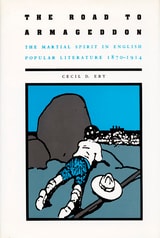
The Road to Armageddon
The Martial Spirit in English Popular Literature, 1870–1914Cecil D. Eby
Duke University Press, 1988
In The Road to Armageddon Cecil Eby shows how the widely admired writers of English popular fiction and poetry contributed, at least in England, to a romantic militarism coupled with xenophobia that helped create the climate that made World War I seem almost inevitable.
Between the close of the Franco-Prussian War of 1871 and the opening guns of 1914, the works of such widely read and admired writers as H. G. Wells, Rudyard Kipling, J. M. Barrie, and Rupert Brooke, as well as a host of now almost forgotten contemporaries, bombarded their avid readers with strident warnings of imminent invasions and prophecies of the collapse of civilization under barbarian onslaught and internal moral collapse.
Eby seems these narratives as growing from and in turn fueling a collective neurosis in which dread of coming war coexisted with an almost loving infatuation with it. The author presents a vivid panorama of a militant mileau in which warfare on a scale hitherto unimaginable was largely coaxed into being by works of literary imagination. The role of covert propaganda, concealed in seemingly harmless literary texts, is memorably illustrated.
The Ruins of Allegory
Paradise Lost and the Metamorphosis of Epic ConventionCatherine Gimelli Martin
Duke University Press, 1998
Martin shows how Paradise Lost, written at the threshold of the enormous imaginative shift that accompanied the Protestant, scientific, and political revolutions of the seventeenth century, conforms to a prophetic baroque model of allegory similar to that outlined by Walter Benjamin. As she demonstrates, Milton’s experimentation with baroque forms radically reformulates classical epic, medieval romance, and Spenserian allegory to allow for both a naturalistic, empirically responsible understanding of the universe and for an infinite and incomprehensible God. In this way, the resulting poetic world of Paradise Lost is like Milton’s God, an allegorical “ruin” in which the divine is preserved but at the price of a loss of certainty. Also, as Martin suggests, the poem affirmatively anticipates modernity by placing the chief hope of human progress in the fully self-authored subject.
Maintaining a dialogue with a critical tradition that extends from Johnson and Coleridge to the best contemporary Milton scholarship, Martin sets Paradise Lost in both the early modern and the postmodern worlds. Ruins of Allegory will greatly interest all Milton scholars, as well as students of literary criticism and early modern studies.
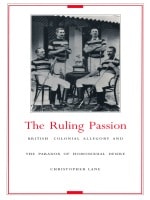
The Ruling Passion
British Colonial Allegory and the Paradox of Homosexual DesireChristopher Lane
Duke University Press, 1995
Through attentive readings of sexual and political allegory in the work of Kipling, Forster, James, Beerbohm, Firbank, and others—and deft use of psychoanalytic theory—The Ruling Passion interprets turbulent scenes of masculine identification and pleasure, power and mastery, intimacy and antagonism. By foregrounding the shattering effects of male homosexuality and interracial desire, and by insisting on the centrality of unconscious fantasy and the death drive, The Ruling Passion examines the startling recurrence of colonial failure in narratives of symbolic doubt and ontological crisis. Lane argues compellingly that Britain can progress culturally and politically only when it has relinquished its residual fantasies of global mastery.

The Sanitary Arts
Aesthetic Culture and the Victorian Cleanliness CampaignsEileen Cleere
The Ohio State University Press, 2014
The Sanitary Arts covers the mid-forties controversy over cleaning the dirt from the pictures in the National Gallery, the debate over decorative “dust traps” in the overstuffed Victorian home, and the late-century proliferation of hygienic breeding principles as a program of aesthetic perfectibility, to demonstrate the unintentionally collaborative work of seemingly unrelated events and discourses. Bringing figures like Edwin Chadwick and John Ruskin into close conversation about the sanitary status of beauty in a variety of forms and environments, Cleere forcefully demonstrates that aesthetic development and scientific discovery can no longer be understood as separate or discrete forces of cultural change.
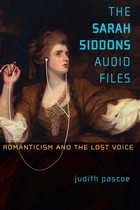
The Sarah Siddons Audio Files
Romanticism and the Lost VoiceJudith Pascoe
University of Michigan Press, 2013
“The theatre scholar’s daunting but irresistible quest to recover some echoes of performance of the past has never been more engagingly presented than in Pascoe’s account of tracing the long-silenced voice of Sarah Siddons. Her report is a warm, witty, and highly informative exploration of the methodology and the pleasures of historical research.”
—Marvin Carlson, author of The Haunted Stage: The Theatre as Memory Machine
During her lifetime (1755–1831), English actress Sarah Siddons was an international celebrity acclaimed for her performances of tragic heroines. We know what she looked like—an endless number of artists asked her to sit for portraits and sculptures—but what of her famous voice, reported to cause audiences to hyperventilate or faint? In The Sarah Siddons Audio Files, Judith Pascoe takes readers on a journey to discover how the actor’s voice actually sounded. In lively and engaging prose, Pascoe retraces her quixotic search, which leads her to enroll in a “Voice for Actors” class, to collect Lady Macbeth voice prints, and to listen more carefully to the soundscape of her life.
Bringing together archival discoveries, sound recording history, and media theory, Pascoe shows how romantic poets’ preoccupation with voices is linked to a larger cultural anxiety about the voice’s ephemerality. The Sarah Siddons Audio Files contributes to a growing body of work on the fascinating history of sound and will engage a broad audience interested in how recording technology has altered human experience.
The Science of Character
Human Objecthood and the Ends of Victorian RealismS. Pearl Brilmyer
University of Chicago Press, 2022
In 1843, the Victorian philosopher John Stuart Mill called for the establishment of a new science, “the science of the formation of character.” Although Mill’s proposal failed as scientific practice, S. Pearl Brilmyer maintains that it found its true home in realist fiction of the period, which employed the literary figure of character to investigate the nature of embodied experience. Bringing to life Mill’s unrealized dream of a science of character, novelists such as George Eliot, Thomas Hardy, and Olive Schreiner turned to narrative to explore how traits and behaviors in organisms emerge and develop, and how aesthetic features—shapes, colors, and gestures—come to take on cultural meaning through certain categories, such as race and sex. Engaged with materialist science and philosophy, these authors transformed character from the liberal notion of the inner truth of an individual into a materially determined figuration produced through shifts in the boundaries between the body’s inside and outside. In their hands, Brilmyer argues, literature became a science, not in the sense that its claims were falsifiable or even systematically articulated, but in its commitment to uncovering, through a fictional staging of realistic events, the laws governing physical and affective life. The Science of Character redraws late Victorian literary history to show how women and feminist novelists pushed realism to its aesthetic and philosophical limits in the crucial span between 1870 and 1920.
The Secret Marriage of Sherlock Holmes and Other Eccentric Readings
Michael Atkinson
University of Michigan Press, 1998
"Atkinson demonstrates a love and knowledge of the Holmes stories. . . I would recommend The Secret Marriage of Sherlock Holmes enthusiastically to any lover of the Canon who is prepared to have their perceptions widened."
The Selected Poems of Fulke Greville
Fulke Greville
University of Chicago Press, 2009
Along with his childhood friend Sir Philip Sidney, Fulke Greville (1554–1628) was an important member of the court of Queen Elizabeth I. Although his poems, long out of print, are today less well known than those of Sidney, Spenser, or Shakespeare, Greville left an indelible mark on the world of Renaissance poetry, both in his love poems, which ably work within the English Petrarchan tradition, and in his religious meditations, which, along with the work of Donne and Herbert, stand as a highpoint of early Protestant poetics.
Back in print for a new generation of scholars and readers, Thom Gunn’s selection of Greville’s short poems includes the whole of Greville’s lyric sequence, Caelica, along with choruses from some of Greville’s verse dramas. Gunn’s introduction places Greville’s thought in historical context and in relation to the existential anxieties that came to preoccupy writers in the twentieth century. It is as revealing about Gunn himself, and the reading of earlier English verse in the 1960s, as it is about Greville’s own poetic achievement. This reissue of Selected Poems of Fulke Greville is an event of the first order both for students of early British literature and for readers of Thom Gunn and English poetry generally.

The Servant's Hand
English Fiction from BelowBruce W. Robbins
Duke University Press, 1993
The Snobs of England and Punch's Prize Novelists
William Makepeace Thackeray
University of Michigan Press, 2005
This volume of The Snobs of England and Punch's Prize Novelists is an addition to The Thackeray Edition collection, the first full-scale scholarly edition of William Makepeace Thackeray's works to appear in over seventy years, and the only one ever to be based on an examination of manuscripts and relevant printed texts. It is also a concrete attempt to put into practice a theory of scholarly editing that gives new insight into Thackeray's own compositional process. In The Snobs of England, a series of amusing satirical sketches, Thackeray provides a panoramic awareness of the many varieties of human folly, identifying snobbery not as a social attitude but as the unworthy admiration of foolish things. Punch's Prize Novelists presents a series of illustrated burlesque parodies of Thackeray's contemporary writers, including Edward Bulwer, Benjamin Disraeli, Mrs. Catherine Gore, G.P.R. James, Charles Lever, and James Fenimore Cooper. The works are edited here from a comparative study of all relevant documents: from the first published appearances to the last editions touched by the author.
The Split World of Gerard Manley Hopkins
Dennis Sobolev
Catholic University of America Press, 2011

The Spy Story
John G. Cawelti and Bruce A. Rosenberg
University of Chicago Press, 1987
In addition to a general history of the genre, Cawelti and Rosenberg present in-depth analyses of the work of certain writers who have given the spy story its shape, among them John Buchan, Eric Ambler, Graham Greene, Ian Fleming, and John le Carré. The Spy Story also includes an extensive appendix, featuring a literary and historical bibliography of espionage and clandestinity, a list of the best spy novels and films, a catalog of major spy writers and their heroes, and a selection of novels on espionage themes written by major twentieth-century authors and public figures.
Written in a lively style that reflects the authors' enthusiasm for this intriguing form, The Spy Story will be read with pleasure by devotees of the genre as well as students of popular culture.
The Story of All Things
Writing the Self in English Renaissance Narrative PoetryMarshall Grossman
Duke University Press, 1998
Relating subjectivity to the nature of language, Grossman uses the theories of Lacan to analyze the concept of the self as it encounters a transforming environment. He shows how ideological tensions arose from the reorganization and "modernization" of social life in revolutionary England and how the major poets of the time represented the division of the self in writings that are suspended between lyric and narrative genres. Beginning with the portrayals of the self inherited from Augustine, Dante, and Petrarch, he describes the influence of historic developments such as innovations in agricultural technology, civil war and regicide, and the emergence of republican state institutions on the changing representation of characters in the works of Spenser, Donne, Marvell, and Milton. Furthering this psychoanalytic critique of literary history, Grossman probes the linguistic effects of social and personal factors such as Augustine’s strained relationship with his mother and the marital disharmony of Milton and Mary Powell. With its focus on these and other "literary historical events," The Story of All Things not only proposes a new structural theory of narrative but constitutes a significant challenge to New Historicist conceptions of the self.
The Story of Fictional Truth
Realism from the Death to the Rise of the NovelPaul Dawson
The Ohio State University Press, 2023

The Subaltern Ulysses
Enda Duffy
University of Minnesota Press, 1994
The Subaltern Ulysses was first published in 1994. Minnesota Archive Editions uses digital technology to make long-unavailable books once again accessible, and are published unaltered from the original University of Minnesota Press editions.
How might an IRA bomb and James Joyce's Ulysses have anything in common? Could this masterpiece of modernism, written at the violent moment of Ireland's national emergence, actually be the first postcolonial novel? Exploring the relation of Ulysses to the colony in which it is set, and to the nation being born as the book was written, Enda Duffy uncovers a postcolonial modernism and in so doing traces another unsuspected strain within the one-time critical monolith. In the years between 1914 and 1921, as Joyce was composing his text, Ireland became the first colony of the British Empire to gain its independence in this century after a violent anticolonial war. Duffy juxtaposes Ulysses with documents and photographs from the archives of both empire and insurgency, as well as with recent postcolonial literary texts, to analyze the political unconscious of subversive strategies, twists on class and gender, that render patriarchal colonialist culture unfamiliar.
Ulysses, Duffy argues, is actually a guerrilla text, and here he shows how Joyce's novel pinpoints colonial regimes of surveillance, mocks imperial stereotypes of the "native," exposes nationalism and other chauvinistic ideologies of "imagined community" as throwbacks to the colonial ethos, and proposes versions of a postcolonial subject. A significant intervention in the massive "Joyce industry" founded on the rhetoric and aesthetics of high modernism, Duffy's insights show us not only Ulysses, but also the origins of postcolonial textuality, in a startling new way.Enda Duffy is assistant professor of English at the University of California at Santa Barbara.
The Subject of Elizabeth
Authority, Gender, and RepresentationLouis Montrose
University of Chicago Press, 2006
Montrose offers a masterful account of the texts, pictures, and performances in which the Queen was represented to her people, to her court, to foreign powers, and to Elizabeth herself. Retrieving this “Elizabethan imaginary” in all its richness and fascination, Montrose presents a sweeping new account of Elizabethan political culture. Along the way, he explores the representation of Elizabeth within the traditions of Tudor dynastic portraiture; explains the symbolic manipulation of Elizabeth’s body by both supporters and enemies of her regime; and considers how Elizabeth’s advancing age provided new occasions for misogynistic subversions of her royal charisma.
This book, the remarkable product of two decades of study by one of our most respected Renaissance scholars, will be welcomed by all historians, literary scholars, and art historians of the period.
The Subject of Modernism
Narrative Alterations in the Fiction of Eliot, Conrad, Woolf, and JoyceTony E. Jackson
University of Michigan Press, 1994
The Submerged Plot and the Mother's Pleasure from Jane Austen to Arundhati Roy
Kelly A. Marsh
The Ohio State University Press, 2016
Combining feminist and rhetorical narratological approaches, Marsh’s study offers fresh readings of Persuasion, Jane Eyre, Bleak House, The Woman in White, The House of Mirth, The Last September, The Color Purple, A Thousand Acres, Bastard Out of Carolina, Talking to the Dead, and The God of Small Things. Through these readings, The Submerged Plot and the Mother’s Pleasure explores how the unnarratable can be communicated in fiction and offers a significant contribution to our understanding of narrative progression.
The Substance of Shadow
A Darkening Trope in Poetic HistoryJohn Hollander
University of Chicago Press, 2016
Shadow shows itself here in myriad literary identities, revealing its force as a way of seeing and a form of knowing, as material for fable and parable. Taking up a vast range of texts—from the Bible, Dante, Shakespeare, and Milton to Poe, Dickinson, Eliot, and Stevens—Hollander describes how metaphors of shadow influence our ideas of dreaming, desire, doubt, and death. These shadows of poetry and prose fiction point to unknown, often fearful domains of human experience, showing us concealed shapes of truth and possibility. Crucially, Hollander explores how shadows in poetic history become things with a strange substance and life of their own: they acquire the power to console, haunt, stalk, wander, threaten, command, and destroy. Shadow speaks, even sings, revealing to us the lost as much as the hidden self.
An extraordinary blend of literary analysis and speculative thought, Hollander’s account of the substance of shadow lays bare the substance of poetry itself.
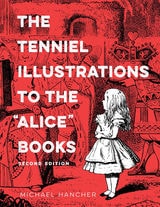
The Tenniel Illustrations to the “Alice” Books, 2nd edition
Michael Hancher
The Ohio State University Press, 2019
This new edition also pays special attention to the material circumstances that enabled and conditioned the printing of the illustrations. The original twelve chapters have been revised and updated throughout, drawing on archival and published resources made available in recent decades. Six chapters are entirely new, explaining how Tenniel’s drawings were professionally hand-engraved on wood blocks; how electrotype replicas were made from those blocks; and what problems could mar the commercial printing of such images—as notoriously happened in the first printing of Alice’s Adventures in Wonderland, which Carroll suppressed on Tenniel’s advice. Also considered for the first time here are the coloring of Tenniel’s black-and-white illustrations, by Tenniel and other artists, and the extraordinary treatment later given to Tenniel’s illustrations by the prestigious Limited Editions Club.

The Tenth Muse
Victorian Philology and the Genesis of the Poetic Language of Gerard Manley HopkinsBy Cary H. Plotkin
Southern Illinois University Press, 1989
With authority and sensitivity Plotkin traces the close relationship between Hopkins’s poetry and the theories of language suggested in his Journals and expounded by Victorian philologists such as Max Müller and George Marsh.
Plotkin seeks to determine what changed Hopkins’s perception of language between the writing of such early poems as "The Habit of Perfection" and "Nondum" (1866) and his creation of The Wreck of the Deutschland (1875–76). Did the language of the ode, and of Hopkins’s mature poetry generally, arise as spontaneously as it appears to have done, or does it have a traceable genesis in the ways in which language as a whole was conceived and studied in mid-century England? In answer, Plotkin fixes the development of Hopkins’s singular poetic language in the philological context of his time.
If one is to understand Hopkins’s writings and poetic language in the context in which they developed rather than in the terms of a present-day theory of history or textuality, then that movement in all of its complexity must be considered. Hopkins "translates" into the language of poetry patterns and categories common to Victorian language study.

The The Complete Works of Robert Browning, Volume IV
Browning, Robert
Ohio University Press, 1973
The Theatre of Death
Rituals of Justice from the English Civil Wars to the RestorationP J Klemp
University of Delaware Press, 2017
This book discusses some rituals of justice—such as public executions, printed responses to the Archbishop of Canterbury’s execution speech, and King Charles I’s treason trial—in early modern England. Focusing on the ways in which genres shape these events’ multiple voices, I analyze the rituals’ genres and the diverse perspectives from which we must understand them.
The execution ritual, like such cultural forms as plays and films, is a collaborative production that can be understood only, and only incompletely, by being alert to the presence of its many participants and their contributions. Each of these participants brings a voice to the execution ritual, whether it is the judge and jury or the victim, executioner, sheriff and other authorities, spiritual counselors, printer, or spectators and readers. And each has at least one role to play. No matter how powerful some institutions and individuals may appear, none has a monopoly over authority and how the events take shape on and beyond the scaffold. The centerpiece of the mid-seventeenth-century’s theatre of death was the condemned man’s last dying utterance. This study focuses on the words and contexts of many of those final speeches, including King Charles I’s (1649), Archbishop William Laud’s (1645), and the Earl of Strafford’s (1641), as well as those of less well known royalists and regicides. Where we situate ourselves to view, hear, and comprehend a public execution—through specific participants’ eyes, ears, and minds or accounts—shapes our interpretation of the ritual. It is impossible to achieve a singular, carefully indoctrinated meaning of an event as complex as a state-sponsored public execution.
Along with the variety of voices and meanings, the nature and purpose of the rituals of justice maintain a significant amount of consistency in a number of eras and cultural contexts. Whether the focus is on the trial and execution of the Marian martyrs, English royalists in the 1640s and 1650s, or the Restoration’s regicides, the events draw on a set of cultural expectations or conventions. Because rituals of justice are shaped by diverse voices and agendas, with the participants’ scripts and counterscripts converging and colliding, they are dramatic moments conveying profound meanings.
Published by University of Delaware Press. Distributed worldwide by Rutgers University Press.
The Tristan Legend
A Study in SourcesSigmund Eisner
Northwestern University Press, 1969
The Triumph of Human Empire
Verne, Morris, and Stevenson at the End of the WorldRosalind Williams
University of Chicago Press, 2013
The Two Gentlemen of Verona
William Shakespeare
Arizona Center for Medieval and Renaissance Studies, 2023
In one of his earliest plays, Two Gentlemen of Verona, Shakespeare began exploring themes of love and friendship that became the focus of some of his greatest works. Amelia Roper’s translation focuses on how the verse sounds—the feeling of the words as spoken by an actor and listened to by an audience. This version offers a new sort of life to the play, letting audiences feel like they’re truly hearing it as Shakespeare’s audience might have more than four hundred years ago.
This translation of Two Gentlemen of Verona was written as part of the Oregon Shakespeare Festival’s Play On! project, which commissioned new translations of thirty-nine Shakespeare plays. These translations present the work of “The Bard” in language accessible to modern audiences while never losing the beauty of Shakespeare’s verse. Enlisting the talents of a diverse group of contemporary playwrights, screenwriters, and dramaturges from diverse backgrounds, this project reenvisions Shakespeare for the twenty-first century. These volumes make these works available for the first time in print—a new First Folio for a new era.
The Uncommon Tongue
The Poetry and Criticism of Geoffrey HillVincent Sherry
University of Michigan Press, 1987
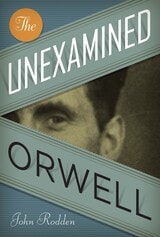
The Unexamined Orwell
By John Rodden
University of Texas Press, 2011
The year 1984 is just a memory, but the catchwords of George Orwell's novel Nineteen Eighty-Four still routinely pepper public discussions of topics ranging from government surveillance and privacy invasion to language corruption and bureaucratese. Orwell's work pervades the cultural imagination, while others of his literary generation are long forgotten. Exploring this astonishing afterlife has become the scholarly vocation of John Rodden, who is now the leading authority on the reception, impact, and reinvention of George Orwell—the man and writer—as well as of "Orwell" the cultural icon and historical talisman.
In The Unexamined Orwell, Rodden delves into dimensions of Orwell's life and legacy that have escaped the critical glare. Rodden discusses how several leading American intellectuals have earned the title of Orwell's "successor," including Lionel Trilling, Dwight Macdonald, Irving Howe, Christopher Hitchens, and John Lukacs. He then turns to Germany and focuses on the role and relevance of Nineteen Eighty-Four in the now-defunct communist nation of East Germany. Rodden also addresses myths that have grown up around Orwell's life, including his "more than half-legendary" encounter with Ernest Hemingway in liberated Paris in March 1945, and analyzes literary issues such as his utopian sensibility and his prose style. Finally, Rodden poses the endlessly debated question, "What Would George Orwell Do?," and speculates about how the prophet of Nineteen Eighty-Four would have reacted to world events. In so doing, Rodden shows how our responses to this question reveal much about our culture's ongoing need to reappropriate "Orwell."
The Unremarkable Wordsworth
Geoffrey H. HartmanForeword by Donald G. Marshall
University of Minnesota Press, 1987
The Unremarkable Wordsworth was first published in 1987. Minnesota Archive Editions uses digital technology to make long-unavailable books once again accessible, and are published unaltered from the original University of Minnesota Press editions.
William Wordsworth was attacked by the critics of his time for imposing unremarkable sights and sentiments on his audience. In this book's title essay, an exemplary reading of the Westminster Bridge sonnet, Geoffrey Hartman shows how Wordsworth's "unremarkable phrases" attain their curious vigor. Drawing upon the propositions of semiological analysis—that signs are not signs unless they become perceptible, through the contrast between "marked" and "unmarked"—Hartman, in a deft and sensitive analysis, is able to play these notions of marking and the unremarkable off against each other. Wordsworth, in the end, overcomes both his critics and the science of signs: his quiet sonnet—with its muted or near-absent signs—is itself, as epitaph for an era, a faithful sign of the times.
Hartman's capacity to open up a dialogue between contemporary theory and Wordsworth's poetry informs all of these essays, written since the 1964 publication of Wordsworth's Poetry, a book that marked an epoch in the study of that poet and of Romantic poetry in general. In the years since then, the nature of literary study has changed dramatically, and Hartman has been a leader in the turn to theoretical modes of interpretation. The fifteen essays in The Unremarkable Wordsworth draw upon a wide range of contemporary theoretical approaches, from psychoanalysis to structuralism, from deconstruction to phenomenology. Yet, as Donald Marshall points out in his foreword, "Wordsworth remains so much the focus of this book that 'critical method' is strangely transmuted." For Hartman, reading and thinking are inseparable; he has an uncanny power to convey in an intensified form the poet's own consciousness, not under the rubric of "intertextuality" but because he "has ears to hear."
Geoffrey H. Hartman is Karl Young Professor of English and Comparative Literature at Yale University. His most recent book is Easy Pieces. Donald G. Marshall is a professor of English at the University of Iowa.
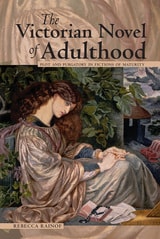
The Victorian Novel of Adulthood
Plot and Purgatory in Fictions of MaturityRebecca Rainof
Ohio University Press, 2015
In The Victorian Novel of Adulthood, Rebecca Rainof confronts the conventional deference accorded the bildungsroman as the ultimate plot model and quintessential expression of Victorian nation building. The novel of maturity, she contends, is no less important to our understanding of narrative, Victorian culture, and the possibilities of fiction.
Reading works by Charles Dickens, George Eliot, Henry James, John Henry Newman, and Virginia Woolf, Rainof exposes the little-discussed theological underpinnings of plot and situates the novel of maturity in intellectual and religious history, notably the Oxford Movement. Purgatory, a subject hotly debated in the period, becomes a guiding metaphor for midlife adventure in secular fiction. Rainof discusses theological models of gradual maturation, thus directing readers’ attention away from evolutionary theory and geology, and offers a new historical framework for understanding Victorian interest in slow and deliberate change.
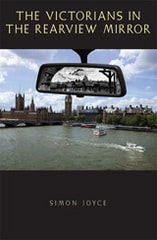
The Victorians in the Rearview Mirror
Simon Joyce
Ohio University Press, 2007
When Margaret Thatcher called in 1979 for a return to Victorian values such as hard work, self-reliance, thrift, and national pride, Labour Party leader Neil Kinnock responded that “Victorian values” also included “cruelty, misery, drudgery, squalor, and ignorance.”
The Victorians in the Rearview Mirror is an in-depth look at the ways that the twentieth century reacted to and reimagined its predecessor. It considers how the Victorian inheritance has been represented in literature, politics, film, and visual culture; the ways in which modernists and progressives have sought to differentiate themselves from an image of the Victorian; and how conservatives (and some liberals) have sought to revive elements of nineteenth-century life. Nostalgic and critical impulses combine to fix an understanding of the Victorians in the popular imagination.
Simon Joyce examines heritage culture, contemporary politics, and the “neo-Dickensian” novel to offer a more affirmative assessment of the Victorian legacy, one that lets us imagine a model of social interconnection and interdependence that has come under threat in today’s politics and culture.
Although more than one hundred years have passed since the death of Queen Victoria, the impact of her time is still fresh. The Victorians in the Rearview Mirror speaks to diverse audiences in literary and cultural studies, in addition to those interested in visual culture and contemporary politics, and situates detailed close readings of literary and cinematic texts in the context of a larger argument about the legacies of an era not as distant as we might like to think.
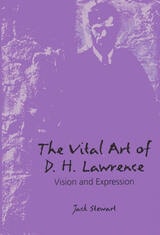
The Vital Art of D.H. Lawrence
Vision and ExpressionJack Stewart
Southern Illinois University Press, 1999
D. H. Lawrence, asserts Jack Stewart, expresses a painter’s vision in words, supplementing visual images with verbal rhythms. With the help of twenty-three illustrations, Stewart examines Lawrence’s painterly vision in The White Peacock, Sons and Lovers, The Rainbow, Women in Love, Kangaroo, and The Plumed Serpent. He concludes by synthesizing the themes that pervade this interarts study: vision and expression, art and ontology.
The Voice of Toil
Nineteenth-Century British Writings about WorkDavid J. Bradshaw
Ohio University Press, 1999
One of the most recurrent and controversial subjects of nineteenth–century discourse was work. Many thinkers associated work with honest pursuit of doing good, not the curse accompanying exile from Eden but rather “a great gift of God.” Sincerely undertaken work comprised a mission entailing a commitment to serve others and promote a better future for all.
Satisfaction with what work could do for individuals had its counterbalance in the anger and dismay expressed at the conditions of those whom Robert Owen, in 1817, first called the “working class.” What working–class people confronted both at the labor site and at their lodgings was construed as oppressive, and the misery of their lives became the subject of sentimental poetry, government report, popular fiction, and journalistic expose. Perhaps as heated as the discussion about conditions of lower–class workers was the conversation about separate spheres of work for men and women. This conversation, too, found its way into the literature and public discourse of the day.
In The Voice of Toil, the editors have collected the central writings from a pivotal place and time, including poems, stories, essays, and a play that reflect four prominent ways in which the subject of work was addressed: Work as Mission, Work as Opportunity, Work as Oppression, and (Separate) Spheres of Work. The resulting anthology offers a provocative text for students of nineteenth-century British literature and history and a valuable resource for scholars.
The text includes readings from John Wesley, William Blake, Elizabeth Gaskell, William Wordsworth, Charles Dickens, Florence Nightingale, William Morris, Joanna Baillie, Friedrich Engels, Matthew Arnold, Angela Burdett–Coutts, John Stuart Mill, Elizabeth Barrett Browning, Bernard Shaw and many others.
The Weight of a World of Feeling
Reviews and Essays by Elizabeth BowenElizabeth Bowen / Edited and with an introduction by Allan Hepburn
Northwestern University Press, 2017
This fascinating collection of reviews is filled with first impressions of novels, autobiographies, memoirs, illustrated books, biographies of politicians and artists, short story collections, and literary criticism. Books spark statements from Bowen about general principles of fictional technique; she articulates her understanding of the inner workings of fiction incidentally, while providing an opinion about the book at hand. In this volume, Hepburn draws together all the reviews that Bowen left uncollected in her non-fiction collections, as well as several more familiar essays that that she published in The Tatler, in order to make them accessible to a broader audience.
The Well-Tun’d Word
Musical Interpretations of English Poetry, 1597-1651Elise Bickford Jorgens
University of Minnesota Press, 1982
The Well-Tun'd Word was first published in 1982. Minnesota Archive Editions uses digital technology to make long-unavailable books once again accessible, and are published unaltered from the original University of Minnesota Press editions.
The years 1957–1651 marked a period of high achievement in the history of song. In The Well-Tun'd Word Elise Bickford Jorgens studies changing musical conventions of English song in relation to new patterns in poetic taste from the late Elizabethan era through the Jacobean and Caroline years, basing her work on the premise that any musical setting of a poem is an interpretation of the poem itself. Thus by 1625, she contends, solo song in England had undergone a pronounced change in musical style, from the lute song of earlier decades to the monophonic continuo song. The appearance of John Donne and especially Ben Johnson and the Cavalier poets marked the demise of the Elizabethan lyrical mode that had inspired composers like John Downland, Thomas Campion, John Danyel, and Robert Jones.
Jorgen's opening chapters describe and illustrate elements of the craft of poetry and the musical conventions that can represent them. Her presentation is both clear and thorough, and will be especially helpful for students and scholars of English literature who are not necessarily musicians. She then discusses four major categories of song: Measured Music, Dance Songs and Tuneful Airs, English Monody, and Pathetic Airs, and notes that influence upon them of Continental music styles. But her major effort is to distinguish between them by pointing out their several characteristic attitudes towards the musical representation of poetic texts. All four groups show patterns of change during the first half of the seventeenth century.
Jorgens concludes that the celebrated union of the "sister arts" for which Elizabethan song was renowned was increasingly difficult to maintain after about 1610. Poets no longer favored those elements of poetic style that could in turn produce pleasing musical styles. Solo songs became, with continuo composers like Henry and William Lawes, Nicholas Lanier, and John Wilson, either notated recitations of poetry or simple pleasant trifles.
The Wild Girl, Natural Man, and the Monster
Dangerous Experiments in the Age of EnlightenmentJulia V. Douthwaite
University of Chicago Press, 2002
A variety of educational experiments failed to tame these feral children by the standards of the day. After telling their stories, Douthwaite turns to literature that reflects on similar experiments to perfect human subjects. Her examples range from utopian schemes for progressive childrearing to philosophical tales of animated statues, from revolutionary theories of regenerated men to Gothic tales of scientists run amok. Encompassing thinkers such as Rousseau, Sade, Defoe, and Mary Shelley, Douthwaite shows how the Enlightenment conceived of mankind as an infinitely malleable entity, first with optimism, then with apprehension. Exposing the darker side of eighteenth-century thought, she demonstrates how advances in science gave rise to troubling ethical concerns, as parents, scientists, and politicians tried to perfect mankind with disastrous results.
The Woman Painter in Victorian Literature
Antonia Losano
The Ohio State University Press, 2008
The nineteenth century saw a marked rise both in the sheer numbers of women active in visual art professions and in the discursive concern for the woman artist in fiction, the periodical press, art history, and politics. The Woman Painter in Victorian Literature argues that Victorian women writers used the controversial figure of the woman painter to intervene in the discourse of aesthetics. These writers were able to assert their own status as artistic producers through the representation of female visual artists.
Women painters posed a threat to the traditional heterosexual erotic art scenarios—a male artist and a male viewer admiring a woman or feminized art object. Antonia Losano traces an actual movement in history in which women writers struggled to rewrite the relations of gender and art to make a space for female artistic production. She examines as well the disruption female artists caused in the socioeconomic sphere. Losano offers close readings of a wide array of Victorian writers, particularly those works classified as noncanonical—by Anne Thackeray Ritchie, Margaret Oliphant, Anne Brontë, and Mrs. Humphrey Ward—and a new look at better-known novels such as Jane Eyre and Daniel Deronda, focusing on the pivotal social and aesthetic meanings of female artistic production in these texts. Each of the novels considered here is viewed as a contained, coherent, and complex aesthetic treatise that coalesces around the figure of the female painter.
The World of Elizabeth Inchbald
Essays on Literature, Culture, and Theatre in the Long Eighteenth CenturyDaniel J. Ennis
University of Delaware Press, 2022