Results by title
2706 books match the query 'European' and 622 start with t
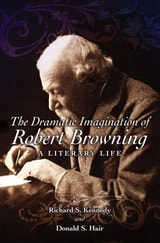
The Dramatic Imagination of Robert Browning
A Literary LifeRichard S. Kennedy & Donald S. Hair
University of Missouri Press, 2007
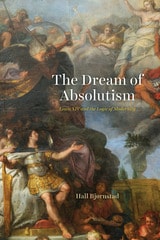
The Dream of Absolutism
Louis XIV and the Logic of ModernityHall Bjørnstad
University of Chicago Press, 2021
What was absolutism, and how did it work? What was the function of the ostentatious display surrounding Louis XIV at Versailles? What is gained—and what is lost—by approaching such expressions of absolutism as propaganda, as present-day scholars tend to do?
In this sweeping reconsideration of absolutist culture, Hall Bjørnstad argues that the exuberance of Louis XIV’s reign was not top-down propaganda in any modern sense, but rather a dream dreamt collectively, by king, court, image-makers, and nation alike. Bjørnstad explores this dream through a sustained close analysis of a corpus of absolutist artifacts, ranging from Charles Le Brun’s famous paintings in the Hall of Mirrors at Versailles via the king’s secret Mémoires to two little-known particularly extravagant verbal and textual celebrations of the king. The dream of absolutism, Bjørnstad concludes, lives at the intersection of politics and aesthetics. It is the carrier of a force that emerges as a glorious image; a participatory emotional reality that requires reality to conform to it. It is a dream, finally, that still shapes our collective political imaginary today.
The Duchess of Suffolk
Thomas Drue. Edited and with an Introduction by Richard Dutton and Steven K. Galbraith
The Ohio State University Press, 2015
With this volume, Dutton and Galbraith provide a critical apparatus that situates The Duchess of Suffolk in historical context and suggests an explanation for its continued resonance. They account for the play’s censorship in 1624 by detailing how it evoked contemporary parallels to the controversial foreign policy of King James I. More specifically, the editors offer an introduction that includes a historical overview of the author, staging, printing, and reception. Facing facsimiles of the original are pages with the updated text, complete with annotations to clarify language and staging details. This edition of The Duchess of Suffolk will have something to offer to early modern drama scholars as well as scholars of book history.
The Dynastic Imagination
Family and Modernity in Nineteenth-Century GermanyAdrian Daub
University of Chicago Press, 2021
Daub builds this conception of dynasty in a syncretic study of literature, sciences, and the history of ideas, engaging with remnants of dynastic ideology in the work of Richard Wagner, Émile Zola, and Stefan George, and in the work of early feminists and pioneering psychoanalysts. At every stage of cultural progression, Daub reveals how the relation of dynastic to nuclear families inflected modern intellectual history.
The Early Novel in French
Poetics of a Genre in the MakingVirginia Krause
Northwestern University Press, 2027
Examining the role of changes in print technologies and poetics in the early novel
Around the same time that Aristotle’s Poetics was reemerging from obscurity, Rabelais was composing his Pantagruel series, while a host of influential works in a chivalric, sentimental, or pastoral vein were being imported from Spain and Italy. From this emergent corpus, Rabelais’s is the only name to have unambiguously made it into our modern canon of literary history, where he appears to stand alone as an early pioneer of the novel. The Early Novel in French: Poetics of a Genre in the Making explores the literary, cultural, and eminently material soil in which these early forms of what we would come to know as the novel originally took root, showing how they were imaginatively responding to the practices and uncertainties of the literary texts of their own era as well as to works of classical antiquity.
Within the flowering of experimental fictional forms in mid-sixteenth-century France, Virginia Krause identifies historical subplots shaping the development of this genre. As rhetorical culture continued to animate fictions through an active literary tradition, print culture was changing the very fabric of books. The early novel was thus at once rhetorically fashioned and technologically manufactured. Meanwhile, the legacy of medieval romance adventure persisted, making the early novel in French both a new laboratory for Aristotelian immersion and a vehicle for a mysterious and fugitive romanesque. Krause sheds fresh light on this new and rapidly evolving genre: its lifelike personas or “person-fictions”; its material forms, from pocket-sized volumes to vast literary serials; its immersive powers; and its underappreciated role in the production of the modern author.
The Early Poetry of Robert Graves
The Goddess BeckonsBy Frank L. Kersnowski
University of Texas Press, 2002
Like many men of his generation, poet Robert Graves was indelibly marked by his experience of trench warfare in World War I. The horrific battles in which he fought and his guilt over surviving when so many perished left Graves shell-shocked and disoriented, desperately seeking a way to bridge the rupture between his conventional upbringing and the uncertainties of postwar British society.
In this study of Graves's early poetry, Frank Kersnowski explores how his war neurosis opened a door into the unconscious for Graves and led him to reject the essential components of the Western idea of reality—reason and predictability. In particular, Kersnowski traces the emergence in Graves's early poems of a figure he later called "The White Goddess," a being at once terrifying and glorious, who sustains life and inspires poetry. Drawing on interviews with Graves's family, as well as unpublished correspondence and drafts of poems, Kersnowski argues that Graves actually experienced the White Goddess as a real being and that his life as a poet was driven by the purpose of celebrating and explaining this deity and her matriarchy.
The Economy of Glory
From Ancien Régime France to the Fall of NapoleonRobert Morrissey
University of Chicago Press, 2013
The Egyptian Renaissance
The Afterlife of Ancient Egypt in Early Modern ItalyBrian Curran
University of Chicago Press, 2007
Fascination with ancient Egypt is a recurring theme in Western culture, and here Brian Curran uncovers its deep roots in the Italian Renaissance, which embraced not only classical art and literature but also a variety of other cultures that modern readers don’t tend to associate with early modern Italy. Patrons, artists, and spectators of the period were particularly drawn, Curran shows, to Egyptian antiquity and its artifacts, many of which found their way to Italy in Roman times and exerted an influence every bit as powerful as that of their more familiar Greek and Roman counterparts.
Curran vividly recreates this first wave of European Egyptomania with insightful interpretations of the period’s artistic and literary works. In doing so, he paints a colorful picture of a time in which early moderns made the first efforts to decipher Egyptian hieroglyphs, and popes and princes erected pyramids and other Egyptianate marvels to commemorate their own authority. Demonstrating that the emergence of ancient Egypt as a distinct category of historical knowledge was one of Renaissance humanism’s great accomplishments, Curran’s peerless study will be required reading for Renaissance scholars and anyone interested in the treasures and legacy of ancient Egypt.
The Elsewhere
On Belonging at a Near DistanceAdam Zachary Newton
University of Wisconsin Press, 2005
The Emergence of the Classical Style in Greek Sculpture
Richard Neer
University of Chicago Press, 2010
The Empire Inside
Indian Commodities in Victorian Domestic NovelsSuzanne Daly
University of Michigan Press, 2011
"The Empire Inside is unique in its tight focus on the objects from one geographical location, and their deployment in one genre of fiction. This combination results in a powerful study with a wealth of fine formal analyses of literary texts and a similar trove of marvelous historical data."
---Elaine Freedgood, New York University
"In The Empire Inside, Suzanne Daly does a wonderful job integrating an array of primary materials, especially novels and journal essays, to show the extent to which these ‘foreign’ colonial products of India represented absolutely central aspects of domestic life, at once part of the unremarkable everyday experience of Victorians and rich with meanings."
---Timothy Carens, College of Charleston
By the early nineteenth century, imperial commodities had become commonplace in middle-class English homes. Such Indian goods as tea, textiles, and gemstones led double lives, functioning at once as exotic foreign artifacts and as markers of proper Englishness. The Empire Inside: Indian Commodities in Victorian Domestic Novels reveals how Indian imports encapsulated new ideas about both the home and the world in Victorian literature and culture. In novels by Charlotte Brontë, Charles Dickens, and Anthony Trollope, the regularity with which Indian commodities appear bespeaks their burgeoning importance both ideologically and commercially. Such domestic details as the drinking of tea and the giving of shawls as gifts point us toward suppressed connections between the feminized realm of private life and the militarized realm of foreign commerce.
Tracing the history of Indian imports yields a record of the struggles for territory and political power that marked the coming-into-being of British India; reading the novels of the period for the ways in which they infuse meaning into these imports demonstrates how imperialism was written into the fabric of everyday life in nineteenth-century England. Situated at the intersection of Victorian studies, material cultural studies, gender studies, and British Empire studies, The Empire Inside is written for academics, graduate students, and advanced undergraduates in all of these fields.
Suzanne Daly is Associate Professor of English, University of Massachusetts Amherst.
The Enduring Work of Biography
James Boswell’s Life of Johnson, 1791–2020Greg Clingham
University of Delaware Press, 2026
The Enduring Work of Biography seeks to revitalize appreciation of Boswell’s great biography for a new generation of scholars, students, and general readers. Engaging accessibly and informatively with biographical, historical, critical, and textual matters and drawing on the Yale Edition of the Private Papers of James Boswell, Enduring Work discusses Boswell’s collaboration with others (both alive and dead) in researching, writing, revising, proofing, publishing, and promoting his biography of Johnson. Central to Boswell’s concept of life writing is memory, and Enduring Work highlights both its dynamic and collaborative force in the Life of Johnson. This collection is book-ended by an introduction that considers the critical reception of the Life of Johnson and an epilogue that suggests its continuing critical insight and relevance. A closing chapter and two appendixes survey the history of the Life of Johnson as a best-selling book for over two centuries, an extraordinary collaboration between readers and publishers and between Boswell and Johnson themselves that is still evolving.
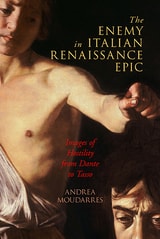
The Enemy in Italian Renaissance Epic
Images of Hostility from Dante to TassoAndrea Moudarres
University of Delaware Press, 2019
Published by University of Delaware Press. Distributed worldwide by Rutgers University Press.
The English Novel in the Magazines, 1740-1815
Robert D. Mayo
Northwestern University Press, 1962
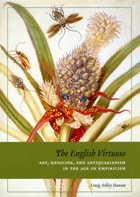
The English Virtuoso
Art, Medicine, and Antiquarianism in the Age of EmpiricismCraig Ashley Hanson
University of Chicago Press, 2009
At the heart of this profoundly interdisciplinary study lies the Royal Society of London for the Improvement of Natural Knowledge, which from its founding in 1660 served as the major professional organization for London’s leading physicians, many of them prominent virtuosi. Craig Ashley Hanson reveals that a vital art audience emerged from the Royal Society—whose members assembled many of the period’s most important nonaristocratic collections—a century before most accounts date the establishment of an institutional base for the arts in England. Unearthing the fascinating stories of an impressive cast of characters, Hanson establishes a new foundation for understanding both the relationship between British art and science and the artistic accomplishments of the late eighteenth and nineteenth centuries.
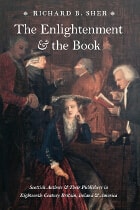
The Enlightenment and the Book
Scottish Authors and Their Publishers in Eighteenth-Century Britain, Ireland, and AmericaRichard B. Sher
University of Chicago Press, 2007
The late eighteenth century witnessed an explosion of intellectual activity in Scotland by such luminaries as David Hume, Adam Smith, Hugh Blair, William Robertson, Adam Ferguson, James Boswell, and Robert Burns. And the books written by these seminal thinkers made a significant mark during their time in almost every field of polite literature and higher learning throughout Britain, Europe, and the Americas.
In this magisterial history, Richard B. Sher breaks new ground for our understanding of the Enlightenment and the forgotten role of publishing during that period. The Enlightenment and the Book seeks to remedy the common misperception that such classics as The Wealth of Nations and The Life of Samuel Johnson were written by authors who eyed their publishers as minor functionaries in their profession. To the contrary, Sher shows how the process of bookmaking during the late eighteenth-century involved a deeply complex partnership between authors and their publishers, one in which writers saw the book industry not only as pivotal in the dissemination of their ideas, but also as crucial to their dreams of fame and monetary gain. Similarly, Sher demonstrates that publishers were involved in the project of bookmaking in order to advance human knowledge as well as to accumulate profits.
The Enlightenment and the Book explores this tension between creativity and commerce that still exists in scholarly publishing today. Lavishly illustrated and elegantly conceived, it will be must reading for anyone interested in the history of the book or the production and diffusion of Enlightenment thought.
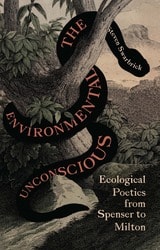
The Environmental Unconscious
Ecological Poetics from Spenser to MiltonSteven Swarbrick
University of Minnesota Press, 2023
Bringing psychoanalysis to bear on the diagnosis of ecological crisis
Why has psychoanalysis long been kept at the margins of environmental criticism despite the many theories of eco-Marxism, queer ecology, and eco-deconstruction available today? What is unique, possibly even traumatic, about eco-psychoanalysis? The Environmental Unconscious addresses these questions as it provides an innovative and theoretical account of environmental loss focused on the counterintuitive forms of enjoyment that early modern poetry and psychoanalysis jointly theorize.
Steven Swarbrick urges literary critics and environmental scholars fluent in the new materialism to rethink notions of entanglement, animacy, and consciousness raising. He introduces concepts from psychoanalysis as keys to understanding the force of early modern ecopoetics. Through close readings of Edmund Spenser, Walter Ralegh, Andrew Marvell, and John Milton, he reveals a world of matter that is not merely hyperconnected, as in the new materialism, but porous and off-kilter. And yet the loss these poets reveal is central to the enjoyment their works offer—and that nature offers.
As insightful as it is engaging, The Environmental Unconscious offers a provocative challenge to ecocriticism that, under the current regime of fossil capitalism in which everything solid interconnects, a new theory of disconnection is desperately needed. Tracing the propulsive force of the environmental unconscious from the early modern period to Freudian and post-Freudian theories of desire, Swarbrick not only puts nature on the couch in this book but also renews the psychoanalytic toolkit in light of environmental collapse.
The Epic Catalogue
List Form and Reception from Beowulf to Paradise LostEva von Contzen
The Ohio State University Press, 2026
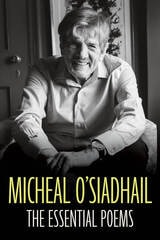
The Essential Poems
Micheal O'Siadhail
Northwestern University Press, 2026
The essential selected works of Ireland’s leading poet, Micheal O’Siadhail
With an illustrious literary career that has spanned over fifty years, renowned poet Micheal O’Siadhail has cemented his place on the international stage. From his debut collection, The Leap Year (1978), to his latest collection, Desire (2023), O’Siadhail captures evolving struggles with love, faith, and humanity. Here, spanning the entirety of his outstanding career, is the essence of his masterful body of work.
The Essential Poems voyages through traditional and innovative poetic forms, investigating love and passion, joy and loss, world-shaping events and personal experiences. O’Siadhail sounds the depths of meaning and evokes wonder, surprise, anguish, and delight. A lyrical meditation on the relationships between humanity and nature, despair and faith, and the richness of courage in the acts of healing completes what proves to be this unforgettable and necessary collection of the inimitable Irish poet.
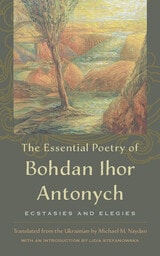
The Essential Poetry of Bohdan Ihor Antonych
Ecstasies and ElegiesBohdan Ihor Antonych (1909-1937)
Bucknell University Press, 2024

The Ethics of Autobiography
Replacing the Subject in Modern SpainAngel G. Loureiro
Vanderbilt University Press, 2000
To address this oversight, Loureiro draws from his own experiences as well as from a wide range of previous theoretical works on autobiography, especially from the writings of Emmanuel Levinas, who believed that the self does not begin as a self-positing consciousness but as a response to an address from the other. On this basis, Loureiro then brilliantly traces the complex interplays between the political, discursive, rhetorical, and ethical dimensions of autobiography.
After laying out these theoretical foundations, Loureiro puts them to work in analyzing four of the most fascinating autobiographies written by Spanish exiles: The Life of Joseph Blanco White, who lived from 1775 to 1841, Memoria de la Melancolia by Maria Teresa Leon (1904-1988), Coto vedado and En los reinos de taifa by Juan Goytisolo (born 1931), and Literature or Life by Jorge Semprun (born 1923). The lives of these authors, all of whom were exiled for political reasons, were disrupted by some of the most crucial events in Spain's tortuous road to modernity and democracy.
The book closes with a discussion of why there have been so few critical examinations of autobiographies written in modern Spain. Loureiro proposes that, even in today's Spain, stifling social and political forces smother ethical responsibility, which is an essential ingredient in creating autobiographies that dare to be more than a humdrum inventory of personal recollections. Only in exile have Spanish authors seemed able to find the conditions to write their lives in a truly responsible manner. This answer to a call that grounds the subject in an other is ultimately the only form of truth available in autobiography.
The Ethics of Persuasion
Derrida's Rhetorical LegaciesBrooke Rollins
The Ohio State University Press, 2020
Drawing on Derrida’s (non)definition of ethics and his pointed accounts of performativity, Rollins argues that this vital ethical component of many ancient theories, practices, and pedagogies of persuasion has been undertheorized for more than two millennia. Through deconstructive readings of some of these texts, she shows us that we are not simply sovereign beings who both wield and guard against linguistic techniques of rule. Our persuasive endeavors, rather, are made possible by an ethics—an always prior encounter with otherness that interrupts self-presence.
The Ethics of Witnessing
The Holocaust in Polish Writers' Diaries from Warsaw, 1939-1945Rachel Feldhay Brenner
Northwestern University Press, 2014
Winner, 2015 USC Book Award in Literary and Cultural Studies, for outstanding monograph published on Russia, Eastern Europe or Eurasia in the fields of literary and cultural studies
The Ethics of Witnessing investigates the reactions of five important Polish diaristswriters—Jaroslaw Iwaszkiewicz, Maria Dabrowska, Aurelia Wylezynska, Zofia Nalkowska, and Stanislaw Rembek—during the period when the Nazis persecuted and murdered Warsaw’s Jewish population. The responses to the Holocaust of these prominent prewar authors extended from insistence on empathic interaction with victims to resentful detachment from Jewish suffering. Whereas some defied the dehumanization of the Jews and endeavored to maintain intersubjective relationships with the victims they attempted to rescue, others selfdeceptively evaded the Jewish plight. The Ethics of Witnessing examines the extent to which ideologies of humanism and nationalism informed the diarists’ perceptions, proposing that the reality of the Final Solution exposed the limits of both orientations and ultimately destroyed the ethical landscape shaped by the Enlightenment tradition, which promised the equality and fellowship of all human beings.
The Ethos of Drama
Rhetorical Theory and Dramatic WorthRobert L. King
Catholic University of America Press, 2010
The European Union and the Rise of Regionalist Parties
Seth K. Jolly
University of Michigan Press, 2015
The Experimental Group
Ilya Kabakov, Moscow Conceptualism, Soviet Avant-GardesMatthew Jesse Jackson
University of Chicago Press, 2010
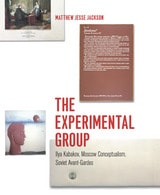
A compelling study of unofficial postwar Soviet art, The Experimental Group takes as its point of departure a subject of strange fascination: the life and work of renowned professional illustrator and conceptual artist Ilya Kabakov.
Kabakov’s art—iconoclastic installations, paintings, illustrations, and texts—delicately experiments with such issues as history, mortality, and disappearance, and here exemplifies a much larger narrative about the work of the artists who rose to prominence just as the Soviet Union began to disintegrate. By placing Kabakov and his conceptualist peers in line with our own contemporary perspective, Matthew Jesse Jackson suggests that the art that emerged in the wake of Stalin belongs neither entirely to its lost communist past nor to a future free from socialist nostalgia. Instead, these artists and their work produced a critical and controversial chapter in the as yet unwritten history of global contemporary art.
The Faithful Virgins
E. Polwhele
Iter Press, 2023
E. Polwhele (c. 1651-c. 1691) was one of the first women to write for the stage in Restoration London. This book presents the first printed edition of Polwhele’s first play, The Faithful Virgins, which until now has existed only in an unsigned manuscript in the Bodleian Library at Oxford University. A tragicomedy apparently performed in London by the Duke's Company ca. 1669–1671, The Faithful Virgins is altogether different in tone from Polwhele's later, better-known prose comedy, The Frolicks; or, The Lawyer Cheated (1671). The introduction to this modern-spelling edition of The Faithful Virgins discusses the play in terms of radical changes in English stage practices following the restoration of the monarchy after England’s civil war and situates Polwhele’s play within the social and political life of seventeenth-century London.
The Fake Husband, A Comedy
Flaminio Scala
Iter Press, 2020
The Other Voice in Early Modern Europe - The Toronto Series, volume 75
The Family Idiot
Gustave Flaubert, 1821-1857, Volume 2Jean-Paul Sartre
University of Chicago Press, 1987
Volume 2, consisting of the first book of part 2 of the original French work, takes the reader through Flaubert's adolescence well into his evolution as an artist. Sartre's approach to his complex subject, whether jaunty or ponderous, psychoanalytical or political, is captured in all of its rich variety of Carol Cosman's translation.
The Family Idiot
Gustave Flaubert, 1821-1857, Volume 3Jean-Paul Sartre
University of Chicago Press, 1989
Volume 3 consists of "School Years" and "Preneurosis," which are the second and third books of part 2 of the original French work. In vivid detail, Sartre renders Flaubert's secondary-school experiences and relationships: his part in a student rebellion against the faculty, his teenage infatuation with Romantic literature, his friendships and rivalries with his classmates, and the ironies inherent in the schoolboys' bourgeois existence. Sartre then discusses Flaubert's years at law school, where he studied at his father's insistence. This volume also contains Sartre's most sustained analysis of Madame Bovary. Sartre's approach to his complex subject, whether jaunty or judicious, psychoanalytical or political, is captured in all of its rich variety in Carol Cosman's translation.
The Family Idiot
Gustave Flaubert, 1821-1857, Volume 4Jean-Paul Sartre
University of Chicago Press, 1991
Volume 4 consists of part three, books one and two, of the original French work. This volume, the fourth in a projected five-volume English-language edition, includes Sartre's discussion of the onset of Flaubert's illness, or neurosis, in 1844, and a significant reading of his L'Education sentimentale.
Sartre's approach to his complex subject, whether jaunty or judicious, psychoanalytic or political, is captured in all of its rich variety in Carol Cosman's translation.
The Family Idiot
Gustave Flaubert, 1821-1857, Volume 5Jean-Paul Sartre
University of Chicago Press, 1993
That Sartre's study of Flaubert, The Family Idiot, is a towering achievement in intellectual history has never been disputed. Yet critics have argued about the precise nature of this novel or biography or "criticism-fiction" which is the summation of Sartre's philosophical, social, and literary thought. In the preface, Sartre writes: "The Family Idiot is the sequel to Search for a Method. The subject: what, at this point in time, can we know about a man? It seemed to me that this question could only be answered by studying a specific case."
Sartre discusses Flaubert's personal development, his relationship to his family, his decision to become a writer, and the psychosomatic crisis or "conversion" from his father's domination to the freedom of his art. Sartre blends psychoanalysis with a sociological study of the ideology of the period, the crisis in literature, and Flaubert's influence on the future of literature.
While Sartre never wrote the final volume he envisioned for this vast project, the existing volumes constitute in themselves a unified work—one that John Sturrock, writing in the Observer, called "a shatteringly fertile, digressive and ruthless interpretation of these few cardinal years in Flaubert's life."
"A virtuoso perfomance. . . . For all that this book does to make one reconsider his life, The Family Idiot is less a case study of Flaubert than it is a final installment of Sartre's mythology. . . . The translator, Carol Cosman, has acquitted herself brilliantly."—Frederick Brown, New York Review of Books
"A splendid translation by Carol Cosman. . . . Sartre called The Family Idiot a 'true novel,' and it does tell a story and eventually reach a shattering climax. The work can be described most simply as a dialectic, which shifts between two seemingly alternative interpretations of Flaubert's destiny: a psychoanalytic one, centered on his family and on his childhood, and a Marxist one, whose guiding themes are the status of the artist in Flaubert's period and the historical and ideological contradictions faced by his social class, the bourgeoisie."—Fredric Jameson, New York Times Book Review
Jean-Paul Sartre (1906-1980) was offered, but declined, the Nobel Prize for literature in 1964. His many works of fiction, drama, and philosophy include the monumental study of Flaubert, The Family Idiot, and The Freud Scenario, both published in translation by the University of Chicago Press.
The Family Idiot
Gustave Flaubert, 1821–1857, An Abridged EditionJean-Paul Sartre
University of Chicago Press, 2023
From 1981 to 1994, the University of Chicago Press published a five-volume translation of Jean-Paul Sartre’s The Family Idiot: Gustave Flaubert, 1821-1857, a sprawling masterwork by one of the greatest intellects of the twentieth century. This new volume delivers a compact abridgment of the original by renowned Sartre scholar, Joseph Catalano.
Sartre claimed that his existential approach to psychoanalysis required a new Freud, and in his study of Gustave Flaubert, Sartre becomes that Freud. The work summarizes Sartre’s overarching aim to reveal that human life is a meaningful adventure of freedom. In discussing Flaubert’s work, particularly his classic novel Madame Bovary, Sartre unleashes a fierce critique of modernity as nihilistic and demeaning of human dignity.
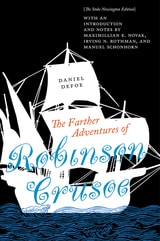
The Farther Adventures of Robinson Crusoe
The Stoke Newington EditionMaximillian E. Novak
Bucknell University Press, 2022
Published by Bucknell University Press. Distributed worldwide by Rutgers University Press.

The Fate of the Self
German Writers and French TheoryStanley Corngold
Duke University Press, 1994
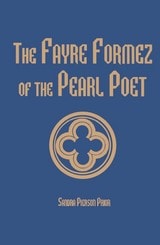
The Fayre Formez of the Pearl Poet
Sandra Pierson Prior
Michigan State University Press, 1996
This book differs from most previous studies of the Pearl poet by treating all of his works as a whole. Prior’s purpose is to identify the underlying poetics of this major body of English poetry. Drawing on both the visual imagery of medieval art (the study includes 18 full-page illustrations) and the verbal imagery of the Bible and other literary sources, Prior shows how the poet’s "fayre formez" are the result of a coherent and self-conscious view of the artist’s craft.
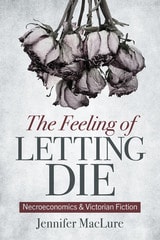
The Feeling of Letting Die
Necroeconomics and Victorian FictionJennifer MacLure
The Ohio State University Press, 2023
In The Feeling of Letting Die, Jennifer MacLure explores how Victorian novels depict the feelings that both fuel and are produced by an economic system that lets some people die in service of the free market. MacLure argues that Victorian authors present capitalism’s death function as a sticking point, a series of contradictions, and a problem to solve as characters grapple with systems that allow, demand, and cause the deaths of their less fortunate fellows.
Utilizing Achille Mbembe’s theorization of necropolitics, MacLure uses the term “necroeconomics,” positioning Victorian authors—even those who were deeply committed to liberal capitalism—as hyperaware of capitalism’s death function. Examining both canonical and lesser-known works by Elizabeth Gaskell, Harriet Martineau, Charles Dickens, William Morris, and George Eliot, The Feeling of Letting Die shows capitalism as not straightforwardly imposed via economic policy but instead as a system functioning through the emotions and desires of the human beings who enact it. In doing so, MacLure reveals how emotion functions as both the legitimating epistemic mode of capitalism and its most salient threat.
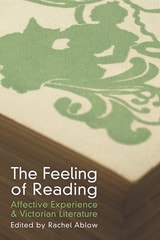
The Feeling of Reading
Affective Experience and Victorian LiteratureEdited by Rachel Ablow
University of Michigan Press, 2010
"A terrifically engaging collection of essays, which exemplifies the very best recent work in the history of reading and affect. The distinguished contributors explore ‘the feeling of reading' throughout Victorian literature, showing how a broad range of works---novels, lyrics, critical essays---not only represent but also analyze and evoke the surprisingly varied experience of immersing oneself in a book. It's rare to encounter a collection of such consistently high quality: the feeling of reading it is one of rich and manifold pleasure."
---James Eli Adams, Columbia University
"This gathering of state-of-the-art work generates a convincing and compelling vision of the emerging state of the field."
---Daniel Hack, University of Michigan
The Feeling of Reading is the first collection to address how we think of reading today through a focus on Victorian reading practices and the individual experience of reading in the nineteenth century. It brings together essays from some of the most established writers in the field with contributions from younger scholars to provide new ways of thinking about this definitive moment. The collection moves from the general to the particular: from excavations of the material and intellectual conditions of Victorian reading to the consequences of such excavations in readings of individual texts. All of the contributors engage the crucial critical question of the shaping of readerly feeling. In addition, they address a set of interlocking issues central to understanding Victorian reading: Kate Flint explores the material and social settings of reading; Nicholas Dames and Leah Price consider the concrete realities of books and periodicals; and the consequences of the mass circulation of texts are explored by Flint, John Plotz, and Rachel Ablow. The temporality of consumption appears in the contribution of Dames as well as those of Catherine Robson and Herbert F. Tucker, who also address the implications of meter; and Ablow, Plotz, Stephen Arata, and Garrett Stewart investigate the notion of identification.
Rachel Ablow is Associate Professor at the University at Buffalo, State University of New York.
Cover design and art by Julian Montague

The Fevered Novel from Balzac to Bernanos
Frenetic Catholicism in Crisis, Delirium and RevolutionFrancesco Manzini
University of London Press, 2010
The Fin-de-Siècle Poem
English Literary Culture and the 1890sJoseph Bristow
Ohio University Press, 2005
The Flowers of Tarbes
or, Terror in LiteratureJean Paulhan
University of Illinois Press, 2005
The Forces of Form in German Modernism
Malika Maskarinec
Northwestern University Press, 2018
Considering canonical artists such as Rodin and Klee, seminal authors such as Kafka and Döblin, and largely neglected thinkers in aesthetics and art history such as those associated with Empathy Aesthetics, Maskarinec unpacks the manifold anthropological and aesthetic concerns and historical lineage embedded in the idea of form as the precarious achievement of uprightness.
The Forces of Form in German Modernism makes a decisive contribution to our understanding of modernism and to contemporary discussions about form, empathy, materiality, and human embodiment.

The Frankenstein of 1790 and Other Lost Chapters from Revolutionary France
Julia V. Douthwaite
University of Chicago Press, 2012
The French Atlantic Triangle
Literature and Culture of the Slave TradeChristopher L. Miller
Duke University Press, 2008
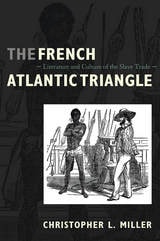
Miller offers a historical introduction to the cultural and economic dynamics of the French slave trade, and he shows how Enlightenment thinkers such as Montesquieu and Voltaire mused about the enslavement of Africans, while Rousseau ignored it. He follows the twists and turns of attitude regarding the slave trade through the works of late-eighteenth- and early-nineteenth-century French writers, including Olympe de Gouges, Madame de Staël, Madame de Duras, Prosper Mérimée, and Eugène Sue. For these authors, the slave trade was variously an object of sentiment, a moral conundrum, or an entertaining high-seas “adventure.” Turning to twentieth-century literature and film, Miller describes how artists from Africa and the Caribbean—including the writers Aimé Césaire, Maryse Condé, and Edouard Glissant, and the filmmakers Ousmane Sembene, Guy Deslauriers, and Roger Gnoan M’Bala—have confronted the aftermath of France’s slave trade, attempting to bridge the gaps between silence and disclosure, forgetfulness and memory.
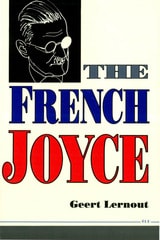
The French Joyce
Geert Lernout
University of Michigan Press, 1992
The French Writers' War, 1940-1953
Gisèle Sapiro
Duke University Press, 2014
The Fulfillment of the Scriptures
Abraham, Moses, and PiersRuth W. Ames
Northwestern University Press, 1970
The Future of Germanistik in the USA
Changing Our ProspectsJohn A. McCarthy
Vanderbilt University Press, 1996
The Gallant Spaniard
Miguel de Cervantes; Translated by Philip Krummrich
Vanderbilt University Press, 2023
This edition, translated by Philip Krummrich, consists of a critical introduction and a full verse translation of the play with notes.
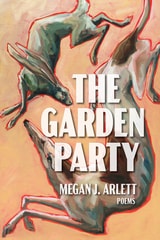
The Garden Party
PoemsMegan J. Arlett
Northwestern University Press, 2027
A stroll through deceptively tranquil spaces and the restlessness of social convention
Depicting the uneasy performance of class and femininity in the stilted, suffocating spaces of a social life suffused with English propriety, Megan J. Arlett’s The Garden Party is a poetic meditation on desire and agency. From the imagined space of the titular garden party to the interior of an art gallery, from the rolling hills of Sussex to Trinidad under British colonial rule, Arlett paints the conventions of polite society as both strange and arbitrary, allowing the restlessness of the poems’ speakers to rise to the surface. Through free verse, received forms, and ekphrasis, these poems stage a conversation with other artists, eras, and art media, moving through natural and constructed locations that are sometimes historical and often imagined. This collection considers what it means to love a place despite its histories and flaws and offers ways of navigating this tension through art. The Garden Party is a striking yet quiet rebellion against order and expectation.