Results by title
775 books match the query 'Germany' and 174 start with t

Theaters of Occupation
Hollywood and the Reeducation of Postwar GermanyJennifer Fay
University of Minnesota Press, 2008
In the aftermath of total war and unconditional surrender, Germans found themselves receiving instruction from their American occupiers. It was not a conventional education. In their effort to transform German national identity and convert a Nazi past into a democratic future, the Americans deployed what they perceived as the most powerful and convincing weapon-movies.
In a rigorous analysis of the American occupation of postwar Germany and the military’s use of “soft power,” Jennifer Fay considers how Hollywood films, including Ninotchka, Gaslight, and Stagecoach, influenced German culture and cinema. In this cinematic pedagogy, dark fantasies of American democracy and its history were unwittingly played out on-screen. Theaters of Occupation reveals how Germans responded to these education efforts and offers new insights about American exceptionalism and virtual democracy at the dawn of the cold war.
Fay’s innovative approach examines the culture of occupation not only as a phase in U.S.–German relations but as a distinct space with its own discrete cultural practices. As the American occupation of Germany has become a paradigm for more recent military operations, Fay argues that we must question its efficacy as a mechanism of cultural and political change.
Jennifer Fay is associate professor and codirector of film studies in the Department of English at Michigan State University.
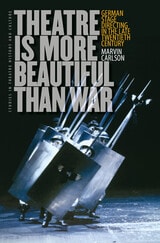
Theatre Is More Beautiful Than War
German Stage Directing in the Late Twentieth CenturyCarlson, Marvin
University of Iowa Press, 2009
In almost every area of production, German theatre of the past forty years has achieved a level of distinction unique in the international community. This flourishing theatrical culture has encouraged a large number of outstanding actors, directors, and designers as well as video and film artists. The dominant figure throughout these years, however, has remained the director. In this stimulating and informative book, noted theatre historian Marvin Carlson presents an in-depth study of the artistic careers, working methods, and most important productions of ten of the leading directors of this great period of German staging.
Beginning with the leaders of the new generation that emerged in the turbulent late 1960s—Peter Stein, Peter Zadek, and Claus Peymann, all still major figures today—Carlson continues with the generation that appeared in the 1980s, particularly after reunification—Frank Castorf, Anna Viebrock, Andrea Breth, and Christoph Marthaler—and concludes with the leading directors to emerge after the turn of the century, Stefan Pucher, Thomas Ostermeier, and Michael Thalheimer. He also provides information not readily available elsewhere in English on many of the leading actors and dramatists as well as the designers whose work, much of it for productions of these directors, has made this last half century a golden age of German scenic design.
During the late twentieth century, no country produced so many major theatre directors or placed them so high in national cultural esteem as Germany. Drawing on his years of regular visits to the Theatertreffen in Berlin and other German productions, Carlson will captivate students of theatre and modern German history and culture with his provocative, well-illustrated study of the most productive and innovative theatre tradition in Europe.
Theory and Practice in Eighteenth-Century Dance
The German-French ConnectionTilden Russell
University of Delaware Press, 2017
This book is about the intersection of two evolving dance-historical realms—theory and practice—during the first two decades of the eighteenth century. France was the source of works on notation, choreography, and repertoire that dominated European dance practice until the 1780s. While these French inventions were welcomed and used in Germany, German dance writers responded by producing an important body of work on dance theory. This book examines consequences in Germany of this asymmetrical confrontation of dance perspectives.
Between 1703 and 1717 in Germany, a coherent theory of dance was postulated that called itself dance theory, comprehended why it was a theory, and clearly, rationally distinguished itself from practice. This flowering of dance-theoretical writing was contemporaneous with the appearance of Beauchamps-Feuillet notation in the Chorégraphie of Raoul Auger Feuillet (Paris, 1700, 1701). Beauchamps-Feuillet notation was the ideal written representation of the dance style known as la belle danse and practiced in both the ballroom and the theater. Its publication enabled the spread of belle danse to the French provinces and internationally. This spread encouraged the publication of new practical works (manuals, choreographies, recueils) on how to make steps and how to dance current dances, as well as of new dance treatises, in different languages.
The Rechtschaffener Tantzmeister, by Gottfried Taubert (Leipzig, 1717), includes a translated edition of Feuillet’s Chorégraphie. Theory and Practice in Eighteenth-Century Dance addresses how Taubert and his contemporary German authors of dance treatises (Samuel Rudolph Behr, Johann Pasch, Louis Bonin) became familiar with Beauchamps-Feuillet notation and acknowledged the Chorégraphie in their own work, and how Taubert’s translation of the Chorégraphie spread its influence northward and eastward in Europe. This book also examines the personal and literary interrelationships between the German writers on dance between 1703 and 1717 and their invention of a theoria of dance as a counterbalance to dance praxis, comparing their dance-theoretical ideas with those of John Weaver in England, and assimilating them all in a cohesive and inclusive description of dance theory in Europe by 1721.
Published by University of Delaware Press. Distributed worldwide by Rutgers University Press.
Theory as Event
Humanistic Knowledge Production in Germany Since 1968Matt Erlin, André Fischer
Northwestern University Press, 2027
Shedding new light on the actors, infrastructures, and events that shaped the development of literary and cultural theory
While theory aspires by its very nature to timeless validity, the ascendency of particular intellectual paradigms at specific historical moments depends on a complex assemblage of institutional, historical, political, material, and medial factors. Theory as Event: Humanistic Knowledge Production in Germany Since 1968 reconsiders the so-called age of theory as it took shape in the German-speaking world after 1968. In invoking the term “event,” this volume draws attention to the myriad incidents and accidents that enable the creation, diffusion, and canonization of humanistic knowledge, from public controversies and debates to the circulation of various forms of print media.
By conceptualizing theory as an event, the volume also sheds new light on the quotidian, praxeological forms of knowledge production—inconspicuous but no less important acts of research, teaching, and even administration that have shaped the intellectual landscape of the humanities, from visiting professorships and habilitation defenses to the founding of new working groups. In shifting attention from the explication of individual works to these seemingly paratextual phenomena, the contributors to this collection not only offer a fresh perspective on key moments in German intellectual history; they also model a new approach to the history of ideas.
Theory as Practice
A Critical Anthology of Early German Romantic WritingsJochen Schulte-Sasse, Haynes Horne, Elizabeth Mittman, Lisa C. Roetzel, Andreas Michel, Assenka Oksiloff, and Mary R. Strand, EditorsTranslated by Jochen Schulte-Sasse
University of Minnesota Press, 1997
Theory as Practice was first published in 1997. Minnesota Archive Editions uses digital technology to make long-unavailable books once again accessible, and are published unaltered from the original University of Minnesota Press editions.
In light of recent, dramatic revisions in criticism of European-particularly German-Romanticism, this anthology brings together key texts of the movement, especially those written in the last quarter of the eighteenth century by a small, influential circle centered at Jena.
In their introductory essays, the editors locate writings by Fichte, Schelling, Novalis, August Wilhelm Schlegel, and Friedrich Schlegel, among others, in this context. The selections include extensive excerpts from the correspondence of the Jena Romantics, their commentaries on each other's work, their most pertinent essays, fragments, and dialogues as well as diary entries and reviews. These works, together with the editors' articulation and elaboration of their significance, provide a new perspective on the provenance of postmodern thought and literary theory.
Jochen Schulte-Sasse is professor of German and comparative literature at the University of Minnesota and coeditor (with Wlad Godzich) of the Theory and History of Literature series at the University of Minnesota Press. Haynes Horne (University of Alabama), Andreas Michel (Indiana University), Assenka Oksiloff (New York University), Elizabeth Mittman (Michigan State University), Lisa C. Roetzel (University of Rochester), and Mary R. Strand each received a Ph.D. from the University of Minnesota.
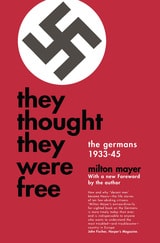
They Thought They Were Free
The Germans, 1933-45Milton Mayer
University of Chicago Press, 1966
“What happened here was the gradual habituation of the people, little by little, to being governed by surprise; to receiving decisions deliberated in secret; to believing that the situation was so complicated that the government had to act on information which the people could not understand, or so dangerous that, even if the people could not understand it, it could not be released because of national security. And their sense of identification with Hitler, their trust in him, made it easier to widen this gap and reassured those who would otherwise have worried about it.”--from Chapter 13, “But Then It Was Too Late”
They Thought They Were Free
The Germans, 1933–45Milton Mayer
University of Chicago Press, 2017
“When this book was first published it received some attention from the critics but none at all from the public. Nazism was finished in the bunker in Berlin and its death warrant signed on the bench at Nuremberg.”
That’s Milton Mayer, writing in a foreword to the 1966 edition of They Thought They Were Free. He’s right about the critics: the book was a finalist for the National Book Award in 1956. General readers may have been slower to take notice, but over time they did—what we’ve seen over decades is that any time people, across the political spectrum, start to feel that freedom is threatened, the book experiences a ripple of word-of-mouth interest.
They Thought They Were Free is an eloquent and provocative examination of the development of fascism in Germany. Mayer’s book is a study of ten Germans and their lives from 1933-45, based on interviews he conducted after the war when he lived in Germany. Mayer had a position as a research professor at the University of Frankfurt and lived in a nearby small Hessian town which he disguised with the name “Kronenberg.” “These ten men were not men of distinction,” Mayer noted, but they had been members of the Nazi Party; Mayer wanted to discover what had made them Nazis. His discussions with them of Nazism, the rise of the Reich, and mass complicity with evil became the backbone of this book, an indictment of the ordinary German that is all the more powerful for its refusal to let the rest of us pretend that our moment, our society, our country are fundamentally immune.
A new foreword to this edition by eminent historian of the Reich Richard J. Evans puts the book in historical and contemporary context. We live in an age of fervid politics and hyperbolic rhetoric. They Thought They Were Free cuts through that, revealing instead the slow, quiet accretions of change, complicity, and abdication of moral authority that quietly mark the rise of evil.
Thomas Mann's World
Empire, Race, and the Jewish QuestionTodd Kontje
University of Michigan Press, 2011
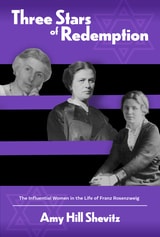
Three Stars of Redemption
The Influential Women in the Life of Franz RosenzweigAmy Hill Shevitz
University of Alabama Press, 2026
A revelatory study of the overlooked ways that Franz Rosenzweig’s closest relationships with women shaped his philosophical legacy and reframed Jewish thought
Three Stars of Redemption: The Influential Women in the Life of Franz Rosenzweig by Amy Hill Shevitz offers a groundbreaking reexamination of Franz Rosenzweig, one of the most influential Jewish philosophers of the twentieth century, through the lens of three pivotal women in his life. The book is a compelling study of the ways that Rosenzweig’s intellectual and emotional world were shaped by his mother, Adele Alsberg Rosenzweig, his wife, Edith Hahn Rosenzweig, and his lover Margrit Rosenstock-Huessy, charting the influence those women had, by extension, on modern Jewish thought.
Rosenzweig is best known for his work of essential religious philosophy The Star of Redemption and his role in the Weimar Jewish Renaissance. Yet Shevitz reveals how the maternal, romantic, and marital relationships he maintained were not peripheral but central to his philosophical development and lived Judaism. Drawing on archival research and close readings of correspondence and historical context, Shevitz restores agency to these women, whose lives have been marginalized or misrepresented in scholarship. Adele’s bourgeois upbringing and intimate intellectual bond with her son, Edith’s independent journey into Judaism, and Margrit’s complex role as both muse and thinker are explored with nuance and depth. Shevitz challenges reductive portrayals and brings their full humanity to light. This richly contextualized study expands the understanding of Jewish cultural history, gender, and the personal dimensions of philosophical inquiry. Three Stars of Redemption is a vital contribution to Jewish studies, women’s history, and the legacy of Rosenzweig’s thought.
Three-Way Street
Jews, Germans, and the TransnationalJay Howard Geller and Leslie Morris, Editors
University of Michigan Press, 2016
Among the first volumes to focus on German-Jewish transnationalism, this interdisciplinary collection spans the fields of history, literature, film, theater, architecture, philosophy, and theology as it examines the lives of significant emigrants. The individuals whose stories are reevaluated include German Jews Ernst Lubitsch, David Einhorn, and Gershom Scholem, the architect Fritz Nathan and filmmaker Helmar Lerski; and eastern European Jews David Bergelson, Der Nister, Jacob Katz, Joseph Soloveitchik, and Abraham Joshua Heschel—figures not normally associated with Germany. Three-Way Street addresses the gap in the scholarly literature as it opens up critical ways of approaching Jewish culture not only in Germany, but also in other locations, from the mid-nineteenth century to the present.
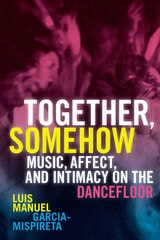
Together, Somehow
Music, Affect, and Intimacy on the DancefloorLuis Manuel Garcia-Mispireta
Duke University Press, 2023

Tomorrow Will Be Better
Surviving Nazi GermanyWalter Meyer with the assistance of Matt Valentine
University of Missouri Press, 1999
How does a young German who has been a member of the Hitler Youth and has competed in Nazi-organized athletic competitions become, over the span of two years, an eighty-pound, tuberculosis-stricken concentration camp escapee?
In this larger-than-life memoir, Walter Meyer leads readers from one harrowing moment to the next as he recounts his experiences during and after Hitler's reign. As a teenager, Meyer refused to conform to institutional rules. While serving in the Hitler Youth, he rebelled by joining a subversive group that focused its efforts on pranks against the youth organization. During World War II, Meyer was arrested, interrogated, and beaten for stealing shoes, but he received a sentence of one to four years, as opposed to the standard penalty for looting—death.
The sixteen-year-old Meyer's refusal to conform to prison regulations and his foiled escape attempts resulted in solitary confinement on several occasions. His fiery spirit eventually landed him in a Nazi work camp. Unbeknownst to his family, Meyer became a concentration camp prisoner. Transported to Ravensbrueck, he was forced to work under grueling conditions in a quarry. He struggled to reach his daily work quota so he could dine on watery broth and bits of bread. In these subhuman conditions, Meyer developed tuberculosis. Knowing he would soon die in the camp, he again plotted his escape. This time he succeeded.
Upon returning home to Duesseldorf, Meyer despaired at the destruction of his hometown. He lamented the pallor that had spread throughout the town and the country itself. After recovering his health, he regained his youthful lust for adventure. His postwar travels began with his infiltration of the Russian-occupied zone of Germany to retrieve his family's possessions. Meyer then began a whirlwind odyssey, ducking into train cars and stowing away on ships, occasionally landing in jail for traveling without a passport—from France to Spain, Belgium to Holland, and finally to South America--in pursuit of something other than the aftermath of war.
Meyer's memoir gives insight into the climate in Germany during World War II and in the defeated nation after the war. His experience as a non-Jewish survivor of the Nazi concentration camps provides an enlightening and varied perspective to the Holocaust dialogue.
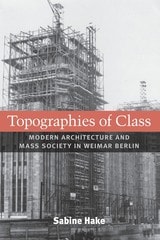
Topographies of Class
Modern Architecture and Mass Society in Weimar BerlinSabine Hake
University of Michigan Press, 2010
In Topographies of Class, Sabine Hake explores why Weimar Berlin has had such a powerful hold on the urban imagination. Approaching Weimar architectural culture from the perspective of mass discourse and class analysis, Hake examines the way in which architectural projects; debates; and representations in literature, photography, and film played a key role in establishing the terms under which contemporaries made sense of the rise of white-collar society.
Focusing on the so-called stabilization period, Topographies of Class maps out complex relationships between modern architecture and mass society, from Martin Wagner's planning initiatives and Erich Mendelsohn's functionalist buildings, to the most famous Berlin texts of the period, Alfred Döblin's city novel Berlin Alexanderplatz (1929) and Walter Ruttmann's city film Berlin, Symphony of the Big City (1927). Hake draws on critical, philosophical, literary, photographic, and filmic texts to reconstruct the urban imagination at a key point in the history of German modernity, making this the first study---in English or German---to take an interdisciplinary approach to the rich architectural culture of Weimar Berlin.
Sabine Hake is Professor and Texas Chair of German Literature and Culture at the University of Texas at Austin. She is the author of numerous books, including German National Cinema and Popular Cinema of the Third Reich.
Cover art: Construction of the Karstadt Department Store at Hermannplatz, Berlin-Neukölln. Courtesy Bildarchiv Preeussischer Kulturbesitz / Art Resource, NY
Toward the Final Solution
A History of European RacismGeorge L. Mosse, With a critical introduction by Christopher R. Browning
University of Wisconsin Press, 2020
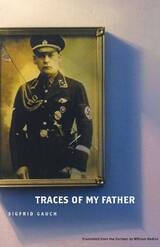
Traces of My Father
William Radice
Northwestern University Press, 2002
In 1979 Sigfrid Gauch published the groundbreaking Vaterspuren, (Traces of My Father), the first of the so-called father books about the relationships of postwar Germans with their parents. It inspired a new genre in German literature. Ever since, such writings have contributed greatly to Germany's ongoing struggle to overcome its own past.
This autobiographical novel is Gauch's attempt to come to terms with his father, Hermann Gauch, a physician who had joined the National Socialists in the 1920s, wrote six books of "race research" as a member of the SS, and to his dying day remained an unrepentant Nazi. The story alternates between the images of the elder Gauch's death and burial and the author's memories of childhood and adolescence.
Unlike many of the father books, however, Traces of My Father is less a political attack than a personal journey. Gauch, though honest about his father's monstrous actions and ideas, does not shirk their shared emotional bond. The result is a poignant attempt by a son to relive his father's notorious life and in doing so free himself from the man's influence.
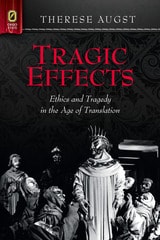
Tragic Effects
Ethics and Tragedy in the Age of TranslationTherese Augst
The Ohio State University Press, 2012
Tragic Effects: Ethics and Tragedy in the Age of Translation confronts the peculiar fascination with Greek tragedy as it shapes the German intellectual tradition, with particular focus on the often controversial practice of translating the Greeks. Whereas the tradition of emulating classical ideals in German intellectual life has generally emerged from the impulse to identify with models, the challenge of translating the Greeks underscores the linguistic and historical discontinuities inherent in the recourse to ancient material and inscribes that experience of disruption as fundamental to modernity.
Friedrich Hölderlin’s translations are a case in point. Regarded in his own time as the work of a madman, his renditions of Sophoclean tragedy intensify dramatic effect with the unsettling experience of familiar language slipping its moorings. His attention to marking the distances between ancient source text and modern translation has granted his Oedipus and Antigone a distinct longevity as objects of discussion, adaptation, and even retranslation. Cited by Walter Benjamin, Martin Heidegger, Bertolt Brecht, and others, Hölderlin’s Sophocles project follows a path both marked by various contexts and tinged by persistent quandaries of untranslatability.
Tragedy has long functioned as a cornerstone for questions about ethical life. By placing emphasis on processes of translation and adaptation, however, Tragic Effects approaches the question of ethics from a perspective informed by recent discourse in translation studies. Reconstructing an ancient text in this context requires negotiating the difficult tension between comprehending the distant past and preserving its radical singularity.
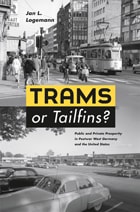
Trams or Tailfins?
Public and Private Prosperity in Postwar West Germany and the United StatesJan L. Logemann
University of Chicago Press, 2012
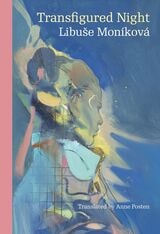
Transfigured Night
Libuše Moníková
Karolinum Press, 2023
In late 1992, three years after the Velvet Revolution and as Czechoslovakia is about to dissolve into the Czech Republic and Slovakia, choreographer and dancer Leonora Marty, who fled the Communist state decades earlier, has returned to Prague. Having wrapped up her ballet of The Makropulos Affair, the famous dancer meets old classmates, wanders the city through crowds of tourists, and visits the most obscure and unvisited museums. When she is approached by Thomas Asperger, a descendant of ethnic Germans driven from Czechoslovakia after World War II, she must confront three relationships—her relationship with the city of her youth, her homeland’s relationship with its past, and her new romance with this German admirer.
Written in German and published in 1995, by an author whose life mirrored her protagonist’s, the novel provides a cultural tour of Prague. Employing a style as influenced by the operas of Leoš Janácek as the novels of Thomas Pynchon, Transfigured Night is a masterpiece of Czech literature, showing that the culture of this nation comes in a variety of tongues.
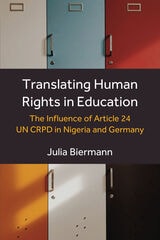
Translating Human Rights in Education
The Influence of Article 24 UN CRPD in Nigeria and GermanyJulia Biermann
University of Michigan Press, 2022
The 2006 United Nations Convention on the Rights of Persons with Disabilities (UN CRPD) is the first human rights treaty to explicitly acknowledge the right to education for persons with disabilities. In order to realize this right, the convention’s Article 24 mandates state parties to ensure inclusive education systems that overcome outright exclusion as well as segregation in special education settings. Despite this major global policy change to tackle the discriminations persons with disabilities face in education, this has yet to take effect in most school systems worldwide.
Focusing on the factors undermining the realization of disability rights in education, Julia Biermann probes current meanings of inclusive education in two contrasting yet equally challenged state parties to the UN CRPD: Nigeria, whose school system overtly excludes disabled children, and Germany, where this group primarily learns in special schools. In both countries, policy actors aim to realize the right to inclusive education by segregating students with disabilities into special education settings. In Nigeria, this demand arises from the glaring lack of such a system. In Germany, conversely, from its extraordinary long-term institutionalization. This act of diverting from the principles embodied in Article 24 is based on the steadfast and shared belief that school systems, which place students into special education, have an innate advantage in realizing the right to education for persons with disabilities. Accordingly, inclusion emerges to be an evolutionary and linear process of educational expansion that depends on institutionalized special education, not a right of persons with disabilities to be realized in local schools on an equal basis with others. This book proposes a refined human rights model of disability in education that shifts the analytical focus toward the global politics of formal mass schooling as a space where discrimination is sustained.
Traveling on One Leg
Herta Muller
Northwestern University Press, 2010
Winner, 2009 Nobel Prize in Literature
Irene is a fragile woman born to a German family in Romania, who has recently emigrated from her native country to West Germany. Politically and socially isolated, Irene moves within the orbit of three troubled men, while simultaneously embarking on an inner exploration of exile, homeland, and identity.
Travels in the Reich, 1933-1945
Foreign Authors Report from GermanyEdited by Oliver Lubrich
University of Chicago Press, 2010
“Even now,” wrote Christopher Isherwood in his Berlin Diary of 1933, “I can’t altogether believe that any of this has really happened.” Three years later, W. E. B. DuBois described Germany as “silent, nervous, suppressed; it speaks in whispers.” In contrast, a young John F. Kennedy, in the journal he kept on a German tour in 1937, wrote, “The Germans really are too good—it makes people gang against them for protection.”
Drawing on such published and unpublished accounts from writers and public figures visiting Germany, Travels in the Reich creates a chilling composite portrait of the reality of life under Hitler. Written in the moment by writers such as Virginia Woolf, Isak Dinesen, Samuel Beckett, Jean-Paul Sartre, William Shirer, Georges Simenon, and Albert Camus, the essays, letters, and articles gathered here offer fascinating insight into the range of responses to Nazi Germany. While some accounts betray a distressing naivete, overall what is striking is just how clearly many of the travelers understood the true situation—and the terrors to come.
Through the eyes of these visitors, Travels in the Reich offers a new perspective on the quotidian—yet so often horrifying—details of German life under Nazism, in accounts as gripping and well-written as a novel, but bearing all the weight of historical witness.
Triumph of the Fatherland
German Unification and the Marginalization of WomenBrigitte Young
University of Michigan Press, 1999

Turkish Berlin
Integration Policy and Urban SpaceAnnika Marlen Hinze
University of Minnesota Press, 2013
The integration of immigrants into a larger society begins at the local level. Turkish Berlin reveals how integration has been experienced by second-generation Turkish immigrant women in two neighborhoods in Berlin, Germany. While the neighborhoods are similar demographically, the lived experience of the residents is surprisingly different.
Informed by first-person interviews with both public officials and immigrants, Annika Marlen Hinze makes clear that local integration policies—often created by officials who have little or no contact with immigrants—have significant effects on the assimilation of outsiders into a community and a society. Focusing on the Turkish neighborhoods of Kreuzberg and Neukölln, Hinze shows how a combination of local policy making and grassroots organizing have contributed to one neighborhood earning a reputation as a hip, multicultural success story and the other as a rougher neighborhood featuring problem schools and high rates of unemployment. Aided by her interviews, she describes how policy makers draw from their imaginations of urban space, immigrants, and integration to develop policies that do not always take social realities into consideration. She offers useful examples of how official policies can actually exacerbate the problems they are trying to help solve and demonstrates that a powerful history of grassroots organizing and resistance can have an equally strong impact on political outcomes.
Employing spatial theory as a tool for understanding the complex processes of integration, Hinze asks two related questions: How do immigrants perceive themselves and their experiences in a new culture? And how are immigrants conceived of by politicians and policy makers? Although her research highlights the German–Turk experience in Berlin, her answers have implications that resonate far beyond the city’s limits.
Twelve Years
An American Boyhood in East GermanyJoel Agee
University of Chicago Press, 2000
"A wonderfully evocative memoir. . . . Agee evoked for me the atmosphere of postwar Berlin more vividly than the actual experience of it—and I was there." —Christopher Lehmann-Haupt, New York Times
"One of those rare personal memoirs that brings to life a whole country and an epoch." —Christopher Isherwood
"Twelve Years consists of a series of finely honed anecdotes written in a precise, supple prose rich with sensual detail." —David Ghitelman, Newsday
"By turns poetic and picturesque, Agee energetically catalogues his expatriate passage to manhood with a pinpoint eye and a healthy American distaste for pretension. . . . Huckleberry Finn would have . . . welcomed [him] as a soulmate on the raft." —J. D. Reed, Time
"A triumph. . . . Unfettered by petty analysis or quick explanations, a story that is timeless and ageless and vital." —Robert Michael Green, Baltimore Sun