Results by title
1787 books match the query 'Literary Collections' and 471 start with t
The Essential Lectures of Charlotte Perkins Gilman, 1890–1894
Charlotte Perkins Gilman Edited and with an introduction by Andrew J. Ball
University of Alabama Press, 2024
A foundational archive of Gilman’s early feminist, sociological, and philosophical thought, revealing the origins of a major American intellectual tradition.
The last decades have seen a resurgence of interest in Charlotte Perkins Gilman, now considered among the most important thinkers in US history. She is best known for fiction—such as the classic short story “The Yellow Wall-Paper” (1892)—and nonfiction, including her manifesto Women and Economics (1898), a work of intersectional sociology avant la lettre. Nevertheless, as a young writer, Gilman made her living delivering lectures. One cannot know Gilman without some knowledge of this body of lectures; this book fills that critical gap in Gilman scholarship.
Since the recovery of Charlotte Perkins Gilman began in the late 1960s and continued with the republication of “The Yellow Wall-Paper” in the 1970s, her image in cultural memory has been increasingly celebrated. Andrew J. Ball presents here fifty previously unpublished texts. They trace the development of Gilman’s thoughts on diverse subjects like gender, education, labor, science, theology, and politics—forming an intellectual diary of her growth.
These lectures are not just a testament to Gilman’s personal evolution, but also a crucial contribution to the foundations of American sociology and philosophy. The Essential Lectures of Charlotte Perkins Gilman, 1890–1894 marks a historic moment, unveiling the hidden genius of Gilman's oratory legacy.
The Essential Margaret Fuller by Margaret Fuller
Steele, Jeffrey
Rutgers University Press, 1992
The leading feminist intellectual of her day, Margaret Fuller has been remembered for her groundbreaking work, Woman in the Nineteenth Century, which recharted the gender roles of nineteenth-century men and women. In this new collection, the full range of her literary career is represented from her earliest poetry to her final dispatch from revolutionary Italy. For the first time, the complete texts of Woman in the Nineteenth Century and Summer on the Lakes are printed together, along with generous selections from Fuller's Dial essays, New York essays, Italian dispatches, and unpublished journals. Special features are the complete text of Fuller's famous "Autobiographical Romance" (never before reprinted in its entirety) and nineteen of her poems, edited from her manuscripts. All of Fuller's major texts are completely annotated, with special attention to her literary and historical sources, as well as her knowledge of American Indian culture, mythology, and the Bible
Jeffrey Steele's introduction provides an important revision of Fuller's biography and literary career, tracing the growth of her feminism and her development into one of America's preeminent social critics. No other writer of Fuller's day could match the range of her experience. Growing up in the world of Boston intellectuals, she was the close friend of the Alcotts, Emerson, Hawthorne, and Thoreau. But she also traveled adventurously to the western frontier, canoed down rapids with Chippewa Indians, visited the outcast and the poor in New York's institutions and prisons, and experienced the rigors of war during the bombardment of Rome. As a whole, this anthology provides the material to understand one of the most fascinating nineteenth-century American women writers.
The Exiles and Other Stories
By Horacio Quiroga
University of Texas Press, 1987
Tales of risk and danger, suffering, disease, horror, and death. Tales, also, of courage and dignity, hard work, and human endurance in the face of hostile nature and the frequent brutality of men. And tales flavored with piquant touches of humor and bemused irony.
These are the stories of the Uruguayan writer Horacio Quiroga, here presented in an important compilation of thirteen of his most compelling tales, sensitively selected and translated by J. David Danielson. Author of some two hundred pieces of fiction, often compared to the works of Kipling, Jack London, and Edgar Allan Poe, Quiroga set many of his stories in the territory of Misiones in northeastern Argentina, the subtropical jungle region where he spent much of his life.
Included here are stories from Los desterrados (1926) often said to be his best book, as well as others from Cuentos de amor de locura y de muerte (1917), Anaconda (1921), and El Desierto (1924). The publication of this selection marks the first appearance in English of all but two of the thirteen stories.
Quiroga here presents a wide range of characters: parents and children, servant girls and prostitutes, landowners and lumber barons, foremen and laborers, natives and immigrants, in stories pervaded by a vision of life that is elemental, incisive, and essentially tragic. The Exiles and Other Stories shows the versatility and skill that have made him a classic Spanish American writer. It complements and illumines The Decapitated Chicken and Other Stories, selected and translated by Margaret Sayers Peden, also published by the University of Texas Press.
The Extinction of Menai
A NovelChuma Nwokolo
Ohio University Press, 2017
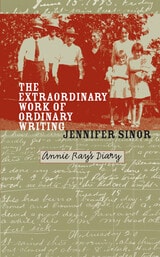
The Extraordinary Work of Ordinary Writing
Annie Ray's DiaryJennifer Sinor
University of Iowa Press, 2002
Exciting and beautifully crafted, The Extraordinary Work of Ordinary Writing provides an entirely new way of viewing “ordinary writing,” the everyday writing we typically ignore or dismiss. It takes as its center the diary of Jennifer Sinor's great-great-great-aunt Annie Ray, a woman who homesteaded in the Dakotas in the late nineteenth century. Diaries such as this have long been ignored by scholars, who prefer instead to focus on diaries with literary features. Reading diaries through this lens gives privileged status to those that are coherently crafted and ignores the very diaries that define the form through their relentless inscription of dailiness.
Annie Ray’s diary is not literary. By considering her ordinary writing as a site of complex and strategic negotiations among the writer, the form of writing, and dominant cultural scripts, Sinor makes visible the extraordinary work of the ordinary writer and the sophistication of these texts. In providing a way to read diaries outside the limits and conventions of literature, she challenges our approaches to other texts as well. Furthermore, because ordinary writing is not crafted for aesthetic reception (in contrast to autobiography proper, memoirs, and literary diaries), it is a productive site for investigating how both writing and culture get made every day.
The book is truly original in its form: nontraditional, storied, creative. Sinor, an accomplished creative writer, includes her own memories as extended metaphors in partnership with critical texts along with excerpts from her aunt's diary. The Extraordinary Work of Ordinary Writing will be a fascinating text for students of creative writing as well as of women's studies and diaries.
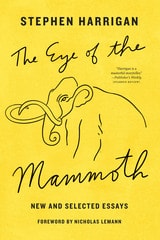
The Eye of the Mammoth
New and Selected EssaysBy Stephen Harrigan; foreword by Nicholas Lemann
University of Texas Press, 2013
History—natural history, human history, and personal history—and place are the cornerstones of The Eye of the Mammoth. Stephen Harrigan's career has taken him from the Alaska Highway to the Chihuahuan Desert, from the casinos of Monaco to his ancestors' village in the Czech Republic. And now, in this new edition, he movingly recounts in "Off Course" a quest to learn all he can about his father, who died in a plane crash six months before he was born.
Harrigan's deceptively straightforward voice belies an intense curiosity about things that, by his own admission, may be "unknowable." Certainly, we are limited in what we can know about the inner life of George Washington, the last days of Davy Crockett, the motives of a caged tiger, or a father we never met, but Harrigan's gift—a gift that has also made him an award-winning novelist—is to bring readers closer to such things, to make them less remote, just as a cave painting in the title essay eerily transmits the living stare of a long-extinct mammoth.
The Fables of Phaedrus
Translated by P. F. Widdows
University of Texas Press, 1992
Animal fables are said to have originated with Aesop, a semilegendary Samian slave, but the earliest surviving record of the fables comes from the Latin poet Phaedrus, who introduced the new genre to Latin literature. This verse translation of The Fables is the first in English in more than two hundred years.
In addition to the familiar animal fables, about a quarter of the book includes such diverse material as prologues and epilogues, historical anecdotes, short stories, enlarged proverbs and sayings, comic episodes and folk wisdom, and many incidental glimpses of Greek and Roman life in the classical period.
The Fables also sheds light on the personal history of Phaedrus, who seems to have been an educated slave, eventually granted his freedom by the emperor Augustus. Phaedrus' style is lively, clean, and sparse, though not at the cost of all detail and elaboration. It serves well as a vehicle for his two avowed purposes—to entertain and to give wise counsel for the conduct of life. Like all fabulists, Phaedrus was a moralist, albeit on a modest and popular level.
An excellent introduction by P. F. Widdows provides information about Phaedrus, the history of The Fables, the metric style of the original and of this translation, and something of the place of these fables in Western folklore. The translation is done in a free version of Anglo-Saxon alliterative verse, a form used by W. H. Auden and chosen here to match the popular tone of Phaedrus' Latin verse.
The Faith Healer of Olive Avenue
StoriesManuel Muñoz and Cherríe Moraga
Northwestern University Press, 2025
From the divergent paths of triplet brothers to a grieving father confronting his mistreatment of his son, these stories interweave a recurring cast of neighborhood characters, many of them in search of escape or release. Lauded for its empathetic portrayals of communities often ignored, The Faith Healer of Olive Avenue won a Whiting Award and an O. Henry Award; it was shortlisted for the Frank O’Connor International Short Story Award as one of the best collections published in English worldwide. A new foreword by author and activist Cherríe Moraga gives testament to Muñoz’s status as “the cartographer of a people.”
The Far Edges of the Fourth Genre
An Anthology of Explorations in Creative NonfictionSean Prentiss
Michigan State University Press, 2014
Contributors: Nancer Ballard, H. Lee Barnes, Kim Barnes, Mary Clearman Blew, Joy Castro, Robin Hemley, Judith Kitchen, Brenda Miller, Ander Monson, Dinty W. Moore, Sean Prentiss, Lia Purpura, Erik Reece, Jonathan Rovner, Bob Shacochis, and Joe Wilkins.
The Feeling Intellect
Selected WritingsPhilip Rieff
University of Chicago Press, 1989
The Fenwick Letters
A Transnational Feminist Life Reconstructed, Volume I: 1797-1821Eliza Fenwick
University of Delaware Press, 2026
The Fenwick Letters
A Transnational Feminist Life Reconstructed, Volume II: 1822-1840Eliza Fenwick
University of Delaware Press, 2027
The second of this two-volume edition of The Fenwick Letters covers the North American phase of Eliza Fenwick’s transformative, transnational odyssey, from 1822 to 1840. Although no longer the radical author she was in the 1790s, advocating for the rights of women to be educated, or the innovative author of children’s books that she was in the early 1800s, she was still very much a writer. In her North American incarnation, however, she was primarily an educator, a businesswoman running her own school, and a single, working grandmother attempting to find safety as well as economic and domestic stability for herself and her remaining family. Eliza’s letters are consistently riveting, filled with sharply drawn portraits of the people, places, environment, politics, and culture of each community in which she lived. The letters also reveal Eliza’s genius for developing networks of social, political, and cultural connections as she established and sought to support herself and her family in North America.
The Fetishists
By Ibrahim al-Koni, Translated by William M. Hutchins
University of Texas Press, 2018
The Fetishists, originally published in Arabic as Al Majus, is considered the masterpiece of Ibrahim al-Koni, one of the most prolific and important writers in Arabic today. In The Fetishists, Al-Koni explores what happens when a writer asks the novel to speak of and for the Sahara, when rival cultures clash, and when communities seek to build a utopia on Earth as individuals struggle between a desire for material well-being (represented by gold dust) and a need for spiritual meaning. As the story opens, Sultan Oragh of Timbuktu, who has already lost most of his power to Fetishist Bambara leaders of the forestlands, fears he will lose his only daughter, Tenere, as a human sacrifice to their god Amnay. The sultan sends Tenere to seek refuge with fellow Tuareg nomads in the plain. But even in their traditional, nomadic community, a competition rages between jihadi militant Islam; moderate Anhi Islam, which is the ancient Tuareg Law; and the cults of gold dust and of traditional African folk religions.
In this epic novel, Al-Koni blends Tuareg folklore and history with intense, fond descriptions of daily life in the desert, creating a mirror for life anywhere. Through its tragic rendering of a clash between the Tuareg and traditional African civilizations, the novel profoundly probes the contradictions of the human soul as it takes the reader on a unique spiritual adventure inside the Tuareg world.
The First Moderns
Profiles in the Origins of Twentieth-Century ThoughtWilliam R. Everdell
University of Chicago Press, 1997
"This exceptionally wide-ranging history is chock-a-block with anecdotes, factoids, odd juxtapositions, and useful insights. Most impressive. . . . For anyone interested in learning about late 19th- and early 20th- century imaginative thought, this engagingly written book is a good place to start."—Washington Post Book World
"The First Moderns brilliantly maps the beginning of a path at whose end loom as many diasporas as there are men."—Frederic Morton, The Los Angeles Times Book Review
"In this truly exciting study of the origins of modernist thought, poet and teacher Everdell roams freely across disciplinary lines. . . . A brilliant book that will prove useful to scholars and generalists for years to come; enthusiastically recommended."—Library Journal, starred review
"Everdell has performed a rare service for his readers. Dispelling much of the current nonsense about 'postmodernism,' this book belongs on the very short list of profound works of cultural analysis."—Booklist
"Innovative and impressive . . . [Everdell] has written a marvelous, erudite, and readable study."-Mark Bevir, Spectator
"A richly eclectic history of the dawn of a new era in painting, music, literature, mathematics, physics, genetics, neuroscience, psychiatry and philosophy."—Margaret Wertheim, New Scientist
"[Everdell] has himself recombined the parts of our era's intellectual history in new and startling ways, shedding light for which the reader of The First Moderns will be eternally grateful."—Hugh Kenner, The New York Times Book Review
"Everdell shows how the idea of "modernity" arose before the First World War by telling the stories of heroes such as T. S. Eliot, Max Planck, and Georges Serault with such a lively eye for detail, irony, and ambiance that you feel as if you're reliving those miraculous years."—Jon Spayde, Utne Reader
The Flock
Mary Austin
University of Nevada Press, 2001
The Folklore Muse
Poetry, Fiction, and Other Reflections by FolkloristsFrank de Caro
Utah State University Press, 2008
Folklore—the inherently creative expression, transmission, and performance of cultural traditions—has always provided a deep well of material for writers, musicians, and artists of all sorts. Folklorists usually employ descriptive and analytical prose, but they, like scholars in other social sciences, have increasingly sought new, creative and reflexive modes of discourse. Many folklorists are also creative writers, some well known as such, and the folk traditions they research often provide shape and substance to their work. This collection of creative writing grounded in folklore and its study brings together some of the best examples of such writing.
Contributors to this collection include Teresa Bergen, John Burrison, Norma E. Cantu, Frank de Caro, Holly Everett, Danusha Goska, Neil R. Grobman, Carrie Hertz, Edward Hirsch, Laurel Horton, Rosan Augusta Jordan, Paul Jordan-Smith, Elaine J. Lawless, Cynthia Levee, Jens Lund, Mary Magoulick, Bernard McCarthy, Joanne B. Mulcahy, Kirin Narayan, Ted Olson, Daniel Peretti, Leslie Prosterman, Jo Radner, Susan Stewart, Jeannie Banks Thomas, Jeff Todd Titon, Libby Tucker, Margaret Yocom, and Steve Zeitlin.
The Food Lovers' Anthology
A Literary CompendiumEdited by the Bodleian Library
Bodleian Library Publishing, 2014
“He was a bold man that first ate an oyster.”—Jonathan Swift
“There is no love sincerer than the love of food,” wrote George Bernard Shaw in 1903. Poets, novelists, chefs, and gourmands before and after him would seem to agree. Collected in this anthology is a mouthwatering selection of excerpts on the subject of eating, drinking, cooking, and serving food that is guaranteed to whet every reader’s appetite.
Themed sections group together poetry and prose on grapes and bottles, the ideal cuisine, hangover cures, and vivid vignettes about dinner party behavior. There are stories about food fit for kings, a duchess’s “rumblings abdominal,” fine dining, eating abroad, cooking at home, and gastronomic excesses. A section on food and travel features Edmund Hillary’s meal at the summit of Everest, Ernest Shackleton’s dish of penguin in the Antarctic, and Joshua Slocum on the unfortunate effects of cheese and plums while sailing solo around the world. Also on the menu are limericks, short-tempered cooks, recipes, fantasy food, special feasts, iron rations, tips on opening oysters, and the uses and abuses of coffee.
Featuring writers as diverse as Jean Anthelme Brillat-Savarin, Edward Lear, John Keats, Charles Dickens, Maria Edgeworth, and Marcel Proust, garnished with a generous helping of cartoons, this is a perfect gift for foodies, chefs, picnickers, and epicurean explorers.
The Ghost of Monsieur Scarron
Janet Lewis
Ohio University Press, 2013
This historical novel is the third and final book in American poet and fiction writer Janet Lewis’s Cases of Circumstantial Evidence series, based on legal case studies compiled in the nineteenth century. In The Ghost of Monsieur Scarron, Lewis returns to her beloved France, the setting of The Wife of Martin Guerre, her best-known novel and the first in the series. As Swallow Press executive editor Kevin Haworth relates in a new introduction, Monsieur Scarron shifts the reader into the center of Paris in 1694, during the turbulent reign of the Sun King, Louis XIV. The junction of this time and place gives Monsieur Scarron an intriguing political element not apparent in either The Wife of Martin Guerre or The Trial of Sören Qvist.
The Ghost of Monsieur Scarron begins in a small bookbinder’s shop on a modest Paris street, but inexorably expands to encompass a tumultuous affair, growing social unrest, and the conflicts between a legal system based on oppressive order and a society about to undergo harsh changes. With its domestic drama set against a larger political and historical backdrop, Monsieur Scarron is considered by some critics and readers to be the most intricately layered and fully realized book of Lewis’s long career. Originally published in 1959, Monsieur Scarron has remained in print almost continuously ever since.
The Gift of Correspondence in Classical Rome
Friendship in Cicero's Ad Familiares and Seneca's Moral EpistlesAmanda Wilcox
University of Wisconsin Press, 2012
Amanda Wilcox offers an innovative approach to two major collections of Roman letters—Cicero’s Ad Familiares and Seneca’s Moral Epistles—informed by modern cross-cultural theories of gift-giving.
By viewing letters and the practice of correspondence as a species of gift exchange, Wilcox provides a nuanced analysis of neglected and misunderstood aspects of Roman epistolary rhetoric and the social dynamics of friendship in Cicero’s correspondence. Turning to Seneca, she shows that he both inherited and reacted against Cicero’s euphemistic rhetoric and social practices, and she analyzes how Seneca transformed the rhetoric of his own letters from an instrument of social negotiation into an idiom for ethical philosophy and self-reflection. Though Cicero and Seneca are often viewed as a study in contrasts, Wilcox extensively compares their letters, underscoring Cicero’s significant influence on Seneca as a prose stylist, philosopher, and public figure.
The Glance of Countess Hahn-Hahn (down the Danube)
Peter Esterhazy
Northwestern University Press, 1999
In The Glance of Countess Hahn-Hahn (down the Danube), Péter Esterházy tells the story of a professional traveler, commissioned--like Marco Polo by Kublai Khan--to undertake a voyage of discovery and prepare a travelogue. Communicating the details of his journey through terse and surreal telegrams, the Traveller weaves a rich tapestry of narratives, evoking the ethereal past and the precarious present of a disappearing world.
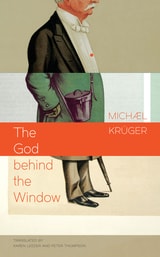
The God Behind the Window
Michael Krüger
Seagull Books, 2018
The thirteen stories of Michael Krüger’s The God behind the Window capture the poignancy and cynicism of late life through tales of misanthropic old men full of the mixture of wisdom and melancholy that so often accompanies old age. In Krüger’s stories, world-weary characters seek—and only temporarily find—solace in nature and culture, rendering their search for a better life simultaneously comedic and heart wrenching. From a solitary hiker in the Swiss Alps to the book’s eponymous shut-in, these aging malcontents are continually surprised by the unexpected interventions of a world that has come to seem predictable. Krüger captures this stage in life masterfully, contrasting the deeply personal emotions of affection, melancholy, and longing with an indifferent world. The resulting stories are lyrical, philosophical, and tender despite their cynicism.
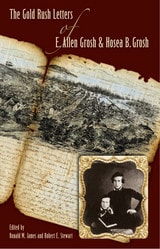
The Gold Rush Letters of E. Allen Grosh and Hosea B. Grosh
Ronald M. James
University of Nevada Press, 2016
The Groshes’ letters are rich in color and important historical details. Generously annotated and with an introduction that provides a context for the brothers’ career and the setting in which they tried to make their fortune, these documents powerfully depict the often harsh realities of Gold Rush life and society.
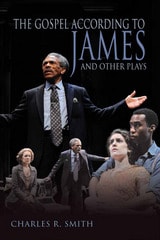
The Gospel According to James and Other Plays
Charles R. Smith
Ohio University Press, 2012
This collection of five award-winning plays by Charles Smith includes Jelly Belly, Free Man of Color, Pudd’nhead Wilson, Knock Me a Kiss, and The Gospel According to James. Powerful, provocative, and entertaining, these plays have been produced by professional theater companies across the country and abroad. Four of the plays are based on historical people and events from W.E.B. Du Bois and Countee Cullen to the Harlem Renaissance. Accurate in the way they capture the political and cultural milieu of their historical settings, and courageous in the way they grapple with difficult questions such as race, education, religion, and social class, these plays jump off the page just as powerfully as they come to life on stage. This first-ever collection from one of the nation’s leading African American playwrights is a journey down the complex road of race and history.
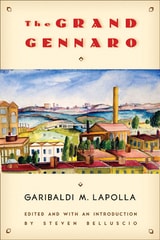
The Grand Gennaro
Belluscio, Steven
Rutgers University Press, 2009
The Grand Gennaro, a riveting saga set at the turn of the last century in Italian American Harlem, reflects on how youthful acts of cruelty and desperation follow many to the grave. A classic in the truest sense, this operatic narrative is alive once again, addressing the question: How does one become an "American"?
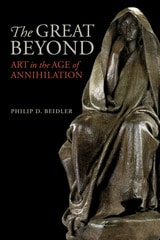
The Great Beyond
Art in the Age of AnnihilationPhilip D. Beidler
University of Alabama Press, 2022
Essays mapping how modern art confronts mortality in an age of war and annihilation.
While much about modernism remains up for debate, there can be no dispute about the connection between modernist art and death. The long modern moment was and is an age of war, genocide, and annihilation. Two world wars killed perhaps as many as 100 million people, through combat, famine, holocaust, and ghastly attacks on civilians. The ongoing COVID-19 pandemic is the fifth global pandemic since 1918, with more than a half-million American deaths and counting.
It can hardly come as a surprise, then, that many of the touchstones of modernism reflect on death and devastation. In Philip D. Beidler’s exploration of the modernist canon, he illuminates how these singular voices looked extinction in the eye and tried to reckon with our finitude—and their own. The Great Beyond: Art in the Age of Annihilation catalogs through lively prose an eclectic selection of artists, writers, and thinkers. In 16 essays, Beidler takes nuanced and surprising approaches to well-studied figures—the haunting sculpture by Saint-Gaudens commissioned by Henry Adams for his late wife; Luchino Visconti’s adaptation of Mann’s Death in Venice; and the author’s own long fascination with Beckett’s Waiting for Godot.
The threads and recurring motifs that emerge through Beidler’s analysis bridge the different media, genres, and timeframes of the works under consideration. Protomodernists Crane and Twain connect with near-contemporary voices like Sebald and Morrison. Robert MacFarlane’s 21st-century nonfiction about what lies underneath the earth echoes the Furerbunker and the poetry of Gertrud Kolmar. Learned but lively, somber but not grim, The Great Beyond is not a comfortable read, but it is in a way comforting. In tracing how his subjects confronted nothingness, be it personal or global, Beidler draws a brilliant map of how we see the end of the road.
The Greek Tragedies
Seventeen Plays by Aeschylus, Sophocles, and EuripidesAeschylus, Sophocles, and Euripides
University of Chicago Press, 2025
The most authoritative, accessible, and poetic translations of the Greek Tragedies ever produced, now in one volume!
Drawn from the authoritative third editions of David Grene and Richmond Lattimore’s collections of the complete Greek tragedies, expertly updated by Mark Griffith and Glenn W. Most, this collection brings together seventeen of the greatest surviving plays of ancient Greece. Combining accuracy, poetic immediacy, and clarity of presentation, the masterpieces of Aeschylus, Sophocles, and Euripides have been rendered so compellingly in English that they remain the definitive translations. Each text has been carefully updated to bring it even closer to the ancient Greek original while retaining the vibrancy for which Chicago’s versions are famous.
Alongside the plays, this edition includes an introduction to the life and work of each tragedian; an introduction to each play offering essential information about its first production, plot, and reception through the centuries; and notes addressing textual uncertainties. Featuring lively translations by eminent classicists and authors including Anne Carson, Robert Fitzgerald, David Grene, Richmond Lattimore, Oliver Taplin, Emily Townsend Vermeule, and Elizabeth Wyckoff, this is an indispensable anthology for any reader of the foundational works of Western drama, art, and life.
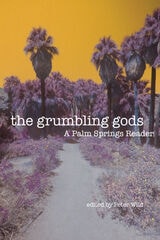
The Grumbling Gods
A Palm Springs ReaderPeter Wild
University of Utah Press, 2007
The Grumbling Gods surveys the history and allure of Palm Springs, beginning with the Cahuilla Indians, the first historical residents of the region. It includes accounts from the early explorers, a report of mysterious shipwrecks amidst the sand dunes, and selections from the grimly rollicking writings of Raymond Chandler. It penetrates the tinsel of casinos and the placidity of gated golf communities to reveal the painful beauty of deserts and mountains under assault.
Francisco Patencio, the last of the traditional Cahuilla Indians, warned his white neighbors to be careful, that the grim gods inhabiting the canyons around Palm Springs were angry. It is their grumbling, at once chilling and prophetic, and yet sometimes humorous, that we hear from the pages of this book.
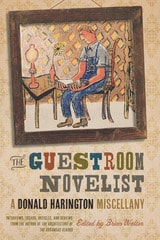
The Guestroom Novelist
A Donald Harington MiscellanyDonald Harington
University of Arkansas Press, 2019
Donald Harington, best known for his fifteen novels, was also a prolific writer of essays, articles, and book reviews.
The Guestroom Novelist: A Donald Harington Miscellany gathers a career-spanning and eclectic selection of nonfiction by the Arkansawyer novelist Donald Harington that reveals how a life of devastating losses and disappointments inspired what the Boston Globe called the “quirkiest, most original body of work in contemporary US letters.”
This extensive collection of interviews and other works of prose—many of which are previously unpublished—offers glimpses into Harington’s life, loves, and favorite obsessions, replays his minor (and not so minor) dramas with literary critics, and reveals the complicated and sometimes contentious relationship between his work of the writers he most admired. The Guestroom Novelist, which takes its title from an essay that serves as a love letter to his fellow underappreciated writers, paints a rich portrait of the artist as a young, middle-aged, and fiercely funny old man, as well as comic, sentimentalist, philosopher, and critic, paying testimony to the writer’s magnificent ability to transform the seemingly crude stuff of our material existence into enduring art.
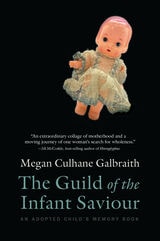
The Guild of the Infant Saviour
An Adopted Child's Memory BookMegan Culhane Galbraith
The Ohio State University Press, 2021
Shortly before Roe v. Wade legalized abortion, adoptee Megan Culhane Galbraith was born in a Catholic charity hospital in New York City to a teenaged resident of the Guild of the Infant Saviour, a home for unwed mothers. Decades later, on the eve of becoming a mother herself, she would travel to the former guild site; to her birth mother’s home in Scotland; and to Cornell University, where she discovered the startling history of its Domestic Economics program. There, from 1919 to 1969, coeds applied scientific principles to domesticity as they collectively mothered a rotating cast of babies awaiting adoption. The babies shared the last name Domecon and provided the inspiration for Galbraith’s art project, The Dollhouse.
The Guild of the Infant Saviour is a dizzyingly inventive hybrid memoir of one adoptee’s quest for her past. Galbraith pairs narrative with images from The Dollhouse as she weaves a personal and cultural history of adoption as it relates to guilt, shame, grief, identity, and memory itself. Ultimately, she connects her experiences to those of generations of adoptees, to the larger stories America tells about sex and motherhood, and to the shadows those stories cast on us all.
The Hairdresser of Harare
A NovelTendai Huchu
Ohio University Press, 2015
The Handywoman Stories
Lenore McComas Coberly
Ohio University Press, 2002
Sometimes it's possible to pick up a book and hear the words being spoken by the characters as if you were sitting across the table from them. This is the sensation you'll have as you read through The Handywoman Stories by Lenore McComas Coberly.
Whether the story describes the civil defense preparations of a small West Virginia town in World War II, the same town years later dealing with an influx of hippies, or the return of a woman to her roots after decades up north, the voices are convincing and true. “I nearly got kicked in the head by a cow before I learned that if you use your full strength pulling milk, you won’t get much milk,” says one. “To see Zevelda the way she was that Sunday is, well, not something you're very likely to see,” says another.
The Handywoman Stories themselves are driven by characters shaped by the place they have lived most all of their lives. They deal with economic depression, mine and war deaths, the arrogance of community leaders, and what might have been, but was not, a stultifying environment. Their tools are astonishing resourcefulness, steadfast friendship, and always humor.
Lenore McComas Coberly has woven together a bittersweet community of strong Appalachian women and men in this remarkable collection. Moving and joyful, these stories are made from the stuff of life.
The Hawk's Done Gone
Mildred Haun
Vanderbilt University Press, 1968
The stories of Mildred Haun, collected here for the first time, are unique in the annals of American literature. Set in the Smoky Mountains of East Tennessee and covering a span of family history from the Civil War to 1940, these tales achieve the forceful, intractable simplicity of the traditional ballads. But one also finds in these twenty-three stories an overview of the forces of nature, the paradoxes inherent in the human condition, and a full acceptance of the real world and the supernatural.
Born to the milieu about which she wrote, Mildred Haun recorded a world which combined stark natural phenomena and passionate supernatural forces. And because the supernatural is woven into the dramatic fabric of the stories, it contributes, paradoxically, to the final credibility of events.
Few writers in the twentieth century have set down so rich and complex a rendering of folk tradition and such a comprehensive treatment of superstition in the southern Appalachians. In these tales we meet a talking apple tree, a boy with the “hant bleach” of doom upon his brow, a bleeding ghost, a child’s winding sheet wet with tears, and God’s revelation in a blue bird.
No other dialect collection from the South has been as close to the oral tradition or has achieved the same distinctive flavor and natural tonal qualities. The speech strikes the ear directly from the printed page. The language is simple and strong. A sparse, direct economy prevails. The total impact is explosive.
Although Miss Haun dramatized themes of cruelty, revenge, and the loss of personal dignity in a harsh world, the comic tales in this volume call to mind the Native American humor of the Old Southwest and demonstrate that a female humorist, without coyness or bawdry, can hold her own alongside Davy Crockett, Sut Lovingood, and the nameless spinners of tall tales.
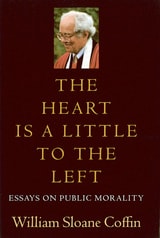
The Heart Is a Little to the Left
Essays on Public MoralityWilliam Sloane Coffin
Dartmouth College Press, 2011
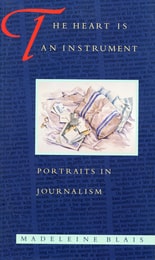
The Heart Is an Instrument
Portraits in JournalismMadeleine Blais
University of Massachusetts Press, 1992
From the Foreword by Geneva Overholser
What is it about really fine writers, how they delight, intrigue, compel us?
Style, you say. But style is not something you begin with. Rather, it's what you end up with, a result of far more fundamental traits. Traits such as an ear and an eye and a heart, traits that Madeleine Blais has honed superbly well.
This is a book well named: The Heart Is an Instrument: Portraits in Journalism. The heart is surely first among Blais's gifts. Whether she is writing about the famous—playwright Tennessee Williams, novelist Mary Gordon—or about the least elevated among us—a teenage prostitute infected with the AIDS virus, a homeless schizophrenic—she brings to her subjects an incomparable empathy.
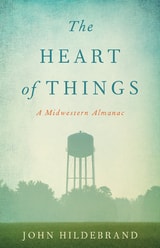
The Heart of Things
A Midwestern AlmanacJohn Hildebrand
Wisconsin Historical Society Press, 2014
In this remarkable book of days, John Hildebrand charts the overlapping rings—home, town, countryside—of life in the Midwest. Like E. B. White, Hildebrand locates the humor and drama in ordinary life: church suppers, Friday night football, outdoor weddings, garden compost, family reunions, roadside memorials, camouflage clothing. In these wry, sharply observed essays, the Midwest isn’t The Land Time Forgot but a more complicated (and vastly more interesting) place where the good life awaits once we figure exactly out what it means. From his home range in northwestern Wisconsin, Hildebrand attempts to do just that by boiling down a calendar year to its rich marrow of weather, animals, family, home—in other words, all the things that matter.
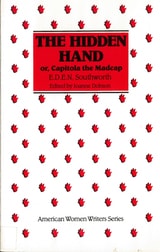
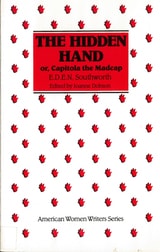
The Hidden Hand
Or, Capitola the Madcap by E. D. E. N. SouthworthDobson, Joanne
Rutgers University Press, 1988
E.D.E.N. Southworth was one of the most popular and prolific writers of the nineteenth century and her Capitola Black, or Black Cap - a cross-dressing, adventure-seeking girl-woman - was so well-loved that the book was serialized three times between 1859 and 1888 and was dramatized in forty different versions.
When we first meet sharp and witty Capitola she is living among beggars and street urchins, and dressed as a boy because a boy can get work and be safe, whereas a girl is left to starve for want of "proper" employment. Unknown to her, Capitola has a very rich elderly guardian who finds her at a providential moment and takes her back to his palatial mansion where she finds herself "decomposing above ground for want of having my blood stirred." But not to fear. There are bandits, true-loves, evil men, long-lost mothers, and sweet women friends in Capitola's future - not to mention thunder storms, kidnap attempts, and duels.
The pace is fast, the action wonderfully unbelievable. This is escape literature at its nineteenth-century best, with a woman at its center who makes you feel strong, daring, and reckless.
The Hidden Hand
Or, Capitola the Madcap by E. D. E. N. SouthworthDobson, Joanne
Rutgers University Press, 1988
The Hindered Hand
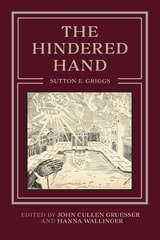
John Cullen Gruesser
University of Delaware Press, 0
Between 1899 and 1908, five long works of fiction by the Nashville-based Black Baptist minister Sutton E. Griggs appeared in print in which he examined the interrelationships among race, politics, economics, gender, culture, religion, violence, and empire, making him the most prolific African American novelist at the turn of the twentieth century, a time at which the civil rights and the very existence of African Americans, especially those in the South, were increasingly in jeopardy.
Brought out by Griggs’s own Orion Publishing Company in three distinct printings in 1905 and 1906, The Hindered Hand; or, the Reign of the Repressionist addresses the author’s key themes of amalgamation, emigration, armed resistance, and US overseas expansion; includes a melodramatic love story; and features two of the most sensational scenes in early African American fiction—a harrowingly graphic lynching of an innocent black couple based on actual events and the elaboration of a plot to wipe out white Southerners by introducing yellow fever germs into the water supply.
Written in response to Thomas Dixon’s recently published race-baiting novel The Leopard’s Spots, Griggs’s book depicts the remnants of the old Southern planter class, the racial crisis threatening the South and the North, the social ferment of the time, the changing roles of women, and the thwarted aspirations of a trio of African American veterans following the war against Spain. This scholarly edition of the novel, providing newly discovered biographical information and copious historical context, makes a significant contribution to African American literary scholarship.
The Hopwood Awards
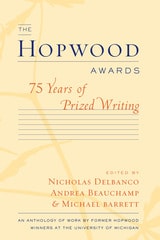
75 Years of Prized WritingEdited by Nicholas Delbanco, Andrea Beauchamp, and Michael Barrett
University of Michigan Press, 2006
-Arthur Miller
The Hopwood Awards claim a gallery of prizewinners who rose to become the Who's Who of writers of the last three generations: Max Apple, John Ciardi, Mary Gaitskill, Robert Hayden, Laura Kasischke, Jane Kenyon, Arthur Miller, Howard Moss, Frank O'Hara, Marge Piercy, Ronald Wallace, and Nancy Willard, among many others.
Since they first began in 1931, funded by a bequest from the will of playwright Avery Hopwood, University of Michigan Class of 1905, the Hopwood Awards have grown in profile and stature to become one of the most sought after and celebrated writing prizes for students.
The Hopwood Awards: 75 Years of Prized Writing collects-for the first time in one volume-poetry and prose by writers who won Hopwood Awards when they were students at the University of Michigan and who went on to achieve fame as writers.
Nicholas Delbanco is Professor of English and Director of the Hopwood Program at the University of Michigan. He is author or editor of numerous books, including Anywhere Out of the World: Essays on Travel, Writing, Death;The Sincerest Form; and The Writing Life: The Hopwood Lectures.
Andrea Beauchamp is Program Associate at the Hopwood Program, and Michael Barrett is Associate Editor at the Hopwood Program, University of Michigan.
The Hopwood Lectures
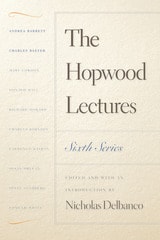
Edited and with an introduction by Nicholas Delbanco
University of Michigan Press, 2009
The prestigious Hopwood Creative Writing Awards were established in 1931 from a bequest of the will of Avery Hopwood, a University of Michigan graduate and one of the most popular and successful dramatists of his time. Hopwood left one-fifth of his estate to his alma mater, an endowment that now awards approximately $135,000 each year in prize money. Annual awards are offered to both undergraduate and graduate students in drama, screenplay, nonfiction, novel, short fiction, and poetry. Among the program's most famous recipients are Robert Hayden, Arthur Miller, Frank O'Hara, and Marge Piercy.
In addition to the prize ceremony, the Hopwood Awards are celebrated each year with a lecture delivered by a prominent literary figure. Past Hopwood speakers include such luminaries as Saul Bellow, Richard Ford, Louise Glück, Nadine Gordimer, Robert Hass, Norman Mailer, Joyce Carol Oates, and John Crowe Ransom. Their speeches have been collected in five previous volumes published by the University of Michigan Press over the past half-century: The Writer and His Craft: The Hopwood Lectures 1932-1952, edited by Roy W. Cowden; To The Young Writer: Hopwood Lectures, Second Series, edited by A. L. Bader; The Writer's Craft, edited by Robert A. Martin; Speaking of Writing: Selected Hopwood Lectures, edited by Nicholas Delbanco; and The Writing Life: The Hopwood Lectures, Fifth Series, edited by Nicholas Delbanco.
The present collection contains the ten lectures delivered since the last publication and includes work by Andrea Barrett, Charles Baxter, Mary Gordon, Donald Hall, Richard Howard, Lawrence Kasdan, Susan Orlean, Susan Stamberg, and Edmund White. The tenth lecture was delivered in spring 2008 by Charles Johnson.
Nicholas Delbanco is Robert Frost Collegiate Professor of English Language and Literature and Chair of the Hopwood Committee. Delbanco is the author of twenty books of fiction and nonfiction, including, most recently, Spring and Fall: A Novel. As editor he has compiled the work of, among others, John Gardner and Bernard Malamud. In addition to directing the MFA Program and the Hopwood Awards Program at the University of Michigan, he has served as Chair of the Fiction Panel for the National Book Awards and has received a Guggenheim Fellowship and, twice, a National Endowment for the Arts Writing Fellowship. He lives in Ann Arbor, Michigan.

The Hour of All Things and Other Plays
Caridad Svich
Intellect Books, 2018
The House of Breath
William Goyen
Northwestern University Press, 1999
The Huguenot Experience of Persecution and Exile
Three Women’s StoriesCharlotte Arbaleste Duplessis-Mornay, Anne de Chaufepié, and Anne Marguerite Petit Du Noyer
Iter Press, 2019
Edited by Colette H. Winn. Translated by Lauren King and Colette H. Winn
The Other Voice in Early Modern Europe: The Toronto Series, Vol. 68
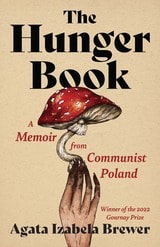
The Hunger Book
A Memoir from Communist PolandAgata Izabela Brewer
The Ohio State University Press, 2023
“A searing memoir about growing up behind the Iron Curtain, motherhood, addiction, and finding sustenance in the natural world.” —Kirkus
In The Hunger Book, Agata Izabela Brewer evokes her Polish childhood under Communism, where the warmth of her grandparents’ love and the scent of mushrooms drying in a tiny apartment are as potent as the deprivations and traumas of life with a terrifyingly unstable, alcoholic single mother. Brewer indelibly renders stories of foraging for food, homemade potato vodka (one of the Eastern Bloc’s more viable currencies), blood sausage, sparrows plucked and fried with linseed oil, and the respite of a country garden plot, all amid Stalinist-era apartment buildings, food shortages, martial law, and nuclear disaster in nearby Ukraine.
Brewer reflects on all of this from her immigrant’s vantage point, as she wryly tries to convince her children to enjoy the mushrooms she gathers from a roadside and grieves when they choose to go by Americanized versions of their Polish names. Hunting mushrooms, like her childhood, carried both reward and mortal peril. The Hunger Book, which includes recipes, is an unforgettable meditation on motherhood and addiction, resilience and love.
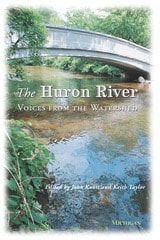
The Huron River
Voices from the WatershedJohn Knott and Keith Taylor, Editors
University of Michigan Press, 2000
"The Huron River . . . was called 'Cos-scut-e-nong Sebee'. . . . [It] is a beautiful, transparent stream, passing alternatively through rich bottoms, openings, plains, and sloping woodlands, covered with heavy timber."
---History of Washtenaw County, Michigan, 1881
The Huron River---stretching 130 miles through three counties---has inspired numerous writers throughout the nineteenth and twentieth centuries. Contained here is a collection of new poems, essays, and stories, accompanied by maps, photographs, and illustrations that celebrate the Huron River. Over twenty locally and nationally known literary figures, including Alice Fulton and Charles Baxter, have contributed to this volume. In addition, the work of biologists, naturalists, and even an arche-ologist have been included to give a richer sense of the physical and cultural environment.
Each of these writers reminds us that our lives are more intertwined with the river and its watershed than we might think. The Huron River opens with these words: "Watersheds are the oldest and most durable markers of place. . . . These boundaries affect our lives by defining our natural environment, not only its topography but its soils, its plant and animal life, and to some extent its weather. The water that sustains most of us is the water that flows through our local watershed."
And the river's strength is wondrous unto itself. "The water will always be there, and it will always find its way down," writer Gary Snyder tells us. The river is sometimes visible, sometimes not; yet it "is alive and well under the city streets, running in giant culverts."
John Knott is Professor of English, University of Michigan. After working as a bookseller for twenty years, Keith Taylor now teaches writing part-time for the University of Michigan and works as a freelance writer.
The Iliad
Homer
University of Michigan Press, 2007
nuances of English."
---Stephen G. Daitz, Professor Emeritus of Classics, City University of New York
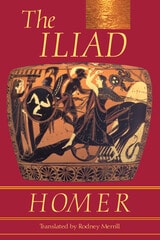
Rodney Merrill's translation of Homer's Iliad offers a form of English poetry particularly relevant to the epic, producing a strong musical setting that brings many elements of the narrative truly to life. Most notable are the many battle scenes, in which Homer's strong dactylic hexameters make credible the "war-lust" in the deeds of the combatants.
The Imaginative Vision of Abdilatif Abdalla’s Voice of Agony
Abdilatif Abdalla, edited by Annmarie Drury
University of Michigan Press, 2024
Yet, Imaginative Vision is also something more. Even as it centers on a literary translation of a singularly beautiful and influential book of poetry, it tells English-language readers the story of that book. Supporting materials illuminate the circumstances of its inception when Abdilatif, aged 22, was arrested and tried. They explore what the volume meant to its first readers and its affiliations with subsequent extraordinary works of prison literature by Alamin Mazrui and Ngũgĩ wa Thiong’o. They trace its links to literary art of the past, including the nineteenth-century poet Muyaka bin Haji, and to writing that followed. And they explain social and historical aspects of the Swahili coastal world that nurtured Abdilatif’s political engagement and stunning verbal art. Under the editorship of scholar, translator, and poet Annmarie Drury, contributors bring insights from their diverse backgrounds to present contextualizing material that illuminates the poems at the heart of this book.
The Inconvenient Indian
A Curious Account of Native People in North AmericaThomas King
University of Minnesota Press, 2013
In The Inconvenient Indian, Thomas King offers a deeply knowing, darkly funny, unabashedly opinionated, and utterly unconventional account of Indian–White relations in North America since initial contact. Ranging freely across the centuries and the Canada–U.S. border, King debunks fabricated stories of Indian savagery and White heroism, takes an oblique look at Indians (and cowboys) in film and popular culture, wrestles with the history of Native American resistance and his own experiences as a Native rights activist, and articulates a profound, revolutionary understanding of the cumulative effects of ever-shifting laws and treaties on Native peoples and lands.
Suffused with wit, anger, perception, and wisdom, The Inconvenient Indian is at once an engaging chronicle and a devastating subversion of history, insightfully distilling what it means to be “Indian” in North America. It is a critical and personal meditation that sees Native American history not as a straight line but rather as a circle in which the same absurd, tragic dynamics are played out over and over again. At the heart of the dysfunctional relationship between Indians and Whites, King writes, is land: “The issue has always been land.” With that insight, the history inflicted on the indigenous peoples of North America—broken treaties, forced removals, genocidal violence, and racist stereotypes—sharpens into focus. Both timeless and timely, The Inconvenient Indian ultimately rejects the pessimism and cynicism with which Natives and Whites regard one another to chart a new and just way forward for Indians and non-Indians alike.
The Incorporative Consciousness of Robert Bly
Victoria Frenkel Harris
Southern Illinois University Press, 1991
Victoria Frenkel Harris traces the aesthetic journey of poet Robert Bly from his early structured works of mystical imagery and lyrical landscapes to his recent explorations of intimate relationships and male socialization.
Examining the various ways Bly’s prose poems articulate his opposition to the Vietnam War and his recent writings manipulate more formal patterns in detailing the intricacies of human relationships, Harris labels this evolution in form, subject, and imagery the incorporative consciousness, incorporative because it assimilates Jungian psychological categories, international poetic traditions, and a compelling breadth of topics.
Harris relies in part on contemporary feminist theory to throw revealing new light on Bly’s recent works. Though sympathetic to Bly, Harris finds that—in spite of his affirmation of the interaction of psychic, creative, and intellectual energies in both sexes—the poet’s later, erotic poems tend to objectify women in counterproductive ways. Bly’s idealization of woman as a Jungian universal, Harris contends, can blind him toward actual women.
Harris is at her best as she delimits with balance and precision the full complexity of the poet’s work.
The Influence of Darwin on Philosophy and Other Essays in Contemporary Thought
John Dewey. Edited by Larry A. Hickman. Introduction by Douglas Browning
Southern Illinois University Press, 2007
Presenting Dewey’s new view of philosophical inquiry
This critical edition of The Influence of Darwin on Philosophy and Other Essays in Contemporary Thought presents the results of John Dewey’s patient construction, throughout the previous sixteen years, of the radically new view of the methods and concerns of philosophical inquiry. It was a view that he continued to defend for the rest of his life.
In the 1910 The Influence of Darwin on Philosophy and Other Essays in Contemporary Thought—the first collection of Dewey’s previously published, edited essays—John Dewey provided readers with an overview of the scope and direction of his philosophical vision in one volume. The order in which the eleven essays were presented was a reverse chronology, with more recently published essays appearing first. The collection of eleven essays offered a detailed portrait of Dewey’s proposed reconstruction of the traditional concepts of knowledge and truth. It furthermore elaborated on how his new logic and his proposal regarding knowledge and truth fit comfortably together, not only with each other but also with a pragmatically proper understanding of belief, reality, and experience.
Because material in the Collected Works of John Dewey, 1882–1953 was published chronologically, however, the essays published together in the 1910 Darwin book have appeared in seven different volumes in the Collected Works. This new, critical edition restores a classic collection of essays authored and edited by John Dewey as they originally appeared in the volume. The edition is presented with ancillary materials, including responses by Dewey’s critics and an introduction by Douglas Browning.