Results by title
1107 books match the query 'Memoirs' and 198 start with t
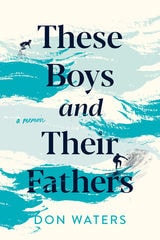
These Boys and Their Fathers
A MemoirDon Waters
University of Iowa Press, 2019
These Boys and Their Fathers touches on Waters’s early life with his single mother—and her string of dysfunctional men—and his later search for and encounters with his father, but it quickly expands into a gripping account of the life of a 1930s pulp writer, also named Don Waters, with whom Waters becomes obsessed. This wildly original book blends memoir, investigative reporting, and fiction to sort out difficult aspects of family, masculinity, and what it means to be a father.
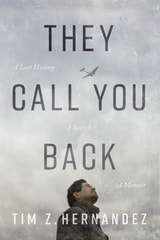
They Call You Back
A Lost History, A Search, A MemoirTim Z. Hernandez
University of Arizona Press, 2024
A haunting, an obsession, a calling: Tim Z. Hernandez has been searching for people his whole life. Now, in this highly anticipated memoir, he takes us along on an investigative odyssey through personal and collective history to uncover the surprising conjunctions that bind our stories together.
Hernandez’s mission to find the families of the twenty-eight Mexicans who were killed in the 1948 plane wreck at Los Gatos Canyon formed the basis for his acclaimed documentary novel All They Will Call You, which the San Francisco Chronicle dubbed “a stunning piece of investigative journalism,” and the New York Times hailed as “painstaking detective work by a writer who is the descendant of farmworkers.”
In this riveting new work, Hernandez continues his search for the plane crash victims while also turning the lens on himself and his ancestral past, revealing the tumultuous and deeply intimate experiences that have fueled his investigations—a lifelong journey haunted by memory, addiction, generational trauma, and the spirit world.
They Call You Back is the true chronicle of one man’s obsession to restore dignity to an undignified chapter in America’s past, while at the same time making a case for why we must heal our personal wounds if we are ever to heal our political ones.
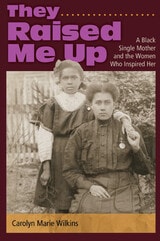
They Raised Me Up
A Black Single Mother and the Women Who Inspired HerCarolyn Marie Wilkins
University of Missouri Press, 2013
At the height of the cocaine-fueled 1980s, Carolyn Wilkins left a disastrous marriage in Seattle and, hoping to make it in the music business, moved with her four-year-old daughter to a gritty working-class town on the edge of Boston. They Raised Me Up is the story of her battle to succeed in the world of jam sessions and jazz clubs—a man’s world where women were seen as either sex objects or doormats. To survive, she had to find a way to pay the bills, overcome a crippling case of stage fright, fend off a series of unsuitable men, and most important, find a reliable babysitter.
Alternating with Carolyn’s story are the stories of her ancestors and mentors—five musically gifted women who struggled to realize their dreams at the turn of the twentieth century:
Philippa Schuyler, whose efforts to “pass” for white inspired Carolyn to embrace her own black identity despite her “damn near white” appearance and biracial child;
Marjory Jackson, the musician and single mother whose dark complexion and flamboyant lifestyle raised eyebrows among her contemporaries in the snobby, color-conscious world of the African American elite;
Lilly Pruett, the daughter of an illiterate sharecropper whose stunning beauty might have been her only ticket out of the “Jim Crow” South;
Ruth Lipscomb, the country girl who dreamed, against all odds, of becoming a concert pianist and realized her improbable ambition in 1941;
Alberta Sweeney, who survived a devastating personal tragedy by relying on the musical talent and spiritual stamina she had acquired growing up in a rough-and-tumble Kansas mining town.
They Raised Me Up interweaves memoir with family history to create an entertaining, informative, and engrossing read that will appeal to anyone with an interest in African American or women’s history or to readers simply looking for an intriguing story about music and family.
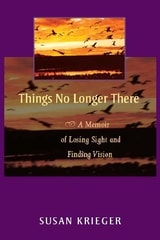
Things No Longer There
A Memoir of Losing Sight and Finding VisionSusan Krieger
University of Wisconsin Press, 2005
Krieger's touching memoir explores the ways that outer landscapes may change and sight may be lost, but inner visions persist, giving meaning, jarring the senses with a very different picture than what appears before the eyes. This book will reward both the general reader and those interested in disability studies, feminist ethnography, and lesbian studies.
Things You Need to Hear
Collected Memories of Growing Up in Arkansas, 1890–1980Margaret Jones Bolsterli
University of Arkansas Press, 2016
Thirty Rooms to Hide In
Insanity, Addiction, and Rock ‘n’ Roll in the Shadow of the Mayo ClinicLuke Longstreet Sullivan
University of Minnesota Press, 2014
Author Luke Longstreet Sullivan has a simple way of describing his new memoir: “It’s like The Shining . . . only funnier.” Thirty Rooms to HideIn tells the astonishing story of Sullivan’s father and his descent from one of the world’s top orthopedic surgeons at the Mayo Clinic to a man who is increasingly abusive, alcoholic, and insane, ultimately dying alone on the floor of a Georgia motel room. For his wife and six sons, the years prior to his death were characterized by turmoil, anger, and family dysfunction; but somehow they were also a time of real happiness for Sullivan and his brothers, full of dark humor and much laughter.
Through the 1950s and 1960s, the six brothers had a wildly fun and thoroughly dysfunctional childhood living in a forbidding thirty-room mansion, known as the Millstone, on the outskirts of Rochester, Minnesota. The many rooms of the immense home, as well as their mother’s loving protection, allowed the Sullivan brothers to grow up as normal, mischievous boys. Against a backdrop of the times—the Cold War, the Cuban Missile Crisis, fallout shelters, JFK’s assassination, and the Beatles—the cracks in their home life and their father’s psyche continue to widen. When their mother decides to leave the Millstone and move the family across town, the Sullivan boys are able to find solace in each other and in rock ’n’ roll.
As Thirty Rooms to HideIn follows the story of the Sullivan family—at times grim, at others poignant—a wonderful, dark humor lifts the narrative. Tragic, funny, and powerfully evocative of the 1950s and 1960s, Thirty Rooms to Hide In is a tale of public success and private dysfunction, personal and familial resilience, and the strange power of humor to give refuge when it is needed most, even if it can’t always provide the answers.
This Is Where I Am
A MemoirZeke Caligiuri
University of Minnesota Press, 2016
Prison is where Zeke Caligiuri is. Powderhorn Park in South Minneapolis, dubbed “Murderapolis” the year he turned eighteen, is where he comes from. It was the same neighborhood his father grew up in but had changed dramatically by the early 1990s. Yet in Zeke’s family, father and mother and grandmother kept things together while all around them the houses decayed and once-safe streets gave way to the crush of poverty and crime.
This Is Where I Am is Zeke Caligiuri’s clear-eyed account of how he got from there to here, how a boy who had every hope went from dreaming of freedom to losing it, along with nearly everything and everyone he loved. Tenderhearted in its reflections on his lost childhood, brutally candid in its description of a life of hanging and hustling, Zeke’s memoir recreates a world of tagging and goofing gone awry, of moving from smoking pot to unsuccessful attempts at dealing crack, of watching his father weep at the funeral of a seventeen-year-old boy, of going to jail: first strike. It is a place where, when asked what he's going to do with his life, a friend can only answer: “What the fuck are you talking about?”
This Is Where I Am is Zeke's own answer: he is going to tell his story, every sharp detail and sobering word, with the natural grace of a gifted writer and the hard-won wisdom of hindsight.
This Is a True War Story
My Improbable History with VietnamRobert K. Brigham
University of Chicago Press, 2026
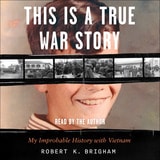
Robert K. Brigham has had a substantial career as a historian of the Vietnam War, with a hand in nine books, a documentary, public history projects, and more. While many a historian has felt compelled at some point to write about a subject close to them personally, Brigham did not think he was doing that. But, at age fifty-eight, Brigham, who had long known he was adopted, discovered that he’d improbably and unknowingly been studying and talking about his biological father for decades. That man, Bruce Atwell, was a Marine Corps photographer who took some of that war’s most indelible and widely reproduced pictures. Brigham had used those images over and over again in decades’ worth of classes and public lectures, never knowing the truth.
Both Brigham and Atwell were products of the American foster care and adoption system, and both were defined professionally by Vietnam. In a story shot through with echoes and shadows, Brigham not only reveals his own history as an adoptee but opens a startlingly fresh vantage on the fragility of American families; the power of social norms and taboos to shape lives; and the forces that inequitably disrupt families, not least of them war. The result is an accessible and moving book that is at once both a powerful personal story and an illuminating social critique.
This Is a True War Story
My Improbable History with VietnamRobert K. Brigham
University of Chicago Press, 2026
A personal account by a war historian and adoptee who discovers his biological father was a famous Marine combat photographer in Vietnam.
Robert K. Brigham has had a substantial career as a historian of the Vietnam War, with a hand in nine books, a documentary, public history projects, and more. While many a historian has felt compelled at some point to write about a subject close to them personally, Brigham did not think he was doing that. But, at age 58, Brigham, who had long known he was adopted, discovered that he’d improbably and unknowingly been studying and talking about his real father for decades. That man, Bruce Atwell, was a Marine Corps photographer who took some of that war’s most indelible and widely reproduced pictures. Brigham had used those images over and over again in decades’ worth of classes and public lectures, never knowing the truth.
Both Brigham and Atwell were products of the American foster care and adoption system, and both were defined professionally by Vietnam. In a story shot through with echoes and shadows, Brigham not only reveals his own history as an adoptee but opens a startlingly fresh vantage on the fragility of American families; the power of social norms and taboos to shape lives; and the forces that inequitably disrupt families, not least of them war. The result is an accessible and moving book that is at once both a powerful personal story and an illuminating social critique.
This One Will Hurt You
Paul Crenshaw
The Ohio State University Press, 2019
With eloquence, subtle humor, and an urgent poignancy, Crenshaw delivers a powerful and moving collection of nonfiction essays, tied together by place and the violence of the world in which we live.
This Tender Place
The Story of a Wetland YearLaurie Lawlor
University of Wisconsin Press, 2007
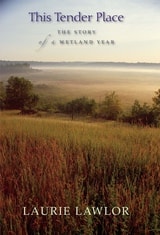
After the deaths of her father and father-in-law, Laurie Lawlor discovers an unlikely place for healing and transformation in a wetland in southeastern Wisconsin—a landscape of abundant and sometimes inaccessible beauty that has often been ignored, misunderstood, and threatened by human destruction. In her decade-long personal wetland journey, she examines the sky, delves underwater, and peers between sedges in all seasons and all times of day.
This Tender Place is a celebration of nature, the elements, and humanity. From the wetland’s genesis during the ice age to its survival in the twenty-first century, Lawlor chronicles the universal ties among people, wild places, and healthy wetlands.
An engaging and deeply intimate record, This Tender Place is at its heart a story of refuge and renewal refracted through the lens of life within the wetlands—one of the most productive, yet most endangered, ecosystems in the world.
This Way Back
Joanna Eleftheriou
West Virginia University Press, 2020
Going back to her ancestral homeland, a Greek American girl discovers she is a lesbian in love with God, so her questions about home and belonging will not be easily answered.
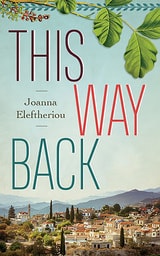
This Way Back dramatizes a childhood split between Queens, New York, and Cyprus, an island nation with a long colonial history and a culture to which Joanna Eleftheriou could never quite adjust. The book avows a Greek-Cypriot-American lesbian’s existence by documenting its scenes: reenacting an 1829 mass suicide by jumping off a school stage onto gym mats at St. Nicholas, harvesting carobs on ancestral land, purchasing UNESCO-protected lace, marching in the island’s first gay pride parade, visiting Cyprus’s occupied north against a dying father’s wish, and pruning geraniums, cypress trees, and jasmine after her father grew too weak to lift the shears. While the author’s life binds the essays in This Way Back into what reads like a memoir, the book questions memoir’s conventional boundaries between the individual and her community, and between political and personal loss, the human and the environment, and the living and the dead.
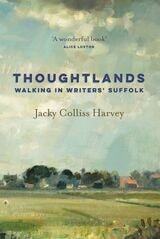
Thoughtlands
Walking in Writers' SuffolkJacky Colliss Harvey
Haus Publishing, 2026
The first book of its kind to map writers, walks, and writing within the Suffolk landscape.
This is a book about walking and writing: about walkers who wrote and writers who walk. It is about the circuit that exists between mind and feet, and about landscapes that exist both physically in front of you and in a line of words. And since all this walking and writing and thinking must have somewhere to take place, it is also a book about Suffolk, the author’s birthplace, and how writers have used and responded to its unmistakable magic.
Colliss Harvey travels from west to east, from chalk plain to crag, from velvety farmlands muffled by leaves to deafening shingle and uncompromising sea. She walks in excellent company—her fellow writers range from Daniel Defoe and Robert Louis Stevenson to Patricia Highsmith, P. D. James, Ronald Blythe, and Ruth Rendell. They include the poets George Crabbe and Robert Bloomfield; literary greats Wilkie Collins, George Orwell, and W. G. Sebald, who found a new native land here; and those born in Suffolk, such as M. R. James and Edward Fitzgerald.
The walks can be followed on foot with this book in a backpack, for those moments when walking gives way to reading, or from within the deep comfort of a favorite armchair. A bit of the writer’s notebook, a little of the memoir, and a dash of the love letter, Thoughtlands is a one-of-a-kind literary journey and an unparalleled exploration of the Suffolk landscape.
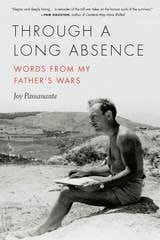
Through a Long Absence
Words from My Father's WarsJoy Passanante
The Ohio State University Press, 2017
Against the backdrop of World War II, Joy Passanante’s touching new book, Through a Long Absence: Words from My Father’s Wars, is the saga of a wartime medical unit, a passionate long-distance love, the making of a surgeon, and two first-generation American families. Told through her father’s eyes—drawing on hundreds of his letters to his beloved wife, his four-volume wartime diary, and his paintings—Passanante masterfully recreates his wartime journey and physically retraces his steps more than sixty years later in an attempt to understand a time in her parents’ lives that they’d spoken about very little.
More than just a World War II story, Through a Long Absence delves into one man’s past to explore his personal wars: a stint as a child bootlegger, a marriage between newlyweds separated by continents and strained by years apart, and his struggle late in life with his own mind. The narrative propels readers to surprising places—from a freight train through North Africa to an underground St. Louis distillery during Prohibition, from a young couple’s forbidden courtship to the chaos of surgical tents under fire in Normandy, from an underground trove of priceless artwork hidden by the Nazis to Jewish New Year services in Paris a week after its liberation. Through a Long Absence is a love story, an honest look into one man’s life, and a daughter’s moving quest to rediscover her father years later through his own words.
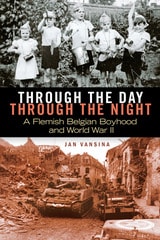
Through the Day, through the Night
A Flemish Belgian Boyhood and World War IIJan Vansina
University of Wisconsin Press, 2014
Within the vast literature on World War II, a much smaller body of work treats the everyday experiences of civilians, particularly in smaller countries drawn into the conflict. Recalling the war in Belgium from a child’s-eye perspective, Vansina describes pangs of hunger so great as to make him crave the bitter taste of cod-liver oil. He vividly remembers the shock of seeing severely wounded men on the grounds of a field hospital, the dangers of crossing fields and swimming in ponds strafed by planes, and his family’s interactions with occupying and escaping soldiers from both sides. After the war he recalls emerging numb from the cinema where he first saw the footage of the Nazi death camps, and he describes a new phase of unrest marked by looting, vigilante justice, and the country’s efforts at reunification.
Vansina, a historian and anthropologist best known for his insights into oral tradition and social memory, draws on his own memories and those of his siblings to reconstruct daily life in Belgium during a tumultuous era.
Best Special Interest Books, selected by the American Association of School Librarians
Best Books for General Audiences, selected by the Public Library Reviewers
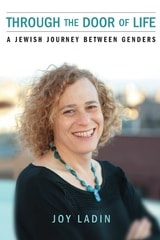
Through the Door of Life
A Jewish Journey between GendersJoy Ladin
University of Wisconsin Press, 2012
Professor Jay Ladin made headlines around the world when, after years of teaching literature at Yeshiva University, he returned to the Orthodox Jewish campus as a woman—Joy Ladin. In Through the Door of Life, Joy Ladin takes readers inside her transition as she changed genders and, in the process, created a new self.
With unsparing honesty and surprising humor, Ladin wrestles with both the practical problems of gender transition and the larger moral, spiritual, and philosophical questions that arise. Ladin recounts her struggle to reconcile the pain of her experience living as the “wrong” gender with the pain of her children in losing the father they love. We eavesdrop on her lifelong conversations with the God whom she sees both as the source of her agony and as her hope for transcending it. We look over her shoulder as she learns to walk and talk as a woman after forty-plus years of walking and talking as a man. We stare with her into the mirror as she asks herself how the new self she is creating will ever become real.
Ladin’s poignant memoir takes us from the death of living as the man she knew she wasn’t, to the shattering of family and career that accompanied her transition, to the new self, relationships, and love she finds when she opens the door of life.
2012 Finalist for the National Jewish Book Award for Biography, Autobiography, or Memoir
“Given her high-profile academic position, Ladin’s transition was a major news story in Israel and even internationally. But behind the public story was a private struggle and learning experience, and Ladin pulls no punches in telling that story. She offers a peek into how daunting it was to learn, with little support from others, how to dress as a middle-aged woman, to mu on make-up, to walk and talk like a female. She provides a front-row seat for observing how one person confronted a seemingly impossible situation and how she triumphed, however shakingly, over the many adversities, both societal and psychological, that stood in the way.”—The Gay and Lesbian Review Worldwide
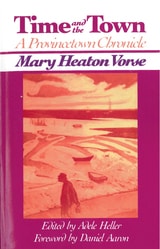
Time and the Town
A Provincetown ChronicleAdele Heller
Rutgers University Press, 1991
Time and the Town was the last of Mary Heaton Vorse's books. It is about many things —a town and its people, the author, a certain kind of idyllic life. As much as anything else, it is the biography of the house Vorse bought in 1907 and lived in, off and on, for the next thirty-six years. The moods of the house mirrored her own. "Our houses," she wrote, "are our biographies, the stories of our defeats and victories."
Tinged with nostalgia and disenchantment, the book describes a Provincetown that has changed, a place on the verge of modernity. It is no longer a major fishing port. It has become a place whose business is tourism. Contrasting the old and the new, Vorse celebrates the enduring character of the town itself. She tells stories that are engaging and charming, droll and fabulous. The wrinkled Mrs. Mary Mooncusser who, though drunk and stark naked, conducts herself with great decorum when Vorse pays her a call, might have stepped out of the pages of Sherwood Anderson or Eudora Welty. In another anecdote, the townspeople scour the beaches for cases of booze dumped into the sea by rumrunners and are briefly inflated with the spirit of ancestral smugglers and buccaneers.
Vorse herself remained something of an outsider in Provincetown, despite her evident affection for the place and its inhabitants. They surely regarded her as simply another of those artist-intellectuals--many of whom appear in the pages of this book. The "off-Cape" outsiders put the town in the national limelight but took no interest in local matters. Vorse here ponders local matters exclusively, almost, one suspects, as a way of forgetting the more complex matters that occupied her--her agonies of parental guilt, her resentment of domestic obligations, her third marriage, her depressions and breakdowns. The town is in that sense beyond time.
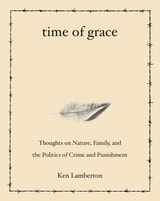
Time of Grace
Thoughts on Nature, Family, and the Politics of Crime and PunishmentKen Lamberton
University of Arizona Press, 2007
Time of Grace is a remarkable book, written with great eloquence by a former science teacher who was incarcerated for twelve years for his sexual liaison with a teenage student. Far more than a “prison memoir,” it is an intimate and revealing look at relationships—with fellow humans and with the surprising wildlife of the Sonoran Desert, both inside and beyond prison walls. Throughout, Ken Lamberton reflects on human relations as they mimic and defy those of the natural world, whose rhythms calibrate Lamberton’s days and years behind bars. He writes with candor about his life, while observing desert flora and fauna with the insight and enthusiasm of a professional naturalist.
While he studies a tarantula digging her way out of the packed earth and observes Mexican freetail bats sailing into the evening sky, Lamberton ruminates on his crime and on the wrenching effects it has had on his wife and three daughters. He writes of his connections with his fellow inmates—some of whom he teaches in prison classes—and with the guards who control them, sometimes with inexplicable cruelty. And he unflinchingly describes a prison system that has gone horribly wrong—a system entrapped in a self-created web of secrecy, fear, and lies.
This is the final book of Lamberton’s trilogy about the twelve years he spent in prison. Readers of his earlier books will savor this last volume. Those who are only now discovering Lamberton’s distinctive voice—part poet, part scientist, part teacher, and always deeply, achingly human—will feel as if they are making a new friend.
Gripping, sobering, and beautifully written, Lamberton’s memoir is an unforgettable exploration of crime, punishment, and the power of the human spirit.
Times of Upheaval
Four Medievalists in Twentieth-Century Central Europe. Conversations with Jerzy Kloczowski, János M. Bak, František Šmahel, and Herwig WolframPavlína Rychterová
Central European University Press, 2019
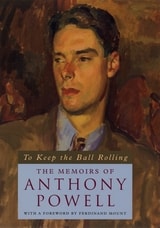
To Keep the Ball Rolling
The Memoirs of Anthony PowellAnthony Powell
University of Chicago Press, 2001
Powell did eventually reveal himself in four volumes of memoirs, published between 1976 and 1982. This edition of Anthony Powell's Memoirs is an abridged and revised version of those volumes, a version that has never before been published in this form in the United States. The result is not only a fascinating view of Powell as a man and an author but also a unique history of British literary society and the social elite Powell lampooned and moved within from the twenties through the eighties. From Eton and Oxford to his life as a novelist and critic, Powell observes all—the obscenity trial sparked by Lady Chatterley's Lover; Shirley Temple's libel suit after Graham Greene reviewed Wee Willie Winkie "with even more than his usual verve"—and paints vivid portraits of Kingsley Amis, V.S. Naipaul, T.S. Eliot, Virginia Woolf, and countless others. Most importantly, Powell's lively memoirs banish all thought of the man as a relic of the British gentry. He was a modernist, a Tory, and more than a little interested in genealogy and peerage, but a man who, according to Ferdinand Mount, "miraculously knew what life was like."
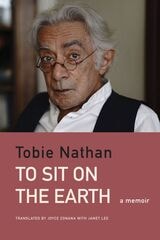
To Sit on the Earth
A MemoirTobie Nathan
Seagull Books, 2024
In To Sit on the Earth, pioneering ethno-psychiatrist Tobie Nathan charts his intellectual and emotional journey, from his youthful infatuation with Freud and Wilhelm Reich to his mature adoption of anthropologist Georges Devereux’s ethnographic approach to psychoanalysis.
Expelled from Egypt as a Jew in 1956 when he was just a boy, Nathan spent his formative years on the outskirts of Paris. Caught up in situationist and Marxist politics, he enthusiastically participated in the revolutionary Events of May 1968. He then settled into a distinguished career as a writer, professor, and founding director of a free ethno-psychiatry clinic serving migrant populations in the French capital. Along the way, Nathan’s field research and practice took him to Benin, Burundi, and Brazil, where he sought out sorcerers, shamans, and other indigenous healers. As he did so, he encountered telling echoes of his ancestors’ age-old practices in Judeo-Arab Cairo.
Combining case histories and theoretical reflections with personal and familial anecdotes, while engaging with contemporary thinkers—including Sartre, Lacan, Bourdieu, and Foucault—this multi-layered, genre-defying memoir invites us to reconsider the beliefs that connect us to others and ourselves. To Sit on the Earth lays out a subtle, compelling case for the theological and cultural diversity essential to a thriving modernity.
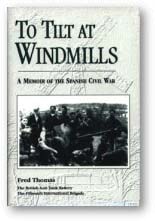
To Tilt at Windmills
A Memoir of the Spanish Civil WarFred A. Thomas
Michigan State University Press, 1996
To Tilt at Windmills is the memoir of Briton Fred Thomas who served with the International Brigades in the Spanish Civil War (July 1936-March 1939).
Inspired by a memorable return to Iberian battlefields forty years later, and based on diaries kept during the many months Thomas spent as a gunner with the British Anti-Tank Battery, the narrative moves eloquently along a journey into the war zone, through the several campaigns in which he fought and where he was twice wounded, and finally to the withdrawal of the Brigades from the conflict. What distinguishes Thomas' account is the remarkable detail provided by the diaries and the measured tone of his reminiscence, There is, as well, the poignant inquiry of the veteran into the shape and meaning of experience as a young soldier. The historian Paul Preston has cited the "warmth, directness and deep humanity" of To Tilt at Windmills, "an important contribution to the collective memory of the war.
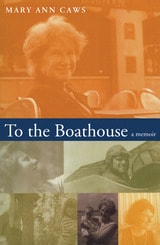
To the Boathouse
A MemoirMary Ann Caws
University of Alabama Press, 2008
From Southern roots to scholarly heights—one woman’s journey to find peace, purpose, and her place in the world.
A neat and lavish, if constricting, childhood in the lush landscapes of North Carolina. Summers at a calm, remote beach house. A proper and religiously influenced prep school in Washington. Years at Bryn Mawr, an impulsive study trip to Paris, further education at Yale, married life, and divorced life. These are the settings for Mary Ann Caws’s passionate memoir, in which she recounts the highs and lows of her journey through life. Marked by complicated relationships and a passion for learning, Caws’s story is one that resonates not only with writers like herself, but with all who have struggled with determining their path within the surrounding world.
Caws writes of her formal, stylish parents, her rebellious and deeply admired sister, and her artistic grandmother, whom she respected and idolized more than anyone else. She describes her marriage and subsequent divorce, her bouts with therapy, her children, and her growth as a student and writer. Throughout the memoir is evidence of her love for writing, teaching, art, and poetry as well as her deep respect for the people in her life that ultimately guided her into her career.
The author describes Southern society and her own life with fondness, nostalgia, and a tinge of honest criticism. The carefully selected details and delicate balance of sentiment and fact bring readers into the fascinating, complicated, and all-too-real world of Caws’s—and our own—past.
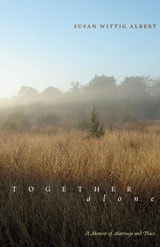
Together, Alone
A Memoir of Marriage and PlaceBy Susan Wittig Albert
University of Texas Press, 2009
What does it mean to belong to a place, to be truly rooted and grounded in the place you call home? How do you commit to a marriage, to a full partnership with another person, and still maintain your own separate identity? These questions have been central to Susan Wittig Albert's life, and in this beautifully written memoir, she movingly describes how she has experienced place, marriage, and aloneness while creating a home in the Texas Hill Country with her husband and writing partner, Bill Albert.
Together, Alone opens in 1985, as Albert leaves a successful, if rootless, career as a university administrator and begins a new life as a freelance writer, wife, and homesteader on a patch of rural land northwest of Austin. She vividly describes the work of creating a home at Meadow Knoll, a place in which she and Bill raised their own food and animals, while working together and separately on writing projects. Once her sense of home and partnership was firmly established, Albert recalls how she had to find its counterbalance—a place where she could be alone and explore those parts of the self that only emerge in solitude. For her, this place was Lebh Shomea, a silent monastic retreat. In writing about her time at Lebh Shomea, Albert reveals the deep satisfaction she finds in belonging to a community of people who have chosen to be apart and experience silence and solitude.
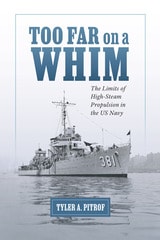
Too Far on a Whim
The Limits of High-Steam Propulsion in the US NavyTyler A. Pitrof
University of Alabama Press, 2024
WINNER OF THE LYMAN BOOK AWARD FOR MARITIME AND NAVAL SCIENCE, TECHNOLOGY, AND ENVIRONMENT
Argues that the US Navy’s commitment to high-steam propulsion for its World War II fleet was a tactical, technological, and bureaucratic failure
In Too Far on a Whim, Tyler A. Pitrof presents a high-spirited revision of the US Navy’s commitment to high-steam propulsion systems, the mainstay of its World War II fleets. Pitrof’s research persuasively demonstrates that in its war against the Imperial Japanese Navy, the US Navy succeeded despite its high-steam propulsion systems rather than because of them.
War with an aggressive Japan and a resurgent Germany loomed in the dark days of the late 1930s. Rear Admiral Harold G. Bowen Sr., head of the US Navy’s Bureau of Engineering, advanced a radical vision: a new fleet based on high-steam propulsion, a novel technology that promised high speeds with smaller engines and better fuel efficiency. High-steam engines had drawbacks—smaller operational ranges and maintenance issues. Nevertheless, trusting its engineers to resolve these issues, the US Navy put high-steam propulsion at the heart of its warship design from 1938 to 1945.
The official record of high-steam technology’s subsequent performance has relied heavily on Bowen’s own memoir, in which he painted high-steam innovation in heroic colors. Pitrof’s empirical review of primary sources such as ship’s maintenance records, however, illuminates the opposite—that the heroism lay in the ability of American seamen to improvise solutions to keep these difficult engines running.
Pitrof artfully explains engineering concepts in layman’s terms and provides an account that extends far beyond technology and into matters of naval hierarchies and bureaucracy, strategic theory, and ego. He offers a cautionary tale—as relevant to any endeavor as it is to military undertakings—about how failures arise when technical experts lack managers who understand their work. Admiral Bowen wielded excessive power because no one else in the US Navy knew enough to countermand him.
Compulsively readable, Too Far on a Whim is a landmark for those interested in naval history and technology but also for readers interested in the interplay between innovation, decision-making, and engineering.
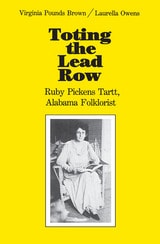
Toting the Lead Row
Ruby Pickens Tartt, Alabama FolkloristVirginia Pounds Brown
University of Alabama Press, 1981
Preserving voices from the back roads—Ruby Pickens Tartt and the folklore of Alabama’s Black Belt.
“You recall the expression ‘toting the lead row’, don’t you? In chopping cotton or corn there is always a leader, one who can chop the fastest of them all. When he finishes his row, he goes back and helps the other choppers finish theirs. The one who totes the lead row takes the lead place in the next row.”—Ruby Pickens Tartt
Toting the Lead Row is a powerful biographical and cultural tribute to Ruby Pickens Tartt, a white woman from Alabama’s Black Belt who devoted her life to preserving the oral traditions of rural Black communities. Born in 1880 in Livingston, Alabama, Tartt witnessed nearly a century of social transformation and made it her mission to document the songs, stories, and life histories of her African American neighbors. She believed that the soul of Sumter County resided not in its institutions, but in its cabins, fields, and voices.
During the Great Depression, Tartt worked with the Federal Writers’ Project, collaborating with renowned folklorists such as Carl Carmer and John Lomax. Her home became a hub for cultural preservation, attracting scholars and artists who recognized the depth of her fieldwork. The book’s title refers to a Southern agricultural phrase—“toting the lead row”—symbolizing leadership and support, a role Tartt embodied in her efforts to elevate the voices of those often overlooked.
This volume is divided into two parts: the first offers a detailed biography of Tartt and her work with the WPA, while the second presents a curated selection of her collected writings, including 18 life histories and 12 slave narratives. Through these stories, Tartt preserved a vital piece of Southern history and gave voice to generations whose experiences might otherwise have been lost.
Toting the Lead Row is both a celebration of a remarkable woman and a vital contribution to the study of folklore, race, and Southern identity.
Touching This Leviathan
Peter Wayne Moe
Oregon State University Press, 2021
Touching This Leviathan asks how we might come to know the unknowable—in this case, whales, animals so large yet so elusive, revealing just a sliver of back, a glimpse of a fluke, or a split-second breach before diving away.
Whale books often sit within disciplinary silos. Touching This Leviathan starts a conversation among them. Drawing on biology, theology, natural history, literature, and writing studies, Peter Wayne Moe offers a deep dive into the alluring and impalpable mysteries of Earth’s largest mammal.
Entertaining, thought-provoking, and swimming with intelligence and wit, Touching is Leviathan is creative nonfiction that gestures toward science and literary criticism as it invites readers into the belly of the whale.
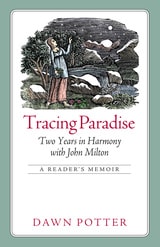
Tracing Paradise
Two Years in Harmony with John MiltonDawn Potter
University of Massachusetts Press, 2009
One winter morning, poet Dawn Potter sat down at her desk in Harmony, Maine, and began copying out the opening lines of John Milton's Paradise Lost. Her intent was to spend half an hour with a poem she had never liked, her goal to transcribe a page or two. Maybe she would begin to appreciate the poet's art, though she had no real expectations that the exercise would change her mind about the poem. Yet what began as a whim turned rapidly into an obsession, and soon Potter was immersed in a strange and unexpected project: she found herself copying out every single word of Milton's immense, convoluted epic.
Tracing Paradise: Two Years in Harmony with John Milton is her memoir of that long task. Over the course of twelve chapters, Potter explores her very personal response to Milton and Paradise Lost, tracing the surprising intersections between a seventeenth-century biblical epic and the routine joys and tragedies of domestic life in contemporary rural Maine. Curious, opinionated, and eager, she engages with the canon on mutable, individual terms. Though she writes perceptively about the details and techniques of Milton's art, always her reactions are linked to her present-tense experiences as a poet, small-time farmer, family member, and citizen of a poor and beleaguered north-country town.
A skilled and entertaining writer, Potter is also a wide-ranging and sophisticated reader. Yet her memoir is not a scholarly treatise: her enthusiasms and misgivings about both Milton and Paradise Lost ebb and flow with the days. Tracing Paradise reminds us that close engagement with another artist's task may itself be a form of creation. Above all, Potter's memoir celebrates one reader's difficult yet transformative love affair with Milton's glorious, irritating, inscrutable masterpiece.
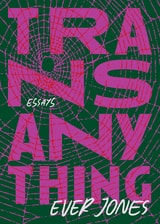
Transanything
EssaysEver Jones
Northwestern University Press, 2025
Transanything reveals a world in metamorphosis. A hermit crab retires its shell, lovers drift apart, and seasons churn, all amid Ever Jones’s own narrative of midlife gender transition.
Jones takes up a tradition of writing—about the American landscape, solitude, wilderness, and the West—long intertwined with colonialism and heteropatriarchy, and makes it wholly their own. A self-proclaimed “nature essay” misbehaves, wandering away from the hummingbird outside Jones’s window. In their chronicle of a week in Yellowstone, Jones navigates trails frequented by grizzlies and a campground where their identity is regarded as equally dangerous. Elk, bison, and bark spiders roam this book’s pages, but it is the gray wolf—the embattled apex predator of the American West, narrow survivor of settler colonial violence, and vessel for American myths of independence—who emerges as Jones’s shapeshifting coprotagonist.
Taking on a global web of colonial systems that seek to divide us, Jones disrupts loneliness and forges space for queerness and transness to be aliveness—to be transanything.
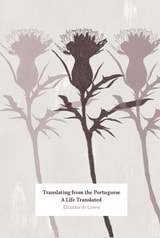
Translating from the Portuguese
A Life TranslatedElizabeth Lowe
Tagus Press, 2025
Elizabeth Lowe charts her journey to becoming a translator through a series of vignettes relating her life as a “third-culture kid” and living and working abroad in a kaleidoscope of cultures and languages. She lived in Germany as a young child immediately after the Second World War while her father worked in the Nuremberg trials and as a newly married military spouse during the Vietnam War; she lived in Haiti just prior to Papa Doc's consolidation of power, in Brazil when the military dictatorship seized the country in its two-decade vise, at the University of Coimbra, Portugal during Salazar, and Colombia at the height of the guerrilla conflicts, and in Miami during the heyday of the cartels. The book is a reflection on translation as an art, on five decades teaching languages, literatures, and translation, and on her close relationship with writers from the Lusophone world. It explores theoretical aspects of translation as well as practical challenges faced by translators, especially those working in Portuguese literature. Lowe offers intimate insights into the creative process of the writers she translates and her own philosophy of literary translation.
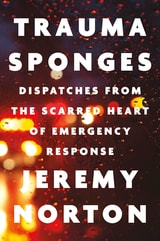
Trauma Sponges
Dispatches from the Scarred Heart of Emergency ResponseJeremy Norton
University of Minnesota Press, 2027
Beyond an adrenaline ride or a chronicle of bravura heroics, this unflinching view of a Minneapolis firefighter reveals the significant toll of emergency response
In this remarkable memoir, Jeremy Norton marshals twenty-two years of professional experience to offer, with compassion and critique, an extraordinary portrayal of emergency responders. Trauma Sponges captures in arresting detail the personal and social toll the job exacts, as well as the unique perspective afforded by sustained direct encounters with the sick, the dying, and the dead.
From his first days as a rookie firefighter and emergency medical technician to his command of a company as a twenty-year veteran, Norton documents the life of an emergency responder in Minneapolis: the harrowing, heartbreaking calls, from helping the sick and hurt, to reassuring the scared and nervous, to attempting desperate measures and providing final words. In the midst of the uncertainty, fear, and loss caused by the Covid pandemic, Norton and his crew responded to the scene of George Floyd’s murder. The social unrest and racial injustice Norton had observed for years exploded on the streets of Minneapolis, and he and his fellow firefighters faced the fires, the injured, and the anguish in the days and months that followed.
Norton brings brutally honest insight and grave social conscience to his account, presenting a rare insider’s perspective on the insidious role of sexism and machismo in his profession, as well as an intimate observer’s view of individuals trapped in dire circumstances and a society ill equipped to confront trauma and death. His thought-provoking, behind-the-scenes depiction of the work of first response and last resort starkly reveals the realities of humanity at its finest and its worst.
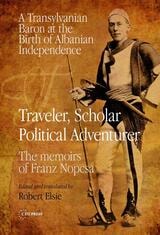
Traveler, Scholar, Political Adventurer
A Transylvanian Baron at the Birth of Albanian Independence: The memoirs of Franz NopcsaFranz Nopcsa
Central European University Press, 2014
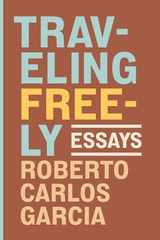
Traveling Freely
EssaysRoberto Carlos Garcia
Northwestern University Press, 2025
A poet’s debut essay collection exploring American faults through the eyes of a Dominican American
In Traveling Freely: Essays, Roberto Carlos Garcia explores intersecting topics such as race, identity, American socioeconomic inequality, police violence, our inability to partake in our culture as innocents, and our complicity as Americans in all that’s wrong with the United States from the author’s specific vantage point as a Black Dominican American man. The voice in these essays is both clear and nuanced, and as readers move through the collection, the various themes cohere into a multilayered investigation of institutional racism and the inherent exploitations of capitalism.
In essays that are uniquely straightforward and accessible, Garcia insists that in order to resist state-sanctioned violence against marginalized bodies and populations, we must understand our shared history of oppression—so that we can rise against it effectively and find new paths forward.
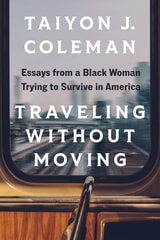
Traveling without Moving
Essays from a Black Woman Trying to Survive in AmericaTaiyon J. Coleman
University of Minnesota Press, 2024
A stunning lyrical commentary on the constructions of race, gender, and class in the fraught nexus of a Black woman’s personal experience and cultural history
The Fair Housing Act passed in 1968, and more than fifty years later, yours seems to be the only Black family on your block in Minneapolis. You and your Black African husband, both college graduates, make less money than some White people with a felony record and no high school diploma. You’re the only Black student in your graduate program. You just aren’t working hard enough. You’re too sensitive. Sandra Bland? George Floyd? Don't take everything so personally. Amid the White smiles of Minnesota Nice and the Minnesota Paradox—the insidious racism of an ostensibly inclusive place to live—what do you do? If you’re Taiyon J. Coleman, you write.
In Traveling without Moving, Coleman shares intimate essays from her life: her childhood in Chicago—growing up in poverty with four siblings and a single mother—and the empowering decision to leave her first marriage. She writes about being the only Black student in a prestigious and predominantly White creative writing program, about institutional racism and implicit bias in writing instruction, about the violent legacies of racism in the U.S. housing market, about the maternal health disparities seen across the country and their implication in her own miscarriage. She explores what it means to write her story and that of her family—an act at once a responsibility and a privilege—bringing forth the inherent contradictions between American ideals and Black reality.
Using a powerful blend of perspectives that move between a first-person lens of lived experience and a wider-ranging critique of U.S. culture, policy, and academia, Coleman’s writing evinces how a Black woman in America is always on the run, always Harriet Tubman, traveling with her babies in tow, seeking safety, desperate to survive, thrive, and finally find freedom.
Retail e-book files for this title are screen-reader friendly.
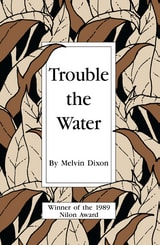
Trouble the Water
Melvin Dixon
University of Alabama Press, 1989
A haunting and poetic journey of memory, identity, and reconciliation in the heart of the Black South.
Winner of the Excellence in Minority Fiction Award
Trouble the Water moves among finely woven layers of time and place as it takes on a new and controversial theme in contemporary black writing, the search for family reconciliation. Twenty years after running away from home in Pee Dee, North Carolina, Jordan Henry believed he had found success, as a young college professor of history, a married man, and a resident of New England, whose colonial past he knew so well. When Jordan finds his career stymied by local prejudices, his world crumbles. Word of his grandmother's death reaches him, and he returns home to claim the ambiguous legacy of her farmland and face the consequences of his long absence.
Jordan's estranged father also returns to Pee Dee on a quest of his own restoring his good name in a community which blames him for Chloe Henry's death in childbirth. Chloe was Jordan's mother and his grandmother's only child. Unresolved hostility in the family and in the community breaks out, making Jordan the unsuspecting pawn in a plot of revenge against his father. Jordan may be the only one who can free his family from the past and the equally troubled present.
Trouble the Water gains resonance from its unflinching confrontation with dualities common in the Afro-American experience: reality and myth, folklore and sophistication, North and South, rural and cosmopolitan. While sacrificing none of its complexities for the sake of simplicity, it has the relentless movement of a fairy tale that reaches deep into the unconscious roots of behavior. It is intensely lyrical and dense in realism. Trouble the Water is magical in the way it reveals the Afro-American psyche and symbolizes fundamental truths about American life.
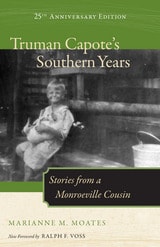
Truman Capote's Southern Years, 25th Anniversary Edition
Stories from a Monroeville CousinMarianne M. Moates, Foreword by Ralph F. Voss
University of Alabama Press, 2014
Readers are well acquainted with Truman Capote’s meteoric rise to fame and his metamorphosis from literary enfant terrible to literary genius, celebrity author, and dispenser of venomously comic witticisms. It is also well-known that he spent his formative years in the south Alabama hamlet of Monroeville, and that he was abandoned there by his mother to be cared for and then to care for elderly relatives. Yet details of those years have remained sketchy and vague.
In Monroeville young Capote formed significant bonds and played childhood games with his cousin, Jennings Faulk Carter, and next door neighbor, Nelle Harper Lee, author of "To Kill a Mockingbird" and "Go Set a Watchman." Through the tales told by Carter and spun into a fascinating and revealing narrative by Marianne M. Moates readers discover in Truman Capote's Southern Years the lively imagination and the early tragedies of a brilliant child.
A new foreword by Ralph F. Voss underscores the enduring relevance of Truman Capote’s work and the influence his Alabama childhood had on his work.
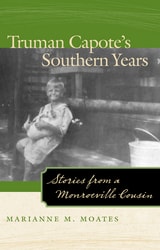
Truman Capote's Southern Years
Stories from a Monroeville CousinMarianne M. Moates
University of Alabama Press, 2008
Although much is known about the mature Truman Capote--his literary genius and flamboyant life-style--details of his childhood years spent in Monroeville, Alabama, have remained a mystery. Truman Capote's Southern Years explores Capote's formative years, the abandonment by his mother, and his early life in the care of elderly relatives. In Monroeville young Capote formed significant bonds and played childhood games with his cousin, Jennings Faulk Carter, and next door neighbor, Nelle Harper Lee. Through the tales told here by Carter, readers discover the lively imagination and the early tragedies of a brilliant child.
Truth Has a Different Shape
Kari O'Driscoll
CavanKerry Press, 2020
Growing up in the 1970s and 1980s, Kari O’Driscoll was taught that strength and stoicism were one and the same. She was also taught that a girl’s job was to take care of everyone else. For decades, she believed these ideas, doing everything she could to try and keep the remaining parts of her family together, systematically anticipating disaster and fixing catastrophes one by one.
Truth Has a Different Shape is one woman’s meditation on how societal and familial expectations of mothering influenced her sense of self and purpose, as well as her ideas about caretaking. As an adult, finding herself a caretaker both to her own children and to her aging parents, O’Driscoll finally reckons with the childhood trauma that shaped her world. Adoption, loss, and divorce defined her approach to motherhood, but in Truth Has a Different Shape, O’Driscoll finally pushes back. This memoir tracks her progress as she discovers how to truly care for those she loves without putting herself at risk, using mindfulness and compassion as tools for healing both herself and her difficult relationships.
Truth Has a Different Shape
Kari O’Driscoll
CavanKerry Press, 2024
Growing up in the 1970s and 1980s, Kari O’Driscoll was taught that strength and stoicism were one and the same. She was also taught that a girl’s job was to take care of everyone else. For decades, she believed these ideas, doing everything she could to try and keep the remaining parts of her family together, systematically anticipating disaster and fixing catastrophes one by one.
Truth Has a Different Shape is one woman’s meditation on how societal and familial expectations of mothering influenced her sense of self and purpose, as well as her ideas about caretaking. As an adult, finding herself a caretaker both to her own children and to her aging parents, O’Driscoll finally reckons with the childhood trauma that shaped her world. Adoption, loss, and divorce defined her approach to motherhood, but in Truth Has a Different Shape, O’Driscoll finally pushes back. This memoir tracks her progress as she discovers how to truly care for those she loves without putting herself at risk, using mindfulness and compassion as tools for healing both herself and her difficult relationships.
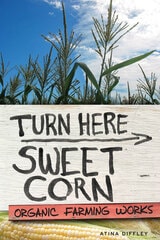
Turn Here Sweet Corn
Organic Farming WorksAtina Diffley
University of Minnesota Press, 2013
When the hail starts to fall, Atina Diffley doesn’t compare it to golf balls. She’s a farmer. It’s “as big as a B-size potato.” As her bombarded land turns white, she and her husband Martin huddle under a blanket and reminisce: the one-hundred-mile-per-hour winds; the eleven-inch rainfall (“that broccoli turned out gorgeous”); the hail disaster of 1977. The romance of farming washed away a long time ago, but the love? Never. In telling her story of working the land, coaxing good food from the fertile soil, Atina Diffley reminds us of an ultimate truth: we live in relationships—with the earth, plants and animals, families and communities.
A memoir of making these essential relationships work in the face of challenges as natural as weather and as unnatural as corporate politics, her book is a firsthand history of getting in at the “ground level” of organic farming. One of the first certified organic produce farms in the Midwest, the Diffleys’ Gardens of Eagan helped to usher in a new kind of green revolution in the heart of America’s farmland, supplying their roadside stand and a growing number of local food co-ops. This is a story of a world transformed—and reclaimed—one square acre at a time.
And yet, after surviving punishing storms and the devastating loss of fifth-generation Diffley family land to suburban development, the Diffleys faced the ultimate challenge: the threat of eminent domain for a crude oil pipeline proposed by one of the largest privately owned companies in the world, notorious polluters Koch Industries. As Atina Diffley tells her David-versus-Goliath tale, she gives readers everything from expert instruction in organic farming to an entrepreneur’s manual on how to grow a business to a legal thriller about battling corporate arrogance to a love story about a single mother falling for a good, big-hearted man.

Twelve Views from the Distance
Mutsuo Takahashi
University of Minnesota Press, 2012
From one of the foremost poets in contemporary Japan comes this entrancing memoir that traces a boy’s childhood and its intersection with the rise of the Japanese empire and World War II. Originally published in 1970, this translation is the first available in English.
In twelve chapters that visit and revisit critical points in his boyhood, Twelve Views from the Distance presents a vanished time and place through the eyes of an accomplished poet. Recounting memories from his youth, Mutsuo Takahashi captures the full range of his internal life as a boy, shifting between his experiences and descriptions of childhood friendships, games, songs, and school. With great candor, he also discusses the budding awareness of his sexual preference for men, providing a rich exploration of one man’s early queer life in a place where modern, Western-influenced models of gay identity were still unknown.
Growing up poor in rural southwestern Japan, far from the urban life that many of his contemporaries have written about, Takahashi experienced a reality rarely portrayed in literature. In addition to his personal remembrances, the book paints a vivid portrait of rural Japan, full of oral tradition, superstition, and remnants of customs that have quickly disappeared in postwar Japan. With profuse local color and detail, he re-creates the lost world that was the setting for his beginnings as a gay man and poet.
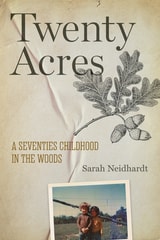
Twenty Acres
A Seventies Childhood in the WoodsSarah Neidhardt
University of Arkansas Press, 2023
"A memoir infused with both empathy and inquiry."
—Wendy J. Fox, Electric Literature
“Twenty Acres is an engaging, thoughtful memoir of growing up in an off-the-grid cabin as part of the 1970s back-to-the-land movement. Sarah Neidhardt captures her subject beautifully and offers a compelling portrait of a highly specific, historically significant time and place.”
—Kate Daloz, author of We Are As Gods: Back to the Land in the 1970s on the Quest for a New America
Sarah Neidhardt grew up in the woods. When she was an infant, her parents left behind comfortable, urbane lives to take part in the back-to-the-land movement. They moved their young family to an isolated piece of land deep in the Arkansas Ozarks where they built a cabin, grew crops, and strove for eight years to live self-sufficiently.
In this vivid memoir Neidhardt explores her childhood in wider familial and social contexts. Drawing upon a trove of family letters and other archival material, she follows her parents’ journey from privilege to food stamps—from their formative youths, to their embrace of pioneer homemaking and rural poverty, to their sudden and wrenching return to conventional society—and explores the back-to-the-land movement of the 1970s as it was, and as she lived it.
A story of strangers in a strange land, of class, marriage, and family in a changing world, Twenty Acres: A Seventies Childhood in the Woods is part childhood idyll, part cautionary tale. Sarah Neidhardt reveals the treasures and tolls of unconventional, pastoral lives, and her insightful reflections offer a fresh perspective on what it means to aspire to pre-industrial lifestyles in a modern world.

Twenty Square Feet of Skin
Megan Baxter
The Ohio State University Press, 2023
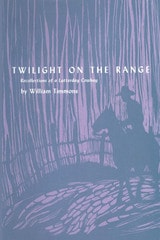
Twilight on the Range
Recollections of a Latterday CowboyBy William Timmons
University of Texas Press, 1962
Billie Timmons was fourteen when he met Charles Goodnight—over a wagonload of manure that had been jammed on a gatepost—and he went to work on the Goodnight Cross J Ranch shortly thereafter. The spirit of helpfulness that led Mr. Goodnight to strip off his coat and lift the wagon free for a lad in need sets the tone of this book, in which the author unwinds a spool of recollections of range-riding in Texas and North Dakota over an eighteen-year period.
When Billie Timmons went to work for Mr. Goodnight in 1892, Texas was undergoing a rapid transition from open range to fences. But around Texas campfires he heard tales about the northern range, told by cowboys who had ridden there and who had seen the northern lights, the tall free grass, swollen streams, and stampeding cattle. A longing to see that exciting country took hold of young Timmons.
His chance came when four buffaloes from the Goodnight ranch needed a nursemaid for their freight car trip to Yellowstone Park. Once in the northern country, Timmons stayed, casting his lot with the cowmen of North Dakota. He became the protégé of an extraordinary man, William Ray; he was foreman, friend, and confidant of banker-rancher Wilse Richards, a member of the Cowboy Hall of Fame. But even during his days in North Dakota he never lost touch with Charles Goodnight, a lifelong friend, and his portrayal of Goodnight provides much insight into the character of the man whose name belongs to the West.
In this book you experience the terror of being lost in the dead-white expanse of a North Dakota snowstorm; the gaiety of cowboy dances, for which there were never enough women available; the excitement of a near-riot in a Hebron, North Dakota, saloon, where cowboys from the 75 Ranch drank up or poured out all the liquor, then smashed all the glasses and bottles—one day before the state became bone-dry; and the loneliness of work on the range, where a flickering lantern on the side of a chuck wagon on a stormy night meant home for many a cowboy. Running like a bright thread through the narrative is Billie Timmons’s love of horses, from whom he learned the wisdom that some horses and some men are to be handled with great care and others are not to be handled at all. His chapter on Buck, his best-loved horse, is memorable.
In North Dakota, as in Texas, fences brought the end of the big herds and the end of cowboying for a man who enjoyed it to the hilt.
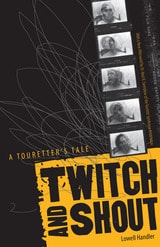
Twitch And Shout
A Touretter’s TaleLowell Handler
University of Minnesota Press, 2004
The remarkable memoir of a Touretter’s journey of self-discovery—now back in print!
Lowell Handler has Tourette’s syndrome, a disorder characterized by exaggerated facial tics, sudden jerking movements of the body and limbs, and explosive public outbursts, usually in the form of expletives and racial epithets. Although he is a successful and acclaimed photojournalist, Handler has often seen himself as an outsider—a social outcast. With courage and candor, he recalls the difficulties he suffered growing up, the confusion he experienced when doctors misdiagnosed his bizarre behavior as a psychological aberration, and finally how, restless and despairing, he embarked on a quest for answers.In Twitch and Shout, Handler sets out, camera in hand, on a journey through less than savory parts of America. From a transvestite bar in Tampa to a flophouse in New Orleans to a community health center in New York, he meets a variety of people who, like himself, don’t conform to the standards of conventional society. With a keen eye for detail and an acute sense of humor, this memoir perfectly captures the unique and unforgettable life of a Touretter.

Two Lucky People
MemoirsMilton Friedman and Rose D. Friedman
University of Chicago Press, 1998
"The Friedmans come across as the last Enlightenment thinkers in a post-modern world. . . . This is a book that restores your faith in reasoned discourse. . . . There really are people who believe in scholarly exchange as a way to discover truth."—David Brooks, New York Times Book Review
"The Friedmans are a feisty couple, who clearly delight in their lives and each other. And shining through their reticence, and their conservatism, is a decency that even liberals will recognize."—Milton and Judith Viorst, Washington Post Book World
"This engaging book recounts the life and contributions of one of America's most influential writers and economists in the second half of the twentieth century. And her husband's no slouch either. . . . An indispensable guide through the evolution of economic thought."—Stephen Moore, National Review
"A thought-provoking book and one rich in history, the personal history of the Friedmans . . . and the cultural and political history of our country."—Steve Huntley, Chicago Sun-Times Books
"[Two Lucky People] is almost like a letter from a couple of old friends—a couple of old friends who had a long, compelling intellectual journey, came to know some of the great world leaders of this century, and had 60 years of happy, supportive marriage."—N. Gregory Mankiw, Fortune
"A rich autobiographical and historical panorama."—William P. Kucewicz, Wall Street Journal
Two Lucky People
MemoirsMilton Friedman and Rose D. Friedman
University of Chicago Press, 2026
The story of Rose and Milton Friedman’s incredible lives and influential work told in their own words, now with a new foreword by Sebastian Edwards.
In Two Lucky People, Rose and Milton Friedman provide a memorable and lively account of their lives, the people they knew, and the work they shared. Their involvement with world leaders and many of this century's most important public policy issues moves their memoir beyond the merely personal and makes fascinating reading for anyone interested in the history of twentieth-century ideas.
This new edition of the Friedmans’ jointly authored memoir includes a foreword by economist Sebastian Edwards, the Henry Ford II Professor of International Economics at the University of California, Los Angeles.
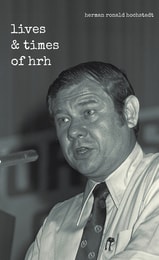
the lives & times of hrh
Herman Hochstadt
National University of Singapore Press, 2020