Results by title
660 books match the query 'Texas' and 189 start with t

The Tacos of Texas
By Mando Rayo and Jarod Neece
University of Texas Press, 2016
Rooted in tradición mexicana and infused with Texas food culture, tacos are some of Texans’ all-time favorite foods. In The Tacos of Texas, the taco journalists Mando Rayo and Jarod Neece take us on a muy sabroso taco tour around the state as they discover the traditions, recipes, stories, and personalities behind puffy tacos in San Antonio, trompo tacos in Dallas, breakfast tacos in Austin, carnitas tacos in El Paso, fish tacos in Corpus Christi, barbacoa in the Rio Grande Valley, and much more.
Starting with the basics—tortillas, fillings, and salsas—and how to make, order, and eat tacos, the authors highlight ten taco cities/regions of Texas. For each place, they describe what makes the tacos distinctive, name their top five places to eat, and listen to the locals tell their taco stories. They hear from restaurant owners, taqueros, abuelitas, chefs, and patrons—both well-known and everyday folks—who talk about their local taco history and culture while sharing authentic recipes and recommendations for the best taco purveyors.
Whether you can’t imagine a day without tacos or you’re just learning your way around the trailers, trucks, and taqueros that make tacos happen, The Tacos of Texas is the indispensable guidebook, cookbook, and testimonio.
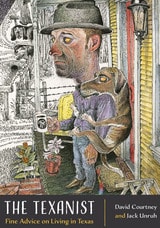
The Texanist
Fine Advice on Living in TexasBy David Courtney and Jack Unruh
University of Texas Press, 2017
The Texanist, Texas Monthly’s perennially popular back-page column, has become the magazine’s most-read feature. With an inimitable style and an unassailable wholesomeness, columnist David Courtney has counseled many a well-intentioned Texan, native or wannabe, on how to properly conduct him- or herself. Until the July 2016 issue, an original illustration by the late award-winning artist Jack Unruh, depicting the Texanist in a situation described in the column, accompanied the Texanist’s sage wisdom. Unruh’s peerless illustrations displayed a sly wit that paired perfectly with Courtney’s humorous ripostes.
The Texanist gathers several dozen of Unruh’s most unforgettable illustrations, along with the fascinating, perplexing, and even downright weird questions that inspired them. Curing the curious, exorcizing bedevilment, and orienting the disoriented, the Texanist advises on such things as: Is it wrong to wear your football team’s jersey to church? When out at a dancehall, do you need to stick with the one that brung ya? Is it real Tex-Mex if it’s served with a side of black beans? Can one have too many Texas-themed tattoos? The Texanist addresses all of these important subjects and more. Whether you heed the good guidance, or just enjoy the whimsical illustrations, The Texanist will both entertain and educate you.
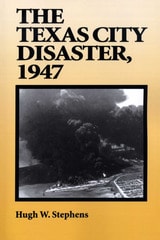
The Texas City Disaster, 1947
By Hugh W. Stephens
University of Texas Press, 1997
On April 16, 1947, a small fire broke out among bags of ammonium nitrate fertilizer in the hold of the ship Grandcamp as it lay docked at Texas City, Texas. Despite immediate attempts to extinguish the fire, it rapidly intensified until the Grandcamp exploded in a blast that caused massive loss of life and property. In the ensuing chaos, no one gave much thought to the ship in the next slip, the High Flyer. It exploded sixteen hours later.
The story of the Texas City explosions—America's worst industrial disaster in terms of casualties—has never been fully told until now. In this book, Hugh W. Stephens draws on official reports, newspaper and magazine articles, personal letters, and interviews with several dozen survivors to provide the first full account of the disaster at Texas City.
Stephens describes the two explosions and the heroic efforts of Southeast Texans to rescue survivors and cope with extensive property damage. At the same time, he explores why the disaster occurred, showing how a chain of indifference and negligence made a serious industrial accident almost inevitable, while a lack of emergency planning allowed it to escalate into a major catastrophe. This gripping, cautionary tale holds important lessons for a wide reading public.
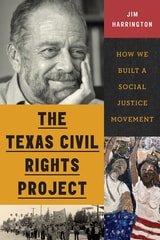
The Texas Civil Rights Project
How We Built a Social Justice MovementJim Harrington
University of Texas Press, 2025
Texas civil rights icon Jim Harrington recounts his lifelong fight for equality, winning major reforms for farmworkers and disabled Texans and helping build a movement for social justice.
Jim Harrington arrived in South Texas in 1973, ready to file class action lawsuits and “save the world.” Over the following fifty years, he built one of Texas’s key civil rights organizations and played an essential role in many of its greatest victories.
Harrington takes readers on his journey from a Midwest seminary to a United Farm Workers office in the Rio Grande Valley and on to founding the Texas Civil Rights Project. He fought for the rights of a wide range of Texans, bringing justice to victims of police brutality, injured farmworkers, silenced students, and people with disabilities excluded from full participation in society, building a movement for social justice, and a family, along the way. These major gains were tempered by heartbreaking losses, and Harrington recounts the difficult work of persevering in the face of injustice.
Framed by a foreword from Judge Lora Livingston and an afterword by Congressman Greg Casar, The Texas Civil Rights Project is at once a history of the struggle for equality over the last fifty years, a celebration of the individuals and grassroots organizations who fought hard to improve the lives of others, and a memoir of a singular force who pushed the Texas justice system to live up to its ideals.
The Texas Cookbook
From Barbecue to Banquet-- an Informal View of Dining and Entertaining the Texas WayMary Faulk Koock
University of North Texas Press, 1965
The Texas Supreme Court
A Narrative History, 1836–1986By James L. Haley
University of Texas Press, 2013
“Few people realize that in the area of law, Texas began its American journey far ahead of most of the rest of the country, far more enlightened on such subjects as women’s rights and the protection of debtors.” Thus James Haley begins this highly readable account of the Texas Supreme Court. The first book-length history of the Court published since 1917, it tells the story of the Texas Supreme Court from its origins in the Republic of Texas to the political and philosophical upheavals of the mid-1980s.
Using a lively narrative style rather than a legalistic approach, Haley describes the twists and turns of an evolving judiciary both empowered and constrained by its dual ties to Spanish civil law and English common law. He focuses on the personalities and judicial philosophies of those who served on the Supreme Court, as well as on the interplay between the Court’s rulings and the state’s unique history in such areas as slavery, women’s rights, land and water rights, the rise of the railroad and oil and gas industries, Prohibition, civil rights, and consumer protection. The book is illustrated with more than fifty historical photos, many from the nineteenth and early twentieth centuries. It concludes with a detailed chronology of milestones in the Supreme Court’s history and a list, with appointment and election dates, of the more than 150 justices who have served on the Court since 1836.
The Texas Way
Money, Power, Politics, and Ambition at The UniversityBy William H. Cunningham
University of Texas Press, 2013
This engaging memoir details Bill Cunningham’s seven years as president of the University of Texas at Austin and his eight years as chancellor of the UT System. Along the way, he relates accounts of the important issues UT faced during that time, including fraternity hazing, affirmative action, the demise of the Southwest Conference and the creation of the Big 12, apartheid and divestment protests, the future of higher education in Texas, and many other issues.
The Texas Way outlines how money, power, politics, and ambition all play roles in the business of running the state’s premier university system, particularly in its relations with the state government. As president and then as chancellor, Cunningham dealt with conflict from all sides of the political spectrum, always striving to protect the university’s interests.
Bill Cunningham was at the center of many important issues during the fifteen years he served as president and chancellor. The Dolph Briscoe Center for American History at the University of Texas at Austin is pleased to publish Cunningham’s detailed and insightful memoir, which serves as a reminder of how these issues continue to resonate and affect higher education in Texas.
The Texas-Mexican Conjunto
History of a Working-class MusicBy Manuel H. Peña
University of Texas Press, 1985
Around 1930, a highly popular and distinctive type of accordion music, commonly known as conjunto, emerged among Texas-Mexicans. Manuel Peña's The Texas-Mexican Con;unto is the first comprehensive study of this unique folk style. The author's exhaustive fieldwork and personal interviews with performers, disc jockeys, dance promoters, recording company owners, and conjunto music lovers provide the crucial connection between an analysis of the music itself and the richness of the culture from which it sprang.
Using an approach that integrates musicological, historical, and sociological methods of analysis, Peña traces the development of the conjunto from its tentative beginnings to its preeminence as a full-blown style by the early 1960s. Biographical sketches of such major early performers as Narciso Martínez (El Huracán del Valle), Santiago Jiménez (El Flaco), Pedro Ayala, Valerio Longoria, Tony de la Rosa, and Paulino Bernal, along with detailed transcriptions of representative compositions, illustrate the various phases of conjunto evolution.
Peña also probes the vital connection between conjunto's emergence as a powerful symbolic expression and the transformation of Texas-Mexican society from a pre-industrial folk group to a community with increasingly divergent socioeconomic classes and ideologies. Of concern throughout the study is the interplay between ethnicity, class, and culture, and Peña's use of methods and theories from a variety of scholarly disciplines enables him to tell the story of conjunto in a manner both engaging and enlightening. This important study will be of interest to all students of Mexican American culture, ethnomusicology, and folklore.
The Trail Drivers of Texas
Interesting Sketches of Early Cowboys...Compiled and edited by J. Marvin Hunter
University of Texas Press, 1993
These are the chronicles of the trail drivers of Texas—those rugged men and, sometimes, women who drove cattle and horses up the trails from Texas to northern markets in the late 1800s. Gleaned from members of the Old Time Trail Drivers' Association, these hundreds of real-life stories—some humorous, some chilling, some rambling, all interesting—form an invaluable cornerstone to the literature, history, and folklore of Texas and the West. First published in the 1920s and reissued by the University of Texas Press in 1985, this classic work is now available in a handsome paperback edition that contains the full text, historical illustrations, and name index of the hardcover edition.
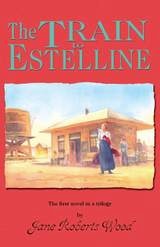
The Train to Estelline
The First Novel in a TrilogyJane Roberts Wood
University of North Texas Press, 2000

The Trials of Eroy Brown
The Murder Case That Shook the Texas Prison SystemBy Michael Berryhill
University of Texas Press, 2011
In April 1981, two white Texas prison officials died at the hands of a black inmate at the Ellis prison farm near Huntsville. Warden Wallace Pack and farm manager Billy Moore were the highest-ranking Texas prison officials ever to die in the line of duty. The warden was drowned face down in a ditch. The farm manager was shot once in the head with the warden's gun. The man who admitted to killing them, a burglar and robber named Eroy Brown, surrendered meekly, claiming self-defense.
In any other era of Texas prison history, Brown's fate would have seemed certain: execution. But in 1980, federal judge William Wayne Justice had issued a sweeping civil rights ruling in which he found that prison officials had systematically and often brutally violated the rights of Texas inmates. In the light of that landmark prison civil rights case, Ruiz v. Estelle, Brown had a chance of being believed.
The Trials of Eroy Brown, the first book devoted to Brown's astonishing defense, is based on trial documents, exhibits, and journalistic accounts of Brown's three trials, which ended in his acquittal. Michael Berryhill presents Brown's story in his own words, set against the backdrop of the chilling plantation mentality of Texas prisons. Brown's attorneys—Craig Washington, Bill Habern, and Tim Sloan—undertook heroic strategies to defend him, even when the state refused to pay their fees. The Trials of Eroy Brown tells a landmark story of prison civil rights and the collapse of Jim Crow justice in Texas.
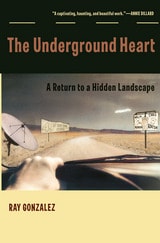
The Underground Heart
A Return to a Hidden LandscapeRay Gonzalez
University of Arizona Press, 2002
As Gonzalez drives the highways of New Mexico and west Texas, he shows us a border culture rejuvenated by tourist and trade dollars, one that will surprise readers for whom the border means only illegal immigration, NAFTA, and the drug trade. Played out against a soundtrack of the Allman Brothers and The Doors, The Underground Heart takes readers on a trip through a seemingly barren landscape that teems with life and stories. Gonzalez witnesses Minnesotans experiencing culture shock while attending a college football game in El Paso; he finds a proliferation of Pancho Villa death masks housed at different museums; he revisits Carlsbad Caverns, discovering unsuspected beauty beneath the desert's desolation; and he takes us shopping at El Mercado—where tourists can buy everything from black velvet paintings of Elvis (or Jesus, or JFK) to Mexican flag underwear.
From "nuclear tourism" in New Mexico to "heritage tourism" in the restored missions of San Antonio, Gonzalez goes behind the slogans of The Land of Enchantment and The Lone Star State to uncover a totally different Southwest. Here are tourist centers that give a distorted view of southwestern life to outsiders, who leave their dollars in museum gift shops and go home weighed down with pounds of Indian jewelry around their necks. Here border history is the story of one culture overlaid on another, re-forming itself into a whole new civilization on the banks of the Rio Grande.
The Underground Heart is a book brimming with subtle ironies and insights both quiet and complex—one which recognizes that sometimes one must go away and grow older to finally recognize home as a life-giving, spiritually sustaining place. As Gonzalez rediscovers the land of his past, he comes to understand the hyper, bilingual atmosphere of its future. And in the Southwest he describes, readers may catch a glimpse of their own hidden landscapes of home.
The Upshaws of County Line
An American FamilyRichard Orton
University of North Texas Press, 2014

The Very Air
A NovelDouglas Bauer
University of Iowa Press, 2014
The Very Air is a compelling exploration of human motives and hidden meanings. It is a detailed picture of America’s myth of the rugged individual in the psychological and narrative tradition of The Great Gatsby and Citizen Kane. With a resonant sense of the period and culture, Douglas Bauer evokes the freewheeling feel of the old Southwest in the charlatans of our own era. The Very Air shows, through storytelling both exhilarating and chilling, that the past is prologue and that our personal histories indeed shape the course of our individual futures.

The Wandering Womb
Essays in Search of HomeS. L. Wisenberg
University of Massachusetts Press, 2023
Even as a fourth-generation Jewish Texan, S. L. Wisenberg has always felt the ghost of Europe dogging her steps, making her feel uneasy in her body and in the world. At age six, she’s sure that she hears Nazis at her bedroom window and knows that after they take her away, she’ll die without her asthma meds. In her late twenties, she infiltrates sorority rush at her alma mater, curious about whether she’ll get a bid now. Later in life, she makes her first and only trip to the mikvah while healing from a breast biopsy (benign this time), prompting an exploration of misogyny, shame, and woman-fear in rabbinical tradition.
With wit, verve, blood, scars, and a solid dose of self-deprecation, Wisenberg wanders across the expanse of continents and combs through history books and family records in her search for home and meaning. Her travels take her from Selma, Alabama, where her Eastern European Jewish ancestors once settled, to Vienna, where she tours Freud’s home and figures out what women really want, and she visits Auschwitz, which—disappointingly—leaves no emotional mark.
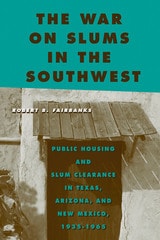
The War on Slums in the Southwest
Public Housing and Slum Clearance in Texas, Arizona, and New Mexico, 1935-1965Robert B Fairbanks
Temple University Press, 2016
In The War on Slums in the Southwest, Robert Fairbanks provides compelling and probing case studies of economic problems and public housing plights in Albuquerque, Dallas, Houston, Phoenix and San Antonio. He provides brief histories of each city--all of which expanded dynamically between 1935 and 1965--and how they responded to slums under the Housing Acts of 1937, 1949, and 1954.
Despite being a region where conservative politics has ruled, these Southwestern cities often handled population growth, urban planning, and economic development in ways that closely followed the national account of efforts to eliminate slums and provide public housing for the needy. The War on Slums in the Southwest therefore corrects some misconceptions about the role of slum clearance and public housing in this region as Fairbanks integrates urban policy into the larger understanding of federal and state-based housing policies.

The Women of CourtWatch
Reforming a Corrupt Family Court SystemBy Carole Bell Ford
University of Texas Press, 2005
Houston was a terrible place to divorce or seek child custody in the 1980s and early 1990s. Family court judges routinely rendered verdicts that damaged the interests of women and children. In some especially shocking cases, they even granted custody to fathers who had been accused of molesting their own children. Yet despite persistent allegations of cronyism, incompetence, sexism, racism, bribery, and fraud, the judges wielded such political power and influence that removing them seemed all but impossible. The family court system was clearly broken, but there appeared to be no way to fix it.
This book recounts the inspiring and courageous story of women activists who came together to oppose Houston's family court judges and whose political action committee, CourtWatch, played a crucial role in defeating five of the judges in the 1994 judicial election. Carole Bell Ford draws on extensive interviews with Florence Kusnetz, the attorney who led the reform effort, and other CourtWatch veterans, as well as news accounts, to provide a full history of the formation, struggles, and successes of a women's grassroots organization that overcame powerful political interests to improve Houston's family courts. More than just a local story, however, this history of CourtWatch provides a model that can be used by activists in other communities in which legal and social institutions have gone astray. It also honors the heroism of Florence Kusnetz, whose commitment to the Jewish concept of tikkun olam ("repairing and improving the world") brought her out of a comfortable retirement to fight for justice for women and children.
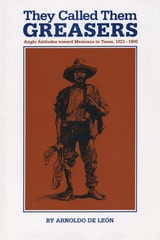
They Called Them Greasers
Anglo Attitudes toward Mexicans in Texas, 1821–1900by Arnoldo De León
University of Texas Press, 1983
Tension between Anglos and Tejanos has existed in the Lone Star State since the earliest settlements. Such antagonism has produced friction between the two peoples, and whites have expressed their hostility toward Mexican Americans unabashedly and at times violently.
This seminal work in the historical literature of race relations in Texas examines the attitudes of whites toward Mexicans in nineteenth-century Texas. For some, it will be disturbing reading. But its unpleasant revelations are based on extensive and thoughtful research into Texas' past. The result is important reading not merely for historians but for all who are concerned with the history of ethnic relations in our state.
They Called Them Greasers argues forcefully that many who have written about Texas's past—including such luminaries as Walter Prescott Webb, Eugene C. Barker, and Rupert N. Richardson—have exhibited, in fact and interpretation, both deficiencies of research and detectable bias when their work has dealt with Anglo-Mexican relations. De León asserts that these historians overlooled an austere Anglo moral code which saw the morality of Tejanos as "defective" and that they described without censure a society that permitted traditional violence to continue because that violence allowed Anglos to keep ethnic minorities "in their place."
De León's approach is psychohistorical. Many Anglos in nineteenth-century Texas saw Tejanos as lazy, lewd, un-American, subhuman. In De León's view, these attitudes were the product of a conviction that dark-skinned people were racially and culturally inferior, of a desire to see in others qualities that Anglos preferred not to see in themselves, and of a need to associate Mexicans with disorder so as to justify their continued subjugation.
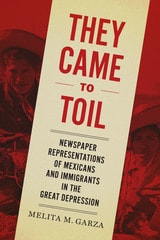
They Came to Toil
Newspaper Representations of Mexicans and Immigrants in the Great DepressionBy Melita M. Garza
University of Texas Press, 2018
As the Great Depression gripped the United States in the early 1930s, the Hoover administration sought to preserve jobs for Anglo-Americans by targeting Mexicans, including long-time residents and even US citizens, for deportation. Mexicans comprised more than 46 percent of all people deported between 1930 and 1939, despite being only 1 percent of the US population. In all, about half a million people of Mexican descent were deported to Mexico, a “homeland” many of them had never seen, or returned voluntarily in fear of deportation.
They Came to Toil investigates how the news reporting of this episode in immigration history created frames for representing Mexicans and immigrants that persist to the present. Melita M. Garza sets the story in San Antonio, a city central to the formation of Mexican American identity, and contrasts how the city’s three daily newspapers covered the forced deportations of Mexicans. She shows that the Spanish-language La Prensa not surprisingly provided the fullest and most sympathetic coverage of immigration issues, while the locally owned San Antonio Express and the Hearst chain-owned San Antonio Light varied between supporting Mexican labor and demonizing it. Garza analyzes how these media narratives, particularly in the English-language press, contributed to the racial “othering” of Mexicans and Mexican Americans. Adding an important new chapter to the history of the Long Civil Rights Movement, They Came to Toil brings needed historical context to immigration issues that dominate today’s headlines.
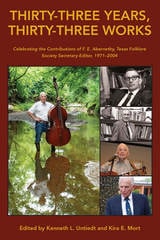
Thirty-three Years, Thirty-three Works
Celebrating the Contributions of F.E. Abernethy, Texas Folklore Society Secretary-Editor, 1971-2004Kenneth L. Untiedt
University of North Texas Press, 2016
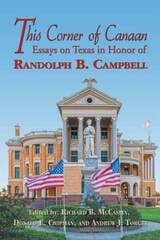
This Corner of Canaan
Essays on Texas in Honor of Randolph B. CampbellRichard B. McCaslin
University of North Texas Press, 2013

Three Friends
Roy Bedichek, J. Frank Dobie, Walter Prescott WebbBy William A. Owens
University of Texas Press, 1975
Roy Bedichek, J. Frank Dobie, and Walter Prescott Webb—a naturalist, a folklorist, and a historian—all taught at the University of Texas, lived only a few blocks apart, and saw each other almost every day. The true cement of their friendship, however, was the correspondence that makes up much of this book. They wrote not to exchange information, but to communicate ideas, to nail down the generalities of conversation, and, above all, to challenge, encourage, and stimulate one another.
William A. Owens, who knew all three personally, has tied their letters together with his own observations and with transcripts of tape interviews with the men. The result is a unique book, a combination of biography and personal history that portrays not only the three friends, but the land they loved as well.
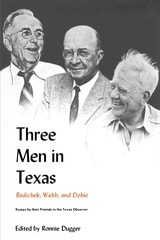
Three Men in Texas
Bedichek, Webb, and DobieEssays by their Friends in the <em>Texas Observer</em>, Edited by Ronnie Dugger
University of Texas Press, 1967
Three Plays
Dividing the Estate, The Trip to Bountiful, and The Young Man from AtlantaHorton Foote
Northwestern University Press, 2008

Through Animals' Eyes, Again
Stories of Wildlife RescueLynn Marie Cuny
University of North Texas Press, 2006

Through Animals' Eyes
True Stories from a Wildlife SanctuaryLynn Marie Cuny
University of North Texas Press, 1998
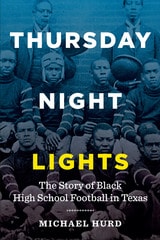
Thursday Night Lights
The Story of Black High School Football in TexasBy Michael Hurd
University of Texas Press, 2019
At a time when “Friday night lights” shone only on white high school football games, African American teams across Texas burned up the gridiron on Wednesday and Thursday nights. The segregated high schools in the Prairie View Interscholastic League (the African American counterpart of the University Interscholastic League, which excluded black schools from membership until 1967) created an exciting brand of football that produced hundreds of outstanding players, many of whom became college All-Americans, All-Pros, and Pro Football Hall of Famers, including NFL greats such as “Mean” Joe Green (Temple Dunbar), Otis Taylor (Houston Worthing), Dick “Night Train” Lane (Austin Anderson), Ken Houston (Lufkin Dunbar), and Bubba Smith (Beaumont Charlton-Pollard).
Thursday Night Lights tells the inspiring, largely unknown story of African American high school football in Texas. Drawing on interviews, newspaper stories, and memorabilia, Michael Hurd introduces the players, coaches, schools, and towns where African Americans built powerhouse football programs under the PVIL leadership. He covers fifty years (1920–1970) of high school football history, including championship seasons and legendary rivalries such as the annual Turkey Day Classic game between Houston schools Jack Yates and Phillis Wheatley, which drew standing-room-only crowds of up to 40,000, making it the largest prep sports event in postwar America. In telling this story, Hurd explains why the PVIL was necessary, traces its development, and shows how football offered a potent source of pride and ambition in the black community, helping black kids succeed both athletically and educationally in a racist society.
Toward a Cooperative Commonwealth
The Transplanted Roots of Farmer-Labor Radicalism in TexasThomas Alter II
University of Illinois Press, 2022
A rare look at the German roots of radicalism in Texas, Toward a Cooperative Commonwealth illuminates the labor movements and populist ideas that changed the nation’s course at a pivotal time in its history.

Tracking the Texas Ranger Historians
Bruce Glasrud
University of North Texas Press, 2024
Tracking the Texas Rangers
The Nineteenth CenturyBruce A. Glasrud
University of North Texas Press, 2012
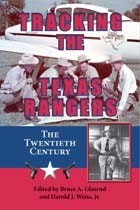
Tracking the Texas Rangers
The Twentieth CenturyBruce A. Glasrud
University of North Texas Press, 2013
Tracking the Texas Rangers covers leaders such as Captains Bill McDonald, "Lone Wolf" Gonzaullas, and Barry Caver, accomplished Rangers like Joaquin Jackson and Arthur Hill, and the use of Rangers in the Mexican Revolution. Chapters discuss their role in the oil fields, in riots, and in capturing outlaws. Most important, the Rangers of the twentieth century experienced changes in investigative techniques, strategy, and intelligence gathering. Tracking looks at the use of Rangers in labor disputes, in race issues, and in the Tejano civil rights movement. The selections cover critical aspects of those experiences--organization, leadership, cultural implications, rural and urban life, and violence.
In their introduction, editors Bruce A. Glasrud and Harold J. Weiss, Jr., discuss various themes and controversies surrounding the twentieth-century Rangers and their treatment by historians over the years. They also have added annotations to the essays to explain where new research has shed additional light on an event to update or correct the original article text.
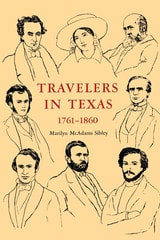
Travelers In Texas, 1761-1860
By Marilyn McAdams Sibley
University of Texas Press, 1967
History passed in review along the highways of Texas in the century 1761–1860. This was the century of exploration and settlement for the big new land, and many thousands of people traveled its trails: traders, revolutionaries, missionaries, warriors, government agents, adventurers, refugees, gold seekers, prospective settlers, land speculators, army wives, and filibusters. Their reasons for coming were many and varied, and the travelers viewed the land and its people with a wide variety of reactions. Political and industrial revolution, famine, and depression drove settlers from many of the countries of Europe and many of the states of the United States. Some were displeased with what they found in Texas, but for many it was a haven, a land of renewed hope. So large was the migration of people to Texas that the land that was virtually unoccupied in 1761 numbered its population at 600,000 a century later.
Several hundred of these travelers left published accounts of their impressions and adventures. Collectively the accounts tell a panoramic story of the land as its boundaries were drawn and its institutions formed. Spain gave way to Mexico, Mexico to the Republic of Texas, the Republic to statehood in the United States, and statehood in the Union was giving way to statehood in the Confederate states by 1860. The travelers’ accounts reflect these changes; but, more important, they tell the story of the receding frontier.
In Travelers in Texas, 1761–1860, the author examines the Texas seen by the traveler-writer. Opening with a chapter about travel conditions in general (roads or trails, accommodations, food), she also presents at some length the travelers’ impressions of the country and its people. She then proceeds to examine particular aspects of Texas life: the Indians, slavery, immigration, law enforcement, and the individualistic character of the people, all as seen through the eyes of the travelers. The discussion concludes with a “Critical Essay on Sources,” containing bibliographic discussions of over two hundred of the more important travel accounts.
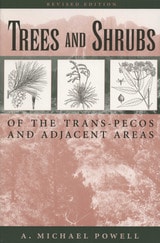
Trees & Shrubs of the Trans-Pecos and Adjacent Areas
By A. Michael Powell
University of Texas Press, 1997
First published by the Big Bend Natural History Association in 1988 as Trees & Shrubs of Trans-Pecos Texas, this book is the only keyed guide to the more than 400 species of woody plants native to the Trans-Pecos region and adjacent areas in eastern New Mexico and northern Mexico. A. Michael Powell has significantly revised and expanded this edition, including nomenclature changes for 62 genera and new distribution information for 60 genera.
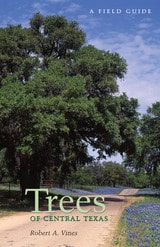
Trees of Central Texas
By Robert A. Vines
University of Texas Press, 1984
A comprehensive and compact field guide, Trees of Central Texas introduces 186 species of tree life in Central Texas, an area roughly the region of the Edwards Plateau and bordered by the Balcones Escarpment on the south and east, the Pecos River on the west, and the Texas Plains and the Llano Uplift on the north. From the hardy oaks and rugged mesquites to the graceful willows, cottonwoods, and pecans, the tree life of Central Texas varies as much as the vast and changing land that hosts it. Full descriptions and superb illustrations of all the native and naturalized trees of the region as well as fascinating bits of history and lore make this an essential guide to the wealth of tree life in Central Texas.
Drawn from Robert A. Vines' monumental Trees, Shrubs, and Woody Vines of the Southwest (University of Texas Press), Trees of Central Texas combines the essential detail of the larger work with the ease and convenience of a field guide.
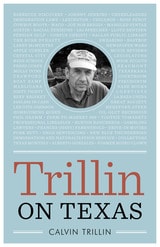
Trillin on Texas
By Calvin Trillin
University of Texas Press, 2011
A remarkably perceptive portrait of the Lone Star State, this collection of pieces from the New Yorker, the Nation, and other publications presents highlights of bestselling author Calvin Trillin’s classic writing on Texas subjects.
"Yes, I do have a Texas connection, but, as we say in the Midwest, where I grew up, not so's you'd know it." So Calvin Trillin introduces this collection of articles and poems about a place that turns up surprisingly often when he's ostensibly writing about something else. Whether reporting on the American scene for the New Yorker, penning comic verse and political commentary for the Nation, or writing his memoirs, Trillin has bumped into Texas again and again. He insists that "this has not been by design . . . there has simply been a lot going on in Texas." Astute readers will note, however, that Trillin's family immigrated to the United States through the port of Galveston, and, after reading this book, many will believe that the Lone Star State has somehow imprinted itself in the family's imagination.
Trillin on Texas gathers some of Trillin's best writing on subjects near to his heart—politics, true crime, food, and rare books, among them—which also have a Texas connection. Indulging his penchant for making "snide and underhanded jokes about respectable public officials," he offers his signature sardonic take on the Bush dynasty and their tendency toward fractured syntax; a faux, but quite believable, LBJ speech; and wry portraits of assorted Texas county judges, small town sheriffs, and Houston immigration lawyers. Trillin takes us on a mouthwatering pilgrimage to the barbecue joint that Texas Monthly proclaimed the best in Texas and describes scouting for books with Larry McMurtry—who rejects all of his "sleepers." He tells the stories of two teenagers who dug up half a million dollars in an ice chest on a South Texas ranch and of rare book dealer Johnny Jenkins, who was found floating in the Colorado River with a bullet wound in the back of his head. And he recounts how redneck movie reviewer "Joe Bob Briggs" fueled a war between Dallas's daily newspapers and pays tribute to two courageous Texas women who spoke truth to power—Molly Ivins and Sissy Farenthold.
Sure to entertain Texans and other folks alike, Trillin on Texas proves once again that Calvin Trillin is one of America's shrewdest observers and wittiest writers.
Turn Out the Lights
Chronicles of Texas during the 80s and 90sBy Gary Cartwright
University of Texas Press, 2000
Whether the subject is Jack Ruby, Willie Nelson, or his own leukemia-stricken son Mark, when it comes to looking at the world through another person's eyes, nobody does it better than Gary Cartwright. For over twenty-five years, readers of Texas Monthly have relied on Cartwright to tell the stories behind the headlines with pull-no-punches honesty and wry humor. His reporting has told us not just what's happened over three decades in Texas, but, more importantly, what we've become as a result.
This book collects seventeen of Cartwright's best Texas Monthly articles from the 1980s and 1990s, along with a new essay, "My Most Unforgettable Year," about the lasting legacy of the Kennedy assassination. He ranges widely in these pieces, from the reasons for his return to Texas after a New Mexican exile to profiles of Kris Kristofferson and Willie Nelson. Along the way, he strolls through San Antonio's historic King William District; attends a Dallas Cowboys old-timers reunion and the Holyfield vs. Foreman fight; visits the front lines of Texas' new range wars; gets inside the heads of murderers, gamblers, and revolutionaries; and debunks Viagra miracles, psychic surgery, and Kennedy conspiracy theories. In Cartwright's words, these pieces all record "the renewal of my Texas-ness, a rediscovery of Texas after returning home."
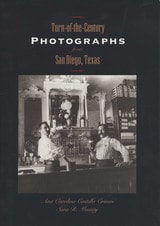
Turn-of-the-Century Photographs from San Diego, Texas
By Ana Carolina Castillo Crimm and Sara R. Massey
University of Texas Press, 2003
Situated in the South Texas borderlands some fifty miles west of Corpus Christi, San Diego was a thriving town already a hundred years old at the turn of the twentieth century. With a population that was 90 percent Mexican or Mexican American and 10 percent Anglo, the bicultural community was the seat of Duval County and a prosperous town of lumberyards, banks, mercantile stores, and cotton gins, which also supplied the needs of area ranchers and farmers. Though Anglos dominated its economic and political life, San Diego was culturally Mexican, and Mexican Americans as well as Anglos built successful businesses and made fortunes.
This collection of nearly one hundred photographs from the estate of amateur photographer William Hoffman captures the cosmopolitan town of San Diego at a vibrant moment in its history between 1898 and 1909. Grouped into the categories women and their jobs, local homes, men and their businesses, children at school and church, families and friends, and entertainment about town, the photos offer an immediate visual understanding of the cultural and economic life of the community, enhanced by detailed captions that identify the subjects and circumstances of the photos. An introductory historical chapter constitutes the first published history of Duval County, which was one of the most important areas of South Texas in the early twentieth century.
Twentieth-Century Texas
A Social and Cultural HistoryJohn W. Storey
University of North Texas Press, 2008
Two Counties in Crisis
Measuring Political Change in Reconstruction TexasRobert J. Dillard
University of North Texas Press, 2023