Results by title
967 books match the query 'Theater' and 260 start with t
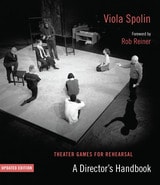
Theater Games for Rehearsal
A Director's Handbook, Updated EditionViola Spolin with a foreword by Rob Reiner
Northwestern University Press, 2010
An updated edition of a key reference text by “the high priestess of improvisational theater”
A major force in the development of American theater, Viola Spolin devised pedagogical techniques that have influenced and inspired legions of actors, improvisers, and directors. Theater Games for Rehearsal: A Director's Handbook, first published in 1985, is a practical application of Spolin's famous method that guides directors and their companies step-by-step through all phases of the rehearsal period.
In Theater Games for Rehearsal, Spolin shows in easy-to-follow detail how her techniques can be used for a variety of theater needs, from selecting performance material, casting, and building a harmonious company to warming up actors, creating stage space, and overcoming opening-night jitters. This new edition, edited by Carol Bleackley Sills, incorporates Spolin's wished-for updates: four important exercises have been added, and instructions presenting her improvisational approach have been clarified throughout. Sidecoaching instructions and game evaluations are boxed and highlighted for on-the-spot reading by the director during rehearsal.
With these additions and improvements, Theater Games for Rehearsal: A Director's Handbook brings Spolin's ideas to a new generation with greater accessibility and excitement. Featuring a new foreword by renowned film director Rob Reiner, the updated edition is mandatory for any theater bookshelf.
Theater Games for the Classroom
A Teacher's HandbookViola Spolin
Northwestern University Press, 1986
The most comprehensive theater instruction guide for all types of students
This best-selling book by Viola Spolin offers the most comprehensive theater instruction for all types of students, from small children to young adults. It includes over 130 theater games, plus exercises and instructional strategies. First developed by Spolin, the originator of modern improvisational theater techniques, these games have been tried and tested for over fifty years.
Theater Games for the Lone Actor
A HandbookViola Spolin
Northwestern University Press, 2001
Spolin's improvisational techniques changed the nature and practice of modern theater. Her work has inspired actors, directors, teachers, and writers in theater, television, and film. Her techniques have also influenced the fields of education, mental health, social work, and psychology.
Theater Historiography
Critical InterventionsHenry Bial and Scott Magelssen, editors
University of Michigan Press, 2010

Theater Of Envy
William ShakespeareRene Girard
St. Augustine's Press, 2004
In this ground-breaking work, one of our foremost literary and cultural critics turns to the major figure in English literature, William Shakespeare, and proposes a dramatic new reading of nearly all his plays and poems. The key to A Theater of Envy is Girard's novel reinterpretation of "mimesis." For Girard, people desire objects not for their intrinsic value, but because they are desired by someone else - we mime or imitate their desires. This envy - or "mimetic desire" - he sees as one of the foundations of the human condition.
Bringing such proocative and iconoclastic insights to bear on Shakespeare, Girard reveals the previously overlooked coherence of problem plays like Troilus and Cressida, and makes a convincing argument for elevating A Midsummer Night's Dream from the status of a chaotic comedy to a masterpiece. The book abounds with novel and provocative interpretations: Shakespeare becomes "a prophet of modern advertising," and the threat of nuclear disaster is read in the light of Hamlet. Most intriguing of all, perhaps, is a brief, but brilliant aside in which an entirely new perspective is brought to the chapter on Joyce's Ulysses in which Stephen Dedalus gives a lecture on Shakespeare. In Girard's view only Joyce, perhaps the greatest of twentieth-century novelists, comes close to understanding the greatest of Renaissance playwrights.
Throughout this impressively sustained reading of Shakespeare, Girard's prose is sophisticated, but contemporary, and accessible to the general reader.
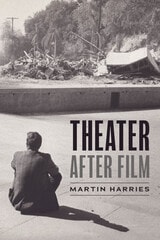
Theater after Film
Martin Harries
University of Chicago Press, 2025
In Theater after Film, Martin Harries argues that after 1945, as cinema became omnipresent in popular culture, theater had to respond to cinema’s hegemony. Theater couldn’t break that hegemony, but it could provide a zone of contestation. Theater made film’s domination of the cultural field visible through hyperbole, refusal, and other strategies, thereby unsettling its power. Postwar theatrical experiment, Harries shows, often channeled and represented film’s mass cultural force, while knowing that it could never possess that force. Throughout the book, Harries brings critical theory into contact with theories of performance. Although Theater after Film treats the theatrical work of many figures, its central focus falls on Tennessee Williams, Samuel Beckett, and Adrienne Kennedy. Discussions of these dramatists consider their ways of addressing spectators, the politics of race between film and theater, and the place of the theatrical apparatus. Readings of these central figures in twentieth-century theater exemplify the book’s historical engagement with the media surround that drama confronted. This confrontation, Harries shows, was central to the development of some of the most continually compelling postwar drama.
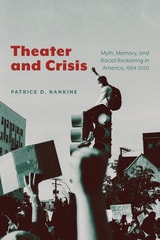
Theater and Crisis
Myth, Memory, and Racial Reckoning in America, 1964-2020Patrice D. Rankine
Lever Press, 2024
Rather than approaching the problem of racial reckoning through history, where periodization and progress are dominant narratives, Theater and Crisis argues that myth and memory allow for better theorization about recurring events from the past, their haunting, and what these apparent ghosts ask of us. Building on the study of myth as active, processual storytelling, Rankine acknowledges that it grounds and orients groups toward significant events. Theater and Crisis aligns narratives about Emmett Till, Trayvon Martin, and George Floyd, among others, with ancient, mythic figures such as Christ, Dionysus, Oedipus, and Moses. As living and verbal visitations, these stories performed on stage encode the past through their epiphanies in the present, urging audiences toward shared meaning.
Rankine traces the cyclical hauntings of race through the refiguring of mythic stories across the past 75 years in the plays of James Baldwin, Ntozake Shange, Antoinette Nwandu, and many more, and in response to flashpoints in US racial history, such as the 1955 lynching of Emmett Till, the upheavals of the 1960s and 1970s, the wars on drugs and crime, and the continued violence against and disenfranchisement of Black people into the twenty-first century. Theater and Crisis explores the appearance of myth on the American stage and showcases the ongoing response by the theatrical establishment to transform the stage into a space for racial reckoning. This timely book is essential reading for scholars of theater studies, classics, and American studies.

Theater and Democracy in an Era of Immersion
James R. Ball III
University of Michigan Press, 2027
From theater to virtual reality, we find ourselves making sense of imagined worlds that surround us. Our experience of democracy in the twenty-first century is similar: we are spectators to politics, immersed in 24-hour news, joining candidates on the campaign trail, reflecting on civic life and national memory in spaces of culture. Theater and Democracy in an Era of Immersion draws on extensive interviews with artists to develop a theory of immersive spectatorship as political action, arguing that through our experience of art, we can cultivate practices to navigate the disorientations and disenchantments of our democracy. This theory complements and complicates debates over the democratic promise of participatory performance by theorizing a mode of spectatorship that cuts across media, disciplines, genres, and everyday experiences.
James R. Ball III investigates phenomena that compose our experience of democracy, including campaign trail debates and rallies; electoral microtargeting; misinformation, disinformation, and conspiracy theory; sonic weapons and psychic spying; political assassination; racist state violence; public commemoration; AI in government; and the democratic work of mourning. Theater and Democracy in an Era of Immersion provides a unique performance studies intervention into political theory, indicating new avenues for research into political spectatorship and the theatricality of deliberative and ocular democracy.
Theater and Integrity
Emptying Selves in Drama, Ethics, and ReligionLarry D Bouchard
Northwestern University Press, 2011
It locates ambiguities in our discourse about integrity, and it delves into conceptions of identity, morality, selfhood, and otherness. Its explorations ask if integrity is less a quality we might possess than a contingent gift that may appear, disappear, and perhaps reappear. Not only does he chart anew the ethical and religious dimensions of integrity, but he also reads closely across the history of theater, from Greek and Shakespearean drama to the likes of Seamus Heaney, T. S. Eliot, Caryl Churchill, Wole Soyinka, Tony Kushner, and Suzan-Lori Parks. His is an approach of juxtaposition and reflection, starting from the perennial observation that theater both criticizes and acknowledges dimensions of drama and theatricality in life.
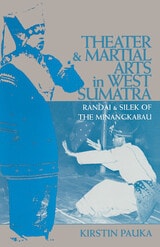
Theater and Martial Arts in West Sumatra
Randai and Silek of the MinangkabauKirstin Pauka
Ohio University Press, 1998
Randai, the popular folk theater tradition of the Minangkabau ethnic group in West Sumatra, has evolved to include influences of martial arts, storytelling, and folk songs. Theater and Martial Arts in West Sumatra describes the origin, development, and cultural background of randai and highlights two recent developments: the emergence of female performers and modern staging techniques.
This book also explores the indigenous martial arts form silek, a vital part of randai today. The strong presence of silek is illustrated in the martial focus of the stories that are told through randai, in its movement repertoire, and even in its costumes and musical accompaniment. As Kirstin Pauka shows, randai, firmly rooted in silek and Minangkabau tradition, is an intriguing mirror of the Minangkabau culture.

Theater and Social Change, Volume 31
Alisa Solomon, ed.
Duke University Press, 0
Theater and Social Change not only tracks the historical evolution of political theater but also explores the current state and future prospects of different modes, including agit-prop, demonstrations, solo performance, Augusto Boal’s Theater of the Oppressed, and community-based production. With such notable contributors as Anna Deavere Smith, Jonathan Kalb, Holly Hughes, and Tony Kushner, the issue offers a diverse assemblage of personal statements, conversations, photographs, interviews, and performance text.
Contributors include: Reverend Billy, Jan Cohen-Cruz, Arlene Goldbard, Sharon Green, Lani Guinier, Holly Hughes, Jonathan Kalb, Tony Kushner, Judith Malina, Robbie McCauley, John O'Neal, Claudia Orenstein, Bill Rauch, Julie Salverson, Anna Deavere Smith, Alisa Solomon, Roberta Uno
Theater and Society in the Classical World
Ruth Scodel, Editor
University of Michigan Press, 1993
Theater and Violence, Volume 35
Tom Sellar, ed.
Duke University Press, 0
In Theater and Violence, through interviews, play excerpts, and full-length plays—including the first American publication of two major German playwrights and directors—theater artists offer their own narratives for humankind’s violent psychologies. One full-length play, Falk Richter’s Seven Seconds (In God We Trust), probes the mind of an American pilot moments before he releases a bomb on a city below. Another, René Pollesch’s 24 Hours Are Not a Day, humorously explores the ironies and pathologies of globalization after September 11. The issue also includes a commentary on the National Endowment for the Arts’ Shakespeare presentations for the U.S. military; interviews with Russian theater artists on the first anniversary of the Chechen rebels’ siege of a Moscow theater; and Jonathan Kalb’s powerful adaptation of Heiner Müller’s Mauser, set in Tikrit.
Contributors. Josh Fox, Gitta Honegger, Jonathan Kalb, Anna Kohler, James Leverett, Mark Lord, Marlene Norst, René Pollesch, Falk Richter, Yana Ross, Scott Saul, Tom Sellar, Catherine Sheehy, Robert Woodruff
Theater as Data
Computational Journeys into Theater ResearchMiguel Escobar Varela
University of Michigan Press, 2021
Theater in Israel
Linda Ben-Zvi, Editor
University of Michigan Press, 1996
The first volume of its kind in English or Hebrew, Theater in Israel gathers original essays, interviews, and commentaries by leading international theater practitioners and critics. The book explores the rich history and diversity of Israel's theater and illustrates the ways in which this politically committed theater mirrors the historical and cultural forces that have shaped Israeli-Arab relations, the events in the Middle East, and the post-Holocaust Jewish experience. The collection provides a thorough and engaging survey of the playwrights, directors, actors, and productions that comprise this dynamic theater, a theater whose evolution and ideology diverge from Anglo-American models.
The book's early essays trace the development of Hebrew drama from its inception in Moscow in 1918 to the establishment of a national theater and the emergence of a national repertoire. Succeeding essays explore the personalities and themes that have dominated the Israeli stage, featuring interviews with leading Israeli playwrights, actors, directors, and dramaturgs. The book also provides highlights from the first Palestinian and Israeli Arab Theater Symposium, focusing on the history, themes, and future of Arab theater. The contributors include Karen Alkalay-Gut, Shosh Avigal, Linda Ben-Zvi, Erella Brown, Joseph Chaikin, Scott Cummings, Ben-Ami Feingold, Gad Kaynar, Shimon Lev- Ari, Shimon Levy, Gabriella Moscati-Steindler, Freddie Rokem, Eli Rozik, Gershon Shaked, Chaim Shoham, Michael Taub, Dan Urian, Shoshana Weitz, and Nurit Yaari.
Theater of Capital
Modern Drama and Economic LifeAlisa Zhulina
Northwestern University Press, 2024
Emerging amid the turbulent rise of market finance and wider socioeconomic changes, modern drama enacted vital critiques of art and life under capitalism. Alisa Zhulina shows how fin-de-siècle playwrights such as Henrik Ibsen, August Strindberg, Anton Chekhov, George Bernard Shaw, and Gerhart Hauptmann interrogated the meaning of this newly coined economic concept. Acutely aware of their complicity in the system they sought to challenge, these playwrights staged economic questions as moral and political concerns, using their plays to explore the theories of Adam Smith, Karl Marx and Friedrich Engels, Max Weber, and others within the boundaries of bourgeois theater.
Theater of Capital: Modern Drama and Economic Life reveals the prescient and unsettling visions of life in a new financial and societal reality in now-canonical plays such as A Doll’s House, Miss Julie, and The Cherry Orchard, as well as in lesser-known and long-overlooked works. This wide-ranging study prompts us to reevaluate modern drama and its legacy for the urgent economic and political questions that haunt our present moment.
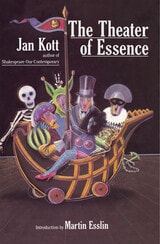
Theater of Essence
Jan Kott
Northwestern University Press, 1986
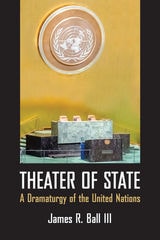
Theater of State
A Dramaturgy of the United NationsJames R. Ball III
Northwestern University Press, 2020
This study of the lived experience of spectacular politics on the world stage draws on theories of theater, performance, and politics to offer new ways of approaching issues of war, cosmopolitanism, international justice, governance, and activism. Situated at the nexus of two disciplines, performance studies and political science, this volume encourages conversations between the two so that each might offer lessons to the other.

Theater of War
Edited by Meredith Davenport
Intellect Books, 2015
Bringing together a series of two dozen photographs with essays discussing and analyzing the influence of the media, particularly photographs and video, on the culture at large and how conflict is "discussed" in the visual realm, Theater of War is a unique look at the influence of contemporary conflict, and their omni-presence in the media on popular culture. Written by an experienced photojournalist who has covered a variety of human rights issues worldwide, this book is an essential addition to the library of anyone interested in the confluence of war and media.
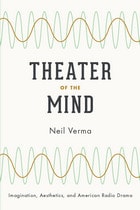
Theater of the Mind
Imagination, Aesthetics, and American Radio DramaNeil Verma
University of Chicago Press, 2012
For generations, fans and critics have characterized classic American radio drama as a “theater of the mind.” This book unpacks that characterization by recasting the radio play as an aesthetic object within its unique historical context. In Theater of the Mind, Neil Verma applies an array of critical methods to more than six thousand recordings to produce a vivid new account of radio drama from the Depression to the Cold War.
In this sweeping exploration of dramatic conventions, Verma investigates legendary dramas by the likes of Norman Corwin, Lucille Fletcher, and Wyllis Cooper on key programs ranging from The Columbia Workshop, The Mercury Theater on the Air, and Cavalcade of America to Lights Out!, Suspense, and Dragnet to reveal how these programs promoted and evolved a series of models of the imagination.
With close readings of individual sound effects and charts of broad trends among formats, Verma not only gives us a new account of the most flourishing form of genre fiction in the mid-twentieth century but also presents a powerful case for the central place of the aesthetics of sound in the history of modern experience.
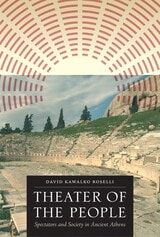
Theater of the People
Spectators and Society in Ancient AthensBy David Kawalko Roselli
University of Texas Press, 2011
Greek drama has been subject to ongoing textual and historical interpretation, but surprisingly little scholarship has examined the people who composed the theater audiences in Athens. Typically, scholars have presupposed an audience of Athenian male citizens viewing dramas created exclusively for themselves—a model that reduces theater to little more than a medium for propaganda. Women's theater attendance remains controversial, and little attention has been paid to the social class and ethnicity of the spectators. Whose theater was it?
Producing the first book-length work on the subject, David Kawalko Roselli draws on archaeological and epigraphic evidence, economic and social history, performance studies, and ancient stories about the theater to offer a wide-ranging study that addresses the contested authority of audiences and their historical constitution. Space, money, the rise of the theater industry, and broader social forces emerge as key factors in this analysis. In repopulating audiences with foreigners, slaves, women, and the poor, this book challenges the basis of orthodox interpretations of Greek drama and places the politically and socially marginal at the heart of the theater. Featuring an analysis of the audiences of Aeschylus, Sophocles, Euripides, Aristophanes, and Menander, Theater of the People brings to life perhaps the most powerful influence on the most prominent dramatic poets of their day.
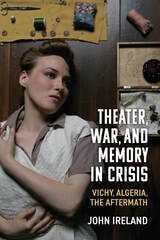
Theater, War, and Memory in Crisis
Vichy, Algeria, the AftermathJohn Ireland
University of Michigan Press, 2025
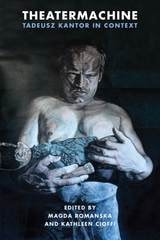
Theatermachine
Tadeusz Kantor in ContextEdited by Magda Romanska and Kathleen Cioffi
Northwestern University Press, 2019
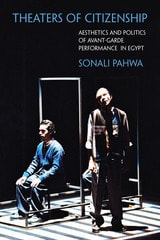
Theaters of Citizenship
Aesthetics and Politics of Avant-Garde Performance in EgyptSonali Pahwa
Northwestern University Press, 2020
In 2004, independent cultural institutions were sites for more democratic forms of youth organization and cultural participation than were Egyptian state theaters. Sonali Pahwa looks at identity formation within this infrastructure for new cultural production: festivals, independent troupes, workshops, and manifesto movements. Bringing institutional changes in dialogue with new performance styles on stages and streets, Pahwa conceptualizes performance culture as a school of citizenship. Independent theater incubated hope in times of despair and pointed to different futures for the nation’s youth than those seen in television and newspapers. Young dramatists countered their generation’s marginalization in the neoliberal economy, media, and political institutions as they performed alternative visions for the nation. An important contribution to the fields of anthropology and performance studies, Pahwa’s analysis will also interest students of sociology and Egyptian history.
Theaters of the Everyday
Aesthetic Democracy on the American StageJacob Gallagher-Ross
Northwestern University Press, 2018
Offering both fresh reappraisals of canonical figures and movements and new examinations of theatrical innovators, Theaters of the Everyday reveals surprising affinities between artists often considered poles apart, such as John Cage and Lee Strasberg, and Thornton Wilder and the New York experimentalist Nature Theater of Oklahoma. Gallagher-Ross persuasively shows how these creators eschew conventional definitions of dramatic action and focus attention on smaller but no less profound dramas of perception, consciousness, and day-to-day life.
Gallagher-Ross traces some of the intellectual roots of the theater of the everyday to American transcendentalism, with its pragmatic process philosophy as well as its sense of ordinary experience as the wellspring of aesthetic awareness.
Theatre Fandom
Engaged Audiences in the Twenty-first CenturyKirsty Sedgman
University of Iowa Press, 2025
Contributors: Tom Cantrell, Francesca Coppa, Ruth Foulis, Helen Freshwater, Emily Garside, Caroline Heim, Matt Hills, Natalie Ibu, Laura MacDonald, Dominique Morisseau, Rachael Nicholas, Louie Lang Norman, Owen G. Parry, Stephanie E. Pitts, Sarah M. Price, Beth Emily Richards, Kirsty Sedgman, Megan Vaughan, Ben Walmsley, Sarah K. Whitfield
Theatre History Studies 1982, Vol. 2
Ron Engle
University of Alabama Press, 1982
Theatre History Studies 1983, Vol. 3
Ron Engle
University of Alabama Press, 1983

Theatre History Studies 2003, Vol. 23
Robert A. Schanke
University of Alabama Press, 2003
Theatre History Studies is a peer-reviewed journal of theatre history and scholarship published annually since 1981 by the Mid-American Theatre Conference (MATC), a regional body devoted to theatre scholarship and practice. The conference encompasses the states of Illinois, Iowa, Nebraska, Kansas, Missouri, Minnesota, North Dakota, South Dakota, Wisconsin, Indiana, Michigan, and Ohio. The purpose of the conference is to unite persons and organizations within the region with an interest in theatre and to promote the growth and development of all forms of theatre.
THS is a member of the Council of Editors of Learned Journals and is included in the MLA Directory of Periodicals. THS is indexed in Humanities Index, Humanities Abstracts, Book Review Index, MLA International Bibliography, International Bibliography of Theatre, Arts & Humanities Citation Index, IBZ International Bibliography of Periodical Literature, and IBR International Bibliography of Book Reviews. Full texts of essays appear in the databases of both Humanities Abstracts Full Text as well as SIRS.
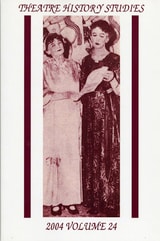
Theatre History Studies 2004, Vol. 24
VoluRobert A. Schanke
University of Alabama Press, 2004
THS is a member of the Council of Editors of Learned Journals and is included in the MLA Directory of Periodicals. THS is indexed in Humanities Index, Humanities Abstracts, Book Review Index, MLA International Bibliography, International Bibliography of Theatre, Arts & Humanities Citation Index, IBZ International Bibliography of Periodical Literature, and IBR International Bibliography of Book Reviews. Full texts of essays appear in the databases of both Humanities Abstracts Full Text as well as SIRS.
Theatre History Studies 2007, Vol. 27
Edited by Rhona Justice-Malloy
University of Alabama Press, 2007
A Copublication of the Mid-American Theatre Conference and The University of Alabama Press.
Theatre History Studies is a peer-reviewed journal of theatre history and scholarship published annually since 1981 by the Mid-American Theatre Conference (MATC), a regional body devoted to theatre scholarship and practice. The conference encompasses the states of Illinois, Iowa, Nebraska, Kansas, Missouri, Minnesota, North Dakota, South Dakota, Wisconsin, Indiana, Michigan, and Ohio. The purpose of the conference is to unite persons and organizations within the region with an interest in theatre and to promote the growth and development of all forms of theatre.
Rhona Justice-Malloy is Chair of the Department of Theatre Arts at the University of Mississippi.
Theatre History Studies 2008, Vol. 28
Edited by Rhona Justice-Malloy
University of Alabama Press, 2008
Theatre History Studies is a peer-reviewed journal of theatre history and scholarship published annually since 1981 by the Mid-American Theatre Conference (MATC), a regional body devoted to theatre scholarship and practice. The conference encompasses the states of Illinois, Iowa, Nebraska, Kansas, Missouri, Minnesota, North Dakota, South Dakota, Wisconsin, Indiana, Michigan, and Ohio. The purpose of the conference is to unite persons and organizations within the region with an interest in theatre and to promote the growth and development of all forms of theatre.
Theatre History Studies 2009, Vol. 29
Edited by Rhona Justice-Malloy, with contributions from Christin Essin, Carolyn D. Roark, Meredith Lowe, Valleri J. Hohman, Fonzie D. Geary II, Robert B. Shimko, Robert B. Theatre History Studies, Elizabeth Osborne, Paul Cornwell, Harry J. Elam Jr., etc.
University of Alabama Press, 2009
Reimagining the archive, one performance at a time.
Theatre History Studies is a peer-reviewed journal dedicated to excellence in theatre historiography. Volume 29, edited by Rhona Justice-Malloy, includes essays that span a wide range of historical periods, geographic regions, and thematic concerns. Highlights include explorations of pain and torment in performance, the aesthetics of American modernity through Belasco and Jones, and the cultural politics of prohibition on stage. The volume also features visual and archival studies, including an interview with playwright Wendy Wasserstein and analyses of Shakespeare’s reception in Restoration theatre. With contributions from over thirty scholars, this edition offers a rich and multifaceted view of how theatre reflects, resists, and reshapes historical narratives.
Theatre History Studies 2010, Vol. 30
Edited by Rhona Justice-Malloy
University of Alabama Press, 2010
To mark the thirtieth anniversary of the Theatre History Studies journal, editor Rhona Justice-Malloy and the Mid-America Theatre Conference have collected a special-themed volume covering the past and present of African and African American theatre. Topics included range from modern theatrical trends and challenges in Zimbabwe and Kenya, and examining the history and long-range impact of Paul Robeson’s groundbreaking and troubled life and career, to gender issues in the work of Ghanaian playwright Efo Kodjo Mawugbe, and the ways that 19th-century American blackness was defined through Othello and Desdemona. This collection fills a vacancy in academic writing. Readers will enjoy it; academics can incorporate it into their curriculum; and students will find it helpful and illuminating.
Theatre History Studies 2011, Vol. 31
Rhona Justice-Malloy
University of Alabama Press, 2011
THS is a member of the Council of Editors of Learned Journals and is included in the MLA Directory of Periodicals. THS is indexed in Humanities Index, Humanities Abstracts, Book Review Index, MLA International Bibliography, International Bibliography of Theatre, Arts & Humanities Citation Index, IBZ International Bibliography of Periodical Literature, and IBR International Bibliography of Book Reviews. Full texts of essays appear in the databases of both Humanities Abstracts Full Text as well as SIRS
From published reviews
“This established annual is a major contribution to the scholarly analysis and historical documentation of international drama. Refereed, immaculately printed and illustrated . . . . The subject coverage ranges from the London season of 1883 to the influence of David Belasco on Eugene O’Neill.”—CHOICE
“International in scope but with an emphasis on American, British, and Continental theater, this fine academic journal includes seven to nine scholarly articles dealing with everything from Filipino theater during the Japanese occupation to numerous articles on Shakespearean production to American children’s theater. . . . an excellent addition for academic, university, and large public libraries.”—Magazines for Libraries, 6th Edition
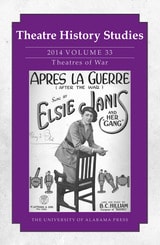
Theatre History Studies 2014, Vol. 33
Theatres of WarElizabeth Reitz Mullenix
University of Alabama Press, 2014
War and theatre is a subject of increasing popularity among scholars of theatre. The essays in this special edition of Theatre History Studies brings together a unique collection of work by thirteen innovative scholars whose work explores such topics as theatre performances during war times, theatre written and performed to resist war, and theatre that fosters and promotes war.
The contributors to this volume write poignantly about nationhood and about how war—through both propaganda and protest—defines a people. The contributors also delve into numerous fascinating themes that transcend time, peoples, nations, and particular conflicts: the foundations of nationalism and the concepts of occupied and occupier, nostalgia and utopia, and patriotism and revolution.
These essays survey a march of civil and international wars spanning three centuries. Arranged chronologically, they invite comparisons between themes and trace the development of the major themes of war. Ideas manifest in the theatre of one period recall ideologies and propaganda of the past, reflect those of the present, and anticipate wars to come.
Theatre History Studies 2015, Vol. 34
Elizabeth Reitz Mullenix
University of Alabama Press, 2015
The five essays are arranged chronologically, starting with Alan Sikes’s discussion of the Abydos Passion Play. Sikes challenges the long-held interpretation of that ritualized annual reenactment of the death, dismemberment, and return to life of Egyptian god-king Osiris as the world’s first recorded dramatic production. In analyzing the “Passion Play”—Sikes argues the term is not apt—he applies semiotic theory using "sign and referent" to revise general concepts of mimesis, and in so doing clarifies the fundamental answer to the question, “What is theatre?”
In a pair of essays, Andrew Gibb and Nicole Berkin both explore theatre during America’s antebellum period. Gibb examines minstrelsy in antebellum California, exploding narrow definitions of minstrelsy as a primarily Eastern phenomenon and one reflecting a stark interaction of two races. Following the story of Jewish African Caribbean immigrant William Alexander Leidesdorff, Gibb demonstrates that national forms are always affected by their local productions and audiences. Berkin’s essay focuses on the struggles over cultural power that took place between popular entertainers and theatre managers. She examines how both parties used touring strategically to engage with antebellum notions of deception and fraud.
The last two essays, by Megan Geigner and Heide Nees, present findings from performance studies which, by examining a wide array of dramatic and performative texts, expands the interdisciplinary foundations of theatre history studies. This fascinating collection is rounded out by an expanded selection of insightful reviews of recent literature in the area.

Theatre History Studies 2016, Vol. 35
Sara Freeman
University of Alabama Press, 2016
Theatre History Studies, published since 1981 by the Mid-American Theatre Conference (MATC) is a leading scholarly publication in the field of theatrical history and theory. The conference encompasses the states of Illinois, Iowa, Nebraska, Kansas, Missouri, Minnesota, North Dakota, South Dakota, Wisconsin, Indiana, Michigan, and Ohio. The purpose of the conference is to unite persons and organizations within the region with an interest in theatre and to promote the growth and development of all forms of theatre.
Theatre History Studies 2017, Vol. 36
Edited by Sara Freeman
University of Alabama Press, 2017
Theatre History Studies is devoted to research in all areas of theatre studies, with special interest in archival research, historical documentation, and historiography. Many issues feature a special section curated around a special theme or topic; for 2017 that special section focus on histories of new writing for the theatre.
Featured in THEATRE HISTORY STUDIES 2017, VOLUME 36
- “Resisting Arlecchino’s Mask: The Case of Marcello Moretti” by Gabrielle Houle
- “Making Space for Performance: Theatrical-Architectural Nationalism in Postindependence Ghana” by David Afriyie Donkor
- “Preparing Boys for War: J. M. Barrie’s Peter Pan Enlists in World War I’s ‘Great Adventure’” by Laura Ferdinand Feldmeyer
- “Not Just Rock ‘n’ Roll: Chicago Theatre, 1984–1990” by Julie Jackson
- “New Writing and Theatre History” by Sara Freeman
- “New Plays in New Tongues: Bilingualism and Immigration at the New Italian Theatre in France” by Matthew McMahan
- “The Waterloo Summer of the Prince of Wales’s Theatre: New Writing, Old Friends, and Early Realism in the Victorian Theatre” by Shannon Epplett
- “Chekhov’s Three Sisters: A Proto-Poststructuralist Experiment” by Sarah Wyman
- “Historicizing Shakesfear and Translating Shakespeare Anew” by Lezlie C. Cross
- “A New Noble Kinsmen: The Play On! Project and Making New Plays Out of Old” by Martine Kei Green-Rogers and Alex N. Vermillion
- “Making New Theatre Together: The First Writers’ Group at the Royal Court Theatre and Its Legacy Within the Young Writers’ Programme” by Nicholas Holden
- “New Writing in a Populist Context: A Play,a Pie, and a Pint” by Deana Nichols
- “American Playwriting and the Now New” by Todd London
- The Robert A. Schanke Award-Winning Essay: “Black Folk’s Theatre to Black Lives Matter: The Black Revolution on Campus” by La Donna L. Forsgren
Theatre History Studies 2018, Vol. 37
Sara Freeman
University of Alabama Press, 2018
THEATRE HISTORY STUDIES, VOLUME 37
STEFAN AQUILINA
Meyerhold and The Revolution: A Reading through Henri Lefebvre’s Theories on “Everyday Life”
VIVIAN APPLER
“Shuffled Together under the Name of a Farce”: Finding Nature in Aphra Behn’s The Emperor of the Moon
KRISTI GOOD
Kate Soffel’s Life of Crime: A Gendered Journey from Warden’s Wife to Criminal Actress
PETER A. CAMPBELL
Staging Ajax’s Suicide: A Historiography
BRIAN E. G. COOK
Rousing Experiences: Theatre, Politics, and Change
MEGAN LEWIS
Until You See the Whites of Their Eyes: Brett Bailey’s Exhibit B and the Consequences of Staging the Colonial Gaze
PATRICIA GABORIK
Taking the Theatre to the People: Performance Sponsorship and Regulation in Mussolini’s Italy
ILINCA TODORUT AND ANTHONY SORGE
To Image and to Imagine: Walid Raad, Rabih Mouré, and the Arab Spring
SHULAMITH LEV-ALADGEM
Where Has the Political Theatre in Israel Gone? Rethinking the Concept of Political Theatre Today
CHRISTINE WOODWORTH
“Equal Rights By All Means!”: Beatrice Forbes-Robertson’s 1910 Suffrage Matinee and the Onstage Junction of the US And UK Franchise Movements
LURANA DONNELS O’MALLEY
“Why I Wrote the Phyllis Wheatley Pageant-Play”: Mary Church Terrell’s Bicentennial Activism
JULIET GUZZETTA
The Lasting Theatre of Dario Fo and Franca Rame
ASHLEY E. LUCAS
Chavez Ravine: Culture Clash and the Political Project of Rewriting History
NOE MONTEZ
The Heavy Lifting: Resisting the Obama Presidency’s Neoliberalist Conceptions of the American Dream in Kristoffer Diaz’s The Elaborate Entrance of Chad Deity
Theatre History Studies 2019, Vol. 38
Edited by Sara Freeman
University of Alabama Press, 2019
THEATRE HISTORY STUDIES, VOLUME 38
PART I: Studies in Theatre History
ELIZABETH COEN
Hanswurst’s Public: Defending the Comic in the Theatres of Eighteenth-Century Vienna
BRIDGET MCFARLAND
“This Affair of a Theatre”: The Boston Theatre Controversy and the Americanization of the Stage
RYAN TVEDT
From Moscow to Simferopol: How the Russian Cubo-Futurists Accessed the Provinces
DANIELLA VINITSKI MOONEY
So Long Ago I Can’t Remember: GAle GAtes et al. and the 1990s Immersive Theatre
Part II: The Site-Based Theatre Audience Experience: Dramaturgy and Ethics
—EDITED BY PENELOPE COLE AND RAND HARMON
PENELOPE COLE
Site-Based Theatre: The Beginning
PENELOPE COLE
Becoming the Mob: Mike Brookes and Mike Pearson’s Coriolan/us
SEAN BARTLEY
A Walk in the Park: David Levine’s Private Moment and Ethical Participation in Site-Based Performance
DAVID BISAHA
“I Want You to Feel Uncomfortable”: Adapting Participation in A 24-Decade History of Popular Music at San Francisco’s Curran Theatre
COLLEEN RUA
Navigating Neverland and Wonderland: Audience as Spect-Character
GUILLERMO AVILES-RODRIGUEZ, PENELOPE COLE, RAND HARMON, AND ERIN B. MEE
Ethics and Site-Based Theatre: A Curated Discussion
PART III: The Robert A. Schanke Award-Winning Essay from the 1038 Mid-America Theatre Conference
MICHELLE GRANSHAW
Inventing the Tramp: The Early Tramp Comic on the Variety Stage
Theatre History Studies 2020, Vol. 39
Edited by Lisa Jackson-Schebetta
University of Alabama Press, 2020
Theatre History Studies (THS) is a peer-reviewed journal of theatre history and scholarship published annually since 1981 by the Mid-America Theatre Conference
Reframing the past to illuminate the future of performance.
Theatre History Studies is a peer-reviewed journal devoted to excellence in theatre historiography. Volume 38, edited by Lisa Jackson-Schebetta, features three distinct sections: foundational studies in theatre history, a special section on hemispheric historiographies, and award-winning essays from the Mid-America Theatre Conference. Contributors examine topics ranging from Shakespeare and racial antagonism to systemic dramaturgy, labor unions in regional theatre, and digital diasporic activism. The volume also includes visual histories and decolonial methodologies that challenge Eurocentric narratives and foreground Latinx, feminist, and socialist performance traditions. With 272 pages and 18 black-and-white figures, this edition is a rich resource for scholars seeking to expand the scope and methods of theatre history.
Theatre History Studies 2021, Vol 40
Edited by Lisa Jackson-Schebetta
University of Alabama Press, 2021
A peer-reviewed journal of theatre history and scholarship published annually since 1981 by the Mid-America Theatre Conference
Theatre History Studies 2021, Vol. 40, edited by Lisa Jackson-Schebetta, marks the fortieth volume of the respected, peer-reviewed journal published by the Mid-America Theatre Conference, a leading forum for innovative scholarship in theatre and performance studies. Bringing together a diverse collection of essays from established and emerging scholars, this volume examines the intersections of theatre history, cultural memory, performance, identity, race, gender, and social change across a wide range of historical and contemporary contexts.
The volume opens with a series of studies that challenge conventional narratives of theatre history and performance. Contributors explore topics including Voltaire and Enlightenment thought, the contributions and erasure of African American artists within the Federal Theatre Project's Negro Unit, questions of empathy and historical consciousness in contemporary drama, and the influence of Asian aesthetics on the work of modern dance innovator Alwin Nikolais. Together, these essays demonstrate the ongoing importance of theatre history as a lens through which to understand cultural power, representation, and artistic expression.
A special section,"Witch Characters and Witchy Performance," investigates the enduring cultural fascination with witches on stage and in popular performance. Essays examine witchcraft in the works of Joanna Baillie and Shakespeare, representations of female bodies and power in Caryl Churchill's Vinegar Tom, the feminist dimensions of Wicked, and the immersive theatrical worlds of productions such as Sleep No More and Then She Fell. Through these studies, the collection highlights how witch figures continue to serve as powerful symbols for exploring gender, authority, resistance, and cultural imagination.
The volume also features the recipient of the Robert A. Schanke Award, recognizing outstanding scholarship presented at the Mid-America Theatre Conference. This essay examines the evolving relationship between Broadway and high school musical theatre in the 2010s, offering valuable insight into theatre education, performance culture, and the transmission of theatrical traditions to new generations.
In addition to original research articles, Theatre History Studies 2021, Vol. 40 includes scholarly book reviews, contributor notes, and discussions of recent publications in the field, making it an essential resource for researchers, educators, students, and theatre practitioners. By bringing together rigorous historical inquiry and contemporary critical perspectives, this landmark volume showcases the breadth, vitality, and continuing relevance of theatre and performance scholarship in the twenty-first century.
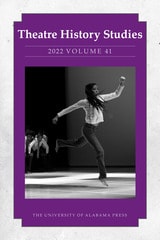
Theatre History Studies 2022, Vol 41
edited by Lisa Jackson-Schebetta
University of Alabama Press, 2023
New perspectives and rigorous scholarship shaping the histories of theatre and performance.
Theatre History Studies 2022, Vol. 41 presents a dynamic collection of peer‑reviewed essays that exemplify current directions in theatre and performance historiography. Edited by Lisa Jackson‑Schebetta, this volume brings together scholars whose work spans diverse periods, geographies, and performance traditions, demonstrating the field’s continued expansion in scope and methodology. As the official journal of the Mid‑America Theatre Conference, Theatre History Studies remains a vital venue for rigorous historical inquiry grounded in archival research, critical theory, and historiographic reflection.
Volume 41 engages pressing questions about how theatre histories are constructed, narrated, and mobilized in relation to social, political, and cultural contexts. Contributors explore performance as a site of embodied knowledge, identity formation, resistance, and memory, with essays that address race, gender, sexuality, labor, migration, and transnational exchange. The volume reflects a historiographic turn toward interdisciplinary approaches, drawing from dance studies, performance studies, critical race theory, and cultural history to reconsider established narratives and recover overlooked voices.
Together, the essays in this volume demonstrate the continued relevance of theatre history as both a scholarly practice and a critical framework for understanding performance’s role in shaping—and being shaped by—broader historical forces. Theatre History Studies 2022, Vol. 41 will be of particular value to scholars, educators, and graduate students in theatre and performance studies, as well as researchers in related fields who are interested in innovative historical methods and the evolving contours of performance scholarship.
CONTRIBUTORS
Angela K. Ahlgren / Samer Al-Saber / Kelly I. Aliano / Gordon Alley-Young / Melissa Blanco Borelli / Trevor Boffone / Jay Buchanan / Matthieu Chapman / Joanna Dee Das / Ryan J. Douglas / Victoria Fortuna / Christiana Molldrem Harkulich / Alani Hicks-Bartlett / Jeanmarie Higgins / Lisa Jackson-Schebetta / Erin Rachel Kaplan / Heather Kelley / Patrick Maley / Karin Maresh / Lisa Milner / Courtney Elkin Mohler / Heather S. Nathans / Heidi L. Nees / Sebastian Samur / Michael Schweikardt / Teresa Simone / Dennis Sloan / Guilia Taddeo / Kyle A. Thomas / Alex Vermillion / Bethany Wood
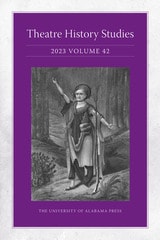
Theatre History Studies 2023, Vol. 42
edited by Lisa Jackson-Schebetta
University of Alabama Press, 2024
The official journal of the Mid-America Theatre Conference
Theatre History Studies (THS) is a peer-reviewed journal of theatre history and scholarship published annually since 1981 by the Mid-America Theatre Conference (MATC), a regional body devoted to theatre scholarship and practice. The conference encompasses the states of Illinois, Iowa, Nebraska, Kansas, Missouri, Minnesota, North Dakota, South Dakota, Wisconsin, Indiana, Michigan, and Ohio. The purpose of the conference is to unite persons and organizations within the region with an interest in theatre and to promote the growth and development of all forms of theatre. THS is a member of the Council of Editors of Learned Journals and is included in the MLA Directory of Periodicals. THS is indexed in Humanities Index, Humanities Abstracts, Book Review Index, MLA International Bibliography, International Bibliography of Theatre, Arts & Humanities Citation Index, IBZ International Bibliography of Periodical Literature, and IBR International Bibliography of Book Reviews. Full texts of essays appear in the databases of both Humanities Abstracts Full Text and SIRS.Along with book reviews on the latest publications from established and emerging voices in the field, this issue of Theatre History Studies contains three sections with fourteen essays total. In the general section, three essays offer an array of insights, methods, and provocations. In the special section on care, contributors capture their experience as scholars, humans, and citizens in 2022. In Part III, the 2022 Robert A. Schanke Research Award-winning paper by Heidi L. Nees asks historians to rethink Western constructions of time. Taken together, volume 42 captures how this journal serves theatre historians as scholars and laborers as they work to attend and tend to their field.
CONTRIBUTORS
Cheryl Black / Shelby Brewster / Matthieu Chapman / Meredith Conti / Zach Dailey / Michael DeWhatley / Whit Emerson / Katherine Gillen / Miles P. Grier / Patricia Herrera / Lisa Jackson-Schebetta / Nancy Jones / Joshua Kelly / Felicia Hardison Londré / Bret McCandless / Marci R. McMahon/ Tom Mitchell / Sherrice Mojgani / John Murillo III / Heidi L. Nees / Jessica N. Pabón-Colón / Kara Raphaeli / Leticia L. Ridley / Cynthia Running-Johnson / Alexandra Swanson / Catherine Peckinpaugh Vrtis / Shane Wood / Christine Woodworth / Robert O. Yates
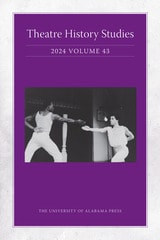
Theatre History Studies 2024, Vol 43
Edited by Jocelyn L. Buckner
University of Alabama Press, 2025
The official journal of the Mid-America Theatre Conference
Where past and performance converge—scholarship that moves the stage forward.
Theatre History Studies (THS) is a peer-reviewed journal of theatre history and scholarship published annually since 1981 by the Mid-America Theatre Conference (MATC), a regional body devoted to theatre scholarship and practice. The conference encompasses the states of Illinois, Iowa, Nebraska, Kansas, Missouri, Minnesota, North Dakota, South Dakota, Wisconsin, Indiana, Michigan, and Ohio. The purpose of the conference is to unite persons and organizations within the region with an interest in theatre and to promote the growth and development of all forms of theatre. THS is a member of the Council of Editors of Learned Journals and is included in the MLA Directory of Periodicals. THS is indexed in Humanities Index, Humanities Abstracts, Book Review Index, MLA International Bibliography, International Bibliography of Theatre, Arts & Humanities Citation Index, IBZ International Bibliography of Periodical Literature, and IBR International Bibliography of Book Reviews. Full texts of essays appear in the databases of both Humanities Abstracts Full Text as well as SIRS.
Along with books reviews on the latest publications from established and emerging voices in the field, this issue of Theatre History Studies contains four sections with two introductions, nine essays, and eleven book reviews total. In the general section, three essays offer an array of insights, methods, and provocations. In the special section titled “Manifestos for Black Theatre, Then and Now,” contributors capture their moment, their ways of working, and their experience as scholars, humans, and citizens in 2023. In part III, Ariel Nereson’s Robert A. Schanke Research Award-winning paper from the 2023 MATC conference examines collective dance histories through the Bill T. Jones/Arnie Zane Dance Company’s Continuous Replay. Taken together, volume 43 captures how this journal serves theatre historians as scholars and laborers as they work to attend and tend to their field.
CONTRIBUTORS
Daniel E. Atkinson / Ashlyn K. Barnett / David Bisaha / Jocelyn L. Buckner / Julie Burrell / Jordana Cox / Jordan Ealey / Eric M. Glover / Adam Goldstein / Chao Guo / Amy B. Huang / Ariel Nereson / Zachary F. Price / Danielle Rosvally / Letica L. Ridley / Bradford G. Sadler / Richard Sautter / Michael Schweikardt / Margo Skornia / Dennis Sloan / Josh Stenberg / Paul Michael Thomson / Scott Venters / Isaiah Matthew Wooden

Theatre History Studies 2026, Vol 44
Edited by Jocelyn L. Buckner
University of Alabama Press, 2026
The official journal of the Mid-America Theatre Conference
Theatre History Studies (THS) is a peer-reviewed journal of theatre history and scholarship published annually since 1981 by the Mid-America Theatre Conference (MATC), a regional body devoted to theatre scholarship and practice. The conference is dedicated to the growth and improvement of all forms of theatre throughout a twelve-state region encompassing Illinois, Indiana, Iowa, Kansas, Michigan, Minnesota, Missouri, Nebraska, North Dakota, Ohio, South Dakota, and Wisconsin. The purposes of the conference are to unite people and organizations within the region and elsewhere who have an interest in theatre and to promote the growth and development of all forms of theatre. THS is a member of the Council of Editors of Learned Journals and is included in the MLA Directory of Periodicals. THS is cataloged in numerous periodical indexes and databases.
Along with sixteen book reviews on the latest publications from established and emerging voices in the field, this issue of Theatre History Studies contains four sections with two introductions and nine essays total. In the general section, three essays consider performance histories and reevaluations of historiographical approaches. The special section on queer historiographies responds to calls for a more expansive and inclusive understanding of trans histories and for centralizing contemporary queer performers. In part III, the Robert A. Schanke Research Award-winning paper from the 2024 MATC conference by Ali-Reza Mirsajadi addresses erasures in the theatrical archive and highlights the long legacy of queer, Southwest Asian, and North African representation in dramatic texts. Taken together, volume 44 captures how this journal serves theatre historians as scholars and laborers as they work to attend and tend to their field.
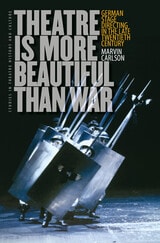
Theatre Is More Beautiful Than War
German Stage Directing in the Late Twentieth CenturyCarlson, Marvin
University of Iowa Press, 2009
In almost every area of production, German theatre of the past forty years has achieved a level of distinction unique in the international community. This flourishing theatrical culture has encouraged a large number of outstanding actors, directors, and designers as well as video and film artists. The dominant figure throughout these years, however, has remained the director. In this stimulating and informative book, noted theatre historian Marvin Carlson presents an in-depth study of the artistic careers, working methods, and most important productions of ten of the leading directors of this great period of German staging.
Beginning with the leaders of the new generation that emerged in the turbulent late 1960s—Peter Stein, Peter Zadek, and Claus Peymann, all still major figures today—Carlson continues with the generation that appeared in the 1980s, particularly after reunification—Frank Castorf, Anna Viebrock, Andrea Breth, and Christoph Marthaler—and concludes with the leading directors to emerge after the turn of the century, Stefan Pucher, Thomas Ostermeier, and Michael Thalheimer. He also provides information not readily available elsewhere in English on many of the leading actors and dramatists as well as the designers whose work, much of it for productions of these directors, has made this last half century a golden age of German scenic design.
During the late twentieth century, no country produced so many major theatre directors or placed them so high in national cultural esteem as Germany. Drawing on his years of regular visits to the Theatertreffen in Berlin and other German productions, Carlson will captivate students of theatre and modern German history and culture with his provocative, well-illustrated study of the most productive and innovative theatre tradition in Europe.
Theatre Symposium, Vol. 15
Theatre and Moral OrderM. Scott Phillips
University of Alabama Press, 2007
Theatre Symposium, Vol. 16
Comedy Tonight!Jay Malarcher
University of Alabama Press, 2008
The essays gathered in Volume 16 of the annual journal Theatre Symposium illustrate well the range of material that falls under the heading "comedy" as it is played on stage.
Stanley Longman's essay on "The Commedia dell'Arte as the Quintessence of Comedy" introduces us to the inhabitants of "Commediatown," character types who are descendents of the Greeks and ancestors, it seems, of almost everyone who came after. Boris Senker, an eyewitness to Croatia's evolution from communism to democracy, reports on the all-too-real "Commedia" stereotypes that have found their way onto the stage in his homeland.
Other essays address the improvisational nature of "Commedia"; the roots of laughter and the expectations inherent in presenting "old schtick" to a new generation; comedic technique, verbal and physical, in Molière; the use of the macabre to create humor in the "Théâtre du Grand Guignol"; the story of Henry Fielding, the theatre practitioner most responsible for the British government's crackdown on subversive material, via the Licensing Act of 1737; Beckett's theatrical connections to the comedy theory of Henri Bergson; and do-it-yourself (DIY) comedy—happenings, situations, gatherings—as practiced in British stand-up comedy.
Volume 16 provides just a glimpse into the possibilities for comedy on the stage. If the past examples allow for extrapolation into the future, the position of comedy as a means of communicating problems and solutions for society's woes is remarkably sound.