Results by title
991 books match the query 'Writing' and 165 start with t
Transformations
Change Work across Writing Programs, Pedagogies, and PracticesHolly Hassel
Utah State University Press, 2021
The collection includes chapters from multiple award-winning writing programs, including the recipients of the Two-Year College Association’s Outstanding Programs in English Award and the Conference on College Composition and Communication’s Writing Program Certificate of Excellence. These authors offer perspectives that demonstrate the deep work of transformation in writing programs and practices writ large, confirm the ways in which writing programs are connected to and situated within larger institutional and disciplinary contexts, and outline successful methods for navigating these contexts in order to transform the work.
In using the prism of transformation as the organizing principle for the collection, Transformations offers a range of strategies for adapting writing programs so that they meet the needs of students and teachers in service of creating equitable, ethical literacy instruction in a range of postsecondary contexts.
Contributors: Leah Anderst, Cynthia Baer, Ruth Benander, Mwangi Alex Chege, Jaclyn Fiscus-Cannaday, Joanne Giordano, Rachel Hall Buck, Sarah Henderson Lee, Allison Hutchinson, Lynee Lewis Gaillet, Jennifer Maloy, Neil Meyer, Susan Miller-Cochran, Ruth Osorio, Lori Ostergaard, Shyam Pandey, Cassie Phillips, Brenda Refaei, Heather Robinson, Shelley Rodrigo, Julia Romberger, Tiffany Rousculp, Megan Schoen, Paulette Stevenson
Transforming Ethos
Place and the Material in Rhetoric and WritingRosanne Carlo
Utah State University Press, 2020
Through case studies of professional and student writings as well as narrative reflections Transforming Ethos imagines the ethos appeal as not only connected to style and voice but also a process of habituation, related to practices of everyday interaction in places and with things. Carlo addresses how ethos aids in creating identification, transcending divisions between the self and other. She shows that when writers tell their experiences, they create and reveal the ethos appeal, and this type of narrative/multimodal writing is central to scholarship in rhetoric and composition as well as the teaching of writing. In addition, Carlo considers how composition is becoming compromised by professionalization—particularly through the idea of “transfer”—which is overtaking the critical work of self-development with others that a writing classroom should encourage in college students.
Transforming Ethos cements ethos as an essential term for the modern practice and teaching of rhetoric and places it at the heart of writing studies. This book will be significant for students and scholars in rhetoric and composition, as well as those interested in higher education more broadly.
Transiciones
Pathways of Latinas and Latinos Writing in High School and CollegeTodd Ruecker
Utah State University Press, 2015
Transiciones is a thorough ethnography of seven Latino students in transition between high school and community college or university. Data gathered over two years of interviews with the students, their high school English teachers, and their writing teachers and administrators at postsecondary institutions reveal a rich picture of the conflicted experience of these students as they attempted to balance the demands of schooling with a variety of personal responsibilities.
Todd Ruecker explores the disconnect between students’ writing experiences in high school and higher education and examines the integral role that writing plays in college. Considering the almost universal requirement that students take a writing class in their critical first year of college, he contends that it is essential for composition researchers and teachers to gain a fuller understanding of the role they play in supporting and hindering Latina and Latino students’ transition to college.
Arguing for situating writing programs in larger discussions of high school/college alignment, student engagement, and retention, Transiciones raises the profile of what writing programs can do while calling composition teachers, administrators, and scholars to engage in more collaboration across the institution, across institutions, and across disciplines to make the transition from high school to college writing more successful for this important group of students.
Transient Literacies in Action
Composing with the Mobile SurroundStacey Pigg
University Press of Colorado, 2020
Translingual Dispositions
The Affordances of Globalized Approaches to the Teaching of WritingAllana Frost
University Press of Colorado, 2020
Translingual Pedagogical Perspectives
Engaging Domestic and International Students in the Composition ClassroomJulia Kiernan
Utah State University Press, 2021
The book showcases concrete and adaptable writing assignments from a variety of learning environments in postsecondary, English-medium writing classrooms, writing centers, and writing programs populated by monolingual and multilingual students. By providing descriptive and reflective examples of how understanding translanguaging can influence pedagogy, Translingual Pedagogical Perspectives fills the gap between theoretical inquiry surrounding translanguaging and existing translingual pedagogical models for writing classrooms and programs.
Additional appendixes provide a variety of readings, exercises, larger assignments, and other entry points, making Translingual Pedagogical Perspectives useful for instructors and graduate students interested in engaging translingual theories in their classrooms.
Contributors: Daniel V. Bommarito, Mark Brantner, Tania Cepero Lopez, Emily Cooney, Norah Fahim, Ming Fang, Gregg Fields, Mathew Gomes, Thomas Lavalle, Esther Milu, Brice Nordquist, Ghanashyam Sharma, Naomi Silver, Bonnie Vidrine-Isbell, Xiqiao Wang, Dan Zhu
Translingual and Transnational Graduate Education in Rhetoric and Composition
Nancy Bou Ayash
Utah State University Press, 2023
Contributors to the collection articulate the need for translingual and transnational sensibilities in rhetoric and composition graduate programs in light of the material conditions of graduate students’ lives and labor. They further present pathways for rethinking the design of graduate-level coursework, foreign language learning policies and labor, mentoring practices, writing teacher and writing center tutor training, and other professionalization initiatives. Offering a range of conceptually and empirically driven pieces, the collection brings together the voices and lived experiences of graduate students, faculty advisors, and administrators involved in the constant, necessary reworking of rhetoric and composition graduate education in a variety of institutional locales.
Translingual and Transnational Graduate Education in Rhetoric and Composition provides inspiration for graduate programs working to enact well-grounded curricular and pedagogical changes to counter the long-standing effects of the dominant racist and monolingualist ideologies in higher education generally, and rhetoric and composition studies specifically.
Contributors: Lucía Durá, Patricia Flores, Joe Franklin, Moisés Garcia-Renteria, Bruce Horner, Aimee Jones, Corina Lerma, Kate Mangelsdorf, Brice Nordquist, Madelyn Pawlowski, Christine Tardy, Amy Wan, Alex Way, Anselma Widha Prihandita, Joe Wilson, Xiaoye You, Emily Yuko Cousins, Michelle Zaleski
Transnational Writing Program Administration
David S. Martins
Utah State University Press, 2014
While local conditions remain at the forefront of writing program administration, transnational activities are slowly and thoroughly shifting the questions we ask about writing curricula, the space and place in which writing happens, and the cultural and linguistic issues at the heart of the relationships forged in literacy work. Transnational Writing Program Administration challenges taken-for-granted assumptions regarding program identity, curriculum and pedagogical effectiveness, logistics and quality assurance, faculty and student demographics, innovative partnerships and research, and the infrastructure needed to support writing instruction in higher education.
Well-known scholars and new voices in the field extend the theoretical underpinnings of writing program administration to consider programs, activities, and institutions involving students and faculty from two or more countries working together and highlight the situated practices of such efforts. The collection brings translingual graduate students at the forefront of writing studies together with established administrators, teachers, and researchers and intends to enrich the efforts of WPAs by examining the practices and theories that impact our ability to conceive of writing program administration as transnational.
This collection will enable writing program administrators to take the emerging locations of writing instruction seriously, to address the role of language difference in writing, and to engage critically with the key notions and approaches to writing program administration that reveal its transnationality.
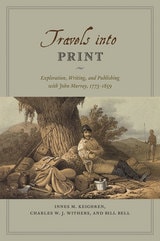
Travels into Print
Exploration, Writing, and Publishing with John Murray, 1773-1859Innes M. Keighren, Charles W. J. Withers, and Bill Bell
University of Chicago Press, 2015
Drawing on detailed examination of the John Murray Archive of manuscripts, images, and the firm’s correspondence with its many authors—a list that included such illustrious explorers and scientists as Charles Darwin and Charles Lyell, and literary giants like Jane Austen, Lord Byron, and Sir Walter Scott—Travels into Print considers how journeys of exploration became published accounts and how travelers sought to demonstrate the faithfulness of their written testimony and to secure their personal credibility. This fascinating study in historical geography and book history takes modern readers on a journey into the nature of exploration, the production of authority in published travel narratives, and the creation of geographical authorship—a journey bound together by the unifying force of a world-leading publisher.
Treatment of Error in Second Language Student Writing
Dana R. Ferris
University of Michigan Press, 2002
Unlike a teachers' manual or a handbook that purports to give all the answers needed, Ferris's research-based volume offers a solid scholarly foundation for the practical ideas presented together with an abundance of illustrative sample texts. This book will be a rich resource in language teaching methodology courses, but experienced teachers too will no doubt benefit from the depth and breadth of Ferris's coverage of various error response techniques as well as of the research that motivates those techniques.
Ferris offers a realistic, well-reasoned account of what second language (L2) writing teacher--or teachers with L2 students in their classes--need to know about error and how to put what they know to use. She persuasively addresses the fundamental error treatment questions that plague novice and expert writing specialists alike: What types of errors should teachers respond to? When should we respond to them? What are the most efficacious ways of responding to them? And ultimately, what role should error treatment play in the teaching of the process of writing?
Try This
Research Methods for Writersedited by Jennifer Clary-Lemon, Derek Mueller, and Kate Pantelides
University Press of Colorado, 2022
This book is also available as an open access ebook through the WAC Clearinghouse.
Tutoring Second Language Writers
Shanti Bruce
Utah State University Press, 2015
Tutoring Second Language Writers, a complete update of Bruce and Rafoth’s 2009 ESL Writers, is a guide for writing center tutors that addresses the growing need for tutors who are better prepared to work with the increasingly international population of students seeking guidance at the writing center.
Drawing upon philosopher John Dewey’s belief in reflective thinking as a way to help build new knowledge, the book is divided into four parts. Part 1: Actions and Identities is about creating a proactive stance toward language difference, thinking critically about labels, and the mixed feelings students may have about learning English. Part 2: Research Opportunities demonstrates writing center research projects and illustrates methods tutors can use to investigate their questions about writing center work. Part 3: Words and Passages offers four personal stories of inquiry and discovery, and Part 4: Academic Expectations describes some of the challenges tutors face when they try to help writers meet readers’ specific expectations.
Advancing the conversations tutors have with one another and their directors about tutoring second language writers and writing, Tutoring Second Language Writers engages readers with current ideas and issues that highlight the excitement and challenge of working with those who speak English as a second or additional language.
Contributors include Jocelyn Amevuvor, Rebecca Day Babcock, Valerie M. Balester, Shanti Bruce, Frankie Condon, Michelle Cox, Jennifer Craig, Kevin Dvorak, Paula Gillespie, Glenn Hutchinson, Pei-Hsun Emma Liu, Bobbi Olson, Pimyupa W. Praphan, Ben Rafoth, Jose L. Reyes Medina, Guiboke Seong, and Elizabeth (Adelay) Witherite.
Twentieth-Century American Success Rhetoric
How to Construct a Suitable SelfJohn Ramage
Southern Illinois University Press, 2005
Self-help authors like Tom Peters and Stephen Covey, who have dominated best-seller lists over the last two decades, have exercised increasing influence on political, governmental, and educational organizations. By contrast, the topic of American success books— texts that promise to help readers succeed by retrofitting their identity to meet workplace demands—has been ignored by scholars since the 1980s. John Ramage challenges the neglect of this hugely popular literature and revives a once-lively conversation among eminent critics about the social phenomenon represented in the work of Bruce Barton, Dale Carnegie, and Norman Vincent Peale, among others.
Using literary texts from Don Quixote to Catch-22 to gloss the discussion, Ramage utilizes Kenneth Burke’s rhetorical theory to understand symbolic acts and social issues and brings together earlier commentaries within a new critical framework. He considers the problematic and paradoxical nature of success and examines its meaning in terms of its traditional dialectic partner, happiness. A synopsis of seventeenth- to nineteenth-century forerunners prefaces this analysis in which Ramage links literary code heroes with the activities of twentieth-century business leaders to determine whether, in the search for authenticity, the heroic individual or the corporation is ultimately served.
This comprehensive study chronicles the legitimation of the success book genre, enumerates rhetorical strategies used to win over readers, and supplies the historical context that renders each book’s message timely. After considering some of the dangers of crossing disciplinary borders, as exemplified by Deborah Tannen’s work, Ramage critiques Stanley Fish’s theoretical strictures against this practice, finally summoning academic critics to action with a strong call to exert greater influence within the popular marketplace.
Twenty-One Genres and How to Write Them
Brock Dethier
Utah State University Press, 2013
In the first section, Dethier efficiently presents each genre, providing models; a description of the genres’ purpose, context, and discourse; and suggestions for writing activities or “moves” that writers can use to get words on the page and accomplish their writing tasks. The second section explains these moves, over two hundred of them, in chapters ranging from “Solve Your Process Problems” and “Discover” to “Revise” and “Present.” Applicable to any writing task or genre, these moves help students overcome writing blocks and develop a piece of writing from the first glimmers of an idea to its presentation.
This approach to managing the complexity and challenge of writing in college strives to be useful, flexible, eclectic, and brief—a valuable resource for students learning to negotiate unfamiliar writing situations.
Two-Year College Writing Studies
Rationale and Praxis for Just TeachingDarin Jensen
Utah State University Press, 2023
Contributors draw on theories of identity, rhetorical third space, and linguistics to articulate a praxis of just teaching. They describe existing institutional challenges and opportunities that foster equity and offer cautionary tales of educational systems dismantled for short-term economic and political gains. Two-year college writing studies—when properly resourced—holds the potential to foster (or undermine) democratic ideals of civic literacy and uplift. Chapters in this volume offer case study examples of changes in departmental practices for reflection, interaction, and assessment that empower faculty to break free and engage directly with institutional, regional, state, and national constraints.
By making these resilient practices visible, Two-Year College Writing Studies amplifies the voices and validates the experiences of instructors engaging in this work. It will serve generalists, specialists, and academics interested in the subdiscipline of student success pedagogies and the political histories of two-year colleges and be useful for instructors new to the field, as professional development for veteran instructors, and as an introduction for graduate students entering two-year college writing studies programs.