Results by title
4030 books match the query 'Language Arts & Disciplines' and 760 start with t

The Culture of Digital Scholarship in Academic Libraries
Robin Chin Roemer
American Library Association, 2019
At the heart of digital scholarship are universal questions, lessons, and principles relating both to the mission of higher education and the shared values that make an academic library culture. But while global in aspirations, digital scholarship starts with local culture drawn from the community. Editors Chin Roemer and Kern invite you into their institutional workspace, the University of Washington, gathering voices from a range of positions that speak to the facets of digital scholarship. This mosaic of perspectives reveals the challenges, questions, and personalities that sit at the nexus of academic libraries and digital scholarship culture. Reflecting on UW’s approach, you’ll gain insights for your own institution on topics such as
- ways to create awareness of digital services through training;
- supporting students as creators of content;
- blending existing analog collections with ongoing digital initiatives using a media lab;
- creating a campus-wide, discipline agnostic, data repository service;
- how a popular digital storytelling workshop spawned digital scholarship across campus;
- digital scholarship consultations, viewed from an instructional technologist’s approach;
- the place of digital scholarship in the fabric of a revitalized urban community;
- four strategies for teaching research skills within an online-only bachelor’s degree program; and
- assessment findings from focus groups, surveys, digital pedagogy projects, and Omeka case studies.
By thoroughly exploring a single institution, this unique volume elucidates the many ways in which digital scholarship can express the values, priorities, opportunities, and challenges of the community’s intellectual and technical environment.
The Culture of Public Problems
Drinking-Driving and the Symbolic OrderJoseph R. Gusfield
University of Chicago Press, 1980
"A sophisticated and thoughtful critic. . . . Gusfield argues that the 'myth of the killer drunk' is a creation of the 'public culture of law.' . . . Through its dramatic development and condemnation of the anti-social character of the drinking-driver, the public law strengthens the illusion of moral consensus in American society and celebrates the virtues of a sober and orderly world."—James D. Orcutt, Sociology and Social Research
"Joseph Gusfield denies neither the role of alcohol in highway accidents nor the need to do something about it. His point is that the research we conduct on drinking-driving and the laws we make to inhibit it tells us more about our moral order than about the effects of drinking-driving itself. Many will object to this conclusion, but none can ignore it. Indeed, the book will put many scientific and legal experts on the defensive as they face Gusfield's massive erudition, pointed analysis and criticism, and powerful argumentation. In The Culture of Public Problems, Gusfield presents the experts, and us, with a masterpiece of sociological reasoning."—Barry Schwartz, American Journal of Sociology
This book is truly an outstanding achievement. . . . It is sociology of science, sociology of law, sociology of deviance, and sociology of knowledge. Sociologists generally should find the book of great theoretical interest, and it should stimulate personal reflection on their assumptions about science and the kind of consciousness it creates. They will also find that the book is a delight to read."—William B. Bankston, Social Forces
The Data Literacy Cookbook
Kelly Getz
Assoc of College & Research Libraries, 2022
The Data Literacy Cookbook includes a variety of approaches to and lesson plans for teaching data literacy, from simple activities to self-paced learning modules to for-credit and discipline-specific courses. Sixty-five recipes are organized into nine sections based on learning outcomes:
- Interpreting Polls and Surveys
- Finding and Evaluating Data
- Data Manipulation and Transformation
- Data Visualization
- Data Management and Sharing
- Geospatial Data
- Data in the Disciplines
- Data Literacy Outreach and Engagement
- Data Literacy Programs and Curricula
The Data Wrangler's Handbook
Simple Tools for Powerful ResultsKyle Banerjee
American Library Association, 2019
Data manipulation and analysis are far easier than you might imagine—in fact, using tools that come standard with your desktop computer, you can learn how to extract, manipulate, and analyze data (and metadata) of any size and complexity. In this handbook, data wizard Banerjee will familiarize you with easily digestible but powerful concepts that will enable you to feel confident working with data. With his expert guidance, you’ll learn how to
- use a single-word command to sort files of any size by any criteria, identify duplicates, and perform numerous other common library tasks;
- understand data formats, delimited text and CSV files, XML, JSON, scripting, and other key components of data;
- undertake more sophisticated tasks such as comparing files, converting data from one format to another, reformatting values, combining data from multiple files, and communicating with APIs (Application Programming Interfaces);
- save time and stress through simple techniques for transforming text, recognizing symbols that perform important tasks, a Regular Expression cheat sheet, a glossary, and other tools.
Library technologists and those involved in maintaining and analyzing data and metadata will find Banerjee’s resource essential.
The Deaf Experience
Classics in Language and EducationHarlan Lane
Gallaudet University Press, 2006
The fifth volume in the Gallaudet Classics in Deaf Studies series features works written from 1764 up to1840. Pierre Desloges offers a stirring paean to sign language in an excerpt from his book, the first ever published by a deaf person. Saboureux de Fontenay and Jean Massieu, two prominent leaders, relate their respective experiences in autobiographical accounts. In separate essays, Charles-Michel de l’Epée and Roch-Ambroise Sicard describe systems for teaching manual French, followed by a critique of these methods by Roch-Ambroise Bébian, a well-known hearing friend of Deaf people during that era. Ferdinand Berthier, a renowned Deaf teacher and writer in the 19th century, concludes with a history of Deaf people up to that time.
The Deaf Experience shows clearly how this extraordinary era of French deaf education influenced the adoption of the manual method by the first schools for deaf students in America, in sharp contrast to the oral movement that repressed sign-language-centered education for nearly a century afterward. Deaf studies scholars and students alike will welcome the return of this invaluable resource.
The Deaf Way
Perspectives from the International Conference on Deaf CultureCarol J. Erting
Gallaudet University Press, 1994
The Debater's Guide, 3rd Edition
Jon M. Ericson, James J. Murphy, and Raymond Bud Zeuschner
Southern Illinois University Press, 2003
Thousands of debaters at all levels have relied on this practical guide for reference and instruction in argumentation and communication since it was first published in 1961. Now in a third, fully revised edition featuring restructured chapters, updated examples, and the addition of parliamentary debate as a form, The Debater’s Guide continues to be the leading handbook for helping both novice and advanced students develop the skills necessary to successfully apply the basic principles of debate.
Cutting through theory with clear explanations and specific applications, this compact volume with a broad scope offers students and teachers no-frills assistance in resolving the major problem faced by debaters: the need to present arguments forcefully and cogently while reacting effectively to criticism. Readers are advised on matters from budgeting time in a debate to speaking in outline form through a well-organized series of explanations, specific examples, and graphic presentations related to both policy and value issues.
Beginning with a clear explication of basic principles, The Debater’s Guide presents chronologically the steps of building a debate case, reviews the strategy of planning for refutation and defense, and offers sound advice on presenting the case in oral discourse. Expanded contents pages and effective use of subheadings allow for quick reference to any particular aspect of debate, making it an excellent classroom text as well as a valuable, hands-on tool during actual debates. A glossary of key terms used in debate complements the volume.
The Debater's Guide, Fourth Edition
Jon M. Ericson, James J. Murphy, and Raymond Bud Zeuschner
Southern Illinois University Press, 2011
With straightforward explanations and specific applications geared toward contemporary debate practice, this compact volume offers students and teachers clear-cut assistance in resolving the key problem faced by debaters: the need to present arguments forcefully and cogently while reacting effectively to criticism. Beginning with a candid explanation of the basic principles of debate, The Debater's Guide then introduces the steps to building a case, from reviewing strategies for refutation and defense to engaging in cross-examination, solid research, and critical thinking. It advises readers on a wide range of important topics, from budgeting time in a debate to speaking in outline form by using a well-organized series of explanations, specific examples, and graphic presentations related to both policy and value issues. The authors apply these concepts to a variety of formats and situations commonly found in high school and collegiate debating.
Avoiding jargon and complex theory discussions, The Debater's Guide offers sound advice on presenting an effective case in oral discourse, helps students build their understanding of how and why debate functions, and provides a solid foundation for success in any format. The expanded contents pages and new subheadings allow for quick reference to any particular aspect of debate, making this new edition an excellent choice for classroom use as well as a valuable hands-on tool during debates.
The Deseret Alphabet
A Fixed and Unalterable SoundRyan K. Shosted and N. E. Davis
University of Illinois Press, 2026
Shosted and Davis draw on a wide range of sources, including previously unpublished archival material, to trace the alphabet’s roots in Joseph Smith’s esoteric translations and its role in shaping Latter-day Saint identity. Their account brings together theology, linguistics, and culture. As they show, the Deseret Alphabet remains relevant as a living artifact of a religion wrestling with its visionary origins and the divine potential of words.
In-depth and up to date, The Deseret Alphabet traces the script’s creation, use, and legacy across Latter-day Saint history.
The Design of Agreement
Evidence from ChamorroSandra Chung
University of Chicago Press, 1998
The Design of Books
An Explainer for Authors, Editors, Agents, and Other Curious ReadersDebbie Berne
University of Chicago Press, 2024
Design is central to the appeal, messaging, and usefulness of books, but to most readers, it’s mysterious or even invisible. Through interiors as well as covers, designers provide structure and information that shape the meaning and experience of books. In The Design of Books, Debbie Berne shines a light on the conventions and processes of her profession, revealing both the aesthetic and market-driven decisions designers consider to make books readable and beautiful. In clear, unstuffy language, Berne reveals how books are put together, with discussions of production considerations, typography and fonts, page layouts, use of images and color, special issues for ebooks, and the very face of each book: the cover.
The Design of Books speaks to readers and directly to books’ creators—authors, editors, and other publishing professionals—helping them to become more informed partners in the design of their projects. Berne lays out the practical steps at each stage of the design process, providing insight into who does what when and offering advice for authors on how to be effective advocates for their ideas while also letting go and trusting their manuscripts with teams of professionals. She includes guidance as well for self-publishing authors, including where to find a designer, what to expect from that relationship, and how to art direct your own book.
Throughout, Berne teaches how understanding the whats, hows, and whys of book design heightens our appreciation of these cherished objects and helps everyone involved in the process to create more functional, desirable, and wonderful books.
The Devil's Dictionary
Ambrose Bierce
Bodleian Library Publishing, 2018
A contemporary of Mark Twain, Bierce brought his biting humor to bear on spoof definitions of everyday words, writing deliberate mistranslations of the vocabulary of the establishment, the church, and the politics of his day, and shining a sardonic light on hypocrisy and deception. These columns formed the beginnings of a dictionary, first published in 1906 as The Cynic’s Word Book, which stopped at the letter L, and five years later as a full A–Z text known as The Devil's Dictionary. More than one hundred years later, Bierce’s redefinitions still give us pause for thought: interpreting reporter, for example, as “a writer who guesses his way to the truth and dispels it with a tempest of words”; un-american as “wicked, intolerable, heathenish”; and politics as “the conduct of public affairs for private advantage.” This timely new edition of Bierce’s irreverent and provocative dictionary is the perfect gift for misanthropes and word lovers alike.
The Disaster Planning Handbook for Libraries
Mary Grace Flaherty
American Library Association, 2021
Your library is a vital information hub and resource provider every single day, and that’s doubly true when calamity strikes. In fact, your library’s role as an “essential community function” during disasters is now encoded in U.S. law. Engaging as a partner in planning and preparedness will build much-needed community support should disaster strike, and even a basic plan will also save you time and stress later on. No matter where your library is in the disaster planning cycle, this handbook will make the process clearer and less daunting. You’ll get tools, activities, easy-to-adapt templates, and hands-on guidance on such topics as
- the six phases of disaster response;
- 15 first-hand accounts of library disaster planning or responses, helping you identify the library services most needed during a disaster;
- three essential factors that will shape the form of your disaster plan;
- preparing for hurricanes, tornadoes, fires, floods, and earthquakes;
- ideas for connecting with your community’s emergency response teams;
- federal government planning resources;
- pointers on working with state and local governments;
- a sample Memorandum of Understanding to outline mutual support for a speedier recovery;
- recommended courses and training, many of which are free;
- targeted advice for archives and special collections;
- sample building inspection checklists; and
- recommended games to help children and families prepare.
The Discourse of Police Interviews
Edited by Marianne Mason and Frances Rock
University of Chicago Press, 2020
The first book to focus exclusively on the discourses of police interviewing, The Discourse of Police Interviews examines leading debates, approaches, and topics in contemporary police interview research. Among other topics, the book explores the sociolegal, psychological, and discursive framework of popular police interview techniques employed in the United States and the United Kingdom, such as PEACE and Reid, and the discursive practices of institutional representatives like police officers and interpreters that can influence the construction and quality of linguistic evidence. Together, the contributions situate the police interview as part of a complex, and multistage, criminal justice process. The book will be of interest to both scholars and practitioners in a variety of fields, such as linguistic anthropology, interpreting studies, criminology, law, and sociology.
The Dissertation-to-Book Workbook
Exercises for Developing and Revising Your Book ManuscriptKatelyn E. Knox and Allison Van Deventer
University of Chicago Press, 2023
So, you’ve written a dissertation. Congratulations! But how do you turn it into a book? Even if you know what to do when revising your dissertation, do you know how to do those things? This workbook by Katelyn E. Knox and Allison Van Deventer, creators of the successful online Dissertation-to-Book Boot Camp, offers a series of manageable, concrete steps with exercises to help you revise your academic manuscript into publishable book form.
The Dissertation-to-Book Workbook uses targeted exercises and prompts to take the guesswork out of writing a book. You’ll clarify your book’s core priorities, pinpoint your organizing principle, polish your narrative arc, evaluate your evidence, and much more. Using what this workbook calls “book questions and chapter answers,” you’ll figure out how to thread your book’s main ideas through its chapters. Then, you’ll assemble an argument, and finally, you’ll draft any remaining material and revise the manuscript. And most important, by the time you complete the workbook, you’ll have confidence that your book works as a book—that it’s a cohesive, focused manuscript that tells the story you want to tell.
Indispensible to anyone with an academic manuscript in progress, the prompts, examples, checklists, and activities will give you confidence about all aspects of your project—that it is structurally sound, coherent, free of the hallmarks of “dissertationese," and ready for submission to an academic publisher.
The Divided City and Its New Cinemas, 1920-1980
Amy Murphy
University of Illinois Press, 2026
The Dynamics of Lexical Interfaces
Ruth Kempson, Eleni Gregoromichelaki, Christine Howes
CSLI, 2011
Dynamic Syntax is a formal model of utterance description that attempts to articulate and substantiate the claim that human linguistic knowledge is essentially the ability to process language in context. The model provides an explicit demonstration of how interpretation is built up incrementally from the information provided by the words as they are encountered. Drawing from a range of analyses of natural language data, the authors use formal definitions, step-by-step derivations, and detailed lexical definitions to illustrate this new form of syntactic analysis and to show how the model can be applied to a broad range of constructions and languages.
The Dysfunctional Library
Challenges and Solutions to Workplace RelationshipsJo Henry
American Library Association, 2017
The ESL Writer's Handbook
Janine Carlock, Maeve Eberhardt, Jaime Horst, Lionel Menasche
University of Michigan Press, 2010
The ESL Writer’s Handbook is a reference work for ESL students who are taking college-level courses. Because its purpose is to provide help with the broad variety of writing questions students may have when working on school assignments, the text focuses on
English for Academic Purposes. Unlike other handbooks on the market, this book’s sole purpose is to address the issues of second language learners.
This spiral-bound Handbook complements a student writer’s dictionary, thesaurus, and grammar reference book. It would be suitable as a text for an advanced ESL writing course when used together with the companion Workbook (978-0-472-03404-8). The Handbook is concise and easily navigated; is accessible, with clear and direct explanatory language; features information on both APA and MLA styles (including a sample paper for each); and includes many examples from ESL student writers to provide realistic models.
Included as special features in the Handbook are:
• The topic selection is based on ESL writers’ needs as observed by the authors over many years.
• The coverage of topics is more complete than the limited amount usually provided for ESL writers in first language or L1 handbooks.
• The explanatory language is appropriate for ESL students, in contrast to the more complex and idiomatic language of other English handbooks.
• The level of detail is more manageable for ESL students, compared to what is in other English handbooks.
- Many of the examples of paragraphs, essays, research papers, and exercise sentences were written by ESL students; this encourages users of this Handbook to realize that they can also become effective writers.
The ESL Writer's Handbook, 2nd Ed.
Janine Carlock, Maeve Eberhardt, Jaime Horst, Lionel Menasche
University of Michigan Press, 2018
The spiral-bound Handbook complements a student writer’s dictionary, thesaurus, and grammar reference book. It would be suitable as a text for an advanced ESL writing course when used together with the companion Workbook (978-0-472-03726-1).
The new edition features significant revisions to Sections 3 and 4; in particular, both APA and MLA style guides have been updated and new sample papers for each are included. The new edition includes new and revised exercises and many new samples of student writing.
Like its predecessor, the 2nd Edition has these special features:
- The topic selection is based on ESL writers’ needs as observed by the authors over many years.
- The coverage of topics is more complete than the limited amount usually provided for ESL writers in first language or L1 handbooks.
- The explanatory language is appropriate for ESL students, in contrast to the more complex and idiomatic language of other English handbooks.
- Many of the examples of paragraphs, essays, research papers, and exercise sentences were written by ESL students to help users realize that they too can become effective writers.
The ESL Writer's Handbook, 3rd Edition
Janine Carlock, Maeve Eberhardt, Jaime Horst
University of Michigan Press, 2025
In addition to updated style guides, sample student papers, writing examples, and exercises, the 3rd edition highlights “tech tips” on different technologies that may be useful to students, explains inclusive language, and expands the section on taking notes as a research tool.
With this handbook, students will learn:
- The concept of genre and apply it to unpacking assignments and writing effectively.
- The process for generating ideas, structuring those ideas into a paper, and checking over a paper before turning it in.
- Five common patterns for organizing an academic essay: narrative, process, comparison/contrast, cause and effect, and argument.
- Different steps for creating a good research paper, including major citation styles.
- Guidance for addressing the grammar, punctuation, and style issues most often encountered by international students writing in English.
- How to differentiate between other types of writing U.S. undergraduate students are expected to complete, such as emails, resumes, cover letters, and personal statements.
The Earth on Show
Fossils and the Poetics of Popular Science, 1802-1856Ralph O'Connor
University of Chicago Press, 2007
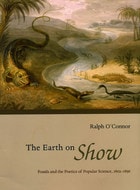
Shrewd science-writers, O’Connor shows, marketed spectacular visions of past worlds, piquing the public imagination with glimpses of man-eating mammoths, talking dinosaurs, and sea-dragons spawned by Satan himself. These authors—including men of science, women, clergymen, biblical literalists, hack writers, blackmailers, and prophets—borrowed freely from the Bible, modern poetry, and the urban entertainment industry, creating new forms of literature in order to transport their readers into a vanished and alien past.
In exploring the use of poetry and spectacle in the promotion of popular science, O’Connor proves that geology’s success owed much to the literary techniques of its authors. An innovative blend of the history of science, literary criticism, book history, and visual culture, The Earth on Show rethinks the relationship between science and literature in the nineteenth century.
The Edge of Change
Women in the Twenty-First-Century PressEdited by June O. Nicholson, Pamela J. Creedon, Wanda S. Lloyd, and Pamela J. Jo: Foreword by Ellen Goodman
University of Illinois Press, 2008
Prominent female voices in journalism provide critical perspectives on the challenges women face in today's news organizations, such as connecting with diverse audiences, educating readers about international issues and cultures, maintaining credibility, negotiating media consolidation and corporate pressures, and overcoming the persistent barriers to professional advancement. A powerful and complex assessment of how women are transforming the news industry, The Edge of Change explores how the news industry might implement further reforms aimed at creating a more inclusive journalistic community.
Contributors are Catalina Camia, Kathleen Carroll, Pamela J. Creedon, Paula Lynn Ellis, Helen E. Fisher, Dorothy Butler Gilliam, Ellen Goodman, Sharon Grigsby, Carol Guzy, Kirsten Scharnberg Hampton, Cathy Henkel, Pamela J. Johnson, Jane Kirtley, Jan Leach, Caroline Little, Wanda S. Lloyd, Arlene Notoro Morgan, June O. Nicholson, Geneva Overholser, Marty Petty, Deb Price, Donna M. Reed, Sandra Mims Rowe, Peggy Simpson, Margaret Sullivan, Julia Wallace, and Keven Ann Willey.
The Editor Function
Literary Publishing in Postwar AmericaAbram Foley
University of Minnesota Press, 2021
Offering the everyday tasks of literary editors as inspired sources of postwar literary history
Michel Foucault famously theorized “the author function” in his 1969 essay “What Is an Author?” proposing that the existence of the author limits textual meaning. Abram Foley shows a similar critique at work in the labor of several postwar editors who sought to question and undo the corporate “editorial/industrial complex.” Marking an end to the powerful trope of the editor as gatekeeper, The Editor Function demonstrates how practices of editing and publishing constitute their own kinds of thought, calling on us to rethink what we read and how.
The Editor Function follows avant-garde American literary editors and the publishing practices they developed to compete against the postwar corporate consolidation of the publishing industry. Foley studies editing and publishing through archival readings and small press and literary journal publishing lists as unique sites for literary inquiry. Pairing histories and analyses of well- and lesser-known figures and publishing formations, from Cid Corman’s Origin and Nathaniel Mackey’s Hambone to Dalkey Archive Press and Semiotext(e), Foley offers the first in-depth engagement with major publishing initiatives in the postwar United States.
The Editor Function proposes that from the seemingly mundane tasks of these editors—routine editorial correspondence, line editing, list formation—emerge visions of new, better worlds and new textual and conceptual spaces for collective action.
The Electronic Resources Troubleshooting Guide
Holly Talbott
American Library Association, 2020
A library user can’t access an article. Your log in credentials won’t work. In the realm of electronic resources everything runs smoothly—until suddenly, without warning, it doesn’t. Invariably, systems will break down, but a trial and error approach to finding out what’s wrong is highly inefficient. This hands-on guide from two expert ERM librarians walks you through the essentials of troubleshooting. It outlines a methodical process that will help you identify the source of a problem even when it’s not obvious and take steps to reach a resolution. With the goal of developing a library-wide workflow in mind, this guide will teach you how to
- familiarize yourself with the components of electronic resources, using flowchart diagrams of common access chains such as discovery services, knowledge bases, research guides, and library services platforms;
- navigate the complete triage and troubleshooting workflow, illustrated through 14 in-depth examples;
- recognize the symptoms of common access disruptions;
- conduct efficient troubleshooting interviews;
- manage help tickets and design problem reports that capture key information without overburdening the user;
- create publicly available help pages for problems originating with users’ devices or computers;
- communicate with vendors and IT personnel for speedy resolutions, providing dozens of clear definitions of library and technology terms that will help you minimize confusion; and
- customize your own troubleshooting workflow chart for common use across departments and staff hierarchies.
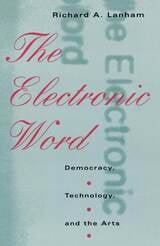
The Electronic Word
Democracy, Technology, and the ArtsRichard A. Lanham
University of Chicago Press, 1993
This highly acclaimed collection of Richard Lanham's witty, provocative, and engaging essays surveys the effects of electronic text on the arts and letters. Lanham explores how electronic text fulfills the expressive agenda of twentieth-century visual art and music, revolutionizes the curriculum, democratizes the instruments of art, and poses anew the cultural accountability of humanism itself.
Persuading us with uncommon grace and power that the move from book to screen gives cause for optimism, not despair, Lanham proclaims that "electronic expression has come not to destroy the Western arts but to fulfill them."
The Electronic Word is also available as a Chicago Expanded Book for your Macintosh®. This hypertext edition allows readers to move freely through the text, marking "pages," annotating passages, searching words and phrases, and immediately accessing annotations, which have been enhanced for this edition. In a special prefatory essay, Lanham introduces the features of this electronic edition and gives a vividly applied critique of this dynamic new edition.
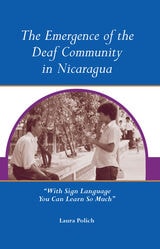
The Emergence of the Deaf Community in Nicaragua
“With Sign Language You Can Learn So Much”Laura Polich
Gallaudet University Press, 2005
The sudden discovery of Nicaraguan Sign Language (NSL) enthralled scholars worldwide who hoped to witness the evolution of a new language. But controversy erupted regarding the validity of NSL as a genuinely spontaneous language created by young children. Laura Polich’s fascinating book recounts her nine-year study of the Deaf community in Nicaragua and her findings about its formation and that of NSL in its wake.
Polich crafted The Emergence of the Deaf Community in Nicaragua from her copious research in Nicaragua’s National Archives, field observations of deaf pupils in 20 special education schools, polls of the teachers for deaf children about their education and knowledge of deafness, a survey of 225 deaf individuals about their backgrounds and living conditions, and interviews with the oldest members of the National Nicaraguan Association of the Deaf.
Polich found that the use of a “standardized” sign language in Nicaragua did not emerge until there was a community of users meeting on a regular basis, especially beyond childhood. The adoption of NSL did not happen suddenly, but took many years and was fed by multiple influences. She also discovered the process that deaf adolescents used to attain their social agency, which gained them recognition by the larger Nicaraguan hearing society. Her book illustrates tremendous changes during the past 60 years, and the truth in one deaf Nicaraguan’s declaration, “With sign language you can learn so much.”

The Empirical Base of Linguistics
Grammaticality Judgments and Linguistic MethodologyCarson T. Schütze
University of Chicago Press, 1996
Integrating substantive and methodological findings, Schütze proposes a model in which judgments result from interactions of linguistic competence with general cognitive processes, and offers practical suggestions about collecting more useful data. The result is a work of importance to linguists, cognitive psychologists, and philosophers of language alike.
The End of Composition Studies
David W. Smit
Southern Illinois University Press, 2007
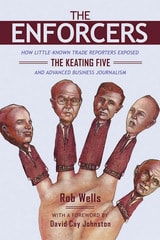
The Enforcers
How Little-Known Trade Reporters Exposed the Keating Five and Advanced Business JournalismRob Wells with a foreword by David Cay Johnston
University of Illinois Press, 2019
The English Department
A Personal and Institutional HistoryW. Ross Winterowd
Southern Illinois University Press, 1998
Tounderstand the history of "English," Ross Winterowd insists, one must understand how literary studies, composition-rhetoric studies, and influential textbooks interrelate. Stressing the interrelationship among these three forces, Winterowd presents a history of English studies in the university since the Enlightenment.
Winterowd’s history is unique in three ways. First, it tells the whole story of English studies: it does not separate the history of literary studies from that of composition-rhetoric studies, nor can it if it is going to be an authentic history. Second, it traces the massive influence on English studies exerted by textbooks such as Adventures in Literature, Understanding Poetry, English in Action, and the Harbrace College Handbook. Finally, Winterowd himself is very much a part of the story, a partisan with more than forty years of service to the discipline, not simply a disinterested scholar searching for the truth.
After demonstrating that literary studies and literary scholars are products of Romantic epistemology and values, Winterowd further invites controversy by reinterpreting the Romantic legacy inherited by English departments. His reinterpretation of major literary figures and theory, too, invites discussion, possibly argument. And by directly contradicting current histories of composition-rhetoric that allow for no points of contact with literature, Winterowd intensifies the argument by explaining the development of composition-rhetoric from the standpoint of literature and literary theory.

The Environmental Beat
Inside the Struggle to Legitimize the Environment as NewsSuzannah Evans Comfort
University of Missouri Press, 2026
Environmental degradation has been part of American life for centuries, and yet environmental journalism as a specialized reporting beat has only existed since the 1960s. In the ensuing decades, the environment has fallen in and out of favor as a priority for news organizations. Moreover, journalists who pursue environmental stories have long been dogged by a reputation that they are activists, a charge that delegitimizes their labor and further undermines the potential for news organizations to commit to reporting on environmental issues.
In The Environmental Beat: Inside the Struggle to Legitimize the Environment as News, Suzannah Evans Comfort examines the circumstances under which news organizations chose to invest in environmental journalism since the early 20th century, demonstrating that a combination of external social factors and internal newsroom dynamics must occur for the environment to appear as a newsworthy topic. Comfort also examines actors on the margins of journalistic legitimacy, such as newspaper outdoor columnists who wrote on the sports pages, and environmental advocacy presses that provided a far more consistent source of environmental news making than their peers in the newsroom. These low-status actors in the journalistic field embraced advocacy and rejected both-siderism in their reporting on issues of the environment. Their consistency and longevity, even as more traditionally produced news attention waxed and waned, may provide an explanation for the perception of environmental news making as fundamentally activist.
The Environmental Beat will be of interest to working journalists as well as scholars of journalism.
The Epistemic Music of Rhetoric
Toward the Temporal Dimension of Affect in Reader Response and WritingSteven B. Katz
Southern Illinois University Press, 1996
Arguing for an oral theory of Reader Response Criticism, Steven B. Katz conducts a philosophical investigation into the possibility and desirability of teaching reading and writing as rhetorical music.
In the course of this investigation, Katz deals with New Physics, the sophists, Cicero, orality, epistemology, voice, writing, temporality, and sound. He demonstrates that Reader Response Criticism—as part of a new sophistic that has entered the mainstream of pedagogy and practice in our culture—parallels the philosophy of science engendered by the Copenhagen school of New Physics, which theoretically holds that knowledge of subatomic phenomena is probable, relative, contingent, and uncertain, thus requiring more nonformalistic, nonrationalistic methods in understanding and reconstructing it; Katz shows how the same methods are required in the study of affect in reading and writing. Katz also demonstrates that, like New Physics, Reader Response Criticism, in its commitment to interpretation as the primary function and goal of writing about literature, must remain somewhat committed to the formalistic, rationalistic epistemology it seeks to redress.
Basing his oral theory of Reader Response Criticism on notions of language as physical, sensuous, and musical and understanding reception as participatory performance rather that interpretation, Katz suggests a way to reconceptualize Reader Response Criticism. He accounts for "voice," "felt sense," "dissonance," and aesthetic response generally as it is created by the temporal, musical patterns of language, noting that the physical, musical dimension of language has been relatively neglected in contemporary movements in rhetoric, composition, and literature.
Thus, set against the relationship between literature and science, especially between Reader Response Criticism and the philosophy of science engendered by New Physics, Katz examines the sophistic and Ciceronian conceptions of rhetoric. He reinterprets Cicero’s rhetorical theory in light of recent revisionist scholarship on the sophists and reevaluates his assigned position in rhetorical history as neo-Aristotelian by focusing on his oral notions of style as epistemic music. In so doing, Katz offers a new interpretation of Cicero within the sophistic tradition.
Discussing the relationship between sophistic and Ciceronian conceptions of style as an oral, physical, nonrational, indirect form of knowledge and viewing philosophical conceptions of language as sensuous, temporal gestalten or "shapes" in consciousness, Katz suggests that response to and performance of the epistemic music of language can supplement analysis and interpretation in the teaching of reading and writing and can provide less formalistic, less rationalistic foundation for a reader response criticism as a new sophistic.
The Erotic as Rhetorical Power
Archives of Romantic Friendship between Women TeachersPamela VanHaitsma
The Ohio State University Press, 2024
Winner, 2025 Marie Hochmuth Nichols Award from the National Communication Association’s Public Address Division
The Erotic as Rhetorical Power offers a queer feminist history of rhetoric that recovers the civic contributions of women teachers in same-sex romantic friendships. Extending perspectives from ancient rhetoric to nineteenth-century progressivism, from Audre Lorde’s Black lesbian feminist theory to its present-day uptakes, Pamela VanHaitsma conceives of the erotic as an interanimation of desires that, in being passionately shared, becomes imbued with the power to forge connection and foment change.
VanHaitsma’s theory of the erotic as rhetorical power emerges from both historiographic and imaginative engagements with more than twenty archives of romantic friendships between women: Sallie Holley and Caroline Putnam, Irene Leache and Anna Wood, Gertrude Buck and Laura Wylie, and Rebecca Primus and Addie Brown. VanHaitsma considers how even as the erotic in these romantic friendships fueled the women’s rhetorical activities toward transformational ends—whether working toward the abolition of slavery, greater educational access, or voting rights—it also energized rhetorical activities that sometimes challenged but also reinforced troubling power dynamics. The Erotic as Rhetorical Power uncovers the erotic’s significance as a conflicted site of power that is central to rhetorical theory and history as well as feminist and LGBTQ+ studies.
The Essential Lapsit Guide
A Multimedia How-To-Do-It Manual and Programming Guide for Stimulating Literacy Development from 12 to 24 MonthsLinda L. Ernst
American Library Association, 2015
Not just a sourcebook or a reference, but a complete multimedia guide, this innovative, comprehensive resource will help you stimulate the minds of your youngest patrons with rhymes, songs, fingerplays, books, and other creative activities. The engaging materials and methods in this book are equally useful for experienced children's librarians looking for new ideas and new librarians starting to build their own program for the very young. Through researching the latest in early learner and developmental theories, Ernst
- Carefully details the physical, mental, emotional, and social development of children 12 to 24 months
- Guides you through using Lapsit programming to perform effective outreach to all segments of your community
- Shows how to build and maintain effective partnerships with caregivers, child-care providers, early childhood educators, and others
- Offers tips for seeking funding for early childhood services
The Essential Paul Simon
Timeless Lessons for Today's PoliticsEdited by John S. Jackson. Foreword by David Yepsen
Southern Illinois University Press, 2012
While Simon covered a broad spectrum of topics in his written works, his mission throughout the years remained the same: to urge his constituents to study and understand issues that affected their daily lives and to make the complexities of politics accessible to the average citizen. An indispensable volume for voters and politicians alike, The Essential Paul Simon compiles some of the most thought-provoking writings from one of the keenest political minds in our nation’s history. Years after their publication, Simon’s eloquent and energetic conversations continue to provide witty, informative guidance through the maze of American politics and inspire the development of spirited public discussion and debate.
Certificate of Excellence from the Illinois State Historical Society, 2013
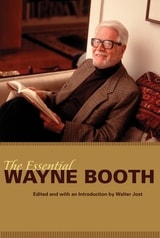
The Essential Wayne Booth
Wayne C. Booth
University of Chicago Press, 2006
While Booth’s work was formative to the study of literature, his essential writings have never been collected in a single volume—until now. Selected by Walter Jost in collaboration with Booth himself, the texts anthologized here present a picture of this indispensable critic’s contributions to literary and rhetorical studies. The selections range from memorable readings of Macbeth, Jane Austen, George Eliot, and Henry James to engagements with Booth’s intellectual heroes, such as Richard McKeon and Mikhail Bakhtin. But rhetoric, Booth’s abiding concern as a critic and thinker, provides the organizing principle of the anthology. The Essential Wayne Booth illuminates the scope of Booth’s rhetorical inquiry: the entire range of resources that human beings share for producing effects on one another. Whether about metaphors for our friendship with books or the two cultures of science and religion, the texts collected here always return to the techniques and ethics of our ways of communicating with each other—that is, to rhetoric.
The Essential Wayne Booth is a capstone to Booth's long career and an eloquent reminder of the ways in which criticism can make us alive to the arts of writing, talking, and listening.
The Eternal Present of Sport
Rethinking Sport and ReligionDaniel A. Grano
Temple University Press, 2017
Grano asserts that it is precisely through sport’s highest religious ideals that controversies are taking shape and constituting points of political and social rupture. He examines issues of transcendence, “legacy”—e.g., “greatest ever,” or “all-time”—and “witnessing” through instant replay, which undermine institutional authority. Grano also reflects on elite athletes representing especially powerful embodiments of religious and social conflict, including around issues related to gender, sexuality, ability doping, traumatic brain injury, and institutional greed.
Elite sport is in a period of profound crisis. It is through the ideals Grano analyzes that we can imagine a radically alternative future for elite sport.
The Ethics and Politics of Speech
Communication and Rhetoric in the Twentieth CenturyPat J. Gehrke
Southern Illinois University Press, 2009
In The Ethics and Politics of Speech, Pat J. Gehrke provides an accessible yet intensive history of the speech communication discipline during the twentieth century. Drawing on several previously unpublished or unexamined sources—including essays, conference proceedings, and archival documents—Gehrke traces the evolution of communication studies and the dilemmas that often have faced academics in this field. In his examination, Gehrke not only provides fresh perspectives on old models of thinking; he reveals new methods for approaching future studies of ethical and political communication.
Gehrke begins his history with the first half of the twentieth century, discussing the development of a social psychology of speech and an ethics based on scientific principles, and showing the importance of democracy to teaching and scholarship at this time. He then investigates the shift toward philosophical—especially existential—ways of thinking about communication and ethics starting in the 1950s and continuing through the mid-1970s, a period associated with the rise of rhetoric in the discipline. In the chapters covering the last decades of the twentieth century, Gehrke demonstrates how the ethics and politics of communication were directed back onto the practices of scholarship within the discipline, examining the increased use of postmodern and poststructuralist theories, as well as the new trend toward writing original theory, rather than reinterpreting the past. In offering a thorough history of rhetoric studies, Gehrke sets the stage for new questions and arguments, ultimately emphasizing the deeply moral and political implications that by nature embed themselves in the field of communication.
More than simply a history of the discipline's major developments, The Ethics and Politics of Speech is an account of the philosophical and moral struggles that have faced communication scholars throughout the last century. As Gehrke explores the themes and movements within rhetoric and speech studies of the past, he also provides a better understanding of the powerful forces behind the forging of the field. In doing so, he reveals history’s potential to act as a vehicle for further academic innovation in the future.
The Ethics of Persuasion
Derrida's Rhetorical LegaciesBrooke Rollins
The Ohio State University Press, 2020
Drawing on Derrida’s (non)definition of ethics and his pointed accounts of performativity, Rollins argues that this vital ethical component of many ancient theories, practices, and pedagogies of persuasion has been undertheorized for more than two millennia. Through deconstructive readings of some of these texts, she shows us that we are not simply sovereign beings who both wield and guard against linguistic techniques of rule. Our persuasive endeavors, rather, are made possible by an ethics—an always prior encounter with otherness that interrupts self-presence.
The Ethos of Drama
Rhetorical Theory and Dramatic WorthRobert L. King
Catholic University of America Press, 2010
The Everest Effect
Nature, Culture, IdeologyElizabeth Mazzolini
University of Alabama Press, 2015
The Everest Effect is an accessibly written cultural history of how nature, technology, and culture have worked together to turn Mount Everest into a powerful and ubiquitous physical measure of Western values.
In The Everest Effect Elizabeth Mazzolini traces a series of ideological shifts in the status of Mount Everest in Western culture over the past century to the present day and links these shifts to technologies used in climbs. By highlighting the intersections of technology and cultural ideologies at this site of environmental extremity, she shows both how nature is shaped—physically and symbolically—by cultural values and how extreme natural phenomena shape culture.
Nostalgia, myth, and legend are intrinsic features of the conversations that surround discussions of historic and contemporary climbs of Everest, and those conversations themselves reflect changing relations between nature, technology, and ideology. Each of the book’s chapters links a particular value with a particular technology to show how technology is implicated in Mount Everest’s cultural standing and commodification: authenticity is linked with supplemental oxygen; utility with portable foodstuffs; individuality with communication technology; extremity with visual technology; and ability with money. These technologies, Mazzolini argues, are persuasive—and increasingly so as they work more quickly and with more intimacy on our bodies and in our daily lives.
As Mazzolini argues, the ideologies that situate Mount Everest in Western culture today are not debased and descended from a more noble time; rather, the material of the mountain and its surroundings and the technologies deployed to encounter it all work more immediately with the bodies and minds of actual and “armchair” mountaineers than ever before. By moving the analysis of a natural site and phenomenon away from the traditional labor of production and toward the symbolic labor of affective attachment, The Everest Effect shows that the body and nature have helped constitute the capitalization that is usually characterized as taking over Everest.

The Evidence Is Life
Deaf Pilgrimages to Language and Community in Mexico CityAnne E. Pfister
Gallaudet University Press, 2025
The Evolution of Grammar
Tense, Aspect, and Modality in the Languages of the WorldJoan Bybee, Revere Perkins, and William Pagliuca
University of Chicago Press, 1994
Through a survey of seventy-six languages in twenty-five different phyla, the authors show that the same paths of change occur universally and that movement along these paths is in one direction only. This analysis reveals that lexical substance evolves into grammatical substance through various mechanisms of change, such as metaphorical extension and the conventionalization of implicature. Grammaticization is always accompanied by an increase in frequency of the grammatical marker, providing clear evidence that language use is a major factor in the evolution of synchronic language states.
The Evolution of Grammar has important implications for the development of language and for the study of cognitive processes in general.
The Evolution of Pragmatism in India
Ambedkar, Dewey, and the Rhetoric of ReconstructionScott R. Stroud
University of Chicago Press, 2023
In The Evolution of Pragmatism in India, Scott R. Stroud delivers a comprehensive exploration of the influence of John Dewey’s pragmatism on Bhimrao Ambedkar, architect of the Republic of India’s constitution. Stroud traces Ambedkar’s development in Dewey’s Columbia University classes in 1913–1916 through his final years in 1950s India when he rewrote the story of Buddhism. Stroud examines pragmatism’s influence not only on the philosophical ideas underpinning Ambedkar’s fight against caste oppression but also how his persuasive techniques drew on pragmatism’s commitment to reconstruction and meliorism. At the same time, Stroud is careful to point out the ways that Ambedkar pushed back against Dewey’s paradigm and developed his own approach to challenges in India. The result is a nuanced study of one of the most important figures in Indian history.

The Expert Library
Staffing, Sustaining, And Advancing TheScott Walter
Assoc of College & Research Libraries, 2011
The Expert Library
Staffing, Sustaining, and Advancing the Academic Library in the 21st CenturyScott Walter
Assoc of College & Research Libraries, 2011
The Extraordinary Decade
Literary MemoirsBy P.V. Annenkov, Edited by Arthur P. Mendel, Translated by Irwin R. Titunik
University of Michigan Press, 1981
The Fanfiction Reader
Folk Tales for the Digital AgeFrancesca Coppa
University of Michigan Press, 2017
The First-Year Experience Cookbook
Raymond Pun
Assoc of College & Research Libraries, 2017