Results by title
1917 books match the query 'Law' and 526 start with t
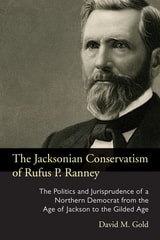
The Jacksonian Conservatism of Rufus P. Ranney
The Politics and Jurisprudence of a Northern Democrat from the Age of Jackson to the Gilded AgeDavid M. Gold
Ohio University Press, 2016
Ohio’s Rufus P. Ranney embodied many of the most intriguing social and political tensions of his time. He was an anticorporate campaigner who became John D. Rockefeller’s favorite lawyer. A student and law partner of abolitionist Benjamin F. Wade, Ranney acquired an antislavery reputation and recruited troops for the Union army; but as a Democratic candidate for governor he denied the power of Congress to restrict slavery in the territories, and during the Civil War and Reconstruction he condemned Republican policies.
Ranney was a key delegate at Ohio’s second constitutional convention and a two-time justice of the Ohio Supreme Court. He advocated equality and limited government as understood by radical Jacksonian Democrats. Scholarly discussions of Jacksonian jurisprudence have primarily focused on a handful of United States Supreme Court cases, but Ranney’s opinions, taken as a whole, outline a broader approach to judicial decision making.
A founder of the Ohio State Bar Association, Ranney was immensely influential but has been understudied until now. He left no private papers, even destroying his own correspondence. In The Jacksonian Conservatism of Rufus P. Ranney, David M. Gold works with the public record to reveal the contours of Ranney’s life and work. The result is a new look at how Jacksonian principles crossed the divide of the Civil War and became part of the fabric of American law and at how radical antebellum Democrats transformed themselves into Gilded Age conservatives.

The Journal of Law and Economics, volume 63 number 4 (November 2020)
The University of Chicago Press
University of Chicago Press Journals, 2020
The Journal of Law and Economics, volume 64 number 1 (February 2021)
The University of Chicago Press
University of Chicago Press Journals, 2021
The Journal of Law and Economics, volume 64 number 2 (May 2021)
The University of Chicago Press
University of Chicago Press Journals, 2021
The Journal of Law and Economics, volume 64 number 3 (August 2021)
The University of Chicago Press
University of Chicago Press Journals, 2021
The Journal of Law and Economics, volume 64 number 4 (November 2021)
The University of Chicago Press
University of Chicago Press Journals, 2021
The Journal of Law and Economics, volume 65 number 1 (February 2022)
The University of Chicago Press
University of Chicago Press Journals, 2022
The Journal of Law and Economics, volume 65 number 2 (May 2022)
The University of Chicago Press
University of Chicago Press Journals, 2022
The Journal of Law and Economics, volume 65 number 3 (August 2022)
The University of Chicago Press
University of Chicago Press Journals, 2022
The Journal of Law and Economics, volume 65 number 4 (November 2022)
The University of Chicago Press
University of Chicago Press Journals, 2022
The Journal of Law and Economics, volume 65 number S1 (February 2022)
The University of Chicago Press
University of Chicago Press Journals, 2022
The Journal of Law and Economics, volume 65 number S2 (November 2022)
The University of Chicago Press
University of Chicago Press Journals, 2022
The Journal of Law and Economics, volume 66 number 1 (February 2023)
The University of Chicago Press
University of Chicago Press Journals, 2023
The Journal of Law and Economics, volume 66 number 2 (May 2023)
The University of Chicago Press
University of Chicago Press Journals, 2023
The Journal of Law and Economics, volume 66 number 3 (August 2023)
The University of Chicago Press
University of Chicago Press Journals, 2023
The Journal of Law and Economics, volume 66 number 4 (November 2023)
The University of Chicago Press
University of Chicago Press Journals, 2023
The Journal of Law and Economics, volume 67 number 1 (February 2024)
The University of Chicago Press
University of Chicago Press Journals, 2024
The Journal of Law and Economics, volume 67 number 2 (May 2024)
The University of Chicago Press
University of Chicago Press Journals, 2024
The Journal of Law and Economics, volume 67 number 3 (August 2024)
The University of Chicago Press
University of Chicago Press Journals, 2024
The Journal of Law and Economics, volume 67 number 4 (November 2024)
The University of Chicago Press
University of Chicago Press Journals, 2024
The Journal of Law and Economics, volume 68 number 1 (February 2025)
The University of Chicago Press
University of Chicago Press Journals, 2025
The Journal of Law and Economics, volume 68 number 2 (May 2025)
The University of Chicago Press
University of Chicago Press Journals, 2025
The Journal of Law and Economics, volume 68 number 3 (August 2025)
The University of Chicago Press
University of Chicago Press Journals, 2025
The Journal of Law and Economics, volume 68 number 4 (November 2025)
The University of Chicago Press
University of Chicago Press Journals, 2025
The Journal of Law and Economics, volume 69 number 1 (February 2026)
The University of Chicago Press
University of Chicago Press Journals, 2026
The Journal of Law and Economics, volume 69 number 2 (May 2026)
The University of Chicago Press
University of Chicago Press Journals, 2026
The Journal of Law and Economics, volume 69 number 3 (August 2026)
The University of Chicago Press
University of Chicago Press Journals, 2026
The Journal of Legal Studies, volume 51 number 1 (January 2022)
The University of Chicago Press
University of Chicago Press Journals, 2022
The Journal of Legal Studies, volume 51 number 2 (June 2022)
The University of Chicago Press
University of Chicago Press Journals, 2022
The Journal of Legal Studies, volume 53 number 2 (June 2024)
The University of Chicago Press
University of Chicago Press Journals, 2024
The Journal of Legal Studies, volume 54 number 1 (January 2025)
The University of Chicago Press
University of Chicago Press Journals, 2025
The Journal of Legal Studies, volume 54 number 2 (June 2025)
The University of Chicago Press
University of Chicago Press Journals, 2025
The Journal of Legal Studies, volume 55 number 1 (January 2026)
The University of Chicago Press
University of Chicago Press Journals, 2026

The Journal of Legal Studies, volume 55 number 2 (June 2026)
The University of Chicago Press
University of Chicago Press Journals, 2026
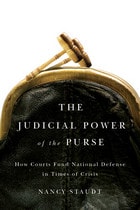
The Judicial Power of the Purse
How Courts Fund National Defense in Times of CrisisNancy Staudt
University of Chicago Press, 2011
Congress and the president are not the only branches that deal with fiscal issues in times of war. In this innovative book, Nancy Staudt focuses on the role of federal courts in fiscal matters during warfare and high-cost national defense emergencies. There is, she argues, a judicial power of the purse that becomes evident upon examining the budgetary effects of judicial decision making. The book provides substantial evidence that judges are willing—maybe even eager—to redirect private monies into government hands when the country is in peril, but when the judges receive convincing cues that ongoing wartime activities undermine the nation’s interests, they are more likely to withhold funds from the government by deciding cases in favor of private individuals and entities who show up in court.
In stark contrast with conventional legal, political, and institutional thought that privileges factors associated with individual preferences, The Judicial Power of the Purse sheds light on environmental factors in judicial decision making and will be an excellent read for students of judicial behavior in political science and law.
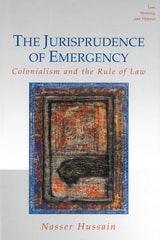
The Jurisprudence of Emergency
Colonialism and the Rule of LawNasser Hussain
University of Michigan Press, 2003
Ever-more-frequent calls for the establishment of a rule of law in the developing world have been oddly paralleled by the increasing use of "exceptional" measures to deal with political crises. To untangle this apparent contradiction, The Jurisprudence of Emergency analyzes the historical uses of a range of emergency powers, such as the suspension of habeas corpus and the use of military tribunals. Nasser Hussain focuses on the relationship between "emergency" and the law to develop a subtle new theory of those moments in which the normative rule of law is suspended.
The Jurisprudence of Emergency examines British colonial rule in India from the late eighteenth to the early twentieth century in order to trace tensions between the ideology of liberty and government by law, which was used to justify the British presence, and the colonizing power's concurrent insistence on a regime of conquest. Hussain argues that the interaction of these competing ideologies exemplifies a conflict central to all Western legal systems—between the universal, rational operation of law on the one hand and the absolute sovereignty of the state on the other. The author uses an impressive array of historical evidence to demonstrate how questions of law and emergency shaped colonial rule, which in turn affected the development of Western legality.
The pathbreaking insights developed in The Jurisprudence of Emergency reevaluate the place of colonialism in modern law by depicting the colonies as influential agents in the interpretation and delineation of Western ideas and practices. Hussain's interdisciplinary approach and subtly shaded revelations will be of interest to historians as well as scholars of legal and political theory.
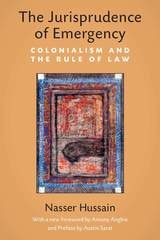
The Jurisprudence of Emergency
Colonialism and the Rule of LawNasser Hussain
University of Michigan Press, 2019
The Jurisprudence of Emergency examines British rule in India from the late eighteenth to the early twentieth century, tracing tensions between the ideology of liberty and government by law used to justify the colonizing power's insistence on a regime of conquest. Nasser Hussain argues that the interaction of these competing ideologies exemplifies a conflict central to all Western legal systems—between the universal, rational operation of law on the one hand and the absolute sovereignty of the state on the other. The author uses an impressive array of historical evidence to demonstrate how questions of law and emergency shaped colonial rule, which in turn affected the development of Western legality.
The pathbreaking insights developed in The Jurisprudence of Emergency reevaluate the place of colonialism in modern law by depicting the colonies as influential agents in the interpretation of Western ideas and practices. Hussain's interdisciplinary approach and subtly shaded revelations will be of interest to historians as well as scholars of legal and political theory.
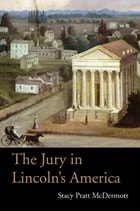
The Jury in Lincoln’s America
Stacy Pratt McDermott
Ohio University Press, 2012
In the antebellum Midwest, Americans looked to the law, and specifically to the jury, to navigate the uncertain terrain of a rapidly changing society. During this formative era of American law, the jury served as the most visible connector between law and society. Through an analysis of the composition of grand and trial juries and an examination of their courtroom experiences, Stacy Pratt McDermott demonstrates how central the law was for people who lived in Abraham Lincoln’s America.
McDermott focuses on the status of the jury as a democratic institution as well as on the status of those who served as jurors. According to the 1860 census, the juries in Springfield and Sangamon County, Illinois, comprised an ethnically and racially diverse population of settlers from northern and southern states, representing both urban and rural mid-nineteenth-century America. It was in these counties that Lincoln developed his law practice, handling more than 5,200 cases in a legal career that spanned nearly twenty-five years.
Drawing from a rich collection of legal records, docket books, county histories, and surviving newspapers, McDermott reveals the enormous power jurors wielded over the litigants and the character of their communities.
The Just
Paul Ricoeur
University of Chicago Press, 2000
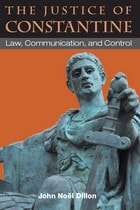
The Justice of Constantine
Law, Communication, and ControlJohn Noël Dillon
University of Michigan Press, 2012
As the first Christian emperor of Rome, Constantine the Great has long interested those studying the establishment of Christianity. But Constantine is also notable for his ability to control a sprawling empire and effect major changes. The Justice of Constantineexamines Constantine's judicial and administrative legislation and his efforts to maintain control over the imperial bureaucracy, to guarantee the working of Roman justice, and to keep the will of his subjects throughout the Roman Empire.
John Dillon first analyzes the record of Constantine's legislation and its relationship to prior legislation. His initial chapters also serve as an introduction to Roman law and administration in later antiquity. Dillon then considers Constantine's public edicts and internal communications about access to law, trials and procedure, corruption, and punishment for administrative abuses. How imperial officials relied on correspondence with Constantine to resolve legal questions is also considered. A study of Constantine's expedited appellate system, to ensure provincial justice, concludes the book.
Constantine's constitutions reveal much about the Theodosian Code and the laws included in it. Constantine consistently seeks direct sources of reliable information in order to enforce his will. In official correspondence, meanwhile, Constantine strives to maintain control over his officials through punishment; trusted agents; and the cultivation of accountability, rivalry, and suspicion among them.
The Justice of Mercy
Linda Ross Meyer
University of Michigan Press, 2010
"The Justice of Mercy is exhilarating reading. Teeming with intelligence and insight, this study immediately establishes itself as the unequaled philosophical and legal exploration of mercy. But Linda Meyer's book reaches beyond mercy to offer reconceptualizations of justice and punishment themselves. Meyer's ambition is to rethink the failed retributivist paradigm of criminal justice and to replace it with an ideal of merciful punishment grounded in a Heideggerian insight into the gift of being-with-others. The readings of criminal law, Heideggerian and Levinasian philosophy, and literature are powerful and provocative. The Justice of Mercy is a radical and rigorous exploration of both punishment and mercy as profoundly human activities."
---Roger Berkowitz, Director of the Hannah Arendt Center for Ethical and Political Thinking, Bard College
"This book addresses a question both ancient and urgently timely: how to reconcile the law's call to justice with the heart's call to mercy? Linda Ross Meyer's answer is both philosophical and pragmatic, taking us from the conceptual roots of the supposed conflict between justice and mercy to concrete examples in both fiction and contemporary criminal law. Energetic, eloquent, and moving, this book's defense of mercy will resonate with philosophers, legal scholars, lawyers, and policymakers engaged with criminal justice, and anyone concerned about our current harshly punitive legal system."
---Carol Steiker, Harvard Law School
"Far from being a utopian, soft and ineffectual concept, Meyer shows that mercy already operates within the law in ways that we usually do not recognize. . . . Meyer's piercing insights and careful analysis bring the reader to think of law, justice, and mercy itself in a new and far more profound light."
---James Martel, San Francisco State University
How can granting mercy be just if it gives a criminal less punishment than he "deserves" and treats his case differently from others like it? This ancient question has become central to debates over truth and reconciliation commissions, alternative dispute resolution, and other new forms of restorative justice. The traditional response has been to marginalize mercy and to cast doubt on its ability to coexist with forms of legal justice.
Flipping the relationship between justice and mercy, Linda Ross Meyer argues that our rule-bound and harsh system of punishment is deeply flawed and that mercy should be, not the crazy woman in the attic of the law, but the lady of the house. This book articulates a theory of punishment with mercy and illustrates the implications of that theory with legal examples drawn from criminal law doctrine, pardons, mercy in military justice, and fictional narratives of punishment and mercy.
Linda Ross Meyer is Carmen Tortora Professor of Law at Quinnipiac University School of Law; President of the Association for the Study of Law, Culture and the Humanities; and Associate Editor of Journal of Law, Culture and the Humanities.
The Justice of the Greeks
Raphael Sealey
University of Michigan Press, 1994

The Kingfisher's Wings
Glimpsing the British Constitution in the 2020sPeter Hennessy and Andrew Blick
Haus Publishing, 2024
The Language of Judges
Lawrence M. Solan
University of Chicago Press, 1993
Solan uses a wealth of examples to illustrate the way linguistics enters the process of judicial decision making: a death penalty case that the Supreme Court decided by analyzing the use of adjectives in a jury instruction; criminal cases whose outcomes depend on the Supreme Court's analysis of the relationship between adverbs and prepositional phrases; and cases focused on the meaning of certain words in the Constitution. Solan finds that judges often describe our use of language poorly because there is no clear relationship between the principles of linguistics and the jurisprudential goals that the judge wishes to promote.
A major contribution to the growing interdisciplinary scholarship on law and its social and cultural context, Solan's lucid, engaging book is equally accessible to linguists, lawyers, philosophers, anthropologists, literary theorists, and political scientists.
The Language of Statutes
Laws and Their InterpretationLawrence M. Solan
University of Chicago Press, 2010
Pulling the rug out from debates about interpretation, The Language of Statutes joins together learning from law, linguistics, and cognitive science to illuminate the fundamental issues and problems in this highly contested area. Here, Lawrence M. Solan argues that statutory interpretation is alive, well, and not in need of the major overhaul that many have suggested. Rather, he suggests, the majority of people understand their rights and obligations most of the time, with difficult cases occurring in circumstances that we can predict from understanding when our minds do not work in a lawlike way.
Solan explains that these cases arise because of the gap between our inability to write crisp yet flexible laws on one hand and the ways in which our cognitive and linguistic faculties are structured on the other. Making our lives easier and more efficient, we’re predisposed to absorb new situations into categories we have previously formed—but in the legislative and judicial realms this can present major difficulties. Solan provides an excellent introduction to statutory interpretation, rejecting the extreme arguments that judges have either too much or too little leeway, and explaining how and why a certain number of interpretive problems are simply inevitable.
The Last Great Colonial Lawyer
The Life and Legacy of Jeremiah GridleyCharles R. McKirdy
University of Massachusetts Press, 2018
Jeremiah Gridley (1702–1767) is considered “the greatest New England lawyer of his generation,” yet we know little about him. Most of his renown is a product of the fame of his students, most notably John Adams. Gridley deserves more. He was an active participant in the Writs of Assistance trial and the Stamp Act controversy, and as a leader of the Boston bar, an editor, speculator, legislator, and politician, his life touched and was touched by much that was integral to eighteenth-century Massachusetts.
The Last Great Colonial Lawyer presents a portrait of Gridley against the background of his times. Religious controversies enter into this narrative, as do colonial wars and the increasing strains with Great Britain, but Charles R. McKirdy also rescues from the footnotes of time subjects such as the smallpox epidemic of 1721 and the currency crisis of the 1740s. Because Gridley was above all a lawyer, the primary focus is on his cases, which illuminate in a unique and very human way attitudes regarding race, status, commerce, property, and power.
The Last Resort
Success And Failure In Campaigns For CasinosJohn Dombrink
University of Nevada Press, 1990

The Law and the Prophets
Black Consciousness in South Africa, 1968–1977Daniel Magaziner
Ohio University Press, 2010
“No nation can win a battle without faith,” Steve Biko wrote, and as Daniel R. Magaziner demonstrates in The Law and the Prophets, the combination of ideological and theological exploration proved a potent force.
The 1970s are a decade virtually lost to South African historiography. This span of years bridged the banning and exile of the country’s best-known antiapartheid leaders in the early 1960s and the furious protests that erupted after the Soweto uprisings of June 16, 1976. Scholars thus know that something happened—yet they have only recently begun to explore how and why.
The Law and the Prophets is an intellectual history of the resistance movement between 1968 and 1977; it follows the formation, early trials, and ultimate dissolution of the Black Consciousness movement. It differs from previous antiapartheid historiography, however, in that it focuses more on ideas than on people and organizations. Its singular contribution is an exploration of the theological turn that South African politics took during this time. Magaziner argues that only by understanding how ideas about race, faith, and selfhood developed and were transformed in this period might we begin to understand the dramatic changes that took place.
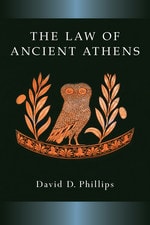
The Law of Ancient Athens
David D. Phillips
University of Michigan Press, 2013
The Law of Ancient Athens contains the principal literary and epigraphical sources, in English, for Athenian law in the Archaic and Classical periods, from the first known historical trial (late seventh century) to the fall of the democracy in 322 BCE.
This accessible and important volume is designed for teachers, students, and general readers interested in the ancient Greek world, the history of law, and the history of democracy, an Athenian invention during this period. Offering a comprehensive treatment of Athenian law, it assumes no prior knowledge of the subject and is organized in user-friendly fashion, progressing from the person to the family to property and obligations to the gods and to the state. David D. Phillips has translated all sources into English, and he has added significant introductory and explanatory material.
Topics covered in the book include homicide and wounding; theft; marriage, children, and inheritance; citizenship; contracts and commerce; impiety; treason and other offenses against the state; and sexual offenses including rape and prostitution. The volume’s unique feature is its presentation of the actual primary sources for Athenian laws, with many key or disputed terms rendered in transliterated Greek. The translated sources, together with the topical introductions, notes, and references, will facilitate both research in the field and the teaching of increasingly popular courses on Athenian law and law in the ancient world.
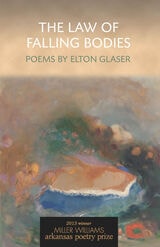
The Law of Falling Bodies
PoemsElton Glaser
University of Arkansas Press, 2013