Results by title
998 books match the query 'Life' and 223 start with t
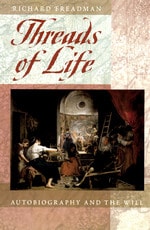
Threads of Life
Autobiography and the WillRichard Freadman
University of Chicago Press, 2001
In this new study, unprecedented in subject and scope, Richard Freadman offers the first sustained account of how changing theological, philosophical, and psychological accounts of the human will have been reflected in the writing of autobiography, and of how autobiography in its turn has helped shape various understandings of the will. Early chapters trace narrative representations of the will from antiquity (the Greeks and Augustine) to postmodernism (Derrida and Barthes), with particular emphasis on late modernity's culture of the will. Later chapters then present detailed and powerfully original readings of autobiographical texts by Louis Althusser, Roland Barthes, B. F. Skinner, Ernest Hemingway, Simone de Beauvoir, Arthur Koestler, Stephen Spender, and Diana Trilling.
Freadman's interdisciplinary approach to autobiography and the will includes a theoretical defense of the view that autobiographers are, in varying degrees, agents in their own texts. Threads of Life argues that late modernity has inherited deeply conflicted attitudes to the will. Freadman suggests that these attitudes, now deeply embedded in contemporary cultural discourse, need reexamining. In this, he contends, 'reflective autobiography' has an important part to play.
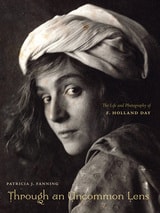
Through an Uncommon Lens
The Life and Photography of F. Holland DayPatricia J. Fanning
University of Massachusetts Press, 2008
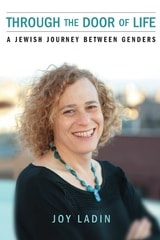
Through the Door of Life
A Jewish Journey between GendersJoy Ladin
University of Wisconsin Press, 2012
Professor Jay Ladin made headlines around the world when, after years of teaching literature at Yeshiva University, he returned to the Orthodox Jewish campus as a woman—Joy Ladin. In Through the Door of Life, Joy Ladin takes readers inside her transition as she changed genders and, in the process, created a new self.
With unsparing honesty and surprising humor, Ladin wrestles with both the practical problems of gender transition and the larger moral, spiritual, and philosophical questions that arise. Ladin recounts her struggle to reconcile the pain of her experience living as the “wrong” gender with the pain of her children in losing the father they love. We eavesdrop on her lifelong conversations with the God whom she sees both as the source of her agony and as her hope for transcending it. We look over her shoulder as she learns to walk and talk as a woman after forty-plus years of walking and talking as a man. We stare with her into the mirror as she asks herself how the new self she is creating will ever become real.
Ladin’s poignant memoir takes us from the death of living as the man she knew she wasn’t, to the shattering of family and career that accompanied her transition, to the new self, relationships, and love she finds when she opens the door of life.
2012 Finalist for the National Jewish Book Award for Biography, Autobiography, or Memoir
“Given her high-profile academic position, Ladin’s transition was a major news story in Israel and even internationally. But behind the public story was a private struggle and learning experience, and Ladin pulls no punches in telling that story. She offers a peek into how daunting it was to learn, with little support from others, how to dress as a middle-aged woman, to mu on make-up, to walk and talk like a female. She provides a front-row seat for observing how one person confronted a seemingly impossible situation and how she triumphed, however shakingly, over the many adversities, both societal and psychological, that stood in the way.”—The Gay and Lesbian Review Worldwide
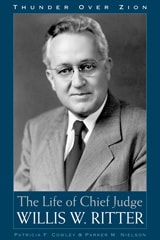
Thunder Over Zion
The Life and Times of Chief Judge Willis W RitterCowley & Nielson
University of Utah Press, 2006
Ritter was clearly ahead of his time, for his opinions on criminal justice, police interrogation, and the rights to counsel have now become accepted standards in jurisprudence. They are, indeed, so universally accepted that few if any viewers of televised police court dramas would even question them. In his personal life he was a man flawed on a grand scale and he lived a life fraught with contradictions. This is his compelling story, compellingly recounted.
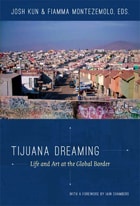
Tijuana Dreaming
Life and Art at the Global BorderJosh Kun and Fiamma Montezemolo, eds.
Duke University Press, 2012
Contributors. Tito Alegría, Humberto Félix Berumen, Roberto Castillo Udiarte, Iain Chambers, Luis Humberto Crosthwaite, Teddy Cruz, Ejival, Tarek Elhaik, Guillermo Fadanelli, Néstor García Canclini, Ingrid Hernández, Jennifer Insley-Pruitt, Kathryn Kopinak, Josh Kun, Jesse Lerner, Fiamma Montezemolo, Rene Peralta, Rafa Saavedra, Lucía Sanromán, Santiago Vaquera-Vásquez, Heriberto Yépez
To Heal the Scourge of Prejudice
The Life and Writings of Hosea EastonHosea Easton
University of Massachusetts Press, 1999
How did racial prejudice originate and why has it been so deeply rooted in American culture? What have been the long-term effects of prejudice on the intellectual, communal, and psychological resources of African Americans? How might the nightmare of racial domination be truly brought to an end? Still pertinent today, these were among the key questions addressed more than a century and a half ago by Hosea Easton (1799–1837), an important yet long neglected activist and intellectual.
A black minister from New England, Easton rose to prominence during the 1820s and 1830s by joining in the struggle of free African Americans to resist southern slavery and secure racial equality. From this experience he developed a deep understanding of the problem of "race" in the United States and became a trenchant critic of white supremacy and its devastating consequences. This volume brings back into print the only extended writings of Easton that have survived into our time: his insightful, almost prescient A Treatise on the Intellectual Character, and the Civil and Political Condition of the Colored People of the U. States, first published in 1837; and his passionate 1828 Thanksgiving Day “Address.” The book also provides a biographical portrait of Easton and his family, drawn from primary documents as well as secondary sources in the areas of biography, genealogy, and social history.
To Life
Jews Exploring NatureJoel Greenberg
Rutgers University Press, 2026
To Life explores the Jewish relationship with nature by illuminating significant Jewish thinkers who increased in important ways our understanding of various aspects of natural history. In eight compelling chapter-long biographies, naturalist Joel Greenberg demonstrates the diversity of both Jewish identity and the natural sciences.
Greenberg’s rich biographical sketches spotlight great Jewish scientists who not only made major contributions to the study of the natural world but also led rich and colorful lives: botanist and spy Aaron Aaronsohn, zoologist Libbie Henrietta Hyman, infamous ornithologist Nathan Leopold, mammalogist Philip Hershkovitz, arachnologist Herbert Levi, herpetologist Hymen Marx, public health entomologist Andrew Spielman, and ecologist Joan Ehrenfeld. These individuals manifested different aspects of Jewish identity—some observant, some secular—but all were affected in one way or another by their being Jewish.
By exploring the relationship between Jews and nature through the lives of these figures, Greenberg shares new and underrecognized aspects of Jewish and environmental history and opens new portals into the fields they studied.
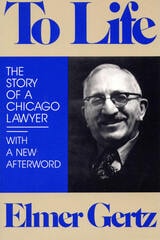
To Life
The Story of a Chicago LawyerElmer Gertz
Southern Illinois University Press, 1990
Elmer Gertz has defended famous people—including Henry Miller, Nathan Leopold, and Jack Ruby—and he has become famous in his own right through his struggle for civil liberties and personal rights.
Gertz has taken on a lengthy list of cases and causes over the six decades of his legal career. He fought successfully against the censorship of Henry Miller’s book Tropic of Cancer,which had been banned in Chicago for obscenity. He got Nathan Leopold released from prison after Leopold had served 34 years for his part in the death of 14-year-old Bobby Franks. An ardent foe of the death penalty, Gertz labored for years as part of a national team of lawyers that was finally able to overturn Jack Ruby’s death sentence for the murder of Lee Harvey Oswald. Gertz’s cases have helped make libel law in the nation.
For this edition, Gertz adds an afterword that covers the 15 years since the book’s first publication. Gertz talks of Henry Miller’s last days and his travels to the USSR on behalf of the Refuseniks.
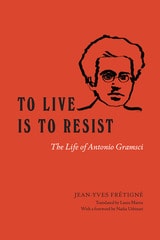
To Live Is to Resist
The Life of Antonio GramsciJean-Yves Frétigné
University of Chicago Press, 2021
One of the most influential political thinkers of the twentieth century, Antonio Gramsci (1891–1937) has left an indelible mark on philosophy and critical theory. His innovative work on history, society, power, and the state has influenced several generations of readers and political activists, and even shaped important developments in postcolonial thought. But Gramsci’s thinking is scattered across the thousands of notebook pages he wrote while he was imprisoned by Italy’s fascist government from 1926 until shortly before his death.
To guide readers through Gramsci’s life and works, historian Jean-Yves Frétigné offers To Live Is to Resist, an accessible, compelling, and deeply researched portrait of an extraordinary figure. Throughout the book, Frétigné emphasizes Gramsci’s quiet heroism and his unwavering commitment to political practice and resistance. Most powerfully, he shows how Gramsci never surrendered, even in conditions that stripped him of all power—except, of course, the power to think.
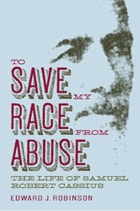
To Save My Race from Abuse
The Life of Samuel Robert CassiusEdward J. Robinson
University of Alabama Press, 2009
Samuel Robert Cassius was born to a slave mother and a white father in Virginia in 1853 and became a member of the Restorationist Movement (Disciples of Christ) while a coal miner in Indiana. For the rest of his long life (he died in 1931 at age 78), Cassius was an active evangelist, prolific publicist, dedicated leader of black Disciples, and an outspoken and uncompromising opponent of racism in religion and society.
An indefatigable preacher, Cassius ranged throughout the Midwest, California, and the southwestern states, founding and encouraging black Stone-Campbell Restorationist congregations. After entering the Oklahoma Territory in 1891, he worked for three decades as an educator, newspaper editor, social activist, postmaster, and Justice of the Peace. Because he consistently incorporated social and racial issues into his religious writings, Cassius often found himself at odds with whites in the Stone-Campbell Movement, the very people he relied on for monetary support. He advocated a Booker T. Washington-style self-help ethos while at the same time firmly resisting racism wherever he encountered it. Largely invisible in a world dominated by such towering figures as Washington, Frederick Douglass, Ida B. Wells, and W. E. B. DuBois, Cassius lived a life of virtual obscurity beyond the circle of the Stone-Campbell Movement. His story is important because, as a racial militant and separatist, he presaged the schism that would engulf and fracture the Churches of Christ in the 1960s, when blacks and whites went their separate ways and formed two distinct groups in one religious fellowship.
By combing through a plethora of primary sources that Cassius left behind in both religious and nonreligious journals, Edward J. Robinson has successfully reconstructed and recaptured the essence of Cassius’ complex and extraordinary life. This book offers the first full-length study of a man of remarkable attainment despite daily obstacles and resistance.
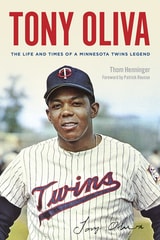
Tony Oliva
The Life and Times of a Minnesota Twins LegendThom Henninger
University of Minnesota Press, 2019
If not for the botched Bay of Pigs invasion, Minnesota might never have known one of its most popular baseball players, Twins three-time batting champion and eight-time All-Star Tony Oliva. In April 1961, the twenty-two-year-old Cuban prospect failed to impress the Twins in a tryout, but the sudden rupture in U.S.–Cuba relations made a return visa all but impossible. The story of how Oliva’s unexpected stay led to a second chance and success with the Twins—as well as decades of personal and cultural isolation—is told for the first time in this full-scale biography of the man the fans affectionately call “Tony O.”
With unprecedented access to the very private Oliva, baseball writer Thom Henninger captures what life was like for the Cuban newcomer as he adjusted to major league play and American culture—and at the same time managed to earn Rookie of the Year honors and win the American League batting title in his first two seasons, all while playing with a knuckle injury. Packed with never-before-published photographs, the book follows Oliva through the 1965 season, all the way to the World Series, and then, with repaired knuckle and knee, into one of the most dramatic pennant races in baseball history in 1967. Through the voices of Oliva, his family, and his teammates—including the Cuban players who shared his cultural challenges and the future Hall of Famers he mentored, Rod Carew and Kirby Puckett—the personal and professional highs and lows of the years come alive: the Gold Glove Award in 1966, a third batting title in 1971, the devastating injury that curtailed his career, and, through it all, the struggle to build a family and recover the large and close-knit one he had left behind in Cuba.
Nearly forty years after Oliva’s retirement, the debate continues over whether his injury-shortened career was Hall of Fame caliber—a question that gets a measured and resounding answer here.
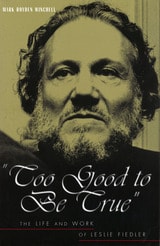
Too Good to Be True
The Life and Work of Leslie FiedlerMark Royden Winchell
University of Missouri Press, 2002
Tormented Master
A Life of Rabbi Nahman of BratslavWritten by Arthur E. Green
University of Alabama Press, 1979
“If Hasidism begins in the life-enhancing spirituality of the Baal Shem Tov, it concludes in the tortuous, elitist and utterly fascinating career of Nahman of Bratslav (1722–1810) whose biography and teaching Arthur Green has set forth in his comprehensive, moving, and subtle study, Tormented Master.
“Arthur Green has managed to lead us through the thickets of the Bratslaver discourse with a grace and facility thus far unequaled in the English language literature on Hasidism. Tormented Master is a model of clarity and percipience, balancing awed respect and honor for its subject with a ruthless pursuit of documented truth. . . . Tormented Master is sufficiently open to the agonies of religion in general and the issues of modern religion in particular to make Nahman a thinker utterly relevant to our time.
“Nahman of Bratslav is unique in the history of Judaism, Green emphasizes, for having made the individual’s quest for intimacy with God the center of the religious way. He was a Kierkegaard before his time, believing in the utter abandon of the life of faith and the risk of paradoxicality. . . . He was, more than all others, the predecessor of Kafka, whose tales, like Nahman’s, have no explicit key and rankle, flush and irritate the spirit, compelling us—even in our failure to understand—to acknowledge their potency and challenge.”
—New York Times
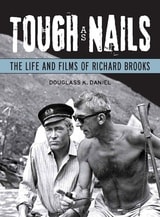
Tough as Nails
The Life and Films of Richard BrooksDouglass K. Daniel
University of Wisconsin Press, 2011
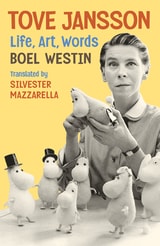
Tove Jansson
Life, Art, WordsBoel Westin
University of Minnesota Press, 2024
An in-depth, perceptive account of the unconventional life of the Moomins’ beloved creator, now available in the United States
Tove Jansson achieved fame as the creator of the Moomins, beloved by generations of readers around the world. Remarkably, the Moomins were only part of the prodigious creative output of this Finnish-Swedish writer and artist. Jansson’s work also includes short stories and five novels for adults, as well as paintings, murals, and book illustrations. In this acclaimed biography, Boel Westin relies on numerous conversations with Jansson and unprecedented access to her journals, letters, and personal archives to present an engrossing and comprehensive review of the life and world of Scandinavia’s best-loved author.
As Westin’s meticulous research makes clear, Jansson’s artistic and literary works reflected what was most important to her: the love of family and nature and the desire to pursue her art. Guided by her personal motto, “Love and work,” Jansson seized both with uncompromising joy. And while her romantic relationships with men proved unfulfilling, she found those with women—especially with her longtime partner, the artist Tuulikki Pietilä—both grounding and inspiring.
Westin weaves together the many threads of Jansson’s rich, complex life: an education interrupted to help her family; the bleak war years and her emergence as a painter; the decades of Moominmania across books, newspaper comic strips, merchandise, and adaptations; her later fictions, including her popular The Summer Book; and her time with Pietilä on the solitary island of Klovharu. Tove Jansson: Life, Art, Words offers fans and admirers around the world the most complete portrait of the writer Philip Pullman described as “a genius, a woman of profound wisdom and great artistry.”
Tracking the Meaning of Life
A Philosophical JourneyYuval Lurie
University of Missouri Press, 2006
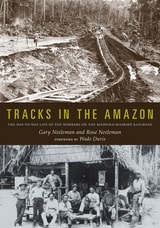
Tracks in the Amazon
The Day-to-Day Life of the Workers on the Madeira-Mamoré RailroadGary Neeleman
University of Utah Press, 2014
Although there have been many brief chronicles and writings about the Madeira-Mamoré Railroad over the years, most barely scratch the surface of this incredible story. Of particular import in Tracks in the Amazon are the photographs—which until now have rarely been seen—taken by Dana Merrill, a New York photographer hired to document the construction of the railroad. It also includes reproductions of the Porto Velho Marconigram, an English-language newspaper written for and by the American expatriates who lived in the construction headquarters at Porto Velho. Because this unique railroad traversed the densest tropical jungle on earth, more than 10,000 workers lost their lives laying the first five miles of track. The images and descriptions of the life of the workers on the railroad illustrate the challenges of working in the jungles—the unforgiving climate, malaria and yellow feverbearing mosquitoes, and the threat of wild animals—which made conditions for the workers next to impossible.
Finalist for the International Latino Book Awards: Best Book in Nonfiction in Portuguese.
Travels in a Tree House
Essays on Life and Other JoysJohn Workman
University of Arkansas Press, 2001
Trees as a Way of Life
An Arborist’s StoryR. Bruce Allison
Wisconsin Historical Society Press, 2027
An arborist’s lifelong journey reveals the deep connections between people and trees.
Bruce Allison has spent decades listening to trees and making sense of what they tell us. In this intimate and absorbing memoir, he deftly weaves personal stories, botanical insights, and moments of wonder and revelation into a captivating ode to trees.
Trees as a Way of Life follows Allison on his journey from seedling to sapling to maturity, as he explores a eucalyptus grove as a boy in Bonita, California; learns the tree ethic as an apprentice arborist in Baltimore, Maryland; and establishes his own tree care company in Madison, Wisconsin. After more than fifty years as a professional arborist, he tells stories of stewarding the trees at the Wisconsin State Capitol and Frank Lloyd Wright’s Taliesin, among other sites, and describes formative encounters with notable tree-loving clients, including American Girl creator Pleasant Rowland and Epic Systems founder Judith Faulkner. As he tells his own story, Allison incorporates the voices and stories of renowned naturalists like Henry David Thoreau, John Muir, Aldo Leopold, and Rachel Carson.
Allison also uses his own tree encounters as jumping-off points for deep dives into individual species, memorable moments in tree history, and tips and tricks for tree care and maintenance. As only an accomplished arborist and educator could, he provides a detailed-yet-accessible tutorial on trees, from the upper canopy of stem and crown, through the veil of bark, to the hidden underground landscape of tree roots and fungi.
In the tradition of the international bestseller The Hidden Life of Trees, this book carries readers root by root and limb by limb to a deeper understanding of the trees that feed us, protect us, shade us, and inspire us. In an engaging narrative style that blends the personal, the scientific, and the poetic, Allison’s story is an intimate love letter to trees, a master class in understanding and appreciating them, and an invitation to readers who also long to make trees a way of life.
Turning Archival
The Life of the Historical in Queer StudiesDaniel Marshall and Zeb Tortorici, editors
Duke University Press, 2022
Contributors. Anjali Arondekar, Kate Clark, Ann Cvetkovich, Carolyn Dinshaw, Kate Eichhorn, Javier Fernández-Galeano, Emmett Harsin Drager, Elliot James, Marget Long, Martin F. Manalansan IV, Daniel Marshall, María Elena Martínez, Joan Nestle, Iván Ramos, David Serlin, Zeb Tortorici
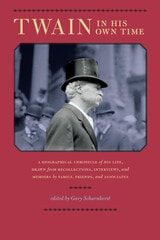
Twain in His Own Time
A Biographical Chronicle of His Life, Drawn from Recollections, Interviews, and Memoirs by Family, Friends, and AssociatesGary Scharnhorst
University of Iowa Press, 2010
Never one to suffer fools gladly, especially if they wore crinolines, Mark Twain lost as many friends as he made, and he targeted them all indiscriminately. The first major American writer born west of the Mississippi River, he enjoys a reputation unrivaled in American literary history, and from the beginning of his career he tried to control that reputation by fiercely protecting his public persona. Not a debunking account of Twain’s life but refreshingly immune from his relentless image making, Gary Scharnhorst’s Twain in His Own Time offers an anecdotal version of Twain’s life over which the master spin-doctor had virtually no control.
The ninety-four recollections gathered in Twain in His Own Time form an unsanitized, collaborative biography designed to provide a multitude of perspectives on the iconic author. Opening with an interview with his mother that has never been reprinted, it includes memoirs by his daughters and by men who knew him when he was roughing it in Nevada and California, an interview with the pilot who taught him to navigate the Mississippi River, reminiscences from his illustrators E. M. Kemble and Dan Beard and two of his so-called adolescent angelfish, contributions from politicians and from such literary figures as Dan De Quille and George Bernard Shaw, and one of the most damning assessments of his character—by the author Frank Harris—ever published.
Each entry is introduced by a brief explanation of its historical and cultural context; explanatory notes provide further information about people and places; and Scharnhorst’s introduction and chronology of Twain’s eventful life are comprehensive and detailed. Dozens of lively primary sources published incrementally over more than eighty years, most recorded after his death, illustrate the complexities of this flamboyant, outspoken personality in a way that no single biographer could.
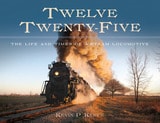
Twelve Twenty-Five
The Life and Times of a Steam LocomotiveKevin P. Keefe
Michigan State University Press, 2016
Pere Marquette 1225 was built in 1941 at the peak of steam locomotive development. The narrative traces the 1225’s regular freight service in Michigan, its unlikely salvation from the scrapyard for preservation at Michigan State University, and the subsequent work to bring it back to steam, first by a student club and later by a railroad museum. Milestones along the way include 1225’s retirement in 1951, its donation to MSU in 1957, its return to steam in 1988, a successful career hauling tens of thousands of excursion riders, and its starring role in the 2004 movie The Polar Express. The massive infrastructure that supported American steam locomotives in their heyday disappeared long ago, forcing 1225’s faithful to make their own spare parts, learn ancient railroad skills, and interpret the entire effort for the public. As such, the continuing career of 1225 is a triumph of historic preservation.
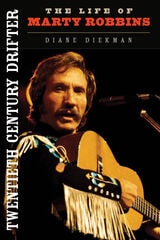
Twentieth Century Drifter
The Life of Marty RobbinsDiane Diekman
University of Illinois Press, 2012
Twentieth Century Drifter: The Life of Marty Robbins is the first biography of this legendary country music artist and NASCAR driver who scored sixteen number-one hits and two Grammy awards. Yet even with fame and fortune, Marty Robbins always yearned for more.
Drawing from personal interviews and in-depth research, biographer Diane Diekman explains how Robbins saw himself as a drifter, a man always searching for self-fulfillment and inner peace. Born Martin David Robinson to a hardworking mother and an abusive alcoholic father, he never fully escaped the insecurities burned into him by a poverty-stricken nomadic childhood in the Arizona desert. In 1947 he got his first gig as a singer and guitar player. Too nervous to talk, the shy young man walked onstage singing. Soon he changed his name to Marty Robbins, cultivated his magnetic stage presence, and established himself as an entertainer, songwriter, and successful NASCAR driver.
For fans of Robbins, NASCAR, and classic country music, Twentieth Century Drifter: The Life of Marty Robbins is a revealing portrait of this well-loved, restless entertainer, a private man who kept those who loved him at a distance.