914 books match the query 'Medieval' and 244 start with t
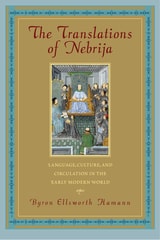
cover of The Translations of Nebrija: Language, Culture, and Circulation in the Early Modern World

The Translations of Nebrija

Language, Culture, and Circulation in the Early Modern World

Byron Ellsworth Hamann

University of Massachusetts Press, 2015

In 1495, the Spanish humanist Antonio de Nebrija published a Spanish-to-Latin dictionary that became a best seller. Over the next century it was revised dozens of times, in nine European cities. As these dictionaries made their way around the globe in this age of encounters, their lists of Spanish words became frameworks for dictionaries of non-Latin languages. What began as Spanish to Latin became Spanish to Arabic, French, English, Tuscan, Nahuatl, Mayan, Quechua, Aymara, Tagalog, and more.

Tracing the global influence of Nebrija's dictionary, Byron Ellsworth Hamann, in this interdisciplinary, deeply researched book, connects pagan Rome, Muslim Spain, Aztec Tenochtitlan, Elizabethan England, the Spanish Philippines, and beyond, revealing new connections in world history. The Translations of Nebrija re-creates the travels of people, books, and ideas throughout the early modern world and reveals the adaptability of Nebrija's text, tracing the ways heirs and pirate printers altered the dictionary in the decades after its first publication. It reveals how entries in various editions were expanded to accommodate new concepts, such as for indigenous languages in the Americas—a process with profound implications for understanding pre-Hispanic art, architecture, and writing. It shows how words written in the margins of surviving dictionaries from the Americas shed light on the writing and researching of dictionaries across the early modern world.

Exploring words and the dictionaries that made sense of them, this book charts new global connections and challenges many assumptions about the early modern world.
[more]
cover of The Treatise on Laws (Decretum DD. 1-20) with the Ordinary Gloss (Studies in Medieval and Early Modern Canon Law, Volume 2)

The Treatise on Laws (Decretum DD. 1-20) with the Ordinary Gloss (Studies in Medieval and Early Modern Canon Law, Volume 2)

Catholic University of America Press, 1993
No description available
[more]
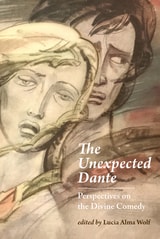
cover of The Unexpected Dante: Perspectives on the Divine Comedy

The Unexpected Dante

Perspectives on the Divine Comedy

Lucia Alma Wolf

Bucknell University Press, 2021

Dante Alighieri’s long poem The Divine Comedy has been one of the foundational texts of European literature for over 700 years. Yet many mysteries still remain about the symbolism of this richly layered literary work, which has been interpreted in many different ways over the centuries.
 
The Unexpected Dante brings together five leading scholars who offer fresh perspectives on the meanings and reception of The Divine Comedy. Some investigate Dante’s intentions by exploring the poem’s esoteric allusions to topics ranging from musical instruments to Roman law. Others examine the poem’s long afterlife and reception in the United States, with chapters showcasing new discoveries about Nicolaus de Laurentii’s 1481 edition of Commedia and the creative contemporary adaptations that have relocated Dante’s visions of heaven and hell to urban American settings. 
 
This study also includes a guide that showcases selected treasures from the extensive Dante collections at the Library of Congress, illustrating the depth and variety of The Divine Comedy’s global influence. The Unexpected Dante is thus a boon to both Dante scholars and aficionados of this literary masterpiece.

Published by Bucknell University Press in association with the Library of Congress. Distributed worldwide by Rutgers University Press.
[more]
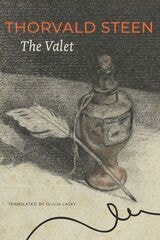
cover of The Valet

The Valet

Thorvald Steen

Seagull Books, 2026

A gripping historical novel that explores how the Fourth Crusade plundered Constantinople and forever changed the course of European history.

The year is 1204. Stripped of his power and held captive, Massimo Gasparino, once the most trusted aide to the Doge of Venice, pens a desperate secret letter to Pope Innocent III. His confession? He has witnessed the most egregious crime in human history: the deliberate diversion of the Fourth Crusade from Jerusalem to the heart of Christian Europe, Constantinople. As the city is ruthlessly plundered and its treasures shipped to Venice, Gasparino’s letter exposes the Doge’s shocking betrayal, a sin that irrevocably alters the course of history. But with his life and the fate of this explosive truth hanging precariously in the balance, can he get his message to Pope Innocent III before the Doge silences him forever?

The Valet is a tense, intimate drama of ambition, guilt, and the enduring shadows of a war that still resonates in today’s world.
[more]
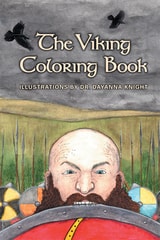
cover of The Viking Coloring Book

The Viking Coloring Book

Dayanna Knight

Arizona Center for Medieval and Renaissance Studies, 2017

What do you think of when you think of the Vikings? Fierce warriors? Sailors of magnificent dragon-prowed ships who terrorized North-Western Europe? Do you think of darkened halls thick with smoke and song?

Like all people those researchers now consider to be Viking were much more complex than the modern world sees them as. This coloring book is meant to show that. It is designed to provide scenes of the beauty of the early medieval world the Vikings inhabited. It is in this context that Viking cultures developed. You will find artifacts and animals, plants and landscapes within these pages to explore. Species that held some use to the Vikings, such as those that provided fur in particular have been focused on. Reconstructed scenes are inspired by the diverse world experienced in the north. There are no horned helmets here. The real Vikings were much more practical than that.
[more]
cover of The Visual World of the Hungarian Angevin Legendary

The Visual World of the Hungarian Angevin Legendary

Béla Zsolt Szakács

Central European University Press, 2016
Dispersed in two continents, four countries and six collections; many of its pages were cropped, cut into four, or lost forever; its history, origin, commissioner and audience are obscure; still, in its fragmented state it presents fifty-eight legends in abundant series of images, on folios fully covered by miniatures, richly gilded, using only one side of the fine parchment; a luxurious codex worthy of a ruler; a unique iconographic treasury of medieval legends; one of the most significant manuscripts of the medieval Hungarian Kingdom – these are all what we call the Hungarian Angevin Legendary.
[more]
cover of The Wealth of Wives: A Fifteenth-Century Marriage Manual

The Wealth of Wives

A Fifteenth-Century Marriage Manual

Francesco Barbaro

Iter Press, 2015

In 1415, Francesco Barbaro produced a marriage manual intended at once for his friend, a scion of the Florentine Medici family, and for the whole set of his peers, the young nobility of Venice. Countering the trends of the day toward dowry chasing and dowry inflation, Barbaro insisted that the real wealth of wives was their capacity to conceive, birth, and rear children worthy of their heritage. The success of the patriciate depended, ironically, on women: for they alone could ensure the biological, cultural, and spiritual reproduction of their marital lineage. The Wealth of Wives circulated in more than 100 manuscript versions, five Latin editions, and translations into German, Italian, French, and English, far outstripping in its influence Leon Battista Alberti’s On the Family (1434).
[more]
cover of The Whole Book: Cultural Perspectives on the Medieval Miscellany

The Whole Book

Cultural Perspectives on the Medieval Miscellany

Stephen G. Nichols and Siegfried Wenzel, Editors

University of Michigan Press, 1996

In the last few decades it has become abundantly clear how important is the "archaeology of the manuscript-book" in literary and textual scholarship. This method offers essential contexts for an editor's understanding of a manuscript, and helps to set the manuscript in the historical matrix in which the work was first brought out and understood.
This group of papers, edited by two well-known scholars of the medieval world, offers both general and particular approaches to the issues surrounding manuscripts produced in the medieval habit of "miscellany," works of seemingly diverse natures bound together into one volume. Julia Boffey investigates how certain poetical miscellanies came to be assembled, for example, while Sylvia Huot suggests that the miscellany had many different sorts of function and significance. Siegfried Wenzel considers a taxonomy of such collections, and A. S. G. Edwards' paper considers Bodleian Selden B.24 as an example of how the notions of canon, authorship, and attribution might come into play. Ann Matter's final chapter offers the notion that what we call "miscellanies" are likely to have an internal logic that we have been trained to miss, but can come to understand. Other contributors are Ralph Hanna III, Georg Knauer, Stephen Nichols, James J. O'Donnell, and Barbara A. Shailor.
Because The Whole Book deals not only with the content of miscellanies but also with contemporary literary principles, this volume will be of interest to a wide circle of literary critics and historians, as well as to students of the survival of literature and of cultural values.
Stephen G. Nichols is James M. Beall Professor of French and Chair of the Department of French, The Johns Hopkins University. Siegfried Wenzel is Professor of English, University of Pennsylvania.
[more]
cover of The Worlds of Petrarch

The Worlds of Petrarch

Giuseppe Mazzotta

Duke University Press, 1993

At the center of Petrarch's vision, announcing a new way of seeing the world, was the individual, a sense of the self that would one day become the center of modernity as well. This self, however, seemed to be fragmented in Petrarch's work, divided among the worlds of philosophy, faith, and love of the classics, politics, art, and religion, of Italy, France, Greece, and Rome. In recent decades scholars have explored each of these worlds in depth. In this work, Giuseppe Mazzotta shows for the first time how all these fragmentary explorations relate to each other, how these separate worlds are part of a common vision.

Written in a clear and passionate style, The Worlds of Petrarch takes us into the politics of culture, the poetic imagination, into history and ethics, art and music, rhetoric and theology. With this encyclopedic strategy, Mazzotta is able to demonstrate that the self for Petrarch is not a unified whole but a unity of parts, and, at the same time, that culture emerges not from a consensus but from a conflict of ideas produced by opposition and dark passion. These conflicts, intrinsic to Petrarch's style of thought, lead Mazzotta to a powerful rethinking of the concepts of "fragments" and "unity" and, finally, to a new understanding of the relationship between them.
[more]
cover of Themistius and the Imperial Court: Oratory, Civic Duty, and Paideia from Constantius to Theodosius

Themistius and the Imperial Court

Oratory, Civic Duty, and Paideia from Constantius to Theodosius

John Vanderspoel

University of Michigan Press, 1995

For generations the debate has continued: can politicians, or mid-level administrators, speak freely and say what they think, or must they describe their superiors in purely flattering ways and abandon any philosophy of independent thought? The politician and philosopher Themistius faced these same issues in the later fourth century, in composing and delivering his panegyrics for several Roman emperors.
John Vanderspoel examines the relationship between Themistius and the emperors whom he served, and assesses realistically how philosopher and emperor interacted. Themistius' speeches cover a range of periods and topics, and offer an important body of evidence for governmental affairs in the later fourth century.
Themistius and the Imperial Court includes chapters on Themistius himself, as well as on his relations with the emperors Constantius, Julian, Jovian, Valens, and Theodosius. Appendices discuss Themistius' philosophical works and extant speeches, present translations of selected sections of his Orations, and offer a chronology of Themistius' speeches, among other topics.
Themistius and the Imperial Court will be of interest to ancient historians, classicists, students and scholars of the ancient Near East, and all those interested in power politics within governing classes.
John Vanderspoel is Associate Professor of Ancient History, University of Calgary. He has written numerous articles and reviews on late antiquity.
[more]
cover of Theorizing Anglo-Saxon Stone Sculpture

Theorizing Anglo-Saxon Stone Sculpture

CATHERINE E. KARKOV

West Virginia University Press, 2003

Theorizing Anglo-Saxon Stone Sculpture significantly advances the complex study of Anglo-Saxon carved monuments, such as the Ruthwell Cross, by adopting more explicit theoretical approaches to the subject. Scholars included here are explicit in describing how their approaches complement (or, more often, contradict) the work of others. This book comes as a shot across the bow of these vessels. Contributors include the best scholars on this subject matter in England, Ireland, and America.
[more]
cover of Theory And The Premodern Text

Theory And The Premodern Text

Paul Strohm

University of Minnesota Press, 2000

A major reconsideration of relations between new theories and old texts.

Medieval Studies/Literary Theory

A major reconsideration of relations between new theories and old texts. The work of Paul Strohm allies the most distinguished traditions of medieval study with the most challenging and innovative of theoretical approaches. These features, working together to revise and expand our understanding of both medieval texts and contemporary critical practice, are apparent in full and compelling force in this collection of essays, most now in print for the first time. In a range of theoretical engagements with late medieval texts, dealing with social practice, time, and narrative, this volume proposes a "practical" relation between the text and the theory that illuminates it.Insisting on the imaginative multiplicity of the text, Strohm finds in theory an augmentation of interpretive possibilities-an augmentation that sometimes requires respectful disagreement with what a work says-or seems to want known-about itself. He thus defines theory as "any standpoint from which we might challenge a text’s self-understanding." Coupled with this strategic disrespect is a new and amplified form of respect-for the text as a meaning-making system, for its unruly power and its unpredictable effects in the world.In this spirit, Strohm offers new and illustrative readings of Hoccleve’s "Male Regle" and Regiment of Princes, Ricardian coronation documents, Chaucer’s "Cook’s Tale," Capgrave’s chronicle, the Gesta Henrici Quinti, records of the king’s bench, Malory’s "Knight of the Cart," and other later medieval texts. Throughout, Strohm traverses categories of "literary" and "non-literary" in the service of a more comprehensive understanding of texts and the resourcefulness with which they accomplish their social work.Medieval Cultures Series, volume 26Translation Inquiries: University of Minnesota Press
[more]
cover of They Came to Japan: An Anthology of European Reports on Japan, 1543-1640

They Came to Japan

An Anthology of European Reports on Japan, 1543-1640

Michael Cooper, Editor

University of Michigan Press, 1995
The Japan accidentally discovered by the Europeans in 1543 was a country torn by internecene wars waged by independent barons who recognised no effective central government and were free to appropriate as many neighbouring fiefs as force of arms and treachery would permit. The Japan which deported the Europeans a century later was a stable, highly centralised bureaucracy under the firm control of a usurping family which was to continue to rule the country until well into the Victorian age. Europeans living in Japan at the time have not only recorded the events of this fascinating period but also provided a picture of sixteenth- and seventeenth-century Japanese life. Apart from a few lacunae, a remarkably full description of the country in this century—its history, people, traditions, culture, and religion—can be pieced together.
They Came to Japan collects and translates excerpts from more than thirty early European accounts of Japan, many previously unpublished and extremely rare. Arranged into thematic chapters on aspects of Japanese society, these commentaries are most interesting not for what they say about the Japan but about the European writers themselves. Their attitude towards the newly discovered country and its inhabitants is clearly reflected in their letters and reports, especially when implicit comparisons are made between Japan and Europe. During the course of their discovery of the East, the Europeans had generally adopted the role of representatives of a superior race. They had taken for granted that Europe was synonymous with the civilised world, and thus the discovery of the highly developed Japanese culture and civilisation, which had grown up quite independently of Europe, came as a salutary shock. Because they could not aggressively assert themselves by force of arms in such a remote place, as was their norm, this was to be the first confrontation between East and West on equal terms.
[more]
cover of Thinking Through Revelation

Thinking Through Revelation

Robert J. Dobie

Catholic University of America Press, 2019
Navigating the seemingly competing claims of human reason and divine revelation to truth is without a doubt one of the central problems of medieval philosophy. Medieval thinkers argued a whole gamut of positions on the proper relation of religious faith to human reason. Thinking Through Revelation attempts to ask deeper questions: what possibilities for philosophical thought did divine revelation open up for medieval thinkers? How did the contents of the sacred scriptures of Judaism, Christianity, and Islam put into question established philosophical assumptions? But most fundamentally, how did not merely the content of the sacred books but the very mode in which revelation itself is understood to come to us – as a book “sent down” from on high, as a covenant between God and his people, or as incarnate person - create or foreclose possibilities for the resolution of the philosophical problems that the Abrahamic revelations themselves raised?
[more]
cover of Thinking in the Past Tense: Eight Conversations

Thinking in the Past Tense

Eight Conversations

Alexander Bevilacqua and Frederic Clark

University of Chicago Press, 2019
If the vibrancy on display in Thinking in the Past Tense is any indication, the study of intellectual history is enjoying an unusually fertile period in both Europe and North America. This collection of conversations with leading scholars brims with insights from such diverse fields as the history of science, the reception of classical antiquity, book history, global philology, and the study of material culture. The eight practitioners interviewed here specialize in the study of the early modern period (c. 1400–1800), for the last forty years a crucial laboratory for testing new methods in intellectual history. The lively conversations don’t simply reveal these scholars’ depth and breadth of thought; they also disclose the kind of trade secrets that historians rarely elucidate in print. Thinking in the Past Tense offers students and professionals alike a rare tactile understanding of the practice of intellectual history. Here is a collectively drawn portrait of the historian’s craft today.
[more]
cover of This Is My Body: Representational Practices in the Early Middle Ages

This Is My Body

Representational Practices in the Early Middle Ages

Michal Kobialka

University of Michigan Press, 2003

The recipient of the annual Award for Outstanding Book in Theatre Practice and Pedagogy from the Association for Theatre in Higher Education, This Is My Body realigns representational practices in the early Middle Ages with current debates on the nature of representation. Michal Kobialkai's study views the medieval concept of representation as having been in flux and crossed by different modes of seeing, until it was stabilized by the constitutions of the Fourth Lateran Council in 1215. Kobialka argues that the concept of representation in the early Middle Ages had little to do with the tradition that considers representation in terms of Aristotle or Plato; rather, it was enshrined in the interpretation of Hoc est corpus meum [This is my body] -- the words spoken by Christ to the apostles at the Last Supper -- and in establishing the visibility of the body of Christ that had disappeared from view.
Michal Kobialka is Professor in the Department of Theatre Arts and Dance at the University of Minnesota.
[more]
cover of Thomas Aquinas and His Legacy

Thomas Aquinas and His Legacy

David M. Gallagher

Catholic University of America Press, 2018
The ten essays in this collection approach the philosophy of Thomas Aquinas not merely as an object of scholarly interest but also as a framework for addressing perennial philosophical questions, even as they are raised and debated in our own times. The f
[more]
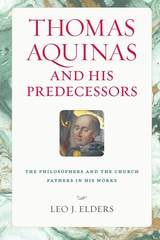
cover of Thomas Aquinas and His Predecessors: The Philosophers and the Church Fathers

Thomas Aquinas and His Predecessors

The Philosophers and the Church Fathers

Leo J. Elders

Catholic University of America Press, 2018
Thomas Aquinas and His Predecessors takes us on a voyage through the history of philosophical thought as present in the works of Thomas Aquinas. It is a synthetic presentation of the works and thought of the great predecessors of Aquinas, as he kne
[more]
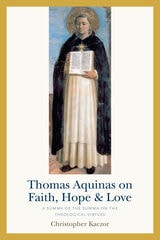
cover of Thomas Aquinas on Faith, Hope, and Love: A Summa of the Summa on the Theological Virtues

Thomas Aquinas on Faith, Hope, and Love

A Summa of the Summa on the Theological Virtues

Christopher Kaczor

Catholic University of America Press, 2020
Thomas Aquinas on Faith, Hope, and Love is designed to make as easy as possible a first reading of key passages from the Summa theologiae. This book contains selections from the Summa that are most influential, most important, or likely to be most interesting to the contemporary reader. The text of the Summa itself is edited and arranged for beginners. Each article begins with Thomas’s answers to the question at hand and then goes to the first objection, followed by the reply to the first objection, the second objection and its reply, and so on. This arrangement provides a greater accessibility and ease in following the argument. Below the text, copious footnotes illuminate the text as a professor in the classroom might. Some notes provide historical background to figures that Thomas presupposes his reader will know such as Gratian, Dionysius, and Lombard. Other notes offer doctrinal summaries of other parts of the Summa that illuminate what Thomas says about faith, hope, or love. Thomas had an enormous influence on theologians, Church councils, and popes after his time, so some footnotes examine this influence. Thomas drew heavily on sources of wisdom before him, so other footnotes summarize the teachings of earlier authors, such as Aristotle and Augustine. This book also contains introductory essays on the Summa, on faith, on hope, and on love, which provide an overview to situate the reader and place treatment of the theological virtues in its larger context of the Summa. For those who have never read Thomas Aquinas on faith, hope, and love (and for those who teach them), this book provides ready access to the wisdom of the Angelic doctor.
[more]
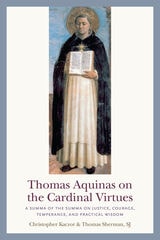
cover of Thomas Aquinas on the Cardinal Virtues: A Summa of the Summa on Prudence, Justice, Temperance, and Courage

Thomas Aquinas on the Cardinal Virtues

A Summa of the Summa on Prudence, Justice, Temperance, and Courage

Christopher Kaczor

Catholic University of America Press, 2020
Thomas Aquinas on the Cardinal Virtues provides essential passages from Thomas's treatment of the cardinal virtues in the Summa theologiae, edited and explained for classroom use or the independent reader. Arranged for beginners, this book contains passages from the Summa theologiae of great historical import, contemporary relevance, or intrinsic interest combined with abundant footnotes aiding the modern reader. Each individual article is arranged so that the question, e.g. “Is capital punishment moral?” is followed directed by Thomas’s answer. Then the first objection is raised, followed immediately by Thomas’s response, the second objection is raised and then Thomas answers it, and so forth. The abundant footnotes help first time readers navigate key theological and philosophical terms which may be unfamiliar. In addition, the notes provide biographical information about key authors cited by Thomas, such as Tully, Vegetius, and Gregory the Great. The footnotes sometimes look back at the sources and philosophical roots of what Thomas teaches. Other notes note how authors after Aquinas including theologians, church councils, and popes developed, synthesized, and sometimes rejected what Thomas teaches. In sum, this book seeks to illuminate Thomas’s teaching on the cardinal virtues such as a teacher might do in the classroom.
[more]
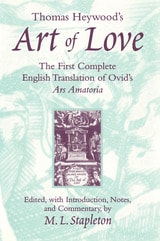
cover of Thomas Heywood's Art of Love: The First Complete English Translation of Ovid's Ars Amatoria

Thomas Heywood's Art of Love

The First Complete English Translation of Ovid's Ars Amatoria

Edited, with Introduction, Notes, and Commentary by M. L. Stapleton

University of Michigan Press, 2000

Thomas Heywood (ca 1573-1641) was a major Renaissance playwright who wrote or collaborated on over two hundred plays. Loues Schoole was one of his many nondramatic works that shows his fascination with antiquity. It was the standard English translation of the Ars in the seventeenth century, so popular that it was pirated almost as soon as he had written it--then printed, sold, reprinted, and resold in England and the Netherlands. It was not attributed to him during his lifetime, and he was not allowed to share in the profits that its (considerable) sales generated, two things that rankled him for the rest of his life. This is understandable because it is an excellent translation into English heroic verse, accurate without stuffiness, colloquial without indecorousness. Twenty years after Heywood's death, Loues Schoole was pirated yet again and went to six different editions during the Restoration (1662-84).
The present edition represents the first instance in which the translation has been edited in a scholarly manner. Besides a full Introduction that accounts for the history of Loues Schoole, Ovid in the English Renaissance, and the editorial method, each of the three books of the poem includes a Commentary that provides cross-references within the text; glosses for unusual, archaic, or regional forms peculiar to Heywood's English; annotations from sourcebooks that Heywood used to identify or understand characters from classical history, literature, and mythology; and explanations for any emendations the editor deemed necessary. In his efforts to make the Ars a seventeenth-century poem, Heywood contemporizes Ovid's references to dress, behavior, courtship, marriage, games, theater, agriculture, horsemanship, war, literature --all of which the Commentary explains at great length.
Loues Schoole will find readership in these areas: early modern history, literature, and culture; classical studies; Renaissance drama; the history of sexuality; and translation theory.
M. L. Stapleton is Associate Professor of English and Philosophy, Stephen F. Austin State University.
[more]
cover of Time, Creation and the Continuum: Theories in Antiquity and the Early Middle Ages

Time, Creation and the Continuum

Theories in Antiquity and the Early Middle Ages

Richard Sorabji

University of Chicago Press, 2006

Richard Sorabji here takes time as his central theme, exploring fundamental questions about its nature: Is it real or an aspect of consciousness? Did it begin along with the universe? Can anything escape from it? Does it come in atomic chunks? In addressing these and myriad other issues, Sorabji engages in an illuminating discussion of early thought about time, ranging from Plato and Aristotle to Islamic, Christian, and Jewish medieval thinkers. Sorabji argues that the thought of these often negelected philosophers about the subject is, in many cases, more complete than that of their more recent counterparts.

“Splendid. . . . The canvas is vast, the picture animated, the painter nonpareil. . . . Sorabji’s work will encourage more adventurers to follow him to this fascinating new-found land.”—Jonathan Barnes, Times Literary Supplement

“One of the most important works in the history of metaphysics to appear in English for a considerable time. No one concerned with the problems with which it deals either as a historian of ideas or as a philosopher can afford to neglect it.”—Donald MacKinnon, Scottish Journal of Theology
 
“Unusually readable for such scholarly content, the book provides in rich and cogent terms a lively and well-balanced discussion of matters of concern to a wide academic audience.”—Choice
[more]
cover of Times of Upheaval: Four Medievalists in Twentieth-Century Central Europe. Conversations with Jerzy Kloczowski, János M. Bak, František Šmahel, and Herwig Wolfram

Times of Upheaval

Four Medievalists in Twentieth-Century Central Europe. Conversations with Jerzy Kloczowski, János M. Bak, František Šmahel, and Herwig Wolfram

Pavlína Rychterová

Central European University Press, 2019
The volume unites conversations with four masters of Medieval Studies from east-central Europe: János Bak from Hungary, Jerzy Kloczowski from Poland, František Šmahel from the Czech Republic, and Herwig Wolfram from Austria. The interviews, made by younger colleagues, reveal engaging life stories, with numerous observations, anecdotes and experiences. The four scholars grew up before and during the war, under Nazi occupation, emerged as young scholars in the difficult post-war period, and, for most of their careers worked in the shadow of the Iron Curtain, two of them spending most of their lifetimes under communist regimes. The conversations focus on ways in which open-minded young intellectuals became medieval historians under difficult circumstances, how they experienced the long shadows of totalitarian regimes with their acute sensitivity for historical change, and how their perceptions of the world around them reflected back on their approach to medieval history. The histories of their nations were broken, most of them ceased to exist and then were re-established during their lifetimes, came under foreign domination, were split up, or had their territories shifted. These changes affected these scholars' identities and patriotic feelings, and their present was reflected in the distant mirror of the medieval past.
[more]
cover of Tolkien Studies, Volume X

Tolkien Studies, Volume X

Michael Drout

West Virginia University Press, 2013

Tolkien Studies: An Annual Scholarly Review presents the growing body of critical commentary and scholarship on both J. R. R. Tolkien’s voluminous fiction and his academic work in literary and linguistic fields.
[more]
cover of Tolkien Studies: An Annual Scholarly Review,  Volume III

Tolkien Studies

An Annual Scholarly Review, Volume III

Michael D.C. Drout

West Virginia University Press, 2006
Tolkien Studies: An Annual Scholarly Review presents the growing body of critical commentary and scholarship on both J. R. R. Tolkien's voluminous fiction and his academic work in literary and linguistic fields.
[more]
cover of Tolkien Studies: An Annual Scholarly Review, Volume II

Tolkien Studies

An Annual Scholarly Review, Volume II

Michael D.C. Drout

West Virginia University Press, 2005
Tolkien Studies: An Annual Scholarly Review presents the growing body of critical commentary and scholarship on both J. R. R. Tolkien's voluminous fiction and his academic work in literary and linguistic fields.
[more]
cover of Tolkien Studies: An Annual Scholarly Review, Volume IV

Tolkien Studies

An Annual Scholarly Review, Volume IV

Michael D.C. Drout

West Virginia University Press, 2007
Tolkien Studies: An Annual Scholarly Review presents the growing body of critical commentary and scholarship on both J. R. R. Tolkien's voluminous fiction and his academic work in literary and linguistic fields.
[more]
cover of Tolkien Studies: An Annual Scholarly Review, Volume IX

Tolkien Studies

An Annual Scholarly Review, Volume IX

Drout

West Virginia University Press, 2012
Tolkien Studies: An Annual Scholarly Review presents the growing body of critical commentary and scholarship on both J. R. R. Tolkien's voluminous fiction and his academic work in literary and linguistic fields.
[more]
cover of Tolkien Studies: An Annual Scholarly Review, Volume V

Tolkien Studies

An Annual Scholarly Review, Volume V

Michael D.C. Drout

West Virginia University Press, 2008
Tolkien Studies: An Annual Scholarly Review presents the growing body of critical commentary and scholarship on both J. R. R. Tolkien's voluminous fiction and his academic work in literary and linguistic fields.
[more]
cover of Tolkien Studies: An Annual Scholarly Review, Volume VI

Tolkien Studies

An Annual Scholarly Review, Volume VI

Michael D.C. Drout

West Virginia University Press, 2009
Tolkien Studies: An Annual Scholarly Review presents the growing body of critical commentary and scholarship on both J. R. R. Tolkien's voluminous fiction and his academic work in literary and linguistic fields
[more]
cover of Tolkien Studies: An Annual Scholarly Review, Volume VII

Tolkien Studies

An Annual Scholarly Review, Volume VII

Michael D.C. Drout

West Virginia University Press, 2010
Tolkien Studies: An Annual Scholarly Review presents the growing body of critical commentary and scholarship on both J. R. R. Tolkien's voluminous fiction and his academic work in literary and linguistic fields.
[more]
cover of Tolkien Studies: An Annual Scholarly Review, Volume VIII

Tolkien Studies

An Annual Scholarly Review, Volume VIII

Michael D.C. Drout

West Virginia University Press, 2011
Tolkien Studies: An Annual Scholarly Review presents the growing body of critical commentary and scholarship on both J. R. R. Tolkien's voluminous fiction and his academic work in literary and linguistic fields.
[more]
cover of Tolkien Studies: Volume XI

Tolkien Studies

Volume XI

Michael Drout

West Virginia University Press, 2014

Tolkien Studies: An Annual Scholarly Review presents the growing body of critical commentary and scholarship on both J. R. R. Tolkien’s voluminous fiction and his academic work in literary and linguistic fields.

[more]
cover of Tough Love: Amazon Encounters in the English Renaissance

Tough Love

Amazon Encounters in the English Renaissance

Kathryn Schwarz

Duke University Press, 2000

In Tough Love Kathryn Schwarz takes up a range of literary, historical, and theoretical texts in order to examine the relationship between Amazon myth and the social conventions that governed gender and sexuality during the early modern period. Imagined as embodiments of female masculinity, amazonian figures stimulated both homoerotic and heteroerotic response, and Schwarz shows that their appearance in narratives disrupted assumptions concerning identity, gender, domesticity, and desire.
Despite seeming to function as signs for what is outside the social—the alien, the exotic, the other—Amazons in sixteenth- and seventeenth-century texts were often represented in conventionally domestic roles, as mothers and lovers, wives and queens, Schwarz demonstrates. She traces this pattern in works by Shakespeare, Spenser, Sidney, Raleigh, and Jonson, as well as in such materials as conduct manuals, explorers’ accounts, court spectacles, and political tracts. Through readings of these texts, Schwarz shows that the Amazon myth provided a language both for setting forth and for challenging the terms of social logic. In representations of Amazon encounters, she argues, homosocial bonds became indistinguishable from heterosexual desires, masculine agency attached itself as logically to women as it did to men, and sexual difference was made nearly impossible to sustain or define. Schwarz’s analysis unveils the Amazon as a theoretical term, one that illuminates the tensions and paradoxes through which ideologies of the domestic take shape.
Tough Love contributes to the ongoing discussion of gendered identity and sexual desire in the early modern period. It will interest students of queer theory, cultural studies, early modern history, feminism, and literature.
[more]
cover of Trade and Romance

Trade and Romance

Michael Murrin

University of Chicago Press, 2013
In Trade and Romance, Michael Murrin examines the complex relations between the expansion of trade in Asia and the production of heroic romance in Europe from the second half of the thirteenth century through the late seventeenth century. He shows how these tales of romance, ostensibly meant for the aristocracy, were important to the growing mercantile class as a way to gauge their own experiences in traveling to and trading in these exotic locales. Murrin also looks at the role that growing knowledge of geography played in the writing of the creative literature of the period, tracking how accurate, or inaccurate, these writers were in depicting far-flung destinations, from Iran and the Caspian Sea all the way to the Pacific.
           
With reference to an impressive range of major works in several languages—including the works of Marco Polo, Geoffrey Chaucer, Matteo Maria Boiardo, Luís de Camões, Fernão Mendes Pinto, Edmund Spenser, John Milton, and more—Murrin tracks numerous accounts by traders and merchants through the literature, first on the Silk Road, beginning in the mid-thirteenth century; then on the water route to India, Japan, and China via the Cape of Good Hope; and, finally, the overland route through Siberia to Beijing. All of these routes, originally used to exchange commodities, quickly became paths to knowledge as well, enabling information to pass, if sometimes vaguely and intermittently, between Europe and the Far East. These new tales of distant shores fired the imagination of Europe and made their way, with surprising accuracy, as Murrin shows, into the poetry of the period.

[more]
cover of Trading Tongues: Merchants, Multilingualism, and Medieval Literature

Trading Tongues

Merchants, Multilingualism, and Medieval Literature

Jonathan Hsy

The Ohio State University Press, 2013
Trading Tongues offers fresh approaches to the multilingualism of major early English authors like Geoffrey Chaucer, John Gower, Margery Kempe, and William Caxton, and lesser-known figures like French lyricist Charles d’Orléans. Juxtaposing literary works with contemporaneous Latin and French civic records, mixed-language merchant miscellanies, and bilingual phrasebooks, Jonathan Hsy illustrates how languages commingled in late medieval and early modern cities. Chaucer, a customs official for the Port of London, infused English poetry with French and Latin merchant jargon, and London merchants incorporated Latin and vernacular verse forms into trilingual account books.
 
Hsy examines how writers working in English, Latin, and French (and combinations thereof) theorized the rich contours of polyglot identity. In a range of genres—from multilingual lyrics, poems about urban life, and autobiographical narratives—writers found venues to consider their own linguistic capacities and to develop new modes of conceiving language contact and exchange. Interweaving close readings of medieval texts with insights from sociolinguistics and postcolonial theory, Trading Tongues not only illuminates how multilingual identities were expressed in the past; it generates new ways of thinking about cultural contact and language crossings in our own time.
[more]
cover of Tradition And Belief: Religious Writing in Late Anglo-Saxon England

Tradition And Belief

Religious Writing in Late Anglo-Saxon England

Clara A. Lees

University of Minnesota Press, 1999

Looks at early religious texts and their influence on medieval literature and culture.

Looks at early religious texts and their influence on medieval literature and culture.

In this major study of Anglo-Saxon religious texts-sermons, homilies, and saints’ lives written in Old English-Clare A. Lees reveals how the invention of preaching transformed the early medieval church, and thus the culture of medieval England. By placing Anglo-Saxon prose within a social matrix, her work offers a new way of seeing medieval literature through the lens of culture.To show how the preaching mission of the later Anglo-Saxon church was constructed and received, Lees explores the emergence of preaching from the traditional structures of the early medieval church-its institutional knowledge, genres, and beliefs. Understood as a powerful rhetorical, social, and epistemological process, preaching is shown to have helped define the sociocultural concerns specific to late Anglo-Saxon England.The first detailed study of traditionality in medieval culture, Tradition and Belief is also a case study of one cultural phenomenon from the past. As such-and by concentrating on the theoretically problematic areas of history, religious belief, and aesthetics-the book contributes to debates about the evolving meaning of culture.ISBN 0-8166-3002-X Cloth £34.50 $49.95xxISBN 0-8166-3003-8 Paper £14.00 $19.95x232 Pages 5 7/8 x 9 NovemberMedieval Cultures Series, volume 19Translation inquiries: University of Minnesota Press
[more]
cover of Translation Effects: Language, Time, and Community in Medieval England

Translation Effects

Language, Time, and Community in Medieval England

Mary Kate Hurley

The Ohio State University Press, 2021
In Translation Effects: Language, Time, and Community in Medieval England, Mary Kate Hurley reinterprets a well-recognized and central feature of medieval textual production: translation. Medieval texts often leave conspicuous evidence of the translation process. These translation effects are observable traces that show how medieval writers reimagined the nature of the political, cultural, and linguistic communities within which their texts were consumed. Examining translation effects closely, Hurley argues, provides a means of better understanding not only how medieval translations imagine community but also how they help create communities. Through fresh readings of texts such as the Old English Orosius, Ælfric’s Lives of the Saints, Ælfric’s Homilies, Chaucer, Trevet, Gower, and Beowulf, Translation Effects adds a new dimension to medieval literary history, connecting translation to community in a careful and rigorous way and tracing the lingering outcomes of translation effects through the whole of the medieval period.
[more]
cover of Trial by Farce: A Dozen Medieval French Comedies in English for the Modern Stage

Trial by Farce

A Dozen Medieval French Comedies in English for the Modern Stage

Edited and Translated by Jody Enders

University of Michigan Press, 2023

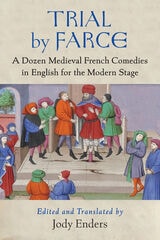
Was there more to comedy than Chaucer, the Second Shepherds’ Play, or Shakespeare? Of course! But, for a real taste of medieval and Renaissance humor and in-your-face slapstick, one must cross the Channel to France, where over two hundred extant farces regularly dazzled crowds with blistering satires. Dwarfing all other contemporaneous theatrical repertoires, the boisterous French corpus is populated by lawyers, lawyers everywhere. No surprise there. The lion’s share of mostly anonymous farces was written by barristers, law students, and legal apprentices. Famous for skewering unjust judges and irreligious ecclesiastics, they belonged to a 10,000-member legal society known as the Basoche, which flourished between 1450 and 1550. What is more, their dramatic send-ups of real and fictional court cases were still going strong on the eve of Molière, resilient against those who sought to censor and repress them. The suspenseful wait to see justice done has always made for high drama or, in this case, low drama. But, for centuries, the scripts for these outrageous shows were available only in French editions gathered from scattered print and manuscript sources.

In Trial by Farce, prize-winning theater historian Jody Enders brings twelve of the funniest legal farces to English-speaking audiences in a refreshingly uncensored but philologically faithful vernacular. Newly conceived as much for scholars as for students and theater practitioners, this repertoire and its familiar stock characters come vividly to life as they struggle to negotiate the limits of power, politics, class, gender, and, above all, justice. Through the distinctive blend of wit, social critique, and breathless boisterousness that is farce, we gain a new understanding of comedy itself as form of political correction. In ways presciently modern and even postmodern, farce paints a different cultural picture of the notoriously authoritarian Middle Ages with its own vision of liberty and justice for all. Theater eternally offers ways for new generations to raise their voices and act.
[more]
cover of Truth and Tales: Cultural Mobility and Medieval Media

Truth and Tales

Cultural Mobility and Medieval Media

Edited by Fiona Somerset and Nicholas Watson

The Ohio State University Press, 2015

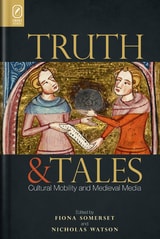
In the medieval period, as in the media culture of the present, learned and popular forms of talk were intermingled everywhere. They were also highly mobile, circulating in speech, writing, and symbol, as performances as well as in material objects. The communication through and between different media we all negotiate in daily life did not develop from a previous separation of orality and writing, but from a communications network not unlike our own, if slower, and similarly shaped by disparities of access. Truth and Tales: Cultural Mobility and Medieval Media, edited by Fiona Somerset and Nicholas Watson, develops a variety of approaches to the labor of imaginatively reconstructing this network from its extant artifacts.
 
Truth and Tales includes fourteen essays by medieval literary scholars and historians. Some essays focus on written artifacts that convey high or popular learning in unexpected ways. Others address a social problem of concern to all, demonstrating the genres and media through which it was negotiated. Still others are centered on one or more texts, detailing their investments in popular as well as learned knowledge, in performance as well as writing. This collective archaeology of medieval media provides fresh insight for medieval scholars and media theorists alike.
[more]
cover of Turning Away: The Poetics of an Ancient Gesture

Turning Away

The Poetics of an Ancient Gesture

Benjamin A. Saltzman

University of Chicago Press, 2026

A sweeping account of how we are at our most human when we turn away from the pains of the world.

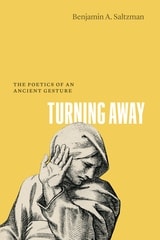
Why do we look away from the suffering of others? Why do we cover our faces in shame? Why do we lower our heads in grief? Few gestures are as universal as the averted gaze. Fewer still are as ambivalent and inscrutable. In this incisive study, Benjamin A. Saltzman reveals how the kaleidoscopic appearance of these gestures in art, poetry, and philosophy has turned them into an essential language for our uncomfortable engagements with the world, challenging us to reflect on the ways we fundamentally relate to others.

Into the horizon of contemporary discourse, Turning Away sets out from five influential scenes in which figures avert their gaze: Timanthes’s Sacrifice of Iphigenia, Plato’s Republic, Augustine’s Confessions, Christ’s Crucifixion, and the Fall and Expulsion of Adam and Eve. The gestures of aversion in these scenes refract across visual media, through philosophy and politics, into modernity and the present day, having been reimagined along the way by thinkers like Hannah Arendt, artists like Marc Chagall and Salvador Dalí, poets like Langston Hughes, and many others. Saltzman offers a timely critique of the privilege of turning away and of the too-easy condemnation of our tendencies to do so.
[more]
cover of Two Lives of Saint Colette: With a Selection of Letters by, to, and about Colette

Two Lives of Saint Colette

With a Selection of Letters by, to, and about Colette

Pierre de Vaux and Sister Perrine de Baume

Iter Press, 2022

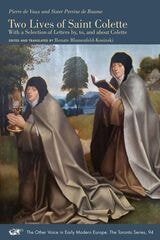
Two accounts of the life of Saint Colette of Corbie.

Saint Colette of Corbie (1381–1447) was a French reformer of the Franciscan Order and the founder of seventeen convents. Though of humble origin, she attracted the support of powerful patrons and important Church officials. The two biographies translated here were authored by Pierre de Vaux, her confessor and mentor, and Perrine de Baume, a nun who for decades was Colette’s companion and confidant. Both accounts offer fascinating portraits of the saint as a pious ascetic assailed by demons and performing miracles, as well as in her role as skillful administrator and caring mother of her nuns. This is the first English translation of two biographies in Middle French of the most important female figures of the Middle Ages. 
 
[more]
cover of Two Women of the Great Schism: The Revelations of Constance de Rabastens by Raymond de Sabanac and Life of the Blessed Ursulina of Parma by Simone Zanacchi

Two Women of the Great Schism

The Revelations of Constance de Rabastens by Raymond de Sabanac and Life of the Blessed Ursulina of Parma by Simone Zanacchi

Raymond de Sabanac and Simone Zanacchi

Iter Press, 2010
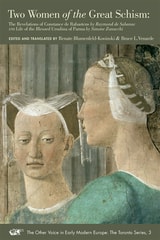
The Great Schism (1378–1417) divided Western Christendom into two groups: those who recognized a pope in Rome and those who recognized one in Avignon. It was a crisis of authority that brought with it spiritual anxiety and political uproar. This book presents the responses of two fascinating women whose experiences demonstrate the impact of the Schism on ordinary Christians. Constance de Rabastens (active 1384–1386), who lived in a village in rural Languedoc, had dramatic visions indicting the Avignon pope Clement VII, despite his being recognized in her region. Ursulina of Parma (1375–1408), a diminutive young woman from an urban milieu in Italy, believed that she was commanded by Christ to engage in shuttle diplomacy between the Roman and Avignon papacies in order to end the Schism. Two Women of the Great Schism translates an account of Constance’s visionary experiences as recorded by her confessor Raymond de Sabanac and a posthumous biography of Ursulina by Simone Zanacchi, a pious abbot who wrote some sixty years after his subject’s death. These texts bring to life the extraordinary spiritual and political engagement of two late medieval women who refused to be passive bystanders as rival papal factions tore Christendom apart.
[more]
cover of Typographic Firsts

Typographic Firsts

John Boardley

Bodleian Library Publishing, 2018

How were the first fonts made? Who invented italics? When did we figure out how to print in color?

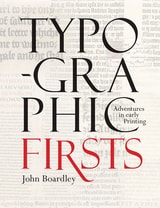
Many of the standard features of printed books were designed by pioneering typographers and printers in the latter half of the fifteenth century. Johannes Gutenberg is credited with printing the first books in Europe with moveable type in the fifteenth century, but many different European printers and publishers went on to find innovative solutions to replicate the appearance of manuscript books in print and improve on them throughout the Renaissance. The illustrated examples in Typographic Firsts originate in those early decades, bringing into focus the influences and innovations that shaped the printed book and established a Western typographic canon.

From the practical challenges of polychromatic printing and sheet music printing to the techniques for illustrating books with woodcuts and producing books for children to the design of the first fonts, these stories chart the invention of the printed book, the world’s first means of mass communication. Also covering title pages, maps, printing in gold, and printing in color, this book shows how a mixture of happenstance and brilliant technological innovation came together to form the typographic and design conventions of the book.
[more]