Results by title
4917 books match the query 'Philosophy' and 1267 start with t
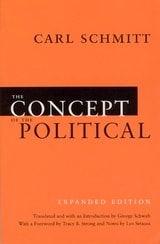
The Concept of the Political
Expanded EditionCarl Schmitt
University of Chicago Press, 2007
In this, his most influential work, legal theorist and political philosopher Carl Schmitt argues that liberalism’s basis in individual rights cannot provide a reasonable justification for sacrificing oneself for the state—a critique as cogent today as when it first appeared. George Schwab’s introduction to his translation of the 1932 German edition highlights Schmitt’s intellectual journey through the turbulent period of German history leading to the Hitlerian one-party state. In addition to analysis by Leo Strauss and a foreword by Tracy B. Strong placing Schmitt’s work into contemporary context, this expanded edition also includes a translation of Schmitt’s 1929 lecture “The Age of Neutralizations and Depoliticizations,” which the author himself added to the 1932 edition of the book. An essential update on a modern classic, The Concept of the Political, Expanded Edition belongs on the bookshelf of anyone interested in political theory or philosophy.
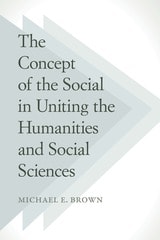
The Concept of the Social in Uniting the Humanities and Social Sciences
Michael E. Brown
Temple University Press, 2015
In this book, Michael Brown provides original and critical analysis of the state of the social sciences and the humanities. He examines the different disciplines that address human affairs--from sociology, philosophy, political science, and anthropology to the humanities in general--to understand their common ground. He probes the ways in which we investigate the meaning of individuality in a society for which individuals are not the agents of the activities in which they participate, and he develops a critical method for studying the relations among activities, objects, and situations.
The Concept of the Social in Uniting the Humanities and Social Sciences restores the centrality of sociality to all disciplines that provide for and depend on the social dimension of human life. Ultimately, he establishes a theory of the unity of the human sciences that will surely make readers rethink the current state and future of theory in those fields for years to come.
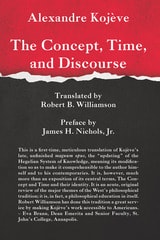
The Concept, Time, and Discourse
Alexandre Kojève
St. Augustine's Press, 2019
Alexandre Kojève (1902–1968) is most widely known in America for his provocative assertion that history is at its end, that is, its completion. In the “practical” sense, this means that the process of historical development can at last be seen (if from a distance) as the realization of the Marxist “universal and homogeneous state.” However, Kojève claimed as well that the history of philosophical thinking had also reached its goal in the transformation of philosophy, as the “love of wisdom” (or the unsatisfied quest for comprehensive knowledge), into that very Wisdom itself and had done so in the most essential respects in the philosophy of Hegel.
The Concept, Time, and Discourse is the first volume of Kojève’s magnum opus, which was to have given an exposition of the (Hegelian) System of Knowledge and of which five volumes were written before his death. It contains, along with a preliminary discussion of the need for an updating of the Hegelian system, the first two of three introductions to the exposition of that system: a First Introduction of the Concept (the integrated totality of what is comprehensible, which is the final object of philosophic inquiry) and a Second Introduction concerning Time, both introductions leading to the (Hegelian) identification of the Concept with Time, an identification which alone takes adequate account of the fact that Philosophy is necessarily discursive (that it must actualize the requirements and essential structure of Discourse).
The present volume offers Kojève’s fullest statement of his Ontology. It includes a critical discussion of the traditional oppositions of the “general” to the “particular” and of the “abstract” to the “concrete” and an analysis of the act of “generalizing abstraction,” which detaches Essence from the Existence of Things. Kojève then discusses the three great figures in the three-stage development of philosophy into wisdom: Parmenides, Plato, and Hegel. Parmenides’ monadic account of Being (= Eternity) rendered it ineffable, thereby reducing philosophy to (non-philosophic) silence; Plato’s dyadic account of Being (as eternal) was intended to make Being a possible subject of discourse but failed to reflect adequately the triadic (and temporally developing) structure which Plato himself discerned in Discourse. Finally, Hegel’s triadic account of Being as itself “dialectical” achieved the final identification of the Concept with Time.
This is a first-time, meticulous translation of Kojève’s late, unfinished magnum opus, the “updating” of the Hegelian System of Knowledge, meaning its modification so as to make it comprehensible to the author himself and to his contemporaries. It is, however, much more than an exposition of its central terms, The Concept and Time and their identity. It is an acute, original review of the major themes of the West’s philosophical tradition; it is, in fact, a philosophical education in itself. Robert Williamson has done this tradition a great service by making Kojève’s work accessible to Americans. – Eva Brann, Dean Emerita and Senior Faculty, St. John’s College, Annapolis, Maryland
We now recognize Alexandre Kojève as one of the central figures of 20th century European philosophy. A translation of his The Concept, Time, and Discourse will enable English speaking readers to have a fuller understanding of his remarkably ambitious intellectual project. – Michael S. Roth, President, Wesleyan University, Middletown, Connecticut.
Robert B. Williamson is Tutor Emeritus at St. John’s College in Annapolis, Maryland, where he continues to teach. He is co-author, with Alfred Mollin, of An Introduction to Ancient Greek (University Press of America) and the author of articles on Plato’s philosophy and Einstein’s early work on relativity theory.
James H. Nichols, Jr. is Professor of Government and Dr. Jules L. Whitehill Professor of Humanism and Ethics at Claremont McKenna College, where he teaches political philosophy. Among his publications are Epicurean Political Philosophy: The De rerum natura of Lucretius, translations with interpretations of Plato’s Gorgias and Phaedrus, and most recently Alexandre Kojève: Wisdom at the End of History.
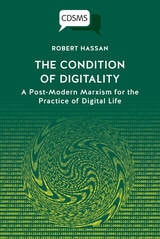
The Condition of Digitality
A Post-Modern Marxism for the Practice of Digital LifeRobert Hassan
University of Westminster Press, 2020
David Harvey’s The Condition of Postmodernity rationalised capitalism’s transformation during an extraordinary year: 1989. It gave theoretical expression to a material and cultural reality that was just then getting properly started – globalisation and postmodernity – whilst highlighting the geo-spatial limits to accumulation imposed by our planet.
However this landmark publication, author Robert Hassan argues, did not address the arrival of digital technology, the quantum leap represented by the move from an analogue world to a digital economy and the rapid creation of a global networked society. Considering first the contexts of 1989 and Harvey’s work, then the idea of humans as analogue beings he argues this arising new human condition of digitality leads to alienation not only from technology but also the environment. This condition he suggests, is not an ideology of time and space but a reality stressing that Harvey’s time-space compression takes on new features including those of ‘outward’ and ‘inward’ globalisation and the commodification of all spheres of existence.
Lastly the author considers culture’s role drawing on Rahel Jaeggi’s theories to make the case for a post-modern Marxism attuned to the most significant issue of our age. Stimulating and theoretically wide-ranging The Condition of Digitality recognises post-modernity’s radical new form as a reality and the urgent need to assert more democratic control over digitality.
The Confessions and Correspondence, Including the Letters to Malesherbes
Jean-Jacques Rousseau
Dartmouth College Press, 1998
The Confessions of Odysseus
Nalin Ranasinghe
St. Augustine's Press, 2021
Predrag Cicovacki in his indispensable preface to the book, elucidates: “In Ranasinghe’s view, Odysseus is both the first recognizable human being and a model of curious and concupiscent human rationality that constantly strives toward the virtues of self-knowledge and moderation. Homer leads us to believe that the cosmos leans toward virtue, although its fundamental truths may be inherently unspeakable. This is the line of thought that Ranasinghe believes was further developed by Socrates, Plato, and Jesus, while being obscured by Aristotle, Augustine, and their followers. Homer’s later epic and his central insights are, according to Ranasinghe, the most fertile soil on which a humane civilization can grow and flourish.”
Yet Ranasinghe ultimately says it best. “Homer must be read as the wisest Greeks did, not for fantastic tales of the Olympians but because his myths reveal eternal constants of the human state: the soul’s ruling passions and the possibility of knowing and educating these false gods. Wrestled with thus the Iliad becomes a cautionary tale, not one urging literal reading or mindless mimesis. It may always be that for the few who grasp Homer, many more will obey his gods or imitate his antiheroes; but the Odyssey hints that while its poet sees this potential for misuse, he is willing to take a noble risk and hope that eros can listen to and educate thumos. This faith is implicit in his tale of Achilles and the Trojan War. It is vital today that we see how the West’s end resembles its angry origins, as depicted in the Iliad. This is why Homer is said to be as fresh as the morning newspaper. His wisdom may outlive our literacy.”
The Conflict of Interpretations
Paul Ricoeur
Northwestern University Press, 1974
The Conflict of Interpretations
Essays in HermeneuticsPaul Ricoeur
Northwestern University Press, 2007

The Constitution of a Historical Transcendental in Hegel's "Phenomenology of Spirit"
Graduate Thesis in Philosophy, 1949Michel Foucault
University of Chicago Press, 0
The first English translation of Foucault’s previously lost master’s thesis, itself an original contribution to the study of Hegel’s philosophy.
On June 11, 1949, a twenty-three-year-old Michel Foucault defended his master’s thesis in philosophy at the Sorbonne entitled The Constitution of a Historical Transcendental in Hegel’s “Phenomenology of Spirit.” Long considered a lost holy grail of French philosophy, the thesis was only recently rediscovered, and it is presented here in English for the first time.
In his master’s thesis, Foucault offers an original reading of Hegel that understands “absolute knowing,” the famous but enigmatic final figure of experience in the Phenomenology, as inextricably bound to time, language, and historical experience. Indeed, readers will discover how many of Foucault’s famous later concepts—the historical a priori, the episteme, and the limit-experience—are intimately rooted in his early, intense engagement with Hegel’s philosophy.
An introduction and critical apparatus provided by Hegel scholar Christophe Bouton traces previously unknown connections between the thesis and Foucault’s later masterpieces, particularly History of Madness and The Order of Things. Introducing a fundamental shift in our understanding of Foucault’s intellectual trajectory, this book is an essential text for anyone interested in Foucault, Hegel, and the dramatic evolution of twentieth-century continental philosophy.
The Constitutional Logic of Affirmative Action
Ronald J. Fiscus
Duke University Press, 1992
Beginning with a distinction drawn between principles of compensatory and distributive justice, Fiscus argues that the former, although often the basis for judgments made in individual discrimination cases, cannot sufficiently justify broad programs of affirmative action. Only a theory of distributive justice, one that assumes minorities have a right to what they would have gained proportionally in a nonracist society, can persuasively provide that justification. On this basis, the author argues in favor of proportional racial quotas—and challenges the charge of “reverse discrimination” raised in protest in the name of the “innocent victims” of affirmative action—as an action necessary to approach the goals of fairness and equality.
The Constitutional Logic of Affirmative Action focuses on Supreme Court affirmative action rulings from Bakke (1976) to Croson (1989) and includes an epilogue by editor Stephen L. Wasby that considers developments through 1995. General readers concerned with racial justice, affirmative action, and public policy, as well as legal specialists and constitutional scholars will find Fiscus’s argument passionate, balanced, and persuasive.

The Context of Self
A Phenomenological Inquiry Using Medicine as a ClueRichard M. Zaner
Ohio University Press, 1981
This study takes up the challenge presented to philosophy in a dramatic and urgent way by contemporary medicine: the phenomenon of human life. Initiated by a critical appreciation of the work of Hans Jonas, who poses that issue as well, the inquiry is brought to focus on the phenomenon of embodiment, using relevant medical writing to help elicit its concrete dimensions.
The explication of embodiment, aided by critical studies and inquiries into medical phenomena (autism, brain injury, terminal illness) make possible the development of the author’s original phenomenological theory of self, and its concrete relationships with the other self. This study attempts not only to show connections among the works of a number of thinkers in terms of central problems, but to demonstrate the mutual relevance of medicine and philosophy through concrete illustrations and analysis.
The Continuity of Peirce's Thought
Kelly A. Parker
Vanderbilt University Press, 1998
We are still in the early stages of understanding the thought of C. S. Peirce (1839-1914). Although much good work has been done in isolated areas, relatively little considers the Peircean system as a whole. Peirce made it his life's work to construct a scientifically sophisticated and logically rigorous philosophical system, culminating in a realist epistemology and a metaphysical theory ("synechism") that postulates the connectedness of all things in a universal evolutionary process.
In The Continuity of Peirce's Thought, Kelly Parker shows how the principle of continuity functions in phenomenology and semeiotics, the two most novel and important of Peirce's philosophical sciences, which mediate between mathematics and metaphysics. Parker argues that Peirce's concept of continuity is the central organizing theme of the entire Peircean philosophical corpus. He explains how Peirce's unique conception of the mathematical continuum shapes the broad sweep of his thought, extending from mathematics to metaphysics and in religion. He thus provides a convenient and useful overview of Peirce's philosophical system, situating it within the history of ideas and mapping interconnections among the diverse areas of Peirce's work.
This challenging yet helpful book adopts an innovative approach to achieve the ambitious goal of more fully understanding the interrelationship of all the elements in the entire corpus of Peirce's writings. Given Peirce's importance in fields ranging from philosophy to mathematics to literary and cultural studies, this new book should appeal to all who seek a fuller, unified understanding of the career and overarching contributions of Peirce, one of the key figures in the American philosophical tradition.

The Corn Wolf
Michael Taussig
University of Chicago Press, 2015
The leading figure of these projects is the corn wolf, whom Wittgenstein used in his fierce polemic on Frazer’s Golden Bough. For just as the corn wolf slips through the magic of language in fields of danger and disaster, so we are emboldened to take on the widespread culture of academic—or what he deems “agribusiness”—writing, which strips ethnography from its capacity to surprise and connect with other worlds, whether peasant farmers in Colombia, Palestinians in Israel, protestors in Zuccotti Park, or eccentric yet fundamental aspects of our condition such as animism, humming, or the acceleration of time.
A glance at the chapter titles—such as “The Stories Things Tell” or “Iconoclasm Dictionary”—along with his zany drawings, testifies to the resonant sensibility of these works, which lope like the corn wolf through the boundaries of writing and understanding.
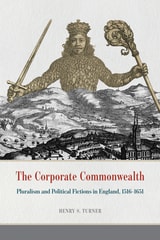
The Corporate Commonwealth
Pluralism and Political Fictions in England, 1516-1651Henry S. Turner
University of Chicago Press, 2016
Henry S. Turner uses the resources of economic and political history, literary analysis, and political philosophy to demonstrate how a number of English institutions with corporate associations—including universities, guilds, towns and cities, and religious groups—were gradually narrowed to the commercial, for-profit corporation we know today, and how the joint-stock corporation, in turn, became both a template for the modern state and a political force that the state could no longer contain. Through innovative readings of works by Thomas More, William Shakespeare, Francis Bacon, and Thomas Hobbes, among others, Turner tracks the corporation from the courts to the stage, from commonwealth to colony, and from the object of utopian fiction to the subject of tragic violence. A provocative look at the corporation’s peculiar character as both an institution and a person, The Corporate Commonwealth uses the past to suggest ways in which today’s corporations might be refashioned into a source of progressive and collective public action.
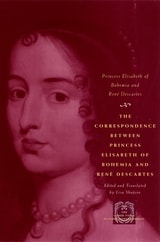
The Correspondence between Princess Elisabeth of Bohemia and René Descartes
Princess Elisabeth of Bohemia and René Descartes
University of Chicago Press, 2007
Between the years 1643 and 1649, Princess Elisabeth of Bohemia (1618–80) and René Descartes (1596–1650) exchanged fifty-eight letters—thirty-two from Descartes and twenty-six from Elisabeth. Their correspondence contains the only known extant philosophical writings by Elisabeth, revealing her mastery of metaphysics, analytic geometry, and moral philosophy, as well as her keen interest in natural philosophy. The letters are essential reading for anyone interested in Descartes’s philosophy, in particular his account of the human being as a union of mind and body, as well as his ethics. They also provide a unique insight into the character of their authors and the way ideas develop through intellectual collaboration.
Philosophers have long been familiar with Descartes’s side of the correspondence. Now Elisabeth’s letters—never before available in translation in their entirety—emerge this volume, adding much-needed context and depth both to Descartes’s ideas and the legacy of the princess. Lisa Shapiro’s annotated edition—which also includes Elisabeth’s correspondence with the Quakers William Penn and Robert Barclay—will be heralded by students of philosophy, feminist theorists, and historians of the early modern period.
The Correspondence of Edmund Burke, Volume X
IndexEdmund Burke
University of Chicago Press, 1978
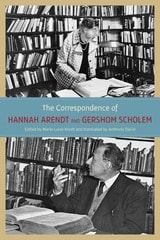
The Correspondence of Hannah Arendt and Gershom Scholem
Hannah Arendt and Gershom Scholem
University of Chicago Press, 2017
Arendt and Scholem met in 1932 in Berlin and quickly bonded over their mutual admiration for and friendship with Walter Benjamin. They began exchanging letters in 1939, and their lively correspondence continued until 1963, when Scholem’s vehement disagreement with Arendt’s Eichmann in Jerusalem led to a rupture that would last until Arendt’s death a dozen years later. The years of their friendship, however, yielded a remarkably rich bounty of letters: together, they try to come to terms with being both German and Jewish, the place and legacy of Germany before and after the Holocaust, the question of what it means to be Jewish in a post-Holocaust world, and more. Walter Benjamin is a constant presence, as his life and tragic death are emblematic of the very questions that preoccupied the pair. Like any collection of letters, however, the book also has its share of lighter moments: accounts of travels, gossipy dinner parties, and the quotidian details that make up life even in the shadow of war and loss.
In a world that continues to struggle with questions of nationalism, identity, and difference, Arendt and Scholem remain crucial thinkers. This volume offers us a way to see them, and the development of their thought, anew.
The Correspondence of Jeremy Bentham, Volume 14
Supplementary LettersEdited by Philip Schofield, Tim Causer, and Chris Riley
University College London, 2026
Over 250 letters and other materials by the philosopher and reformer Jeremy Bentham, published in full and in authoritative form for the first time.
This volume is a supplement to the chronological series The Correspondence of Jeremy Bentham. It contains over 250 letters offering new biographical information and deepens our knowledge of Bentham’s relationship with his family, with the panopticon penitentiary scheme, and with notable “disciples” such as Étienne Dumont, Henry Bickersteth, and Leicester Stanhope. Additionally, this volume deepens our understanding of Bentham’s relationship with his younger brother, Samuel Bentham, and provides a detailed account of Samuel's journey to and sojourn in the Russian Empire.
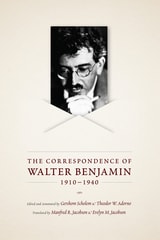
The Correspondence of Walter Benjamin, 1910-1940
Walter Benjamin
University of Chicago Press, 1994
A powerful, mesmerizing collection of letters from one of the most important intellectuals and writers of the twentieth century
The Cosmopolitan Self
George Herbert Mead and Continental PhilosophyMitchell Aboulafia
University of Illinois Press, 2001
In this incisive commentary, Mitchell Aboulafia examines the relevance of the American pragmatist philosopher George Herbert Mead to current debates on pluralism, universalism, and the fostering of a democratic temper. Addressing the relationship between Mead's notions of self and society and those of important continental thinkers, The Cosmopolitan Self demonstrates that Mead's ideas not only speak to resolving the tension between universalism and pluralism, they do so in a manner that challenges and advances the positions of these continental theoreticians.
Aboulafia examines how Mead's insights illuminate Hannah Arendt's reading of Immanual Kant's third Critique and Jürgen Habermas's understanding of the relationship among communicative action, universality, and individuation. Teasing out strands of agreement and disagreement among Mead and these theorists on topics such as impartiality and good judgment, Aboulafia develops a conception of universalism that is compatible with contemporary notions of pluralism. He also addresses the serious challenge presented to Mead's approach to pluralism by Emmanuel Levinas, who holds that true pluralism, presupposing an irreducible individualism, is fundamentally irreconcilable with universalism.
The Cosmopolitan Self offers a model of the democratically inclined individual who embodies both a capacity to establish common ground with others and a sensitivity to their uniqueness. This important volume appreciably advances the dialogue between continental thought and classical American philosophy.
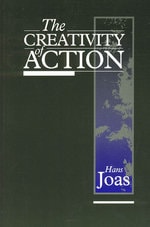
The Creativity of Action
Hans Joas
University of Chicago Press, 1996
Joas argues for adding a third model of action to the two predominant models of rational and normative action—one that emphasizes the creative character of human action. This model encompasses the other two, allowing for a more comprehensive theory of action. Joas elaborates some implications of his model for theories of social movements and social change and for the status of action theory in sociology in the face of competition from theories advanced by Luhmann and Habermas.
The problem of action is of crucial importance in both sociology and philosophy, and this book—already widely debated in Germany—will add fresh impetus to the lively discussions current in the English-speaking world.
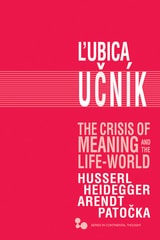
The Crisis of Meaning and the Life-World
Husserl, Heidegger, Arendt, PatockaLubica Ucník
Ohio University Press, 2016
In The Crisis of Meaning and the Life-World, Ľubica Učník examines the existential conflict that formed the focus of Edmund Husserl’s final work, which she argues is very much with us today: how to reconcile scientific rationality with the meaning of human existence. To investigate this conundrum, she places Husserl in dialogue with three of his most important successors: Martin Heidegger, Hannah Arendt, and Jan Patočka.
For Husserl, 1930s Europe was characterized by a growing irrationalism that threatened to undermine its legacy of rational inquiry. Technological advancement in the sciences, Husserl argued, had led science to forget its own foundations in the primary “life-world”: the world of lived experience. Renewing Husserl’s concerns in today’s context, Učník first provides an original and compelling reading of his oeuvre through the lens of the formalization of the sciences, then traces the unfolding of this problem through the work of Heidegger, Arendt, and Patočka.
Although many scholars have written on Arendt, none until now has connected her philosophical thought with that of Czech phenomenologist Jan Patočka. Učník provides invaluable access to the work of the latter, who remains understudied in the English language. She shows that together, these four thinkers offer new challenges to the way we approach key issues confronting us today, providing us with ways to reconsider truth, freedom, and human responsibility in the face of the postmodern critique of metanarratives and a growing philosophical interest in new forms of materialism.

The Critical Turn
Rhetoric and Philosophy in Postmodern DiscourseEdited by Ian Angus and Lenore Langsdorf
Southern Illinois University Press, 1992
Concerned with criticizing representational theories of knowledge by developing alternative concepts of knowing and communicating, Ian Angus and Lenore Langsdorf bring together eight essays that are united by a common theme: the convergence of philosophy and rhetoric.
In the first chapter, Angus and Langsdorf illustrate the centrality of critical reasoning to the nature of questioning itself, arguing that human inquiry has entered a "new situation" where "the convictions and orientations that have traditionally marked the separation of rhetoric and philosophy—the concern for truth and the focus on persuasion—have begun to converge on a new space that can be defined through the central term discourse."In these essays, this convergence of rhetoric and philosophy is addressed as it presents itself to a variety of interests that transcend the traditional boundaries of these fields.
The two editors, Raymie E. McKerrow, Michael J. Hyde and Craig R. Smith, James W. Hikins and Kenneth S. Zagacki, Calvin O. Schrag and David James Miller, and Richard L. Lanigan map this new space, recognizing that such mapping "simultaneously constitutes the territory mapped."
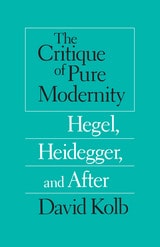
The Critique of Pure Modernity
Hegel, Heidegger, and AfterDavid Kolb
University of Chicago Press, 1986
Kolb offers his own views, proposing the possibility of a meaningful life that is free but still rooted in shared contexts. He concludes with comments on "postmodernity" as discussed by Lyotard and others, arguing persuasively against the presupposition of a unified Modern or Postmodern Age.
The Critique of Scientific Reason
Kurt Hübner
University of Chicago Press, 1983
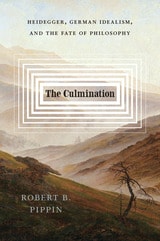
The Culmination
Heidegger, German Idealism, and the Fate of PhilosophyRobert B. Pippin
University of Chicago Press, 2024
Heidegger claimed that Western philosophy ended—failed, even—in the German Idealist tradition. In The Culmination, Robert B. Pippin explores the ramifications of this charge through a masterful survey of Western philosophy, especially Heidegger’s critiques of Hegel and Kant. Pippin argues that Heidegger’s basic concern was to determine sources of meaning for human life, particularly those that had been obscured by Western philosophy’s attention to reason. The Culmination offers a new interpretation of Heidegger, German Idealism, and the fate of Western rationalism.
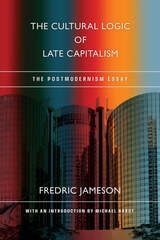
The Cultural Logic of Late Capitalism
The Postmodernism EssayFredric Jameson. Introduction by Michael Hardt.
Duke University Press, 2026
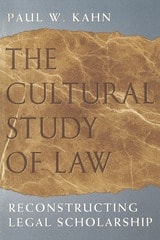
The Cultural Study of Law
Reconstructing Legal ScholarshipPaul W. Kahn
University of Chicago Press, 1999
"Professor Kahn's perspective is neat and alluring: We need a form of legal scholarship released from the project of reform so that we can better understand who and what we are. The new discipline should study 'not legal rules, but the imagination as it constructs a world of legal meaning.' . . . [C]oncise, good reading, and recommended." —New York Law Journal
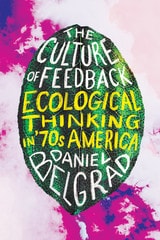
The Culture of Feedback
Ecological Thinking in Seventies AmericaDaniel Belgrad
University of Chicago Press, 2019
The Culture of Feedback digs deep into a dazzling variety of left-of-center experiences and attitudes from this misunderstood period, bringing us a new look at the wild side of the 1970s. Belgrad shows us how ideas from systems theory were taken up by the counterculture and the environmental movement, eventually influencing a wide range of beliefs and behaviors, particularly related to the question of what is and is not intelligence. He tells the story of a generation of Americans who were struck by a newfound interest in—and respect for—plants, animals, indigenous populations, and the very sounds around them, threading his tapestry with cogent insights on environmentalism, feminism, systems theory, and psychedelics. The Culture of Feedback repaints the familiar image of the ’70s as a time of Me Generation malaise to reveal an era of revolutionary and hopeful social currents, driven by desires to radically improve—and feed back into—the systems that had come before.
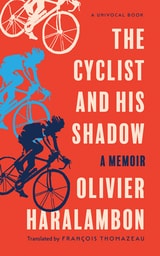
The Cyclist and His Shadow
A MemoirOlivier Haralambon
University of Minnesota Press, 2022
A philosopher and former racing cyclist examines how competitive riders lose their sense of self as they pursue perfect motion and mastery over pain
After ten years as a racing cyclist, riding in up to ninety races a year, Olivier Haralambon became a journalist and philosopher. In The Cyclist and His Shadow, he writes about the world of competitive cycling with rare honesty and self-reflection, exploring it not merely as a sport but as a spiritual and artistic practice, imbued with a mystical quality.
In prose at once poetic and precise, Haralambon depicts the intensity of cycling as physical activity in which the rider’s consciousness becomes inseparable from the instantaneous movements of limbs, the exertion of heart and lungs, and the marshaling and expenditure of energy. He describes riding as an ascetic activity always accompanied by pain that the cyclist can control but never fully eliminate. But cycling for Haralambon is not only suffering but also an addictively pleasurable activity in which the rider’s sense of self dissolves and melds with the bicycle, mind and body exploring the vibrant solitude of the course and limits of human endurance. Engaging in the repetition of ascension and the endless hours immersed in an oceanic interior, cyclists are artists in the vastness of landscape, both interior and exterior.
Published in association with The Cycling Podcast (https://thecyclingpodcast.com), The Cyclist and His Shadow offers an illuminating meditation on what drives cyclists to devote their lives and bodies to training, racing, and even doping. Drawing from personal experience, Haralambon presents cycling as simultaneously physical and creative, technological and mystical, torturous and ecstatic.
The Daily Henry David Thoreau
A Year of Quotes from the Man Who Lived in SeasonHenry David Thoreau
University of Chicago Press, 2020
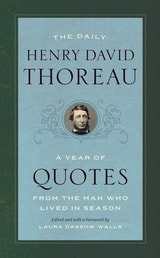
Modernity rules our lives by clock and calendar, dividing the stream of time into units and coordinating every passing moment with the universal globe. Henry David Thoreau subverted both clock and calendar, using them not to regulate time’s passing but to open up and explore its presence. This little volume thus embodies, in small compass, Thoreau’s own ambition to “live in season”—to turn with the living sundial of the world, and, by attuning ourselves to nature, to heal our modern sense of discontinuity with our surroundings.
Ralph Waldo Emerson noted with awe that from flowers alone, Thoreau could tell the calendar date within two days; children remembered long into adulthood how Thoreau showed them white waterlilies awakening not by the face of a clock but at the first touch of the sun. As Thoreau wrote in Walden, “Time is but the stream I go a-fishing in. I drink at it; but while I drink I see the sandy bottom and detect how shallow it is.”
Drawn from the full range of Thoreau’s journals and published writings, and arranged according to season, The Daily Henry David Thoreau allows us to discover the endless variation and surprise to be found in the repetitions of mundane cycles. Thoreau saw in the kernel of each day an earth enchanted, one he honed into sentences tuned with an artist’s eye and a musician’s ear. Thoreau’s world lives on in his writing so that we, too, may discover, even in a fallen world, a beauty worth defending.
The Dark Abyss of Time
The History of the Earth and the History of Nations from Hooke to VicoPaolo Rossi
University of Chicago Press, 1984
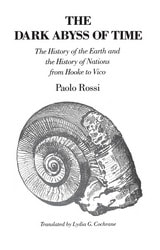
"This book, by a distinguished Italian historian of philosophy, is a worthy successor to the author's important works on Francis Bacon and on technology and the arts. First published in Italian (in 1979), it now makes available to English readers some subtly wrought arguments about the ways in which geology and anthropology challenged biblical chronology and forced changes in the philosophy of history in the early modern era. . . . [Rossi] shows that the search for new answers about human origins spanned many disciplines and involved many fascinating intellects—Bacon, Bayle, Buffon, Burnet, Descartes, Hobbes, Holbach, Hooke, Hume, Hutton, Leibniz, de Maillet, Newton, Pufendorf, Spinoza, Toland, and, most especially, Vico, whose works are impressively and freshly reevaluated here."—Nina Gelbart, American Scientist
The Dark Gaze
Maurice Blanchot and the SacredKevin Hart
University of Chicago Press, 2004
The result is not a mere introduction to Blanchot but rather a profound reconsideration of how his work figures theologically in some of the major currents of twentieth-century thought. Hart reveals Blanchot to be a thinker devoted to the possibilities of a spiritual life; an atheist who knew both the Old and New Testaments, especially the Hebrew Bible; and a philosopher keenly interested in the relation between art and religion, the nature of mystical experience, the link between writing and the sacred, and the possibilities of leading an ethical life in the absence of God.
The De-Definition of Art
Harold Rosenberg
University of Chicago Press, 1983
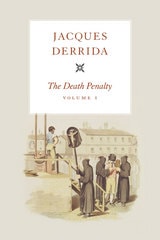
The Death Penalty, Volume I
Jacques Derrida
University of Chicago Press, 2013
With his signature genius and patient yet dazzling readings of an impressive breadth of texts, Derrida examines everything from the Bible to Plato to Camus to Jean Genet, with special attention to Kant and post–World War II juridical texts, to draw the landscape of death penalty discourses. Keeping clearly in view the death rows and execution chambers of the United States, he shows how arguments surrounding cruel and unusual punishment depend on what he calls an “anesthesial logic,” which has also driven the development of death penalty technology from the French guillotine to lethal injection. Confronting a demand for philosophical rigor, he pursues provocative analyses of the shortcomings of abolitionist discourse. Above all, he argues that the death penalty and its attendant technologies are products of a desire to put an end to one of the most fundamental qualities of our finite existence: the radical uncertainty of when we will die.
Arriving at a critical juncture in history—especially in the United States, one of the last Christian-inspired democracies to resist abolition—The Death Penalty is both a timely response to an important ethical debate and a timeless addition to Derrida’s esteemed body of work.
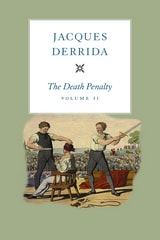
The Death Penalty, Volume II
Jacques Derrida
University of Chicago Press, 2017
Of central importance in this second volume is Kant’s explicit justification of the death penalty in the Metaphysics of Morals. Thoroughly deconstructing Kant’s position—which holds the death penalty as exemplary of the eye-for-an-eye Talionic law—Derrida exposes numerous damning contradictions and exceptions. Keeping the current death penalty in the United States in view, he further explores the “anesthesial logic” he analyzed in volume one, addressing the themes of cruelty and pain through texts by Robespierre and Freud, reading Heidegger, and—in a fascinating, improvised final session—the nineteenth-century Spanish Catholic thinker Donoso Cortés. Ultimately, Derrida shows that the rationality of the death penalty as represented by Kant involves an imposition of knowledge and calculability on a fundamental condition of non-knowledge—that we don’t otherwise know what or when our deaths will be. In this way, the death penalty acts out a phantasm of mastery over one’s own death.
Derrida’s thoughts arrive at a particular moment in history: when the death penalty in the United States is the closest it has ever been to abolition, and yet when the arguments on all sides are as confused as ever. His powerful analysis will prove to be a paramount contribution to this debate as well as a lasting entry in his celebrated oeuvre.
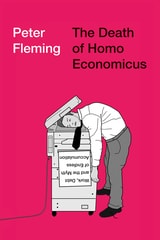
The Death of Homo Economicus
Work, Debt and the Myth of Endless AccumulationPeter Fleming
Pluto Press, 2017
In The Death of Homo Economicus, Fleming presents this controversial claim with the same fierce logic and perception that launched his Guardian column into popularity. Fleming argues that as an invented model of a human being, Homo economicus is, in reality, a tool used by economists and capitalists to manage our social world through the state, business, and even family. As workers, we are barraged with constant reminders that we should always strive toward this ideal persona. It’s implied—and sometimes directly stated—that if we don’t then we are failures. Ironically, the people most often encouraged to emulate this model are those most predisposed to fail due to their socioeconomic circumstances: the poor, the unemployed, students, and prisoners.
Fleming illuminates why a peculiar proactive negativity now marks everyday life in capitalist societies, and he explores how this warped, unattainable model for workers would cause chaos if enacted to the letter. Timely and revelatory, The Death of Homo Economicus offers a sharp, scathing critique of who we are supposed to be in the workplace and beyond.
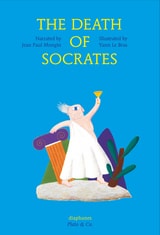
The Death of Socrates
Jean Paul Mongin and Yann Le Bras
Diaphanes, 2015
“Tell us, Delphic Oracle, who is the wisest man in all of Greece?” So begins The Death of Socrates. No mortal man is wiser than Socrates, who, on his daily walks through Athens, talks to all the people he meets. When the person he talks to takes himself to be very wise, Socrates asks so many questions that the person ends up admitting he knows nothing. When he runs into people who know little, Socrates sets them on the way to wisdom. But not everyone shares Socrates’s love for the truth. When the people of Athens become angry with him for his ceaseless questioning, how will he find the courage to continue to speak the truth?
Plato & Co.’s clear approach and charming illustrations make this series the perfect addition to any little library.
The Debate Between Sartre and Merleau-Ponty
Jon Stewart
Northwestern University Press, 1998

The Decision Between Us
Art and Ethics in the Time of ScenesJohn Paul Ricco
University of Chicago Press, 2014
Laying out this theory of “unbecoming community” in modern and contemporary art, literature, and philosophy, and calling our attention to such things as blank sheets of paper, images of unmade beds, and the spaces around bodies, The Decision Between Us opens in 1953, when Robert Rauschenberg famously erased a drawing by Willem de Kooning, and Roland Barthes published Writing Degree Zero, then moves to 1980 and the “neutral mourning” of Barthes’ Camera Lucida, and ends in the early 1990s with installations by Felix Gonzalez-Torres. Offering surprising new considerations of these and other seminal works of art and theory by Jean Genet, Marguerite Duras, and Catherine Breillat, The Decision Between Us is a highly original and unusually imaginative exploration of the spaces between us, arousing and evoking an infinite and profound sense of sharing in scenes of passionate, erotic pleasure as well as deep loss and mourning.
The Deconstruction of Sex
Jean-Luc Nancy and Irving Goh
Duke University Press, 2021
The Deepest Human Life
An Introduction to Philosophy for EveryoneScott Samuelson
University of Chicago Press, 2014
Sometimes it seems like you need a PhD just to open a book of philosophy. We leave philosophical matters to the philosophers in the same way that we leave science to scientists. Scott Samuelson thinks this is tragic, for our lives as well as for philosophy. In The Deepest Human Life he takes philosophy back from the specialists and restores it to its proper place at the center of our humanity, rediscovering it as our most profound effort toward understanding, as a way of life that anyone can live. Exploring the works of some of history’s most important thinkers in the context of the everyday struggles of his students, he guides us through the most vexing quandaries of our existence—and shows just how enriching the examined life can be.
Samuelson begins at the beginning: with Socrates, working his most famous assertion—that wisdom is knowing that one knows nothing—into a method, a way of approaching our greatest mysteries. From there he springboards into a rich history of philosophy and the ways its journey is encoded in our own quests for meaning. He ruminates on Epicurus against the sonic backdrop of crickets and restaurant goers in Iowa City. He follows the Stoics into the cell where James Stockdale spent seven years as a prisoner of war. He spins with al-Ghazali first in doubt, then in the ecstasy of the divine. And he gets the philosophy education of his life when one of his students, who authorized a risky surgery for her son that inadvertently led to his death, asks with tears in her eyes if Kant was right, if it really is the motive that matters and not the consequences. Through heartbreaking stories, humanizing biographies, accessible theory, and evocative interludes like “On Wine and Bicycles” or “On Zombies and Superheroes ,” he invests philosophy with the personal and vice versa. The result is a book that is at once a primer and a reassurance—that the most important questions endure, coming to life in each of us.
The Delight Makers
Anglo-American Metaphysical Religion and the Pursuit of HappinessCatherine L. Albanese
University of Chicago Press, 2023
The pursuit of happiness weaves disparate strands of Anglo-American religious history together. In The Delight Makers, Catherine L. Albanese unravels a theology of desire tying Jonathan Edwards to Ralph Waldo Emerson to the religiously unaffiliated today. As others emphasize redemptive suffering, this tradition stresses the “metaphysical” connection between natural beauty and spiritual fulfillment. In the earth’s abundance, these thinkers see an expansive God intent on fulfilling human desire through prosperity, health, and sexual freedom. Through careful readings of Cotton Mather, Andrew Jackson Davis, William James, Esther Hicks, and more, Albanese reveals how a theology of delight evolved alongside political overtures to natural law and individual liberty in the United States.

The Democracy of Objects
Levi R. Bryant
Michigan Publishing Services, 2011
The Democratic Constitution
Experimentalism and InterpretationBrian E. Butler
University of Chicago Press, 2017
Butler offers an alternative democratic conception of constitutional law, “democratic experimentalism,” and applies it in a thorough reconstruction of Supreme Court cases across the centuries, such as Brown v. Board of Education, Citizens United v. Federal Election Commission, Lucas v. South Carolina Coastal Council, and Lochner v. New York. In contrast to the traditional tools and conceptions of legal analysis that see the law as a formally unique and separate type of practice, democratic experimentalism combines democratic aims and experimental practice. Butler also suggests other directions jurisprudential roles could take: for example, adjudication could be performed by primary stakeholders with better information. Ultimately, Butler argues persuasively for a move away from the current absolute centrality of courts toward a system of justice that emphasizes local rule and democratic choice.
The Derrida-Habermas Reader
Edited by Lasse Thomassen
University of Chicago Press, 2006
Jacques Derrida and Jürgen Habermas have long represented opposite camps in contemporary thought. Derrida, who pioneered the intellectual style of inquiry known as deconstruction, ushered in the postmodern age with his dramatic critique of reason; Habermas, on the other hand, has consistently argued in defense of reason, modernity, and the legacy of the Enlightenment. Their many differences led to a long-standing, if scattered, dialogue, evidence of which has been available in only bits and pieces. But now, for the first time, TheDerrida-Habermas Reader brings these pieces together, along with a collection of essays documenting the intellectual relationship between two of the twentieth century’s preeminent thinkers.
Taken together, Derrida and Habermas’s writings—combined here with contributions by other prominent philosophers and social theorists—tell the story of the two thinkers’ provocative engagement with each other’s ideas. Beyond exploring the conflict between Derrida’s deconstruction and Habermas’s communicative rationality, they show how the Derrida-Habermas encounter changed over the years, becoming more theoretically productive without ever collapsing into mutual rejection or simple compromise.
Lasse Thomassen has divided the essays—including works on philosophy and literature, ethics, politics, and international law—into four parts that cover the full range of thought in which Derrida and Habermas engaged. The last of these sections fittingly includes the thinkers’ jointly signed work on European solidarity and the Iraq War, highlighting the hopes they held in common despite their differences. The wide breadth of this book, along with Thomassen’s lucid introductions to each section, makes The Derrida-Habermas Reader an ideal starting point for anyone interested in one of the most dynamic intellectual debates of our time.
The Desire of Psychoanalysis
Exercises in Lacanian ThinkingGabriel Tupinambá; With a foreword by Slavoj Žižek
Northwestern University Press, 2021
The Desire of Psychoanalysis proposes that recognizing how certain theoretical and institutional problems in Lacanian psychoanalysis are grounded in the historical conditions of Lacan’s own thinking might allow us to overcome these impasses. In order to accomplish this, Gabriel Tupinambá analyzes the socioeconomic practices that underlie the current institutional existence of the Lacanian community—its political position as well as its institutional history—in relation to theoretical production.
By focusing on the underlying dynamic that binds clinical practice, theoretical work, and institutional security in Lacanian psychoanalysis today, Tupinambá is able to locate sites for conceptual innovation that have been ignored by the discipline, such as the understanding of the role of money in clinical practice, the place of analysands in the transformation of psychoanalytic theory, and ideological dead-ends that have become common sense in the Lacanian field. The Desire of Psychoanalysis thus suggests ways of opening up psychoanalysis to new concepts and clinical practices and calls for a transformation of how psychoanalysis is understood as an institution.
The Dialectical Necessity of Morality
An Analysis and Defense of Alan Gewirth's Argument to the Principle of Generic ConsistencyDeryck Beyleveld
University of Chicago Press, 1991
Beyleveld then classifies all the criticisms that Gewirth's argument has received and measures them against his reconstruction of the argument. The overall result is an immensely rich picture of the argument, in which all of its complex issues and key moves are clearly displayed and its validity can finally be discerned.
The comprehensiveness of Beyleveld's treatment provides ready access to the entire debate surrounding the foundational argument of Reason and Morality. It will be required reading for all who are interested in Gewirth's theory and deontological ethics and will be of central importance to moral and legal theorists.
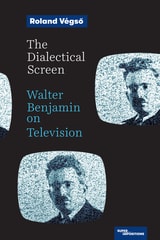
The Dialectical Screen
Walter Benjamin on TelevisionRoland Végso
Northwestern University Press, 2027
Exploring the meanings of media technologies through Walter Benjamin’s thought
Walter Benjamin’s prime years as a cultural critic coincided with the rise of televised broadcasting in Europe and North America, a unique period of rapid expansion in a new technological medium. So why would such a subtle and sensitive critic of media, known for his cultural criticism across genres, seem to have ignored or even missed the entire phenomenon of television? This book reveals how television, as a concept and a metaphor, in fact structures Benjamin’s philosophy.
Through a careful reading of Benjamin’s work across various media—literature, photography, cinema, radio, and television—Roland Végső reconstructs a powerful vision of media technologies as not merely tools of communication but as forces that shape how we imagine and construct the world as a conceptual totality. The Dialectical Screen provides a timely and provocative framework for understanding how media continue to shape our political, cultural, and existential horizons, recasting Benjamin's understanding of historical materialism in fundamentally tele-visual terms as a theoretical orientation that makes visible the perishing of the world itself.
The Dialogic Imagination
Four EssaysBy M. M. Bakhtin
University of Texas Press, 1982
These essays reveal Mikhail Bakhtin (1895-1975)—known in the West largely through his studies of Rabelais and Dostoevsky—as a philosopher of language, a cultural historian, and a major theoretician of the novel. The Dialogic Imagination presents, in superb English translation, four selections from Voprosy literatury i estetiki (Problems of literature and esthetics), published in Moscow in 1975. The volume also contains a lengthy introduction to Bakhtin and his thought and a glossary of terminology.
Bakhtin uses the category "novel" in a highly idiosyncratic way, claiming for it vastly larger territory than has been traditionally accepted. For him, the novel is not so much a genre as it is a force, "novelness," which he discusses in "From the Prehistory of Novelistic Discourse." Two essays, "Epic and Novel" and "Forms of Time and of the Chronotope in the Novel," deal with literary history in Bakhtin's own unorthodox way. In the final essay, he discusses literature and language in general, which he sees as stratified, constantly changing systems of subgenres, dialects, and fragmented "languages" in battle with one another.