Results by title
1668 books match the query 'Popular culture' and 292 start with t
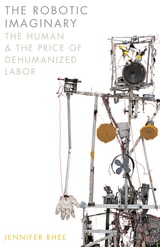
The Robotic Imaginary
The Human and the Price of Dehumanized LaborJennifer Rhee
University of Minnesota Press, 2018
Tracing the connections between human-like robots and AI at the site of dehumanization and exploited labor
The word robot—introduced in Karel Čapek’s 1920 play R.U.R.—derives from rabota, the Czech word for servitude or forced labor. A century later, the play’s dystopian themes of dehumanization and exploited labor are being played out in factories, workplaces, and battlefields. In The Robotic Imaginary, Jennifer Rhee traces the provocative and productive connections of contemporary robots in technology, film, art, and literature. Centered around the twinned processes of anthropomorphization and dehumanization, she analyzes the coevolution of cultural and technological robots and artificial intelligence, arguing that it is through the conceptualization of the human and, more important, the dehumanized that these multiple spheres affect and transform each other.
Drawing on the writings of Alan Turing, Sara Ahmed, and Arlie Russell Hochschild; such films and novels as Her and The Stepford Wives; technologies like Kismet (the pioneering “emotional robot”); and contemporary drone art, this book explores anthropomorphic paradigms in robot design and imagery in ways that often challenge the very grounds on which those paradigms operate in robotics labs and industry. From disembodied, conversational AI and its entanglement with care labor; embodied mobile robots as they intersect with domestic labor; emotional robots impacting affective labor; and armed military drones and artistic responses to drone warfare, The Robotic Imaginary ultimately reveals how the human is made knowable through the design of and discourse on humanoid robots that are, paradoxically, dehumanized.
The Russia That We Have Lost
Pavel Khazanov
University of Wisconsin Press, 2023
Khazanov’s careful untangling of this discourse in the late Soviet period reveals a process that involved figures of all political stripes, from staunch conservatives to avowed intelligentsia liberals. Further, Khazanov shows that this process occurred not outside of or in opposition to Soviet guidance and censorship, but in mainstream Soviet culture that commanded wide audiences, especially among the Soviet middle class. Excavating the cultural logic of this newly foundational, mythic memory of a “lost Russia,” Khazanov reveals why, despite the apparently liberal achievement of the collapse of the Soviet Union in 1991, Boris Yeltsin (and later, Vladamir Putin) successfully steered Russia into oligarchy and increasing autocracy. The anti-Soviet memory of the pre-Soviet past, ironically constructed during the late socialist period, became and remains a politically salient narrative, a point of consensus that surprisingly attracts both contemporary regime loyalists and their would-be liberal opposition.
The Scrapbook in American Culture
Susan Tucker
Temple University Press, 2006
The Secret Marriage of Sherlock Holmes and Other Eccentric Readings
Michael Atkinson
University of Michigan Press, 1998
"Atkinson demonstrates a love and knowledge of the Holmes stories. . . I would recommend The Secret Marriage of Sherlock Holmes enthusiastically to any lover of the Canon who is prepared to have their perceptions widened."
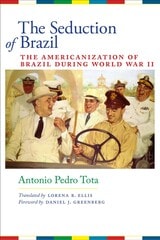
The Seduction of Brazil
The Americanization of Brazil during World War IIBy Antonio Pedro Tota
University of Texas Press, 2009
Following completion of the U.S. air base in Natal, Brazil, in 1942, U.S. airmen departing for North Africa during World War II communicated with Brazilian mechanics with a thumbs-up before starting their engines. This sign soon replaced the Brazilian tradition of touching the earlobe to indicate agreement, friendship, and all that was positive and good—yet another indication of the Americanization of Brazil under way during this period.
In this translation of O Imperialismo Sedutor, Antonio Pedro Tota considers both the Good Neighbor Policy and broader cultural influences to argue against simplistic theories of U.S. cultural imperialism and exploitation. He shows that Brazilians actively interpreted, negotiated, and reconfigured U.S. culture in a process of cultural recombination. The market, he argues, was far more important in determining the nature of this cultural exchange than state-directed propaganda efforts because Brazil already was primed to adopt and disseminate American culture within the framework of its own rapidly expanding market for mass culture. By examining the motives and strategies behind rising U.S. influence and its relationship to a simultaneous process of cultural and political centralization in Brazil, Tota shows that these processes were not contradictory, but rather mutually reinforcing.
The Seduction of Brazil brings greater sophistication to both Brazilian and American understanding of the forces at play during this period, and should appeal to historians as well as students of Latin America, culture, and communications.
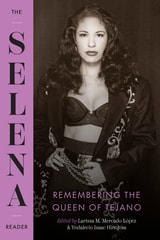
The Selena Reader
Remembering the Queen of TejanoEdited by Larissa M. Mercado-López and Yndalecio Isaac Hinojosa
University of Texas Press, 2026
A literary collection honoring and memorializing Selena, the Queen of Tejano.
Thirty years after her death, Selena Quintanilla-Pérez remains a cherished figure of Mexican American popular culture, her music and celebrity resounding across the decades. This unique collection of creative and scholarly works traces Selena’s lasting impact as an entertainer and focal point of community and identity.
Assembling essays, memoir, short stories, and poems, The Selena Reader memorializes a beloved singer while also exploring the politics and personal meaning of what we remember. Selena’s devoted admirers tell us what they took from her lyrics and stage presence, the official and fan tributes, and the media and products she inspired. In one essay, Tejana coming-of-age is sharply refracted through the prism of Selena’s art and social status. Another piece considers how Selena’s body and distinctive clothing have shaped the author’s sense of queer self. Honey Avila (aka Honey Andrews), the renowned Selena impersonator, shares vivid recollections of her hero. A father and daughter describe how their conversations about Selena changed their relationship and contributed to Chicana feminist consciousness in their lives. All told, this anthology amplifies the gratitude of generations who have loved, and learned from, Selena.
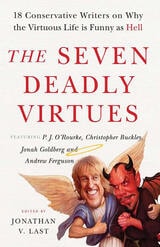
The Seven Deadly Virtues
18 Conservative Writers on Why the Virtuous Life is Funny as HellJonathan V. Last
Templeton Press, 2014
The book’s contributors include Sonny Bunch, Christopher Buckley, David “Iowahawk” Burge, Christopher Caldwell, Andrew Ferguson, Jonah Goldberg, Michael Graham, Mollie Hemingway, Rita Koganzon, Matt Labash, James Lileks, Rob Long, Larry Miller, P. J. O’Rourke, Joe Queenan, Christine Rosen, and Andrew Stiles. Jonathan V. Last, senior writer at the Weekly Standard, editor of the collection, is also a contributor. All eighteen essays in this book are appearing for the first time anywhere.
In the book’s opening essay, P. J. O’Rourke observes: “Virtue has by no means disappeared. It’s as much in public view as ever. But it’s been strung up by the heels. Virtue is upside down. Virtue is uncomfortable. Virtue looks ridiculous. All the change and the house keys are falling out of Virtue’s pants pockets.”
Here are the virtues everyone (including the book’s contributors) was taught in Sunday school but have totally forgotten about until this very moment. In this sanctimony-free zone:
• Joe Queenan observes: “In essence, thrift is a virtue that resembles being very good at Mahjong. You’ve heard about people who can do it, but you’ve never actually met any of them.”
• P. J. O’Rourke notes: “Fortitude is quaint. We praise the greatest generation for having it, but they had aluminum siding, church on Sunday, and jobs that required them to wear neckties or nylons (but never at the same time). We don’t want those either.”
• Christine Rosen writes: “A fellowship grounded in sociality means enjoying the company of those with whom you actually share physical space rather than those with whom you regularly and enthusiastically exchange cat videos.”
• Rob Long offers his version of modern day justice: if you sleep late on the weekend, you are forced to wait thirty minutes in line at Costco.
• Jonah Goldberg offers: “There was a time when this desire-to-do-good-in-all-things was considered the only kind of integrity: ‘Angels are better than mortals. They’re always certain about what is right because, by definition, they’re doing God’s will.’ Gabriel knew when it was okay to remove a mattress tag and Sandalphon always tipped the correct amount.”
• Sonny Bunch dissects forbearance, observing that the fictional Two Minutes Hate of George Orwell’s 1984 is now actually a reality directed at living, breathing people. Thanks, in part, to the Internet, “Its targets are designated by a spontaneously created mob—one that, due to its hive-mind nature—is virtually impossible to call off.”
By the time readers have completed The Seven Deadly Virtues, they won’t even realize that they’ve just been catechized into an entirely different—and better—moral universe.
The Seventies Now
Culture as SurveillanceStephen Paul Miller
Duke University Press, 1999
The concept of surveillance and its attendant social ramifications have been powerful agents in U.S. culture for many decades, but in describing how during the 1970s Americans learned to “survey” themselves, Miller shines surprising new light on such subjects as the women’s movement, voting rights enforcement, the Ford presidency, and environmental legislation. He illuminates the significance of what he terms “microperiods” and analyzes relevant themes in many of the decade’s major films—such as The Deer Hunter, Network, Jaws, Star Wars, and Apocalypse Now—and in the literature of writers including John Ashbery, Toni Morrison, Adrienne Rich, and Sam Shepard. In discussing the reverberations of the 1969 Stonewall riots, technological innovations, the philosophy of Michel Foucault, and a host of documents and incidents, Miller shows how the 1970s marked an important period of transition, indeed a time of many transitions, to the world we confront at the end of the millennium.
The Seventies Now will interest students and scholars of cultural studies, American history, theories of technology, film and literature, visual arts, and gay and lesbian studies.

The Significance of Sibling Relationships in Literature
Joanna Stephens Mink
University of Wisconsin Press, 1993
The essays bring together studies in the fields of social and family therapy, psychological research, and literary criticism.
The Six-Gun Mystique Sequel
John G. Cawelti
University of Wisconsin Press, 1999
In this expanded version, Cawelti revises his analysis of the structural characteristics of the Western novel and film, synthesizing much of the rich discussion of the Western genre that has appeared since The Six-Gun Mystique's original publication. To this structural analysis he adds a new account of the genre's history and its relationship to the myths of the West that have played such an influential role in American history. The Six-Gun Mystique Sequel concludes with an exploration of the continuing influence of Western themes and symbols on many aspects of postmodern American culture, and an assessment of the critical tradition that has developed around the Western genre. The appendices of the book are also revised and expanded to include useful lists of the most important Western novels and films, as well as the best critical and historical studies of different aspects of the genre.
The Sixties, Center Stage
Mainstream and Popular Performances in a Turbulent DecadeEdited by James M. Harding and Cindy Rosenthal
University of Michigan Press, 2017
The Small Book of Hip Checks
On Queer Gender, Race, and WritingErica Rand
Duke University Press, 2021
The Sopranos
Dana Polan
Duke University Press, 2009
A show about corrupt figures who parasitically try to squeeze illicit profit from the system, The Sopranos itself seems a target of attempts to glom on to its fame as a successful TV series: attempts by media executives, marketers, critics and writers, and even presidential candidates. “Everyone wants a piece of Sopranos action,” says Polan, and he traces the marketing of the series across both official and unauthorized media platforms, including cookbooks, games, DVDs, and the kitschy Sopranos bus tour. Critiquing previous books on The Sopranos, Polan suggests that in their quest to find deep meaning, many of the authors missed the show’s ironic and comedic side.
The Soul of Anime
Collaborative Creativity and Japan's Media Success StoryIan Condry
Duke University Press, 2013
The Sound of Things to Come
An Audible History of the Science Fiction FilmTrace Reddell
University of Minnesota Press, 2018
A groundbreaking approach to sound in sci-fi films offers new ways of construing both sonic innovation and science fiction cinema
Including original readings of classics like The Day the Earth Stood Still, 2001: A Space Odyssey, Star Wars, and Blade Runner, The Sound of Things to Come delivers a comprehensive history of sound in science fiction cinema. Approaching movies as sound objects that combine cinematic apparatus and consciousness, Trace Reddell presents a new theory of sonic innovation in the science fiction film.
Reddell assembles a staggering array of movies from sixty years of film history—including classics, blockbusters, B-movies, and documentaries from the United States, Britain, France, Germany, Japan, and the Soviet Union—all in service to his powerful conception of sound making as a speculative activity in its own right. Reddell recasts debates about noise and music, while arguing that sound in the science fiction film provides a medium for alien, unknown, and posthuman sound objects that transform what and how we hear.
Avoiding genre criticism’s tendency to obsess over utopias, The Sound of Things to Come draws on film theory, sound studies, and philosophies of technology to advance conversations about the avant-garde, while also opening up opportunities to examine cinematic sounds beyond the screen.
The Stage Life of Props
Andrew Sofer
University of Michigan Press, 2003
Using case studies that explore the Eucharistic wafer on the medieval stage, the bloody handkerchief on the Elizabethan stage, the skull on the Jacobean stage, the fan on the Restoration and early eighteenth-century stage, and the gun on the modern stage, Andrew Sofer reveals how stage props repeatedly thwart dramatic convention and reinvigorate theatrical practice.
While the focus is on specific objects, Sofer also gives us a sweeping history of half a millennium of stage history as seen through the device of the prop, revealing that as material ghosts, stage props are a way for playwrights to animate stage action, question theatrical practice, and revitalize dramatic form.
Andrew Sofer is Assistant Professor of English, Boston College. He was previously a stage director.
The Stars
Edgar Morin
University of Minnesota Press, 2005
The Stars Are Not Enough
Scientists--Their Passions and ProfessionsJoseph C. Hermanowicz
University of Chicago Press, 1998
These deeply personal narratives reveal dreams of fame and glory, in which scientists confess their ambitions of becoming the next Newton or Einstein. However, these scientists also discuss the meaning of success and failure. We hear their stories of aspiration and anxiety, disappointment and tragedy, hope and achievement; we are privy to their doubts and to what they consider to be their limitations and weaknesses. As the scientists age in their professions, the specter of failure often visits them, and they have to accept something less than scientific immortality or even the Nobel Prize.
Ultimately these stories give us more than an inside look at the details of careers in science, they also examine ambition by uncovering the forces that drive people in their professions and by describing how these forces persist or fade over time. Ambition for greatness often ignites a career and often sustains it. Yet, as Hermanowicz's study reveals, greatness eludes nearly all people in their heroic quests for extraordinary achievement. The Stars Are Not Enough offers a fascinating account that will appeal to anyone interested in how people's dreams blossom and evolve.
The Stone and the Wireless
Mediating China, 1861–1906Shaoling Ma
Duke University Press, 2021
The Subject and Other Subjects
On Ethical, Aesthetic, and Political IdentityTobin Siebers
University of Michigan Press, 1998
The Subversion of Romance in the Novels of Barbara Pym
University of Wisconsin Press, 1998
This book seeks to explore how Barbara Pym subverts the discourse of the romance novel through her use of food, clothes, heroine and hero characterizations, and marriage customs.
The Superhero Symbol
Media, Culture, and PoliticsLiam Burke
Rutgers University Press, 2020
It is hard to imagine a time when superheroes have been more pervasive in our culture. Today, superheroes are intellectual property jealously guarded by media conglomerates, icons co-opted by grassroots groups as a four-color rebuttal to social inequities, masks people wear to more confidently walk convention floors and city streets, and bulletproof banners that embody regional and national identities. From activism to cosplay, this collection unmasks the symbolic function of superheroes.
Bringing together superhero scholars from a range of disciplines, alongside key industry figures such as Harley Quinn co-creator Paul Dini, The Superhero Symbol provides fresh perspectives on how characters like Captain America, Iron Man, and Wonder Woman have engaged with media, culture, and politics, to become the “everlasting” symbols to which a young Bruce Wayne once aspired.
The TV Arab
Jack G. Shaheen
University of Wisconsin Press, 1984
Dr. Shaheen, studying over 100 different popular entertainment programs, cartoons and major documentaries telecast on network, independent and public channels, totaling nearly 200 episodes that relate to Arabs, has thrown new and revealing light on the stereotypes of people from the Middle East.
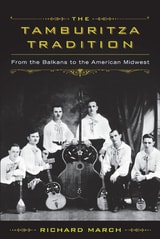
The Tamburitza Tradition
From the Balkans to the American MidwestRichard March
University of Wisconsin Press, 2013
The Taste of Art
Cooking, Food, and Counterculture in Contemporary PracticesSilvia Bottinelli
University of Arkansas Press, 2017
The Taste of Art offers a sample of scholarly essays that examine the role of food in Western contemporary art practices. The contributors are scholars from a range of disciplines, including art history, philosophy, film studies, and history. As a whole, the volume illustrates how artists engage with food as matter and process in order to explore alternative aesthetic strategies and indicate countercultural shifts in society.
The collection opens by exploring the theoretical intersections of art and food, food art’s historical root in Futurism, and the ways in which food carries gendered meaning in popular film. Subsequent sections analyze the ways in which artists challenge mainstream ideas through food in a variety of scenarios. Beginning from a focus on the body and subjectivity, the authors zoom out to look at the domestic sphere, and finally the public sphere.
Here are essays that study a range of artists including, among others, Filippo Tommaso Marinetti, Daniel Spoerri, Dieter Roth, Joseph Beuys, Al Ruppersberg, Alison Knowles, Martha Rosler, Robin Weltsch, Vicki Hodgetts, Paul McCarthy, Luciano Fabro, Carries Mae Weems, Peter Fischli and David Weiss, Janine Antoni, Elżbieta Jabłońska, Liza Lou, Tom Marioni, Rirkrit Tiravanija, Michael Rakowitz, and Natalie Jeremijenko.
The Tented Field
A History of Cricket in AmericaTom Melville
University of Wisconsin Press, 1998
The Terrible Fitzball
The Melodramatist of the MacabreLarry Stephen Clifton
University of Wisconsin Press, 1993
The Transatlantic Zombie
Slavery, Rebellion, and Living DeathSarah Juliet Lauro
Rutgers University Press, 2015
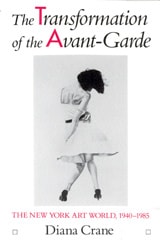
The Transformation of the Avant-Garde
The New York Art World, 1940-1985Diana Crane
University of Chicago Press, 1989
Crane's account is built around discussions of seven styles: Abstract Expressionism in the forties; Pop art and Minimalism in the sixties; Figurative painting, Photorealism, and Pattern painting in the early seventies; and Neo-Expressionism in the early eighties. Demonstrating that the New York art world moved toward increasing acceptance of dominant American cultural trends, Crane offers a fascinating look not only at the intricacies of New York's artistic inner circle but also at the sociology of work and professions, the economics of culture markets such as "dealing art," and the sociology of culture.
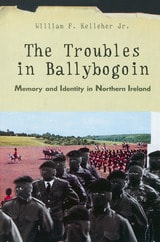
The Troubles in Ballybogoin
Memory and Identity in Northern IrelandWilliam F. Kelleher, Jr.
University of Michigan Press, 2004
Why are the political polarities of Northern Ireland so intractable? Why, in a society riven by class division, do Northern Ireland's people identify most strongly with the nationalist and religious groupings of British Protestant versus Irish Catholic? Why, after over thirty years of violence and death, is dialogue about the future so difficult to create and sustain?
In The Troubles in Ballybogoin, William F. Kelleher Jr. examines the patterns of avoidance and engagement deployed by people in the western region of Northern Ireland and compares them to colonial patterns of settlement and retreat. The book shows how social memories inform and are strengthened by mundane aspects of daily life—the paths people use to move through communal spaces, the bodily movements involved in informal social encounters that mark political identities, and the "holiday" marches that displace citizens for the day and divide cross-community friendships.
The Troubles in Ballybogoin is the story of Ireland, its historical conundrums, its violence. It details the location of historical memory in the politics of the everyday and the colonial modernities that so often nurture long-term conflict.
". . . Bill Kelleher brings the reader in to the heart of Northern Ireland and its long, tragic conflict. Northern Ireland, in all its complexity, is authentically rendered."-Robert Connolly, writer and co-director, The Road to Reconciliation
". . . this exemplary ethnography is among the best books on Northern Ireland, and one of the very few that makes human sense of daily sectarian life."
-Lawrence Taylor, National University of Ireland, Maynooth
"More than a tour-a moving narrative."
-David Stark, Columbia University
"This is a wonderful contribution to Irish studies, postcolonial studies, and anthropology."
-Begoña Arétxaga, University of Texas, Austin
"It is a book that will be widely read and greatly appreciated."
--David Lloyd, Scripps College
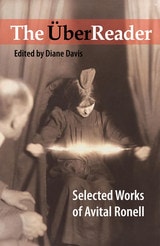
The UberReader
SELECTED WORKS OF AVITAL RONELLEdited by Diane Davis
University of Illinois Press, 2007
For twenty years Avital Ronell has stood at the forefront of the confrontation between literary study and European philosophy. She has tirelessly investigated the impact of technology on thinking and writing, with groundbreaking work on Heidegger, dependency and drug rhetoric, intelligence and artificial intelligence, and the obsession with testing. Admired for her insights and breadth of field, she has attracted a wide readership by writing with guts, candor, and wit.
Coyly alluding to Nietzsche’s “gay science,” The ÜberReader presents a solid introduction to Avital Ronell’s later oeuvre. It includes at least one selection from each of her books, two classic selections from a collection of her early essays (Finitude’s Score), previously uncollected interviews and essays, and some of her most powerful published and unpublished talks. An introduction by Diane Davis surveys Ronell’s career and the critical response to it thus far.
With its combination of brevity and power, this Ronell “primer” will be immensely useful to scholars, students, and teachers throughout the humanities, but particularly to graduate and undergraduate courses in contemporary theory.

The Vampire in Nineteenth Century English Literature
Carol A. Senf
University of Wisconsin Press, 1988
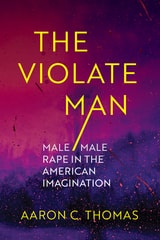
The Violate Man
Male/Male Rape in the American ImaginationAaron C. Thomas
Vanderbilt University Press, 2025
From the punchline of bro comedies to the vengeance arc of prison dramas, Thomas argues that male/male rape narratives are used by writers, filmmakers, and comedians to make sense of the changing landscape of American masculinity, and that these narratives have shifted widely since the 1960s, reflecting masculinity’s varying anxieties and concerns.
The Walls of Jericho
Rudolph Fisher
University of Michigan Press, 1994
The War in American Culture
Society and Consciousness during World War IIEdited by Lewis A. Erenberg and Susan E. Hirsch
University of Chicago Press, 1996
World War II posed a crisis for American culture: to defeat the enemy, Americans had to unite across the class, racial and ethnic boundaries that had long divided them. Exploring government censorship of war photography, the revision of immigration laws, Hollywood moviemaking, swing music, and popular magazines, these essays reveal the creation of a new national identity that was pluralistic, but also controlled and sanitized. Concentrating on the home front and the impact of the war on the lives of ordinary Americans, the contributors give us a rich portrayal of family life, sexuality, cultural images, and working-class life in addition to detailed consideration of African Americans, Latinos, and women who lived through the unsettling and rapidly altered circumstances of wartime America.
The War of My Generation
Youth Culture and the War on TerrorKieran, David
Rutgers University Press, 2015
The War of My Generation is the first essay collection to focus specifically on how the terrorist attacks and their aftermath have shaped these new generations of Americans. Drawing from a variety of disciplines, including anthropology, sociology, cultural studies, and literary studies, the essays cover a wide range of topics, from graphic war images in the classroom to computer games designed to promote military recruitment to emails from parents in the combat zone. The collection considers what cultural factors and products have shaped young people's experience of the 9/11 attacks, the wars that have followed, and their experiences as emerging citizen-subjects in that moment. Revealing how young people understand the War on Terror—and how adults understand the way young people think—The War of My Generation offers groundbreaking research on catastrophic events still fresh in our minds.
The Wedding Complex
Forms of Belonging in Modern American CultureElizabeth Freeman
Duke University Press, 2002
Freeman draws on queer theory and social history to focus on a range of texts where weddings do not necessarily lead to legal marriage but instead reflect yearnings for intimate arrangements other than long-term, state-sanctioned, domestic couplehood. Beginning with a look at the debates over gay marriage, she proceeds to consider literary works by Nathaniel Hawthorne, William Faulkner, Carson McCullers, Vladimir Nabokov, and Edgar Allan Poe, along with such Hollywood films as Father of the Bride, The Graduate, and The Godfather. She also discusses less well-known texts such as Su Friedrich’s experimental film First Comes Love and the off-Broadway, interactive dinner play Tony ‘n’ Tina’s Wedding.
Offering bold new ways to imagine attachment and belonging, and the public performance and recognition of social intimacy, The Wedding Complex is a major contribution to American studies, queer theory, and cultural studies.
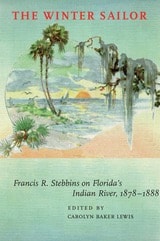
The Winter Sailor
Francis R. Stebbins on Florida's Indian River, 1878-1888Edited by Carolyn Frances Baker Lewis
University of Alabama Press, 2004
A unique guide to Florida's frontier history along Indian River.
The Winter Sailor is a historical adventure that details the yearly winter travels of Francis R. Stebbins to Florida's Indian River. Stebbins, a writer from Michigan, visited Florida in March of 1878 and became entranced by its pristine beauty. Subsequently, Stebbins and his traveling companions made annual visits to Indian River—until 1888 when tragedy struck and ended Stebbins' yearly journeys.
Being an observant traveler, Stebbins began a series of descriptive articles for his hometown newspaper that chronicled his journeys to the Indian River area. Stebbins's articles tell of his own personal experiences during his leisurely visits, which included such activities as hunting and fishing, studying the natural surroundings, and excavating Indian mounds. What Stebbins enjoyed most was sailing down the river interviewing townspeople and examining local attractions as he went. His articles also detail the lifestyle of the region, food, fashion, industry, history, environment, and changes that occurred over time. Stebbins's articles not only entertained and informed but also became a travelogue for his readers. He inspired northern travelers to go south and visit Florida, which contributed to the beginnings of large-scale tourism in the region.
The Winter Sailor combines Stebbins's 49 articles along with three by his companions, to provide an enjoyable, historical guide. Unique among 19th-century travelogues, this fascinating look into Florida's past documents a decade of change to the Indian River wilderness and becomes Stebbins's gift to the present.
The Wonder Team
The True Story of the Incomparable 1927 New York YankeesLeo Trachtenberg
University of Wisconsin Press, 1995
In detailing the events leading to the 1927 World Series, Leo Trachtenberg weaves players’ profiles and histories along with those of the Yankee owner, management, coaches, scouts, trainer, and batboy/mascot. Also included are 1927 statistics and photos from Yankee archives.
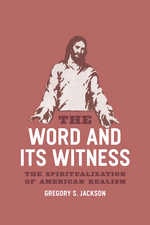
The Word and Its Witness
The Spiritualization of American RealismGregory S. Jackson
University of Chicago Press, 2009
Jackson shows how the homiletic tradition in Protestant sermons provided a foundation for the development of visual and literary realism. Evangelical preachers and writers used vivid language grounded in everyday life to translate abstract concepts like hell into concrete reality—a key influence on realist authors that brought about the more secular forms of the movement we know today. This emphasis on the sensuous also paved the way for Protestantism’s embrace of new media, evident in the photographs of Jacob Riis as well as the video game Left Behind: Eternal Forces.
With its remarkable scope and timely insights into the interplay between religion, secularism, and politics, The Word and Its Witness will transform the way we understand American realism and American religion.
The World Sixties Made
Politics And Culture In Recent Americaedited by Van Gosse and Richard Moser
Temple University Press, 2003

The emergence of post-hybrid identities
a comparative analysis of national identity formations in Germany’s hip-hop cultureMarissa Munderloh
University of London Press, 2017
Theatre Fandom
Engaged Audiences in the Twenty-first CenturyKirsty Sedgman
University of Iowa Press, 2025
Contributors: Tom Cantrell, Francesca Coppa, Ruth Foulis, Helen Freshwater, Emily Garside, Caroline Heim, Matt Hills, Natalie Ibu, Laura MacDonald, Dominique Morisseau, Rachael Nicholas, Louie Lang Norman, Owen G. Parry, Stephanie E. Pitts, Sarah M. Price, Beth Emily Richards, Kirsty Sedgman, Megan Vaughan, Ben Walmsley, Sarah K. Whitfield
Themes and Issues in Asian Cartooning
John A. Lent
University of Wisconsin Press, 1999
Themes and Issues in Asian Cartooning uses overviews and case studies by scholars to discuss Asian animation, humor magazines, gag cartoons, comic strips, and comic books. The first half of the book looks at contents and audiences of Malay humor magazines, cultural labor in Korean animation, the reception of Aladdin in Islamic Southeast Asia, and a Singaporean comic book as a reflection of that society’s personality. Four other chapters treat gender and Asian comics, concentrating on Japanese anime and manga and Indian comic books.
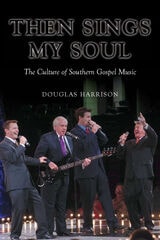
Then Sings My Soul
The Culture of Southern Gospel MusicDouglas Harrison
University of Illinois Press, 2012

Theory for the World to Come
Speculative Fiction and Apocalyptic AnthropologyMatthew J. Wolf-Meyer
University of Minnesota Press, 2019
Can social theories forge new paths into an uncertain future?
The future has become increasingly difficult to imagine. We might be able to predict a few events, but imagining how looming disasters will coincide is simultaneously necessary and impossible. Drawing on speculative fiction and social theory, Theory for the World to Come is the beginning of a conversation about theories that move beyond nihilistic conceptions of the capitalism-caused Anthropocene and toward generative bodies of thought that provoke creative ways of thinking about the world ahead. Matthew J. Wolf-Meyer draws on such authors as Kim Stanley Robinson and Octavia Butler, and engages with afrofuturism, indigenous speculative fiction, and films from the 1970s and ’80s to help think differently about the future and its possibilities.
Forerunners: Ideas First
Short books of thought-in-process scholarship, where intense analysis, questioning, and speculation take the lead
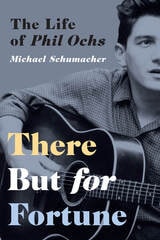
There But for Fortune
The Life of Phil OchsMichael Schumacher
University of Minnesota Press, 2018
The life and influence of singer Phil Ochs
Phil Ochs burst onto the American music scene just as the popularity of folk music was breaking through on the national consciousness. Along with friend and rival Bob Dylan, Ochs wrote some of the most compelling topical music of his time. In There But for Fortune, Michael Schumacher explores the life and career of a singer, songwriter, and political activist whose music resonates today as much as it applied to a divided country a half-century ago. His politically charged songs were covered by Pete Seeger; Joan Baez; Gordon Lightfoot; Peter, Paul and Mary; and a host of others, and such songs as “I Ain’t Marching Anymore” and “The War Is Over” became anthems of the anti–Vietnam War movement. He seemed to be performing everywhere, from concerts on college campuses to huge demonstrations, culminating with an appearance at the Democratic National Convention in Chicago in 1968.
But as this biography illustrates in painstaking detail, Ochs suffered from a dark side that gravely affected his life and music. Diagnosed as manic depressive, he shifted between incredible highs and debilitating lows that ultimately drove him to suicide at age 36. To piece together his life story, Schumacher interviewed Ochs’s friends, family members, and fellow musicians; examined his journals and scrapbooks; and even scrutinized his FBI files. While Phil Ochs’s life might have been plagued by downturn and tragedies, his music is an enduring call to activism and fighting for a better future.
There She Goes Again
Gender, Power, and Knowledge in Contemporary Film and Television FranchisesAviva Dove-Viebahn
Rutgers University Press, 2024
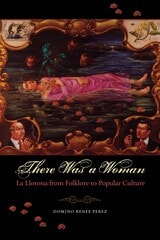
There Was a Woman
La Llorona from Folklore to Popular CultureBy Domino Renee Perez
University of Texas Press, 2008
"How is it that there are so many lloronas?" A haunting figure of Mexican oral and literary traditions, La Llorona permeates the consciousness of her folk community. From a ghost who haunts the riverbank to a murderous mother condemned to wander the earth after killing her own children in an act of revenge or grief, the Weeping Woman has evolved within Chican@ imaginations across centuries, yet no truly comprehensive examination of her impact existed until now. Tracing La Llorona from ancient oral tradition to her appearance in contemporary material culture, There Was a Woman delves into the intriguing transformations of this provocative icon.
From La Llorona's roots in legend to the revisions of her story and her exaltation as a symbol of resistance, Domino Renee Perez illuminates her many permutations as seductress, hag, demon, or pitiful woman. Perez draws on more than two hundred artifacts to provide vivid representations of the ways in which these perceived identities are woven from abstract notions—such as morality or nationalism—and from concrete, often misunderstood concepts from advertising to television and literature. The result is a rich and intricate survey of a powerful figure who continues to be reconfigured.
There’s No Place Like Home Video
James M. Moran
University of Minnesota Press, 2002
Defines, examines, and elevates home video to its rightful place
From its recording of family events to its influence on filmmaking, home video defies easy categorization and demands serious consideration. In There’s No Place Like Home Video, James Moran takes on this neglected aspect of popular culture. He offers a cultural history of amateur home video, exploring its technological and ideological predecessors, the development of event videography, and its symbiotic relationship with television and film. He also investigates the broader field of video, taking on the question of medium specificity: the attempt to define its unique identity, to capture what constitutes its pure practice.
In Moran’s discussion of video, he argues that previous scholars have not sufficiently dealt with its nature as hybrid, varied, and mutable. He argues that such a medium shouldn’t be conceived as pure in and of itself; it is neither autonomous from other media nor entirely dependent on any other, but instead has a chameleonlike interface with films, television, computers, telephones, and even architecture. Rather than look for a grand narrative to define its specificity, Moran places video and home video at the intersections of multiple forms of communication.