Results by title
1214 books match the query 'Subjects & Themes' and 227 start with t
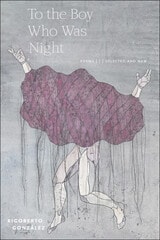
To the Boy Who Was Night
Poems: Selected and NewRigoberto González
Four Way Books, 2023
The capstone of a quarter-century career in poetry, To the Boy Who Was Night collects the poetry published by Rigoberto González since 1999, including selections from five previous books as well as new work. Mirroring González’s personal trajectory, the arc of this work articulates the course of a life: these poems recall leaving a beloved homeland, confront masculinity and sexuality in new adulthood, imagine the earth devoid of human inhabitants, descend into the realm of ghosts, and return to arrive at Dispatches from the Broken World. This latest section ventures into foreign terrain — an autobiographical confrontation with isolation and the aging body. His lyrical exploration, like the weather reports scrawled on ancient temple walls, will preserve this age-old message: “likely a poem, surely an epitaph.” To the Boy Who Was Night bears the fruit of 25 years of poetry, González’s boldest and most comprehensive volume yet.
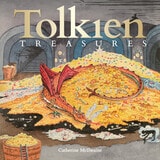
Tolkien
TreasuresCatherine McIlwaine
Bodleian Library Publishing, 2018
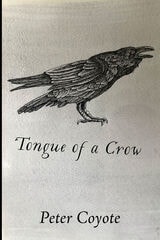
Tongue of a Crow
Peter Coyote
Four Way Books, 2021
Peter Coyote’s first collection of poetry takes us on a whirlwind tour of an eclectic and exciting life as an actor and Zen Buddhist priest, meandering from love affairs to marriage to divorce to the Sixties to psychedelic spirituality and beyond. Written over several decades, these poems read as a collage, each piece distinct and contributing to a cohesive lyric narrative.
Tongue of a Crow
Peter Coyote
Four Way Books, 2021
Peter Coyote’s first collection of poetry takes us on a whirlwind tour of an eclectic and exciting life as an actor and Zen Buddhist priest, meandering from love affairs to marriage to divorce to the Sixties to psychedelic spirituality and beyond. Written over several decades, these poems read as a collage, each piece distinct and contributing to a cohesive lyric narrative.
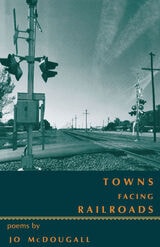
Towns Facing Railroads
PoemsJo McDougall
University of Arkansas Press, 1991
In her second book of poetry, Jo McDougall takes her readers to the dusty prairie towns of the central states, places where the flat terrain belies a complex human landscape. In short, dceptively simple lines, McDougall can so keenly trace the lineaments of place and era that her subject stands before us, its essence displayed and made timeless.
Quietly, with an almost aphoristic bit, McDougall writes about ordinary lives and small towns in a way that her readers may never forget.
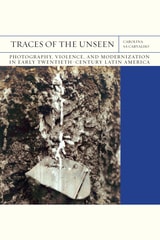
Traces of the Unseen
Photography, Violence, and Modernization in Early Twentieth-Century Latin AmericaCarolina Sá Carvalho
Northwestern University Press, 2023
Winner of the 2024 Roberto Reis Book Award
Winner of the LASA Environment Section Best Book of 2023
Winner of the LASA Amazonian Studies Section Best Book of 2024
Co-Winner of the LASA Book Award for the Visual Culture Studies 2024
A richly illustrated examination of photography as a technology for documenting, creating, and understanding the processes of modernization in turn-of-the-century Brazil and the Amazon
Photography at the turn of the twentieth century was not only a product of modernity but also an increasingly available medium to chronicle the processes of modernization. Traces of the Unseen: Photography, Violence, and Modernization in Early Twentieth-Century Latin America situates photography’s role in documenting the destruction wrought by infrastructure development and extractive capitalist expansion in the Amazon and outside the Brazilian metropole. Combining formal analysis of individual photographs with their inclusion in larger multimedia assemblages, Carolina Sá Carvalho explores how this visual evidence of violence was framed, captioned, cropped, and circulated. As she explains, this photographic creation and circulation generated a pedagogy of the gaze with which increasingly connected urban audiences were taught what and how to see: viewers learned to interpret the traces of violence captured in these images within the larger context of modernization.
Traces of the Unseen draws on works by Flavio de Barros, Euclides da Cunha, Roger Casement, Claude Lévi-Strauss, and Mario de Andrade to situate an unruly photographic body at the center of modernity, in all its disputed meanings. Moreover, Sá Carvalho locates historically specific practices of seeing within the geopolitical peripheries of capitalism. What emerges is a consideration of photography as a technology through which modern aspirations, moral inclinations, imagined futures, and lost pasts were represented, critiqued, and mourned.
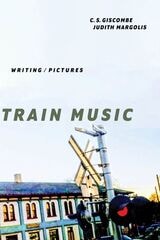
Train Music
Writing / PicturesC.S. Giscombe and Judith Margolis
Omnidawn, 2021
Late in the fall of 2017, poet C. S. Giscombe and book artist Judith Margolis boarded an Amtrak train in New York City and, four days later, stepped off another train at the edge of San Francisco Bay. Giscombe was returning home to California to address an all-white audience on the problem of white supremacy, and expatriate Margolis, accustomed to a somewhat solitary existence, was visiting the United States and making collages. Traveling together, they each turned their train quarters into writing and drawing “studios” where they engaged in conversations and arguments and shared experiences of the discomforts and failures of recent times.
Their original intention had been to travel west and document, in journals and sketchpads, the complex, charged American landscape, but as the trip progressed—and in the months afterwards—the project took on a new shape. Train Music, the book that resulted, recollects and explores the century’s racial and gendered conflicts—sometimes sensually, sometimes in stark images, sometimes in a “mixed economy” of poetry and prose.
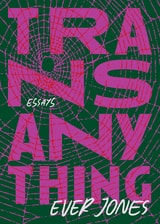
Transanything
EssaysEver Jones
Northwestern University Press, 2025
Transanything reveals a world in metamorphosis. A hermit crab retires its shell, lovers drift apart, and seasons churn, all amid Ever Jones’s own narrative of midlife gender transition.
Jones takes up a tradition of writing—about the American landscape, solitude, wilderness, and the West—long intertwined with colonialism and heteropatriarchy, and makes it wholly their own. A self-proclaimed “nature essay” misbehaves, wandering away from the hummingbird outside Jones’s window. In their chronicle of a week in Yellowstone, Jones navigates trails frequented by grizzlies and a campground where their identity is regarded as equally dangerous. Elk, bison, and bark spiders roam this book’s pages, but it is the gray wolf—the embattled apex predator of the American West, narrow survivor of settler colonial violence, and vessel for American myths of independence—who emerges as Jones’s shapeshifting coprotagonist.
Taking on a global web of colonial systems that seek to divide us, Jones disrupts loneliness and forges space for queerness and transness to be aliveness—to be transanything.
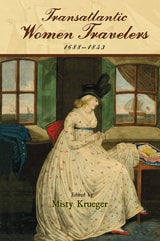
Transatlantic Women Travelers, 1688-1843
Misty Krueger
Bucknell University Press, 2021
Transit Lit
Fictions of Migration in Twenty-First-Century African Immigrant LiteratureCameron Leader-Picone
Northwestern University Press, 2026
The expanding number of migrants to the United States from continental Africa since the 1960s has led to a flourishing twenty-first-century literary corpus by immigrants and the children of immigrants. Transit Lit: Fictions of Migration in Twenty-First-Century African Immigrant Literature analyzes key works by African immigrant authors such as Chimamanda Ngozi Adichie, Teju Cole, and Yaa Gyasi to argue that such texts reveal the tensions between the authors’ own cosmopolitan ideals and a necessary critique of how such ideals become co-opted and commodified within contemporary geopolitics. Cameron Leader-Picone offers a new conceptual framework for reading contemporary diasporic texts that do not fit easily into national or continental traditions or previous literary models. Instead, he argues for the need to embrace the overlapping instabilities—of meaning, identity, and citizenship—that characterize twenty-first-century diasporic movement in an interconnected world. These texts, and the constructions of identity that they trace, map the terrain of contemporary migration.
Translating the Unspeakable
Poetry and the Innovative NecessityKathleen Fraser
University of Alabama Press, 1999
A prominent avant-garde poet charts both her personal artistic development and the difficulties faced by women writers pursuing innovative paths.
An accomplished and influential poet, Kathleen Fraser has been instrumental in drawing attention to other women poets working outside the mainstream. Translating the Unspeakable gathers eighteen of her essays written over nearly twenty years, combining autobiography and criticism to examine what it means for any artist to innovate instead of following an already traveled path.
In autobiographical passages Fraser tells how her generation was influenced by revolutions in art and philosophy during the early 1960s and how she spent years pursuing idiosyncratic means of rediscovering the poem's terms. By the 1970s her evolving poetics were challenged by questions of gender, until immersion in feminist/modernist scholarship led her to initiate greater dialogue among experimentalist poets.
Other essays examine modernist women writers, their contemporary successors, and the visual poetics they have practiced. By exploring the work of such poets as H. D., Mina Loy, Lorine Niedecker, and Barbara Guest, Fraser conveys their struggle to establish a presence within accepted poetic conventions and describes the role experimentation plays in helping women overcome self-imposed silence.
All of Fraser's writings explore how the search to find one's own way of speaking into a very private yet historic space—of translating the unspeakable—drives poetic experimentation for women and men alike. This provocative book provides a glimpse into the thought processes of
the poetic mind, enhancing our understanding of innovative writing.
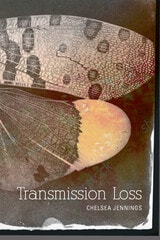
Transmission Loss
Chelsea Jennings
University of Massachusetts Press, 2018
In the study of sound waves and optics, the term transmission loss refers to how a signal grows weaker as it travels across distance and between objects. In this book, Chelsea Jennings reimagines the term in poems that register attenuated signals, mark presence and loss, and treat the body as an instrument sensitive to the weather of immediate experience. Threading together landscapes, abstract paintings, family heirlooms, maps, manuscripts, and photographs, these poems follow the seasons and traverse the spectrum of visible light. Vivid and precise, Transmission Loss brings us to the boundary between inside and outside, “As if what the hand knows / could be held in the hand.”
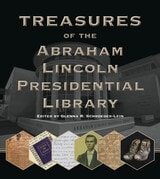
Treasures of the Abraham Lincoln Presidential Library
Edited by Glenna R. Schroeder-Lein
Southern Illinois University Press, 2014
Illinois State Historical Society Superior Achievement Award 2015
The Abraham Lincoln Presidential Library in Springfield, Illinois, houses a trove of invaluable historical resources concerning all aspects of the Prairie State’s past. Treasures of the Abraham Lincoln Presidential Library commemorates the institution’s 125-year history, as well as its contributions to scholarship and education by highlighting a selection of eighty-five treasures from among more than twelve million items in the library’s collections.
After opening with a historical overview and extensive chronology of the Library, the volume organizes the treasures by various topics, including items that illustrate various locations and materials relating to business, the mid-nineteenth century and the Civil War, World Wars I and II, the oldest items, unusual treasures, ethnicity, and art. From the Gettysburg Address, Abraham and Mary Lincoln’s letters, and Governor Dan Walker’s boots to a Deering Harvester Company catalog, WPA publications, and an Adlai Stevenson I campaign hat, each entry includes a thorough description of the item, one or more images, and a discussion of its history and how the library acquired it, if known. Other treasures include the Thomas Yates General Store daybook, Dubin Pullman car materials, Civil War newspapers, a Lincoln coffin photograph, the Mary Lincoln insanity verdict, the Directory of Sangamon County’s Colored Citizens, andLincoln’s stovepipe hat.
To highlight the academic importance of the Library, nineteen researchers share how study in the Library’s collections proved essential to their projects. Although these treasures only scrape the surface of the vast holdings of the Abraham Lincoln Presidential Library, together they epitomize the rich, varied, and sometimes quirky resources available to both serious scholars and curious tourists alike at this valuable cultural institution.
Tremors
Cammy Thomas
Four Way Books, 2021
Thomas’s short, musical poems make stops in the terrains of childhood, difficult and somewhat violent; middle life, with parents breaking down and children moving away into their own lives; and later life when memory falters but passion does not.
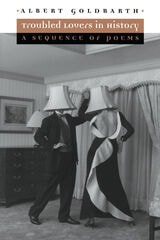
Troubled Lovers in History
A Sequence of PoemsAlbert Goldbarth
The Ohio State University Press, 1999
Troubled Lovers in History demonstrates an exhilarating range: from the briefest of lyrics to rich and multipartite narrative adventures in exotic realms; from a comic monologue spoken in immigrant “Yinglish” to a soulful elegy set in San Antonio’s Pearl Beer brewery plant; from Martian invaders, through polar explorers, to all of us busy inflicting “words with edges” on those we love.
Goldbarth sets his unflinching study of individual hope and grief against the backdrop of history: the travels of Marco Polo; Bertha and Wilhelm Rontgen’s discovery of X-rays; an 1800 battle “twixt Dragon Sam, the great Exhaler of Gouts of Amazing Flame . . . and Liquid Dan, the Living Geyser.”
From the night stars to the little starring parts we all play every day, Troubled Lovers in History takes us into the text of our dreams and despairs, as witnessed by the writer whom Joyce Carol Oates called “a poet of remarkable gifts—a dazzling virtuoso who can break your heart.”
True Faith, True Light
The Devotional Art of Ed StilleyKelly Mulhollan
University of Arkansas Press, 2015
But one day Ed’s life was permanently altered. While plowing his field, he became convinced he was having a heart attack. Ed stopped his work and lay down on the ground. Staring at the sky, he saw himself as a large tortoise struggling to swim across a river. On his back were five small tortoises—his children—clinging to him for survival. And then, as he lay there in the freshly plowed dirt, Ed received a vision from God, telling him that he would be restored to health if he would agree to do one thing: make musical instruments and give them to children.
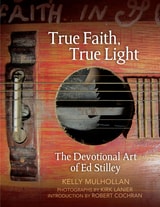
And so he did. Beginning with a few simple hand tools, Ed worked tirelessly for twenty-five years to create over two hundred instruments, each a crazy quilt of heavy, rough-sawn wood scraps joined with found objects. A rusty door hinge, a steak bone, a stack of dimes, springs, saw blades, pot lids, metal pipes, glass bottles, aerosol cans—Ed used anything he could to build a working guitar, fiddle, or dulcimer. On each instrument Ed inscribed “True Faith, True Light, Have Faith in God.”
True Faith, True Light: The Devotional Art of Ed Stilley documents Ed Stilley’s life and work, giving us a glimpse into a singular life of austere devotion.
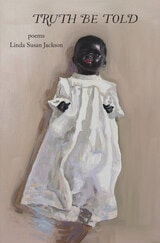
Truth Be Told
Linda Susan Jackson
Four Way Books, 2024
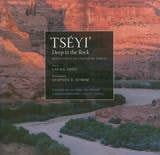
Tséyi' / Deep in the Rock
Reflections on Canyon de ChellyText by Laura Tohe; photographs by Stephen E. Strom
University of Arizona Press, 2005
Diné poet Laura Tohe draws deeply on her heritage to create lyrical writings that are rooted in the canyon but universal in spirit, while photographer Stephen Strom captures images that reveal the very soul of this ancient place. Tohe’s words take readers on a journey from the canyon rim down sheer sandstone walls to its rich bottomlands; from the memory of Kit Carson’s rifle shots and the forced march of the Navajo people to the longings of modern lovers. Her poems view the land through Diné eyes, blending history, tradition, and personal reflection while remaining grounded in Strom’s delicate yet striking images. These photographs are not typical of most southwestern landscapes. Strom’s eye for the subtleties and mysticism of the canyon creates powerful images that linger in the mind long after the pages are turned, compelling us to look at the earth in new ways.
Tséyi' / Deep in the Rock is a unique evocation of Canyon de Chelly and the people whose lives and spirits are connected to it. It is a collaboration that conjures the power of stories and images, inviting us to enter a world of harmony and be touched by its singularly haunting beauty.
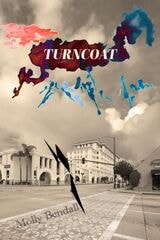
Turncoat
Molly Bendall
Omnidawn, 2025
Through the poems in Turncoat, Molly Bendall’s sixth collection, the speaker and other figures dwell under the ever-present eye of surveillance by unspecified authorities. Mistrust and dread become part of the fabric of their lives, as they never know who may be a turncoat—a person who disguises her allegiances and traffics in betrayal. These poems employ an invented paranoid syntax meant to evade oppressive surveillance. A series of intimate and darkly humorous incidents press the speaker to continually adapt to unseen—or even nonexistent—dangers. Haunted by a sense of disorientation and uncertainty about whether old friendships may have been compromised, or if spaces could disappear overnight, Bendall’s poems coax the reader to step across boundaries and snares, alternating between episodes of interrogation and flight.
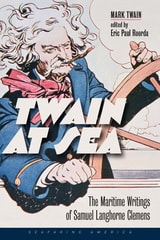
Twain at Sea
The Maritime Writings of Samuel Langhorne ClemensMark Twain
University Press of New England, 2018
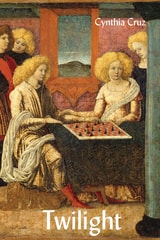
Twilight
Cynthia Cruz
Four Way Books, 2026
Twilight is the intermediary state of becoming, the suspension between, when one is no longer who one was and not yet who they will be. At the end of psychoanalysis, after one has worked through the symbolic investitures one has been relegated to, one is reduced to such a state. In this state of momentary suspension, one is, in a sense, nothing.
Twilight also names a historical moment, when one world is ending but the next has yet to appear. That we are existing in the suspension between the the end of the world as we have known it and the void of what has yet to come is a commonly repeated truth. Hegel describes twilight as “a flash” that in “a single stroke brings to view the structure of the new world,” suggesting that novelty arises out of darkness and obscurity. We are living, in other words, in a state of twilight.
Cruz’s tenth poetry collection takes the concept of twilight and presents, through a series of elliptical poems, a working through of the term. The speakers in these poems exist within this wavering. As she writes in one of several poems titled “Twilight,” “Twilight, its world between worlds / its miraculous suspension. / I belong to the school of Freud’s / hypothetical boarding school girls. / We wait and we wait / for the world to begin.”
Twilight of a Golden Age
Selected Poems of Abraham Ibn EzraWeinberger, Leon J.
University of Alabama Press, 1997
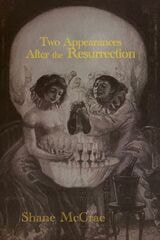
Two Appearances After the Resurrection
Shane McCrae
Omnidawn, 2025
This is a book about perceiving and being perceived. The various subjects of these poems are viewed by an artist, a devil, a soul floating out of a body it had inhabited, a god fed up with her husband’s infidelities, and a father whose young child has COVID-19. The poems of Two Appearances After the Resurrection are haunted by the question of what one ought to do with their perceivability.
After a decade of publishing poems almost exclusively utilizing no punctuation aside from the slash, Shane McCrae began including semi-regular punctuation in his 2023 book, The Many Hundreds of the Scent. He continues that project in Two Appearances After the Resurrection. Here, he further explores the consequences—especially the rhythmical consequences—of the change. Throughout these poems, McCrae perceives and implicitly considers his own shifting approaches to writing.
Two Signatures
Sara Ellen Fowler
University of Utah Press, 2024
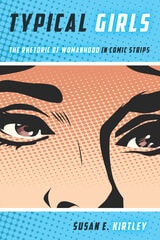
Typical Girls
The Rhetoric of Womanhood in Comic StripsSusan E. Kirtley
The Ohio State University Press, 2021
In the years following 1975, a group of female-created comic strips came to national attention in a traditionally male-dominated medium. Typical Girls: The Rhetoric of Womanhood in Comic Strips uncovers the understudied and developing history of these strips, defining and exploring the ramifications of this expression of women’s roles at a time of great change in history and in comic art. This impressive, engaging, and timely study illustrates how these comics express the complexities of women’s experiences, especially as such experiences were shaped by shifting and often competing notions of womanhood and feminism. Including the comics of Lynn Johnston (For Better or For Worse), Cathy Guisewite (Cathy), Nicole Hollander (Sylvia), Lynda Barry (Ernie Pook’s Comeek), Barbara Brandon-Croft (Where I’m Coming From), Alison Bechdel (Dykes to Watch Out For), and Jan Eliot (Stone Soup), Typical Girls is an important history of the representation of womanhood and women’s rights in popular comic strips.
Tyrants Writing Poetry
Albrecht Koschorke
Central European University Press, 2018
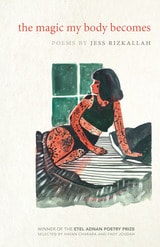
the magic my body becomes
Poems byJess Rizkallah
University of Arkansas Press, 2017
Winner, 2017 Etel Adnan Poetry Prize
In the magic my body becomes, Jess Rizkallah seeks a vernacular for the inescapable middle ground of being Arab American—a space that she finds, at times, to be too Arab for America and too American for her Lebanese elders.
These poems freely assert gender, sexuality, and religious beliefs while at the same time respecting a generational divide: the younger’s privilege gained by the sacrifice of the older, the impossibility of separating what is wholly hers from what is hers secondhand.
In exploring family history, civil war, trauma, and Lebanon itself, Rizkallah draws from the spirits of canonical Arab and Middle Eastern poets. As a result of her conjuring, the reader feels these spirits begin to exorcise the grief of those who are still alive. Throughout, there is the body, a reclamation and pushback against cultures that simultaneously sexualize and shame women. And there is a softness as inherent as rage, a resisting of stereotypes that too often speak louder than the complexities of a resilient cultural identity.
The magic my body becomes is an exciting new book from an exciting young poet, a love letter to a people as well as a fist in the air.