Results by title
2285 books match the query 'Women' and 370 start with t
The Paradox of Gender Equality
How American Women's Groups Gained and Lost Their Public VoiceKristin A. Goss
University of Michigan Press, 2013
Drawing on original research, Kristin A. Goss examines how women's civic place has changed over the span of more than 120 years, how public policy has driven these changes, and why these changes matter for women and American democracy. Suffrage, which granted women the right to vote and invited their democratic participation, provided a dual platform for the expansion of women's policy agendas. As measured by women's groups' appearances before the U.S. Congress, women's collective political engagement continued to grow between 1920 and 1960—when many conventional accounts claim it declined—and declined after 1980, when it might have been expected to grow. This waxing and waning was accompanied by major shifts in issue agendas, from broad public interests to narrow feminist interests.
Goss suggests that ascriptive differences are not necessarily barriers to disadvantaged groups' capacity to be heard; that enhanced political inclusion does not necessarily lead to greater collective engagement; and that rights movements do not necessarily constitute the best way to understand the political participation of marginalized groups. She asks what women have gained — and perhaps lost — through expanded incorporation as well as whether single-sex organizations continue to matter in 21st-century America.
The Paradox of Gender Equality
How American Women's Groups Gained and Lost Their Public VoiceKristin A. Goss
University of Michigan Press, 2020
Goss asks what women have gained, and perhaps lost, through expanded incorporation, as well as whether single-sex organizations continue to matter in 21st-century America.
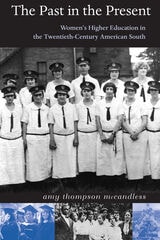
The Past in the Present
Women's Higher Education in the Twentieth-Century American SouthAmy T. McCandless
University of Alabama Press, 1999
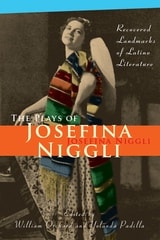
The Plays of Josefina Niggli
Recovered Landmarks of Latino LiteratureJosefina Niggli; Edited by William Orchard and Yolanda Padilla
University of Wisconsin Press, 2007
Although Niggli is perhaps best known for her fiction and folk plays, this anthology recovers her historical dramas, most of which have been long out of print or were never published. These plays are deeply concerned with the aftermath of the 1910 Mexican Revolution, imagining its implications for Mexico, Mexican Americans, and U.S.-Mexico relations. Included are Mexican Silhouettes (1928), Singing Valley (1936), The Cry of Dolores (1936), The Fair God (1936), Soldadera (1938), This is Villa! (1939), and The Ring of General Macias (1943). These works reflect on the making of history and often portray the Revolution through the lens of women’s experiences.
Also included in this volume are an extensive critical introduction to Niggli, a chronology of her life and writings, plus letters and reviews by, to, and about Josefina Niggli. that provide illuminating context for the plays.

The Poetics and Politics of the Veil in Iran
An Archival and Photographic AdventureAzadeh Fatehrad
Intellect Books, 2019
The Poetics and Politics of the Veil in Iran features Fatehrad’s own photographs in addition to work by artists Hengameh Golestan, Shirin Neshat, Shadi Ghadirian, Abbas Kiarostami, Mohsen Makhmalbaf, Adolf Loos, Gaëtan Gatian de Clérambault, and Alison Watt. In exploring women’s lives in post-revolutionary Iran, Fatehrad considers the role of the found image and the relationship between the archive and the present, resulting in an illuminating history of feminism in Iran in the twentieth and twenty-first centuries.
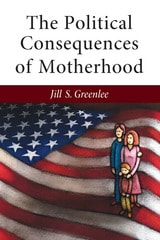
The Political Consequences of Motherhood
Jill S. Greenlee
University of Michigan Press, 2015
From civically and politically engaged women linking their identity as “mothers” to their fight for prohibition, public sanitation, and protective labor laws to the general call to arms of “mama grizzlies” issued by Sarah Palin in 2010, American political activists and candidates have used motherhood to rally women’s interest, support, and participation throughout American history. Politicized motherhood persists, and motherhood continues to inspire women’s participation and direct their concerns.
In The Political Consequences of Motherhood, Jill S. Greenlee investigates the complex relationship between motherhood and women’s political attitudes. Combining a historical overview of the ways motherhood has been used for political purposes with recent political opinion surveys and individual-level analysis, she explains how and when motherhood shapes women’s thoughts and preferences. Greenlee argues that two mechanisms account for the durability of motherhood politics. First, women experience attitudinal shifts when they become mothers. Second, “mother” is a broad-based identity, widely shared and ideologically unconstrained, that lends itself to appeals across the political spectrum to build support for candidates and policy issues.
The Political Integration of Women
Roles, Socialization, and PoliticsVirginia Sapiro
University of Illinois Press, 1983
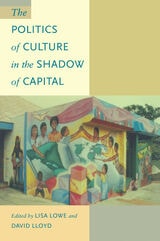
The Politics of Culture in the Shadow of Capital
Lisa Lowe and David Lloyd, eds.
Duke University Press, 1997
Reworking Marxist critique, these essays on Asia, Latin America, the Caribbean, North America, and Europe advance a new understanding of "cultural politics" within the context of transnational neocolonial capitalism. This perspective contributes to an overall critique of traditional approaches to modernity, development, and linear liberal narratives of culture, history, and democratic institutions. It also frames a set of alternative social practices that allows for connections to be made between feminist politics among immigrant women in Britain, women of color in the United States, and Muslim women in Iran, Egypt, Pakistan, and Canada; the work of subaltern studies in India, the Philippines, and Mexico; and antiracist social movements in North and South America, the Caribbean, and Europe. These connections displace modes of opposition traditionally defined in relation to the modern state and enable a rethinking of political practice in the era of global capitalism.
Contributors. Tani E. Barlow, Nandi Bhatia, Dipesh Chakrabarty, Chungmoo Choi, Clara Connolly, Angela Davis, Arturo Escobar, Grant Farred, Homa Hoodfar, Reynaldo C. Ileto, George Lipsitz, David Lloyd, Lisa Lowe, Martin F. Manalansan IV, Aihwa Ong, Pragna Patel, José Rabasa, Maria Josefina Saldaña-Portillo, Jaqueline Urla
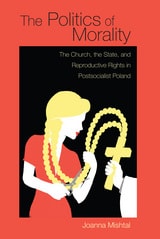
The Politics of Morality
The Church, the State, and Reproductive Rights in Postsocialist PolandJoanna Mishtal
Ohio University Press, 2015
After the fall of the state socialist regime and the end of martial law in 1989, Polish society experienced both a sense of relief from the tyranny of Soviet control and an expectation that democracy would bring freedom. After this initial wave of enthusiasm, however, political forces that had lain concealed during the state socialist era began to emerge and establish a new religious-nationalist orthodoxy. While Solidarity garnered most of the credit for democratization in Poland, it had worked quietly with the Catholic Church, to which a large majority of Poles at least nominally adhered. As the church emerged as a political force in the Polish Sejm and Senate, it precipitated a rapid erosion of women’s reproductive rights, especially the right to abortion, which had been relatively well established under the former regime.
The Politics of Morality is an anthropological study of this expansion of power by the religious right and its effects on individual rights and social mores. It explores the contradictions of postsocialist democratization in Poland: an emerging democracy on one hand, and a declining tolerance for reproductive rights, women’s rights, and political and religious pluralism on the other. Yet, as this thoroughly researched study shows, women resist these strictures by pursuing abortion illegally, defying religious prohibitions on contraception, and organizing into advocacy groups. As struggles around reproductive rights continue in Poland, these resistances and unofficial practices reveal the sharp limits of religious form of governance.
The Politics of Rape
Sexual Atrocity, Propaganda Wars, and the Restoration StageJennifer L. Airey
University of Delaware Press, 2013
Published by University of Delaware Press. Distributed worldwide by Rutgers University Press.
The Politics of State Feminism
Innovation in Comparative ResearchAuthored by Dorothy E. McBride and Amy G. Mazur
Temple University Press, 2012
The Politics of State Feminism addresses essential questions of women's movement activism and political change in western democracies. The authors—top gender and politics scholars—provide a comparative analysis of the effectiveness of government agencies and women's movements regarding women’s policy issues—if, how, and why they form a kind of state feminism.
The central research questions are examined across five issue areas in thirteen postindustrial democracies in Europe and North America from the 1960s through the early 2000s. The authors explore a range of topics drawn from contemporary theory, interactions between descriptive and substantive representation, and the place of institutions in democratic change.
Using the innovative qualitative and quantitative methods employed by the Research Network on Gender Politics and the State, the authors have developed a new body of theories about the role of state feminism and how it can help further women’s rights.
The Politics of Women's Biology
Hubbard, Ruth
Rutgers University Press, 1990
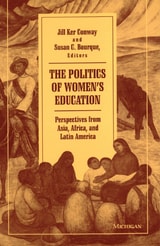
The Politics of Women's Education
Perspectives from Asia, Africa, and Latin AmericaJill Ker Conway and Susan C. Bourque, Editors
University of Michigan Press, 1995
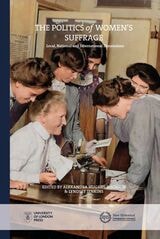
The Politics of Women's Suffrage
Local, National and International DimensionsEdited by Alexandra Hughes-Johnson and Lyndsey Jenkins
University of London Press, 2021
In the United Kingdom, the question of women’s suffrage represented the most substantial challenge to the constitution since 1832, seeking not only to expand but to redefine definitions of citizenship and power. At the same time, it was inseparable from other urgent contemporary political debates—the Irish question, the decline of the British Empire, the Great War, and the increasing demand for workers’ rights.
This collection positions women’s suffrage as central to, rather than separate from, these broader political discussions, demonstrating how they intersected and were mutually constitutive. In particular, this collection pays close attention to the issues of class and Empire which shaped this era. It demonstrates how campaigns for women’s rights were consciously and unconsciously played out, impacting attitudes to motherhood, spurring the radical “birth-strike” movement, and burgeoning communist sympathies in working-class communities around Britain and beyond.
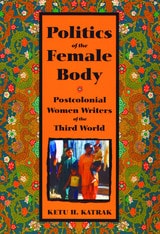
The Politics of the Female Body
Postcolonial Women WritersKetu H. Katrak
Rutgers University Press, 2006
Is it possible to simultaneously belong to and be exiled from a community? In Politics of the Female Body, Ketu H. Katrak argues that it is not only possible, but common, especially for women who have been subjects of colonial empires.
Through her careful analysis of postcolonial literary texts, Katrak uncovers the ways that the female body becomes a site of both oppression and resistance. She examines writers working in the English language, including Anita Desai from India, Ama Ata Aidoo from Ghana, and Merle Hodge from Trinidad, among others. The writers share colonial histories, a sense of solidarity, and resistance strategies in the on-going struggles of decolonization that center on the body.
Bringing together a rich selection of primary texts, Katrak examines published novels, poems, stories, and essays, as well as activist materials, oral histories, and pamphlets—forms that push against the boundaries of what is considered strictly literary. In these varied materials, she reveals common political and feminist alliances across geographic boundaries.
A unique comparative look at women’s literary work and its relationship to the body in third world societies, this text will be of interest to literary scholars and to those working in the fields of postcolonial studies and women’s studies.
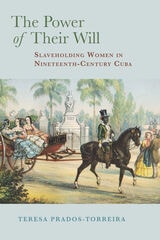
The Power of Their Will
Slaveholding Women in Nineteenth-Century CubaTeresa Prados-Torreira
University of Alabama Press, 2021
CHOICE OUTSTANDING ACADEMIC TITLE, 2022
“This fascinating book explores the unique circumstances of white slaveholding women in 19th-century Cuba and the enslaved peoples they controlled . . .This is a must read for scholars of the Caribbean and the African diaspora. Essential.” —CHOICE
In the early nineteenth century, while abolitionism was rising and the slave trade was declining in the Atlantic world, Spain used this opportunity to massively expand plantation slavery in Cuba. Between 1501 and 1866, more than 778,000 Africans were torn from their homelands and brought to work for the Cuban slaveholding class.
An understudied aspect of Cuban slaveholding society is the role of the white Cuban slave mistress (amas). The Power of Their Will: Slaveholding Women in Nineteenth-Century Cuba illuminates the interaction of female slaveholders and the enslaved during this time. Teresa Prados-Torreira shows, despite the lack of political power in a highly patriarchal society, Cuban women as property owners were instrumental in supporting the long duration of slavery, whether by enforcing the disciplining of the enslaved in the domestic sphere or helping to create the illusion of slavery as a humane institution. Thousands of Creole slaveholding women relied on slaves to lead a comfortable life. Even the subsistence of many poor women depended on the income derived from the hiring out of their enslaved.
In this accessible cultural history, culled from government documents, fiction, newspaper articles, traveler’s accounts, women’s wills, and archival research, Prados-Torreira coalesces a valuable narrative out of the often paradoxical and conflicting stories of the human bonds between the female owner and the enslaved. Narrative chapters, enlivened by vignettes, describe the daily life of slave mistresses in the main cities of Havana and Santiago and other towns, workings of sugar mills and coffee plantations, how slaveholding women coping with slave rebellions and wartime during the Ten Years’ War, and how personal relationships could occasionally affect the balance of power.
The Practice of U.S. Women's History
Narratives, Intersections, and DialoguesEdited by S. Jay Kleinberg, Eileen Boris, and Vicki L. Ruiz
Rutgers University Press, 2008
In the last several decades, U.S. women’s history has come of age. Not only have historians challenged the national narrative on the basis of their rich explorations of the personal, the social, the economic, and the political, but they have also entered into dialogues with each other over the meaning of women’s history itself.
In this collection of seventeen original essays on women’s lives from the colonial period to the present, contributors take the competing forces of race, gender, class, sexuality, religion, and region into account. Among many other examples, they examine how conceptions of gender shaped government officials’ attitudes towards East Asian immigrants; how race and gender inequality pervaded the welfare state; and how color and class shaped Mexican American women’s mobilization for civil and labor rights.
The Prism of Human Rights
Seeking Justice amid Gender Violence in Rural EcuadorKarin Friederic
Rutgers University Press, 2023
The Prodigal Daughter
Reclaiming an Unfinished ChildhoodMargaret Gibson
University of Missouri Press, 2008
The 1950s and 1960s were years of shifting values and social changes that did not sit well with many citizens of Richmond, Virginia, and in particular with one conservative family, a staunchly southern mother and father and their two daughters. A powerful evocation of time and place, this memoir—a gifted poet's first book of prose—is the story of an inquisitive and sensitive young woman's coming of age and a deeply moving recounting of her reconciliation later in life with the family she left behind.
Returning us to a Cold War world marked by divisions of race, gender, wealth, and class, The Prodigal Daughter is an exploration of difference, the powerful wedge that separates individuals within a social milieu and within a family. Echoing the biblical Prodigal Son, Margaret Gibson's memoir is less concerned with the years of excess away from home than with the seeds of division sown in this family's early years. Hers is the story of a mother proud to be a Lady, a Southerner, and a Christian; of two daughters trapped by their mother's power; and of their father's breakdown under social and family expectations.
Slow to rebel, young Margaret finally flees the world of manners and custom—which she deems poor substitutes for right thought and right action in the face of the Civil Rights movement and the Vietnam War—and abandons her fundamentalist upbringing. In a defiant gesture that proves prophetic, she once signed a postcard home "The Prodigal." After years of being the distant, absent daughter, she finds herself returning home to meet the needs of her stroke-crippled younger sister and her incapacitated parents.
In this tale of homecoming and forgiveness, death and dying, Gibson recounts how she overcame her long indifference to a sister she had thought different from herself, recognizing the strengths of the bonds that both hold us and set us free. Interweaving astute social observations on social pressures, race relations, sibling rivalry, adolescent angst, and more, The Prodigal Daughter is a startlingly honest portrayal of one family in one southern city and the story of all too many families across America.
The Prophetess and the Patriarch
The Visions of an Anti-Regicide in Seventeenth-Century EnglandElizabeth Poole
Iter Press, 2023
In 1649, a seamstress named Elizabeth Poole appeared at the Whitehall debates in London to prophesy in front of Parliament’s army shortly after it had defeated the crown in the English civil wars. Invited to help deliberate the fate of Charles I, Poole advised the army to spare the king’s life but to put him on trial for tyranny and to enter into a new compact with the people. After her visions proved controversial, she was defamed as a prostitute and a witch. She retaliated by printing her prophecies, along with two new defenses of her original revelations. This collection publishes Poole’s pamphlets in full for the first time.
The Provocative Joan Robinson
The Making of a Cambridge EconomistNahid Aslanbeigui and Guy Oakes
Duke University Press, 2009
Aslanbeigui and Oakes demonstrate that Robinson’s professional identity was thoroughly embedded in a local scientific culture in which the Cambridge economists A. C. Pigou, John Maynard Keynes, Dennis Robertson, Piero Sraffa, Richard Kahn (Robinson’s closest friend on the Cambridge faculty), and her husband Austin Robinson were important figures. Although the economists Joan Robinson most admired—Pigou, Keynes, and their mentor Alfred Marshall—had discovered ideas of singular greatness, she was convinced that each had failed to grasp the essential theoretical significance of his own work. She made it her mission to recast their work both to illuminate their major contributions and to redefine a Cambridge tradition of economic thought. Based on the extensive correspondence of Robinson and her colleagues, The Provocative Joan Robinson is the story of a remarkable woman, the intellectual and social world of a legendary group of economists, and the interplay between ideas, ambitions, and disciplinary communities.
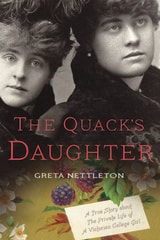
The Quack's Daughter
A True Story about the Private Life of a Victorian College Girl, Revised EditionGreta Nettleton
University of Iowa Press, 2014
This lively, stereotype-shattering story might have been lost, had Cora’s great-granddaughter, Greta Nettleton, not decided to go through some old family trunks instead of discarding most of the contents unexamined. Inside she discovered a rich cache of Cora’s college memorabilia—essential complements to her 1885 diary, which Nettleton had already begun to read. The Quack’s Daughter details Cora’s youthful travails and adventures during a time of great social and economic transformation. From her working-class childhood to her gilded youth and her later married life, Cora experienced triumphs and disappointments as a gifted concert pianist that the reader will recognize as tied to the limited opportunities open to women at the turn of the twentieth century, as well as to the dangerous consequences for those who challenged social norms.
Set in an era of surging wealth torn by political controversy over inequality and women’s rights and widespread panic about domestic terrorists, The Quack’s Daughter is illustrated with over a hundred original images and photographs that illuminate the life of a spirited and charming heroine who ultimately faced a stark life-and-death crisis that would force her to re-examine her doubts about her mother’s medical integrity.
The Question of Women in Chinese Feminism
Tani E. Barlow
Duke University Press, 2004

The Red Riviera
Gender, Tourism, and Postsocialism on the Black SeaKristen Ghodsee
Duke University Press, 2005
Interspersed throughout The Red Riviera are vivid examinations of the lives of Bulgarian women, including a waitress, a tour operator, a chef, a maid, a receptionist, and a travel agent. Through these women’s stories, Ghodsee describes their employment prior to 1989 and after. She considers the postsocialist forces that have shaped the tourist industry over the past fifteen years: the emergence of a new democratic state, the small but increasing interest of foreign investors and transnational corporations, and the proliferation of ngos. Ghodsee suggests that many of the ngos, by insisting that Bulgarian women are necessarily disenfranchised, ignore their significant professional successes.
The Resilient Self
Gender, Immigration, and Taiwanese AmericansGu, Chien-Juh
Rutgers University Press, 2017
Most of the women immigrated as dependents when their U.S.-educated husbands found professional jobs upon graduation. Constrained by their dependent visas, these women could not work outside of the home during the initial phase of their settlement. The significant contrast of their lives before and after immigration—changing from successful professionals to foreign housewives—generated feelings of boredom, loneliness, and depression. Mourning their lost careers and lacking fulfillment in homemaking, these highly educated immigrant women were forced to redefine the meaning of work and housework, which in time shaped their perceptions of themselves and others in the family, at work, and in the larger community.
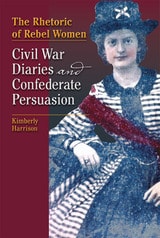
The Rhetoric of Rebel Women
Civil War Diaries and Confederate PersuasionKimberly Harrison
Southern Illinois University Press, 2013
Informed by more than one hundred diaries, this study provides insight into how women cultivated rhetorical agency, challenging traditional gender expectations while also upholding a cultural status quo. Author Kimberly Harrison analyzes the rhetorical choices these women made and valued in wartime and postwar interactions with Union officers and soldiers, slaves and former slaves, local community members, and even their God. In their intimate accounts of everyday war, these diarists discussed rhetorical strategies that could impact their safety, their livelihoods, and those of their families. As they faced Union soldiers in attempts to protect their homes and property, diarists saw their actions as not only having local, immediate impact on their well-being but also as reflecting upon their cause and the character of the southern people as a whole. They instructed themselves through their personal writing, allowing insight into how southern women prepared themselves to speak and act in new and contested contexts.
The Rhetoric of Rebel Women highlights the contributions of privileged white southern women in the development of the Confederate national identity, presenting them not as passive observers but as active participants in the war effort.
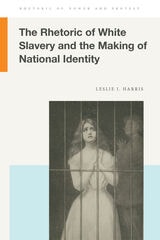
The Rhetoric of White Slavery and the Making of National Identity
Leslie J Harris
Michigan State University Press, 2023
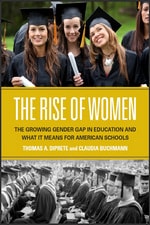
The Rise of Women
The Growing Gender Gap in Education and What it Means for American SchoolsThomas A. DiPrete
Russell Sage Foundation, 2013
The Rising of Women
Feminist Solidarity and Class Conflict, 1880-1917Meredith Tax
University of Illinois Press, 2001
Through detailed studies of the Woman's Trade Union League, the Illinois Women's Alliance, the New York shirtwaist makers strike of 1909-10, and the 1912 textile workers strike in Lawrence, Massachusetts, Meredith Tax uncovers the circumstances that helped and hindered cross-class and cross-gender cooperation on behalf of women of the working class. In a new introduction to this first Illinois paperback edition, Tax assesses the progress of women's solidarity since the book's original publication.

The Rival
Sara Wallace
University of Utah Press, 2015
Winner of the Agha Shahid Ali Poetry Prize
In The Rival, Sara Wallace takes her readers on an intimate journey through a woman’s solitary, surreal rural childhood and her brutal, sexually fraught first marriage to the conflicted redemption she finds in motherhood and a second chance at love. In this debut poetry collection, Wallace reveals how closely emotional devastation and transcendence can coexist. The Rival is sensuous, darkly humorous, and frequently luminous in its unflinching exploration of the inner life.

The River of Angry Dogs
A MemoirMira Hamermesh
Pluto Press, 2004
As a young Jewish teenager Hamermesh escaped the horrors of German-occupied Poland and was spared the experience of the ghetto and the concentration camp that claimed most of her family. Mira shows how her status as a refugee has continued to influence her throughout her life. The journey led her across Europe and eventually to Palestine in 1941; her account of that region, before the establishment of Israel, provides a fascinating insight into the historical setting for today's conflict.
Having settled in London where she studied art and married, she eventually won a place at the celebrated Polish Film School in Lodz. At the height of the Cold War Mira Hamermesh commuted across the Iron Curtain – her experience of a divided Europe offers many insights into the political factors that affected people's everyday lives. Mira's theme of political conflict, so often explored in her films, is brought to life here in an intimate account that will live long in the memory.
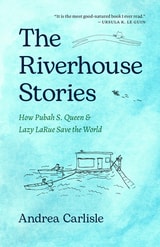
The Riverhouse Stories
How Pubah S. Queen and Lazy LaRue Save the WorldAndrea Carlisle
Oregon State University Press, 1986
40th anniversary edition of a rediscovered classic
When Pubah and Lazy LaRue move to a houseboat on an Oregon river, they find themselves immersed in a life filled with whimsical adventures. Even though their dwelling is ancient, tippy, and in need of endless repairs, their affection for it, for river life, and for one another does not wane. These linked stories teem with life and with love for their friends and for new neighbors—other houseboat people, ducks, beavers, muskrats, and all else the river has to offer. Lazy LaRue writes stories; Pubah is an apprentice electrician. Their world encompasses the mundane and the fanciful—from lassoing logs and rewiring a houseboat to dreaming of new inventions and traveling in a hot air balloon.
Filled with humor, optimism, and playful exploration, the stories in these pages bring warmth and inspiration. Illustrations by Mary Narkiewicz capture the quirky quality of the tales with splendid charm and add to the dreamlike quality of the storytelling. A new afterword by the author reflects on writing The Riverhouse Stories and on the cultural climate of the time, showing how much the world has changed over four decades.
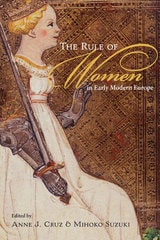
The Rule of Women in Early Modern Europe
Edited by Anne J. Cruz and Mihoko Suzuki
University of Illinois Press, 2008
Drawing on early modern literature and historical documents, this study investigates the various political, discursive, and symbolic measures employed to negotiate and support female sovereignty by both early modern writers and the rulers themselves. The detailed analysis of the women's responses--or inability to respond--to these strictures underscores the relationship between early modern authors and sovereigns and the complex and vexed situation of European women rulers.
Contributors are Tracy Adams, Anne J. Cruz, Éva Deák, Mary C. Ekman, Catherine L. Howey, Elizabeth Ketner, Carole Levin, Sandra Logan, Magdalena S. Sánchez, Mihoko Suzuki, and Barbara F. Weissberger.
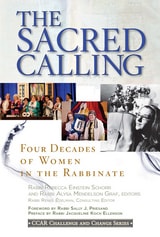
The Sacred Calling
Four Decades of Women in the RabbinateRabbi Rebecca Einstein Schorr and Rabbi Alysa Mendelson Graf
Central Conference of American Rabbis, 2016
Winner of the 2016 National Jewish Book Award in Women's Studies, this pioneering anthology paints an illuminating and necessary picture of the past while laying the groundwork for important work yet to be done.
Women have been rabbis for over forty years. No longer are women rabbis a unique phenomenon, rather they are part of the fabric of Jewish life. In this anthology, rabbis and scholars from across the Jewish world reflect back on the historic significance of women in the rabbinate and explore issues related to both the professional and personal lives of female rabbis. This collection examines the ways in which the reality of women in the rabbinate has impacted all aspects of Jewish life, including congregational culture, liturgical development, life cycle ritual, the Jewish healing movement, spirituality, theology, and more.
The Scandal of the State
Women, Law, and Citizenship in Postcolonial IndiaRajeswari Sunder Rajan
Duke University Press, 2003
The Scandal of the State develops through a series of compelling case studies, each of which centers around an incident exposing the contradictory position of the Indian state vis-à-vis its female citizens and, ultimately, the inadequacy of its commitment to women’s rights. Sunder Rajan focuses on the custody battle over a Muslim child bride, the compulsory sterilization of mentally retarded women in state institutional care, female infanticide in Tamilnadu, prostitution as labor rather than crime, and the surrender of the female outlaw Phoolan Devi. She also looks at the ways the Uniform Civil Code presented many women with a stark choice between allegiance to their religion and community or the secular assertion of individual rights. Rich with theoretical acumen and activist passion, The Scandal of the State is a powerful critique of the mutual dependence of women and the state on one another in the specific context of a postcolonial modernity.
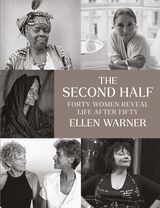
The Second Half
Forty Women Reveal Life After FiftyEllen Warner
Brandeis University Press, 2022
A frank, honest, and insightful look into the lives of women over fifty.
The Second Half explores, in photographic portraits and interviews, how the second half of life is experienced by women from many different cultures. From a French actress to a British novelist, from an Algerian nomad to a Saudi Arabian doctor, and an American politician, Ellen Warner traveled all over the world to interview women about their lives. She asked them what they learned in the first half that was helpful in the second, and what advice they would give to younger women. Their revealing and inspiring stories are enlightening for all readers, and are illustrated by Warner’s stunning portraits which tell their own story.

The Seductions of Quantification
Measuring Human Rights, Gender Violence, and Sex TraffickingSally Engle Merry
University of Chicago Press, 2016
With The Seductions of Quantification, leading legal anthropologist Sally Engle Merry investigates the techniques by which information is gathered and analyzed in the production of global indicators on human rights, gender violence, and sex trafficking. Although such numbers convey an aura of objective truth and scientific validity, Merry argues persuasively that measurement systems constitute a form of power by incorporating theories about social change in their design but rarely explicitly acknowledging them. For instance, the US State Department’s Trafficking in Persons Report, which ranks countries in terms of their compliance with antitrafficking activities, assumes that prosecuting traffickers as criminals is an effective corrective strategy—overlooking cultures where women and children are frequently sold by their own families. As Merry shows, indicators are indeed seductive in their promise of providing concrete knowledge about how the world works, but they are implemented most successfully when paired with context-rich qualitative accounts grounded in local knowledge.
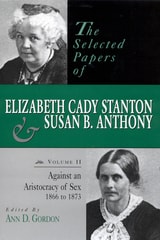
The Selected Papers of Elizabeth Cady Stanton and Susan B. Anthony
Against an Aristocracy of Sex, 1866 to 1873Gordon, Ann D
Rutgers University Press, 2000
The second volume picks up the story of Stanton and Anthony at the end of 1866, when they launched their drive to make universal suffrage the priority of Reconstruction. Through letters, speeches, articles, and diaries, this volume recounts their years as editor and publisher of the weekly paper the Revolution, their extensive travels, and their lobbying with Congress. It touches on the bitter division that occurred among suffragists over such controversial topics as marriage and divorce, and a national debate over the citizenship of women under the Fourteenth and Fifteenth Amendments. By the summer of 1873, when this volume ends, Anthony stood convicted of the federal crime of illegal citizenship of women under the Fourteenth and Fifteenth Amendments. By the summer of 1873, when this volume ends, Anthony stood convicted of the federal crime of illegal voting. An irate Stanton warned, "I felt afresh the mockery of this boasted chivalry of man towards woman."
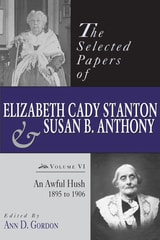
The Selected Papers of Elizabeth Cady Stanton and Susan B. Anthony
An Awful Hush, 1895 to 1906Gordon, Ann D
Rutgers University Press, 2012
The “hush” of the title comes suddenly, when first Elizabeth Cady Stanton dies on October 26, 1902, and three years later Susan B. Anthony dies on March 13, 1906. It is sudden because Stanton, despite near blindness and immobility, wrote so intently right to the end that editors had supplies of her articles on hand to publish several months after her death. It is sudden because Anthony, at the age of eighty-five, set off for one more transcontinental trip, telling a friend on the Pacific Coast, “it will be just as well if I come to the end on the cars, or anywhere, as to be at home.”
Volume VI of this extraordinary series of selected papers is inescapably about endings, death, and silence. But death happens here to women still in the fight. An Awful Hush is about reformers trained “in the school of anti-slavery” trying to practice their craft in the age of Jim Crow and a new American Empire. It recounts new challenges to “an aristocracy of sex,” whether among the bishops of the Episcopal church, the voters of California, or the trustees of the University of Rochester. And it sends last messages about woman suffrage. As Stanton wrote to Theodore Roosevelt on the day before she died, “Surely there is no greater monopoly than that of all men, in denying to all women a voice in the laws they are compelled to obey.”
With the publication of Volume VI, this series is now complete.
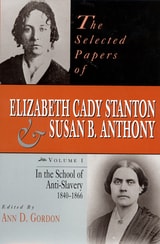
The Selected Papers of Elizabeth Cady Stanton and Susan B. Anthony
In the School of Anti-Slavery, 1840 to 1866Gordon, Ann D
Rutgers University Press, 1997
In the School of Anti-Slavery, 1840-1866 is the first of six volumes of The Selected Papers of Elizabeth Cady Stanton and Susan B. Anthony. The collection documents the lives and accomplishments of two of America's most important social and political reformers. Though neither Stanton nor Anthony lived to see the passage of the Nineteenth Amendment in 1920, each of them devoted fifty-five years to the cause. Their names were synonymous with woman suffrage in the United States and around the world as they mobilized thousands of women to fight for the right to a political voice.
Opening when Stanton was twenty-five and Anthony was twenty, and ending when Congress sent the Fourteenth Amendment to the states for ratification, this volume recounts a quarter of a century of staunch commitment to political change. Readers will enjoy an extraordinary collection of letters, speeches, articles, and diaries that tells a story-both personal and public-about abolition, temperance, and woman suffrage.
When all six volumes are complete, the Selected Papers of Stanton and Anthony will contain over 2,000 texts transcribed from their originals, the authenticity of each confirmed or explained, with notes to allow for intelligent reading. The papers will provide an invaluable resource for examining the formative years of women's political participation in the United States. No library or scholar of women's history should be without this original and important collection.
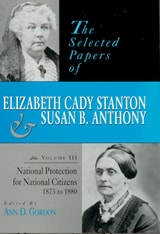
The Selected Papers of Elizabeth Cady Stanton and Susan B. Anthony
National Protection for National Citizens, 1873 to 1880Gordon, Ann D
Rutgers University Press, 2003
National Protection for National Citizens, 1873 to 1880 is the third of six planned volumes of TheSelected Papers of Elizabeth Cady Stanton and Susan B. Anthony. The entire collection documents the friendship and accomplishments of two of America's most important social and political reformers. Though neither Stanton nor Anthony lived to see passage of the Nineteenth Amendment in 1920, each of them devoted fifty-five years to the cause of woman suffrage.
The third volume of the Selected Papers of Elizabeth Cady Stanton and Susan B. Anthony opens while woman suffragists await the decision of the U.S. Supreme Court in cases testing whether the Constitution recognized women as voters within the terms of the Fourteenth and Fifteenth Amendments. At its close they are pursuing their own amendment to the Constitution and pressing the presidential candidates of 1880 to speak in its favor. Through their letters, speeches, articles, and diaries, the volume recounts the national careers of Elizabeth Cady Stanton and Susan B. Anthony as popular lecturers, their work with members of Congress to expand women's rights, their protests during the Centennial Year of 1876, and the launch that same year of their campaign for a Sixteenth Amendment.
The Selected Papers of Elizabeth Cady Stanton and Susan B. Anthony
Their Place Inside the Body-Politic, 1887 to 1895Gordon, Ann D
Rutgers University Press, 2009
At the beginning, Stanton and Anthony focus their attention on organizing the International Council of Women in 1888. Late in 1887, Lucy Stone’s American Woman Suffrage Association announced its desire to merge with the national association led by Stanton and Anthony. Two years of fractious negotiations preceded the 1890 merger, and years of sharp disagreements followed. Stanton made her last trip to Washington in 1892 to deliver her famous speech “Solitude of Self.” Two states enfranchised women—Wyoming in 1890 and Colorado in 1893—but failures were numerous. Anthony returned to grueling fieldwork in South Dakota in 1890 and Kansas and New York in 1894. From the campaigns of 1894, Stanton emerged as an advocate of educated suffrage and staunchly defended her new position.
The Selected Papers of Elizabeth Cady Stanton and Susan B. Anthony
When Clowns Make Laws for Queens, 1880-1887Gordon, Ann D
Rutgers University Press, 2006
At the opening of the fourth volume, suffragists hoped to speed passage of a sixteenth amendment to the Constitution through the creation of Select Committees on Woman Suffrage in Congress. Congress did not vote on the amendment until January 1887. Then, in a matter of a week, suffragists were dealt two major blows: the Senate defeated the amendment and the Senate and House reached agreement on the Edmunds-Tucker Act, disenfranchising all women in the Territory of Utah.
As evidenced in this volume's selection of letters, articles, speeches, and diary entries, these were years of frustration. Suffragists not only lost federal and state campaigns for partial and full voting rights, but also endured an invigorated opposition. In spite of these challenges, Stanton and Anthony continued to pursue their life's work. In 1880 both women retired from lecturing to devote attention to their monumental History of Woman Suffrage. They also opened a new transatlantic dialogue about woman's rights during a trip to Europe in 1883.
The Selected Papers of Jane Addams, Volume 4
Moving Beyond Hull-House, 1901-1907Jane Addams; Edited by Stacy Lynn with Cathy Moran Hajo and Victoria Sciancalepore
University of Illinois Press, 2026
The fourth volume in the series follows Addams’s increasingly busy life. Her activities included greater participation in the women’s suffrage movement and speaking tours of twenty-five states and the District of Columbia to discuss child labor, settlement work, and women’s issues. At the same time, she maintained relationships with an intimate circle of female friends, her extended family, the Hull-House community, and most importantly her companion Mary Rozet Smith. The editors provide an extensive collection of documents on this side of Addams’s life while rooting her in the unique time and place of an era of fast and far-reaching change.
The Selected Papers of Jane Addams
Vol. 2: Venturing into UsefulnessEdited by Mary Lynn McCree Bryan, Barbara Bair, and Maree de Angury; with the assistance of Elizabeth Stevens, Stewart Burns, and Ellen Skerrett
University of Illinois Press, 2009
Artfully annotated, The Selected Papers of Jane Addams offers an evocative choice of correspondence, photographs, and other primary documents, presenting a multi-layered narrative of Addams's personal and emerging professional life. Themes inaugurated in the previous volume are expanded here, including dilemmas of family relations and gender roles; the history of education; the dynamics of female friendship; religious belief and ethical development; changes in opportunities for women; and the evolution of philanthropy, social welfare, and reform ideas.
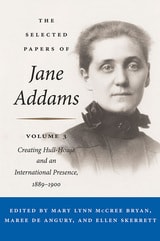
The Selected Papers of Jane Addams
Vol. 3: Creating Hull-House and an International Presence, 1889-1900Jane Addams Edited by Mary Lynn McCree Bryan, Maree de Angury, and Ellen Skerrett: with the assistance of Richard R. Seidel,
University of Illinois Press, 2019
The third volume in this acclaimed series documents Addams’s creation of Hull-House and her rise to worldwide fame as the acknowledged female leader of progressive reform. It also provides evidence of her growing commitment to pacifism. Here we see Addams, a force of thought, action, and commitment, forming lasting relationships with her Hull-House neighbors and the Chicago community of civic, political, and social leaders, even as she matured as an organizer, leader, and fund-raiser, and as a sought-after speaker, and writer. The papers reveal her positions on reform challenges while illuminating her strategies, successes, and responses to failures. At the same time, the collection brings to light Addams’s private life. Letters and other documents trace how many of her Hull-House and reform alliances evolved into deep, lasting friendships and also explore the challenges she faced as her role in her own family life became more complex.
Fully annotated and packed with illustrations, The Selected Papers of Jane Addams, Volume 3 is a portrait of a woman as she changed—and as she changed history.

The Selected Papers of Jane Addams
vol. 1: Preparing to Lead, 1860-81Edited by Mary Lynn McCree Bryan, Barbara Bair, and Maree de Angury
University of Illinois Press, 2002

The Selected Papers of Margaret Sanger, Volume 1
The Woman Rebel, 1900-1928Margaret Sanger, Edited by Esther Katz
University of Illinois Press, 2002

The Selected Papers of Margaret Sanger, Volume 4
Round the World for Birth Control, 1920-1966Margaret Sanger: Edited by Esther Katz: Peter C. Engelman and Cathy Moran Hajo, Associate Editors
University of Illinois Press, 2016
This volume focuses on Sanger from her groundbreaking overseas advocacy during the interwar years through her postwar role in creating the International Planned Parenthood Federation. The documents reconstruct Sanger's dramatic birth control advocacy tours through early 1920s Germany, Japan, and China in the midst of significant government and religious opposition to her ideas. They also trace her tireless efforts to build a global movement through international conferences and tours. Letters, journal entries, writings, and other records reveal Sanger's contentious dealings with other activists, her correspondence with the likes of Albert Einstein and Eleanor Roosevelt, and Sanger's own dramatic evolution from gritty grassroots activist to postwar power broker and diplomat.
A powerful documentary history of a transformative twentieth-century figure, The Selected Papers of Margaret Sanger, Volume 4 is a primer for the debates on individual choice, sex education, and planned parenthood that remain all-too-pertinent in our own time.

The Selected Stories of Ann Scott-Moncrief
Ann Scott-Moncrief
Catholic University of America Press, 2026