Results by title
1296 books match the query 'Women authors' and 235 start with t

Took House
Lauren Camp
Tupelo Press, 2020
Tortilleras
Hispanic & U.S. Latina Lesbian ExpressionLourdes Torres
Temple University Press, 2003

Toward a Feminist Theater
Selected PlaysKate Hamill and Kristin Leahey
Northwestern University Press, 2025
Bringing together seven critically acclaimed feminist adaptations of literary classics and one delightfully original new work, this collection demonstrates why Kate Hamill is one of the most electrifying and widely produced playwrights working today. Whether probing the power of toxic leaders (The Piper), revitalizing Jane Austen for the stage (Sense and Sensibility, Pride and Prejudice, Emma), “cheerfully desecrating” Arthur Conan Doyle through a post-pandemic lens (Ms. Holmes & Ms. Watson—Apt. 2B), reexamining an American classic’s gender roles (Little Women), or dramatizing the nineteenth-century classic of puritanical New England through the lens of an ostracized mother and daughter (The Scarlet Letter), Hamill’s work has transformed the theatrical landscape over the past decade.
An introduction from editor Kristin Leahey and an interview with Hamill frame this landmark anthology, with reflections on the current state of American drama, Hamill’s unique dramaturgical practice, and how the art form may move further and faster toward a feminist theater.
Toward a Latina Feminism of the Americas
Repression and Resistance in Chicana and Mexicana LiteratureBy Anna Marie Sandoval
University of Texas Press, 2008
Weaving strands of Chicana and Mexicana subjectivities, Toward a Latina Feminism of the Americas explores political and theoretical agendas, particularly those that undermine the patriarchy, across a diverse range of Latina authors. Within this range, calls for a coalition are clear, but questions surrounding the process of these revolutionary dialogues provide important lines of inquiry. Examining the works of authors such as Sandra Cisneros, Laura Esquivel, Carmen Boullosa, and Helena María Viramontes, Anna Sandoval considers resistance to traditional cultural symbols and contemporary efforts to counteract negative representations of womanhood in literature and society.
Offering a new perspective on the oppositional nature of Latina writers, Sandoval emphasizes the ways in which national literatures have privileged male authors, whose viewpoint is generally distinct from that of women—a point of departure rarely acknowledged in postcolonial theory. Applying her observations to the disciplinary, historical, and spatial facets of literary production, Sandoval interrogates the boundaries of the Latina experience. Building on the dialogues begun with such works as Sonia Saldivar-Hull's Feminism on the Border and Ellen McCracken's New Latina Narrative, this is a concise yet ambitious comparative approach to the historical and cultural connections (as well as disparities) found in Chicana and Mexicana literature.
Towns Facing Railroads
PoemsJo McDougall
University of Arkansas Press, 1991
In her second book of poetry, Jo McDougall takes her readers to the dusty prairie towns of the central states, places where the flat terrain belies a complex human landscape. In short, dceptively simple lines, McDougall can so keenly trace the lineaments of place and era that her subject stands before us, its essence displayed and made timeless.
Quietly, with an almost aphoristic bit, McDougall writes about ordinary lives and small towns in a way that her readers may never forget.

Transatlantic Conversations
Nineteenth-Century American Women’s Encounters with Italy and the Atlantic WorldBeth L. Lueck
University of New Hampshire Press, 2017
This unique interdisciplinary essay collection offers a fresh perspective on the active involvement of American women authors in the nineteenth-century transatlantic world. Internationally diverse contributors explore topics ranging from women's social and political mobility to their authorship and activism. While a number of essays focus on such well-known writers as Margaret Fuller, Catharine Maria Sedgwick, Harriet Beecher Stowe, George Eliot, Louisa May Alcott, and Charlotte Perkins Gilman, other, perhaps lesser-known authors are also included, such as E. D. E. N. Southworth, Elizabeth Stuart Phelps, Elizabeth Peabody, Jeannette Hart, and Laura Richards.
These essays show the spectrum of interests and activities in which nineteenth-century women were involved as they moved, geographically and metaphorically, toward gaining their independence and the right to control their lives. Traveling far and wide—to Italy, France, Great Britain, and the Bahamas—these writers came into contact with realities far different from their own. On topics ranging from homeopathy and literary endeavors to politics and revolution, they conversed with others, reaching and inspiring transnational audiences with their words and deeds, and creating a space for self-expression in the rapidly changing transatlantic world.
Transatlantic Stowe
Harriet Beecher Stowe and European CultureDenise Kohn
University of Iowa Press, 2006
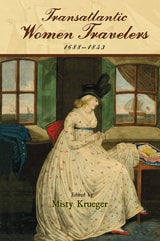
Transatlantic Women Travelers, 1688-1843
Misty Krueger
Bucknell University Press, 2021

Transatlantic Women
Nineteenth-Century American Women Writers and Great BritainBeth L. Lueck
University of New Hampshire Press, 2012
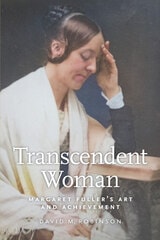
Transcendent Woman
Margaret Fuller’s Art and AchievementDavid M. Robinson
University of Massachusetts Press, 2025
Journalist, editor, critic, translator, and women’s rights advocate, Margaret Fuller was America’s first major female intellectual. Throughout much of the late-19th and 20th centuries, however, critics and scholars largely saw her as a minor figure in the transcendentalist movement with which she is associated, and her work was considered secondary to that of male figures like Emerson and Hawthorne. While her biography—including her marriage to an Italian noble and her dramatic death in a shipwreck—was often the focus, her skill as a writer was generally overlooked, and her intellectual development largely ignored.
In the early 1980s, David M. Robinson was one of the first scholars to publish an article that focused on Fuller’s mind and art. Now Transcendent Woman completes and extends this early work. Outlining the development of her philosophy, which Robinson defines as a “purpose-oriented form of thinking, tailored to the commitment and assets of each individual,” he traces Fuller’s intellectual journey, first in relation to her family and the people around her in New England and later in her travels in the midwestern United States and, more importantly, through Europe and her residency in Italy. He focuses first and foremost on what Fuller was reading (Goethe was key), what she was thinking as revealed in her letters and journals, and what she was writing, including seminal works such as Summer on the Lakes and Woman in the Nineteenth Century as well as lesser-known essays, translations, and short stories. Drawing extensively on primary sources, Robinson charts Fuller’s development and achievement as an original thinker and fearless advocate of democracy.
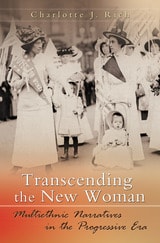
Transcending the New Woman
Multiethnic Narratives in the Progressive EraCharlotte J. Rich
University of Missouri Press, 2009
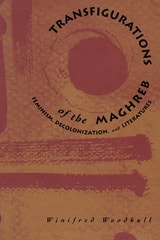
Transfigurations Of The Maghreb
Feminism, Decolonization, and LiteraturesWinfred Woodhull
University of Minnesota Press, 1993
Through readings of some of the best-known texts in Algerian literature in French, Woodhull both challenges the separation between French and Francophone literatures and cultures in the academy and explores the ways in which "femininity" has been represented in the texts of North African and French writers since the mid-1950s.
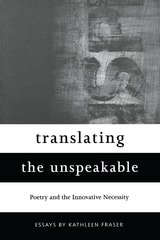
Translating the Unspeakable
Poetry and the Innovative NecessityKathleen Fraser
University of Alabama Press, 1999
A prominent avant-garde poet charts both her personal artistic development and the difficulties faced by women writers pursuing innovative paths.
An accomplished and influential poet, Kathleen Fraser has been instrumental in drawing attention to other women poets working outside the mainstream. Translating the Unspeakable gathers eighteen of her essays written over nearly twenty years, combining autobiography and criticism to examine what it means for any artist to innovate instead of following an already traveled path.
In autobiographical passages Fraser tells how her generation was influenced by revolutions in art and philosophy during the early 1960s and how she spent years pursuing idiosyncratic means of rediscovering the poem's terms. By the 1970s her evolving poetics were challenged by questions of gender, until immersion in feminist/modernist scholarship led her to initiate greater dialogue among experimentalist poets.
Other essays examine modernist women writers, their contemporary successors, and the visual poetics they have practiced. By exploring the work of such poets as H. D., Mina Loy, Lorine Niedecker, and Barbara Guest, Fraser conveys their struggle to establish a presence within accepted poetic conventions and describes the role experimentation plays in helping women overcome self-imposed silence.
All of Fraser's writings explore how the search to find one's own way of speaking into a very private yet historic space—of translating the unspeakable—drives poetic experimentation for women and men alike. This provocative book provides a glimpse into the thought processes of
the poetic mind, enhancing our understanding of innovative writing.
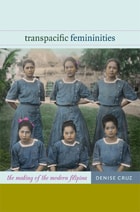
Transpacific Femininities
The Making of the Modern FilipinaDenise Cruz
Duke University Press, 2012
Through a careful study of multiple texts produced by Filipina and Filipino writers in the Philippines and the United States—including novels and short stories, newspaper and magazine articles, conduct manuals, and editorial cartoons—Cruz provides a new archive and fresh perspectives for understanding Philippine literature and culture. She demonstrates that the modern Filipina did not emerge as a simple byproduct of American and Spanish colonial regimes, but rather was the result of political, economic, and cultural interactions among the Philippines, Spain, the United States, and Japan. Cruz shows how the complex interplay of feminism, nationalism, empire, and modernity helped to shape, and were shaped by, conceptions of the transpacific Filipina.
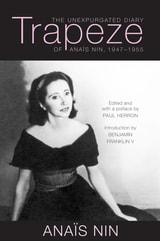
Trapeze
The Unexpurgated Diary of Anaïs Nin, 1947–1955Anaïs Nin
Ohio University Press, 2017
Anaïs Nin made her reputation through publication of her edited diaries and the carefully constructed persona they presented. It was not until decades later, when the diaries were published in their unexpurgated form, that the world began to learn the full details of Nin’s fascinating life and the emotional and literary high-wire acts she committed both in documenting it and in defying the mores of 1950s America. Trapeze begins where the previous volume, Mirages, left off: when Nin met Rupert Pole, the young man who became not only her lover but later her husband in a bigamous marriage.
It marks the start of what Nin came to call her “trapeze life,” swinging between her longtime husband, Hugh Guiler, in New York and her lover, Pole, in California, a perilous lifestyle she continued until her death in 1977. Today what Nin did seems impossible, and what she sought perhaps was impossible: to find harmony and completeness within a split existence. It is a story of daring and genius, love and pain, largely unknown until now.
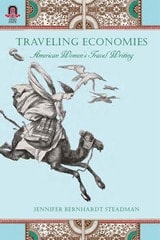
Traveling Economies
American Women's Travel WritingJennifer Bernhardt Steadman
The Ohio State University Press, 2007
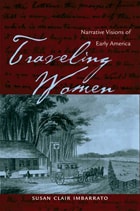
Traveling Women
Narrative Visions of Early AmericaSusan Clair Imbarrato
Ohio University Press, 2006
Susan Clair Imbarrato closely examines women’s accounts of their journeys from 1700 to 1830, including Sarah Kemble Knight’s well-known journal of her trip from Boston to New York in 1704 and many lesser-known accounts, such as Sarah Beavis’s 1779 journal of her travel to Ohio via Kentucky and Susan Edwards Johnson’s account or her 1801–2 journey from Connecticut to North Carolina.
In the women’s keen observations and entertaining wit, readers will find bravado mixed with hesitation, as women set forth on business, to relocate, and for pleasure. These travelers wrote compellingly of crossing rivers and mountains, facing hunger, encountering native Americans, sleeping in taverns, and confronting slavery, expressing themselves in voices that differed in sensibility from male explorers and travelers.
These accounts, as Imbarrato shows, challenge assumptions that such travel was predominately a male enterprise. In addition, Traveling Women provides a more balanced portrait of westward settlement by affirming women’s importance in the settling of early America.
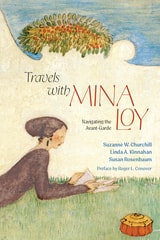
Travels with Mina Loy
Navigating the Avant-GardeSuzanne W. Churchill, Linda A. Kinnahan, and Susan Rosenbaum
Lever Press, 2026
Artist and writer Mina Loy (1882-1966) traversed continents, participated in Futurism, Dada, and Surrealism, and depicted poetic and painterly vistas ranging from lunar landscapes to the gritty streets of the Bowery. Travels with Mina Loy: Navigating the Avant-Garde, a companion text to the award-winning, multi-authored web resource Mina Loy: Navigating the Avant-Garde, offers an illustrated tour of Mina Loy’s long and varied career, contextualized with in-depth explorations of key places that shaped her life and work. Shedding new light on Loy's poetic responses to Italy, her theatrical explorations in New York City, and her forays into the museums of Paris and New York, the book brings in newly discovered and critically overlooked Loy works, as well as fresh timelines and surveys of the critical corpus on her creative output. This essential guidebook to Mina Loy charts her migrations across geography, movements among artistic circles and people, and transit across arts to illuminate her evolving aesthetics, politics, and artistic commitments.
Trembling Air
PoemsMichelle Boisseau
University of Arkansas Press, 2003

Tremors
Cammy Thomas
Four Way Books, 2021
Thomas’s short, musical poems make stops in the terrains of childhood, difficult and somewhat violent; middle life, with parents breaking down and children moving away into their own lives; and later life when memory falters but passion does not.
Tribunal
Lyn Hejinian
Omnidawn, 2019
Tributaries
Laura Da'
University of Arizona Press, 2015
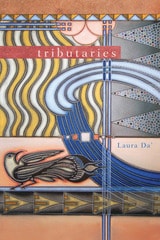
Precise images open to piercing meditations of Shawnee history. In the present, a woman watches the approximation of a scalping at a theatrical presentation. Da’ writes, “Soak a toupee with cherry Kool-Aid and mineral oil. / Crack the egg onto the actor’s head. / Red matter will slide down the crown / and egg shell will mimic shards of skull.” This vivid image is paired with a description of the traditional removal path of her own Shawnee ancestors through small towns in Ohio.
These poems range from the Midwestern landscapes of Ohio and Oklahoma to the Pacific Northwest, and the importance of place is apparent. Tributaries simultaneously offers us an extended narrative rumination on the impact of Indian policy and speaks to the contemporary experiences of parenthood and the role of education in passing knowledge from one generation to the next. This collection is composed of four sections that come together to create an important new telling of Shawnee past and present.
Troping the Body
Gender, Etiquette, and PerformanceGwendolyn Audrey Foster
Southern Illinois University Press, 2000
Troping the Body: Gender, Etiquette, and Performance is an interdisciplinary study of etiquette texts, conduct literature, and advice books and films. GwendolynAudrey Foster analyzes the work of such women authors as Emily Post, Christine de Pizan, Hannah Webster Foster, Emily Brontë, Frances E. W. Harper, and Martha Stewart as well as such women filmmakers as Lois Weber and Kasi Lemmons.
“Specifically,” Foster notes, “I was interested in the possibility of locating power and agency in the voices of popular etiquette writers.” Her investigation led her to analyze etiquette and conduct literature from the Middle Ages to the present. Within this wide scope, she redefines the boundaries of conduct literature through a theoretical examination of the gendered body as it is positioned in conduct books, etiquette texts, poetry, fiction, and film.
Drawing on Bakhtin, Gates, Foucault, and the new school of performative feminism to develop an interdisciplinary approach to conduct literature—and literature as conduct—Foster brings a unique perspective to the analysis of ways in which the body has been gendered, raced, and constructed in terms of class and sexuality.
Even though women writers have been actively writing conduct and etiquette texts since the medieval period, few critical examinations of such literature exist in the fields of cultural studies and literary criticism. Thus, Foster’s study fills a gap and does so uniquely in the existing literature. In examining these voices of authority over the body, Foster identifies the dialogic in the texts of this discipline that both supports and disrupts the hegemonic discourse of a gendered social order.
Troubling Nationhood in U.S. Latina Literature
Explorations of Place and BelongingSocolovsky, Maya
Rutgers University Press, 2013
Looking at such concerns as nation, place, trauma, and storytelling, writers Denise Chavez, Sandra Cisneros, Esmeralda Santiago, Ana Castillo, Himilce Novas, and Judith Ortiz Cofer challenge popular views of Latino cultural “unbelonging” and make strong cases for the legitimate presence of Latinas/os within the United States. In this way, they also counter much of today’s anti-immigration rhetoric.
Imagining the U.S. as part of a broader "Americas," these writings trouble imperialist notions of nationhood, in which political borders and a long history of intervention and colonization beyond those borders have come to shape and determine the dominant culture's writing and the defining of all Latinos as "other" to the nation.
True Mistakes
Lena Moses-Schmitt
University of Arkansas Press, 2025
Finalist, 2025 Miller Williams Poetry Prize
In her debut collection True Mistakes, the poet Lena Moses-Schmitt unleashes her powers of scrutiny on herself and on works of art to interrogate the essential nature of consciousness, identity, and time.
As the poet goes about daily life—taking long walks, painting at her desk, going to work, grappling with the deaths of friends, struggling with anxiety and depression—she ruminates on the boundaries between art and reality, grief and joy, living and imagining. For Moses-Schmitt, thought, like painting, is relentlessly high-stakes: “I often think about things so hard / I kill them.” And: “Is it possible to paint myself so precisely / I disappear? Can I remember myself / so completely I’m erased?” In the context of such ruminations, the poet’s reflections on David Hockney’s seminal pool paintings shimmer with sublimity and insight.
Working to turn “mistakes”—misperceptions, errors in life and in art—into sites of possibility and imagination instead of failure or confusion, Moses-Schmitt offers “a truth for every reader,” writes series editor Patricia Smith.
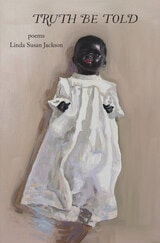
Truth Be Told
Linda Susan Jackson
Four Way Books, 2024
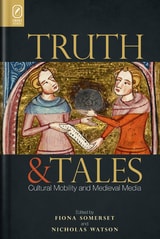
Truth and Tales
Cultural Mobility and Medieval MediaEdited by Fiona Somerset and Nicholas Watson
The Ohio State University Press, 2015
Truth and Tales includes fourteen essays by medieval literary scholars and historians. Some essays focus on written artifacts that convey high or popular learning in unexpected ways. Others address a social problem of concern to all, demonstrating the genres and media through which it was negotiated. Still others are centered on one or more texts, detailing their investments in popular as well as learned knowledge, in performance as well as writing. This collective archaeology of medieval media provides fresh insight for medieval scholars and media theorists alike.
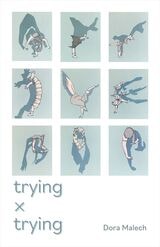
Trying x Trying
Dora Malech
Carnegie Mellon University Press, 2025
In Trying × Trying, Dora Malech dissects the language of our times; she turns over the familiar phrases of politics, parenthood, and pandemic to reveal what lies beneath. Through playing with the double meaning of “trying” as both perseverance and reproductive struggle, these poems navigate public and private spheres and interrogate the words we use to make sense of uncertainty and belief.
With sharp lyricism and restless energy, Malech transforms language into prayer and protest. Sound bends, meanings shift, and repetition becomes a revelation as she traces the tensions between individual and collective experience. Trying × Trying is an enlightening meditation on persistence, reminding us that even in fractured times, poetry finds a way forward.
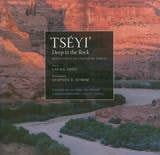
Tséyi' / Deep in the Rock
Reflections on Canyon de ChellyText by Laura Tohe; photographs by Stephen E. Strom
University of Arizona Press, 2005
Diné poet Laura Tohe draws deeply on her heritage to create lyrical writings that are rooted in the canyon but universal in spirit, while photographer Stephen Strom captures images that reveal the very soul of this ancient place. Tohe’s words take readers on a journey from the canyon rim down sheer sandstone walls to its rich bottomlands; from the memory of Kit Carson’s rifle shots and the forced march of the Navajo people to the longings of modern lovers. Her poems view the land through Diné eyes, blending history, tradition, and personal reflection while remaining grounded in Strom’s delicate yet striking images. These photographs are not typical of most southwestern landscapes. Strom’s eye for the subtleties and mysticism of the canyon creates powerful images that linger in the mind long after the pages are turned, compelling us to look at the earth in new ways.
Tséyi' / Deep in the Rock is a unique evocation of Canyon de Chelly and the people whose lives and spirits are connected to it. It is a collaboration that conjures the power of stories and images, inviting us to enter a world of harmony and be touched by its singularly haunting beauty.
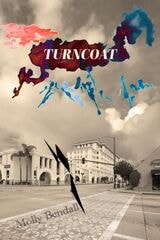
Turncoat
Molly Bendall
Omnidawn, 2025
Through the poems in Turncoat, Molly Bendall’s sixth collection, the speaker and other figures dwell under the ever-present eye of surveillance by unspecified authorities. Mistrust and dread become part of the fabric of their lives, as they never know who may be a turncoat—a person who disguises her allegiances and traffics in betrayal. These poems employ an invented paranoid syntax meant to evade oppressive surveillance. A series of intimate and darkly humorous incidents press the speaker to continually adapt to unseen—or even nonexistent—dangers. Haunted by a sense of disorientation and uncertainty about whether old friendships may have been compromised, or if spaces could disappear overnight, Bendall’s poems coax the reader to step across boundaries and snares, alternating between episodes of interrogation and flight.
Twelve Clocks
Julie Sophia Paegle
University of Arizona Press, 2015
As the reader is transported from Las Vegas to Argentina to the landscapes of Ancient Greek epic poetry, Twelve Clocks explores the connections between song, ancestry, family, loss, and time. If the imagery of the collection hints Troy might be an image of the wrecked Argentine economy under neoliberal economics, the poems eschew the abstractions of politics in favor of a vivid and sensuous lyricism.
The interconnectivity of the poems in Twelve Clocks is mirrored by different elements’ transcendence throughout the collection. The clock that goes missing in one poem turns up in another, characters vanish and reappear, matter destroyed in one poem reoccurs as energy in another, and then matter and energy both go missing. Taken together, the poems confront the literary legacy of Western poetic tradition and our shared future.
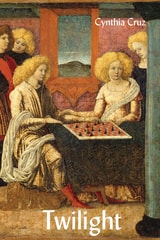
Twilight
Cynthia Cruz
Four Way Books, 2026
Twilight is the intermediary state of becoming, the suspension between, when one is no longer who one was and not yet who they will be. At the end of psychoanalysis, after one has worked through the symbolic investitures one has been relegated to, one is reduced to such a state. In this state of momentary suspension, one is, in a sense, nothing.
Twilight also names a historical moment, when one world is ending but the next has yet to appear. That we are existing in the suspension between the the end of the world as we have known it and the void of what has yet to come is a commonly repeated truth. Hegel describes twilight as “a flash” that in “a single stroke brings to view the structure of the new world,” suggesting that novelty arises out of darkness and obscurity. We are living, in other words, in a state of twilight.
Cruz’s tenth poetry collection takes the concept of twilight and presents, through a series of elliptical poems, a working through of the term. The speakers in these poems exist within this wavering. As she writes in one of several poems titled “Twilight,” “Twilight, its world between worlds / its miraculous suspension. / I belong to the school of Freud’s / hypothetical boarding school girls. / We wait and we wait / for the world to begin.”
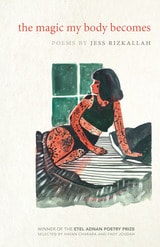
the magic my body becomes
Poems byJess Rizkallah
University of Arkansas Press, 2017
Winner, 2017 Etel Adnan Poetry Prize
In the magic my body becomes, Jess Rizkallah seeks a vernacular for the inescapable middle ground of being Arab American—a space that she finds, at times, to be too Arab for America and too American for her Lebanese elders.
These poems freely assert gender, sexuality, and religious beliefs while at the same time respecting a generational divide: the younger’s privilege gained by the sacrifice of the older, the impossibility of separating what is wholly hers from what is hers secondhand.
In exploring family history, civil war, trauma, and Lebanon itself, Rizkallah draws from the spirits of canonical Arab and Middle Eastern poets. As a result of her conjuring, the reader feels these spirits begin to exorcise the grief of those who are still alive. Throughout, there is the body, a reclamation and pushback against cultures that simultaneously sexualize and shame women. And there is a softness as inherent as rage, a resisting of stereotypes that too often speak louder than the complexities of a resilient cultural identity.
The magic my body becomes is an exciting new book from an exciting young poet, a love letter to a people as well as a fist in the air.
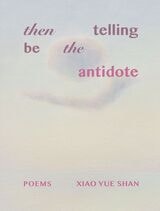
then telling be the antidote
Xiao Yue Shan
Tupelo Press, 2024
By illuminating what has been left untold, these writings present the vivid landscape of a mind layering itself over the world, thinking and speaking its way through a myriad of places, objects, and visions. From rooms overlooking Tokyo rivers to Shanghai streets in the thrall of nighttime, Shan throws light on a nation’s quieted crevices, on the distances between the carnal and the eternal, and most pivotally, on the ability of language to elucidate fact with imagination.

torch song tango choir
Julie Sophia Paegle
University of Arizona Press, 2010
The poems in the first section, torch songs, hover near a heartbreaking lyricism as they reckon with political histories, landscapes, and loss. As she writes in this section, there is truly “nothing in this life like being blind in Granada.” The sonnet crown that comprises the next section, tango liso, plots a history of cultural inheritance and renewal, weaving back and forth in time and spanning Argentina, Spain, and the United States. Here the reader encounters Eva Perón alongside Katharine of Aragon and Billie Holiday. The final section, choir, commemorates sites of pilgrimage in Latvia, West Germany, and Spain, among other places. In this extended contemplation of cathedral spaces, Paegle interrogates the boundary between the sacred and the secular, silence and song. What emerges from this diverse collection is a sensual and allusive space where music and memory coincide.