Results by title
28167 books match the query 'History' and 6372 start with t
The Hunt for Nazi Spies
Fighting Espionage in Vichy FranceSimon Kitson
University of Chicago Press, 2007
Simon Kitson informs this remarkable story with findings from his investigation—the first by any historian—of thousands of Vichy documents seized in turn by the Nazis and the Soviets and returned to France only in the 1990s. His pioneering detective work uncovers a puzzling paradox: a French government that was hunting down left-wing activists and supporters of Charles de Gaulle’s Free French forces was also working to undermine the influence of German spies who were pursuing the same Gaullists and resisters. In light of this apparent contradiction, Kitson does not deny that Vichy France was committed to assisting the Nazi cause, but illuminates the complex agendas that characterized the collaboration and shows how it was possible to be both anti-German and anti-Gaullist.
Combining nuanced conclusions with dramatic accounts of the lives of spies on both sides, The Hunt for Nazi Spies adds an important new dimension to our understanding of the French predicament under German occupation and the shadowy world of World War II espionage.
The Hunters or the Hunted?
An Introduction to African Cave TaphonomyC. K. Brain
University of Chicago Press, 1981
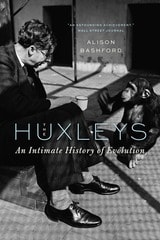
The Huxleys
An Intimate History of EvolutionAlison Bashford
University of Chicago Press, 2022
Two hundred years of modern science and culture told through one family history.
This momentous biography tells the story of the Huxleys: the Victorian natural historian T. H. Huxley (“Darwin’s Bulldog”) and his grandson, the scientist, conservationist, and zoologist Julian Huxley. Between them, they communicated to the world the great modern story of the theory of evolution by natural selection. In The Huxleys, celebrated historian Alison Bashford writes seamlessly about these omnivorous intellects together, almost as if they were a single man whose long, vital life bookended the colossal shifts in world history from the age of sail to the Space Age, and from colonial wars to world wars to the cold war.
The Huxleys’ specialty was evolution in all its forms—at the grandest level of species, deep time, the Earth, and at the most personal and intimate. They illuminated the problems and wonders of the modern world and they fundamentally shaped how we see ourselves, as individuals and as a species.
But perhaps their greatest subject was themselves. Bashford’s engaging, brilliantly ambitious book interweaves the Huxleys’ momentous public achievements with their private triumphs and tragedies. The result is the history of a family, but also a history of humanity grappling with its place in nature. This book shows how much we owe—for better or worse—to the unceasing curiosity, self-absorption, and enthusiasm of a small, strange group of men and women.

The Hygienic Apparatus
Weimar Cinema and Environmental DisorderPaul Dobryden
Northwestern University Press, 2022
Framing hygiene within the project of national reconstruction after World War I, The Hygienic Apparatus explores cinema’s material contexts alongside its representations of housework, urban space, traffic, pollution, disability, aging, and labor. Reformers worried about the health risks associated with moviegoing but later used film to popularize hygienic ideas, encouraging viewers to see the world and themselves in relation to public health objectives. Modernist architecture and design fashioned theaters into regenerative environments for fatigued spectators. Filmmakers like F. W. Murnau and Slatan Dudow, meanwhile, explored the aesthetic and political possibilities of dirt, contagion, intoxication, and disorder. Dobryden recovers a set of ecological and biopolitical concerns to show how the problem of environmental disorder fundamentally shaped cinema’s relationship to modernity. As accessible as it is persuasive, the book adds to a growing body of scholarship on biopolitics within German studies and reveals fresh ways of understanding the apparatus of Weimar cinema.
The Hysteric's Revenge
French Women Writers at the Fin de SiecleRachel Mesch
Vanderbilt University Press, 2006
This book argues, however, that the fear of sexual abandon--though real--veiled an even more insidious fear: that women might be capable of intellectual equality with men and thus pose a threat to the most basic structures of French patriarchal society. In demonstrating the pervasiveness of this anxiety through analysis of nineteenth-century medical texts, literary criticism, and fiction, The Hysteric's Revenge brings into relief a critical relationship between the female mind and body that is essential to understanding the discursive position of the turn-of-the-century woman writer.
The novels presented here confront this mind/body problem through a wide variety of styles and genres that challenge conventional fin-de-siecle notions of femininity. From the compelling autobiography of Liane de Pougy--one of Paris's most renowned courtesans--to Colette's frank discussions of female pleasure in one of her early novels, to the violent creativity of Rachilde's androgynous heroine, Mesch demonstrates how both canonical and non-canonical writers promoted women's intellectual authority through the development of a sexual counter-discourse. In engaging the relationship between women's minds and bodies, these novels challenge the conclusions of a century of doctors who sought to prove a physiological basis for female intellectual inferiority. At the same time, they point the way towards later French feminists who sought to subvert patriarchal structures through literary explorations of sexuality.
The Ice Broken, volume I
Puritan Influences on the Netherlands in the Seventeenth CenturyCentral European University Press, 2026

The Ice Broken, volume II
Puritan Influences on the Netherlands in the Seventeenth CenturyCentral European University Press, 2026
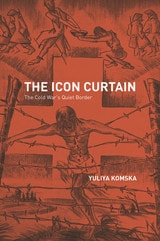
The Icon Curtain
The Cold War's Quiet BorderYuliya Komska
University of Chicago Press, 2015
Yuliya Komska transports readers to the western edge of the Bohemian Forest, one of Europe’s oldest borderlands, where in the 1950s civilians set out to shape the so-called prayer wall. A chain of new and repurposed pilgrimage sites, lookout towers, and monuments, the prayer wall placed two long-standing German obsessions, forest and border, at the heart of the century’s most protracted conflict. Komska illustrates how civilians used the prayer wall to engage with and contribute to the new political and religious landscape. In the process, she relates West Germany’s quiet sylvan periphery to the tragic pitch prevalent along the Iron Curtain’s better-known segments.
Steeped in archival research and rooted in nuanced interpretations of wide-ranging cultural artifacts, from vandalized religious images and tourist snapshots to poems and travelogues, The Icon Curtain pushes disciplinary boundaries and opens new perspectives on the study of borders and the Cold War alike.
The Iconic Page in Manuscript, Print, and Digital Culture
George Bornstein and Theresa Tinkle, Editors
University of Michigan Press, 1998
The material features of texts as physical artifacts--their "bibliographic codes" --have over the last decade excited increasing interest in a variety of disciplines. The Iconic Page in Manuscript, Print, and Digital Culture gathers essays by an extraordinarily distinguished group of scholars to offer the most comprehensive examination of these issues yet, drawing on examples from literature, history, the fine arts, and philosophy.
Fittingly, the volume contains over two dozen illustrations that display the iconic features of the works analyzed--from Alfred the Great's Boethius through medieval manuscripts to the philosophy of C. S. Peirce and the dustjackets on works by F. Scott Fitzgerald and William Styron.
The Iconic Page in Manuscript, Print, and Digital Culture will be groundbreaking reading for scholars in a wide range of fields.
George Bornstein is C. A. Patrides Professor of English, University of Michigan. Theresa Tinkle is Associate Professor of English, University of Michigan.
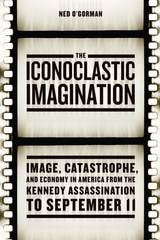
The Iconoclastic Imagination
Image, Catastrophe, and Economy in America from the Kennedy Assassination to September 11Ned O'Gorman
University of Chicago Press, 2015
In The Iconoclastic Imagination, Ned O’Gorman approaches each of these moments as an image of icon-destruction that give us distinct ways to imagine social existence in American life. He argues that the Cold War gave rise to crises in political, aesthetic, and political-aesthetic representations. Locating all of these crises within a “neoliberal imaginary,” O’Gorman explains that since the Kennedy assassination, the most powerful way to see “America” has been in the destruction of representative American symbols or icons. This, in turn, has profound implications for a neoliberal economy, social philosophy, and public policy. Richly interwoven with philosophical, theological, and rhetorical traditions, the book offers a new foundation for a complex and innovative approach to studying Cold War America, political theory, and visual culture.
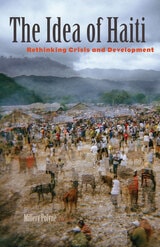
The Idea of Haiti
Rethinking Crisis and DevelopmentMillery Polyné
University of Minnesota Press, 2013
After Haiti was struck by a devastating earthquake on January 12, 2010, aid workers and offers of support poured in from around the world. Tellingly, though, news reports on the catastrophe and relief efforts frequently included a pejorative description of the country that outsiders were determined to rebuild: the troubled island nation, a nation plagued by political violence. There was much talk of inventing a “new” Haiti, which would presumably mimic Western modes of development and thus mitigate political instability and crisis.
As contributors to this wide-ranging book reveal, Haiti has long been marginalized as an embodiment of alterity, as the other, and the idea of a new Haiti is actually nothing new. An investigation of the notion of newness through the lenses of history and literature, urban planning, religion, and governance, The Idea of Haiti illuminates the politics and the narratives of Haiti’s past and present. The essays, which grow from original research and in-depth interviews, examine how race, class, and national development inform the policies that envision re-creating the country.
Together the contributors address important questions: How will the present narratives of deviance affect international relief and rebuilding efforts? What do Haitians themselves think about Haiti, old and new? What are the potential complications and weakness of aid strategies during these trying times? And what do we mean by crisis in Haiti?
Contributors: Yveline Alexis, Rutgers U; Wein Weibert Arthus, State U of Haiti; Greg Beckett, Bowdoin College; Alex Dupuy, Wesleyan U; Harley F. Etienne, U of Michigan; Robert Fatton Jr., U of Virginia; Sibylle Fischer, New York U; Elizabeth McAlister, Wesleyan U; Nick Nesbitt, Princeton U; Karen Richman, U of Notre Dame; Mark Schuller, York College (CUNY); Patrick Sylvain, Brown U; Évelyne Trouillot, State U of Haiti; Tatiana Wah, Columbia U.

The Idea of India
A DialogueGayatri Chakravorty Spivak and Romila Thapar
Seagull Books, 2024
Through a stimulating dialogue, two old friends trace the history of the idea of India through digressions, anecdotes, and observations. Historian Romila Thapar and theorist Gayatri Chakravorty Spivak reflect on the challenges posed by essentialism and exclusion whenever cultures attempt to define and assert themselves. They also emphasize the role of education in fostering a more inclusive and accurate understanding of the nation’s complex history. Their conversation revolves around the narratives that have shaped Indian identity—from Vedic times to the present—and those whose voices and visions for this land remain unheard and unseen.
Ranging from nationalism to religion and beyond, TheIdea of India discusses an urgent question: What does it mean to be an Indian in contemporary society?
The Idea of Race in Latin America, 1870-1940
Edited and with an introduction by Richard Graham
University of Texas Press, 1990
From the mid-nineteenth century until the 1930s, many Latin American leaders faced a difficult dilemma regarding the idea of race. On the one hand, they aspired to an ever-closer connection to Europe and North America, where, during much of this period, "scientific" thought condemned nonwhite races to an inferior category. Yet, with the heterogeneous racial makeup of their societies clearly before them and a growing sense of national identity impelling consideration of national futures, Latin American leaders hesitated. What to do? Whom to believe?
Latin American political and intellectual leaders' sometimes anguished responses to these dilemmas form the subject of The Idea of Race in Latin America. Thomas Skidmore, Aline Helg, and Alan Knight have each contributed chapters that succinctly explore various aspects of the story in Brazil, Argentina, Cuba, and Mexico. While keenly alert to the social and economic differences that distinguish one Latin American society from another, each author has also addressed common issues that Richard Graham ably draws together in a brief introduction. Written in a style that will make it accessible to the undergraduate, this book will appeal as well to the sophisticated scholar.
The Idea of World
Public Intellect and Use of LifePaolo Virno
Seagull Books, 2022
A short vade mecum for unrepentant materialism, The Idea of World collects three essays by Italian philosopher Paulo Virno that are intricately wrapped around one another. The first essay, “Mundanity,” tries to clarify what the term “world,” as referred to as the perceptual and historical context of our existence, means—both with and against Kant and Wittgenstein. How should we understand expressions such as “worldly people,” “the course of the world,” or “getting by in this world”? The second, “Virtuosity and Revolution,” is a minor political treatise. Virno puts forward a set of concepts capable of confronting the magnetic storm that has knocked out the compasses that every reflection on the public sphere has relied on since the seventeenth century. The third, “The Use of Life”, is the shorthand delineation of a research program on the notion of use. What exactly are we doing when we use a hammer, a time span, or an ironic sentence? And, above all, what does the use of the self—of one’s own life, which lies at the basis of all uses—amount to in human existence?
Presenting his ideas in three distinct vignettes, Virno examines how the philosophy of language, anthropology, and political theory are inextricably linked.
The Idea of a Free Press
The Enlightenment and Its Unruly LegacyDavid Copeland
Northwestern University Press, 2006
The rise of a free press was, in many ways, a legacy of the Reformation and Enlightenment. Copeland describes a discourse centered on questions of religion--a discussion that the government, with all its religious authority, could not suppress because of the belief that the ability to reason for oneself was God-given. In this account we see how the debate moved from religion to the purely political sphere, and how, through the increased use of the printing press, it was opened to a multiplicity of voices and opinions. Spanning nearly four centuries in Britain and America, Copeland's book reveals how the tension between government control and the right to debate public affairs openly ultimately led to the idea of a free press; in doing so, it documents an intellectual development of unparalleled relevance and importance to the history of journalism.
The Idea of the ANC
Anthony Butler
Ohio University Press, 2013
The African National Congress (ANC) is Africa’s most famous liberation movement. It has recently celebrated its centenary, a milestone that has prompted partisans to detail a century of unparalleled achievement in the struggle against colonialism and racial discrimination. Critics paint a less flattering portrait of the historical ANC as a communist puppet, a moribund dinosaur, or an elitist political parasite. For such skeptics, the ANC—now in government for two decades—has betrayed South Africans rather than liberating them.
South Africans endure deep inequality and unemployment, violent community protests, murders of foreign residents, major policy blunders, an AIDS crisis, and deepening corruption. Inside the ANC there are episodes of open rebellion against the leadership, conflicts over the character of a postliberation movement, and debilitating battles for succession to the movement’s presidency. The ANC is nevertheless likely to remain the party of government for the foreseeable future.
This remarkable book explores how ANC intellectuals and leaders interpret the historical project of their movement. It investigates three interlocking ideas: a conception of power, a responsibility for promoting unity, and a commitment to human liberation. Anthony Butler explores how these notions have shaped South African politics in the past and how they will inform ANC leaders’ responses to the challenges of the future.
The Idea of the Sciences in the French Enlightenment
A ReinterpretationG. Matthew Adkins
University of Delaware Press, 2014
Published by University of Delaware Press. Distributed worldwide by Rutgers University Press.
The Idea of the Theater in Latin Christian Thought
Augustine to the Fourteenth CenturyDonnalee Dox
University of Michigan Press, 2004
---Margaret Knapp, Arizona State University
"...an elegantly concise survey of the way classical notions of theater have been interpreted in the Latin Middle Ages. Dox convincingly demonstrates that far from there being a single 'medieval' attitude towards theater, there was in fact much debate about how theater could be understood to function within Christian tradition, even in the so-called 'dark ages' of Western culture. This book makes an innovative contribution to studies of the history of the theater, seen in terms of the history of ideas, rather than of practice."
---Constant Mews, Director, Centre for the Study of Religion & Theology, University of Monash, Australia
"In the centuries between St. Augustine and Bartholomew of Bruges, Christian thought gradually moved from a brusque rejection of classical theater to a progressively nuanced and positive assessment of its value. In this lucidly written study, Donnalee Dox adds an important facet to our understanding of the Christian reaction to, and adaptation of, classical culture in the centuries between the Church Fathers and the rediscovery of Aristotle."
---Philipp W. Rosemann, University of Dallas
This book considers medieval texts that deal with ancient theater as documents of Latin Christianity's intellectual history. As an exercise in medieval historiography, this study also examines biases in modern scholarship that seek links between these texts and performance practices. The effort to bring these texts together and place them in their intellectual contexts reveals a much more nuanced and contested discourse on Greco-Roman theater and medieval theatrical practice than has been acknowledged. The book is arranged chronologically and shows the medieval foundations for the Early Modern integration of dramatic theory and theatrical performance.
The Idea of the Theater in Latin Christian Thought will be of interest to theater historians, intellectual historians, and those who work on points of contact between the European Middle Ages and Renaissance. The broad range of documents discussed (liturgical treatises, scholastic commentaries, philosophical tracts, and letters spanning many centuries) renders individual chapters useful to philosophers, aestheticians, and liturgists as well as to historians and historiographers. For theater historians, this study offers an alternative reading of familiar texts which may alter our understanding of the emergence of dramatic and theatrical traditions in the West. Because theater is rarely considered as a component of intellectual projects in the Middle Ages, this study opens a new topic in the writing of medieval intellectual history.
The Ideal of the Practical
Colombia’s Struggle to Form a Technical EliteBy Frank Safford
University of Texas Press, 1976
The Ideal of the Practical is a study of efforts by a segment of the upper class in an aristocratic Latin American society to alter cultural values in the society, creating stronger orientations toward the technical and the practical. Frank Safford describes attempts by members of Colombia’s nineteenth-century political elite to use technical education as a means of nurturing energetic upper-class entrepreneurs and an industrious working class in a static agrarian economy. In the course of his analysis, Safford sketches the historical development of scientific and technical education and of the engineering profession in Colombia.
The book opens with a description of the economic and social context of early nineteenth-century Colombia. It then discusses some early experiments with manual industrial training between 1820 and 1850. Later chapters deal with the careers of upper-class youths sent abroad for scientific and technical training, the growth of indigenous engineering education, and the crystallization of a Colombian engineering profession. While the book primarily explores the nineteenth century, it also touches on eighteenth-century Spanish Bourbon antecedents and provides an epilogue on the twentieth-century evolution of technical elites in Colombia.
The author focuses on the reasons why the implantation of technical education and technical orientations proved difficult. He examines the interplay between various obstructions: on the one hand, a hierarchical social structure and aristocratic social values and, on the other, obstructions created by fundamental geographic and economic conditions. He concludes that, while Colombian leaders had hoped that technical education and the development of values oriented toward the technical would spearhead economic growth, in fact economic growth proved a prerequisite for the effective implantation of technical orientations and training.
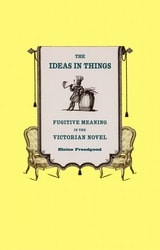
The Ideas in Things
Fugitive Meaning in the Victorian NovelElaine Freedgood
University of Chicago Press, 2006
While the Victorian novel famously describes, catalogs, and inundates the reader with things, the protocols for reading it have long enjoined readers not to interpret most of what crowds its pages. The Ideas in Things explores apparently inconsequential objects in popular Victorian texts to make contact with their fugitive meanings. Developing an innovative approach to analyzing nineteenth-century fiction, Elaine Freedgood here reconnects the things readers unwittingly ignore to the stories they tell.
Building her case around objects from three well-known Victorian novels—the mahogany furniture in Charlotte Brontë’s Jane Eyre, the calico curtains in Elizabeth Gaskell’s Mary Barton, and “Negro head” tobacco in Charles Dickens’s Great Expectations—Freedgood argues that these things are connected to histories that the novels barely acknowledge, generating darker meanings outside the novels’ symbolic systems. A valuable contribution to the new field of object studies in the humanities, The Ideas in Things pushes readers’ thinking about things beyond established concepts of commodity and fetish.

The Idols of ISIS
From Assyria to the InternetAaron Tugendhaft
University of Chicago Press, 2020
Beginning with the Islamic State’s claim that the smashed objects were idols of the “age of ignorance,” Aaron Tugendhaft questions whether there can be any political life without idolatry. He then explores the various roles Mesopotamian sculpture has played in European imperial competition, the development of artistic modernism, and the formation of Iraqi national identity, showing how this history reverberates in the choice of the Mosul Museum as performance stage. Finally, he compares the Islamic State’s production of images to the ways in which images circulated in ancient Assyria and asks how digitization has transformed politics in the age of social media. An elegant and accessibly written introduction to the complexities of such events, The Idols of ISIS is ideal for students and readers seeking a richer cultural perspective than the media usually provides.

The Igor Moiseyev Dance Company
Dancing DiplomatsAnthony Shay
Intellect Books, 2019
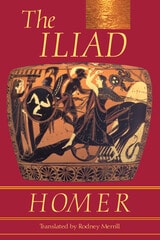
The Iliad
Homer
University of Michigan Press, 2007
nuances of English."
---Stephen G. Daitz, Professor Emeritus of Classics, City University of New York
Rodney Merrill's translation of Homer's Iliad offers a form of English poetry particularly relevant to the epic, producing a strong musical setting that brings many elements of the narrative truly to life. Most notable are the many battle scenes, in which Homer's strong dactylic hexameters make credible the "war-lust" in the deeds of the combatants.
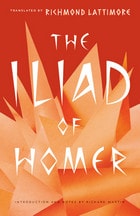
The Iliad of Homer
Homer
University of Chicago Press, 2011
The epic story of the Trojan War in the most faithful and compelling translation available
"Sing, goddess, the anger of Peleus’ son Achilleus / and its devastation." For sixty years, that's how Homer has begun the Iliad in English, in Richmond Lattimore's faithful translation—the gold standard for generations of students and general readers.
This long-awaited new edition of Lattimore's Iliad is designed to bring the book into the twenty-first century—while leaving the poem as firmly rooted in ancient Greece as ever. Lattimore's elegant, fluent verses—with their memorably phrased heroic epithets and remarkable fidelity to the Greek—remain unchanged, but classicist Richard Martin has added a wealth of supplementary materials designed to aid new generations of readers. A new introduction sets the poem in the wider context of Greek life, warfare, society, and poetry, while line-by-line notes at the back of the volume offer explanations of unfamiliar terms, information about the Greek gods and heroes, and literary appreciation. A glossary and maps round out the book.
The result is a volume that actively invites readers into Homer's poem, helping them to understand fully the worlds in which he and his heroes lived—and thus enabling them to marvel, as so many have for centuries, at Hektor and Ajax, Paris and Helen, and the devastating rage of Achilleus.
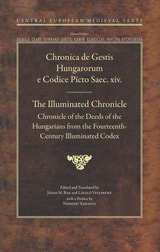
The Illuminated Chronicle
Chronicle of the Deeds of the Hungarians from the Fourteenth-Century Illuminated CodexJános M. Bak
Central European University Press, 2018
The Illuminated Chronicle was composed in 1358 in the international artistic style at the royal court of Louis I of Hungary. Its text, presented here in a new edition and translation, is the most complete record of Hungary's medieval historical tradition, going back to the eleventh century and including the mythical past of its people. The pictures in this manuscript—formerly known as the Vienna Chronicle—are not merely occasional illustrations added to some exemplars, but text and image are closely connected and mutually related to each other, to qualify it as a proper “illuminated chronicle”. The artistic value of the miniatures is quite high, and the characters are drawn with detail and with a knowledge of anatomy. Forty-two of the miniatures are included in the present volume. A full color facsimile will be accessible online.
The 147 pictures are an invaluable source of information on late medieval cultural history, costume, and court life. In a historiographical context, The Illuminated Chronicle is an attempt at the popularization of the national history and a systematic appeal to circles beyond the old monastic-clerical audience.
The Illuminated Chronicle (Chronica de gestis Hungarorum e codice picto saec. xiv.) is the ninth volume in the Central European Medieval Texts, a Latin–English bilingual series.
The Illusion of Cultural Identity
Jean-François Bayart
University of Chicago Press, 2005
In this highly sophisticated book, Bayart shows that the very idea of cultural identity prevents us from grasping the cultural dimensions of political action and economic development. Identities, he argues, are fluid, never homogeneous, and sometimes invented. Political repertoires are instead created through imagined, highly ambiguous aspects of culture—what he calls "imaginaires." For instance, the long beards worn by men in some fundamentalist groups are thought to be key to their core identities and thus assumed to be in conflict with modern values. These beards, however, do not stand in the way of the men's use of technology or their embrace of capitalism—an example Bayart uses to demonstrate the equivocality of cultural identity. The theoretical implications of Bayart's analysis emerge from a fascinating collection of historical examples that often surprise and always instruct.
The Illusion of History
Andrew R. Russ
Catholic University of America Press, 2012
The Illusion of Inclusion
The Untold Political Story of San AntonioBy Rodolfo Rosales
University of Texas Press, 2000
To many observers, the 1981 election of Henry Cisneros as mayor of San Antonio, Texas, represented the culminating victory in the Chicano community's decades-long struggle for inclusion in the city's political life. Yet, nearly twenty years later, inclusion is still largely an illusion for many working-class and poor Chicanas and Chicanos, since business interests continue to set the city's political and economic priorities.
In this book, Rodolfo Rosales offers the first in-depth history of the Chicano community's struggle for inclusion in the political life of San Antonio during the years 1951 to 1991, drawn from interviews with key participants as well as archival research. He focuses on the political and organizational activities of the Chicano middle class in the context of post-World War II municipal reform and how it led ultimately to independent political representation for the Chicano community. Of special interest is his extended discussion of the role of Chicana middle-class women as they gained greater political visibility in the 1980s.
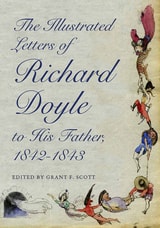
The Illustrated Letters of Richard Doyle to His Father, 1842–1843
Richard Doyle
Ohio University Press, 2015
Before he joined the staff of Punch and designed its iconic front cover, illustrator Richard “Dicky” Doyle was a young man whose father (political caricaturist John Doyle) charged him with sending a weekly letter, even though they lived under the same roof. This volume collects the fifty-three illustrated missives in their entirety for the first time and provides an uncommon peek into the intimate but expansive observations of a precocious social commentator and artist.
In a series of vivid manuscript canvases, Doyle observes Victorian customs and society. He visits operas, plays, and parades. He watches the queen visiting the House of Commons and witnesses the state funeral of the Duke of Sussex. He is caught up in the Chartist riots of August 1842 and is robbed during one of the melees. And he provides countless illustrations of ordinary people strolling in the streets and swarming the parks and picture galleries of the metropolis. The sketches offer a fresh perspective on major social and cultural events of London during the early 1840s by a keen observer not yet twenty years old.
Doyle’s epistles anticipate the modern comic strip and the graphic novel, especially in their experimentation with sequential narrative and their ingenious use of space. The letters are accompanied by a full biographical and critical introduction with new material about Doyle’s life.
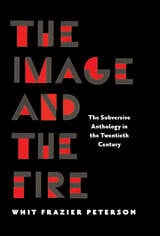
The Image and the Fire
The Subversive Anthology in the Twentieth CenturyWhit Frazier Peterson
University of Massachusetts Press, 2026
Racial identity and literary form in the modernist anthology
The Image and the Fire examines the coterie anthology—a small, outsider literary collection—as a key, yet understudied, instrument of literary intervention within American modernism. Whit Frazier Peterson argues that these anthologies, produced outside of institutional or canonical frameworks, served as deliberate challenges to dominant literary paradigms. Distinct from academic anthologies that helped codify the American literary canon, coterie anthologies were used by both white and Black avant-garde movements to disrupt prevailing cultural narratives and assert alternative literary visions.
Through close analysis of three seminal case studies—Des Imagistes, edited by Ezra Pound; Fire!!, a short-lived but groundbreaking magazine from the Harlem Renaissance, co-edited by Wallace Thurman; and Black Fire, compiled by Amiri Baraka and Larry Neal during the Black Arts Movement—Peterson traces a genealogy of the coterie anthology as a politically charged genre. He reveals how Black American writers and editors, particularly during the Harlem Renaissance and the Black Arts Movement, reappropriated and reconfigured this type of anthology format from white modernists.
Ultimately, The Image and the Fire positions the coterie anthology as a site of aesthetic and ideological contestation, one through which marginalized literary communities engaged in acts of cultural self-definition, canon revision, and formal innovation. By foregrounding the coterie anthology’s role in shaping a hybrid American modernism, Peterson contributes to ongoing conversations in literary studies around race, authorship, and the politics of literary form.
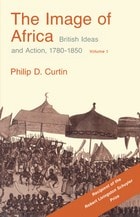
The Image of Africa
British Ideas and Action, 1780-1850, Volume IPhilip D. Curtin
University of Wisconsin Press, 1973
In this encyclopedic work of intellectual history, Philip D. Curtain sought to discover the British image of Africa for the years 1780–1850.
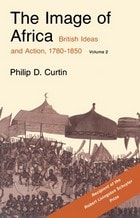
The Image of Africa
British Ideas and Action, 1780-1850, Volume IIPhilip D. Curtin
University of Wisconsin Press, 1973
In this encyclopedic work of intellectual history, Philip D. Curtain sought to discover the British image of Africa for the years 1780–1850.
The Imaginary Geography of Hollywood Cinema 1960-2000
Christian Long
Intellect Books, 2017
A PDF version of this book is available for free in open access via the OAPEN Library platform, www.oapen.org It has been made available under a Creative Commons Attribution 4.0 International Public License and is part of Knowledge Unlatched.
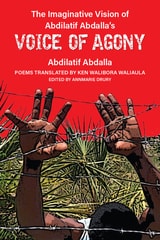
The Imaginative Vision of Abdilatif Abdalla’s Voice of Agony
Abdilatif Abdalla, edited by Annmarie Drury
University of Michigan Press, 2024
Yet, Imaginative Vision is also something more. Even as it centers on a literary translation of a singularly beautiful and influential book of poetry, it tells English-language readers the story of that book. Supporting materials illuminate the circumstances of its inception when Abdilatif, aged 22, was arrested and tried. They explore what the volume meant to its first readers and its affiliations with subsequent extraordinary works of prison literature by Alamin Mazrui and Ngũgĩ wa Thiong’o. They trace its links to literary art of the past, including the nineteenth-century poet Muyaka bin Haji, and to writing that followed. And they explain social and historical aspects of the Swahili coastal world that nurtured Abdilatif’s political engagement and stunning verbal art. Under the editorship of scholar, translator, and poet Annmarie Drury, contributors bring insights from their diverse backgrounds to present contextualizing material that illuminates the poems at the heart of this book.
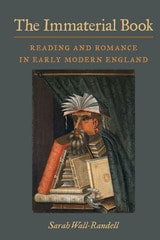
The Immaterial Book
Reading and Romance in Early Modern EnglandSarah Wall-Randell
University of Michigan Press, 2013
In romances—Renaissance England’s version of the fantasy novel—characters often discover books that turn out to be magical or prophetic, and to offer insights into their readers’ selves. The Immaterial Book examines scenes of reading in important romance texts across genres: Spenser’s Faerie Queene, Shakespeare’s Cymbeline and The Tempest, Wroth’s Urania, and Cervantes’ Don Quixote. It offers a response to “material book studies” by calling for a new focus on imaginary or “immaterial” books and argues that early modern romance authors, rather than replicating contemporary reading practices within their texts, are reviving ancient and medieval ideas of the book as a conceptual framework, which they use to investigate urgent, new ideas about the self and the self-conscious mind.
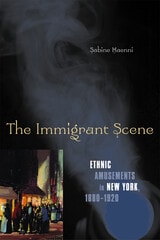
The Immigrant Scene
Ethnic Amusements in New York, 1880–1920Sabine Haenni
University of Minnesota Press, 2008
Explores the relationship between immigrant and national culture
Yiddish melodramas about the tribulations of immigration. German plays about alpine tourism. Italian vaudeville performances. Rubbernecking tours of Chinatown. In the New York City of the late nineteenth and early twentieth centuries, these seemingly disparate leisure activities played similar roles: mediating the vast cultural, demographic, and social changes that were sweeping the nation’s largest city.
In The Immigrant Scene, Sabine Haenni reveals how theaters in New York created ethnic entertainment that shaped the culture of the United States in the early twentieth century. Considering the relationship between leisure and mass culture, The Immigrant Scene develops a new picture of the metropolis in which the movement of people, objects, and images on-screen and in the street helped residents negotiate the complexities of modern times. In analyzing how communities engaged with immigrant theaters and the nascent film culture in New York City, Haenni traces the ways in which performance and cinema provided virtual mobility—ways of navigating the socially complex metropolis—and influenced national ideas of immigration, culture, and diversity in surprising and lasting ways.
The Immigrant Threat
The Integration of Old and New Migrants in Western Europe since 1850Leo Lucassen
University of Illinois Press, 2005
Leo Lucassen tackles the question of whether the integration process of these recent immigrants will fundamentally differ in the long run (over multiple generations) from the experiences of similar immigrant groups in the past. For comparison, Lucassen focuses on "large and problematic groups" from Western Europe's past (the Irish in the United Kingdom, the Poles in Germany, and the Italians in France) and demonstrates a number of structural similarities in the way migrants and their descendants integrated into these nation states. Lucassen emphasizes that the geographic sources of the "threat" have changed and that contemporaries tend to overemphasize the threat of each successive wave of immigrants, in part because the successfully incorporated immigrants of the past have become invisible in national histories.
The Impact of the Civil War and Reconstruction on Arkansas
Persistence in the Midst of RuinCarl H. Moneyhon
University of Arkansas Press, 2002
The Impasse of the Latin American Left
Franck Gaudichaud, Massimo Modonesi, and Jeffery R. Webber
Duke University Press, 2022
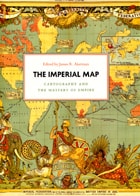
The Imperial Map
Cartography and the Mastery of EmpireEdited by James R. Akerman
University of Chicago Press, 2009
Critically reflecting on elements of mapping and imperialism from the late seventeenth century to the early twentieth century, the essays discuss the nature of the imperial map through a series of case studies of empires, from the Qing dynasty of China, to the Portuguese empire in South America, to American imperial pretensions in the Pacific Ocean, among others. Collectively, the essays reveal that the relationship between mapping and imperialism, as well as the practice of political and economic domination of weak polities by stronger ones, is a rich and complex historical theme that continues to resonate in our modern day.
The Imperial Style of Inquiry in Twentieth-Century China
The Emergence of New ApproachesDonald J. Munro
University of Michigan Press, 1996
The Imperial Sublime
A Russian Poetics of EmpireHarsha Ram
University of Wisconsin Press, 2003
The Imperialist Imaginary
Visions of Asia and the Pacific in American CultureJohn Eperjesi
Dartmouth College Press, 2014
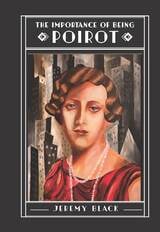
The Importance of Being Poirot
Jeremy Black
St. Augustine's Press, 2021
Hercule Poirot as a character is masterfully imagined, but Black shows us how he is inseparable from Christie’s turbulent and changing world. He also illuminates significant social commentary in Christie’s fiction, and in so doing Black often uses his authority to vindicate Christie’s work from hastily, at times stupidly, applied labels and interpretations. He is especially magnificent in his chapters, “Xenophobia” and “The Sixties.” Black nevertheless gives due recognition to Christie’s critics when they have something relevant and reasonable to say, and hence the reader finds yet another service in Black’s comprehensive review of the reviewers over the expanse of Christie’s writing career.
For all this, Black proves himself to be a worthy history-teller because he can aptly ‘detect’ the meaning of stories that seeks to answer the past and guide the present. His erudition runs much deeper than his ability to navigate the stores of resources available on the subject, and the reader gets a glimpse of this early on when in the introduction he proffers his own defense for writing about the importance of a Hercule Poirot. Black writes, “the notion of crime had a moral component from the outset, and notably so in terms of the struggle between Good and Evil, and in the detection of the latter. Indeed, it is this detection that is the basis of the most powerful strand of detection story, because Evil disguises its purposes. It has to do so in a world and humanity made fundamentally benign and moral by God.” The Golden Age of detective novels represents much more than a triumph of a literary genre. It is in its own right a story of how the challenge to address the problem of evil was accepted. Its convergence with the plot-rich narrative of the twentieth century in the modern age renders Black’s account a thrilling masterpiece, seducing historians to read fiction and crime junkies to read more history.
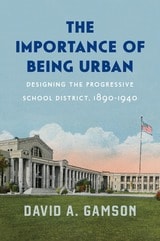
The Importance of Being Urban
Designing the Progressive School District, 1890-1940David A. Gamson
University of Chicago Press, 2019
The Importance of Being Urban
Designing the Progressive School District, 1890-1940David A. Gamson
University of Chicago Press, 2019
From the 1890s through World War II, the greatest hopes of American progressive reformers lay not in the government, the markets, or other seats of power but in urban school districts and classrooms. The Importance of Being Urban focuses on four western school systems—in Denver, Oakland, Portland, and Seattle—and their efforts to reconfigure public education in the face of rapid industrialization and the perceived perils of the modern city. In an era of accelerated immigration, shifting economic foundations, and widespread municipal shake-ups, reformers argued that the urban school district could provide the broad blend of social, cultural, and educational services needed to prepare students for twentieth-century life. These school districts were a crucial force not only in orchestrating educational change, but in delivering on the promise of democracy. David A. Gamson’s book provides eye-opening views of the histories of American education, urban politics, and the Progressive Era.

The Impossible Machine
A Genealogy of South Africa's Truth and Reconciliation CommissionAdam Sitze
University of Michigan Press, 2016
Adam Sitze meticulously traces the origins of South Africa’s Truth and Reconciliation Commission back to two well-established instruments of colonial and imperial governance: the jurisprudence of indemnity and the commission of inquiry. This genealogy provides a fresh, though counterintuitive, understanding of the TRC’s legal, political, and cultural importance. The TRC’s genius, Sitze contends, is not the substitution of “forgiving” restorative justice for “strict” legal justice but rather the innovative adaptation of colonial law, sovereignty, and government. However, this approach also contains a potential liability: if the TRC’s origins are forgotten, the very enterprise intended to overturn the jurisprudence of colonial rule may perpetuate it. In sum, Sitze proposes a provocative new means by which South Africa’s Truth and Reconciliation Commission should be understood and evaluated.

The Impossible Reversal
A History of How We PlayPeter D. McDonald
University of Minnesota Press, 2026
Tracing the cultural history of play—from Fluxus to SimCity
Games and gamified activities have become ubiquitous in many adults’ lives, and play is widely valued for fostering creativity, community, growth, and empathy. But how did we come to our current understanding of what it means to play? The Impossible Reversal charts the transformation of notions of playfulness beginning in the second half of the twentieth century, when a legion of artists, academics, and engineers developed new ways of theorizing, structuring, and designing ludic activity.
Through examples ranging from experimental Fluxus games to corporate role-playing exercises and from the Easy Bake Oven to Tetris, The Impossible Reversal presents four styles of playfulness characteristic of the “era of designed play”: the impossible reversal, which puts a player in a seemingly hopeless scenario they must upend with a tiny gesture; expending the secret, which involves silly rules that gain an obscure power and require players to embrace failure; simulated freedom, a satiric criticism of the ordinary world; and oblique repetition, a way of playing that stumbles toward unimaginable outcomes through simple, meaningless, and endlessly iterated acts.
A unique genealogical account of play as both concept and practice, The Impossible Reversal illuminates how playfulness became essential for understanding cultural, technical, and economic production in the United States.
Retail e-book files for this title are screen-reader friendly with images accompanied by short alt text and/or extended descriptions.

The Impotence Epidemic
Men's Medicine and Sexual Desire in Contemporary ChinaEverett Yuehong Zhang
Duke University Press, 2015
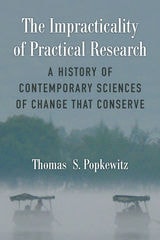
The Impracticality of Practical Research
A History of Contemporary Sciences of Change That ConserveThomas S. Popkewitz
University of Michigan Press, 2020
There is an alluring desire that research should lead us to find the practical knowledge that enables people to live a good life in a just and equitable society. This desire haunted the 19th century emergence of the social sciences as a discipline, then became more pronounced in the postwar mobilizations of research. Today that desire lives on in the international assessments of national schools and in the structure of professional education, both of which influence government modernization of schools and also provide for people’s well-being. American policy thus reflects research in which reforms are verified by “scientific, empirical evidences” about “what works” in experiments, and “will work” therefore in society.
The book explores the idea that practical and useful knowledge changes over time, and shows how this knowledge has been (re)visioned in contemporary research on educational reform, instructional improvement, and professionalization. The study of science draws on a range of social and cultural theories and historical studies to understand the politics of science, as well as scientific knowledge that is concerned with social and educational change. Research hopes to change social conditions to create a better life, and to shape people whose conduct embodies these valued characteristics—the good citizen, parent, or worker. Yet this hope continually articulates the dangers that threaten this future. Thomas Popkewitz explores how the research to correct social wrongs is paradoxically entangled with the inscription of differences that ultimately hamper the efforts to include.