Results by title
22279 books match the query 'Social Science' and 4007 start with t
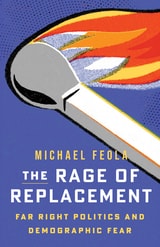
The Rage of Replacement
Far Right Politics and Demographic FearMichael Feola
University of Minnesota Press, 2024
Tracing how the “Great Replacement” narrative has shaped far-right extremism and propelled its dangerous political projects and acts of violence
The “Great Replacement” narrative, which imagines that historic white majorities are being intentionally replaced through immigration policies crafted by global elites, has effectively mobilized racist, nationalist, and nativist movements in the United States and Europe. The Rage of Replacement tracks how this narrative has shaped the politics and worldview of the far right, binding its various camps into a community of rage obsessed with nostalgia for a white-supremacist past.
Showing how the replacement narrative has found significant purchase in recent mainstream discourse through the rise of Trumpism, right-wing media figures like Tucker Carlson, and events such as 2017’s “Unite the Right” rally in Charlottesville, Virginia, Michael Feola diagnoses the dangers this racist theory poses as it shapes the far-right imagination, expands through civil society, and deforms political culture. In particular, he tracks how the replacement narrative has given rise to malignant political strategies designed to “take back” the nation from its perceived enemies—by force if deemed necessary.
Identifying the Great Replacement narrative as a central force behind the rise and expansion of far-right extremism, Feola shows how it has motivated a variety of dangerous political projects in pursuit of illiberal, antidemocratic futures. From calls for the creation of segregated white ethnostates to extremist violence such as the mass shootings in Christchurch, El Paso, and Buffalo, The Rage of Replacement makes clear that replacement theory poses a dire threat to democracy and safety.
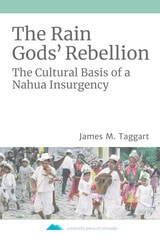
The Rain Gods' Rebellion
The Cultural Basis of a Nahua InsurgencyJames M. Taggart
University Press of Colorado, 2019
The Rain Gods’ Rebellion examines Nahua oral narratives to illuminate the cultural basis of the 1977–1984 rebellion against the local Hispanic elite in Huitzilan de Serdán, Mexico. Drawing from forty years of fieldwork in the region, James M. Taggart traces the sociopolitical role of Nahua rain gods—who took both human and divine forms—back hundreds of years and sheds new light on the connections between social experiences and the Nahua understanding of water and weather in stories. As Taggart shows, Nahua tales of the rain gods’ rebellion anticipated the actual 1977 land invasion in Huitzilan, in which some 200–300 Nahua were killed.
The Rain Gods’ Rebellion reveals how local culture evolves from the expression of unrest to organized insurgency and then into collective memory. Taggart records a tradition of storytelling in which Nahuas radicalized themselves through recounting the rain gods’ stories—stories of the gods organizing and striking with bolts of lightning the companion spirits of autocratic local leaders who worked closely with mestizos. The tales are part of a tradition of resisting the friars’ efforts to convert the Nahuas, Totonacs, Otomi, and Tepehua to Christianity and inspiring nativistic movements against invading settlers.Providing a rare longitudinal look at the cultural basis of this grassroots insurgency, The Rain Gods’ Rebellion offers rare insight into the significance of oral history in forming Nahua collective memory and, by extension, culture. It will be of significance to scholars of Indigenous studies, anthropology, oral history, and violence studies, as well as linguistic anthropologists and sociolinguists.
The Rainy Season
Three Lives in the New South AfricaMaggie Messitt
University of Iowa Press, 2015
The Rainy Season tells the stories of three generations in the Rainbow Nation one decade after its first democratic elections. This multi-threaded narrative follows Regina, a tapestry weaver in her sixties, standing at the crossroads where her Catholic faith and the AIDS pandemic crash; Thoko, a middle-aged sangoma (traditional healer) taking steps to turn her shebeen into a fully licensed tavern; and Dankie, a young man taking his matriculation exams, coming of age as one of Mandela’s Children, the first academic class educated entirely under democratic governance.
Home to Shangaan, Sotho, and Mozambican Tsonga families, Rooiboklaagte sits in a village where an outdoor butchery occupies an old petrol station and a funeral parlor sits in the attached garage. It’s a place where an AIDS education center sits across the street from a West African doctor selling cures for the pandemic. It’s where BMWs park outside of crumbling cement homes, and the availability of water changes with the day of the week. As the land shifts from dusty winter blond to lush summer green and back again, the duration of northeastern South Africa’s rainy season, Regina, Thoko, and Dankie all face the challenges and possibilities of the new South Africa.
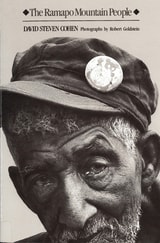
The Ramapo Mountain People
Cohen, David Steven
Rutgers University Press, 1986
In a study combining tee disciplines of anthropology, sociology, folklore, and history, David Cohen found that the old stories about these people were legends, not history.
He found no reliable evidence that their ancestors were Tuscarora Indians, Hessian deserters from the British army, escaped slaves, and British and West Indian prostitutes imported by a sea captain named Jackson for the pleasure of British soldiers occupying Manhattan during the War for Independence.
David Cohen lived among the Ramapo Mountain People for a year, conducting genealogical research into church records, deeds, wills, and inventories in county courthouses and libraries. He established that their ancestors included free black landowners in New York City and mulattoes with some Dutch ancestry who were among the first pioneers to settle in the Hackensack River Valley of New Jersey.
In describing his findings and his experiences, Professor Cohen shows how their racially mixed ancestry, their special family and kinship system, and their intergroup attitudes and folkways distinguish and socially isolate these people as a separate racial group today, despite modern communications and transportation and their proximity to New York City.
The Rape of Mesopotamia
Behind the Looting of the Iraq MuseumLawrence Rothfield
University of Chicago Press, 2009
On April 10, 2003, as the world watched a statue of Saddam Hussein come crashing down in the heart of Baghdad, a mob of looters attacked the Iraq National Museum. Despite the presence of an American tank unit, the pillaging went unchecked, and more than 15,000 artifacts—some of the oldest evidence of human culture—disappeared into the shadowy worldwide market in illicit antiquities. In the five years since that day, the losses have only mounted, with gangs digging up roughly half a million artifacts that had previously been unexcavated; the loss to our shared human heritage is incalculable.
With The Rape of Mesopotamia, Lawrence Rothfield answers the complicated question of how this wholesale thievery was allowed to occur. Drawing on extensive interviews with soldiers, bureaucrats, war planners, archaeologists, and collectors, Rothfield reconstructs the planning failures—originating at the highest levels of the U.S. government—that led to the invading forces’ utter indifference to the protection of Iraq’s cultural heritage from looters. Widespread incompetence and miscommunication on the part of the Pentagon, unchecked by the disappointingly weak advocacy efforts of worldwide preservation advocates, enabled a tragedy that continues even today, despite widespread public outrage.
Bringing his story up to the present, Rothfield argues forcefully that the international community has yet to learn the lessons of Iraq—and that what happened there is liable to be repeated in future conflicts. A powerful, infuriating chronicle of the disastrous conjunction of military adventure and cultural destruction, The Rape of Mesopotamia is essential reading for all concerned with the future of our past.
The Rational Public
Fifty Years of Trends in Americans' Policy PreferencesBenjamin I. Page and Robert Y. Shapiro
University of Chicago Press, 1992
The authors unequivocally demonstrate that, notwithstanding fluctuations in the opinions of individuals, collective public opinion is remarkably coherent: it reflects a stable system of values shared by the majority of Americans and it responds sensitively to new events, arguments, and information reported in the mass media. While documenting some alarming case of manipulation, Page and Shapiro solidly establish the soundness and value of collective political opinion. The Rational Public provides a wealth of information about what we as a nation have wanted from government, how we have changed our minds over the years, and why.
For anyone interested in the short- and long-term trends in Americans' policy preferences, or eager to learn what Americans have thought about issues ranging from racial equality to the MX missile, welfare to abortion, this book offers by far the most sophisticated and detailed treatment available.
The Raw and the Cooked
Mythologiques, Volume 1Claude Lévi-Strauss
University of Chicago Press, 1983

The Reader and the Detective Story
George N. Dove
University of Wisconsin Press, 1997
George Dove demonstrates how the English soft-boiled mystery and the American private-eye story, although they have different settings and develop different plots, belong in the same subgenre and follow the same formula, inherited directly from Poe’s “The Murders in the Rue Morgue.”
The Reagan Range
The Nostalgic Myth in American PoliticsJames Combs
University of Wisconsin Press, 1993
This book is an attempt to make sense out of Ronald Reagan by linking him to various grassroots dimensions of American popular mythology and mind. It attempts to utilize a variety of sources from American and popular culture studies, works on Reagan, and popular materials such as movies to offer an interpretation of reagan as an exemplar of the political relevance and power of popular culture.
The Real Cyber War
The Political Economy of Internet FreedomShawn M. Powers and Michael Jablonski
University of Illinois Press, 2015
Moving beyond debates on the democratic value of new and emerging information technologies, The Real Cyber War focuses on political, economic, and geopolitical factors driving internet freedom policies, in particular the U.S. State Department's emerging doctrine in support of a universal freedom to connect. They argue that efforts to create a universal internet built upon Western legal, political, and social preferences is driven by economic and geopolitical motivations rather than the humanitarian and democratic ideals that typically accompany related policy discourse. In fact, the freedom-to-connect movement is intertwined with broader efforts to structure global society in ways that favor American and Western cultures, economies, and governments.
Thought-provoking and far-seeing, The Real Cyber War reveals how internet policies and governance have emerged as critical sites of geopolitical contestation, with results certain to shape statecraft, diplomacy, and conflict in the twenty-first century.
The Real Economy
Essays in Ethnographic TheoryEdited by Federico Neiburg and Jane I. Guyer
HAU, 2020
An ambitious anthropology of economy, this volume questions how assemblages of vernacular and scientific realizations and enactments of the economy are linked to ideas of truth and moral value; how these multiple and shifting realities become present and entangle with historically and socially situated lives; and how the formal realizations of the concept of the “real” in the governance of economies engage with the experiential lives of ordinary people. Featuring essays from some of the world’s most prominent economic anthropologists, The Real Economy is a milestone collection in economic anthropology that crosses disciplinary boundaries and adds new life to social studies of the economy.
The Real Hiphop
Battling for Knowledge, Power, and Respect in the LA UndergroundMarcyliena Morgan
Duke University Press, 2009
Morgan intersperses her observations with excerpts from interviews and transcripts of freestyle lyrics. Providing a thorough linguistic interpretation of the music, she teases out the cultural antecedents and ideologies embedded in the language, emphases, and wordplay. She discusses the artistic skills and cultural knowledge MCs must acquire to rock the mic, the socialization of hiphop culture’s core and long-term members, and the persistent focus on skills, competition, and evaluation. She brings attention to adults who provided material and moral support to sustain underground hiphop, identifies the ways that women choose to participate in Project Blowed, and vividly renders the dynamics of the workshop’s famous lyrical battles.
The Realm Of Prester John
Robert Silverberg
Ohio University Press, 1996
In this modern account of the genesis of a great medieval myth, celebrated science fiction author Robert Silverberg’s explores the mysterious origins of Prester John, the astonishing Christian potentate of the East.
Prester John was a legendary figure who cast a powerful spell over Latin Christendom for almost five centuries. Rumors of the warrior-king-prelate’s fabulous realms first reached Europe in the eleventh century and quickly assumed an exalted status alongside such fabled wonders as El Dorado, The Fountain of Youth, and the Holy Grail.
The defeat of a Moslem Turkish tribe by a Buddhist Chinese warlord seems to have been the unlikely historical nugget around which the Prester John myth grew, but contributions to this strange saga have also been traced all around the globe to the Apostle Thomas' apocryphal preaching in India, to the actual existence of small colonies of Nestorian schismatics in central Asia, and even to Genghis Khan.
The Reappeared
Argentine Former Political PrisonersPark, Rebekah
Rutgers University Press, 2014
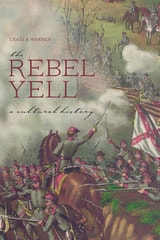
The Rebel Yell
A Cultural HistoryCraig A. Warren
University of Alabama Press, 2014
The first comprehensive history of the fabled Confederate battle cry from its origins and myths through its use in American popular culture.
No aspect of Civil War military lore has received less scholarly attention than the battle cry of the Southern soldier. In The Rebel Yell, Craig A. Warren brings together soldiers' memoirs, little-known articles, and recordings to create a fascinating and exhaustive exploration of the facts and myths about the “Southern screech.”
Through close readings of numerous accounts, Warren demonstrates that the Rebel yell was not a single, unchanging call, but rather it varied from place to place, evolved over time, and expressed nuanced shades of emotion. A multifunctional act, the flexible Rebel yell was immediately recognizable to friends and foes but acquired new forms and purposes as the epic struggle wore on. A Confederate regiment might deliver the yell in harrowing unison to taunt Union troops across the empty spaces of a battlefield. At other times, individual soldiers would call out solo or in call-and-response fashion to communicate with or secure the perimeters of their camps.
The Rebel yell could embody unity and valor, but could also become the voice of racism and hatred. Perhaps most surprising, The Rebel Yell reveals that from Reconstruction through the first half of the twentieth century, the Rebel yell—even more than the Confederate battle flag—served as the most prominent and potent symbol of white Southern defiance of Federal authority. With regard to the late-twentieth and early twenty-first centuries, Warren shows that the yell has served the needs of people the world over: soldiers and civilians, politicians and musicians, re-enactors and humorists, artists and businessmen. Warren dismantles popular assumptions about the Rebel yell as well as the notion that the yell was ever “lost to history.”
Both scholarly and accessible, The Rebel Yell contributes to our knowledge of Civil War history and public memory. It shows the centrality of voice and sound to any reckoning of Southern culture.
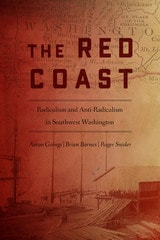
The Red Coast
Radicalism and Anti-Radicalism in Southwest WashingtonAaron Goings
Oregon State University Press, 2019
With a focus on socialists, militant unionists, Wobblies, "Red" Finns, and Communists, The Red Coast covers the people, places, and events that made history-well-known events like the 1919 Armistice Day Tragedy in Centralia and the murders of labor activists William McKay and Laura Law in Aberdeen as well as lesser-known events that have been lost to posterity until now.
The Red Coast also delves deep into the lives and work of the region's anti-radical forces, examining the collective efforts of employers, news editors, and vigilantes to combat working-class organization. Topics include the Wobblies, the labor wars of the 1910s and 1930s, and the lumber and maritime industries. Labor historians, scholars, and general readers with interest in the working-class history of the Pacific Northwest will welcome this comprehensive and accessible account.
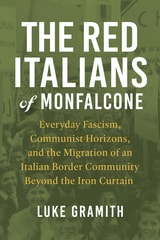
The Red Italians of Monfalcone
Everyday Fascism, Communist Horizons, and the Migration of an Italian Border Community Beyond the Iron CurtainLuke Gramith
University of Wisconsin Press, 2026
Between 1946 and 1948, roughly five thousand ethnic Italians from the northern Adriatic shipbuilding town of Monfalcone relocated to the newly communist Yugoslavia. This rare case of eastward Cold War migration demonstrates how ordinary people conceived of liberation during the transitional years between World War II and the early Cold War—a time when Monfalcone was both the object of competing Italian and Yugoslav territorial claims and the subject of Anglo-American military occupation.
In The Red Italians of Monfalcone, Luke Gramith undertakes a deep and detailed analysis—based on archival sources in Italy, Slovenia, and the United States—of how the Monfalconesi came to understand Fascism and communism through everyday experience and how those emergent ideologies affected and were affected by their migration. In the course of his analysis, Gramith also examines the failure of “defascistization” and how it fueled strong (but ultimately unsuccessful) pro-Yugoslav and communist movements.

The Red Land to the South
American Indian Writers and Indigenous MexicoJames H. Cox
University of Minnesota Press, 2012
The forty years of American Indian literature taken up by James H. Cox—the decades between 1920 and 1960—have been called politically and intellectually moribund. On the contrary, Cox identifies a group of American Indian writers who share an interest in the revolutionary potential of the indigenous peoples of Mexico—and whose work demonstrates a surprisingly assertive literary politics in the era.
By contextualizing this group of American Indian authors in the work of their contemporaries, Cox reveals how the literary history of this period is far more rich and nuanced than is generally acknowledged. The writers he focuses on—Todd Downing (Choctaw), Lynn Riggs (Cherokee), and D’Arcy McNickle (Confederated Salish and Kootenai)—are shown to be on par with writers of the preceding Progressive and the succeeding Red Power and Native American literary renaissance eras.
Arguing that American Indian literary history of this period actually coheres in exciting ways with the literature of the Native American literary renaissance, Cox repudiates the intellectual and political border that has emerged between the two eras.

The Red Riviera
Gender, Tourism, and Postsocialism on the Black SeaKristen Ghodsee
Duke University Press, 2005
Interspersed throughout The Red Riviera are vivid examinations of the lives of Bulgarian women, including a waitress, a tour operator, a chef, a maid, a receptionist, and a travel agent. Through these women’s stories, Ghodsee describes their employment prior to 1989 and after. She considers the postsocialist forces that have shaped the tourist industry over the past fifteen years: the emergence of a new democratic state, the small but increasing interest of foreign investors and transnational corporations, and the proliferation of ngos. Ghodsee suggests that many of the ngos, by insisting that Bulgarian women are necessarily disenfranchised, ignore their significant professional successes.
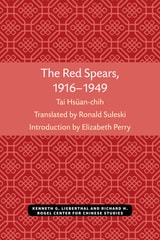
The Red Spears, 1916–1949
Tai Hsüan-chih; Translated by Ronald Suleski; Introduction by Elizabeth Perry
University of Michigan Press, 1981
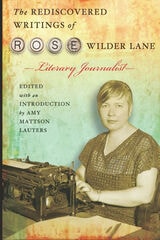
The Rediscovered Writings of Rose Wilder Lane, Literary Journalist
Edited by Amy Mattson Lauters
University of Missouri Press, 2007
This book recovers journalistic work by an American icon for whom scholarly recognition is long overdue. Amy Mattson Lauters introduces readers to Lane’s life through examples of her journalism and argues that her work and career help establish her not only as an author and political rhetorician but also as a literary journalist. Lauters has assembled a collection of rarely seen nonfiction articles that illustrate Lane’s talent as a writer of literary nonfiction, provide on-the-spot views of key moments in American cultural history, and offer sharp commentary on historical events.
Through this collection of Lane’s journalism, dating from early work for Sunset magazine in 1918 to her final piece for Woman’s Day set in 1965 Saigon, Lauters shows how Lane infused her writing with her particular ideology of Americanism and individualism, self-reliance, and freedom from government interference, thereby offering stark commentary on her times. Lane shares her experiences as an extra in a Douglas Fairbanks movie and interviews D.W. Griffith. She reports on average American women struggling to raise a family in wartime and hikes over the Albanian mountains between the world wars. Her own maturing conservative political views provide a lens through which readers can view debates over the draft, war, and women’s citizenship during World War II, and her capstone piece brings us again into a culture torn by war, this time in Southeast Asia.
These writings have not been available to the reading public since they first appeared. They encapsulate important moments for Lane and her times, revealing the woman behind the text, the development of her signature literary style, and her progression as a writer. Lauters’s introduction reveals the flow of Lane’s life and career, offering key insights into women’s history, the literary journalism genre, and American culture in the first half of the twentieth century.
Through these works, readers will discover a writer whose cultural identity was quintessentially American, middle class, midwestern, and simplistic—and who assumed the mantle of custodian to Americanism through women’s arts. The Rediscovered Writings of Rose Wilder Lane traces the extraordinary relationship between one woman and American society over fifty pivotal years and offers readers a treasury of writings to enjoy and discuss.
The Reflective Age
Nostalgia at the End of HistoryZachary Griffith
Rutgers University Press, 2026
The Reformation of Machismo
Evangelical Conversion and Gender in ColombiaBy Elizabeth E. Brusco
University of Texas Press, 1995
Protestant evangelicalism has spread rapidly in Latin America at the same time that foreign corporations have taken hold of economies there. These concurrent developments have led some observers to view this religious movement as a means of melding converts into a disciplined work force for foreign capitalists rather than as a reflection of conscious individual choices made for a variety of personal, as well as economic, reasons.
In this pioneering study, Elizabeth Brusco challenges such assumptions and explores the intra-household motivations for evangelical conversion in Colombia. She shows how the asceticism required of evangelicals (no drinking, smoking, or extramarital sexual relations are allowed) redirects male income back into the household, thereby raising the living standard of women and children. This benefit helps explain the appeal of evangelicalism for women and questions the traditional assumption that organized religion always disadvantages women.
Brusco also demonstrates how evangelicalism appeals to men by offering an alternative to the more dysfunctional aspects of machismo. Case studies add a fascinating human dimension to her findings.
With the challenges this book poses to conventional wisdom about economic, gender, and religious behavior, it will be important reading for a wide audience in anthropology, women’s studies, economics, and religion. For all students of Latin America, it offers thoughtful new perspectives on a major, grass-roots agent of social change.
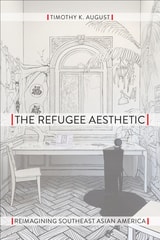
The Refugee Aesthetic
Reimagining Southeast Asian AmericaTimothy August
Temple University Press, 2021
The refugee is conventionally considered a powerless figure, eagerly cast aside by both migrant and host communities. In his book, The Refugee Aesthetic, Timothy August investigates how and why a number of Southeast Asian American artists and writers have recently embraced the figure of the refugee as a particularly transformative position. He explains how these artists, theorists, critics, and culture-makers reconstruct their place in the American imagination by identifying and critiquing the underlying structures of power that create refugees in the contemporary world.
August looks at the outside forces that shape refugee representation and how these expressions are received. He considers the visual legacy of the Southeast Asian refugee experience by analyzing music videos, graphic novels, and refugee artwork. August also examines the power of refugee literature, showing how and why Southeast Asian American writers look to the refugee position to disentangle their complicated aesthetic legacy.
Arguing that “aesthetics” should be central to the conceptualization of critical refugee studies, August shows how representational structures can galvanize or marginalize refugees, depending on how refugee aesthetics are used and circulated.
The Regulation of Sexuality
Experiences of Family Planning WorkersCarole Joffe
Temple University Press, 1987
The Reification of Desire
Toward a Queer MarxismKevin Floyd
University of Minnesota Press, 2009
Kevin Floyd brings queer critique to bear on the Marxian categories of reification and totality and considers the dialectic that frames the work of Georg Lukács, Herbert Marcuse, and Fredric Jameson. Reading the work of these theorists together with influential queer work by such figures as Michel Foucault and Judith Butler, and alongside reconsiderations of such texts as The Sun Also Rises and Midnight Cowboy, Floyd reformulates these two central categories that have been inseparable from a key strand of Marxist thought and have marked both its explanatory power and its limitations. Floyd theorizes a dissociation of sexuality from gender at the beginning of the twentieth century in terms of reification to claim that this dissociation is one aspect of a larger dynamic of social reification enforced by capitalism.
Developing a queer examination of reification and totality, Kevin Floyd ultimately argues that the insights of queer theory require a fundamental rethinking of both.
The Relative Native
Essays on Indigenous Conceptual WorldsEduardo Viveiros de Castro
HAU, 2015
This volume is the first to collect the most influential essays and lectures of Eduardo Viveiros de Castro. Published in a wide variety of venues, and often difficult to find, the pieces are brought together here for the first time in a one major volume, which includes his momentous 1998 Cambridge University Lectures, “Cosmological Perspectivism in Amazonia and Elsewhere.”
Rounded out with new English translations of a number of previously unpublished works, the resulting book is a wide-ranging portrait of one of the towering figures of contemporary thought—philosopher, anthropologist, ethnographer, ethnologist, and more. With a new afterword by Roy Wagner elucidating Viveiros de Castro’s work, influence, and legacy, The Relative Native will be required reading, further cementing Viveiros de Castro’s position at the center of contemporary anthropological inquiry.
The Religion of Science Fiction
Frederick A. Kreuziger
University of Wisconsin Press, 1986
The Remains of War
Bodies, Politics, and the Search for American Soldiers Unaccounted For in Southeast AsiaThomas M. Hawley
Duke University Press, 2005
Hawley combines the theoretical insights of Judith Butler, Michel Foucault, and Emmanuel Levinas with detailed research into the history of the movement to recover the remains of soldiers missing in Vietnam. He examines the practices that constitute the Defense Department’s accounting protocol: the archival research, archaeological excavation, and forensic identification of recovered remains. He considers the role of the American public and the families of missing soldiers in demanding the release of pows and encouraging the recovery of the missing; the place of the body of the Vietnam veteran within the war’s legacy; and the ways that memorials link individual bodies to the body politic. Highlighting the contradictions inherent in the recovery effort, Hawley reflects on the ethical implications of the massive endeavor of the American government and many officials in Vietnam to account for the remains of American soldiers.
The Remarkable Rise of Transgender Rights
Jami K. Taylor, Daniel C. Lewis, and Donald P. Haider-Markel
University of Michigan Press, 2018
The Remittance Landscape
Spaces of Migration in Rural Mexico and Urban USASarah Lynn Lopez
University of Chicago Press, 2014
Lopez not only identifies a clear correspondence between the flow of remittances and the recent building boom in rural Mexico but also proposes that this construction boom itself motivates migration and changes social and cultural life for migrants and their families. At the same time, migrants are changing the landscapes of cities in the United States: for example, Chicago and Los Angeles are home to buildings explicitly created as headquarters for Mexican workers from several Mexican states such as Jalisco, Michoacán, and Zacatecas. Through careful ethnographic and architectural analysis, and fieldwork on both sides of the border, Lopez brings migrant hometowns to life and positions them within the larger debates about immigration.
The Renewal of Cultural Studies
Edited by Paul Smith
Temple University Press, 2011
Cultural Studies, once a burgeoning academic field, developed into a discipline in which just about any cultural text, object or event could be studied. The Renewal of Cultural Studies offers a panoramic view of the field, its assumptions, and its methodologies. Editor Paul Smith and thirty contributors map out new directions that will redefine and sustain the field of cultural studies.
In twenty-seven original essays, cultural studies is examined in relation to other disciplines—history, anthropology, literature, media, and American studies. The discipline is reviewed in the context of globalization, in relation to topics such as war, public policy, and labor, its pedagogy and politics, and in Marxist, feminist, and environmentalist contexts.
Smith wants to establish theoretical and methodological common ground among cultural studies scholars. Providing a “state of the discipline,” The Renewal of Cultural Studies asks, “What can and should the field of Cultural Studies be doing now?”
The Renewal of the Kibbutz
From Reform to TransformationRussell, Raymond
Rutgers University Press, 2015
This book explores the waves of reforms since 1990. Looking through the lens of organizational theories that predict how open or closed a group will be to change, the authors find that less successful kibbutzim were most receptive to reform, and reforms then spread through imitation from the economically weaker kibbutzim to the strong.
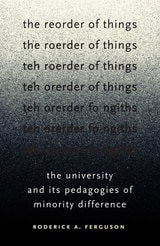
The Reorder of Things
The University and Its Pedagogies of Minority DifferenceRoderick A. Ferguson
University of Minnesota Press, 2012
In the 1960s and 1970s, minority and women students at colleges and universities across the United States organized protest movements to end racial and gender inequality on campus. African American, Chicano, Asia American, American Indian, women, and queer activists demanded the creation of departments that reflected their histories and experiences, resulting in the formation of interdisciplinary studies programs that hoped to transform both the university and the wider society beyond the campus.
In The Reorder of Things, however, Roderick A. Ferguson traces and assesses the ways in which the rise of interdisciplines—departments of race, gender, and ethnicity; fields such as queer studies—were not simply a challenge to contemporary power as manifest in academia, the state, and global capitalism but were, rather, constitutive of it. Ferguson delineates precisely how minority culture and difference as affirmed by legacies of the student movements were appropriated and institutionalized by established networks of power.
Critically examining liberationist social movements and the cultural products that have been informed by them, including works by Adrian Piper, Toni Cade Bambara, Jhumpa Lahiri, and Zadie Smith, The Reorder of Things argues for the need to recognize the vulnerabilities of cultural studies to co-option by state power and to develop modes of debate and analysis that may be in the institution but are, unequivocally, not of it.
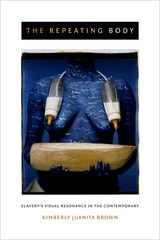
The Repeating Body
Slavery's Visual Resonance in the ContemporaryKimberly Juanita Brown
Duke University Press, 2015
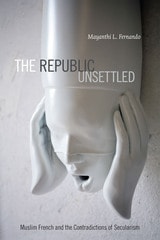
The Republic Unsettled
Muslim French and the Contradictions of SecularismMayanthi L. Fernando
Duke University Press, 2014
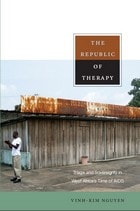
The Republic of Therapy
Triage and Sovereignty in West Africa’s Time of AIDSVinh-Kim Nguyen
Duke University Press, 2010
The Republican Aventine and Rome’s Social Order
Lisa Marie Mignone
University of Michigan Press, 2016
The myth of the “plebeian Aventine” became embedded not only in classical scholarship, but also in modern political and cultural consciousness; it has even been used by modern figures to support their political agenda. Yet The Republican Aventine and Rome’s Social Order makes bold new claims regarding the urban design and social history of ancient Rome and raises a significant question about ancient urbanism and social stability more generally: Did social integration reduce violence in premodern cities and promote urban concord?
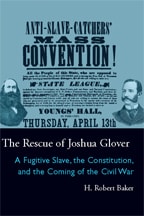
The Rescue of Joshua Glover
A Fugitive Slave, the Constitution, and the Coming of the Civil WarH. Robert Baker
Ohio University Press, 2006
On March 11, 1854, the people of Wisconsin prevented agents of the federal government from carrying away the fugitive slave, Joshua Glover. Assembling in mass outside the Milwaukee courthouse, they demanded that the federal officers respect his civil liberties as they would those of any other citizen of the state. When the officers refused, the crowd took matters into its own hands and rescued Joshua Glover. The federal government brought his rescuers to trial, but the Wisconsin Supreme Court intervened and took the bold step of ruling the Fugitive Slave Act unconstitutional.
The Rescue of Joshua Glover delves into the courtroom trials, political battles, and cultural equivocation precipitated by Joshua Glover’s brief, but enormously important, appearance in Wisconsin on the eve of the Civil War.
H. Robert Baker articulates the many ways in which this case evoked powerful emotions in antebellum America, just as the stage adaptation of Uncle Tom’s Cabin was touring the country and stirring antislavery sentiments. Terribly conflicted about race, Americans struggled mightily with a revolutionary heritage that sanctified liberty but also brooked compromise with slavery. Nevertheless, as The Rescue of Joshua Glover demonstrates, they maintained the principle that the people themselves were the last defenders of constitutional liberty, even as Glover’s rescue raised troubling questions about citizenship and the place of free blacks in America.
The Resilient Self
Gender, Immigration, and Taiwanese AmericansGu, Chien-Juh
Rutgers University Press, 2017
Most of the women immigrated as dependents when their U.S.-educated husbands found professional jobs upon graduation. Constrained by their dependent visas, these women could not work outside of the home during the initial phase of their settlement. The significant contrast of their lives before and after immigration—changing from successful professionals to foreign housewives—generated feelings of boredom, loneliness, and depression. Mourning their lost careers and lacking fulfillment in homemaking, these highly educated immigrant women were forced to redefine the meaning of work and housework, which in time shaped their perceptions of themselves and others in the family, at work, and in the larger community.
The Resolution of African Conflicts
The Management of Conflict Resolution and Post-Conflict ReconstructionAlfred Nhema
Ohio University Press, 2007
“These two volumes clearly demonstrate the efforts by a wide range of African scholars to explain the roots, routes, regimes and resolution of African conflicts and how to re-build post-conflict societies. They offer sober and serious analyses, eschewing the sensationalism of the western media and the sophistry of some of the scholars in the global North for whom African conflicts are at worst a distraction and at best a confirmation of their pet racist and petty universalist theories.”
—From the introduction by Paul Tiyambe Zeleza
This book offers analyses of a range of African conflicts and demonstrates that peace is too important to be left to outsiders.
The Resonance of Unseen Things
Poetics, Power, Captivity, and UFOs in the American UncannySusan Lepselter
University of Michigan Press, 2016
“We really don’t have anything like this in terms of a focused, sympathetic, open-minded ethnographic study of UFO experiencers. . . . The author’s semiotic approach to the paranormal is immensely productive, positive, and, above all, resonant with what actually happens in history.”
—Jeffrey J. Kripal, J. Newton Rayzor Professor of Religion, Rice University
“Lepselter relates a weave of intimate alien sensibilities in out-off-the-way places which are surprisingly, profoundly, close to home. Readers can expect to share her experience of contact with complex logics of feeling, and to do so in a contemporary America they may have thought they understood.”
—Debbora Battaglia, Mount Holyoke College
“An original and beautifully written study of contemporary American cultural poetics. . . . The book convincingly brings into relief the anxieties of those at the margins of American economic and civic life, their perceptions of state power, and the narrative continuities that bond them to histories of violence and expansion in the American West.”
—Deirdre de la Cruz, University of Michigan
The Resounding Revolution
Freedom Song after 1968Stephen Stacks
University of Illinois Press, 2025
Stacks’s analysis shifts the focus of attention from genre--freedom song--to process and practice--freedom singing. As he shows, freedom singing after 1968 generates multilayered meanings. It can reinforce, or resist, consensus memories or dominant narratives. Stacks illuminates freedom singing’s diversity by examining it in three contexts: performance, protest, and within documentary sound recording/film.
Insightful and vividly detailed, The Resounding Revolution examines sixty years of Black music to challenge and reshape the entrenched story of the Civil Rights Movement.

The Rest of It
Hustlers, Cocaine, Depression, and Then Some, 1976–1988Martin Duberman
Duke University Press, 2018
Despite the hardships, Duberman managed to be incredibly productive: he wrote his biography of Paul Robeson, rededicated himself to teaching, wrote plays, and coedited the prize-winning Hidden from History. His exploration of new paths of scholarship culminated in his founding of the Center for Lesbian and Gay Studies, thereby inaugurating a new academic discipline. At the outset of the HIV/AIDS epidemic Duberman increased his political activism, and in these pages he also describes the tensions between the New Left and gay organizers, as well as the profound homophobia that created the conditions for queer radical activism. Filled with gossip, featuring cameo appearances by luminaries such as Gore Vidal, Norman Mailer, Vivian Gornick, Susan Brownmiller, Kate Millett, and Néstor Almendros, among many others, and most importantly, written with an unflinching and fearless honesty, The Rest of It provides scathing insights into a troubling decade of both personal and political history. It is a stimulating look into a key period of Duberman's life, which until now had been too painful to share.

The Restless Anthropologist
New Fieldsites, New VisionsEdited by Alma Gottlieb
University of Chicago Press, 2012
The Restless Dead
Necrowriting and DisappropriationCristina Rivera Garza
Vanderbilt University Press, 2020
Disappropriating is a political operation at the core of projects acknowledging, both at ethical and aesthetic levels, that writers always work with materials that are not their own. Writers borrow from the practitioners of a language, entering in a debt relationship that can only be covered by ushering the text back to the communities from which it grew. In a world rife with violence, where the experiences of many are erased by pillage and extraction, writing among and for the dead is a form of necrowriting that may well become a life-affirming act of decolonization and resistance.
The Restoration of the Roman Forum in Late Antiquity
Transforming Public SpaceBy Gregor Kalas
University of Texas Press, 2015
In The Restoration of the Roman Forum in Late Antiquity, Gregor Kalas examines architectural conservation during late antiquity period at Rome’s most important civic center: the Roman Forum. During the fourth and fifth centuries CE—when emperors shifted their residences to alternate capitals and Christian practices overtook traditional beliefs—elite citizens targeted restoration campaigns so as to infuse these initiatives with political meaning. Since construction of new buildings was a right reserved for the emperor, Rome’s upper echelon funded the upkeep of buildings together with sculptural displays to gain public status. Restorers linked themselves to the past through the fragmentary reuse of building materials and, as Kalas explores, proclaimed their importance through prominently inscribed statues and monuments, whose placement within the existing cityscape allowed patrons and honorees to connect themselves to the celebrated history of Rome.
Building on art historical studies of spolia and exploring the Forum over an extended period of time, Kalas demonstrates the mutability of civic environments. The Restoration of the Roman Forum in Late Antiquity maps the evolution of the Forum away from singular projects composed of new materials toward an accretive and holistic design sensibility. Overturning notions of late antiquity as one of decline, Kalas demonstrates how perpetual reuse and restoration drew on Rome’s venerable past to proclaim a bright future.
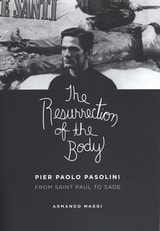
The Resurrection of the Body
Pier Paolo Pasolini from Saint Paul to SadeArmando Maggi
University of Chicago Press, 2009
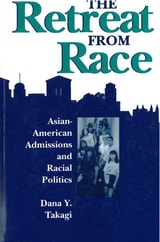
The Retreat from Race
Asian-American Admissions and Racial PoliticsTakagi, Dana Y
Rutgers University Press, 1993
“An excellent book. Takagi takes a very complex and sensitive subject—racial politics—and shows, through a careful analysis . . . that changes in the discourse about Asian American admissions have facilitated a 'retreat from race' in the area of affirmative action. . . . This book will appeal to an audience significantly wider than a typical academic one.”— David Karen, Bryn Mawr College
Charges by Asian Americans that the top universities in the United States used quotas to limit the enrollment of Asian-American students developed into one of the most controversial public controversies in higher education since the Bakke case. In Retreat from Race, Dana Takagi follows the debates over Asian-American admissions at Berkeley, UCLA, Brown, Stanford, Harvard, and Princeton. She explains important developments in the politics of race: changes in ethnic coalitions, reconstruction of the debate over affirmative action, and the conservative challenge to the civil rights agenda of the 1960s. Takagi examines the history and significance of the Asian American admissions controversy on American race relations both inside and outside higher education.
Takagi's central argument is that the Asian-American admissions controversy facilitated a subtle but important shift in affirmative action policy away from racial preferences toward class preferences. She calls this development a retreat from race. Takagi suggests that the retreat signals not only an actual policy shift but also the increasing reluctance on the part of intellectuals, politicans, and policy analysts to identify and address social problems as explicitly racial problems.
Moving beyond the university setting, Takagi explores the political significance of the retreat from race by linking Asian-American admissions to other controversies in higher education and in American politics, including the debates over political correctness and multiculturalism. In her assessment, the retreat from race is likely to fail at its promise of easing racial tension and promoting racial equality.
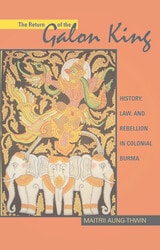
The Return of the Galon King
History, Law, and Rebellion in Colonial BurmaMaitrii Aung-Thwin
Ohio University Press, 2010
In late 1930, on a secluded mountain overlooking the rural paddy fields of British Burma, a peasant leader named Saya San crowned himself King and inaugurated a series of uprisings that would later erupt into one of the largest anti-colonial rebellions in Southeast Asian history. Considered an imposter by the British, a hero by nationalists, and a prophet-king by area-studies specialists, Saya San came to embody traditional Southeast Asia’s encounter with European colonialism in his attempt to resurrect the lost throne of Burma.
The Return of the Galon King analyzes the legal origins of the Saya San story and reconsiders the facts upon which the basic narrative and interpretations of the rebellion are based. Aung-Thwin reveals how counter-insurgency law produced and criminalized Burmese culture, contributing to the way peasant resistance was recorded in the archives and understood by Southeast Asian scholars.
This interdisciplinary study reveals how colonial anthropologists, lawyers, and scholar-administrators produced interpretations of Burmese culture that influenced contemporary notions of Southeast Asian resistance and protest. It provides a fascinating case study of how history is treated by the law, how history emerges in legal decisions, and how the authority of the past is used to validate legal findings.