Results by title
22279 books match the query 'Social Science' and 4007 start with t
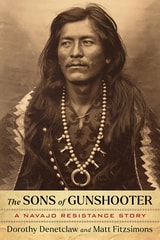
The Sons of Gunshooter
A Navajo Resistance StoryDorothy Denetclaw and Matt Fitzsimons
University of Arizona Press, 2026
In 1919, the brother of one of the West’s most famous Indian traders was shot to death in a remote corner of the Navajo Nation.
Part history, part true crime, The Sons of Gunshooter reexamines the killing and subsequent murder trial, while simultaneously embedding the story in a much larger saga of colonization and resistance. The result is a book that’s sweeping in its scope and surgical in its approach. Rewinding the clock to 1868, the authors follow the intertwining paths of two families to offer a riveting, deeply personal account that has been hailed as “a new way of doing historiography.”
One of the authors is a descendant of participants in the case; the other is an investigative journalist. By merging Diné oral traditions with archival evidence, they succeed in upending one false narrative after another.

The Sopranos
Dana Polan
Duke University Press, 2009
A show about corrupt figures who parasitically try to squeeze illicit profit from the system, The Sopranos itself seems a target of attempts to glom on to its fame as a successful TV series: attempts by media executives, marketers, critics and writers, and even presidential candidates. “Everyone wants a piece of Sopranos action,” says Polan, and he traces the marketing of the series across both official and unauthorized media platforms, including cookbooks, games, DVDs, and the kitschy Sopranos bus tour. Critiquing previous books on The Sopranos, Polan suggests that in their quest to find deep meaning, many of the authors missed the show’s ironic and comedic side.
The Sorcery of Color
Identity, Race, and Gender in BrazilElisa Larkin Nascimento
Temple University Press, 2009
Originally published in 2003 in Portuguese, The Sorcery of Color argues that there are longstanding and deeply-rooted relationships between racial and gender inequalities in Brazil. In this pioneering book, Elisa Larkin Nascimento examines the social and cultural movements that have attempted, since the early twentieth century, to challenge and eradicate these conjoined inequalities.
The book's title describes the social sleight-of-hand that disguises the realities of Brazilian racial inequity. According to Nascimento, anyone who speaks of racism—or merely refers to another person as black—traditionally is seen as racist. The only acceptably non-racist attitude is silence. At the same time, Afro-Brazilian culture and history have been so overshadowed by the idea of a general "Brazilian identity" that to call attention to them is also to risk being labeled racist.
Incorporating leading international scholarship on Pan Africanism and Afrocentric philosophy with the writing of Brazilian scholars, Nascimento presents a compelling feminist argument against the prevailing policy that denies the importance of race in favor of a purposefully vague concept of ethnicity confused with color.

The Sorrow Psalms
A Book of Twentieth-Century ElegyLynn Strongin
University of Iowa Press, 2006

The Sorrowful Eyes Of Hannah Karajich
Ivan Olbracht
Central European University Press, 1999
The Sorrowful Eyes of Hannah Karajich is a lyrical, deeply moving story of love and the pain of emancipation, set in the now vanished world of rural East European Jewish village life. Hanna is the most beautiful girl in all Polona, a Hasidic community in the remote province of Sub-Carpathian Ruthenia. Involvement in the exciting new movement of Zionism takes her away to a commune in a nearby town. But there she meets and falls in love with the strangely named Ivo Karajich: a Jew, yet not a Jew. The agonizing drama that follows, plants into her beautiful almond-shaped eyes the hard grain of sorrow that her children, too, will inherit.
Olbracht's novella is both a great love story and a marvellous portrait of a world that modernity threatened and Hitler destroyed.

The Soul of Anime
Collaborative Creativity and Japan's Media Success StoryIan Condry
Duke University Press, 2013

The Souls of Cyberfolk
Posthumanism as Vernacular TheoryThomas Foster
University of Minnesota Press, 2005
The Sound of Exclusion
NPR and the Latinx PublicChristopher Chávez
University of Arizona Press, 2021
Chávez analyzes NPR as a historical product that has evolved alongside significant changes in technology, industry practice, and demography. In The Sound of Exclusion, Chávez asks these pressing questions: What kind of news organization was NPR intended to be? What has it become over time? In what ways is it evolving to meet the needs of a nation, in which U.S. Latinxs are becoming an increasingly larger portion of the American public that NPR serves? Informed by more than fifty in-depth interviews conducted with public radio practitioners from all aspects of the business, Chávez addresses how power is enacted in everyday broadcast practices. By interrogating industry practices, we might begin to reimagine NPR as a public good that serves the broad and diverse spectrum of the American public.
The Sound of Things to Come
An Audible History of the Science Fiction FilmTrace Reddell
University of Minnesota Press, 2018
A groundbreaking approach to sound in sci-fi films offers new ways of construing both sonic innovation and science fiction cinema
Including original readings of classics like The Day the Earth Stood Still, 2001: A Space Odyssey, Star Wars, and Blade Runner, The Sound of Things to Come delivers a comprehensive history of sound in science fiction cinema. Approaching movies as sound objects that combine cinematic apparatus and consciousness, Trace Reddell presents a new theory of sonic innovation in the science fiction film.
Reddell assembles a staggering array of movies from sixty years of film history—including classics, blockbusters, B-movies, and documentaries from the United States, Britain, France, Germany, Japan, and the Soviet Union—all in service to his powerful conception of sound making as a speculative activity in its own right. Reddell recasts debates about noise and music, while arguing that sound in the science fiction film provides a medium for alien, unknown, and posthuman sound objects that transform what and how we hear.
Avoiding genre criticism’s tendency to obsess over utopias, The Sound of Things to Come draws on film theory, sound studies, and philosophies of technology to advance conversations about the avant-garde, while also opening up opportunities to examine cinematic sounds beyond the screen.

The Sound of Thinking
A Listener's Companion to Conceptual MusicCraig Dworkin
University of Chicago Press, 2026
An artist draws two octaves of pitches randomly from a hat, just enough to set each syllable of the dictionary definition of imprimer (to score, to print). Trawling the internet for cute videos of cats “playing” piano, an artist splices together a complete, note-perfect performance of Arnold Schoenberg’s Opus 11. Half a century after the release of Miles Davis’s album Kind of Blue, a jazz quintet spends months of focused practice to reproduce the original exactly. These performances share a common denominator: absolute fidelity to the outcome of a system. From Marcel Duchamp to Yoko Ono, Steve Reich to Sun Ra, The Sound of Thinking brings together a diverse array of musical or sonic works that are algorithmic, automatic, permutational, procedural, or otherwise structured in contrast to the creative expressivity typically associated with artistic production.
In twenty-six short essays, each keyed to a term that begins with a different letter of the alphabet, Dworkin discusses work composed or performed according to a predetermined rule, transforming artistic creation into a system running its course. The pieces detailed here, drawn from more than a century of musical experimentation, offer a fresh perspective on the history of innovative music by decoupling music from expression and by shunting creativity from the level of organizing sounds to the level of devising a system that can do the organizing. Not only does this book spotlight the critical role of music in twentieth-century conceptual art, but it also identifies previously overlooked links among diverse artists and movements.
The Sounds of Ethnicity
Listening to German North America, 1850 - 1914Barbara Lorenzkowski
University of Manitoba Press, 2010

The Sounds of Furious Living
Everyday Unorthodoxies in an Era of AIDSMatthew Kelly
Rutgers University Press, 2024
Four decades have passed since reports of a mysterious “gay cancer” first appeared in US newspapers. In the ensuing years, the pandemic that would come to be called AIDS changed the world in innumerable ways. It also gave rise to one of the late twentieth century’s largest health-based empowerment movements. Scholars across diverse traditions have documented the rise of the AIDS activist movement, chronicling the impassioned echoes of protestors who took to the streets to demand “drugs into bodies.”
And yet not all activism creates echoes. Included among the ranks of 1980s and 1990s-era AIDS activists were individuals whose expressions of empowerment differed markedly from those demanding open access to mainstream pharmaceutical agents. Largely forgotten today, this activist tradition was comprised of individuals who embraced unorthodox approaches for conceptualizing and treating their condition. Rejecting biomedical expertise, they shared alternative clinical paradigms, created underground networks for distributing unorthodox nostrums, and endorsed etiological models that challenged the association between HIV and AIDS. The theatre of their protests was not the streets of New York City’s Greenwich Village but rather their bodies. And their language was not the riotous chants of public demonstration but the often-invisible embrace of contrarian systems for defining and treating their disease.
The Sounds of Furious Living seeks to understand the AIDS activist tradition, identifying the historical currents out of which it arose. Embracing a patient-centered, social historical lens, it traces historic shifts in popular understanding of health and perceptions of biomedicine through the nineteenth and twentieth centuries to explain the lasting appeal of unorthodox health activism into the modern era. In asking how unorthodox health activism flourished during the twentieth century’s last major pandemic, Kelly also seeks to inform our understanding of resistance to biomedical authority in the setting of the twenty-first century’s first major pandemic: COVID-19. As a deeply researched portrait of distrust and disenchantment, The Sounds of Furious Living helps explain the persistence of movements that challenge biomedicine’s authority well into a century marked by biomedical innovation, while simultaneously posing important questions regarding the meaning and metrics of patient empowerment in clinical practice.
The Southeast Maya Periphery
Edited by Patricia A. Urban and Edward M. Schortman
University of Texas Press, 1986
Archaeologists are continually faced with a pervasive problem: How can cultures, and the interactions among cultures, be differentiated in the archaeological record? This issue is especially difficult in peripheral areas, such as El Salvador, Honduras, and southern Guatemala in the New World. Encompassing zones that are clearly Mayan in language and culture, especially during the Classic period, this area also includes zones that seem to be non-Mayan. The Southeast Maya Periphery examines both aspects of this territory. For the Maya, emphasis is on two sites: Quirigua, Guatemala, and Copan, Honduras. For the non-Maya zone, information is presented on a variety of sites and subregions—the Lower Motagua Valley in Guatemala; the Naco, Sula, and Comayagua valleys and the site of Playa de los Muertos in Honduras; and the Zapotitan Valley and the sites of Cihuatan and Santa Leticia in El Salvador.
Spanning over two thousand years of prehistory, from the Middle Preclassic through the Classic and the poorly understood Postclassic, the essays in this volume address such topics as epigraphy and iconography, architecture, site planning, settlement patterns, and ceramics and include basic information on chronology. Copan and Quirigua are treated both individually and in comparative perspective.
This significant study was the first to attempt to deal with the Periphery as a coherent unit. Unique in its comparative presentation of Copan and Quirigua and in the breadth of information on non-Maya sites in the area, The Southeast Maya Periphery consists largely of previously unpublished data. Offering a variety of approaches to both old and new problems, this volume attempts, among other things, to reassess the relationships between Copan and Quirigua and between Highland and Lowland ceramic traditions, to analyze ceramics by neutron activation, and to define the nature of the apparently non-Mayan cultures in the region. This book will be of major interest not only to Mayanists and Mesoamerican archaeologists but also to others interested in the processes of ethnic group boundary formation and maintenance.
The Southern Debate over Slavery
Volume 2: Petitions to Southern County Courts, 1775-1867Edited by Loren Schweninger
University of Illinois Press, 2007
An incomparably rich source of period information, the second volume of The Southern Debate over Slavery offers a representative and extraordinary sampling of the thousands of petitions about issues of race and slavery that southerners submitted to county courts between the American Revolution and Civil War. These petitions, filed by slaveholders and nonslaveholders, slaves and free blacks, women and men, abolitionists and staunch defenders of slavery, constitute a uniquely important primary source. The collection records with great immediacy and minute detail the dynamics and legal restrictions that shaped southern society.
The Southern Frontier 1670-1732
Verner Crane, with a new introduction by Steven C. Hahn
University of Alabama Press, 2004
A classic resource on the struggle for dominance in southern North America during the colonial period
This volume recounts the clashes and intrigues that played out over the landscape of the Old Southwest and across six decades as the Spanish, French, British, and ultimately Americans vied for control. Rivalry began soon after initial discovery, mapping, and exploration as the world powers, particularly England and France, competed for control of the lucrative fur trade in the Mississippi valley. The French attempted to establish trade networks stretching from the Atlantic Ocean inland to the Mississippi River and northward from ports on the Gulf of Mexico to the Ohio River. But they found the British already entrenched there.
Verner Crane guides us through this multinational struggle and navigates the border wars and diplomatic intrigues that played crucial roles in the settlement of the South by Euro-Americans. In his new introduction, Steven Hahn places the work in the context of its time, sketches its publication history, and provides biographical information on Crane.
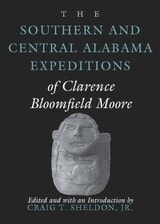
The Southern and Central Alabama Expeditions of Clarence Bloomfield Moore
Clarence Bloomfield Moore, edited and introduced by Craig T. Sheldon Jr.
University of Alabama Press, 2001
Covering 19 years of excavations, this volume provides an invaluable collection of Moore's pioneering archaeological investigations along Alabama's waterways.
In 1996, The University of Alabama Press published The Moundville Expeditions of Clarence Bloomfield Moore, which covered a large part of Moore's early archaeological expeditions to the state of Alabama. This volume collects the balance of Moore's Alabama expeditions, with the exception of those Moore made along the Tennessee River, which will be collected in another, forthcoming volume focusing on the Tennessee basin.
This volume includes:
Certain Aboriginal Remains of the Alabama River (1899);
Certain Aboriginal Remains of the Tombigbee River(1901);
a portion of Certain Aboriginal Remains of the Northwest Florida Coast (1901);
The So-Called "Hoe-Shaped Implement" (1903);
Aboriginal Urn-Burial in the United States (1904);
A Form of Urn-Burial on Mobile Bay (1905);
Certain Aboriginal Remains of the Lower Tombigbee River (1905);
Certain Aboriginal Remains on Mobile Bay and on Mississippi Sound (1905);
a portion of Mounds of the Lower Chattahoochee and Lower Flint Rivers (1907);
a portion of The Northwest Florida Coast Revisited(1918).
Craig Sheldon's comprehensive introduction focuses both on the Moore expeditions and on subsequent archaeological excavations at
sites investigated by Moore. Sheldon places Moore's archaeological work in the context of his times and against the backdrop of similar investigations in the Southeast. Sheldon discusses practical matters, such as the various assistants Moore employed and their roles in these historic expeditions. He provides brief vignettes of daily life on the Gopher and describes Moore's work habits, revealing professional and personal biographical details previously unknown about this enigmatic archaeologist.
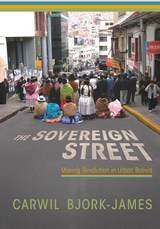
The Sovereign Street
Making Revolution in Urban BoliviaCarwil Bjork-James
University of Arizona Press, 2020
In the early twenty-first century Bolivian social movements made streets, plazas, and highways into the decisively important spaces for acting politically, rivaling and at times exceeding voting booths and halls of government. The Sovereign Street documents this important period, showing how indigenous-led mass movements reconfigured the politics and racial order of Bolivia from 1999 to 2011.
Drawing on interviews with protest participants, on-the-ground observation, and documentary research, activist and scholar Carwil Bjork-James provides an up-close history of the indigenous-led protests that changed Bolivia. At the heart of the study is a new approach to the interaction between protest actions and the parts of the urban landscape they claim. These “space-claiming protests” both communicate a message and exercise practical control over the city. Bjork-James interrogates both protest tactics—as experiences and as tools—and meaning-laden spaces, where meaning is part of the racial and political geography of the city.
Taking the streets of Cochabamba, Sucre, and La Paz as its vantage point, The Sovereign Streetoffers a rare look at political revolution as it happens. It documents a critical period in Latin American history, when protests made headlines worldwide, where a generation of pro-globalization policies were called into question, and where the indigenous majority stepped into government power for the first time in five centuries.
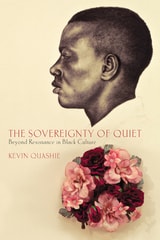
The Sovereignty of Quiet
Beyond Resistance in Black CultureQuashie, Kevin
Rutgers University Press, 2012
The book revisits such iconic moments as Tommie Smith and John Carlos’s protest at the 1968 Mexico City Olympics and Elizabeth Alexander’s reading at the 2009 inauguration of Barack Obama. Quashie also examines such landmark texts as Gwendolyn Brooks’s Maud Martha, James Baldwin’s The Fire Next Time, and Toni Morrison’s Sula to move beyond the emphasis on resistance, and to suggest that concepts like surrender, dreaming, and waiting can remind us of the wealth of black humanity.
The Sower and the Seer
Perspectives on the Intellectual History of the American MidwestJoseph Hogan
Wisconsin Historical Society Press, 2021
The Midwest has been characterized as a fertile seedbed for the germination of great thinkers, but a wasteland for their further growth. The Sower and the Seer reveals that representation to be false. In fact, the region has sustained many innovative minds and been the locus of extraordinary intellectualism. It has also been the site of shifting interpretations—to some a frontier, to others a colonized space, a breadbasket, a crossroads, a heartland. As agrarian reformed (and Michigander) Liberty Hyde Bailey expressed in his 1916 poem “Sower and Seer,” the Midwestern landscape has given rise to significant visionaries, just as their knowledge has nourished and shaped the region.
The essays gathered for this collection examine individual thinkers, writers, and leaders, as well as movements and ideas that shaped the Midwest, including rural school consolidation, women’s literary societies, Progressive-era urban planning, and Midwestern radical liberalism. While disparate in subject and style, these essays taken together establish the irrefutable significance of the intellectual history of the American Midwest.
The Space In-Between
Essays on Latin American CultureSilviano Santiago
Duke University Press, 2001
Santiago’s work creates a theoretical field that transcends both the study of a specific national literature and the traditional perspectives of comparative literature. He examines the pedagogical and modernizing mission of Western voyagers from the conquistadors to the present. He deconstructs the ideas of “original” and “copy,” unpacking their implications for the notions of so-called dominant and dominated cultures. Santiago also confronts questions of cultural dependency and analyzes the problems involved in the imposition of an alien European history, the cultural displacements experienced by the Indians through their religious conversion, and the hierarchical suppression of native and Afro-Brazilian values.
Elegantly written and translated, The Space In-Between will provide insights and perspectives that will interest cultural and literary theorists, postcolonial scholars, and other students of contemporary culture.
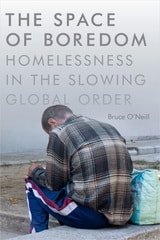
The Space of Boredom
Homelessness in the Slowing Global OrderBruce O'Neill
Duke University Press, 2017
The Spaces of Violence
James R. Giles
University of Alabama Press, 2006
Exploring the landscapes, cultures, and psychological spaces where violence takes root in contemporary American fiction.
The Spaces of Violence is an insightful work of literary criticism in which James R. Giles investigates the complex relationship between violence and space in contemporary American fiction. Through close readings of novels by influential writers including Russell Banks, Cormac McCarthy, Lewis Nordan, Dorothy Allison, Don DeLillo, Denis Johnson, Sherman Alexie, Robert Stone, and Bret Easton Ellis, Giles demonstrates how violence is shaped by the physical, social, and psychological environments in which it occurs.
Drawing on spatial and cultural theory, Giles argues that these novels inhabit a distinctive "fourthspace," a realm existing at the margins of mainstream society where violence permeates everyday life and destabilizes traditional boundaries of identity, community, and morality. Whether set in rural landscapes, urban centers, suburban communities, football stadiums, or transient spaces such as highways and bus stations, the works examined reveal how environments become intertwined with systems of power, alienation, trauma, and destruction.
The book concludes by extending its analysis to representations of violence within family structures, highlighting the far-reaching effects of social and cultural fragmentation. Offering a sophisticated framework for understanding violence in literature, The Spaces of Violence is an important contribution to contemporary literary and cultural studies.
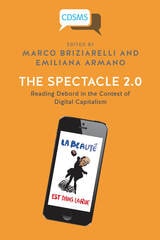
The Spectacle 2.0
Reading Debord in the Context of Digital CapitalismMarco Briziarelli and Emiliana Armano
University of Westminster Press, 2017
“Necessary reading for scholars interested in theorising the spectacle's relation to the labour theory of value, commodity fetishism and subjectivity under post-Fordism.” - https://www.triple-c.at/index.php/tripleC/article/view/1015/1176
Spectacle 2.0 recasts Debord's theory of spectacle within the frame of 21st century digital capitalism. It offers a reassessment of Debord’s original notion of Spectacle from the late 1960s, of its posterior revisitation in the 1990s, and it presents a reinterpretation of the concept within the scenario of contemporary informational capitalism and more specifically of digital and media labour. It is argued that the Spectacle 2.0 form operates as the interactive network that links through one singular (but contradictory) language and various imaginaries, uniting diverse productive contexts such as logistics, finance, new media and urbanism. Spectacle 2.0 thus colonizes most spheres of social life by processes of commodification, exploitation and reification. Diverse contributors consider the topic within the book’s two main sections: Part I conceptualizes and historicizes the Spectacle in the context of informational capitalism; contributions in Part II offer empirical cases that historicise the Spectacle in relation to the present (and recent past) showing how a Spectacle 2.0 approach can illuminate and deconstruct specific aspects of contemporary social reality. All contributions included in this book rework the category of the Spectacle to present a stimulating compendium of theoretical critical literature in the fields of media and labour studies. In the era of the gig-economy, highly mediated content and President Trump, Debord’s concept is arguably more relevant than ever.
The Spectacle of History
Speech, Text, and Memory at the Iran-Contra HearingsMichael Lynch and David Bogen, eds.
Duke University Press, 1996
Lynch and Bogen detail the practices through which the historical agents at the center of the hearings composed, confirmed, used, erased, and denied the historical record. They show how partisan skirmishes over the disclosure of records and testimony led to a divided and irresolute outcome, an outcome further facilitated by the “applied deconstruction” deployed by North and his allies. The Spectacle of History immerses the reader in a crowded field of texts, utterances, visual displays, and media commentaries, but, more than a case study, it develops unique insight into problems at the heart of society and social theory—lying and credibility, the production of civic spectacle, the relationship between testimony and history, the uses of memory, and the interplay between speech and writing.
Drawing on themes from sociology, literary theory, and ethnomethodology and challenging prevailing concepts held by contemporary communication and cultural studies, Lynch and Bogen extract valuable theoretical lessons from this specific and troubling historical episode.

The Spectacle of Women
Imagery of the Suffrage Campaign 1907-14Lisa Tickner
University of Chicago Press, 1988
The Spectacular City, Mexico, and Colonial Hispanic Literary Culture
By Stephanie Merrim
University of Texas Press, 2010
Winner, Katherine Singer Kovacs Prize, Modern Language Association, 2010
The Spectacular City, Mexico, and Colonial Hispanic Literary Culture tracks the three spectacular forces of New World literary culture—cities, festivals, and wonder—from the sixteenth to the seventeenth century, from the Old World to the New, and from Mexico to Colombia, Peru, and Bolivia. It treats a multitude of imperialist and anti-imperialist texts in depth, including poetry, drama, protofiction, historiography, and journalism. While several of the landmark authors studied, including Hernán Cortés and Sor Juana Inés de la Cruz, are familiar, others have received remarkably little critical attention. Similarly, in spotlighting creole writers, Merrim reveals an intertextual tradition in Mexico that spans two centuries. Because the spectacular city reaches its peak in the seventeenth century, Merrim's book also theorizes and details the spirited work of the New World Baroque. The result is the rich examination of a trajectory that leads from the Renaissance ordered city to the energetic revolts of the spectacular city and the New World Baroque.
The Spectacular City
Violence and Performance in Urban BoliviaDaniel M. Goldstein
Duke University Press, 2004
During the period of Goldstein’s fieldwork in Villa Pagador in the mid-1990s, residents attempted to lynch several thieves and attacked the police who tried to intervene. Since that time, there have been hundreds of lynchings in the poor barrios surrounding Cochabamba. Goldstein presents the lynchings of thieves as a form of horrific performance, with elements of critique and political action that echo those of local festivals. He explores the consequences and implications of extralegal violence for human rights and the rule of law in the contemporary Andes. In rich detail, he provides an in-depth look at the development of Villa Pagador and of the larger metropolitan area of Cochabamba, illuminating a contemporary Andean city from both microethnographic and macrohistorical perspectives. Focusing on indigenous peoples’ experiences of urban life and their attempts to manage their sociopolitical status within the broader context of neoliberal capitalism and political decentralization, The Spectacular City highlights the deep connections between performance, law, violence, and the state.

The Spectacular Generic
Pharmaceuticals and the Simipolitical in MexicoCori Hayden
Duke University Press, 2023
The Spectacular State
Culture and National Identity in UzbekistanLaura L. Adams
Duke University Press, 2010
Adams draws on her observations and interviews conducted with artists, intellectuals, and bureaucrats involved in the production of Uzbekistan’s national culture. These elites used globalized cultural forms such as Olympics-style spectacle to showcase local, national, and international aspects of official culture. While these state-sponsored extravaganzas were intended to be displays of Uzbekistan’s ethnic and civic national identity, Adams found that cultural renewal in the decade after Uzbekistan’s independence was not so much a rejection of Soviet power as it was a re-appropriation of Soviet methods of control and ideas about culture. The public sphere became more restricted than it had been in Soviet times, even as Soviet-era ideas about ethnic and national identity paved the way for Uzbekistan to join a more open global community.
The Specter and the Speculative
Afterlives and Archives in the African DiasporaMae G. Henderson
Rutgers University Press, 2024
The Specter of Global China
Politics, Labor, and Foreign Investment in AfricaChing Kwan Lee
University of Chicago Press, 2017
Offering the clearest look yet at China’s state-driven investment in Africa, this book is rooted in six years of extensive fieldwork in copper mines and construction sites in Zambia, Africa’s copper giant. Lee shadowed Chinese, Indian, and South African managers in underground mines, interviewed Zambian miners and construction workers, and worked with Zambian officials. Distinguishing carefully between Chinese state capital and global private capital in terms of their business objectives, labor practices, managerial ethos, and political engagement with the Zambian state and society, she concludes that Chinese state investment presents unique potential and perils for African development. The Specter of Global China will be a must-read for anyone interested in the future of China, Africa, and capitalism worldwide.

The Specter of Materialism
Queer Theory and Marxism in the Age of the Beijing ConsensusPetrus Liu
Duke University Press, 2023

The Spectral Arctic
A History of Ghosts and Dreams in Polar ExplorationShane McCorristine
University College London, 2018
The narratives of Arctic exploration that we are all familiar with today are just the tip of the iceberg, argues Shane McCorristine, and there are a great many more mysterious stories beneath the surface. In contrast to oft-told tales of heroism and disaster, The Spectral Arctic reveals the hidden stories of dreaming and haunted explorers, of frozen mummies, of rescue balloons, visits to Inuit shamans, and of the entranced female clairvoyants who traveled to the Arctic in search of John Franklin’s lost expedition. Through new readings of archival documents, exploration narratives, and fictional texts, these stories reflect the complex ways that men and women actually thought about the Arctic in the past. This revisionist historical account also allows us to make sense of current cultural and political concerns in the Canadian Arctic about the long-lost Franklin Expedition and the recent rediscovery of the two ships.
The Spectral Wound
Sexual Violence, Public Memories, and the Bangladesh War of 1971Nayanika Mookherjee
Duke University Press, 2015
The Spike Lee Reader
Paula Massood
Temple University Press, 2007
Gathered in this anthology are critical writings on Spike Lee's films by leading scholars in the fields of cinema studies and African American studies. In sixteen new and reprinted essays, the contributors to The Spike Lee Reader consider the nexus of race, gender, and sexuality in Lee's work, and in so doing encourage readers to further explore the cultural, social, and political implications of Lee's films as well as his entire body of work.
Contributors include: Christine Acham, Toni Cade Bambara, Mark D. Cunningham, Anna Everett, Daniel Flory, Krin Gabbard, David A. Gerstner, Ed Guerrero, Keith M. Harris, bell hooks, Wahneema Lubiano, James C. McKelly, Tavia Nyong'o, Beretta E. Smith-Shomade, Michele Wallace, S. Craig Watkins, and the editor.

The Spiral of Memory
InterviewsJoy Harjo
University of Michigan Press, 1995
The Spiral of Silence
Public Opinion--Our Social SkinElisabeth Noelle-Neumann
University of Chicago Press, 1993
For this second edition, Noelle-Neumann has added three new chapters: the first discusses new discoveries in the history of public opinion; the second continues the author's efforts to construct a comprehensive theory of public opinion, addressing criticisms and defenses of her "spiral of silence" theory that have appeared since 1980; the third offers a concise and updated summary of the book's arguments.
The Spires Still Point to Heaven
Cincinnati's Religious Landscape, 1788–1873Matthew Smith
Temple University Press, 2023
A case study about the formation of American pluralism and religious liberty, The Spires Still Point to Heaven explores why—and more importantly how—the early growth of Cincinnati influenced the changing face of the United States. Matthew Smith deftly chronicles the urban history of this thriving metropolis in the mid-nineteenth century. As Protestants and Catholics competed, building rival domestic missionary enterprises, increased religious reform and expression shaped the city. In addition, the different ethnic and religious beliefs informed debates on race, slavery, and immigration, as well as disease, temperance reform, and education.
Specifically, Smith explores the Ohio Valley’s religious landscape from 1788 through the nineteenth century, examining its appeal to evangelical preachers, abolitionists, social critics, and rabbis. He traces how Cincinnati became a battleground for newly energized social reforms following a cholera epidemic, and how grassroots political organizing was often tied to religious issues. He also illustrates the anti-immigrant sentiments and anti-Catholic nativism pervasive in this era.
The first monograph on Cincinnati’s religious landscape before the Civil War, The Spires Still Point to Heaven highlights Cincinnati’s unique circumstances and how they are key to understanding the cultural and religious development of the nation.
The Spirit of 1976
Commerce, Community, and the Politics of CommemorationTammy S. Gordon
University of Massachusetts Press, 2013
The most important national commemoration of the twentieth century, the 1976 bicentennial celebration gave rise to a broad-ranging debate over how the American Revolution should be remembered and represented. Federal planners seeking an uncritical glorification of the nation's founding came up against an array of constituencies with other interests and objectives. Inspired by the “new social history” that looked at the past “from the bottom up,” Americans who had previously been disenfranchised by traditional national narratives—African Americans, women, American Indians, workers, young people—demanded a voice and representation in the planning. Local communities, similarly suspicious of federal direction, sought control over their own bicentennial events. Corporate representatives promoted an approach that championed the convergence of patriotism and private enterprise, while commercial interests applied the marketing techniques of an expanding consumerism to hawk every imaginable kind of patriotic souvenir to all of these groups.
The end result of these competing efforts, Tammy S. Gordon shows, was a national celebration that reflected some common themes, including a mistrust of federal power, an embrace of decentralized authority, and a new cultural emphasis on the importance of the self. The American Revolution Bicentennial can thus be seen as both a product of the social and political changes of the 1960s and a harbinger of things to come. After 1976, the postwar myth of a consensus view of American history came to an end, ensuring that future national commemorations would continue to be contested.
The Spirit of Soul Food
Race, Faith, and Food JusticeChristopher Carter
University of Illinois Press, 2021
Soul food has played a critical role in preserving Black history, community, and culinary genius. It is also a response to--and marker of--centuries of food injustice. Given the harm that our food production system inflicts upon Black people, what should soul food look like today?
Christopher Carter's answer to that question merges a history of Black American foodways with a Christian ethical response to food injustice. Carter reveals how racism and colonialism have long steered the development of US food policy. The very food we grow, distribute, and eat disproportionately harms Black people specifically and people of color among the global poor in general. Carter reflects on how people of color can eat in a way that reflects their cultural identities while remaining true to the principles of compassion, love, justice, and solidarity with the marginalized.
Both a timely mediation and a call to action, The Spirit of Soul Food places today's Black foodways at the crossroads of food justice and Christian practice.

The Spirit of Youth and City Streets
Jane Addams
University of Illinois Press, 1972
When this book was first published in 1909, Addams was the most famous woman in America. A celebrity and a spiritual leader, she was widely regarded as practical, realistic, and endowed with a special insight into the problems of urban America. The Spirit of Youth and the City Streets--her favorite of her own books--establishes Addams as an accomplished writer as well as a reformer. In this compact volume she examines the causes for the discontent of youth in the city, chiding educators for their "persistent blindness to youth's most obvious needs."
Addams argues for the importance of providing direction and focus--for example, through public recreation, practical education, and experiences in the arts--for the pent-up energies of young men and women. She takes a realistic view of their basic social and sexual drives and their disaffection and alienation in an industrial world. At the same time, she rejects the hereditary explanations for delinquency that prevailed in her day. Allen F. Davis's introduction provides a biographical profile of Addams and a commentary on her importance as a writer and a social activist.
The Spirit of the Laws in Mozambique
Juan Obarrio
University of Chicago Press, 2014
Having made the transition from a people’s republic to democratic rule in the 1990s, Mozambique offers a fascinating case of postwar reconstruction, economic opening, and transitional justice, one in which the customary has played a central role. Obarrio shows how its sovereignty has met countless ambiguities within the entanglements of local community, nation-state, and international structures. The postcolonial nation-state emerges as a maze of entangled jurisdictions. Ultimately, he looks toward local rituals and relations as producing an emergent kind of citizenship in Africa, which he dubs “customary citizenship,” forming not a vestige of the past but a yet ill-defined political future.
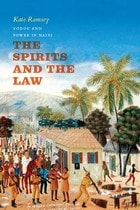
The Spirits and the Law
Vodou and Power in HaitiKate Ramsey
University of Chicago Press, 2011
Vodou has often served as a scapegoat for Haiti’s problems, from political upheavals to natural disasters. This tradition of scapegoating stretches back to the nation’s founding and forms part of a contest over the legitimacy of the religion, both beyond and within Haiti’s borders. The Spirits and the Law examines that vexed history, asking why, from 1835 to 1987, Haiti banned many popular ritual practices.
To find out, Kate Ramsey begins with the Haitian Revolution and its aftermath. Fearful of an independent black nation inspiring similar revolts, the United States, France, and the rest of Europe ostracized Haiti. Successive Haitian governments, seeking to counter the image of Haiti as primitive as well as contain popular organization and leadership, outlawed “spells” and, later, “superstitious practices.” While not often strictly enforced, these laws were at times the basis for attacks on Vodou by the Haitian state, the Catholic Church, and occupying U.S. forces. Beyond such offensives, Ramsey argues that in prohibiting practices considered essential for maintaining relations with the spirits, anti-Vodou laws reinforced the political marginalization, social stigmatization, and economic exploitation of the Haitian majority. At the same time, she examines the ways communities across Haiti evaded, subverted, redirected, and shaped enforcement of the laws. Analyzing the long genealogy of anti-Vodou rhetoric, Ramsey thoroughly dissects claims that the religion has impeded Haiti’s development.
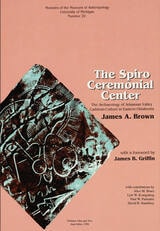
The Spiro Ceremonial Center
The Archaeology of Arkansas Valley Caddoan Culture in Eastern Oklahoma, Vols. 1 and 2James A. Brown with a foreword by James B. Griffin
University of Michigan Press, 1996

The Splendid Drunken Twenties
Selections from the Daybooks, 1922 - 30Carl Van Vechten
University of Illinois Press, 2002
Between 1922 and 1930, Carl Van Vechten--one of the most significant figures of the Harlem Renaissance--kept a daily record of his activities. The records recount his day-to-day life, as well as the alliances, drinking habits, feuds, and affairs of a wide number of the period's luminaries, providing a rich resource for reconstructing the culture of 1920s New York and the social milieu during Prohibition. Bruce Kellner has provided copious informative notes identifying central figures and clarifying details.

The Sponsored Life
Ads, TV, and American CultureLeslie Savan
Temple University Press, 1994
How does a blatant lying in TV commercials—like Joe Isuzu's manic claims—create public trust in a product or a company? How does a company associated with a disaster, Exxon or Du Pont for example, restore its reputation? What is the real story behind the rendering of the now infamous Joe Camel? And what is the deeper meaning of living in an ad, ad, ad world? For a decade, journalist Leslie Savan has been exposing the techniques used by advertisers to push products and pump up corporate images. In the lively essays in this collection, Savan penetrates beneath the slick surfaces of specific ads and marketing campaigns to show how they reflect and shape consumer desires.
Savan's interviews with ad agencies and corporate clients—along with her insightful analyses of influential TV sports—reveal how successful advertising works. Ads do more than command attention. They are signposts to the political, cultural, and social trends that infiltrate the individual consumer's psyche. Think of the products associated with corporate mascots—the drum-beating bunny, the cereal-pushing tiger, the doughboy—that have become pop culture icons. Think cool. Think of the clothing manufacturer that uses multiracial imagery. Think progressive. Buy their worldview, buy their product. When virtually every product can be associate with some positive self-image, we are subtly refashioned into the advertiser's concept of a good citizen. Like it or not, we lead "the sponsored life."

The Sport Marriage
Women Who Make It WorkSteven M. Ortiz
University of Illinois Press, 2020
Ortiz defines the traditional sport marriage as a career-dominated marriage, illustrating how it encourages women to contribute to their own subordination through adherence to an unwritten rulebook and a repertoire of self-management strategies. He explains how they make invaluable contributions to their husbands’ careers while adjusting to public life and trying to maintain family privacy, managing power and control issues, and coping with pervasive groupies, overinvolved mothers, a culture of infidelity, and husbands who prioritize team loyalty. He gives these historically silent women a voice, offering readers perceptive and sensitive insight into what it means to be a woman in the male-dominated world of professional sports.
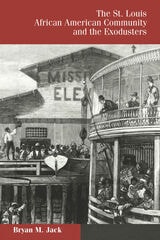
The St. Louis African American Community and the Exodusters
Bryan M. Jack
University of Missouri Press, 2021
In the aftermath of the Civil War, thousands of former slaves made their way from the South to the Kansas plains. Called “Exodusters,” they were searching for their own promised land. Bryan Jack now tells the story of this American exodus as it played out in St. Louis, a key stop in the journey west.
Many of the Exodusters landed on the St. Louis levee destitute, appearing more as refugees than as homesteaders, and city officials refused aid for fear of encouraging more migrants. To the stranded Exodusters, St. Louis became a barrier as formidable as the Red Sea, and Jack tells how the city’s African American community organized relief in response to this crisis and provided the migrants with funds to continue their journey.
The St. Louis African American Community and the Exodusters tells of former slaves such as George Rogers and Jacob Stevens, who fled violence and intimidation in Louisiana and Mississippi. It documents the efforts of individuals in St. Louis, such as Charlton Tandy, Moses Dickson, and Rev. John Turner, who reached out to help them. But it also shows that black aid to the Exodusters was more than charity. Jack argues that community support was a form of collective resistance to white supremacy and segregation as well as a statement for freedom and self-direction—reflecting an understanding that if the Exodusters’ right to freedom of movement was limited, so would be the rights of all African Americans. He also discusses divisions within the African American community and among its leaders regarding the nature of aid and even whether it should be provided.
In telling of the community’s efforts—a commitment to civil rights that had started well before the Civil War—Jack provides a more complete picture of St. Louis as a city, of Missouri as a state, and of African American life in an era of dramatic change. Blending African American, southern, western, and labor history, The St. Louis African American Community and the Exodusters offers an important new lens for exploring the complex racial relationships that existed within post-Reconstruction America.
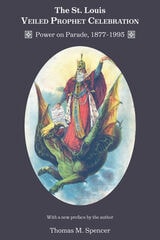
The St. Louis Veiled Prophet Celebration
Power on Parade, 1877-1995Thomas M. Spencer
University of Missouri Press, 2021
The Veiled Prophet organization has been a vital institution in St. Louis for more than a century. Founded in March 1878 by a group of prominent St. Louis businessmen, the organization was fashioned after the New Orleans Carnival society the Mystick Krewe of Comus. In The St. Louis Veiled Prophet Celebration, Thomas Spencer explores the social and cultural functions of the organization's annual celebration—the Veiled Prophet parade and ball—and traces the shifts that occurred over the years in its cultural meaning and importance. Although scholars have researched the more pluralistic parades of the eighteenth and early nineteenth centuries, very little has been done to examine the elite-dominated parades of the late nineteenth and twentieth centuries. This study shows how pluralistic parades ceased to exist in St. Louis and why the upper echelon felt it was so important to end them.
Spencer shows that the celebration originated as the business elite's response to the St. Louis general strike of 1877. Symbolically gaining control of the streets, the elites presented St. Louis history and American history by tracing the triumphs of great men—men who happened to be the Veiled Prophet members' ancestors. The parade, therefore, was intended to awe the masses toward passivity with its symbolic show of power. The members believed that they were helping to boost St. Louis economically and culturally by enticing visitors from the surrounding communities. They also felt that the parades provided the spectators with advice on morals and social issues and distracted them from less desirable behavior like drinking and carousing.
From 1900 to 1965 the celebration continued to include educational and historical elements; thereafter, it began to resemble the commercialized leisure that was increasingly becoming a part of everyday life. The biggest change occurred in the period from 1965 to 1980, when the protests of civil rights groups led many St. Louisans to view the parade and ball as wasteful conspicuous consumption that was often subsidized with taxpayers' money. With membership dropping and the news media giving the organization little notice, it soon began to wither. In response, the leaders of the Veiled Prophet organization decided to have a "VP Fair" over the Fourth of July weekend. The 1990s brought even more changes, and the members began to view the celebration as a way to unite the St. Louis community, with all of its diversity, rather than as a chance to boost the city or teach cultural values. The St. Louis Veiled Prophet Celebration is a valuable addition not only to the cultural history of Missouri and St. Louis but also to recent scholarship on urban culture, city politics, and the history of public celebrations in America.
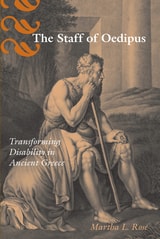
The Staff of Oedipus
Transforming Disability in Ancient GreeceMartha L. Rose
University of Michigan Press, 2013
Ancient Greek images of disability permeate the Western consciousness: Homer, Teiresias, and Oedipus immediately come to mind. But The Staff of Oedipus looks at disability in the ancient world through the lens of disability studies, and reveals that our interpretations of disability in the ancient world are often skewed. These false assumptions in turn lend weight to modern-day discriminatory attitudes toward disability.
Martha L. Rose considers a range of disabilities and the narratives surrounding them. She examines not only ancient literature, but also papyrus, skeletal material, inscriptions, sculpture, and painting, and draws upon modern work, including autobiographies of people with disabilities, medical research, and theoretical work in disability studies. Her study uncovers the realities of daily life for people with disabilities in ancient Greece and challenges the translation of the term adunatos (unable) as "disabled," with all its modern associations.