Results by title
1563 books match the query 'African American & Black Studies' and 273 start with t
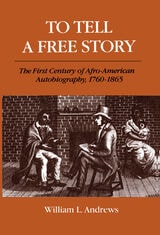
To Tell a Free Story
The First Century of Afro-American Autobiography, 1760-1865William L. Andrews
University of Illinois Press, 1986
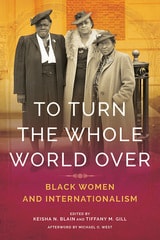
To Turn the Whole World Over
Black Women and InternationalismEdited by Keisha N. Blain and Tiffany M. Gill
University of Illinois Press, 2019
To Turn the World Around
Democracy and the Politics of RepairAli Aslam
University of Minnesota Press, 2027
A stirring exploration of abolitionist thought and Black feminism to articulate a transformative theory of repair
Amid the relentless news of ICE raids, Supreme Court rulings that dismantle our civil rights, and egregious violations of democratic norms, people in the United States are struggling to visualize an actionable path forward. In To Turn the World Around, Ali Aslam proposes a transformative approach that pairs inner healing work with collective external engagement challenging oppressive forces. To actualize W. E. B. DuBois’s concept of abolition democracy, drawing from Black sociality grounded in the refusal of white institutions, Aslam advocates for not working within a broken system nor fleeing it, or merely enduring injustice, and instead offers combined personal healing and embodied action.
Aslam’s vision of transformative selfhood centers healing justice, self and mutual aid, and a somatic approach informed by Black women’s history of navigating bodily dispossession and violations of autonomy and personhood. Simultaneously a tool of personal survival, political refusal, and collective care, inner work incubates new forms of resistance and prepares participants to engage with the outer work of abolition. The movements that rise from the foundation of this inner work are collaborative and experimental, a collective “figuring out” that creates holistic approaches to abolition that transcend conventional politics.
Reimagining inner work as resistance that is ongoing, expansive, and relational, To Turn the World Around offers a stirring framework for the creation of transformational movements. Aslam’s unique theory of repair carefully bridges constituencies, acknowledging the politics of refusal while embracing the hopefulness of sociality.
Retail e-book files for this title are screen-reader friendly.
Toni Morrison and the Geopoetics of Place, Race, and Be/longing
Marilyn Sanders Mobley
Temple University Press, 2024
Mobley’s approach is as interdisciplinary, intersectional, nuanced, and complex as Morrison’s. She combines textual analysis with a study of Morrison’s cultural politics and narrative poetics and describes how Morrison engages with both history and the present political moment.
Informed by research in geocriticism, spatial literary studies, African American literary studies, and Black feminist studies at the intersection of poetics and cultural politics, Mobley identifies four narrative strategies that illuminate how Morrison creates such spaces in her fiction; what these spaces say about her understanding of place, race, and belonging; and how they constitute a way to read and re-read her work.
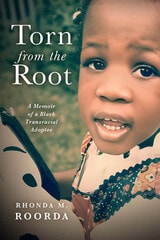
Torn from the Root
A Memoir of a Black Transracial AdopteeRhonda M. Roorda
Temple University Press, 2026
As a Black child adopted out of the New York foster care system as a toddler and raised by white evangelical parents, Rhonda Roorda had to learn how to walk in two different worlds. She often questioned “whether my skin was too dark” and if she “acted too white.” She recalls being haunted by feelings of shame and not being enough. Torn from the Root is her illuminating story of identity, belonging, and purpose and lays bare the deep pain she felt navigating life as a vulnerable Black girl and how she healed herself.
Roorda suffered trauma and abuse in her youth, but she also developed resilience. Eventually, she resolves to find her birth family and takes readers on her exciting and agonizing journey.
Torn from the Root thinks critically about the child welfare system and the long-term impacts of transracial adoption. Roorda helps readers understand her experience, posing necessary questions about the challenges of transracial adoption. Her emotional story, full of wisdom and reflection, recounts how she accepted the truth of her adoption and found balance, not discomfort, in her own skin.
Town and Country
Race Relations in an Urban-Rural Context, Arkansas, 1865–1905John Graves
University of Arkansas Press, 1990
A thoroughly researched and extensively documented look at race relations in Arkansas druing the forty years after the Civil War, Town and Country focuses on the gradual adjustment of black and white Arkansans to the new status of the freedman, in both society and law, after generations of practicing the racial etiquette of slavery.
John Graves examines the influences of the established agrarian culture on the developing racial practices of the urban centers, where many blacks living in the towns were able to gain prominence as doctors, lawyers, successful entrepreneurs, and political leaders. Despite the tension, conflict, and disputes within and between the voice of the government and the voice of the people in an arduous journey toward compromise, Arkansas was one of the most progressive states during Reconstruction in desegregating its people.
Town and Country makes a significant contribution to the history of the postwar South and its complex engagement with the race issue.
Toxic Ivory Towers
The Consequences of Work Stress on Underrepresented Minority FacultyRuth Enid Zambrana
Rutgers University Press, 2018
Traces, Codes, and Clues
Reading Race in Crime FictionReddy, Maureen T
Rutgers University Press, 2002
Detective fiction featuring white women and people of color such as Barbara Neelys Blanche White and Walter Mosleys Easy Rawlinshas become tremendously popular. Although they are considered "light reading," mysteries also hold important cultural and social "clues." Much recent scholarly work has demonstrated that race is both a cultural fiction not a biological reality and a central organizing principle of experience. Popular writers are likely to reflect the conventions of their own historical situations.
In Traces, Codes, and Clues: Reading Race in Crime Fiction, Maureen T. Reddy explores the ways in which crime fiction manipulates cultural constructions such as race and gender to inscribe dominant cultural discourses. She notes that even those writers who appear to set out to revise outdated conventions repeatedly reproduce the genres most conservative elements. The greatest obstacle to transforming crime fiction, Reddy states, is the fact that the genre itself is deeply embedded in the discourse of white (and male) superiority. There is, therefore, an absolute necessity to break away from that discourse through reversal or other strategies in order to produce work that defies, and thus helps readers to defy, the dominant ideology of race.
Tracing Southern Storytelling in Black and White
Sarah Gilbreath Ford
University of Alabama Press, 2014
Exploring the shared storytelling traditions that shaped Southern literature across racial lines.
Tracing Southern Storytelling in Black and White is a study of the historical use of oral storytelling by southern writers in written works. In each chapter, Sarah Gilbreath Ford pairs a white and an African American writer to highlight points of confluence in black and white southern oral traditions. She argues that the connections between white and African American southern writers run deeper than critics have yet explored, and she uses textual comparisons to examine the racial mixing of oral culture.
On porches, in kitchens, and on the pages of their work, black and white southerners exchanged not just stories but strategies for telling stories. As a boy, Joel Chandler Harris listened to the stories of African American slaves, and he devised a framework to turn the oral stories into written ones. Harris’s use of the frame structure influenced how Charles Chesnutt recorded oral stories, but it led Alice Walker to complain that her heritage had been stolen. Mark Twain listened to African American storytellers as a child. His use of oral dialects then impacts how Ralph Ellison and William Faulkner employ oral storytelling and how Toni Morrison later writes in response to Faulkner. The interactions are not linear, not a chain of influence, but a network of interactions, borrowings, and revisions.
Ford’s pairings lead to new readings that reveal how the writers employ similar strategies in their narratives, due in part to shared historical context. While Zora Neale Hurston and William Faulkner, for example, use oral storytelling in the 1930s to examine the fear of racial mixing, Ellen Douglas and Ernest Gaines use it in the 1970s to build bridges between the races. Exploring the cultural crossing that occurs in the use of oral storytelling, Ford offers a different view of this common strategy in southern narrative and a new perspective on how culture is shared.
Transatlantic Disbelonging
Unruliness, Pleasure, and Play in Nigerian Diasporic Women's ArtBimbola Akinbola
Duke University Press, 2025
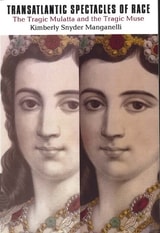
Transatlantic Spectacles of Race
The Tragic Mulatta and the Tragic MuseManganelli, Kimberly Snyder
Rutgers University Press, 2012
The tragic mulatta was a stock figure in nineteenth-century American literature, an attractive mixed-race woman who became a casualty of the color line. The tragic muse was an equally familiar figure in Victorian British culture, an exotic and alluring Jewish actress whose profession placed her alongside the “fallen woman.”
In Transatlantic Spectacles of Race, Kimberly Manganelli argues that the tragic mulatta and tragic muse, who have heretofore been read separately, must be understood as two sides of the same phenomenon. In both cases, the eroticized and racialized female body is put on public display, as a highly enticing commodity in the nineteenth-century marketplace. Tracing these figures through American, British, and French literature and culture, Manganelli constructs a host of surprising literary genealogies, from Zelica to Daniel Deronda, from Uncle Tom’s Cabin to Lady Audley’s Secret. Bringing together an impressive array of cultural texts that includes novels, melodramas, travel narratives, diaries, and illustrations, Transatlantic Spectacles of Race reveals the value of transcending literary, national, and racial boundaries.
Transcending Blackness
From the New Millennium Mulatta to the Exceptional MultiracialRalina L. Joseph
Duke University Press, 2012
Analyzing emblematic representations of multiracial figures in popular culture—Jennifer Beals's character in the The L Word; the protagonist in Danny Senza's novel Caucasia; the title character in the independent film Mixing Nia; and contestants in a controversial episode of the reality show America's Next Top Model, who had to "switch ethnicities" for a photo shoot—Joseph identifies the persistence of two widespread stereotypes about mixed-race African Americans, those of "new millennium mulattas" and "exceptional multiracials." The former inscribes multiracial African Americans as tragic figures whose blackness predestines them for misfortune; the latter rewards mixed-race African Americans for successfully erasing their blackness. Addressing questions of authenticity, sexuality, and privilege, Transcending Blackness refutes the idea that race no longer matters in American society.
Transnational Black Studies, Volume 2003
Lisa Brock , Robin D. G. Kelley, and Karen Sotiropoulos, eds.
Duke University Press, 0
The essays, interviews, and reviews in this special issue of Radical History Review represent the best of the new of this very old tradition of transnational black studies. One contributor explores how “racial citizenship”—the idea of belonging and solidarity across the black world, developed as a result of knowledge formed out of transnational linkages—is employed by Cubans of color fighting against racial discrimination in public spaces in Havana. Another, by outlining a research agenda for the study of African slavery in the Middle East and South Asia, reminds us that the Africa diaspora is global. In a discussion of a paradigm shift from the national to the global, yet another author makes a singular contribution to this collection by locating new spaces for identity formation “in transit.”
Contributors. Martha Biondi, Anthony Bogues, Ashley Dawson, James Early, Mary F. E. Ebeling, Kevin Gaines, Van Gosse, Frank A. Guridy, Joseph E. Harris, Douglas M. Haynes, Joseph Heathcott, Harvey Neptune, Michelle Stephens
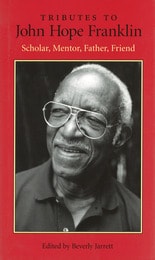
Tributes to John Hope Franklin
Scholar, Mentor, Father, FriendEdited by Beverly Jarrett
University of Missouri Press, 2003
Tropical Freedom
Climate, Settler Colonialism, and Black Exclusion in the Age of EmancipationIkuko Asaka
Duke University Press, 2017
Troubled Ground
A Tale of Murder, Lynching, and Reckoning in the New SouthClaude A. Clegg III
University of Illinois Press, 2010
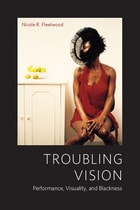
Troubling Vision
Performance, Visuality, and BlacknessNicole R. Fleetwood
University of Chicago Press, 2010
Troubling Vision addresses American culture’s fixation on black visibility, exploring how blackness is persistently seen as a problem in public culture and even in black scholarship that challenges racist discourse. Through trenchant analysis, Nicole R. Fleetwood reorients the problem of black visibility by turning attention to what it means to see blackness and to the performative codes that reinforce, resignify, and disrupt its meaning. Working across visual theory and performance studies, Fleetwood asks, How is the black body visualized as both familiar and disruptive? How might we investigate the black body as a troubling presence to the scopic regimes that define it as such? How is value assessed based on visible blackness?
Fleetwood documents multiple forms of engagement with the visual, even as she meticulously underscores how the terms of engagement change in various performative contexts. Examining a range of practices from the documentary photography of Charles “Teenie” Harris to the “excess flesh” performances of black female artists and pop stars to the media art of Fatimah Tuggar to the iconicity of Michael Jackson, Fleetwood reveals and reconfigures the mechanics, codes, and metaphors of blackness in visual culture.
“Troubling Vision is a path-breaking book that examines the problem of seeing blackness—the simultaneous hyper-visibility and invisibility of African Americans—in US visual culture in the last half century. Weaving together critical modes and methodologies from performance studies, art history, critical race studies, visual culture analysis, and gender theory, Fleetwood expands Du Bois’s idea of double vision into a broad questioning of whether ‘representation itself will resolve the problem of the black body in the field of vision.’ With skilled attention to historical contexts, documentary practices, and media forms, she takes up the works of a broad variety of cultural producers, from photographers and playwrights to musicians and visual artists and examines black spectatorship as well as black spectacle. In chapters on the trope of ‘non-iconicity’ in the photographs of Charles (Teenie) Harris, the ‘visible seams’ in the digital images of the artist Fatimah Tuggar, and a coda on the un-dead Michael Jackson, Fleetwood's close analyses soar. Troubling Vision is a beautifully written, original, and important addition to the field of American Studies.”—Announcement of the American Studies Association for the 2012 Lora Romero First Book Publication Prize
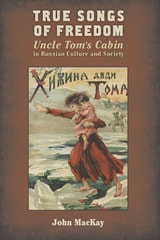
True Songs of Freedom
Uncle Tom’s Cabin in Russian Culture and SocietyJohn MacKay
University of Wisconsin Press, 2013
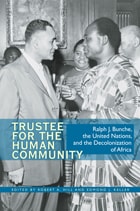
Trustee for the Human Community
Ralph J. Bunche, the United Nations, and the Decolonization of AfricaRobert A. Hill
Ohio University Press, 2010
Ralph J. Bunche (1904–1971), winner of the Nobel Peace Prize in 1950, was a key U.S. diplomat in the planning and creation of the United Nations in 1945. In 1947 he was invited to join the permanent UN Secretariat as director of the new Trusteeship Department. In this position, Bunche played a key role in setting up the trusteeship system that provided important impetus for postwar decolonization ending European control of Africa as well as an international framework for the oversight of the decolonization process after the Second World War.
Trustee for the Human Community is the first volume to examine the totality of Bunche’s unrivalled role in the struggle for African independence both as a key intellectual and an international diplomat and to illuminate it from the broader African American perspective.
These commissioned essays examine the full range of Ralph Bunche’s involvement in Africa. The scholars explore sensitive political issues, such as Bunche’s role in the Congo and his views on the struggle in South Africa. Trustee for the Human Community stands as a monument to the profoundly important role of one of the greatest Americans in one of the greatest political movements in the history of the twentieth century.
Contributors: David Anthony, Ralph A. Austen, Abena P. A. Busia, Neta C. Crawford, Robert R. Edgar, Charles P. Henry, Robert A. Hill, Edmond J. Keller, Martin Kilson, Georges Nzongola-Ntalaja, Jon Olver, Pearl T. Robinson, Elliott P. Skinner, Crawford Young

Trying to Get Over
African American Directors after Blaxploitation, 1977-1986By Keith Corson
University of Texas Press, 2016
From 1972 to 1976, Hollywood made an unprecedented number of films targeted at black audiences. But following this era known as “blaxploitation,” the momentum suddenly reversed for black filmmakers, and a large void separates the end of blaxploitation from the black film explosion that followed the arrival of Spike Lee’s She's Gotta Have It in 1986. Illuminating an overlooked era in African American film history, Trying to Get Over is the first in-depth study of black directors working during the decade between 1977 and 1986.
Keith Corson provides a fresh definition of blaxploitation, lays out a concrete reason for its end, and explains the major gap in African American representation during the years that followed. He focuses primarily on the work of eight directors—Michael Schultz, Sidney Poitier, Jamaa Fanaka, Fred Williamson, Gilbert Moses, Stan Lathan, Richard Pryor, and Prince—who were the only black directors making commercially distributed films in the decade following the blaxploitation cycle. Using the careers of each director and the twenty-four films they produced during this time to tell a larger story about Hollywood and the shifting dialogue about race, power, and access, Corson shows how these directors are a key part of the continuum of African American cinema and how they have shaped popular culture over the past quarter century.
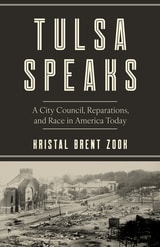
Tulsa Speaks
A City Council, Reparations, and Race in America TodayKristal Brent Zook
Rutgers University Press, 2026
In 2021, the international media descended upon Tulsa, Oklahoma, for the centennial commemoration of the May 31–June 1, 1921, massacre in which a white mob killed more than three hundred African American residents, burned homes and businesses, and decimated a thriving town once referred to as “Black Wall Street.”
Tulsa Speaks is about the ongoing work of the Tulsa City Council, both before the Centennial and afterward, when the cameras were no longer trained on the city. It dives deep into the interpersonal dynamics among the nine councilors, exploring the continuing fight for reparations and racial justice and the long-running efforts of councilor, Vanessa Hall-Harper of District 1, to bring repair to Greenwood.
Tulsa, like many municipal bodies across the country, serves as a hopeful sign of what we might become, as Americans and as a microcosm of race relations in America today.
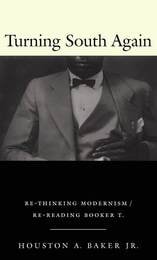
Turning South Again
Re-Thinking Modernism/Re-Reading Booker T.Houston A. Baker Jr.
Duke University Press, 2001
From the holds of slave ships to the peonage of Reconstruction to the contemporary prison system, incarceration has largely defined black life in the United States. Even Washington’s school at Tuskegee, Baker explains, housed and regulated black bodies no longer directly controlled by slave owners. He further implicates Washington by claiming that in enacting his ideas about racial “uplift,” Washington engaged in “mulatto modernism,” a compromised attempt at full citizenship. Combining autobiographical prose, literary criticism, psychoanalytic writing, and, occasionally, blues lyrics and poetry, Baker meditates on the consequences of mulatto modernism for the project of black modernism, which he defines as the achievement of mobile, life-enhancing participation in the public sphere and economic solvency for the majority of African Americans. By including a section about growing up in the South, as well as his recent return to assume a professorship at Duke, Baker contributes further to one of the book’s central concerns: a call to centralize the South in American cultural studies.

Two Evenings in Saramaka
Richard Price and Sally Price
University of Chicago Press, 1991
In this innovative work, Richard and Sally Price explore the fully adult world of Saramaka "folktale-land," where animals speak, the social order is inverted, customs have been only partially worked out, and the weak and clever triumph over the strong and arrogant. Joining the Saramaka of the Suriname rain forest for two tale-telling wakes, we witness mischievous Anasi the spider matching wits with lecherous devils, the scrawny little kid rescuing his nubile sisters in distress, and the bitchy white princess being tamed by the one-sided boy. As seas dry up, books speak out loud, and elephants assume human form, we are present at a whole sequence of world-shaping happenings such as the invention of sex, the discovery of drums, and the arrival of death among humans.
Set in the more general context of tale telling by the descendants of Africans throughout the Americas and of recent scholarship in performance studies, these Saramaka tales are presented as a dramatic script. With the help of nearly forty photographs, readers become familiar not only with the characters in folktale-land, but also with the men and women who so imaginatively bring them to life. And because music complements narration in Saramaka just as it does elsewhere in Afro-America, more than fifty songs are presented here in musical notation.
Narrative, song, dance, and social interaction merge in these two evenings of multimedia entertainment, bearing witness to an Afro-American cultural tradition that remains alive and vibrant, constantly renewed but always reflecting its links with the past.