Results by title
3745 books match the query 'Europe' and 973 start with t
The English Physician
Nicholas Culpeper
University of Alabama Press, 2007
A foundational text in Western herbal medicine bridging botany, astrology, and early modern healing practices.
The English Physician is a humble vest-pocket-sized 94-page medical guide for the common person, by the prolific herbalist and author Nicholas Culpeper. It was a staple in 17th-century England, as it was short, written in accessible prose, and inexpensive; and perhaps as attractive, it took a decidedly skeptical view of "official" medicine, relying instead on popular remedies. Culpeper’s philosophy was to teach the common folk to minister to themselves by providing them with the tools and knowledge for self-help.
Published in Boston in 1708 by Nicholas Boone, the American version of The English Physician was widely cited and used at the time. Today only five copies are known to exist. The rarity of this vade mecum of colonial America is wrapped in mystery: Who really wrote this book and when, where, and how did it originate?
The editor illuminates these mysteries while adding an informative historical introduction on the state of medical knowledge and practice at the time, exploring Culpeper’s position among competing medical writers, and glossing the medical and botanical terms, providing contemporary equivalents. Modern readers will discover the meaning behind the strangely named brews and concoctions of the 17th century and will learn how this Boston printing literally transformed the American landscape with herbs brought from the British colonists’ homeland.

The English Virtuoso
Art, Medicine, and Antiquarianism in the Age of EmpiricismCraig Ashley Hanson
University of Chicago Press, 2009
At the heart of this profoundly interdisciplinary study lies the Royal Society of London for the Improvement of Natural Knowledge, which from its founding in 1660 served as the major professional organization for London’s leading physicians, many of them prominent virtuosi. Craig Ashley Hanson reveals that a vital art audience emerged from the Royal Society—whose members assembled many of the period’s most important nonaristocratic collections—a century before most accounts date the establishment of an institutional base for the arts in England. Unearthing the fascinating stories of an impressive cast of characters, Hanson establishes a new foundation for understanding both the relationship between British art and science and the artistic accomplishments of the late eighteenth and nineteenth centuries.

The Enigma of the Aerofoil
Rival Theories in Aerodynamics, 1909-1930David Bloor
University of Chicago Press, 2011
The Enlightenment and Original Sin
Matthew Kadane
University of Chicago Press, 2024
What was the Enlightenment? This question has been endlessly debated. In The Enlightenment and Original Sin, historian Matthew Kadane advances the bold claim that the Enlightenment is best defined through what it set out to accomplish, which was nothing short of rethinking the meaning of human nature.
Kadane argues that this project centered around the doctrine of original sin and, ultimately, its rejection, signaling the radical notion that an inherently flawed nature can be overcome by human means. Kadane explores this and other wide-ranging themes through the story of a previously unknown figure, Pentecost Barker, an eighteenth-century purser and wine merchant. By examining Barker’s personal diary and extensive correspondence with a Unitarian minister, Kadane tracks the transformation of Barker’s consciousness from a Puritan to an Enlightenment outlook, revealing through one man’s journey the large-scale shifts in self-understanding whose philosophical reverberations have shaped debates on human nature for centuries.
The Enlightenment and the Book
Scottish Authors and Their Publishers in Eighteenth-Century Britain, Ireland, and AmericaRichard B. Sher
University of Chicago Press, 2007
The late eighteenth century witnessed an explosion of intellectual activity in Scotland by such luminaries as David Hume, Adam Smith, Hugh Blair, William Robertson, Adam Ferguson, James Boswell, and Robert Burns. And the books written by these seminal thinkers made a significant mark during their time in almost every field of polite literature and higher learning throughout Britain, Europe, and the Americas.
In this magisterial history, Richard B. Sher breaks new ground for our understanding of the Enlightenment and the forgotten role of publishing during that period. The Enlightenment and the Book seeks to remedy the common misperception that such classics as The Wealth of Nations and The Life of Samuel Johnson were written by authors who eyed their publishers as minor functionaries in their profession. To the contrary, Sher shows how the process of bookmaking during the late eighteenth-century involved a deeply complex partnership between authors and their publishers, one in which writers saw the book industry not only as pivotal in the dissemination of their ideas, but also as crucial to their dreams of fame and monetary gain. Similarly, Sher demonstrates that publishers were involved in the project of bookmaking in order to advance human knowledge as well as to accumulate profits.
The Enlightenment and the Book explores this tension between creativity and commerce that still exists in scholarly publishing today. Lavishly illustrated and elegantly conceived, it will be must reading for anyone interested in the history of the book or the production and diffusion of Enlightenment thought.
The Enlightenment
A GenealogyDan Edelstein
University of Chicago Press, 2010
What was the Enlightenment? Though many scholars have attempted to solve this riddle, none has made as much use of contemporary answers as Dan Edelstein does here. In seeking to recover where, when, and how the concept of “the Enlightenment” first emerged, Edelstein departs from genealogies that trace it back to political and philosophical developments in England and the Dutch Republic. According to Edelstein, by the 1720s scholars and authors in France were already employing a constellation of terms—such as l’esprit philosophique—to describe what we would today call the Enlightenment. But Edelstein argues that it was within the French Academies, and in the context of the Quarrel of the Ancients and the Moderns, that the key definition, concepts, and historical narratives of the Enlightenment were crafted.
A necessary corrective to many of our contemporary ideas about the Enlightenment, Edelstein’s book turns conventional thinking about the period on its head. Concise, clear, and contrarian, The Enlightenment will be welcomed by all teachers and students of the period.
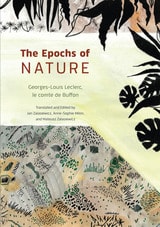
The Epochs of Nature
Georges-Louis Leclerc, le comte de Buffon
University of Chicago Press, 2018
In seven epochs, Buffon reveals the main features of an evolving Earth, from its hard rock substrate to the sedimentary layers on top, from the minerals and fossils found within these layers to volcanoes, earthquakes, and rises and falls in sea level—and he even touches on age-old mysteries like why the sun shines. In one of many moments of striking scientific prescience, Buffon details evidence for species extinction a generation before Cuvier’s more famous assertion of the phenomenon. His seventh and final epoch does nothing less than offer the first geological glimpse of the idea that humans are altering the very foundations of the Earth—an idea of remarkable resonance as we debate the designation of another epoch: the Anthropocene. Also featuring Buffon’s extensive “Notes Justificatives,” in which he offers further evidence to support his assertions (and discusses vanished monstrous North American beasts—what we know as mastodons—as well as the potential existence of human giants), plus an enlightening introduction by editor and translator Jan Zalasiewicz and historians of science Sverker Sörlin, Libby Robin, and Jacques Grinevald, this extraordinary new translation revives Buffon’s quite literally groundbreaking work for a new age.
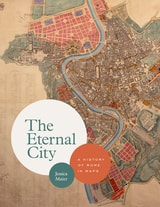
The Eternal City
A History of Rome in MapsJessica Maier
University of Chicago Press, 2020
In this unique and visually engaging book, Jessica Maier considers Rome through the eyes of mapmakers and artists who have managed to capture something of its essence over the centuries. Viewing the city as not one but ten “Romes,” she explores how the varying maps and art reflect each era’s key themes. Ranging from modest to magnificent, the images comprise singular aesthetic monuments like paintings and grand prints as well as more popular and practical items like mass-produced tourist plans, archaeological surveys, and digitizations. The most iconic and important images of the city appear alongside relatively obscure, unassuming items that have just as much to teach us about Rome’s past. Through 140 full-color images and thoughtful overviews of each era, Maier provides an accessible, comprehensive look at Rome’s many overlapping layers of history in this landmark volume.
The first English-language book to tell Rome’s rich story through its maps, The Eternal City beautifully captures the past, present, and future of one of the most famous and enduring places on the planet.
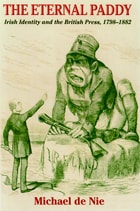
The Eternal Paddy
Irish Identity and the British Press, 1798–1882Michael de Nie
University of Wisconsin Press, 2004
In The Eternal Paddy, Michael de Nie examines anti-Irish prejudice, Anglo-Irish relations, and the construction of Irish and British identities in nineteenth-century Britain. This book provides a new, more inclusive approach to the study of Irish identity as perceived by Britons and demonstrates that ideas of race were inextricably connected with class concerns and religious prejudice in popular views of both peoples. De Nie suggests that while traditional anti-Irish stereotypes were fundamental to British views of Ireland, equally important were a collection of sympathetic discourses and a self-awareness of British prejudice. In the pages of the British newspaper press, this dialogue created a deep ambivalence about the Irish people, an ambivalence that allowed most Britons to assume that the root of Ireland’s difficulties lay in its Irishness.
Drawing on more than ninety newspapers published in England, Scotland, and Wales, The Eternal Paddy offers the first major detailed analysis of British press coverage of Ireland over the course of the nineteenth century. This book traces the evolution of popular understandings and proposed solutions to the "Irish question," focusing particularly on the interrelationship between the press, the public, and the politicians. The work also engages with ongoing studies of imperialism and British identity, exploring the role of Catholic Ireland in British perceptions of their own identity and their empire.
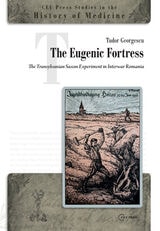
The Eugenic Fortress
The Transylvanian Saxon Experiment in Interwar RomaniaTudor Georgescu
Central European University Press, 2016
The Eurabia Myth
Countercolonization and Masculine Fragility in FranceMehammed Amadeus Mack
University of Minnesota Press, 2025
The roots—and reach—of “Great Replacement” theory in France and beyond
The Eurabia Myth delves into the origins and evolution of far-right anxieties about the future of a Europe that welcomes postcolonial migration, racial and ethnic diversity, and tolerance of Islam. Nationalists deploy the specter of “Eurabia”—an Arabized and Islamized Europe—as a doomsday scenario of demographic replacement that only they can avert. Mehammed Amadeus Mack traces this dark vision to a sociopolitical conspiracy theory that began in France, spread throughout Europe, and has become especially virulent in the United States: Great Replacement Theory.
Examining how the Eurabia narrative gained traction, Mack analyzes dystopian fiction that envisions how this Replacement will take place, the contemporary politicization of medieval history, and ecofascist rhetoric depicting immigrants as an “invasive” species. He also interviews prominent French activists of color about how they subvert being portrayed as Replacers and destroyers of European civilization, and he explores the American echoes of the Great Replacement Theory.
Innovatively deploying gender and sexuality theory to the concept of Eurabia, Mack demonstrates that the demographic and racial anxieties underlying Great Replacement Theory are intertwined with a more fundamental crisis of masculinity, evident in the far right’s accusations that feminists and the LGBT community are responsible for the decline in white birth rates. As it uncovers the deeper roots of this pervasive theory, The Eurabia Myth shows its insidious relevance to a rising tide of nativist fear, hatred, and violence.
Retail e-book files for this title are screen-reader friendly with images accompanied by short alt text and/or extended descriptions.

The Euro-American Cinema
By Peter Lev
University of Texas Press, 1993
With McDonalds in Moscow and Disneyland in Paris and Tokyo, American popular culture is spreading around the globe. Regional, national, and ethnic cultures are being powerfully affected by competition from American values and American popular forms. This literate and lively study explores the spread of American culture into international cinema as reflected by the collision and partial merger of two important styles of filmmaking: the Hollywood style of stars, genres, and action, and the European art film style of ambiguity, authorial commentary, and borrowings from other arts.
Peter Lev departs from the traditional approach of national cinema histories and discusses some of the blends, overlaps, and hegemonies that are typical of the world film industry of recent years. In Part One, he gives a historical and theoretical overview of what he terms the "Euro-American art film," which is characterized by prominent use of the English language, a European art film director, cast and crew from at least two countries, and a stylistic mixing of European art film and American entertainment.
The second part of Lev’s study examines in detail five examples of the Euro-American art film: Contempt (1963), Blow-Up (1966), The Canterbury Tales (1972), Paris, Texas (1983), and The Last Emperor (1987). These case studies reveal that the European art film has had a strong influence on world cinema and that many Euro-American films are truly cultural blends rather than abject takeovers by Hollywood cinema.
The European Identity
Historical and Cultural Realities We Cannot DenyStephen Green
Haus Publishing, 2015
Green points out that Europeans can readily define the differences that separate them from others around the globe, but they have yet to clearly define their own similarities across member states. He argues that Europe has something distinctive and vitally important to offer: the experience of a unique journey through centuries of exploration and conflict, errors and lessons, soul-searching and rebuilding—an evolution of universal significance.
Coming at a time when the divisions in European culture have been laid bare by recent financial crises and calls for independence, The European Identity identifies one of the biggest challenges for all of the member states of the European Union.
The European Radical Left
Movements and Parties since the 1960sGiorgos Charalambous
Pluto Press, 2021
Is today’s left really new? How has the European radical left evolved?
Giorgos Charalambous answers these questions by looking at three moments of rapid political change - the late 1960s to late 1970s; the turn of the millennium; and post-2008. He challenges the conventional understanding of a ‘new left’, drawing out continuities with earlier movements and parties.
Charalambous examines the ‘Long ‘68’, symbolised by the May uprisings in France, which saw the rise of new left forces and the widespread criticism by younger radical activists of traditional communist and socialist parties. He puts this side by side with the turn of the millennium when the Global Justice Movement rose to prominence and changed the face of the international left, and also the period after the financial crash of 2008 and the rise of anti-austerity politics which initiated the most recent wave of new left parties such as Podemos in Spain and Syriza in Greece.
With a unique ‘two-level’ perspective, Charalambous approaches the left through both social movements and party politics, looking at identities, rhetoric and organization, and bringing a fresh new approach to radical history, as well as assessing challenges for both activists and scholars.

The European Revolutions of 1848 and the Americas
Edited by Guy Thomson
University of London Press, 2002
The Europeanization of Cinema
Interzones and Imaginative CommunitiesRandall Halle
University of Illinois Press, 2014
He focuses especially on films about borders, borderlands, and cultural zones as he traces the development of interzones from the inception of central European cinema to the avant-garde films of today. Throughout, he shows how cinema both reflects and engenders interzones that explore the important questions of Europe's social order: imperialism and nation-building in the late nineteenth and early twentieth centuries; "first contact" between former adversaries (such as East and West Germany) following World War II and the Cold War; and migration, neo-colonialism, and cultural imperialism in the twenty-first century.
Ultimately, Halle argues that today's cinema both produces and reflects imaginative communities. He demonstrates how, rather than simply erasing boundaries, the European Union instead fosters a network of cultural interzones that encourage cinematic exploration of the new Europe's processes and limits of connectivity, tolerance, and cooperation.
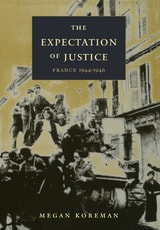
The Expectation of Justice
France, 1944–1946Megan Koreman
Duke University Press, 2000
As the first social history of the “après -Libération” period from the perspective of ordinary people, Koreman’s study reveals how citizens of these towns expected legal, social, and honorary justice—such as punishment for collaborators, fair food distribution, and formal commemoration of patriots, both living and dead. Although the French expected the Resistance’s Provisional Government to act according to local understandings of justice, its policies often violated local sensibilities by instead pursuing national considerations. Koreman assesses both the citizens’ eventual disillusionment and the social costs of the “Resistencialist myth” propagated by the de Gaulle government in an effort to hold together the fragmented postwar nation. She also suggests that the local demands for justice created by World War II were stifled by the Cold War, since many people in France feared that open opposition to the government would lead to a Communist takeover. This pattern of nationally instituted denial and suppression made it difficult for citizens to deal effectively with memories of wartime suffering and collaborationist betrayal. Now, with the end of the Cold War, says Koreman, memories of postwar injustices are resurfacing, and there is renewed interest in witnessing just and deserved closure.
This social history of memory and reconstruction will engage those interested in history, war and peace issues, contemporary Europe, and the twentieth century.
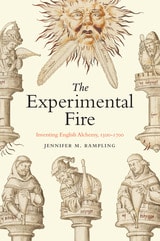
The Experimental Fire
Inventing English Alchemy, 1300–1700Jennifer M. Rampling
University of Chicago Press, 2020
In medieval and early modern Europe, the practice of alchemy promised extraordinary physical transformations. Who would not be amazed to see base metals turned into silver and gold, hard iron into soft water, and deadly poison into elixirs that could heal the human body? To defend such claims, alchemists turned to the past, scouring ancient books for evidence of a lost alchemical heritage and seeking to translate their secret language and obscure imagery into replicable, practical effects.
Tracing the development of alchemy in England over four hundred years, from the beginning of the fourteenth century to the end of the seventeenth, Jennifer M. Rampling illuminates the role of alchemical reading and experimental practice in the broader context of national and scientific history. Using new manuscript sources, she shows how practitioners like George Ripley, John Dee, and Edward Kelley, as well as many previously unknown alchemists, devised new practical approaches to alchemy while seeking the support of English monarchs. By reconstructing their alchemical ideas, practices, and disputes, Rampling reveals how English alchemy was continually reinvented over the space of four centuries, resulting in changes to the science itself. In so doing, The Experimental Fire bridges the intellectual history of chemistry and the wider worlds of early modern patronage, medicine, and science.
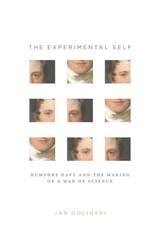
The Experimental Self
Humphry Davy and the Making of a Man of ScienceJan Golinski
University of Chicago Press, 2016
In The Experimental Self, Golinski argues that Davy’s life is best understood as a prolonged process of self-experimentation. He follows Davy from his youthful enthusiasm for physiological experiment through his self-fashioning as a man of science in a period when the path to a scientific career was not as well-trodden as it is today. What emerges is a portrait of Davy as a creative fashioner of his own identity through a lifelong series of experiments in selfhood.
The Exposition of 1 John and An Exposition upon Matthew V-VII
William Tyndale
Catholic University of America Press, 2023
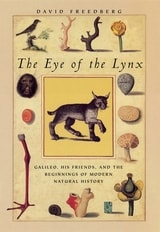
The Eye of the Lynx
Galileo, His Friends, and the Beginnings of Modern Natural HistoryDavid Freedberg
University of Chicago Press, 2003
Founded by Prince Federico Cesi in 1603, the Linceans took as their task nothing less than the documentation and classification of all of nature in pictorial form. In this first book-length study of the Linceans to appear in English, Freedberg focuses especially on their unprecedented use of drawings based on microscopic observation and other new techniques of visualization. Where previous thinkers had classified objects based mainly on similarities of external appearance, the Linceans instead turned increasingly to sectioning, dissection, and observation of internal structures. They applied their new research techniques to an incredible variety of subjects, from the objects in the heavens studied by their most famous (and infamous) member Galileo Galilei—whom they supported at the most critical moments of his career—to the flora and fauna of Mexico, bees, fossils, and the reproduction of plants and fungi. But by demonstrating the inadequacy of surface structures for ordering the world, the Linceans unwittingly planted the seeds for the demise of their own favorite method—visual description-as a mode of scientific classification.
Profusely illustrated and engagingly written, Eye of the Lynx uncovers a crucial episode in the development of visual representation and natural history. And perhaps as important, it offers readers a dazzling array of early modern drawings, from magnificently depicted birds and flowers to frogs in amber, monstrously misshapen citrus fruits, and more.
The Faces of Time
Portrayal of the Past in Old French and Latin Historical Narrative of the Anglo-Norman RegnumJean Blacker
University of Texas Press, 1994
The twelfth century witnessed the sudden appearance and virtual disappearance of an important literary genre—the Old French verse chronicle. These poetic histories of the British kings, which today are treated as fiction, were written contemporaneously with Latin prose narratives, which are regarded as historical accounts. In this pathfinding study, however, Jean Blacker asserts that twelfth-century authors and readers viewed both genres as factual history.
Blacker examines four Old French verse chronicles—Gaimar's Estoire des Engleis (c. 1135), Wace's Roman de Brut (c. 1155) and Roman de Rou (c. 1160–1174), and Benoît de Sainte-Maure's Chronique des Ducs de Normandie (c. 1174–1180) and four Latin narratives—William of Malmesbury's Gesta Regum (c. 1118–1143) and Historia Novella (c. 1140–1143), Orderic Vitalis's Historia Ecclesiastica (c. 1118–1140), and Geoffrey of Monmouth's Historia Regum Britanniae (c. 1138). She compares their similarity in three areas—the authors' stated intentions, their methods of characterization and narrative development, and the possible influences of patronage and audience expectation on the presentation of characters and events.
This exploration reveals remarkable similarity among the texts, including their idealization of historical and even legendary figures, such as King Arthur. It opens fruitful lines of inquiry into the role these writers played in the creation of the Anglo-Norman regnum and suggests that the Old French verse chronicles filled political, psychic, and aesthetic needs unaddressed by Latin historical writing of the period.
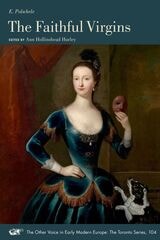
The Faithful Virgins
E. Polwhele
Iter Press, 2023
E. Polwhele (c. 1651-c. 1691) was one of the first women to write for the stage in Restoration London. This book presents the first printed edition of Polwhele’s first play, The Faithful Virgins, which until now has existed only in an unsigned manuscript in the Bodleian Library at Oxford University. A tragicomedy apparently performed in London by the Duke's Company ca. 1669–1671, The Faithful Virgins is altogether different in tone from Polwhele's later, better-known prose comedy, The Frolicks; or, The Lawyer Cheated (1671). The introduction to this modern-spelling edition of The Faithful Virgins discusses the play in terms of radical changes in English stage practices following the restoration of the monarchy after England’s civil war and situates Polwhele’s play within the social and political life of seventeenth-century London.

The False Dawn
European Imperialism in the Nineteenth CenturyRaymond F. Betts
University of Minnesota Press, 1978
The False Dawn was first published in 1975. Minnesota Archive Editions uses digital technology to make long-unavailable books once again accessible, and are published unaltered from the original University of Minnesota Press editions.
As the author explains, the false dawn that greeted and disappointed the visitors in E. M. Forster's A Passage to India is a literary image that might serve as a value judgment of modern overseas empire in general. Commenting that the term "empire" is now badly tarnished, Professor Betts points out that no bright dawn of understanding has yet appeared on the academic horizon. With this perceptive viewpoint, he traces the course of European imperialism beginning with the Treaty of Paris in 1763 and ending with a final glance toward the Western Front in August, 1914.
Reviewing the book in the Historian, Lawrence J. Baack calls it "a clear and concise essay on the nature of European imperialism." In its review Choice says: "Undergraduates and graduate students alike will welcome this book as a readable general introduction to more technical works."
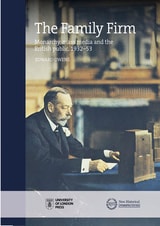
The Family Firm
monarchy, mass media and the British public, 1932-53Edward Owens
University of London Press, 2019
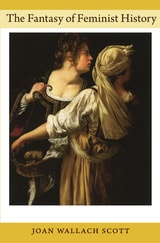
The Fantasy of Feminist History
Joan Wallach Scott
Duke University Press, 2012
The Fascist Revolution
Toward a General Theory of FascismGeorge L. Mosse, with a critical introduction by Roger Griffin
University of Wisconsin Press, 2021

The Fear of Barbarians
Beyond the Clash of CivilizationsTzvetan Todorov
University of Chicago Press, 2010
The relationship between Western democracies and Islam, rarely entirely comfortable, has in recent years become increasingly tense. A growing immigrant population and worries about cultural and political assimilation—exacerbated by terrorist attacks in the United States, Europe, and around the world—have provoked reams of commentary from all parts of the political spectrum, a frustrating majority of it hyperbolic or even hysterical.
In The Fear of Barbarians, the celebrated intellectual Tzvetan Todorov offers a corrective: a reasoned and often highly personal analysis of the problem, rooted in Enlightenment values yet open to the claims of cultural difference. Drawing on history, anthropology, and politics, and bringing to bear examples ranging from the murder of Theo van Gogh to the French ban on headscarves, Todorov argues that the West must overcome its fear of Islam if it is to avoid betraying the values it claims to protect. True freedom, Todorov explains, requires us to strike a delicate balance between protecting and imposing cultural values, acknowledging the primacy of the law, and yet strenuously protecting minority views that do not interfere with its aims. Adding force to Todorov's arguments is his own experience as a native of communist Bulgaria: his admiration of French civic identity—and Western freedom—is vigorous but non-nativist, an inclusive vision whose very flexibility is its core strength.
The record of a penetrating mind grappling with a complicated, multifaceted problem, The Fear of Barbarians is a powerful, important book—a call, not to arms, but to thought.

The Federal Future of Europe
From the European Community to the European UnionDusan Sidjanski
University of Michigan Press, 2000
The author argues that federalism is the best antidote to the reemergence of nationalism in Europe. It is also the best guarantee for a peaceful community that balances the claims of national, regional, and local identity against the need for large-scale economies that springs from the forces of globalization, competition, and technical change. The Union preserves diversity within a flexible and innovating European system.
This major study of the development of the European project, informed by a thorough knowledge of the Community and Union over the years and by deep understanding of the relevant literatures in political science and political economy is important for all who study the European Union or work with it as officials and business people.
Dusan Sidjanski is founder and Professor Emeritus of the Department of Political Science, University of Geneva and Professor Emeritus, European Institute. He has authored numerous publications, most recently, The ECE in the Age of Change (United Nations Economic Commission for Europe, United Nations).
The Feeling of History
Islam, Romanticism, and AndalusiaCharles Hirschkind
University of Chicago Press, 2021
Against this xenophobic tendency, The Feeling of History examines the idea of Andalucismo—a modern tradition founded on the principle that contemporary Andalusia is connected in vitally important ways with medieval Islamic Iberia. Charles Hirschkind explores the works and lives of writers, thinkers, poets, artists, and activists, and he shows how, taken together, they constitute an Andalusian sensorium. Hirschkind also carefully traces the various itineraries of Andalucismo, from colonial and anticolonial efforts to contemporary movements supporting immigrant rights. The Feeling of History offers a nuanced view into the way people experience their own past, while also bearing witness to a philosophy of engaging the Middle East that experiments with alternative futures.
The Fight for Scottish Democracy
Rebellion and Reform in 1820Murray Armstrong
Pluto Press, 2020
This 'Radical War' was the culmination of five years of unsuccessful mass petitioning of Westminster by working people in Scotland and England. The contempt and intransigence of the Tory government forced an escalation in tactics, and on Easter Monday of 1820, the call for a general strike was answered throughout the western counties of Scotland. Their demands were threefold: the vote for all men, annual parliaments and equal constituencies. Coupled with an armed rebellion, the strike was met by the full military might of the British state; hundreds were arrested and imprisoned without trial, while hundreds more fled the country.
This Scottish general strike and insurrection is a little-known chapter of British history and yet remains an immensely important one in the long fight for democracy. In The Fight for Scottish Democracy, Murray Armstrong brings these events dramatically to life.
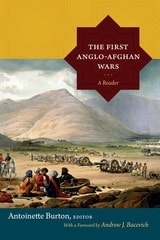
The First Anglo-Afghan Wars
A ReaderAntoinette Burton, ed.
Duke University Press, 2014

The First British Trade Expedition to China
Captain Weddell and the Courteen Fleet in Asia and Late Ming CantonNicholas D. Jackson
Hong Kong University Press, 2022
In The First British Trade Expedition to China, Nicholas D. Jackson explores the pioneering British trade expedition to China launched in the late Ming period by Charles I and the Courteen Association. Utilizing the vivid perspective of its commander Captain John Weddell, this study concentrates on the fleet’s adventures in south China between Portuguese Macao and the provincial capital, Guangzhou. Tracing the obscure origins of Sino-British diplomatic and commercial relations back to the late Ming era, Jackson examines the first episodes of Sino-British interaction, exchange, and collision in the seventeenth century. His analysis constitutes a groundbreaking study of early modern British initiatives and enterprises in the coastal areas of south China.
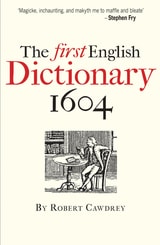
The First English Dictionary 1604
Robert Cawdrey's A Table AlphabeticallRobert Cawdrey
Bodleian Library Publishing, 2007
English is one of the most complicated languages to learn, and its constantly evolving vocabulary certainly doesn’t help matters. For centuries, men and women have striven to chronicle and categorize the expressions of the English language, and Samuel Johnson is usually thought to be their original predecessor. But that lineage is wrong: Robert Cawdrey published his Table Alphabeticall in 1604, 149 years before Johnson’s tome, and it is now republished here for the first time in over 350 years.
This edition, prepared from the sole surviving copy of the first printing, documents Cawdrey’s fascinating selection of 2,543 words and their first-ever definitions. Cawdrey subtitled his dictionary “for the benefit of Ladies, Gentlewomen, and other unskilled folk,” for his aim was not to create a comprehensive catalog, but rather an in-depth guide for the lesser educated who might not know the “hard usual English wordes, borrowed from the Hebrew, Greeke, Latine, or French.” Each entry reveals an intriguing facet of early modern life and the cultural mores of the time. There are familiar terms—“geometrie” was defined as “the art of measuring the earth,” and a “concubine” was described as a “harlot, or light huswife”—and amusingly idiomatic definitions: "prodigall" is "too riotous in spending," while "hecticke" is "inflaming the hart, and soundest parts of the bodie.”

The First Fleets
Colonial Navies of the British Atlantic World, 1630–1775Benjamin C. Schaffer
University of Alabama Press, 2025
A revealing study on the little-known and misunderstood provincial navies established by North American British colonists.
In The First Fleets, Benjamin C. Schaffer reveals how, contrary to widespread beliefs, the American colonies had a long tradition of independent naval defense decades before the Revolution. He demonstrates that Anglo-American governments established and maintained significant provincial naval forces and that the history of provincial navies illuminates broader aspects of colonial history and the colonies’ ultimate break with the British Crown.
Based on meticulous research, Schaffer recounts the sea-borne threats that American colonies faced from the French, Spanish, pirates, and others. He reviews colonial governance and the relationships between colonial governments and Great Britain. Highlighting Britain’s scant naval power in North America, Schaffer demonstrates how the vulnerable coastal colonies undertook their own self-defense.
Schaffer’s readable study offers many fascinating episodes from colonial history. Establishing a navy was controversial in pacifist-minded, Quaker-dominated Pennsylvania. South Carolina deployed its scout-boat navy to pursue enslaved Africans who fled colonial capture. The first paper money issued in North America was an initiative to pay for a naval expedition against French Quebec in 1690. These and other episodes show the intimate connection between these little-known provincial navies and the major sociopolitical developments of their day.
The First Fleets will be of great interest to historians and readers of early American history, particularly colonial maritime and naval activities. Readers interested in the political and military dynamics of pre-Revolutionary America, as well as enthusiasts of naval history and maritime trade, will find The First Fleets both a valuable resource and an engrossing narrative.
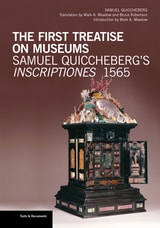
The First Treatise on Museums
Samuel Quiccheberg’s Inscriptiones, 1565Samuel Quiccheberg
J. Paul Getty Trust, The, 2014
Samuel Quiccheberg’s Inscriptiones, first published in Latin in 1565, is an ambitious effort to demonstrate the pragmatic value of curiosity cabinets, or Wunderkammern, to princely collectors in sixteenth-century Europe and, by so doing, inspire them to develop their own such collections. Quiccheberg shows how the assembly and display of physical objects offered nobles a powerful means to expand visual knowledge, allowing them to incorporate empirical and artisanal expertise into the realm of the written word. But in mapping out the collectability of the material world, Quiccheberg did far more than create a taxonomy. Rather, he demonstrated how organizing objects made their knowledge more accessible; how objects, when juxtaposed or grouped, could tell a story; and how such strategies could enhance the value of any single object.
Quiccheberg’s descriptions of early modern collections provide both a point of origin for today’s museums and an implicit critique of their aims, asserting the fundamental research and scholarly value of collections: collections are to be used, not merely viewed. The First Treatise on Museums makes Quiccheberg’s now rare publication available in an English translation. Complementing the translation are a critical introduction by Mark A. Meadow and a preface by Bruce Robertson.
The Footsteps of Israel
Understanding Jews in Anglo-Saxon EnglandAndrew P. Scheil
University of Michigan Press, 2004

The Forgotten Frontier
A History of the Sixteenth-Century Ibero-African FrontierAndrew C. Hess
University of Chicago Press, 1978
The sixteenth-century Mediterranean witnessed the expansion of both European and Middle Eastern civilizations, under the guises of the Habsburg monarchy and the Ottoman empire. Here, Andrew C. Hess considers the relations between these two dynasties in light of the social, economic, and political affairs at the frontiers between North Africa and the Iberian peninsula.
The Formation of a Modern Rabbi
The Life and Times of the Viennese Scholar and Preacher Adolf JellinekSamuel Joseph Kessler
SBL Press, 2022
An intellectual biography that critically engages Adolf Jellinek’s scholarship and communal activities
Adolf Jellinek (1821–1893), the Czech-born, German-educated, liberal chief rabbi of Vienna, was the most famous Jewish preacher in Central Europe in the second half of the nineteenth century. As an innovative rhetorician, Jellinek helped mold and define the modern synagogue sermon into an instrument for expressing Jewish religious and ethical values for a new era. As a historian, he made groundbreaking contributions to the study of the Zohar and medieval Jewish mysticism. Jellinek was emblematic of rabbi-as-scholar-preacher during the earliest, formative years of communal synagogues as urban religious space. In a world that was rapidly losing the felt and remembered past of premodern Jewish society, the rabbi, with Jellinek as prime exemplar, took hold of the Sabbath sermon as an instrument to define and mold Judaism and Jewish values for a new world.
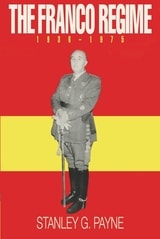
The Franco Regime, 1936–1975
Stanley G. Payne
University of Wisconsin Press, 2011
The history of modern Spain is dominated by the figure of Francisco Franco, who presided over one of the longest authoritarian regimes of the twentieth century. Between 1936 and the end of the regime in 1975, Franco’s Spain passed through several distinct phases of political, institutional, and economic development, moving from the original semi-fascist regime of 1936–45 to become the Catholic corporatist “organic democracy” under the monarchy from 1945 to 1957. Distinguished historian Stanley G. Payne offers deep insight into the career of this complex and formidable figure and the enormous changes that shaped Spanish history during his regime.

The Frankenstein of 1790 and Other Lost Chapters from Revolutionary France
Julia V. Douthwaite
University of Chicago Press, 2012
The French Atlantic Triangle
Literature and Culture of the Slave TradeChristopher L. Miller
Duke University Press, 2008
Miller offers a historical introduction to the cultural and economic dynamics of the French slave trade, and he shows how Enlightenment thinkers such as Montesquieu and Voltaire mused about the enslavement of Africans, while Rousseau ignored it. He follows the twists and turns of attitude regarding the slave trade through the works of late-eighteenth- and early-nineteenth-century French writers, including Olympe de Gouges, Madame de Staël, Madame de Duras, Prosper Mérimée, and Eugène Sue. For these authors, the slave trade was variously an object of sentiment, a moral conundrum, or an entertaining high-seas “adventure.” Turning to twentieth-century literature and film, Miller describes how artists from Africa and the Caribbean—including the writers Aimé Césaire, Maryse Condé, and Edouard Glissant, and the filmmakers Ousmane Sembene, Guy Deslauriers, and Roger Gnoan M’Bala—have confronted the aftermath of France’s slave trade, attempting to bridge the gaps between silence and disclosure, forgetfulness and memory.
The French Imperial Nation-State
Negritude and Colonial Humanism between the Two World WarsGary Wilder
University of Chicago Press, 2005
Gary Wilder develops a sophisticated account of the contradictory character of colonial government and examines the cultural nationalism of Negritude as a multifaceted movement rooted in an alternative black public sphere. He argues that interwar France must be understood as an imperial nation-state—an integrated sociopolitical system that linked a parliamentary republic to an administrative empire. An interdisciplinary study of colonial modernity combining French history, colonial studies, and social theory, The French Imperial Nation-State will compel readers to revise conventional assumptions about the distinctions between republicanism and racism, metropolitan and colonial societies, and national and transnational processes.
The French Joyce
Geert Lernout
University of Michigan Press, 1992
The French Revolution Confronts Pius VI
Volume 1: His Writings to Louis XVI, French Cardinals, Bishops, the National Assembly, and the People of France with Special Emphasis on the Civil Constitution of the ClergyJeffrey J. Langan
St. Augustine's Press, 2020
The writings of Pope Pius VI, head of the Catholic Church during the most destructive period of the French Revolution, were compiled in two volumes by M.N.S. Guillon and published in 1798 and 1800. But during the Revolution, the reign of Napoleon, and the various revolutionary movements of the 19th century, there were extraordinary efforts to destroy writings that critiqued the revolutionary ideology. Many books and treatises, if they survived the revolution or the sacking from Napoleon’s armies. To this day, no public copy of Guillon’s work exists in Paris.
Now, for the first time in English, these works comprising the letters, briefs, and other writings of Pius VI on the French Revolution are available. Volume I treats the first shock of the Revolution and the efforts of the Pope in 1790 and 1791 to oppose the Civil Constitution of the Clergy (which famous revolutionary and shrewd diplomat Talleyrand referred to as “the greatest fault of the National Assembly”). Volume II will be published later, and deals with the aftermath of the Civil Constitution through Pius’s death in exile). Editor and translator Jeffrey Langan presents the materials leading up to and directly connected with these decrees, in which the National Assembly attempted to set up a Catholic Church that would be completely submissive to the demands of the Assembly. Volume I also covers Pius’s efforts to deal with the immediate aftermath of the Constitution after the National Assembly implemented it, including his encyclical, Quod Aliquantum.
The letters will show how Pius chose to oppose the Civil Constitution. He did so not by a public campaign, for he had no real temporal power to oppose the violence, but by attempting to work personally with Louis XVI and various archbishops in France to articulate what were the points on which he could concede (matters dealing with the political structures of France) and what were the essential points in which he could not concede (matters dealing with the organization of dioceses and appointment of bishops).
Since the 1980s, with the writings and school that developed around François Furet, as well as Simon Schama’s Citizens, a new debate over the French Revolution has ensued, bringing forth a more objective account of the Revolution, one that avoids an excessively Marxist lens and that brings to light some of its defects and more gruesome parts – the destruction and theft of Church property, and the sadistic methods of torture and killing of priests, nuns, aristocrats, and fellow-revolutionaries.
An examination of the writings of Pius VI will not only help set the historical record straight for English-speaking students of the Revolution, it will also aid them to better understand the principles that the Catholic Church employs when confronted with chaotic political change. They will see that the Church has a principled approach to distinguishing, while not separating, the power of the Church and the power of the state. They will also see, as Talleyrand himself also saw, that one of the essential elements that makes the Church the Church is the right to appoint bishops and to discipline its own bishops. The Church herself recognizes that she cannot long survive without this principle that guarantees her unity.
Pius VI’s efforts were able to keep the Catholic Church intact (though badly bruised) so that she could reconstitute herself and build up a vibrant life in 19th-century France. (He did this in the face of the Church’s prestige having sunk to historic lows; some elites in Europe thought there would be no successor to Pius and jokingly referred to him as “Pius the Last.”) He began a process that led to the restoration of the prestige of the Papacy throughout the world, and he initiated a two-century process that led to the Church finally being able to select bishops without any interference from secular authorities. This had been at least a 1,000-year problem in the history of the Church. By 1990, only two countries of the world, China and Vietnam, were interfering in any significant way in the process that the Church used to select bishops.
Pius VI’s papacy, especially during the years of the French Revolution, was a pivotal point for the French Revolution and for the interaction between Church and state in Western history. All freedom-loving people will be happy to read his distinc-tions between the secular power and the spiritual power. His papacy also was important for the internal developments that the Church would make over the next 200 years with respect to its self-understanding of the Papacy and the role of the bishop.
The French Writers' War, 1940-1953
Gisèle Sapiro
Duke University Press, 2014
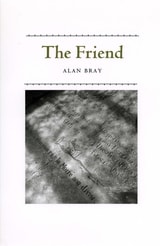
The Friend
Alan Bray
University of Chicago Press, 2003
There was a time, as made clear by this monument, when the English church not only revered such relations between men, but also blessed them. Taking this remarkable idea as its cue, The Friend explores the long and storied relationship between friendship and the traditional family of the church in England. This magisterial work extends from the year 1000, when Europe acquired a shape that became its enduring form, and pursues its account up to the eighteenth and nineteenth centuries. Spanning a vast array of fascinating examples, which range from memorial plaques and burial brasses to religious rites and theological imagery to classic works of philosophy and English literature, Bray shows how public uses of private affection were very common in premodern times. He debunks the now-familiar readings of friendship by historians of sexuality who project homoerotic desires onto their subjects when there were none. And perhaps most notably, he evaluates how the ethics of friendship have evolved over the centuries, from traditional emphases on loyalty to the Kantian idea of moral benevolence to the more private and sexualized idea of friendship that emerged during the modern era.
Finely nuanced and elegantly conceived, The Friend is a book rich in suggestive propositions as well as eye-opening details. It will be essential reading for anyone interested in the history of England and the importance of friendship in everyday life.
History Today’s Book of the Year, 2004
“Bray’s loving coupledom is something with a proper historical backbone, with substance and form, something you can trace over time, visible and archeologicable. . . . Bray made a great contribution in helping to bring this long history to light.”— James Davidson, London Review of Books
The Fullness of Time
Temporalities of the Fifteenth-Century Low CountriesMatthew S. Champion
University of Chicago Press, 2017
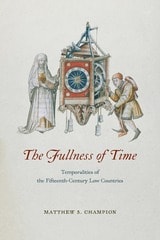
The Fullness of Time asks how the passage of time in the Low Countries was ordered by the rhythms of human action, from the musical life of a cathedral to the measurement of time by clocks and calendars, the work habits of a guildsman to the devotional practices of the laity and religious orders. Through a series of transdisciplinary case studies, it explores the multiple ways that objects, texts and music might themselves be said to engage with, imply, and unsettle time, shaping and forming the lives of the inhabitants of the fifteenth-century Low Countries. Champion reframes the ways historians have traditionally told the history of time, allowing us for the first time to understand the rich and varied interplay of temporalities in the period.
The Future of Illusion
Political Theology and Early Modern TextsVictoria Kahn
University of Chicago Press, 2013
Kahn draws on theorists such as Carl Schmitt, Leo Strauss, Walter Benjamin, and Hannah Arendt and their readings of Shakespeare, Hobbes, Machiavelli, and Spinoza to illustrate that the dialogue between these modern and early modern figures can help us rethink the contemporary problem of political theology. Twentieth-century critics, she shows, saw the early modern period as a break from the older form of political theology that entailed the theological legitimization of the state. Rather, the period signaled a new emphasis on a secular notion of human agency and a new preoccupation with the ways art and fiction intersected the terrain of religion.

The Future of NATO
Regional Defense and Global SecurityAndrew A. Michta and Paal Sigurd Hilde, editors
University of Michigan Press, 2014