Results by title
28167 books match the query 'History' and 6372 start with t
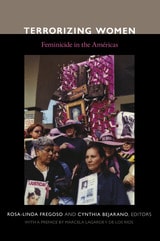
Terrorizing Women
Feminicide in the AmericasRosa-Linda Fregoso and Cynthia L. Bejarano, eds.
Duke University Press, 2010
Terrorizing Women brings together essays by feminist and human rights activists, attorneys, and scholars from Latin America and the United States, as well as testimonios by relatives of women who were disappeared or murdered. In addition to investigating egregious violations of women’s human rights, the contributors consider feminicide in relation to neoliberal economic policies, the violent legacies of military regimes, and the sexual fetishization of women’s bodies. They suggest strategies for confronting feminicide; propose legal, political, and social routes for redressing injustices; and track alternative remedies generated by the communities affected by gender-based violence. In a photo essay portraying the justice movement in Chihuahua, relatives of disappeared and murdered women bear witness to feminicide and demand accountability.
Contributors: Pascha Bueno-Hansen, Adriana Carmona López, Ana Carcedo Cabañas, Jennifer Casey, Lucha Castro Rodríguez , Angélica Cházaro, Rebecca Coplan, Héctor Domínguez-Ruvalcaba, Marta Fontenla, Alma Gomez Caballero, Christina Iturralde, Marcela Lagarde y de los Ríos, Julia Estela Monárrez Fragoso, Hilda Morales Trujillo, Mercedes Olivera, Patricia Ravelo Blancas, Katherine Ruhl, Montserrat Sagot, Rita Laura Segato, Alicia Schmidt Camacho, William Paul Simmons, Deborah M. Weissman, Melissa W. Wright
Testimony
Death of a Guatemalan VillageVictor Montejo
Northwestern University Press, 1987

Testimony
Found Poems from the Special Court for Sierra LeoneShanee Stepakoff
Bucknell University Press, 2021
Sierra Leone’s devastating civil war barely caught the attention of Western media, but it raged on for over a decade, bringing misery to millions of people in West Africa from 1991 to 2002. The atrocities committed in this war and the accounts of its survivors were duly recorded by international organizations, but they run the risk of being consigned to dusty historical archives.
Derived from public testimonies at a UN-backed war crimes tribunal in Freetown, this remarkable poetry collection aims to breathe new life into the records of Sierra Leone’s civil war, delicately extracting heartbreaking human stories from the morass of legal jargon. By rendering selected trial transcripts in poetic form, Shanee Stepakoff finds a novel way to communicate not only the suffering of Sierra Leone’s people, but also their courage, dignity, and resilience. Her use of innovative literary techniques helps to ensure that the voices of survivors are not forgotten, but rather heard across the world.
This volume also includes an introduction that explores how the genre of “found poetry” can serve as a uniquely powerful means through which writers may bear witness to atrocity. This book’s unforgettable excavation and shaping of survivor testimonies opens new possibilities for speaking about the unspeakable.

Testing Fate
Tay-Sachs Disease and the Right to Be ResponsibleShelley Z. Reuter
University of Minnesota Press, 2016
In today’s world, responsible biocitizenship has become a new way of belonging in society. Individuals are expected to make “responsible” medical choices, including the decision to be screened for genetic disease. Paradoxically, we have even come to see ourselves as having the right to be responsible vis-à-vis the proactive mitigation of genetic risk. At the same time, the concept of genetic disease has become a new and powerful way of defining the boundaries between human groups. Tay-Sachs, an autosomal recessive disorder, is a case in point—with origins in the period of Eastern European Jewish immigration to the United States and United Kingdom that spanned the late nineteenth and early twentieth centuries, it has a long and fraught history as a marker of Jewish racial difference.
In Testing Fate, Shelley Z. Reuter asks: Can the biocitizen, especially one historically defined as a racialized and pathologized Other, be said to be exercising authentic, free choice in deciding whether to undertake genetic screening? Drawing on a range of historical and contemporary examples—doctors’ medical reports of Tay-Sachs since the first case was documented in 1881, the medical field’s construction of Tay-Sachs as a disease of Jewish immigrants, YouTube videos of children with Tay-Sachs that frame the disease as tragic disability avoidable through a simple genetic test, and medical malpractice suits since the test for the disease became available—Reuter shows that true agency in genetic decision-making can be exercised only from a place of cultural inclusion. Choice in this context is in fact a kind of unfreedom—a moral duty to act that is not really agency at all.
Tewa Worlds
An Archaeological History of Being and Becoming in the Pueblo SouthwestSamuel Duwe
University of Arizona Press, 2020
Tewa Worlds tells a history of eight centuries of the Tewa people, set among their ancestral homeland in northern New Mexico. Bounded by four sacred peaks and bisected by the Rio Grande, this is where the Tewa, after centuries of living across a vast territory, reunited and forged a unique type of village life. It later became an epicenter of colonialism, for within its boundaries are both the ruins of the first Spanish colonial capital and the birthplace of the atomic bomb. Yet through this dramatic change the Tewa have endured and today maintain deep connections with their villages and a landscape imbued with memory and meaning.
Anthropologists have long trekked through Tewa country, but the literature remains deeply fractured among the present and the past, nuanced ethnographic description, and a growing body of archaeological research. Samuel Duwe bridges this divide by drawing from contemporary Pueblo philosophical and historical discourse to view the long arc of Tewa history as a continuous journey. The result is a unique history that gives weight to the deep past, colonial encounters, and modern challenges, with the understanding that the same concepts of continuity and change have guided the people in the past and present, and will continue to do so in the future.
Focusing on a decade of fieldwork in the northern portion of the Tewa world—the Rio Chama Valley—Duwe explores how incorporating Pueblo concepts of time and space in archaeological interpretation critically reframes ideas of origins, ethnogenesis, and abandonment. It also allows archaeologists to appreciate something that the Tewa have always known: that there are strong and deep ties that extend beyond modern reservation boundaries.
Texan Crucible
How the Irish, Germans, and Czechs Became AngloMarian J. Barber
University of Texas Press, 2026
A history of European immigrants in Texas and how they redefined racial identity.
While the creation of a Black-White racial binary was foundational to most of the United States, nineteenth-century Texas developed a unique tripartite system that acknowledged the role of individuals of Mexican ancestry in a region that was Spanish, Mexican, and an independent nation before becoming a US (and briefly Confederate) state. Yet this framework was fraught, struggling to accommodate new arrivals from beyond North America, in particular the Irish, Germans, and Czechs. Texan Crucible tells the story of these immigrants and how they became Anglo.
Marian Barber reveals the ways language, religion, alcohol use, and attitudes toward slavery distinguished these newcomers to Texas from those arriving from the eastern United States and how they nevertheless created thriving, influential communities. Their status was shaped by events inside and far beyond Texas, including an 1887 prohibition fight, the Civil War, and two world wars that encouraged them to erase their distinctiveness. As segregation was formally outlawed and civil rights activism grew, understandings of race shifted, cementing these groups’ status as Anglo. Texan Crucible recovers the histories of German, Irish, and Czech immigrants and unveils the social construction of racial difference underpinning Texan identity.
Texan Identities
Moving beyond Myth, Memory, and Fallacy in Texas HistoryLight Townsend Cummins
University of North Texas Press, 2016
Texans in Revolt
The Battle for San Antonio, 1835By Alwyn Barr
University of Texas Press, 1990
While the battles of 1836—the Alamo, Goliad, and San Jacinto—are wellknown moments in the Texas Revolution, the battle for Bexar in the fall of 1835 is often overlooked. Yet this lengthy siege, which culminated in a Texan victory in December 1835, set the stage for those famous events and for the later revolutionary careers of Sam Houston, James Bowie, and James W. Fannin.
Drawing on extensive research and on-site study around San Antonio, Alwyn Barr completely maps the ebbs and flows of the Bexar campaign for the first time. He studies the composition of the two armies and finds that they were well matched in numbers and fighting experience—revising a common belief that the Texans defeated a force four times larger. He analyzes the tactics of various officers, revealing how ambition and revolutionary politics sometimes influenced the Texas army as much as military strategy. And he sheds new light on the roles of the Texan and Mexican commanders, Stephen F. Austin and Martín Perfecto de Cos.
As this excellent military history makes clear, to the famous rallying cry "Remember the Alamo!" "Remember Goliad!" should be added: "And don't forget San Antonio!"

Texas Cemeteries
The Resting Places of Famous, Infamous, and Just Plain Interesting TexansBy Bill Harvey
University of Texas Press, 2003
Winner, Journalistic Achievement Award, Texas Historical Foundation, 2004
From the simplest slab of weathered stone to the most imposing mausoleum, every marker in a Texas cemetery bears witness to a life that—in ways small or large—helped shape the history and culture of the state. Telling the stories of some of these significant lives is the purpose of this book. Within its pages, you'll meet not only the heroes of the Texas Revolution, for example, but also one of the great African American cowboys of the traildriving era (Bose Ikard) and the first woman in Texas elected to statewide office (Annie Webb Blanton). Visiting cemeteries from every era and all regions of the state, Bill Harvey recounts the histories of famous, infamous, and just plain interesting Texans who lie at rest in Texas cemeteries.
The book is organized alphabetically by city for easy reference. For each city, Harvey lists one or more cemeteries, giving their location and history, if significant. At the heart of the book are his profiles of the noteworthy people buried in each cemetery. They include not only famous but also lesser-known and even unknown Texans who made important contributions to the state in the arts, sports, business, military service, politics—truly every area of communal life. For those who want to visit these resting places, Harvey also includes tips on finding cemeteries, locating gravesites, and taking good photographs. Spend time with him in the graveyards of Texas, and you'll soon appreciate what fascinating stories the silent stones can tell.
Texas Crossings
The Lone Star State and the American Far West, 1836–1986By Howard R. Lamar; foreword by Lewis L. Gould
University of Texas Press, 1991
“Texas is not a place, it is a commotion!” exclaimed one early visitor to the state, underscoring the mobility and “get-ahead” spirit that have always characterized Texas and its people. In these thought-provoking essays, Howard R. Lamar looks specifically at the “crossings” that have characterized Texas history to see what effect these migrations to and through Texas have had on Texas, the Southwest, and links between Texas and California.
Originally presented in 1986 at the University of Texas at Austin as the first George W. Littlefield Lectures in American History, these essays explore a previously neglected aspect of the western story: the influence of Texans—and other Southerners—on the character and history of the southwestern states. Lamar discusses the many efforts to establish overland trails, and later railroads, to California and how those efforts were fueled by the gold rush era of 1849–1850. He traces the influence of immigrant Texans and the flourishing southern community in California, particularly during the Civil War years. He follows the twentieth-century migration of “Okies,” whose desire to settle and resume their agricultural lifeways clashed with Californians’ preference for migrant workers. And he reveals how the discovery of oil, not only in Texas but also in California, western Canada, and Alaska, continues to link these regions.
Texas has always been a place that people pass through, going either east-west or north-south. Texas Crossings explains what brought the people to Texas and what they carried away with them to California and the West.

Texas Earthquakes
By Cliff Frohlich and Scott D. Davis
University of Texas Press, 2003
When nature goes haywire in Texas, it isn't usually an earthshaking event. Though droughts, floods, tornadoes, and hail all keep Texans talking about the unpredictable weather, when it comes to earthquakes, most of us think we're on terra firma in this state. But we're wrong! Nearly every year, earthquakes large enough to be felt by the public occur somewhere in Texas.
This entertaining, yet authoritative book covers "all you really need to know" about earthquakes in general and in Texas specifically. The authors explain how earthquakes are caused by natural forces or human activities, how they're measured, how they can be predicted, and how citizens and governments should prepare for them. They also thoroughly discuss earthquakes in Texas, looking at the occurrences and assessing the risks region by region and comparing the amount of seismic activity in Texas to other parts of the country and the world. The book concludes with a compendium of over one hundred recorded earthquakes in Texas from 1811 to 2000 that briefly describes the location, timing, and effects of each event.

Texas Furniture, Volume One
The Cabinetmakers and Their Work, 1840-1880, Revised editionBy Lonn Taylor and David B. Warren
University of Texas Press, 2012
The art of furniture making flourished in Texas during the mid-nineteenth century. To document this rich heritage of locally made furniture, Miss Ima Hogg, the well-known philanthropist and collector of American decorative arts, enlisted Lonn Taylor and David B. Warren to research early Texas Furniture and its makers. They spent more than a decade working with museums and private collectors throughout the state to examine and photograph representative examples. They also combed census records, newspapers, and archives for information about cabinetmakers. These efforts resulted in the 1975 publication of Texas Furniture, which quickly became the authoritative reference on this subject.
Now updated with an expanded Index of Texas Cabinetmakers that includes information that has come to light since the original publication and corrects errors, Texas Furniture presents a catalog of more than two hundred pieces of furniture, each superbly photographed and accompanied by detailed descriptions of the piece’s maker, date, materials, measurements, history, and owner, as well as an analysis by the authors. The book also includes chapters on the material culture of nineteenth-century Texas and on the tools and techniques of nineteenth-century Texas cabinetmakers, with a special emphasis on the German immigrant cabinetmakers of the Hill Country and Central Texas. The index of Texas cabinetmakers contains biographical information on approximately nine hundred men who made furniture in Texas, and appendices list information on the state’s largest cabinet shops taken from the United States census records.
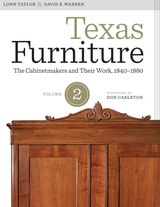
Texas Furniture, Volume Two
The Cabinetmakers and Their Work, 1840–1880By Lonn Taylor and David B. Warren
University of Texas Press, 2012
The art of furniture making flourished in Texas during the mid-nineteenth century. To document this rich heritage of locally made furniture, Miss Ima Hogg, the well-known philanthropist and collector of American decorative arts, enlisted Lonn Taylor and David B. Warren to research early Texas furniture and its makers. After more than a decade of investigation, they published Texas Furniture in 1975, and it quickly became the authoritative reference on this subject. An updated edition, Texas Furniture, Volume One, was issued in the spring of 2012.
Texas Furniture, Volume Two presents over 150 additional pieces of furniture that were not included in Volume One, each superbly photographed in color and accompanied by detailed descriptions of the piece’s maker, date, materials, measurements, history, and owner, as well as an analysis by the authors. Taylor and Warren have also written a new introduction for this volume, in which they amplify the story of early Texas furniture. In particular, they compare and contrast the two important traditions of cabinetmaking in Texas, Anglo-American and German, and identify previously unknown artisans. The authors also discuss nineteenth-century Texans’ desire for refinement and gentility in furniture, non-commercial furniture making, and marquetry work. And they pay tribute to the twentieth-century collectors who first recognized the value of locally made Texas furniture and worked to preserve it. A checklist of Texas cabinetmakers, which contains biographical information on approximately nine hundred men who made furniture in Texas, completes the volume.
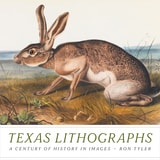
Texas Lithographs
A Century of History in ImagesRon Tyler
University of Texas Press, 2023
2024 Ewell L. Newman Book Award, American Historical Print Collectors Society
2024 Kate Broocks Bates Award for Historical Research, Texas State Historical Association
2024 TCU Texas Book Prize, Friends of the TCU Library and the TCU Press
2024 Kempner Family Book Prize—Nonfiction,The Philosophical Society of Texas
A stunning and comprehensive collection of lithographs from 1818 to 1900 Texas.
Westward expansion in the United States was deeply intertwined with the technological revolutions of the nineteenth century, from telegraphy to railroads. Among the most important of these, if often forgotten, was the lithograph. Before photography became a dominant medium, lithography—and later, chromolithography—enabled inexpensive reproduction of color illustrations, transforming journalism and marketing and nurturing, for the first time, a global visual culture. One of the great subjects of the lithography boom was an emerging Euro-American colony in the Americas: Texas.
The most complete collection of its kind—and quite possibly the most complete visual record of nineteenth-century Texas, period—Texas Lithographs is a gateway to the history of the Lone Star State in its most formative period. Ron Tyler assembles works from 1818 to 1900, many created by outsiders and newcomers promoting investment and settlement in Texas. Whether they depict the early French colony of Champ d’Asile, the Republic of Texas, and the war with Mexico, or urban growth, frontier exploration, and the key figures of a nascent Euro-American empire, the images collected here reflect an Eden of opportunity—a fairy-tale dream that remains foundational to Texans’ sense of self and to the world’s sense of Texas.

Texas Log Buildings
A Folk ArchitectureBy Terry G. Jordan
University of Texas Press, 1978
Once too numerous to attract attention, the log buildings of Texas now stand out for their rustic beauty. This book preserves a record of the log houses, stores, inns, churches, schools, jails, and barns that have already become all too few in the Texas countryside. Terry Jordan explores the use of log buildings among several different Texas cultural groups and traces their construction techniques from their European and eastern American origins.
Texas Mexican Americans and Postwar Civil Rights
By Maggie Rivas-Rodriguez
University of Texas Press, 2015
Texas Monthly On . . .
Texas WomenFrom the editors of Texas Monthly
University of Texas Press, 2006
Since 1973, Texas Monthly has spotlighted hundreds of Texans who, for better or worse, make this state like no place else. TEXAS MONTHLY On . . . Texas Women profiles thirteen women who are not only fascinating in their own right, but also representative of the legions of women who have contributed to the character and uniqueness of Texas. They range from First Ladies Laura Bush and Lady Bird Johnson to pop culture icons such as Candy Barr and Janis Joplin—and all of them exemplify the qualities that make Texas women distinctive. The women's profiles originally appeared as articles in the magazine, authored by some of Texas Monthly's notable writers—Cecilia Ballí, Gary Cartwright, Paul Burka, Mimi Swartz, Jan Jarboe Russell, Skip Hollandsworth, Robert Draper, William Broyles Jr., Jan Reid, Joe Nick Patoski, Pamela Colloff, and Helen Thorpe. The writers also introduce their pieces with headnotes that update the stories or, in some cases, tell the story behind the story.
TEXAS MONTHLY On . . . Texas Women is the first in a series of books in which the editors of Texas Monthly will offer the magazine's inimitable perspective on various aspects of Texas culture, including food, politics, travel, and music, among other topics.

Texas Place Names
By Edward Callary, with Jean K. Callary
University of Texas Press, 2020
Was Gasoline, Texas, named in honor of a gas station? Nope, but the name does honor the town’s original claim to fame: a gasoline-powered cotton gin. Is Paris, Texas, a reference to Paris, France? Yes: Thomas Poteet, who donated land for the town site, thought it would be an improvement over “Pin Hook,” the original name of the Lamar County seat. Ding Dong’s story has a nice ring to it; the name was derived from two store owners named Bell, who lived in Bell County, of course. Tracing the turning points, fascinating characters, and cultural crossroads that shaped Texas history, Texas Place Names provides the colorful stories behind these and more than three thousand other county, city, and community names.
Drawing on in-depth research to present the facts behind the folklore, linguist Edward Callary also clarifies pronunciations (it’s NAY-chis for Neches, referring to a Caddoan people whose name was attached to the Neches River during a Spanish expedition). A great resource for road trippers and historians alike, Texas Place Names alphabetically charts centuries of humanity through the enduring words (and, occasionally, the fateful spelling gaffes) left behind by men and women from all walks of life.
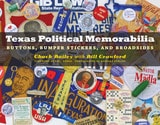
Texas Political Memorabilia
Buttons, Bumper Stickers, and BroadsidesBy Chuck Bailey, with Bill Crawford
University of Texas Press, 2007
Texas politicians are a lively, sometimes controversial, always entertaining breed, and the ways they have chosen to put themselves and their messages before the public are equally as interesting. Anything and everything that can be printed with a candidate's name, image, and slogan—from buttons and bumper stickers to chewing gum, pocket knives, and plastic pickles—is likely to turn up in a Texas political campaign. Though many consider these items ephemeral, collectors value political memorabilia as a fascinating "sound bite" record of the candidates and issues that engaged the voting public over decades. Texas Political Memorabilia presents just such a pictorial history of Texas politics, the first ever compiled.
Drawn from the vast personal collection of Chuck Bailey and augmented with items from other private and public collections, this book presents the most exceptional, most memorable, and most informative examples of Texas political memorabilia. The featured items cover everything from the presidential campaigns of Lyndon Johnson and both George Bushes, to U.S. House and Senate elections, to statewide races for governor and the Texas House and Senate, to county and city elections. All the major figures of twentieth-century Texas politics—as well as Sam Houston and Davy Crockett—are represented in the book. To set the images in context, Chuck Bailey and Bill Crawford provide background on the candidates, races, and issues that inspired many of the pieces pictured in the book.
From LBJ's Stetson-shaped ashtrays to Jake Pickle's plastic squeaker pickles to George W. Bush's "W" buttons, Texas Political Memorabilia is a treasure trove of the nuts and bolts and buttons of Texas politics.

Texas Ranger Captain William L. Wright
Richard B. McCaslin
University of North Texas Press, 2021
Texas Ranger John B. Jones and the Frontier Battalion, 1874-1881
Rick Miller
University of North Texas Press, 2012
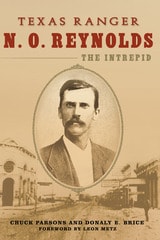
Texas Ranger N. O. Reynolds, the Intrepid
Chuck Parsons
University of North Texas Press, 2014

Texas Rangers
Lives, Legend, and LegacyBob Alexander
University of North Texas Press, 2017

Texas Sports
Unforgettable Stories for Every Day of the YearBy Chad S. Conine
University of Texas Press, 2017
When it comes to sports, Texas more than earns its bragging rights. The Lone Star State has produced championship teams and legendary athletes not only in football, baseball, and basketball, but in dozens of other sports as well. Texas Sports celebrates more than a century of achievements in a day-by-day record of the people and events—both unforgettable and little-known—that have made Texas a powerhouse in the world of sports.
Chad S. Conine packs a wealth of sports facts and stories into 366 days. He ranges from firsts such as UT’s first football game (an 1893 win against Dallas University Football Club) to peak moments such as Earl Campbell running through defenders, Nolan Ryan throwing heat past baffled batters, and Babe Didrickson Zaharias winning the Western Open golf championship for the fourth time. Conine covers more than twenty-five sports and all levels from high school to professional, reminding us that if Texas had never seen a pigskin or a backboard, its sports legacy would still be secure. With a winning combination of victories and heartbreaks, men’s and women’s sports, and all regions of the state, Texas Sports is a must-read for all sports fans and trivia buffs.
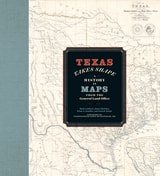
Texas Takes Shape
A History in Maps from the General Land OfficeBy Mark Lambert, James Harkins, Brian A. Stauffer, and Patrick Walsh
University of Texas Press, 2025
2025 Second Place, Presidio La Bahía Award, Sons of the Republic of Texas
2026 Ron Tyler Award for Best Illustrated Book on Texas History and Culture, Texas State Historical Association (TSHA)
A comprehensive volume on historical mapping in Texas.
The Texas General Land Office’s map collection contains over 45,000 maps, some dating from the sixteenth century, making it one of the most important cartographic archives in Texas. As products and agents of history drawn by cartographers with motives and means as diverse as the places they document, maps provide a unique perspective on geopolitical, cultural, and economic processes. The maps of the GLO offer key insights into Texas’s sprawling history. They speak to issues of changing borders, social and political upheaval, and questions of sovereignty and power.
Texas Takes Shape offers an illuminating selection from the GLO archive: over one hundred maps that tell—and sometimes obscure—the stories of European colonization, Spanish and Mexican rule, the Republic of Texas, and the modern US state. There are maps here of every scale, from the hemispheric visions of European explorers to individual survey plats. Accompanying essays offer fascinating lessons on topics ranging from Indigenous cartography to military and railroad mapmaking and frontier surveys. Artful and informative, Texas Takes Shape examines a unique place through the eyes and imaginations of those who sought to govern it, profit from it, understand it, and call it home.

Texas Takes Wing
A Century of Flight in the Lone Star StateBy Barbara Ganson
University of Texas Press, 2014
This book celebrates the aviators, astronauts, airline executives, and other innovators who have made Texas an influential world leader in the aerospace industry over the past century.
Tracing the hundred-year history of aviation in Texas, aviator and historian Barbara Ganson brings to life the colorful personalities that shaped the phenomenally successful development of this industry in the state. Weaving stories and profiles of aviators, designers, manufacturers, and those in related services, Texas Takes Wing covers the major trends that propelled Texas to the forefront of the field. Covering institutions from San Antonio’s Randolph Air Force Base (the West Point of this branch of service) to Brownsville’s airport with its Pan American Airlines instrument flight school (which served as an international gateway to Latin America as early as the 1920s) to Houston’s Johnson Space Center, home of Mission Control for the U.S. space program, the book provides an exhilarating timeline and engaging history of dozens of unsung pioneers as well as their more widely celebrated peers.
Drawn from personal interviews as well as major archives and the collections of several commercial airlines, including American, Southwest, Braniff, Pan American Airways, and Continental, this sweeping history captures the story of powered flight in Texas since 1910. With its generally favorable flying weather, flat terrain, and wide open spaces, Texas has more airports than any other state and is often considered one of America’s most aviation-friendly places. Texas Takes Wing also explores the men and women who made the region pivotal in military training, aircraft manufacturing during wartime, general aviation, and air servicing of the agricultural industry. The result is a soaring history that will delight aviators and passengers alike.
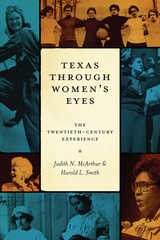
Texas Through Women's Eyes
The Twentieth-Century ExperienceBy Judith N. McArthur and Harold L. Smith
University of Texas Press, 2010
Winner, Liz Carpenter Award For Research in the History of Women, Texas State Historical Association, 2010
Texas women broke barriers throughout the twentieth century, winning the right to vote, expanding their access to higher education, entering new professions, participating fully in civic and political life, and planning their families. Yet these major achievements have hardly been recognized in histories of twentieth-century Texas. By contrast, Texas Through Women's Eyes offers a fascinating overview of women's experiences and achievements in the twentieth century, with an inclusive focus on rural women, working-class women, and women of color.
McArthur and Smith trace the history of Texas women through four eras. They discuss how women entered the public sphere to work for social reforms and the right to vote during the Progressive era (1900–1920); how they continued working for reform and social justice and for greater opportunities in education and the workforce during the Great Depression and World War II (1920–1945); how African American and Mexican American women fought for labor and civil rights while Anglo women laid the foundation for two-party politics during the postwar years (1945–1965); and how second-wave feminists (1965–2000) promoted diverse and sometimes competing goals, including passage of the Equal Rights Amendment, reproductive freedom, gender equity in sports, and the rise of the New Right and the Republican party.
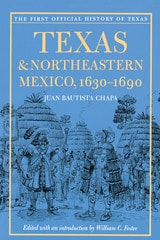
Texas and Northeastern Mexico, 1630-1690
By Juan Bautista Chapa
University of Texas Press, 1997
An English translation of Chapa's Historia de Nuevo León, the first history of the region that eventually became Texas and northeastern Mexico.
Winner, Presidio La Bahía Award, Sons of the Republic of Texas
In the seventeenth century, South Texas and Northeastern Mexico formed El Nuevo Reino de León, a frontier province of New Spain. In 1690, Juan Bautista Chapa penned a richly detailed history of Nuevo León for the years 1630 to 1690. Although his Historia de Nuevo León was not published until 1909, it has since been acclaimed as the key contemporary document for any historical study of Spanish colonial Texas.
This book offers the only accurate and annotated English translation of Chapa's Historia. In addition to the translation, William C. Foster also summarizes the Discourses of Alonso de León (the elder), which cover the years 1580 to 1649. In the appendix, Foster includes a translation of Alonso (the younger) de León's previously unpublished revised diary of the 1690 expedition to East Texas and an alphabetical listing of over 80 Indian tribes identified in this book.
Chapa was also an authority on the local Indians, and his Historia lists the names and locations of over 300 Indian tribes. This information, together with descriptions of the vegetation, wildlife, and climate in seventeenth-century Texas, make this book essential reading for ethnographers, anthropologists, and biogeographers, as well as students and scholars of Spanish borderlands history.
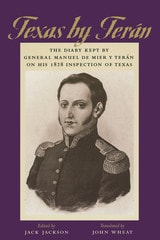
Texas by Terán
The Diary Kept by General Manuel de Mier y Terán on His 1828 Inspection of TexasEdited by Jack Jackson
University of Texas Press, 2000
Texas in 1837
An Anonymous, Contemporary NarrativeEdited by Andrew Forest Muir
University of Texas Press, 1958
Written anonymously in 1838–39 by a "Citizen of Ohio," Texas in 1837 is the earliest known account of the first year of the Texas republic. Providing information nowhere else available, the still-unknown author describes a land rich in potential but at the time "a more suitable arena for those who have everything to make and nothing to lose than [for] the man of capital or family."
The author arrived at Galveston Island on March 22, 1837, before the city of Galveston was founded, and spent the next six months in the republic. His travels took him to Houston, then little more than a camp made up of brush shelters and jerry-built houses, and as far west as San Antonio. He observed and was generally unimpressed by governmental and social structures just beginning to take shape. He attended the first anniversary celebration of the Battle of San Jacinto and has left a memorable account of Texas' first Independence Day. His inquiring mind and objective, actue observations of early Texas provide us a way of returning to the past, revisiting landmarks that have vanished forever.

Texas in the Confederacy
An Experiment in Nation BuildingClayton E. Jewett
University of Missouri Press, 2002
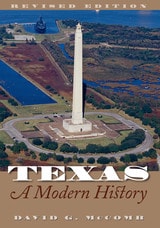
Texas, A Modern History
Revised EditionBy David G. McComb
University of Texas Press, 2010
Since its publication in 1989, Texas, A Modern History has established itself as one of the most readable and reliable general histories of Texas. David McComb paints the panorama of Lone Star history from the earliest Indians to the present day with a vigorous brush that uses fact, anecdote, and humor to present a concise narrative. The book is designed to offer an adult reader the savor of Texan culture, an exploration of the ethos of its people, and a sense of the rhythm of its development. Spanish settlement, the Battle of the Alamo, the Civil War, cattle trails, oil discovery, the growth of cities, changes in politics, the Great Depression, World War II, recreation, economic expansion, and recession are each a part of the picture. Photographs and fascinating sidebars punctuate the text.
In this revised edition, McComb not only incorporates recent scholarship but also tracks the post–World War II rise of the Republican Party in Texas and the evolution of the state from rural to urban, with 88 percent of the people now living in cities. At the same time, he demonstrates that, despite many changes that have made Texas similar to the rest of the United States, much of its unique past remains.
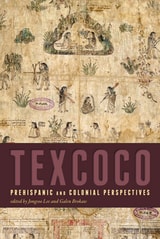
Texcoco
Prehispanic and Colonial PerspectivesJongsoo Lee
University Press of Colorado, 2014
Contributors address some of the most pressing issues in Texcocan studies and bring new ones to light: the role of Texcoco in the Aztec empire, the construction and transformation of Prehispanic history in the colonial period, the continuity and transformation of indigenous culture and politics after the conquest, and the nature and importance of iconographic and alphabetic texts that originated in this city-state, such as the Codex Xolotl, the Mapa Quinatzin, and Fernando de Alva Ixtlilxochitl’s chronicles. Multiple scholarly perspectives and methodological approaches offer alternative paradigms of research and open a needed dialogue among disciplines—social, political, literary, and art history, as well as the history of science.
This comprehensive overview of Prehispanic and colonial Texcoco will be of interest to Mesoamerican scholars in the social sciences and humanities.
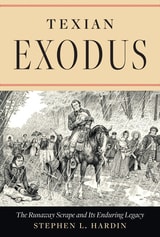
Texian Exodus
The Runaway Scrape and Its Enduring LegacyStephen L. Hardin
University of Texas Press, 2024
2026 Alamo Historical Society Book Award
A narrative account of the evacuation of the Texians in 1836, which was redeemed by the defeat of the Mexican army and the creation of the Republic of Texas.
Two events in Texas history shine so brightly that they can be almost blinding: the stand at the Alamo and the redemption at San Jacinto, where General Sam Houston’s volunteers won the decisive battle of the Texas Revolution. But these milestones came amid a less obviously heroic episode now studiously forgotten—the refugee crisis known as the Runaway Scrape.
Propulsive, lyrical, and richly illustrated, Texian Exodus transports us to the frigid, sodden spring of 1836, when thousands of Texians—Anglo-American settlers—fled eastward for the United States in fear of Antonio López de Santa Anna’s advancing Mexican army. Leading Texas historian Stephen L. Hardin draws on the accounts of the Runaways themselves to relate a tale of high stakes and great sorrow. While Houston tried to build a force that could defeat Santa Anna, the evacuees suffered incalculable pain and suffering. Yet dignity and community were not among the losses. If many of the stories are indeed tragic, the experience as a whole was no tragedy; survivors regarded the Runaway Scrape as their finest hour, an ordeal met with cooperation and courage. For Hardin, such qualities still define the Texas character. That it was forged in retreat as well as in battle makes the Runaway Scrape essential Texas history.

Texian Iliad
A Military History of the Texas Revolution, 1835-1836By Stephen L. Hardin
University of Texas Press, 1996
Winner, T. R. Fehrenbach Book Award, Texas Historical Commission
Summerfield G. Roberts Award, Sons of the Republic of Texas
Honorable Mention, Certificate of Commendation, American Association for State and Local History
Hardly were the last shots fired at the Alamo before the Texas Revolution entered the realm of myth and controversy. French visitor Frederic Gaillardet called it a "Texian Iliad" in 1839, while American Theodore Sedgwick pronounced the war and its resulting legends "almost burlesque."
In this highly readable history, Stephen L. Hardin discovers more than a little truth in both of those views. Drawing on many original Texan and Mexican sources and on-site inspections of almost every battlefield, he offers the first complete military history of the Revolution. From the war's opening in the "Come and Take It" incident at Gonzales to the capture of General Santa Anna at San Jacinto, Hardin clearly describes the strategy and tactics of each side. His research yields new knowledge of the actions of famous Texan and Mexican leaders, as well as fascinating descriptions of battle and camp life from the ordinary soldier's point of view.
This award-winning book belongs on the bookshelf of everyone interested in Texas or military history.

Text
The Genealogy of an Antidisciplinary ObjectJohn Mowitt
Duke University Press, 1992
Beginning with the Tel Quel group in France in the sixties and seventies, Mowitt's study details how a certain interdisciplinary crisis prompted academics to rethink the conditions of cultural interpretation. Concentrating on three disciplinary projects—literary analysis, film studies, and musicology—Mowitt shows how textuality's emergence called into question not merely the relations among these disciplines, but also the cultural logic of disciplinary reason as such.
At once an effort to define "the text" and to explore and extend the theory of textuality, this book illustrates why the notion of interdisciplinary research has recently acquired such urgency. At the same time, by emphasizing the genealogical dimension of the textual object, Mowitt raises the issues of its "antidisciplinary" character, and by extension its immediate pertinence for the current debates over multiculturalism and Eurocentrism.
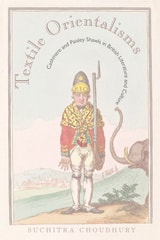
Textile Orientalisms
Cashmere and Paisley Shawls in British Literature and CultureSuchitra Choudhury
Ohio University Press, 2023
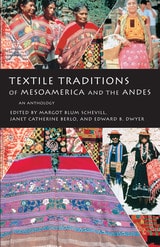
Textile Traditions of Mesoamerica and the Andes
An AnthologyEdited by Margot Blum Schevill, Janet Catherine Berlo, and Edward B. Dwyer
University of Texas Press, 1996
In this volume, anthropologists, art historians, fiber artists, and technologists come together to explore the meanings, uses, and fabrication of textiles in Mexico, Guatemala, Ecuador, Peru, and Bolivia from Precolumbian times to the present. Originally published in 1991 by Garland Publishing, the book grew out of a 1987 symposium held in conjunction with the exhibit "Costume as Communication: Ethnographic Costumes and Textiles from Middle America and the Central Andes of South America" at the Haffenreffer Museum of Anthropology, Brown University.
Texts Of Power
Emerging Disciplines in Colonial BengalPartha Chatterjee
University of Minnesota Press, 1995
The case of Bengal illustrates the interaction of colonialism and modernity.
Bengal was the first “modern” province in India-the first, that is, to undergo a forced encounter with Western modernity. Beginning with this premise, the writers in Texts of Power consider what the case of Bengal says about the workings of Western modernity in a colonial setting.
A truly interdisciplinary effort, this collection probes questions of pedagogy, nationalism, and gender. Among the subjects explored are colonialist and nationalist surveillance of Bengali literature; the disposition of the nation’s art; the politics of child-rearing; the mapping of Calcutta; and the disciplining of historical memory. By applying the theoretical insights of recent historical and cultural studies to the specific circumstances of Bengal, the authors develop a new approach to Indian intellectual and cultural history. Their work makes a significant contribution to our understanding of contemporary intellectual modernity.Contributors: Pradip Kumar Bose, Keya Dasgupta, Tapati Guha-Thakurta, all at the Centre for Studies in Social Sciences, Calcutta; Tapti Roy, Maharani Kashiswari College, Calcutta; Ranabir Samaddar, Maulana Azad Institute of Asian Studies.
Texts and Contexts from the History of Feminism and Women’s Rights
East Central Europe, Second Half of the Twentieth CenturyZsofia Lorand
Central European University Press, 2024
A compendium of one hundred sources, preceded by a short author’s bio and an introduction, this volume offers an English language selection of the most representative texts on feminism and women’s rights from East Central Europe between the end of the Second World War and the early 1990s. While communist era is the primary focus, the interwar years and the post-1989 transition period also receive attention. All texts are new translations from the original.
The book is organised around themes instead of countries; the similarities and differences between nations are nevertheless pointed out. The editors consider women not only in their local context, but also in conjunction with other systems of thought—including shared agendas with socialism, liberalism, nationalism, and even eugenics.
The choice of texts seeks to demonstrate how feminism as political thought was shaped and organised in the region. They vary in type and format from political treatises, philosophy to literary works, even films and the visual arts, with the necessary inclusion of the personal and the private. Women’s political rights, right to education, their role in nation-building, women, and war (and especially women and peace) are part of the anthology, alongside the gendered division of labour, violence against women, the body, and reproduction.
Texts from the Pyramid Age
Nigel C. Strudwick
SBL Press, 2005
Textual History and the Reception of Scripture in Early Christianity
Johannes de Vries
SBL Press, 2013
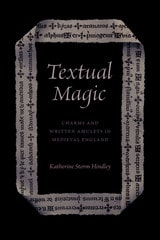
Textual Magic
Charms and Written Amulets in Medieval EnglandKatherine Storm Hindley
University of Chicago Press, 2023
Katherine Storm Hindley explores words at their most powerful: words that people expected would physically change the world. Medieval Europeans often resorted to the use of spoken or written charms to ensure health or fend off danger. Hindley draws on an unprecedented archive of more than a thousand such charms from medieval England—more than twice the number gathered, transcribed, and edited in previous studies and including many texts still unknown to specialists on this topic. Focusing on charms from 1100 to 1350 CE as well as previously unstudied texts in Latin, French, and English, Hindley addresses important questions of how people thought about language, belief, and power. She describes seven hundred years of dynamic, shifting cultural landscapes, where multiple languages, alphabets, and modes of transmission gained and lost their protective and healing power. Where previous scholarship has bemoaned a lack of continuity in the English charms, Hindley finds surprising links between languages and eras, all without losing sight of the extraordinary variety of the medieval charm tradition: a continuous, deeply rooted part of the English Middle Ages.
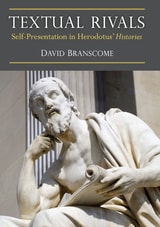
Textual Rivals
Self-Presentation in Herodotus’ HistoriesDavid Branscome
University of Michigan Press, 2013
Textual Rivals studies some of the most debated issues in Herodotean scholarship. One such is Herodotus’ self-presentation: the conspicuousness of his authorial persona is one of the most remarkable features of his Histories. So frequently does he interject first-person comments into the narrative that Herodotus at times almost becomes a character within his own text.
Important issues are tied to Herodotus’ self-presentation. First is the narrator’s relationship to truth: to what extent does he expect readers to trust his narrative? While judgments regarding Herodotus’ overall veracity have often been damning, scholars have begun to concentrate on how Herodotus presents his truthfulness. Second is the precise genre Herodotus means to create with his work. Excluding the anachronistic term historian, exactly what would Herodotus have called himself, as author? Third is the presence of “self-referential” characters, whose actions often mirror Herodotus’ as narrator/researcher, in the Histories.
David Branscome’s investigative text points to the rival inquirers in Herodotus’ Histories as a key to unraveling these interpretive problems. The rival inquirers are self-referential characters Herodotus uses to further his authorial self-presentation. Through the contrast Herodotus draws between his own exacting standards as an inquirer and the often questionable standards of those rivals, Herodotus underlines just how truthful readers should find his own work.
Textual Rivals speaks to those interested in Greek history and historiography, narratology, and ethnography. Those in the growing ranks of Herodotus fans will find much to invite and intrigue.
Textual Sources for the Study of Judaism
Edited and Translated by Philip S. Alexander
University of Chicago Press, 1990
"The texts . . . which are drawn from over two thousand years of history, are usefully divided, annotated and glossed. They enable students to explore the tradition in a new way [and] give a marvellous insight into the richness and liveliness of the Jewish religion and culture: we are given wit and pathos in addition to popular story and religious law."—Janet Trotter, Resource

Thabo Mbeki
Adekeye Adebajo
Ohio University Press, 2017
Thad Snow
A Life of Social Reform in the Missouri BootheelBonnie Stepenoff
University of Missouri Press, 2003
Thai Military Power
A Culture of Strategic AccommodationGregory Vincent Raymond
National University of Singapore Press, 2018
Thai South and Malay North
Ethnic Interactions on a Plural PeninsulaEdited by Michael J. Montesano and Patrick Jory
National University of Singapore Press, 2008
Thai South and Malay North brings together research by academic specialists working on this border zone who examine a broad range of issues relating to the turmoil afflicting the region. Drawing on a broad historical perspective, the authors explore religious observances and national identity, the relationship between electoral democracy and separatist violence, and interactions between northern Malaysia and southern Thailand.
Intellectually rigorous and theoretically sophisticated, Thai South and Malay North is the most comprehensive work to date on a part of Southeast Asia whose historical, linguistic, and political complexity has long defied scholarly synthesis—essential reading for anyone seeking to understand southern Thailand 's complex past and troubled present.
Thai Women in the Global Labor Force
Consuming Desires, Contested SelvesMills, Mary Beth
Rutgers University Press, 1999
Mills describes the environments from which these women left, as well as the urban landscape they now call home. Hence, she examines key aspects of rural Thai community life, such as local consumption practices, gender roles, and the familial tensions that are often the catalyst to labor migration. Then she focuses on the city and the underlying tensions of urban employment as migrants pursue newly imagined identities as modern women, while still upholding economic and moral responsibilities to rural kin.