Results by title
1917 books match the query 'Law' and 526 start with t
The Law of God
The Philosophical History of an IdeaRémi Brague
University of Chicago Press, 2007
The Law of Inheritance
Yasser Abdellatif
Seagull Books, 2018
The symphonic four-part text presents us with narratives of Egyptian identity, a constant knitting and unravelling that moves us back and forth through time, as the reader slides and leaps across the shifting tectonic plates of Abdellatif’s vignettes, his immaculately limpid prose poetry bringing forth the same questions. Nobody quite belongs in Cairo, it seems, but at the same time none of them belongs anywhere else: a relative emigrates from his Nubian village to the Cairo of the 1930s, where Italian fascists chase him through the streets and into a Maltese exile, only for him to return and make his way back South to the homeland he left. Another relative falls into religious esotericism and later madness, spinning away from Cairo and back to the wasteland of a village relocated after it had been flooded by the Aswan Dam. Meanwhile, in the 1990s, students fight security forces and binge on pills amid the dysfunctional remnants of a centralized state whose gravitational pull uprooted their parents and offered the possibility of assimilation into a national identity.
Through the clear sky of Abdellatif’s novel his characters, the spaces they call home, their way-stations, and even the nation that contains them all are a murmuration of starlings, held together and apart forever.
The Law of Love
From Autonomy to CommunionStephen F. Brett, SSJ
University of Scranton Press, 2010
With an interdisciplinary combination of philosophy, theology, and family law, The Law of Love explores the impact of secular conceptions of autonomy on sexuality and family. Drawing from the thought of Aristotle, Cicero, Augustine, Aquinas, and the modern theologian Servais Pinckaers, Stephen F. Brett argues that the divorce of freedom from virtue has caused cultural relativism, and that a potent and healthy mix of temperance, chastity, and modesty is the antidote. Styled accessibly and quite cleverly with a broader audience in mind, The Law of Love will appeal to intellectuals of all faiths who are interested in facing the ambiguities and problems of contemporary life in a secularized society.
The Law of Miracles
And Other StoriesGregory Blake Smith
University of Massachusetts Press, 2011
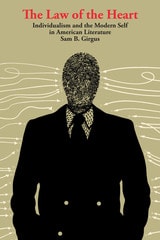
The Law of the Heart
Individualism and the Modern Self in American LiteratureBy Sam B. Girgus
University of Texas Press, 1979
The Law of the Heart is a vigorous challenge to the prevailing concept of the “antidemocratic” image of the self in the American literary and cultural tradition. Sam B. Girgus counters this interpretation and attempts to develop a new understanding of democratic individualism and liberal humanism in American literature under the rubric of literary modernism.
The image of the individual self who retreats inward, conforming to a distorted “law of the heart,” emerges from the works of such writers as Cooper and Poe and composer Charles Ives. Yet, as Girgus shows, other American writers relate the idea of the self to reality and culture in a more complex way: the self confronts and is reconciled to the paradox of history and reality.
In Girgus’ view, the tradition of pragmatic, humanistic individualism provides a foundation for a future where individual liberty is a major priority. He uses literary modernism as a bridge for relating contemporary social conditions to crises of the American self and culture as seen in the works of writers including Emerson, Howells, Whitman, Henry James, William James, Fitzgerald, Bellow, and McLuhan.
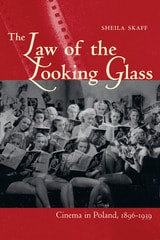
The Law of the Looking Glass
Cinema in Poland, 1896–1939Sheila Skaff
Ohio University Press, 2008
The Law of the Looking Glass: Cinema in Poland, 1896–1939 reveals the complex relationship between nationhood, national language, and national cinema in Europe before World War II. Author Sheila Skaff describes how the major issues facing the region before World War I, from the relatively slow pace of modernization to the desire for national sovereignty, shaped local practices in film production, exhibition, and criticism. She goes on to analyze local film production, practices of spectatorship in large cities and small towns, clashes over language choice in intertitles, and controversy surrounding the first synchronized sound experiments before World War I. Skaff depicts the creation of a national film industry in the newly independent country, the golden years of the silent cinema, the transition from silent to sound film—and debates in the press over this transition—as well as the first Polish and Yiddish “talkies.” She places particular importance on conflicts in majority-minority relations in the region and the types of collaboration that led to important films such as The Dybbuk and The Ghosts.
The Law of the Looking Glass: Cinema in Poland, 1896–1939 is the first comprehensive history of the country’s film industry before World War II. This history is characterized by alternating periods of multilingual, multiethnic production, on the one hand, and rejection of such inclusiveness, on the other. Through it all, however, runs a single unifying thread: an appreciation for visual imagery.
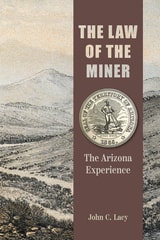
The Law of the Miner
The Arizona ExperienceJohn C. Lacy
University of Nevada Press, 2026
The first adventurers into the New World faced a fundamental legal challenge: how to secure rights to any mineral claims they discovered. Early conquistadors worked under charters that required them to return a portion of their findings to the Spanish crown, but those without such charters had no formal protection—and the crown was slow to clarify individual rights. This uncertainty only grew as miners pushed into the lands that would become the Western United States.
When gold was discovered in California, miners suddenly found themselves operating without any governing laws during the period between the end of the war with Mexico and the establishment of formal U.S. jurisdiction. In response, and without official sanction, they formed self-governing “mining districts,” best understood as mutual protection societies. These districts marked the first organized attempt to define boundaries and create rules for establishing and maintaining mining claims. As the early rushes in California and Nevada subsided, miners carried these practices with them into Arizona and other western territories.
In Arizona, no comprehensive collection of these early regulations has ever existed. The Law of the Mineraddresses this gap by tracing the development of mineral law in early Arizona and presenting the full text of every mining district regulation that could be found. This work serves both the mining industry and historians seeking to identify the individuals involved in creating the districts and to understand these districts’ historical boundaries.
The Law of the Other
The Mixed Jury and Changing Conceptions of Citizenship, Law, and KnowledgeMarianne Constable
University of Chicago Press, 1994
The "mixed jury" doctrine allowed resident foreigners to have law suits against English natives tried before juries composed half of natives and half of aliens like themselves. As she traces the transformations in this doctrine from the Middle Ages to its abolition in 1870, Constable also reveals the emergence of a world where law rooted in actual practices and customs of communities is replaced by law determined by officials, where juries no longer strive to speak the truth but to ascertain the facts.
The Law under the Swastika
Studies on Legal History in Nazi GermanyMichael Stolleis
University of Chicago Press, 1997
Stolleis studies a wide range of legal fields—constitutional, judicial, agrarian, administrative, civil, and business—arguing that all types of law were affected by the political realities of National Socialism. Moreover, he shows that legal traditions were not relinquished immediately with the onset of a new regime. For the first time we can see clearly the continuities between the Nazi period and the postwar period. The law under National Socialism did not make a complete break with the law during the Weimar Republic, nor did the law of the Federal Republic nullify all of the laws under National Socialism. Through a rich and subtle investigation, Stolleis shows how the legal profession and the political regime both reacted to the conditions of the period and molded the judicial system accordingly.
Breaking the conspiracy of silence held by the justices in the postwar period, Stolleis stresses the importance of researching Nazi law in order to confront ethical problems in today's legal profession.
The Laws of Slavery in Texas
Historical Documents and EssaysEdited by Randolph B. Campbell
University of Texas Press, 2010
The laws that governed the institution of slavery in early Texas were enacted over a fifty-year period in which Texas moved through incarnations as a Spanish colony, a Mexican state, an independent republic, a part of the United States, and a Confederate state. This unusual legal heritage sets Texas apart from the other slave-holding states and provides a unique opportunity to examine how slave laws were enacted and upheld as political and legal structures changed. The Laws of Slavery in Texas makes that examination possible by combining seminal historical essays with excerpts from key legal documents from the slave period and tying them together with interpretive commentary by the foremost scholar on the subject, Randolph B. Campbell.
Campbell's commentary focuses on an aspect of slave law that was particularly evident in the evolving legal system of early Texas: the dilemma that arose when human beings were treated as property. As Campbell points out, defining slaves as moveable property, or chattel, presented a serious difficulty to those who wrote and interpreted the law because, unlike any other form of property, slaves were sentient beings. They were held responsible for their crimes, and in numerous other ways statute and case law dealing with slavery recognized the humanness of the enslaved. Attempts to protect the property rights of slave owners led to increasingly restrictive laws—including laws concerning free blacks—that were difficult to uphold. The documents in this collection reveal both the roots of the dilemma and its inevitable outcome.
The Laws of the Roman People
Public Law in the Expansion and Decline of the Roman RepublicCallie Williamson
University of Michigan Press, 2015
The Lawyer Myth
A Defense of the American Legal ProfessionFrank T. Rennard and Read Stickland
Ohio University Press, 2008
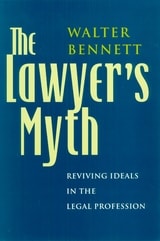
The Lawyer's Myth
Reviving Ideals in the Legal ProfessionWalter Bennett
University of Chicago Press, 2001
Bennett draws on his experience as a lawyer, judge, and law teacher, as well as upon oral histories of lawyers and judges, in his exploration of how and why the legal profession has lost its ennobling mythology. Effectively using examples from history, philosophy, psychology, mythology, and literature, Bennett shows that the loss of professionalism is more than merely the emergence of win-at-all-cost strategies and a scramble for personal wealth. It is something more profound—a loss of professional community and soul. Bennett identifies the old heroic myths of American lawyers and shows how they informed the values of professionalism through the middle of the last century. He shows why, in our more diverse society, those myths are inadequate guides for today's lawyers. And he also discusses the profession's agony over its trickster image and demonstrates how that archetype is not only a psychological reality, but a necessary component of a vibrant professional mythology for lawyers.
At the heart of Bennett's eloquently written book is a call to reinvigorate the legal professional community. To do this, lawyers must revive their creative capacities and develop a meaningful, professional mythology—one based on a deeper understanding of professionalism and a broader, more compassionate ideal of justice.
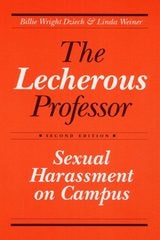
The Lecherous Professor
Sexual Harassment on CampusBillie Wright Dziech and Linda Weiner
University of Illinois Press, 1990
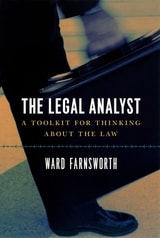
The Legal Analyst
A Toolkit for Thinking about the LawWard Farnsworth
University of Chicago Press, 2007
There are two kinds of knowledge law school teaches: legal rules on the one hand, and tools for thinking about legal problems on the other. Although the tools are far more interesting and useful than the rules, they tend to be neglected in favor of other aspects of the curriculum. In The Legal Analyst, Ward Farnsworth brings together in one place all of the most powerful of those tools for thinking about law.
From classic ideas in game theory such as the “Prisoner’s Dilemma” and the “Stag Hunt” to psychological principles such as hindsight bias and framing effects, from ideas in jurisprudence such as the slippery slope to more than two dozen other such principles, Farnsworth’s guide leads readers through the fascinating world of legal thought. Each chapter introduces a single tool and shows how it can be used to solve different types of problems. The explanations are written in clear, lively language and illustrated with a wide range of examples.
The Legal Analyst is an indispensable user’s manual for law students, experienced practitioners seeking a one-stop guide to legal principles, or anyone else with an interest in the law.
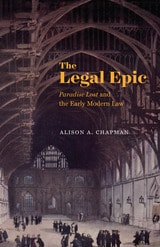
The Legal Epic
"Paradise Lost" and the Early Modern LawAlison A. Chapman
University of Chicago Press, 2017
Alison A. Chapman argues that Milton’s Paradise Lost sits at the apex of the early modern period’s long fascination with law and judicial processes. Milton’s world saw law and religion as linked disciplines and thought therefore that in different ways, both law and religion should reflect the will of God. Throughout Paradise Lost, Milton invites his readers to judge actions using not only reason and conscience but also core principles of early modern jurisprudence. Law thus informs Milton’s attempt to “justify the ways of God to men” and points readers toward the types of legal justice that should prevail on earth.
Adding to the growing interest in the cultural history of law, The Legal Epic shows that England’s preeminent epic poem is also a sustained reflection on the role law plays in human society.
The Legal Imagination
James Boyd White
University of Chicago Press, 1985
"A fascinating study of the language of the law. . . . This book is to be highly recommended: certainly, for those who find the time to read it, it will broaden the mind, and give lawyers a new insight into their role."—New Law Journal
The Legal System
A Social Science PerspectiveLawrence M. Friedman
Russell Sage Foundation, 1975

The Letters and the Law
Legal and Literary Culture in Late Imperial RussiaAnna Schur
Northwestern University Press, 2022
Anna Schur combines historical research and literary analysis to argue that the first generations of Russian trial lawyers shaped their professional identity with an eye to the celebrated figure of the writer and that they considered their own activities to be a form of verbal art. A fuller understanding of writers’ antipathy to the law, Schur contends, must take into account this overlooked cultural backdrop. Laced with the better‑known critique of the lawyer’s legalistic proclivities and lack of moral principle are the writer’s reactions to a whole network of explicit and implicit claims of similarity between the two professions’ goals, methods, and missions that were central to the lawyer’s professional ideal. Viewed in this light, writers’ critiques of the law and lawyers emerge as a concerted effort at protecting literature’s exclusive cultural status in the context of modernization and the rapidly expanding public sphere.
The study draws upon a mix of well-known and rarely studied nineteenth-century authors and texts—with particular attention paid to Fyodor Dostoevsky and Mikhail Saltykov-Shchedrin—and on a wide range of nonliterary sources, including courtroom speeches, guides to forensic oratory, legal treatises, and specialized press.
The Limits of Sovereignty
Property Confiscation in the Union and the Confederacy during the Civil WarDaniel W. Hamilton
University of Chicago Press, 2006
Americans take for granted that government does not have the right to permanently seize private property without just compensation. Yet for much of American history, such a view constituted the weaker side of an ongoing argument about government sovereignty and individual rights. What brought about this drastic shift in legal and political thought?
Daniel W. Hamilton locates that change in the crucible of the Civil War. In the early days of the war, Congress passed the First and Second Confiscation Acts, authorizing the Union to seize private property in the rebellious states of the Confederacy, and the Confederate Congress responded with the broader Sequestration Act. The competing acts fueled a fierce, sustained debate among legislators and lawyers about the principles underlying alternative ideas of private property and state power, a debate which by 1870 was increasingly dominated by today’s view of more limited government power.
Through its exploration of this little-studied consequence of the debates over confiscation during the Civil War, The Limits of Sovereignty will be essential to an understanding of the place of private property in American law and legal history.
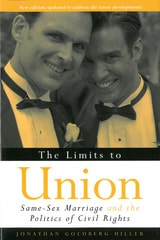
The Limits to Union
Same-Sex Marriage and the Politics of Civil RightsJonathan Goldberg-Hiller
University of Michigan Press, 2004
"The Limits to Union is a superb book about the complexities of recent political struggles over same-sex marriage. Goldberg-Hiller offers a sophisticated account of egalitarian rights advocacy and the reaction it has generated from established majorities animated by a 'new common sense' of exclusionary sovereign authority. The author's analysis is multidimensional and nuanced, but the core argument is bold, important, and well-supported. I recommend it very highly to everyone interested in understanding the character, possibilities, and constraints of civil rights amid our contemporary culture wars."
-Michael McCann, author of Rights at Work: Pay Equity Reform and the Politics of Legal Mobilization
"In this excellent book, Goldberg-Hiller uses Hawaii's experience to examine the interaction between courts and the political system. . . . Relying on briefs, legislative statements, and interviews with activists from both sides of the question, he views this familiar debate . . . through the unfamiliar prism of gay marriage, which allows him to gauge the viability and the pliability of the American civil rights ideal, and how gay and lesbian issues fit (or don't fit) within that ideal."
-Willian Heinzen, New York Law Journal
"Goldberg-Hiller presents the history of the same-sex marriage question since it first sparked debate in Hawaii. He follows the shifting debate through court cases, state propositions, and state and federal legislatures, considering questions about the constitutionality of the Defense of Marriage Act and the concept of equal protection under the law for gays and lesbians. This detailed treatment of the legal issues surrounding same-sex marriages is highly recommended."
-R. L. Abbott, University of Evansville
"[A] valuable contribution to the field, situating the gay marriage debate in broader contexts of theory, law and practice. [S]ame-sex marriage is an important issue...that finds itself caught in the friction points of much larger debates over the nature of rights, the limits of sovereignty and the proper role of courts and law in a democratic society. The Limits to Union should therefore be of interest even to those who do not think of themselves as interested in gay and lesbian rights issues."
-Evan Gerstmann, Loyola Marymount University, Law and Politics Book Review

The Limits to Union
Same-Sex Marriage and the Politics of Civil RightsJonathan Goldberg-Hiller
University of Michigan Press, 2002
"The Limits to Union is a superb book about the complexities of recent political struggles over same-sex marriage. Goldberg-Hiller offers a sophisticated account of egalitarian rights advocacy and the reaction it has generated from established majorities animated by a 'new common sense' of exclusionary sovereign authority. The author's analysis is multidimensional and nuanced, but the core argument is bold, important, and well-supported. I recommend it very highly to everyone interested in understanding the character, possibilities, and constraints of civil rights amid our contemporary culture wars."
-Michael McCann, author of Rights at Work: Pay Equity Reform and the Politics of Legal Mobilization
"In this excellent book, Goldberg-Hiller uses Hawaii's experience to examine the interaction between courts and the political system. . . . Relying on briefs, legislative statements, and interviews with activists from both sides of the question, he views this familiar debate . . . through the unfamiliar prism of gay marriage, which allows him to gauge the viability and the pliability of the American civil rights ideal, and how gay and lesbian issues fit (or don't fit) within that ideal."
-Willian Heinzen, New York Law Journal
"Goldberg-Hiller presents the history of the same-sex marriage question since it first sparked debate in Hawaii. He follows the shifting debate through court cases, state propositions, and state and federal legislatures, considering questions about the constitutionality of the Defense of Marriage Act and the concept of equal protection under the law for gays and lesbians. This detailed treatment of the legal issues surrounding same-sex marriages is highly recommended."
-R. L. Abbott, University of Evansville
"[A] valuable contribution to the field, situating the gay marriage debate in broader contexts of theory, law and practice. [S]ame-sex marriage is an important issue...that finds itself caught in the friction points of much larger debates over the nature of rights, the limits of sovereignty and the proper role of courts and law in a democratic society. The Limits to Union should therefore be of interest even to those who do not think of themselves as interested in gay and lesbian rights issues."
-Evan Gerstmann, Loyola Marymount University, Law and Politics Book Review
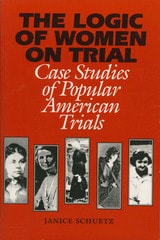
The Logic of Women on Trial
Case Studies of Popular American TrialsJanice Schuetz
Southern Illinois University Press, 1994
Janice Schuetz investigates the felony trials of nine American women from colonial Salem to the present: Rebecca Nurse, tried for witchcraft in 1692; Mary E. Surratt, tried in 1865 for assisting John Wilkes Booth in the assassination of Abraham Lincoln; Lizzie Andrew Borden, tried in 1892 for the ax murder of her father and stepmother; Margaret Sanger, tried in 1915, 1917, and 1929 for her actions in support of birth control; Ethel Rosenberg, tried in 1951 for aiding the disclosure of secrets of the atom bomb to the Soviets; Yvonne Wanrow, tried in 1974 for killing a man who molested her neighbor’s daughter; Patricia Campbell Hearst, tried in 1975 for bank robbery as a member of the Symbionese Liberation Army; Jean Harris, tried in 1982 for killing Herman Tarnower, the Diet Doctor; and Darci Kayleen Pierce, tried in 1988 for kidnapping and brutally murdering a pregnant woman, then removing the baby from the woman’s womb.
In her analysis, Schuetz is careful to define these trials as popular trials. Characteristically, popular trials involve persons, issues, or crimes of social interest that attract extensive public interest and involvement. Such trials make a contribution to the ongoing historical dialogue about the meaning of justice and the legal system, while reflecting the values of the time and place in which they occur.
Schuetz examines the kinds of communication that transpired and the importance of gender in the trials by applying a different current rhetorical theory to each trial text. In every chapter, she explains her chosen interpretive theory, compares that framework with the discourse of the trial, and makes judgments about the meaning of the trial texts based on the interpretive theory.
The Long Walk to Equality
Perspectives on Racial Inequality, Injustice and the LawAvis Whyte, Patricia Tuitt and Judith Bourne
University of Westminster Press, 2024
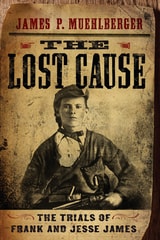
The Lost Cause
The Trials of Frank and Jesse JamesJames P. Muehlberger
Westholme Publishing, 2013
On a dreary December 7, 1869, two strangers entered the Daviess County Savings and Loan in Gallatin, Missouri. One of the men asked the cashier for change and then unexpectedly raised a revolver and shot him at point-blank range. Until now, this crime has been considered the first of a string of bank and train robberies committed by Jesse James, his brother Frank, and other gang members. But a story has circulated for more than a century that the case was actually brought to trial by a young Missouri lawyer—and it was through this case that twenty-two-year-old Jesse was first identified as a criminal to the country. But until recently no evidence for such an action could be found. After years of painstaking searches through dusty court archives across Missouri, defense attorney James P. Muehlberger finally discovered the historic documents in 2007. These fascinating and important records reveal that the gunmen were forced to leave behind a magnificent thoroughbred that linked James to the murder and, more intriguing, that the attack was not a bank robbery at all, but a calculated assassination in retribution for a Civil War killing.
The Lost Cause: The Trials of Frank and Jesse James is a thoroughly researched, thrilling account of the rise, pursuit, and prosecution of the legendary outlaw gang. Beginning with the newfound evidence of the Gallatin bank teller murder, the author explains how Jesse James attempted to avenge the death of his Confederate partisan leader, “Bloody Bill” Anderson, but shot the wrong man. Having lost his thoroughbred, Jesse stole another horse. Newly minted lawyer Henry McDougal brashly sued Jesse and Frank James for the loss of property, which would hang the murder on their heads. While Jesse professed his innocence and remained at large, his case was taken up by John Newman Edwards, editor of the Kansas City Times. Through Edwards’s pen, the James brothers were transformed from petty criminals to noble outlaws still fighting for Southern honor—the “Lost Cause.” Not fooled by Edwards’s rhetoric and populist appeal, McDougal and others, including Pinkerton detectives and the governor of Missouri, led a behind-the-scenes fight to bring down the gang. As the author explains, they first prosecuted lesser gang members, and by infiltrating the group, the authorities slowly unraveled the gang, with Jesse being shot by a paid informant in 1882. Frank James gave himself up, and in what was called the “trial of the century,” he was exonerated on all charges and retired to become a notable horse racing official until his death in 1915. Combining true crime, western adventure, and the transformation of America into a modern nation, The Lost Cause is engaging, entertaining history.

The Love Surgeon
A Story of Trust, Harm, and the Limits of Medical RegulationSarah B. Rodriguez
Rutgers University Press, 2020
It would be easy to dismiss Dr. Burt as a monstrous aberration, a modern-day Dr. Frankenstein. Yet as medical historian Sarah Rodriguez reveals, that’s not the whole story. The Love Surgeon asks tough questions about Burt’s heinous acts and what they reveal about the failures of the medical establishment: How was he able to perform an untested surgical procedure? Why wasn’t he obliged to get informed consent from his patients? And why did it take his peers so long to take action?
The Love Surgeon is both a medical horror story and a cautionary tale about the limits of professional self-regulation.

The Making of Environmental Law
Richard J. Lazarus
University of Chicago Press, 2004
In The Making of Environmental Law, Richard J. Lazarus offers a new interpretation of the past three decades of this area of the law, examining the legal, political, cultural, and scientific factors that have shaped—and sometimes hindered—the creation of pollution controls and natural resource management laws. He argues that in the future, environmental law must forge a more nuanced understanding of the uncertainties and trade-offs, as well as the better-organized political opposition that currently dominates the federal government. Lazarus is especially well equipped to tell this story, given his active involvement in many of the most significant moments in the history of environmental law as a litigator for the Justice Department's Environment and Natural Resources Division, an assistant to the Solicitor General, and a member of advisory boards of the U.S. Environmental Protection Agency, the World Wildlife Fund, and the Environmental Defense Fund.
Ranging widely in his analysis, Lazarus not only explains why modern environmental law emerged when it did and how it has evolved, but also points to the ambiguities in our current situation. As the field of environmental law "grays" with middle age, Lazarus's discussions of its history, the lessons learned from past legal reforms, and the challenges facing future lawmakers are both timely and invigorating.
The Making of Environmental Law
Richard J. Lazarus
University of Chicago Press, 2022
How did environmental law first emerge in the United States? Why has it evolved in the ways that it has? And what are the unique challenges inherent to environmental lawmaking in general and in the United States in particular?
Since its first edition, The Making of Environmental Law has been foundational to our understanding of these questions. For the second edition, Richard J. Lazarus returns to his landmark book and takes stock of developments over the last two decades. Drawing on many years of experience on the frontlines of legal and policy battles, Lazarus provides a theoretical overview of the challenges that environmental protection poses for lawmaking, related to both the distinctive features of US lawmaking institutions and the spatial and temporal dimensions of ecological change. The book explains why environmental law emerged in the manner and form that it did in the 1970s and traces how it developed over sequent decades through key laws and controversies. New chapters, composing more than half of the second edition, examine a host of recent developments. These include how Congress dropped out of environmental lawmaking in the early twenty-first century; the shifting role of the judiciary; long-overdue efforts to provide environmental justice to disadvantaged communities; and the destabilization of environmental law that has resulted from the election of Presidents with dramatically clashing environmental policies.
As the nation’s partisan divide has grown deeper and the challenge of climate change has dramatically raised the perceived stakes for opposing interests, environmental law is facing its greatest challenges yet. This book is essential reading for understanding where we have been and what challenges and opportunities lie ahead.
The Making of Lawyers' Careers
Inequality and Opportunity in the American Legal ProfessionRobert L. Nelson, Ronit Dinovitzer, Bryant G. Garth, Joyce S. Sterling, David B. Wilkins, Meghan Dawe, and Ethan Michelson
University of Chicago Press, 2023
An unprecedented account of social stratification within the US legal profession.
How do race, class, gender, and law school status condition the career trajectories of lawyers? And how do professionals then navigate these parameters?
The Making of Lawyers’ Careers provides an unprecedented account of the last two decades of the legal profession in the US, offering a data-backed look at the structure of the profession and the inequalities that early-career lawyers face across race, gender, and class distinctions. Starting in 2000, the authors collected over 10,000 survey responses from more than 5,000 lawyers, following these lawyers through the first twenty years of their careers. They also interviewed more than two hundred lawyers and drew insights from their individual stories, contextualizing data with theory and close attention to the features of a market-driven legal profession.
Their findings show that lawyers’ careers both reflect and reproduce inequalities within society writ large. They also reveal how individuals exercise agency despite these constraints.
The Making of Tocqueville's America
Law and Association in the Early United StatesKevin Butterfield
University of Chicago Press, 2015
Butterfield explains that the first generations of American citizens found in the concept of membership—in churches, fraternities, reform societies, labor unions, and private business corporations—a mechanism to balance the tension between collective action and personal autonomy, something they accomplished by emphasizing law and procedural fairness. As this post-Revolutionary procedural culture developed, so too did the legal substructure of American civil society. Tocqueville, then, was wrong to see associations as the training ground for democracy, where people learned to honor one another’s voices and perspectives. Rather, they were the training ground for something no less valuable to the success of the American democratic experiment: increasingly formal and legalistic relations among people.
The Marriage Exchange
Property, Social Place, and Gender in Cities of the Low Countries, 1300-1550Martha C. Howell
University of Chicago Press, 1998
Based on extensive research in this archive, this book reveals how these documents were produced in a centuries-long effort to regulate—and ultimately to redefine—property and gender relations. At the center of the transformation was a shift from a marital property regime based on custom to one based on contract. In the former, a widow typically inherited her husband's property; in the latter, she shared it with or simply held it for his family or offspring. Howell asks why the law changed as it did and assesses the law's effects on both social and gender meanings but she insists that the reform did not originate in general dissatisfaction with custom or a desire to disempower widows. Instead, it was born in a complex economic, social and cultural history during which Douaisiens gradually came to think about both property and gender in new ways.

The Maze of Urban Housing Markets
Theory, Evidence, and PolicyJerome Rothenberg, George C. Galster, Richard V. Butler, and John R. Pitkin
University of Chicago Press, 1991
The authors propose a new understanding of the market structure characterized by a closely interrelated array of quality submarkets. Their comprehensive models ground a unified theory that accounts for demand by both renters and owner occupants, supply by owners of existing dwellings, changes in the stock of housing due to conversions and new construction, and interactions across submarkets.

The Medical Malpractice Myth
Tom Baker
University of Chicago Press, 2005
This, according to Tom Baker, is the myth of medical malpractice, and as a reality check he offers The Medical Malpractice Myth, a stunning dismantling of this familiar, but inaccurate, picture of the health care industry. Are there too many medical malpractice suits? No, according to Baker; there is actually a great deal more medical malpractice, with only a fraction of the cases ever seeing the inside of a courtroom. Is too much litigation to blame for the malpractice insurance crisis? No, for that we can look to financial trends and competitive behavior in the insurance industry. Are these lawsuits frivolous? Very rarely. Point by point, Baker—a leading authority on insurance and law—pulls together the research that demolishes the myths that have taken hold about medical malpractice and suggests a series of legal reforms that would help doctors manage malpractice insurance while also improving patient safety and medical accountability.
President Bush has made medical malpractice reform a priority in his last term in office, but if history is any indication, legislative reform would only worsen the situation and perpetuate the gross misunderstanding of it. The debate surely will be transformed by The Medical Malpractice Myth, a book aimed squarely at general readers but with radical conclusions that speak to the highest level of domestic policymaking.
The Medieval Origins of the Legal Profession
Canonists, Civilians, and CourtsJames A. Brundage
University of Chicago Press, 2008
By the end of the eleventh century, Brundage argues, renewed interest in Roman law combined with the rise of canon law of the Western church to trigger a series of consolidations in the profession. New legal procedures emerged, and formal training for proctors and advocates became necessary in order to practice law in the reorganized church courts. Brundage demonstrates that many features that characterize legal advocacy today were already in place by 1250, as lawyers trained in Roman and canon law became professionals in every sense of the term. A sweeping examination of the centuries-long power struggle between local courts and the Christian church, secular rule and religious edict, The Medieval Origins of the Legal Profession will be a resource for the professional and the student alike.

The Michigan Guidelines on the International Protection of Refugees
James C. Hathaway
Michigan Publishing Services, 2019
The Guidelines address five of the most difficult issues of refugee status: what is the meaning of a “well-founded fear”; when may refugee status be denied on grounds of an “internal protection alternative”; how is the causal connection to a Convention ground to be assessed; when is a risk fairly said to be for reasons of “political opinion”; and under what circumstances are persons believed to have violated rules of international criminal law to be excluded from refugee status? Additionally, this volume also addresses three critical aspects of refugee rights – when may a refugee be required to seek protection in a country not of his or her choosing; to what extent is a refugee entitled to undertake employment or other economic activity; and what is the scope of a refugee’s right to freedom of movement, both between states and within the asylum country?
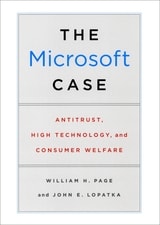
The Microsoft Case
Antitrust, High Technology, and Consumer WelfareWilliam H. Page and John E. Lopatka
University of Chicago Press, 2007
In 1998, the United States Department of Justice and state antitrust agencies charged that Microsoft was monopolizing the market for personal computer operating systems. More than ten years later, the case is still the defining antitrust litigation of our era. William H. Page and John E. Lopatka’s The Microsoft Case contributes to the debate over the future of antitrust policy by examining the implications of the litigation from the perspective of consumer welfare.
The authors trace the development of the case from its conceptual origins through the trial and the key decisions on both liability and remedies. They argue that, at critical points, the legal system failed consumers by overrating government’s ability to influence outcomes in a dynamic market. This ambitious book is essential reading for business, law, and economics scholars as well as anyone else interested in the ways that technology, economics, and antitrust law have interacted in the digital age.
“This book will become the gold standard for analysis of the monopolization cases against Microsoft. . . . No serious student of law or economic policy should go without reading it.”—Thomas C. Arthur, Emory University
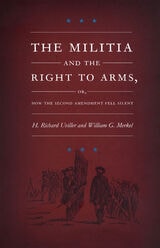
The Militia and the Right to Arms, or, How the Second Amendment Fell Silent
H. Richard Uviller and William G. Merkel
Duke University Press, 2002
—Amendment II, United States Constitution
The Second Amendment is regularly invoked by opponents of gun control, but H. Richard Uviller and William G. Merkel argue the amendment has nothing to contribute to debates over private access to firearms. In The Militia and the Right to Arms, or, How the Second Amendment Fell Silent, Uviller and Merkel show how postratification history has sapped the Second Amendment of its meaning. Starting with a detailed examination of the political principles of the founders, the authors build the case that the amendment's second clause (declaring the right to bear arms) depends entirely on the premise set out in the amendment's first clause (stating that a well-regulated militia is necessary to the security of a free state). The authors demonstrate that the militia envisioned by the framers of the Bill of Rights in 1789 has long since disappeared from the American scene, leaving no lineal descendants. The constitutional right to bear arms, Uviller and Merkel conclude, has evaporated along with the universal militia of the eighteenth century.
Using records from the founding era, Uviller and Merkel explain that the Second Amendment was motivated by a deep fear of standing armies. To guard against the debilitating effects of militarism, and against the ultimate danger of a would-be Caesar at the head of a great professional army, the founders sought to guarantee the existence of well-trained, self-armed, locally commanded citizen militia, in which service was compulsory. By its very existence, this militia would obviate the need for a large and dangerous regular army. But as Uviller and Merkel describe the gradual rise of the United States Army and the National Guard over the last two hundred years, they highlight the nation's abandonment of the militia ideal so dear to the framers. The authors discuss issues of constitutional interpretation in light of radically changed social circumstances and contrast their position with the arguments of a diverse group of constitutional scholars including Sanford Levinson, Carl Bogus, William Van Alstyne, and Akhil Reed Amar.
Espousing a centrist position in the polarized arena of Second Amendment interpretation, this book will appeal to those wanting to know more about the amendment's relevance to the issue of gun control, as well as to those interested in the constitutional and political context of America's military history.
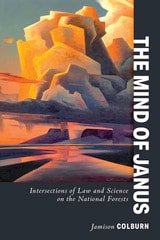
The Mind of Janus
Intersections of Law and Science on the National ForestsJamison E. Colburn
University of Utah Press, 2026
Trees are the embodiment of existence: abundant, regenerative, irrepressible. Yet as more of the planet undergoes profound and accelerating climate change, deforestation, loss of biotic diversity, and a pitiless spread of pests and pathogens, which trees—if any—will thrive are increasingly urgent questions. Managing healthy forests remains factually uncertain, an uneasy dance between law and science.
How can law facilitate or even accelerate the application of forest ecology on landscapes like our national forests? This book is a thorough exploration of that question from more than a century of intersections of law and science on the national forests. With a focus on law—as distinct from mere policy—as an agent in human relations and as a catalyst of scientific research, it makes the case that we can and must do better to solve intractable land management problems.
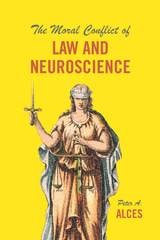
The Moral Conflict of Law and Neuroscience
Peter A. Alces
University of Chicago Press, 2018
Peter A. Alces considers where and how the law currently fails to appreciate the neuroscientific revelation that humans may in key ways lack normative free will—and therefore moral responsibility. The most accessible setting in which to consider the potential impact of neuroscience is criminal law, as certain aspects of criminal law already reveal the naiveté of most normative reasoning, such as the inconsistent treatment of people with equally disadvantageous cognitive deficits, whether congenital or acquired. But tort and contract law also assume a flawed conception of human agency and responsibility. Alces reveals the internal contradictions of extant legal doctrine and concludes by considering what would be involved in constructing novel legal regimes based on emerging neuroscientific insights.
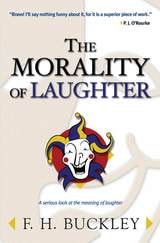
The Morality of Laughter
F. H. Buckley
University of Michigan Press, 2005
superior piece of work.”
—P. J. O’Rourke
“F. H. Buckley’s The Morality of Laughter is at once
a humorous look at serious matters and a serious
book about humor.”
—Crisis Magazine
“Buckley has written a . ne and funny book that will
be read with pleasure and instruction.”
—First Things
“. . . written elegantly and often wittily. . . .”
—National Post
“. . . a fascinating philosophical exposition of
laughter. . . .”
—National Review
“. . . at once a wise and highly amusing book.”
—Wall Street Journal Online
“. . . a useful reminder that a cheery society is a
healthy one.”
—Weekly Standard
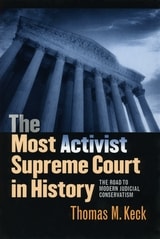
The Most Activist Supreme Court in History
The Road to Modern Judicial ConservatismThomas M. Keck
University of Chicago Press, 2004
Ranging from 1937 to the present, The Most Activist Supreme Court in History traces the legal and political forces that have shaped the modern Court. Thomas M. Keck argues that the tensions within modern conservatism have produced a court that exercises its own power quite actively, on behalf of both liberal and conservative ends. Despite the long-standing conservative commitment to restraint, the justices of the Rehnquist Court have stepped in to settle divisive political conflicts over abortion, affirmative action, gay rights, presidential elections, and much more. Keck focuses in particular on the role of Justices O'Connor and Kennedy, whose deciding votes have shaped this uncharacteristically activist Court.
The Moulding of Ukraine
The Constitutional Politics of State FormationKataryna Wolczuk
Central European University Press, 2002
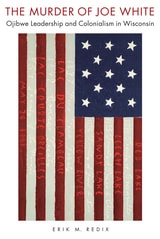
The Murder of Joe White
Ojibwe Leadership and Colonialism in WisconsinErik M. Redix
Michigan State University Press, 2014
The Mysterious Science of the Law
An Essay on Blackstone's CommentariesDaniel J. Boorstin
University of Chicago Press, 1996
The Myth of the Litigious Society
Why We Don't SueDavid M. Engel
University of Chicago Press, 2016
With this book, David M. Engel demolishes the myth that America is a litigious society. The sobering reality is that the vast majority of injury victims—more than nine out of ten—rely on their own resources, family and friends, and government programs to cover their losses. When real people experience serious injuries, they don’t respond as rational actors. Trauma and pain disrupt their thoughts, and potential claims are discouraged by negative stereotypes that pervade American television and popular culture. (Think Saul Goodman in Breaking Bad, who keeps a box of neck braces in his office to help clients exaggerate their injuries.) Cultural norms make preventable injuries appear inevitable—or the victim’s fault. We’re taught to accept setbacks stoically and not blame someone else. But this tendency to “lump it” doesn’t just hurt the victims; it hurts us all. As politicians continue to push reforms that miss the real problem, we risk losing these claims as a way to quickly identify unsafe products and practices. Because injuries disproportionately fall on people with fewer resources, the existing framework creates a social underclass whose needs must be met by government programs all citizens shoulder while shielding those who cause the harm.
It’s time for America to have a more responsible, blame-free discussion about injuries and the law. With The Myth of the Litigious Society, Engel takes readers clearly and powerfully through what we really know about injury victims and concludes with recommendations for how we might improve the situation.
The Natural Law
A Beginner's Thomistic GuideSteven J. Jensen
Catholic University of America Press, 2025
The Nature of Legal Interpretation
What Jurists Can Learn about Legal Interpretation from Linguistics and PhilosophyEdited by Brian G. Slocum
University of Chicago Press, 2017
To fully engage and probe these questions of interpretation, this volume draws upon a variety of experts from several fields, who collectively examine the interpretation of legal texts. In The Nature of Legal Interpretation, the contributors argue that the meaning of language is crucial to the interpretation of legal texts, such as statutes, constitutions, and contracts. Accordingly, expert analysis of language from linguists, philosophers, and legal scholars should influence how courts interpret legal texts. Offering insightful new interdisciplinary perspectives on originalism and legal interpretation, these essays put forth a significant and provocative discussion of how best to characterize the nature of language in legal texts.
The Network Inside Out
Annelise Riles
University of Michigan Press, 2001
The immediate subject of Riles's ethnographic work was a group of Fijian bureaucrats and activists preparing for and participating in the United Nations Fourth World Conference on Women. Participants in this meeting and the activities surrounding it understood themselves to be "focal points" in national, regional, and global "networks."
Starting from the premise that anthropologists are "inside" the Network, that is, that they are producers, consumers, and aesthetes, not simply observers, of the artifacts of late modern institutional life, Riles enacts a new ethnographic method for turning the network "inside out." The resulting experiment in the theory and ethnography of transnational institutional practices makes an important contribution to the anthropology of knowledge.
With its focus on developing a method for studying transnational phenomena, The Network Inside Out will appeal not only to anthropologists, but also to legal scholars and political scientists.
Annelise Riles is Assistant Professor, Northwestern University School of Law, Research Fellow, American Bar Foundation.

The Neurotransmitter Revolution
Serotonin, Social Behavior, and the LawRoger D. Masters
Southern Illinois University Press, 1993
Extraordinary advances in neurochemistry are both transforming our understanding of human nature and creating an urgent problem. Much is now known about the ways that neurotransmitters influence normal social behavior, mental illness, and deviance. What are these discoveries about the workings of the human brain? How can they best be integrated into our legal system?
These explosive issues are best understood by focusing on a single neurotransmitter like serotonin, which is associated with such diverse behaviors as dominance and leadership, seasonal depression, suicide, alcoholism, impulsive homicide, and arson. This book brings together revised papers from a conference on this theme organized by the Gruter Institute for Law and Behavioral Research, supplemented with articles by leading scholars who did not attend. Contributors include psychiatrists, neurologists, social scientists, and legal scholars.
The Neurotransmitter Revolution presents a unique survey of the scientific and legal implications of research on the way serotonin combines with other factors to shape human behavior. The findings are quite different from what might have been expected even a decade ago.
The neurochemistry of behavior is not the same thing as genetic determinism. On the contrary, the activity of serotonin varies from one individual to another for many reasons, including the individual’s life experience, social status, personality, and diet. And there are a number of major neurotransmitter systems, each of which interacts with the other. Behavior, culture, and the social environment can influence neurochemistry along with inheritance. Nature and nurture interact—and these interactions can be understood from a vigorously scientific point of view.
The fact that our actions are heavily influenced by neurotransmitters like serotonin is bound to be disquieting. A sophisticated understanding of law and human social behavior will be needed if our society is to respond adequately to these rapid advances in our knowledge. This book is an essential step in that direction, providing the first comprehensive survey of the biochemical, social, and legal considerations arising from research on the behavioral effects of serotonin and related neurotransmitters.
The New Politics of Pornography
Donald Alexander Downs
University of Chicago Press, 1989