Results by title
22279 books match the query 'Social Science' and 4007 start with t
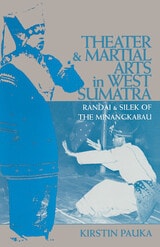
Theater and Martial Arts in West Sumatra
Randai and Silek of the MinangkabauKirstin Pauka
Ohio University Press, 1998
Randai, the popular folk theater tradition of the Minangkabau ethnic group in West Sumatra, has evolved to include influences of martial arts, storytelling, and folk songs. Theater and Martial Arts in West Sumatra describes the origin, development, and cultural background of randai and highlights two recent developments: the emergence of female performers and modern staging techniques.
This book also explores the indigenous martial arts form silek, a vital part of randai today. The strong presence of silek is illustrated in the martial focus of the stories that are told through randai, in its movement repertoire, and even in its costumes and musical accompaniment. As Kirstin Pauka shows, randai, firmly rooted in silek and Minangkabau tradition, is an intriguing mirror of the Minangkabau culture.

Theater in Israel
Linda Ben-Zvi, Editor
University of Michigan Press, 1996
The first volume of its kind in English or Hebrew, Theater in Israel gathers original essays, interviews, and commentaries by leading international theater practitioners and critics. The book explores the rich history and diversity of Israel's theater and illustrates the ways in which this politically committed theater mirrors the historical and cultural forces that have shaped Israeli-Arab relations, the events in the Middle East, and the post-Holocaust Jewish experience. The collection provides a thorough and engaging survey of the playwrights, directors, actors, and productions that comprise this dynamic theater, a theater whose evolution and ideology diverge from Anglo-American models.
The book's early essays trace the development of Hebrew drama from its inception in Moscow in 1918 to the establishment of a national theater and the emergence of a national repertoire. Succeeding essays explore the personalities and themes that have dominated the Israeli stage, featuring interviews with leading Israeli playwrights, actors, directors, and dramaturgs. The book also provides highlights from the first Palestinian and Israeli Arab Theater Symposium, focusing on the history, themes, and future of Arab theater. The contributors include Karen Alkalay-Gut, Shosh Avigal, Linda Ben-Zvi, Erella Brown, Joseph Chaikin, Scott Cummings, Ben-Ami Feingold, Gad Kaynar, Shimon Lev- Ari, Shimon Levy, Gabriella Moscati-Steindler, Freddie Rokem, Eli Rozik, Gershon Shaked, Chaim Shoham, Michael Taub, Dan Urian, Shoshana Weitz, and Nurit Yaari.

Theaters of Occupation
Hollywood and the Reeducation of Postwar GermanyJennifer Fay
University of Minnesota Press, 2008
In the aftermath of total war and unconditional surrender, Germans found themselves receiving instruction from their American occupiers. It was not a conventional education. In their effort to transform German national identity and convert a Nazi past into a democratic future, the Americans deployed what they perceived as the most powerful and convincing weapon-movies.
In a rigorous analysis of the American occupation of postwar Germany and the military’s use of “soft power,” Jennifer Fay considers how Hollywood films, including Ninotchka, Gaslight, and Stagecoach, influenced German culture and cinema. In this cinematic pedagogy, dark fantasies of American democracy and its history were unwittingly played out on-screen. Theaters of Occupation reveals how Germans responded to these education efforts and offers new insights about American exceptionalism and virtual democracy at the dawn of the cold war.
Fay’s innovative approach examines the culture of occupation not only as a phase in U.S.–German relations but as a distinct space with its own discrete cultural practices. As the American occupation of Germany has become a paradigm for more recent military operations, Fay argues that we must question its efficacy as a mechanism of cultural and political change.
Jennifer Fay is associate professor and codirector of film studies in the Department of English at Michigan State University.
Theatre Fandom
Engaged Audiences in the Twenty-first CenturyKirsty Sedgman
University of Iowa Press, 2025
Contributors: Tom Cantrell, Francesca Coppa, Ruth Foulis, Helen Freshwater, Emily Garside, Caroline Heim, Matt Hills, Natalie Ibu, Laura MacDonald, Dominique Morisseau, Rachael Nicholas, Louie Lang Norman, Owen G. Parry, Stephanie E. Pitts, Sarah M. Price, Beth Emily Richards, Kirsty Sedgman, Megan Vaughan, Ben Walmsley, Sarah K. Whitfield
Theatre History Studies 2009, Vol. 29
Edited by Rhona Justice-Malloy, with contributions from Christin Essin, Carolyn D. Roark, Meredith Lowe, Valleri J. Hohman, Fonzie D. Geary II, Robert B. Shimko, Robert B. Theatre History Studies, Elizabeth Osborne, Paul Cornwell, Harry J. Elam Jr., etc.
University of Alabama Press, 2009
Reimagining the archive, one performance at a time.
Theatre History Studies is a peer-reviewed journal dedicated to excellence in theatre historiography. Volume 29, edited by Rhona Justice-Malloy, includes essays that span a wide range of historical periods, geographic regions, and thematic concerns. Highlights include explorations of pain and torment in performance, the aesthetics of American modernity through Belasco and Jones, and the cultural politics of prohibition on stage. The volume also features visual and archival studies, including an interview with playwright Wendy Wasserstein and analyses of Shakespeare’s reception in Restoration theatre. With contributions from over thirty scholars, this edition offers a rich and multifaceted view of how theatre reflects, resists, and reshapes historical narratives.
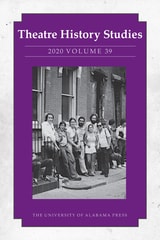
Theatre History Studies 2020, Vol. 39
Edited by Lisa Jackson-Schebetta
University of Alabama Press, 2020
Theatre History Studies (THS) is a peer-reviewed journal of theatre history and scholarship published annually since 1981 by the Mid-America Theatre Conference
Reframing the past to illuminate the future of performance.
Theatre History Studies is a peer-reviewed journal devoted to excellence in theatre historiography. Volume 38, edited by Lisa Jackson-Schebetta, features three distinct sections: foundational studies in theatre history, a special section on hemispheric historiographies, and award-winning essays from the Mid-America Theatre Conference. Contributors examine topics ranging from Shakespeare and racial antagonism to systemic dramaturgy, labor unions in regional theatre, and digital diasporic activism. The volume also includes visual histories and decolonial methodologies that challenge Eurocentric narratives and foreground Latinx, feminist, and socialist performance traditions. With 272 pages and 18 black-and-white figures, this edition is a rich resource for scholars seeking to expand the scope and methods of theatre history.
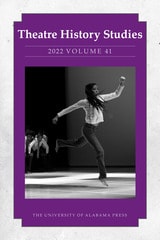
Theatre History Studies 2022, Vol 41
edited by Lisa Jackson-Schebetta
University of Alabama Press, 2023
New perspectives and rigorous scholarship shaping the histories of theatre and performance.
Theatre History Studies 2022, Vol. 41 presents a dynamic collection of peer‑reviewed essays that exemplify current directions in theatre and performance historiography. Edited by Lisa Jackson‑Schebetta, this volume brings together scholars whose work spans diverse periods, geographies, and performance traditions, demonstrating the field’s continued expansion in scope and methodology. As the official journal of the Mid‑America Theatre Conference, Theatre History Studies remains a vital venue for rigorous historical inquiry grounded in archival research, critical theory, and historiographic reflection.
Volume 41 engages pressing questions about how theatre histories are constructed, narrated, and mobilized in relation to social, political, and cultural contexts. Contributors explore performance as a site of embodied knowledge, identity formation, resistance, and memory, with essays that address race, gender, sexuality, labor, migration, and transnational exchange. The volume reflects a historiographic turn toward interdisciplinary approaches, drawing from dance studies, performance studies, critical race theory, and cultural history to reconsider established narratives and recover overlooked voices.
Together, the essays in this volume demonstrate the continued relevance of theatre history as both a scholarly practice and a critical framework for understanding performance’s role in shaping—and being shaped by—broader historical forces. Theatre History Studies 2022, Vol. 41 will be of particular value to scholars, educators, and graduate students in theatre and performance studies, as well as researchers in related fields who are interested in innovative historical methods and the evolving contours of performance scholarship.
CONTRIBUTORS
Angela K. Ahlgren / Samer Al-Saber / Kelly I. Aliano / Gordon Alley-Young / Melissa Blanco Borelli / Trevor Boffone / Jay Buchanan / Matthieu Chapman / Joanna Dee Das / Ryan J. Douglas / Victoria Fortuna / Christiana Molldrem Harkulich / Alani Hicks-Bartlett / Jeanmarie Higgins / Lisa Jackson-Schebetta / Erin Rachel Kaplan / Heather Kelley / Patrick Maley / Karin Maresh / Lisa Milner / Courtney Elkin Mohler / Heather S. Nathans / Heidi L. Nees / Sebastian Samur / Michael Schweikardt / Teresa Simone / Dennis Sloan / Guilia Taddeo / Kyle A. Thomas / Alex Vermillion / Bethany Wood
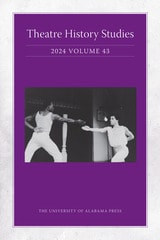
Theatre History Studies 2024, Vol 43
Edited by Jocelyn L. Buckner
University of Alabama Press, 2025
The official journal of the Mid-America Theatre Conference
Where past and performance converge—scholarship that moves the stage forward.
Theatre History Studies (THS) is a peer-reviewed journal of theatre history and scholarship published annually since 1981 by the Mid-America Theatre Conference (MATC), a regional body devoted to theatre scholarship and practice. The conference encompasses the states of Illinois, Iowa, Nebraska, Kansas, Missouri, Minnesota, North Dakota, South Dakota, Wisconsin, Indiana, Michigan, and Ohio. The purpose of the conference is to unite persons and organizations within the region with an interest in theatre and to promote the growth and development of all forms of theatre. THS is a member of the Council of Editors of Learned Journals and is included in the MLA Directory of Periodicals. THS is indexed in Humanities Index, Humanities Abstracts, Book Review Index, MLA International Bibliography, International Bibliography of Theatre, Arts & Humanities Citation Index, IBZ International Bibliography of Periodical Literature, and IBR International Bibliography of Book Reviews. Full texts of essays appear in the databases of both Humanities Abstracts Full Text as well as SIRS.
Along with books reviews on the latest publications from established and emerging voices in the field, this issue of Theatre History Studies contains four sections with two introductions, nine essays, and eleven book reviews total. In the general section, three essays offer an array of insights, methods, and provocations. In the special section titled “Manifestos for Black Theatre, Then and Now,” contributors capture their moment, their ways of working, and their experience as scholars, humans, and citizens in 2023. In part III, Ariel Nereson’s Robert A. Schanke Research Award-winning paper from the 2023 MATC conference examines collective dance histories through the Bill T. Jones/Arnie Zane Dance Company’s Continuous Replay. Taken together, volume 43 captures how this journal serves theatre historians as scholars and laborers as they work to attend and tend to their field.
CONTRIBUTORS
Daniel E. Atkinson / Ashlyn K. Barnett / David Bisaha / Jocelyn L. Buckner / Julie Burrell / Jordana Cox / Jordan Ealey / Eric M. Glover / Adam Goldstein / Chao Guo / Amy B. Huang / Ariel Nereson / Zachary F. Price / Danielle Rosvally / Letica L. Ridley / Bradford G. Sadler / Richard Sautter / Michael Schweikardt / Margo Skornia / Dennis Sloan / Josh Stenberg / Paul Michael Thomson / Scott Venters / Isaiah Matthew Wooden
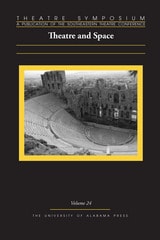
Theatre Symposium, Vol. 24
Theatre and SpaceEdited by Becky K. Becker
University of Alabama Press, 2016
Exploring the dynamic intersections of performance and place.
At a time when so many options exist for access to theatrical entertainments, it is no surprise that theatre practitioners and scholars are often preoccupied with the role of the audience. While space undoubtedly impacts the rehearsal and production processes, its greater significance seems to rest in the impact a specific location has on the audience.
This volume provides diverse viewpoints on theatre and space, as well as its relationship to the audience. Sebastian Trainor and Samuel T. Shanks offer contemporary perspectives on two ancient theatre spaces, while Lisa Marie Bowler describes the Globe Theatre, a replica of the original, as embodying a kind of absence despite its rich link to the past. Focusing on distinctly different periods and settings, both Andrew Gibb and Christine Woodworth describe a politics of space in which specific players gain prestige and power. Chase Bringardner identifies the audience as playing an important role in creating a space for parody in a historic Nashville venue, while Arnab Banerji describes an exhausting process for members of the Bengali group theatre who must continually move from space to space. Finally, Alicia Corts discusses virtual performance spaces and the degree to which participants are able to control their online identities within virtual performances. Bookending these eight essays are Marvin Carlson’s keynote presentation “Whose Space Is It Anyway?” and his closing remarks for the symposium, both of which allude to, and richly explicate, the ultimate arbiters of theatrical space: the audience.
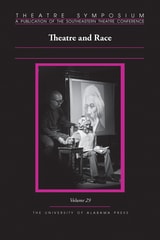
Theatre Symposium, Vol. 29
Theatre and RaceEdited by Andrew Gibb
University of Alabama Press, 2022
Essays whose composition and editing were undertaken almost entirely within the transformed cultural and professional landscape of 2020
A few weeks prior to the submission deadline for this volume of Theatre Symposium, the murder of George Floyd by officers of the Minneapolis Police Department sparked a movement for racial justice that reverberated at every level of US society. At predominantly and historically white academic institutions (including Theatre Symposium and its parent organization, the Southeastern Theatre Conference) leaders were compelled, as perhaps never before, to account for the role of systematic racism in the foundation and perpetuation of their organizations. While the present volume’s theme of “Theatre and Race” was announced in the waning days of 2019, the composition and editing of the issue’s essays were undertaken almost entirely within the transformed cultural and professional landscape of 2020. Throughout its twenty-nine years of publication, Theatre Symposium’s pages have included many excellent essays whose authors have deployed theories of race as an analytical framework, and (less often) treated BIPOC-centered art and artists as subject. The intent of the current editors in conceiving this issue was to center such subjects and theorizations, a goal that has since taken on a more widely recognized urgency.
Taken together, these twelve essays represent a wide range of scholarly responses to the theme of “theatre and race.” The fact that there is so much to say on the topic, from so many different perspectives, is a sign of how profoundly theatre practices have been—and continue to be—shaped by racial discourses and their material manifestations.
Theatres of Struggle and the End of Apartheid
Belinda Bozzoli
Ohio University Press, 2004
A compelling study of the origins and trajectory of one of the legendary black uprisings against apartheid, Theatres of Struggle and the End of Apartheid draws on insights gained from the literature on collective action and social movements. It delves into the Alexandra Rebellion of 1986 to reveal its inner workings.
Belinda Bozzoli’s aim is to examine how the residents of Alexandra, a poverty-stricken segregated township in Johannesburg, manipulated and overturned the meanings of space, time, and power in their sequestered world. She explains how they used political theater to convey, stage, and dramatize their struggle and how young and old residents generated differing ideologies and tactics, giving rise to a distinct form of generational politics.
Theatres of Struggle and the End of Apartheid asks the reader to enter into the world of the rebels and to confront the moral complexity and social duress they experienced as they invented new social forms and violently attacked old ones. It is an important study of collective action that will be of great interest to sociologists and to scholars of Africa, particularly to those interested in the antiapartheid struggle.
Theatres of the Body
Dance and Discourse in Antebellum PhiladelphiaLynn Matluck Brooks
Temple University Press, 2025
Reviewing print culture in the 1840s, Brooks shows how newspapers, magazines, and popular fiction provided documentation of dancing in Philadelphia as well as the responses of dance commentators, practitioners, and moralists. Theatres of the Body also considers the interplay of science with dance in the 1850s, which impacted both dance practices and reception.
Providing an expansive historiography of these significant contributions to dance in the United States, Brooks deepens our understanding of antebellum culture and history.
Theatricality of the Closet
Fashion, Performance, and Subjectivity between Victorian Britain and Meiji JapanMichelle Liu Carriger
Northwestern University Press, 2023
Clothing matters. This basic axiom is both common sense and, in another way, radical. It is from this starting point that Michelle Liu Carriger elucidates the interconnected ways in which gender, sexuality, class, and race are created by the everyday act of getting dressed. Theatricality of the Closet: Fashion, Performance, and Subjectivity between Victorian Britain and Meiji Japan examines fashion and clothing controversies of the nineteenth century, drawing on performance theory to reveal how the apparently superficial or frivolous deeply affects the creation of identity.
By interrogating a set of seemingly disparate examples from the same period but widely distant settings—Victorian Britain and Meiji-era Japan—Carriger disentangles how small, local, ordinary practices became enmeshed in a global fabric of cultural and material surfaces following the opening of trade between these nations in 1850. This richly illustrated book presents an array of media, from conservative newspapers and tabloids to ukiyo-e and early photography, that locate dress as a site where the individual and the social are interwoven, whether in the 1860s and 1870s or the twenty-first century.
Thedford II
A Paleo-Indian Site in the Ausable River Watershed of Southwestern OntarioD. Brian Deller and Christopher J. Ellis with a foreword by Henry T. Wright
University of Michigan Press, 1992
Theft Is Property!
Dispossession and Critical TheoryRobert Nichols
Duke University Press, 2020
Their Day In The Sun
Ruth Howes
Temple University Press, 1999
The Manhattan Project also included women in every capacity. During World War II the manpower shortages opened the laboratory doors to women and they embraced the opportunity to demonstrate that they, too, could do "creative science." Although women participated in all aspects of the Manhattan Project, their contributions are either omitted or only mentioned briefly in most histories of the project. It is this hidden story that is presented in Their Day in the Sun through interviews, written records, and photographs of the women who were physicists, chemists, mathematicians, biologists, and technicians in the labs.
Authors Ruth H. Howes and Caroline L. Herzenberg have uncovered accounts of the scientific problems the women helped solve as well as the opportunities and discrimination they faced. Their Day in the Sun describes their abrupt recruitment for the war effort and includes anecdotes about everyday life in these clandestine improvised communities. A chapter about what happened to the women after the war and about their attitudes now, so many years later, toward the work they did on the bomb is included.

Their Day In The Sun
Women Of The Manhattan ProjectRuth H. Howes
Temple University Press, 2003
Their Determination to Remain
A Cherokee Community's Resistance to the Trail of Tears in North CarolinaLance Greene
University of Alabama Press, 2023
The remarkable story of a North Carolina Cherokee community who avoided forced removal on the Trail of Tears
During the 1838 forced Cherokee removal by the US government, a number of close-knit Cherokee communities in the Southern Appalachian Mountains refused to relinquish their homelands, towns, and way of life. Using a variety of tactics, hundreds of Cherokees avoided the encroaching US Army and remained in the region.
In his book Their Determination to Remain: A Cherokee Community’s Resistance to the Trail of Tears in North Carolina, Lance Greene explores the lives of wealthy plantation owners Betty and John Welch who lived on the southwestern edge of the Cherokee Nation. John was Cherokee and Betty was White. Although few Cherokees in the region participated in slavery, the Welches held nine African Americans in bondage.
During removal, the Welches assisted roughly 100 Cherokees hiding in the steep mountains. Afterward, they provided land for these Cherokees to rebuild a new community, Welch’s Town. Betty became a wealthy and powerful plantation mistress because her husband could no longer own land. Members of Welch’s Town experienced a transitional period in which they had no formal tribal government or clear citizenship yet felt secure enough to reestablish a townhouse, stickball fields, and dance grounds.
Greene’s innovative study uses an interdisciplinary approach, incorporating historical narrative and archaeological data, to examine how and why the Welches and members of Welch’s Town avoided expulsion and reestablished their ways of life in the midst of a growing White population who resented a continued Cherokee presence. The Welch strategy included Betty’s leadership in demonstrating outwardly their participation in modern Western lifestyles, including enslavement, as John maintained a hidden space—within the boundaries of their land—for the continuation of traditional Cherokee cultural practices. Their Determination to Remain explores the complexities of race and gender in this region of the antebellum South and the real impacts of racism on the community.

Their Sisters' Keepers
Women's Prison Reform in America, 1830-1930Estelle B. Freedman
University of Michigan Press, 1984
Their System, Our Game
Homebrew and the Worlds of PathfinderScott DeJong and Marc Lajeunesse
University of Michigan Press, 2026
Our favorite tabletop role-playing games (TTRPGs) provide a chance to act out a fantasy. It might be the desire to wipe out foes with a single strike, the ability to charm even the most curmudgeonly townsfolk, or maybe even just the aspiration to adventure as a potted plant. Since game systems don’t always let players craft the kinds of games they want to experience, this is when they turn to the “homebrew” process to create personal rules and worlds. While Pathfinder has a history of being an underdog to the longtime industry leader Dungeons & Dragons, it has an ethos of open game design that inspires players, indie makers, and third-party content creators to brew up new rules, characters, classes, and game settings.
Their System, Our Game looks at the history of Pathfinder and how it encourages aspiring makers to break into the game design space. Through interviews with player-creators and third party makers, the authors use a range of perspectives to define homebrew for TTRPGs. Taking a closer look at homebrew design, they create two homebrew campaigns (available as free downloads) collaboratively with two different groups of players. Player accounts of gameplay and designer reflections of how their homebrew actually played out at the game table outline some of the challenges and perks of designing on the fly, creating customized settings, and bending or breaking rules. The book concludes by going through the research, interviews, design, and play analysis to show what homebrew and Pathfinder mean together. Ultimately Their System, Our Game is a celebration of how players use homebrew to explore creation and expression in their own TTRPGs.

Their Time Has Come
Youth with Disabilities on the Cusp of AdulthoodLeiter, Valerie
Rutgers University Press, 2012
In Their Time Has Come, Valerie Leiter argues that there are crucial missing links between federal disability policies and the lives of young people. Youth and their parents struggle to gather information about the resources that disability policies have created, and youth are not typically prepared to use their disability rights effectively. Her argument is based on thorough examination of federal disability policy and interviews with young people with disabilities, their parents, and rehabilitation professionals. Attention is given to the diversity of expectations, the resources available to them, and the impact of federal policy and public and private attitudes on their transition to adulthood.
Them Goon Rules
Fugitive Essays on Radical Black FeminismMarquis Bey
University of Arizona Press, 2019
A series of essays that reads like a critical memoir, this work queries the function and implications of politicized Blackness, Black feminism, and queerness. Bey binds together his personal experiences with social justice work at the New York–based Audre Lorde Project, growing up in Philly, and rigorous explorations of the iconoclasm of theorists of Black studies and Black feminism. Bey’s voice recalibrates itself playfully on a dime, creating a collection that tarries in both academic and nonacademic realms.
Fashioning fugitive Blackness and feminism around a line from Lil’ Wayne’s “A Millie,” Them Goon Rules is a work of “auto-theory” that insists on radical modes of thought and being as a refrain and a hook that is unapologetic, rigorously thoughtful, and uncompromising.

Them and Us
Questions of Citizenship in a Globalizing WorldRob Kroes
University of Illinois Press, 2000
An accomplished set of meditations by one of Europe's leading Americanists, Them and Us is a rich comparative study of European and American cultural traditions and their influence on conceptions of community. In contrast with the ethnic and nationalist allegiances that historically have splintered Europe, Rob Kroes identifies a complex of cultural practices that have mitigated against ethnically rooted divisions in the United States. He argues that the American approach–-articulated by a national rhetoric emphasizing openness rather than closure, diversity rather than uniformity--has much to offer a Europe where the nationalist and ethnic conflicts that spawned two world wars continue to sow terror and destruction.
Kroes discusses European and American attitudes toward the welfare state, the human rights tradition in the United States, and the role of regionalism in shaping conceptions of national identity. He also considers new, transnational forms of cultural membership that are emerging to take the place of nation-based citizenship. He contends that the frame of reference Europeans now use to make sense of their collective situation draws on ingredients provided by the worldwide dissemination of American mass culture. He investigates the way this emerging world culture, under American auspices, affects the way people in their local and national settings structure their sense of the past and conceive of their citizenship.
Imagining a new set of cultural relationships that could serve as the basis for global citizenship, Them and Us is an insightful consideration of the types of solidarity that might weave humankind together into a meaningful community.

Themes and Issues in Asian Cartooning
John A. Lent
University of Wisconsin Press, 1999
Themes and Issues in Asian Cartooning uses overviews and case studies by scholars to discuss Asian animation, humor magazines, gag cartoons, comic strips, and comic books. The first half of the book looks at contents and audiences of Malay humor magazines, cultural labor in Korean animation, the reception of Aladdin in Islamic Southeast Asia, and a Singaporean comic book as a reflection of that society’s personality. Four other chapters treat gender and Asian comics, concentrating on Japanese anime and manga and Indian comic books.
Themes in West Africa’s History
Emmanuel Kwaku Akyeampong
Ohio University Press, 2006
There has long been a need for a new textbook on West Africa’s history. In Themes in West Africa’s History, editor Emmanuel Kwaku Akyeampong and his contributors meet this need, examining key themes in West Africa’s prehistory to the present through the lenses of their different disciplines.
The contents of the book comprise an introduction and thirteen chapters divided into three parts. Each chapter provides an overview of existing literature on major topics, as well as a short list of recommended reading, and breaks new ground through the incorporation of original research. The first part of the book examines paths to a West African past, including perspectives from archaeology, ecology and culture, linguistics, and oral traditions. Part two probes environment, society, and agency and historical change through essays on the slave trade, social inequality, religious interaction, poverty, disease, and urbanization. Part three sheds light on contemporary West Africa in exploring how economic and political developments have shaped religious expression and identity in significant ways.
Themes in West Africa’s History represents a range of intellectual views and interpretations from leading scholars on West Africa’s history. It will appeal to college undergraduates, graduate students, and scholars in the way it draws on different disciplines and expertise to bring together key themes in West Africa’s history, from prehistory to the present.
Themes in the Economics of Aging
Edited by David A. Wise
University of Chicago Press, 2001
This volume begins by looking at the implications of private and public personal retirement plans, focusing in particular on the impact of 401(k) programs on retirement strategies in light of potential social security reform and factors such as annuitization and on asset accumulation. Next, the often-observed relationship between health and wealth is dissected from two different perspectives and correlated with striking increases in health-care spending over the past two decades, despite the improved health of older populations. The volume concludes with an investigation of the retirement effects of various social security provisions in both U.S. and German systems.
This carefully developed collection expands the current investigative focus and broadens the dialogue on a rapidly growing area of social and economic concern.
Themes of Indigenous Acculturation in Northwest Mexico
Edited by Thomas B. Hinton and Phil C. Weigand
University of Arizona Press, 1981
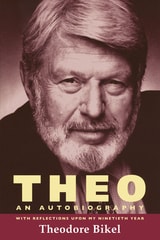
Theo
An AutobiographyTheodore Bikel
University of Wisconsin Press, 2014
In this edition celebrating Bikel’s ninetieth birthday, he looks back in a new chapter at his youth in prewar Vienna, his adolescent years, his continued joy in performing timeless songs, his return to Vienna in recent years, and the active life that keeps him feeling young even after nearly a century of adventure.

Theodor W. Adorno
An IntroductionGerhard Schweppenhäuser
Duke University Press, 2009
After providing a brief overview of Adorno’s life, Schweppenhäuser turns to the theorist’s core philosophical concepts, including post-Kantian critique, determinate negation, and the primacy of the object, as well as his view of the Enlightenment as a code for world domination, his diagnosis of modern mass culture as a program of social control, and his understanding of modernist aesthetics as a challenge to conceive an alternative politics. Along the way, Schweppenhäuser illuminates the works widely considered Adorno’s most important achievements: Minima Moralia, Dialectic of Enlightenment (co-authored with Horkheimer), and Negative Dialectics. Adorno wrote much of the first two of these during his years in California (1938–49), where he lived near Arnold Schoenberg and Thomas Mann, whom he assisted with the musical aesthetics at the center of Mann’s novel Doctor Faustus.
Theogony and Works and Days
A New Bilingual EditionHesiod, Translated from the Greek by Kimberly Johnson
Northwestern University Press, 2017
Theology of Money
Philip Goodchild
Duke University Press, 2009
Engaging with Christian theology and the thought of Carl Schmitt, Georg Simmel, Karl Marx, Adam Smith, and many others, Goodchild develops a theology of money based on four contentions, which he elaborates in depth. First, money has no intrinsic value; it is a promise of value, a crystallization of future hopes. Second, money is the supreme value in contemporary society. Third, the value of assets measured by money is always future-oriented, dependent on expectations about how much might be obtained for those assets at a later date. Since this value, when realized, will again depend on future expectations, the future is forever deferred. Financial value is essentially a degree of hope, expectation, trust, or credit. Fourth, money is created as debt, which involves a social obligation to work or make profits to repay the loan. As a system of debts, money imposes an immense and irresistible system of social control on individuals, corporations, and governments, each of whom are threatened by economic failure if they refuse their obligations to the money system. This system of debt has progressively tightened its hold on all sectors and regions of global society. With Theology of Money, Goodchild aims to make conscious our collective faith and its dire implications.
Theoretical Approaches to the Archaeology of Ancient Greece
Manipulating Material CultureLisa C. Nevett, Editor
University of Michigan Press, 2017
An introductory section exploring the emergence and growth of theoretical approaches is followed by examinations of the potential insights these approaches provide. The authors probe some of the meanings attached to ancient objects, townscapes, and cemeteries, for those who created, and used, or inhabited them.
The range of contexts stretches from the early Greek communities during the eighth and seventh centuries BCE, through Athens between the eighth and fifth centuries BCE, and on into present day Turkey and the Levant during the third and second centuries BCE. The authors examine a range of practices, from the creation of individual items such as ceramic vessels and figurines, through to the construction of civic buildings, monuments, and cemeteries. At the same time they interrogate a range of spheres, from craft production, through civic and religious practices, to funerary ritual.

Theories of Dependent Foreign Policy and the Case of Ecuador in the 1980s
Jeanne A. K. Hey
Ohio University Press, 1995
How do economic weakness and dependence influence foreign policy decisions and behavior in third world countries? Theories in Dependent Foreign Policy examines six foreign policy theories: compliance, consensus, counterdependence, realism, leader preferences and domestic politics, and each is applied to a series of case studies of Ecuador’s foreign policy during the 1980s under two regimes: Osvaldo Hurtado (1981-1984) and his successor León Febres Cordero (1984-1988).
Hey shows that Ecuador during this period represented the third world in many ways. It was a new democracy, having just emerged from years of military rule, extremely indebted to the West, and dependent on primary product export economy that relied heavily on importers, especially the United States.
Jeanne Hey finds that some of the most popular and enduring theories in western research, such as realism and compliance, poorly account for Ecuadorian foreign policy. She explains that poor countries like Ecuador have substantial foreign policy latitude in the diplomatic area. Drawing on archival research and interviews with policy makers including Presidents Hurtado and Febres Cordero, Dr. Hey convincingly argues that many of the traditional foreign policy theories do not “fit” dependent states, and inadequately account for the complexity of foreign policy in the third world.
Theorizing Discrimination in an Era of Contested Prejudice
Discrimination in the United StatesSamuel Roundfield Lucas
Temple University Press, 2009
Despite several decades of attention, there is still no consensus on the effects of racial or sexual discrimination in the United States. In this landmark work, the well-known sociologist Samuel Lucas shows how discrimination is not simply an action that one person performs in relation to another individual, but something far more insidious: a pervasive dynamic that permeates the environment in which we live and work.
Challenging existing literature on the subject, Lucas makes a clear distinction between prejudice and discrimination. He maintains that when an era of “condoned exploitation” ended, the era of “contested prejudice,” as he terms it, began. He argues that the great strides made in the 1950s and 1960s repudiated prejudice, but not discrimination. Drawing on critical race theory, feminist theory, and a critique of dominant perspectives in the social sciences and law, Lucas offers a new understanding of racial and sexual discrimination that can guide our actions and laws into a more just future.
Theorizing Music for Antiracist Futures
Key Terms and Critical MethodsEdited by Jade Conlee and Tatiana Koike
University of Michigan Press, 2027
Every day, musicians and teachers use terms like “pitch,” “scale,” and “meter” to describe what music is made of and how it works. But what are the stories behind our musical terminology? Theorizing Music for Antiracist Futures contends that seemingly neutral musical terms are entangled with human histories of oppression and resistance. Bringing together scholars from music theory, ethnomusicology, music history, and popular music studies, the book reads music history alongside critical philosophies of race and ethnic studies to illuminate the power structures that inform musical description and analysis across disciplines. With each chapter focusing on a single musical term, topics covered include: how ancient Greek philosophers used “harmony” to promote peaceful relationships between the ruling class and their subordinates; how sixteenth-century European colonizers perceived Indigenous groups as “dissonant;” and how nineteenth-century scholars measured “pitch” to form now-discredited scientific proof of Europe’s cognitive and musical superiority over its colonized populations. Other chapters take a global perspective, examining theorizations of meter, scale, and musical texture in Japan, Iraq, Malawi, Georgia, and Central Africa. Theorizing Music for Antiracist Futures brings these histories to light and is a crucial volume in creating antiracist futures for music studies.
Theorizing NGOs
States, Feminisms, and NeoliberalismVictoria Bernal and Inderpal Grewal, eds.
Duke University Press, 2014
Contributors. Sonia E. Alvarez, Victoria Bernal, LeeRay M. Costa, Inderpal Grewal, Laura Grünberg, Elissa Helms, Julie Hemment, Saida Hodžic, Lamia Karim, Sabine Lang, Lauren Leve, Kathleen O'Reilly, Aradhana Sharma
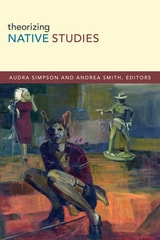
Theorizing Native Studies
Audra Simpson and Andrea Smith, eds.
Duke University Press, 2014
Contributors. Christopher Bracken, Glen Coulthard, Mishuana Goeman, Dian Million, Scott Morgensen, Robert Nichols, Vera Palmer, Mark Rifkin, Audra Simpson, Andrea Smith, Teresia Teaiwa
Theorizing Scriptures
New Critical Orientations to a Cultural PhenomenonWimbush, Vincent
Rutgers University Press, 2008
Historically, religious scriptures are defined as holy texts that are considered to be beyond the abilities of the layperson to interpret. Their content is most frequently analyzed by clerics who do not question the underlying political or social implications of the text, but use the writing to convey messages to their congregations about how to live a holy existence. In Western society, moreover, what counts as scripture is generally confined to the Judeo-Christian Bible, leaving the voices of minorities, as well as the holy texts of faiths from Africa and Asia, for example, unheard.
In this innovative collection of essays that aims to turn the traditional bible-study definition of scriptures on its head, Vincent L. Wimbush leads an in-depth look at the social, cultural, and racial meanings invested in these texts. Contributors hail from a wide array of academic fields and geographic locations and include such noted academics as Susan Harding, Elisabeth Shüssler Fiorenza, and William L. Andrews.
Purposefully transgressing disciplinary boundaries, this ambitious book opens the door to different interpretations and critical orientations, and in doing so, allows an ultimately humanist definition of scriptures to emerge.
Theorizing Self in Samoa
Emotions, Genders, and SexualitiesJeannette Marie Mageo
University of Michigan Press, 1998
Theorizing the City
The New Urban Anthropology ReaderLow, Setha M.
Rutgers University Press, 1999
Anthropological perspectives are not often represented in urban studies, even though many anthropologists have been contributing actively to theory and research on urban poverty, racism, globalization, and architecture. The New Urban Anthropology Reader corrects this omission by presenting 12 cross-cultural case studies focusing on the analysis of space and place.
Theory and History of Folklore
Vladimir Propp
University of Minnesota Press, 1984
Theory and Method in the Social Sciences
Arnold M. Rose
University of Minnesota Press, 1954
Theory and Method in the Social Sciences was first published in 1954. Minnesota Archive Editions uses digital technology to make long-unavailable books once again accessible, and are published unaltered from the original University of Minnesota Press editions.
A series of essays dealing with some previously neglected areas of theory and research in the social sciences make up this volume. The problems considered fall into the general categories of social theory, values in social research, the contributions of sociological theory to the other social sciences, methodological issues in sociology, and some specific techniques of sociological research. The chapter entitled "A Theory of Social Organization and Disorganization," published here for the first time, won for Dr. Rose the 1952 prize of the American Association for the Advancement of Science for essays in social science. Although addressed primarily to sociologists, the book offers material of interest and value to other social scientists, particularly economists, psychologists, political scientists, and students of law.
Theory and Practice of Social Planning
Alfred J. Kahn
Russell Sage Foundation, 1969
Theory for the World to Come
Speculative Fiction and Apocalyptic AnthropologyMatthew J. Wolf-Meyer
University of Minnesota Press, 2019
Can social theories forge new paths into an uncertain future?
The future has become increasingly difficult to imagine. We might be able to predict a few events, but imagining how looming disasters will coincide is simultaneously necessary and impossible. Drawing on speculative fiction and social theory, Theory for the World to Come is the beginning of a conversation about theories that move beyond nihilistic conceptions of the capitalism-caused Anthropocene and toward generative bodies of thought that provoke creative ways of thinking about the world ahead. Matthew J. Wolf-Meyer draws on such authors as Kim Stanley Robinson and Octavia Butler, and engages with afrofuturism, indigenous speculative fiction, and films from the 1970s and ’80s to help think differently about the future and its possibilities.
Forerunners: Ideas First
Short books of thought-in-process scholarship, where intense analysis, questioning, and speculation take the lead

Theory from the Trenches
Decolonization and the Horizons of Subaltern MarxismShozab Raza
Duke University Press, 2027

Theory of African Music, Volume I
Gerhard Kubik
University of Chicago Press, 2010
Taken together, these comprehensive volumes offer an authoritative account of the music of Africa. One of the most prominent experts on the subject, Gerhard Kubik draws on his extensive travels and three decades of study in many parts of the continent to compare and contrast a wealth of musical traditions from a range of cultures.
In the first volume, Kubik describes and examines xylophone playing in southern Uganda and harp music from the Central African Republic; compares multi-part singing from across the continent; and explores movement and sound in eastern Angola. And in the second volume, he turns to the cognitive study of African rhythm, Yoruba chantefables, the musical Kachamba family of Malaŵi, and African conceptions of space and time.
Each volume features an extensive number of photographs and is accompanied by a compact disc of Kubik’s own recordings. Erudite and exhaustive, Theory of African Music will be an invaluable reference for years to come.

Theory of African Music, Volume II
Gerhard Kubik
University of Chicago Press, 2010
In this second volume, Kubik explores a variety of topics, including Yoruba chantefables, the musical Kachamba family of Malawˆ i, and the cognitive study of African rhythm. Drawing on his remarkable ability to make cross-cultural comparisons, Kubik illuminates every facet of the African understanding of rhythm, from timing systems to elementary pulsation. His analysis of tusona ideographs in Luchazi culture leads to an exploration of African space/time concepts that synthesizes his theories of art, rhythm, and culture.
Featuring a large number of photographs and accompanied by a compact disc of Kubik’s own recordings, Theory of African Music, Volume II, will be an invaluable reference for years to come.
Theory of Culture Change
THE METHODOLOGY OF MULTILINEAR EVOLUTIONJulian H. Steward
University of Illinois Press, 1955
some 20 years of work, Steward argues persuasively that cultural change
consists of complex, continuing processes, rather than isolable acts or
events of unitary character ('diffusion' versus 'independent invention')....
With the increasing preponderance of studies of cultural change in archaeology
as well as anthropology this volume assumes as much importance for the prehistorian
as for the student of contemporary societies."
-- American Antiquity

Therapeutic Nations
Healing in an Age of Indigenous Human RightsDian Million
University of Arizona Press, 2013
Million contends that nation-state relations are influenced by a theory of trauma ascendant with the rise of neoliberalism. Such use of trauma theory regarding human rights corresponds to a therapeutic narrative by Western governments negotiating with Indigenous nations as they seek self-determination.
Focusing on Canada and drawing comparisons with the United States and Australia, Million brings a genealogical understanding of trauma against a historical filter. Illustrating how Indigenous people are positioned differently in Canada, Australia, and the United States in their articulation of trauma, the author particularly addresses the violence against women as a language within a greater politic. The book introduces an Indigenous feminist critique of this violence against the medicalized framework of addressing trauma and looks to the larger goals of decolonization. Noting the influence of humanitarian psychiatry, Million goes on to confront the implications of simply dismissing Indigenous healing and storytelling traditions.
Therapeutic Nations is the first book to demonstrate affect and trauma’s wide-ranging historical origins in an Indigenous setting, offering insights into community healing programs. The author’s theoretical sophistication and original research make the book relevant across a range of disciplines as it challenges key concepts of American Indian and Indigenous studies.

Therapeutic Revolutions
Medicine, Psychiatry, and American Culture, 1945-1970Halliwell, Martin
Rutgers University Press, 2014
Beginning with a discussion of the profound impact of World War II and the Cold War on mental health, Halliwell moves from the influence of work, family, and growing up in the Eisenhower years to the critique of institutional practice and the search for alternative therapeutic communities during the 1960s. Blending a discussion of such influential postwar thinkers as Erich Fromm, William Menninger, Erving Goffman, Erik Erikson, and Herbert Marcuse with perceptive readings of a range of cultural text that illuminate mental health issues--among them Spellbound, Shock Corridor, Revolutionary Road, and I Never Promised You a Rose Garden--this compelling study argues that the postwar therapeutic revolutions closely interlink contrasting discourses of authority and liberation.