Results by title
4030 books match the query 'Language Arts & Disciplines' and 760 start with t
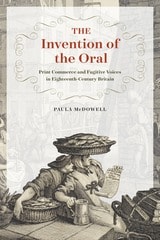
The Invention of the Oral
Print Commerce and Fugitive Voices in Eighteenth-Century BritainPaula McDowell
University of Chicago Press, 2017
Drawing on an impressive array of sources including travel narratives, elocution manuals, theological writings, ballad collections, and legal records, McDowell re-creates a world in which everyone from fishwives to philosophers, clergymen to street hucksters, competed for space and audiences in taverns, marketplaces, and the street. She argues that the earliest positive efforts to theorize "oral tradition," and to depict popular oral culture as a culture (rather than a lack of culture), were prompted less by any protodemocratic impulse than by a profound discomfort with new cultures of reading, writing, and even speaking shaped by print.
Challenging traditional models of oral versus literate societies and key assumptions about culture’s ties to the spoken and the written word, this landmark study reorients critical conversations across eighteenth-century studies, media and communications studies, the history of the book, and beyond.
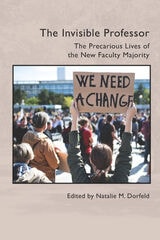
The Invisible Professor
The Precarious Lives of the New Faculty MajorityNatalie M. Dorfeld
University Press of Colorado, 2023
This edited collection, the first in the Practices & Possibilities series to be published in its Voices from the Field section, offers a rich set of narratives by writing instructors who are serving or have worked in contingent positions. Intended for anyone considering a career in the humanities, The Invisible Professor seeks to reach individuals in three phases of their careers: those thinking of entering the profession, those knee-deep in it and looking for ways to improve conditions, and those who have vacated academic positions for more humane alternative tracks.
As academia comes to a crossroads, with a disheartening shift towards a more disposable business model, multiple solutions are desperately needed. Faculty members in contingent positions are the new faculty majority on college campuses, and they are most likely the first professors students will meet. They deserve respect and a livable wage.
The Journey
Stories by K. C. DasPhyllis Granoff, Translator
University of Michigan Press, 2000
The Know-Nothing Campaign Against Higher Learning
James Chandler
Prickly Paradigm Press, 2026
Irony and satire in the contemporary American moment.
The second Trump administration has committed itself to upending the knowledge systems and deliberative institutions that have been essential to modern democracy, with the American university—site of scientific research and liberal education—a primary target. In The Know-Nothing Campaign Against Higher Learning, literary and film critic James Chandler spotlights an American tradition of such hostility to intellectual life, especially the nativist movement of the 1850s that persecuted Catholic immigrants from Ireland and Germany. Ironically, Steve Bannon, the self-proclaimed “Know-Nothing vulgarian” who long ago recruited candidate Trump to his anti-intellectual crusade, is himself the great-grandson of an Irish immigrant who would have faced Know-Nothing backlash in that era.
Such dark ironies define our moment, Chandler argues, and they call out not only for intellectual critique but also for satire. Yet in the midst of the MAGA campaign’s calamitous effects on American public discourse, even satire must confront the “kayfabe” practices imported by Trump from professional wrestling, which mix illusion and reality to turn political life into a “spectacle without thought.” Drawing widely on cultural critics from Jonathan Swift and Alexis de Tocqueville to Roland Barthes, Chandler’s pamphlet offers an elegant and bracing account of the MAGA campaign against higher learning and its transformative effects on criticism and democracy itself.
The Knowledge Most Worth Having
Edited by Wayne C. Booth
University of Chicago Press, 1967

The Kovacs Guide to Electronic Library Collection Development
Essential Core Subject Collections, Selection Criteria, and GuidelinesAmerican Library Association, 2009
The Language Parallax
Linguistic Relativism and Poetic IndeterminacyBy Paul Friedrich
University of Texas Press, 1986
Humankind has always been fascinated and troubled by the way languages and dialects differ. Linguistically based differences in point of view have preoccupied many original minds of the past, such as Kant, and remain at the forefront of language study: in philosophy, anthropology, literary criticism, and other fields.
Paul Friedrich's The Language Parallax argues persuasively that the "locus and focus" of differences among languages lies not so much in practical or rational aspects as in the complexity and richness of more poetic dimensions—in the nuances of words, or the style and voice of an author. This poetic reformulation of what has been called "linguistic relativism" is grounded in the author's theory of the imagination as a main source of poetic indeterminacy. The reformulation is also based on the intimate relation of the concentrated language of poetry to the potential or possibilities for poetry in ordinary conversation, dreams, and other experiences. The author presents challenging thoughts on the order and system of language in their dynamic relation to indeterminacy and, ultimately, disorder and chaos.
Drawing on his considerable fieldwork in anthropology and linguistics, Friedrich interweaves distinct and provocative elements: the poetry of language difference, the indeterminacy in dialects and poetic forms, the discovery of underlying orders, the workings of different languages, the strength of his own poetry. The result is an innovative and organic whole.
The Language Parallax, then, is a highly original work with a single bold thesis. It draws on research and writing that has involved, in particular, English, Russian, and the Tarascan language of Mexico, as well as the personal and literary study of the respective cultures. Anthropologist, linguist, and poet, Friedrich synthesizes from his experience in order to interrelate language variation and structure, the creative individual, ideas of system-in-process, and questions of scientific and aesthetic truth. The result is a new view of language held to the light of its potentially creative nature.
The Language of Fiction
A Writer’s StylebookBrian Shawver
University Press of New England, 2013
The Language of Judges
Lawrence M. Solan
University of Chicago Press, 1993
Solan uses a wealth of examples to illustrate the way linguistics enters the process of judicial decision making: a death penalty case that the Supreme Court decided by analyzing the use of adjectives in a jury instruction; criminal cases whose outcomes depend on the Supreme Court's analysis of the relationship between adverbs and prepositional phrases; and cases focused on the meaning of certain words in the Constitution. Solan finds that judges often describe our use of language poorly because there is no clear relationship between the principles of linguistics and the jurisprudential goals that the judge wishes to promote.
A major contribution to the growing interdisciplinary scholarship on law and its social and cultural context, Solan's lucid, engaging book is equally accessible to linguists, lawyers, philosophers, anthropologists, literary theorists, and political scientists.
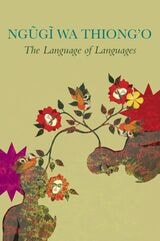
The Language of Languages
Ngugi wa Thiong’o
Seagull Books, 2023
With clear, conversational prose, this is the first book dedicated entirely to Ngũgĩ wa Thiong’o’s writings on translation.
Through his many critically acclaimed novels, stories, essays, plays, and memoirs, Kenyan writer Ngũgĩ wa Thiong’o has been at the forefront of world literature for decades. He has also been, in his own words, “a language warrior,” fighting for indigenous African languages to find their rightful place in the literary world. Having begun his writing career in English, Ngũgĩ shifted to writing in his native language Gikũyũ in 1977, a stance both creatively and politically significant. For decades now, Ngũgĩ has been translating his Gikũyũ works into English himself, and he has used many platforms to champion the practice and cause of literary translations, which he calls “the language of languages.”
This volume brings together for the first time Ngũgĩ’s essays and lectures about translation, written and delivered over the past two decades. Here we find Ngũgĩ discussing translation as a conversation between cultures, proposing that dialogue among African languages is the way to unify African peoples, reflecting on the complexities of auto-translation or translating one’s own work, exploring the essential task translation performed in the history of the propagation of thought, and pleading for the hierarchy of languages to be torn down. He also shares his many experiences of writing across languages, including his story The Upright Revolution, which has been translated into more than a hundred languages around the globe and is the most widely translated text written by an African author.
At a time when dialogues between cultures and peoples are more essential than ever, The Language of Languages makes an outspoken case for the value of literature without borders.
The Language of Statutes
Laws and Their InterpretationLawrence M. Solan
University of Chicago Press, 2010
Pulling the rug out from debates about interpretation, The Language of Statutes joins together learning from law, linguistics, and cognitive science to illuminate the fundamental issues and problems in this highly contested area. Here, Lawrence M. Solan argues that statutory interpretation is alive, well, and not in need of the major overhaul that many have suggested. Rather, he suggests, the majority of people understand their rights and obligations most of the time, with difficult cases occurring in circumstances that we can predict from understanding when our minds do not work in a lawlike way.
Solan explains that these cases arise because of the gap between our inability to write crisp yet flexible laws on one hand and the ways in which our cognitive and linguistic faculties are structured on the other. Making our lives easier and more efficient, we’re predisposed to absorb new situations into categories we have previously formed—but in the legislative and judicial realms this can present major difficulties. Solan provides an excellent introduction to statutory interpretation, rejecting the extreme arguments that judges have either too much or too little leeway, and explaining how and why a certain number of interpretive problems are simply inevitable.

The Language of the Inka since the European Invasion
By Bruce Mannheim
University of Texas Press, 1991
The Inka empire, Tawantinsuyu, fell to Spanish invaders within a year's time (1532-1533), but Quechua, the language of the Inka, is still the primary or only language of millions of Inka descendants throughout the southern Andes. In this innovative study, Bruce Mannheim synthesizes all that is currently known about the history of Southern Peruvian Quechua since the Spanish invasion, providing new insights into the nature of language change in general, into the social and historical contexts of language change, and into the cultural conditioning of linguistic change.
Mannheim first discusses changes in the social setting of language use in the Andes from the time of the first European contact in the sixteenth century until today. He reveals that the modern linguistic homogeneity of Spanish and Quechua is a product of the Spanish conquest, since multilingualism was the rule in the Inka empire. He identifies the social and political forces that have influenced the kinds of changes the language has undergone. And he provides the first synthetic history of Southern Peruvian Quechua, making it possible at last to place any literary document or written text in a chronological and social context.
Mannheim also studies changes in the formal structure of Quechua. He finds that changes in the sound system were motivated primarily by phonological factors and also that the changes were constrained by a set of morphological and syntactic conditions. This last conclusion is surprising, since most historical linguists assume that sound change is completely independent of other aspects of language. Thus, The Language of the Inka since the European Invasion makes an empirical contribution to a general theory of linguistic change.
Written in an engaging style that is accessible to the nonlinguist, this book will have a special appeal to readers interested in the history and anthropology of native South America.
The Languages of Native America
Historical and Comparative AssessmentEdited by Lyle Campbell and Marianne Mithun
University of Texas Press, 1979
These essays were drawn from the papers presented at the Linguistic Society of America's Summer Institute at the State University of New York at Oswego in 1976. The contents are as follows:
- Lyle Campbell and Marianne Mithun, "Introduction: North American Indian Historical Linguistics in Current Perspective"
- Ives Goddard, "Comparative Algonquian"
- Marianne Mithun, "Iroquoian"
- Wallace L. Chafe, "Caddoan"
- David S. Rood, "Siouan"
- Mary R. Haas, "Southeastern Languages"
- James M. Crawford, "Timucua and Yuchi: Two Language Isolates of the Southeast"
- Ives Goddard, "The Languages of South Texas and the Lower Rio Grande"
- Irvine Davis, "The Kiowa-Tanoan, Keresan, and Zuni Languages"
- Susan Steele, "Uto-Aztecan: An Assessment for Historical and Comparative Linguistics"
- William H. Jacobsen, Jr., "Hokan lnter-Branch Comparisons"
- Margaret Langdon, "Some Thoughts on Hokan with Particular Reference to Pomoan and Yuman"
- Michael Silverstein, "Penutian: An Assessment"
- Laurence C. Thompson, "Salishan and the Northwest"
- William H. Jacobsen, Jr., "Wakashan Comparative Studies"
- William H. Jacobsen, Jr., "Chimakuan Comparative Studies"
- Michael E. Krauss, "Na-Dene and Eskimo-Aleut"
- Lyle Campbell, "Middle American Languages"
- Eric S. Hamp, "A Glance from Now On"
The Languages of Scandinavia
Seven Sisters of the NorthRuth H. Sanders
University of Chicago Press, 2017
While the two linguistic families that comprise Scandinavia’s languages ultimately have differing origins, the Seven Sisters have coexisted side by side for millennia. As Sanders reveals, a crisscrossing of names, territories, and even to some extent language genetics—intimate language contact—has created a body of shared culture, experience, and linguistic influences that is illuminated when the story of these seven languages is told as one. Exploring everything from the famed whalebone Lewis Chessmen of Norse origin to the interactions between the Black Death and the Norwegian language, The Languages of Scandinavia offers profound insight into languages with a cultural impact deep-rooted and far-reaching, from the Icelandic sagas to Swedish writer Stieg Larsson’s internationally popular Millennium trilogy. Sanders’s book is both an accessible work of linguistic scholarship and a fascinating intellectual history of language.
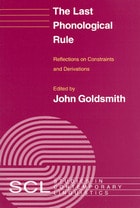
The Last Phonological Rule
Reflections on Constraints and DerivationsEdited by John A. Goldsmith
University of Chicago Press, 1993
In this provocative book, leading linguists and computer scientists consider the challenges that computational innovations pose to current rule-based phonological theories and speculate about the advantages of phonological models based on artificial neural networks and other computer designs. The authors offer new conceptions of phonological theory for the 1990s, the most radical of which proposes that phonological processes cannot be characterized by rules at all, but arise from the dynamics of a system of phonological representations in a high-dimensional vector space of the sort that a neural network embodies. This new view of phonology is becoming increasingly attractive to linguists and others in the cognitive sciences because it answers some difficult questions about learning while drawing on recent results in philosophy, psychology, artificial intelligence, and neuroscience.
The contributors are John A. Goldsmith, Larry M. Hyman, George Lakoff, K. P. Mohanan, David S. Touretzky, and Deirdre W. Wheeler.
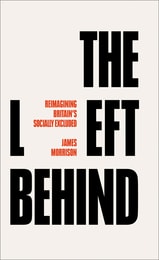
The Left Behind
Reimagining Britain's Socially ExcludedJames
Pluto Press, 2022
Examines the ways in which the 'Left Behind' have been used to symbolize and foment social divisions in contemporary Britain.
'The Left Behind' is a defining motif of contemporary British political discourse. It is the thread that knits together the 2016 Brexit referendum, the crumbling of the fabled 'Red Wall' in the North, and the pernicious culture war being waged today. But who are the Left Behind?
James Morrison goes in search of the reality behind the rhetoric, offering the first comprehensive, historical analysis of the origins, uses and meanings of the term. He interrogates the popular archetype of the Left Behind - as a working-class, Leave-voting white male from a former industrial heartland - and situates the concept in the context of longstanding, demonizing discourses aimed at communities seen as backward and 'undeserving'.
Analyzing national newspaper coverage and parliamentary discussions, and drawing on interviews with MPs, community leaders, charities, and people with direct lived experiences of poverty and precarity, The Left Behind grapples with the real human cost of austerity for neglected post-industrial communities and other marginalized groups across the world, and the stigmatizing discourse that does little to serve them.
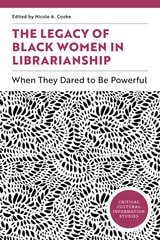
The Legacy of Black Women in Librarianship
When They Dared to Be PowerfulEdited by Nicole A. Cooke
American Library Association, 2025
- span the entire 20th Century, stretching from rural South Carolina and Florida to urban centers like New York and Los Angeles;
- profile better known figures such as Augusta Baker and Eliza Atkins Gleason as well as many who have yet to receive their due;
- grapple with the toxic legacy of segregation in library education, universities, public libraries, schools, and other institutions, showing how these persevering Black women dared to strive and work towards more equitable futures;
- include an inspiring Afterword by Dr. Aisha Johnson-Jones, an educator and revelator of Southern intellectual history;
- will encourage LIS students and newer librarians of all backgrounds to see themselves reflected in the profession’s long and rich heritage; and
- shed light on how librarianship can become ever more diverse and community centered.

The Librarian Stereotype
Deconstructing Perceptions AndMiriam Rigby
Assoc of College & Research Libraries, 2014
The Librarian Stereotype
Deconstructing Perceptions and Presentations of Information WorkNicole Pagowsky
Assoc of College & Research Libraries, 2014
The Librarian as Information Consultant
Sarah Anne Murphy
American Library Association, 2011
The Librarian's Book of Lists
A Librarian's Guide to Helping Job SeekersGeorge M. Eberhart
American Library Association, 2010
The Librarian's Book of Quotes
Tatyana Eckstrand
American Library Association, 2009
The Librarian's Guide to Graphic Novels for Adults
American Library Association, 2010
The Librarian's Guide to Homelessness
An Empathy-Driven Approach to Solving Problems, Preventing Conflict, and Serving EveryoneRyan Dowd
American Library Association, 2018
Homelessness is a perennial topic of concern at libraries. In fact, staff at public libraries interact with almost as many homeless individuals as staff at shelters do. Empathy and understanding, along with specific actionable advice that’s drawn from experience, makes all the difference in working with this group. In this book Dowd, executive director of a homeless shelter, spotlights best practices drawn from his own shelter’s policies and training materials. Filled with to-the-point guidance that will help frontline public library staff and managers understand and serve this population better, this resource
- includes facts about homelessness every librarian should know;
- debunks widespread myths about these individuals, explaining how they see themselves, what issues they struggle with, and how libraries can shift towards supporting them;
- shares de-escalation techniques like showing respect, ways to avoid making things personal, and using proper body language;
- walks readers through dealing with common issues like a sleeping patron, questionable hygiene, offensive behavior, and asking a patron to leave; and
- advises on how to provide backup to a colleague and when to call the police.
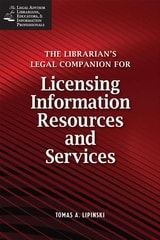
The Librarian's Legal Companion for Licensing Information Resources and Services
Tomas A. Lipinski
American Library Association, 2013
Legal expert Lipinski offers a definitive sourcebook for information licensing in libraries, including copyright and contract matters, general contract law concepts, developments in online and information contracting; and the advantages and disadvantages of licensing. Readers will find clear guidance on deciphering the legalese in agreements, advice on negotiating or countering provisions with library-friendly alternatives, and detailed explanations of specific licenses as well as a discussion of issues regarding online and information contracting. Additionally, three special sections provide valuable information in an easy-to-reference format:
- Deconstructions of four common license agreements: Access Newspaper Archive, BioOne, Nature Academic, and Amazon.com Kindle
- Answers to 126 questions about specific licensing agreements, plus a glossary, checklist and review tool for evaluating a license agreement
- 20 key issues in licensing agreements, accompanied by sample clauses
You'll save time, money, and unnecessary stress by putting the law on your side with this all-in-one guide to buying and licensing agreements.
The Librarian's Nitty-Gritty Guide to Content Marketing
Laura Solomon
American Library Association, 2016
The Librarian's Nitty-Gritty Guide to Social Media
Laura Solomon
American Library Association, 2012
The Librarian’s Guide to Book Programs and Author Events
Brad Hooper
American Library Association, 2016
The Library Assessment Cookbook
Aaron W. Dobbs
Assoc of College & Research Libraries, 2017
The Library Innovation Toolkit
Ideas, Strategies, and ProgramsAnthony Molaro
American Library Association, 2015
The Library Liaison's Training Guide to Collection Management
Alison M. Armstrong
American Library Association, 2020
Library liaisons often have primary jobs that do not involve collection development, but their familiarity with collection practices makes all the difference in faculty relations. And time pressures mean that on-boarding needs to be as streamlined as possible. This concise, field-tested training manual will put your liaison on solid footing. Plus, end of the chapter prompts make it easy to tailor your approach to local practices. With the help of this resource, your new liaison will get up to speed on such topics as
- tracking budget balances in assigned departments;
- differentiating between the needs of an individual faculty member and their department;
- how to say no to monograph requests;
- benchmarking titles with peer institutions or coordinating within a consortium;
- 17 questions to ask when evaluating a database;
- considerations when making weeding decisions;
- four key conversations to have annually between liaisons and collection development librarians; and
- gathering data for program accreditation reports.
The Library Outreach Casebook
Ryan L. Sittler
Assoc of College & Research Libraries, 2018
The Library Outreach Cookbook
Ryan L. Sittler
Assoc of College & Research Libraries, 2020
The Library Quarterly, volume 91 number 3 (July 2021)
The University of Chicago Press
University of Chicago Press Journals, 2021
The Library Quarterly, volume 91 number 4 (October 2021)
The University of Chicago Press
University of Chicago Press Journals, 2021
The Library Quarterly, volume 92 number 1 (January 2022)
The University of Chicago Press
University of Chicago Press Journals, 2022
The Library Quarterly, volume 92 number 2 (April 2022)
The University of Chicago Press
University of Chicago Press Journals, 2022
The Library Quarterly, volume 92 number 3 (July 2022)
The University of Chicago Press
University of Chicago Press Journals, 2022
The Library Quarterly, volume 92 number 4 (October 2022)
The University of Chicago Press
University of Chicago Press Journals, 2022
The Library Quarterly, volume 93 number 1 (January 2023)
The University of Chicago Press
University of Chicago Press Journals, 2023
The Library Quarterly, volume 93 number 2 (April 2023)
The University of Chicago Press
University of Chicago Press Journals, 2023
The Library Quarterly, volume 94 number 1 (January 2024)
The University of Chicago Press
University of Chicago Press Journals, 2024
The Library Quarterly, volume 94 number 2 (April 2024)
The University of Chicago Press
University of Chicago Press Journals, 2024
The Library Quarterly, volume 94 number 3 (July 2024)
The University of Chicago Press
University of Chicago Press Journals, 2024
The Library Quarterly, volume 94 number 4 (October 2024)
The University of Chicago Press
University of Chicago Press Journals, 2024
The Library Quarterly, volume 95 number 1 (January 2025)
The University of Chicago Press
University of Chicago Press Journals, 2025
The Library Quarterly, volume 95 number 2 (April 2025)
The University of Chicago Press
University of Chicago Press Journals, 2025
The Library Quarterly, volume 95 number 3 (July 2025)
The University of Chicago Press
University of Chicago Press Journals, 2025
The Library Quarterly, volume 95 number 4 (October 2025)
The University of Chicago Press
University of Chicago Press Journals, 2025
The Library Quarterly, volume 96 number 1 (January 2026)
The University of Chicago Press
University of Chicago Press Journals, 2026