Results by title
1993 books match the query 'Latin America' and 392 start with t
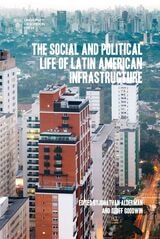
The Social and Political Life of Latin American Infrastructures
Edited by Jonathan Alderman and Geoff Goodwin
University of London Press, 2022
From roads, railways, statues, and bridges, infrastructure provides a unique lens through which to view our own national histories and societies. Serving as an important conduit between individuals and the state, infrastructure can help mediate citizenship, reshape social relations between people both within and across communities, and has the capacity to underpin—or indeed, undermine—nation-building.
Over the last century, infrastructure has transformed Latin America. Roads, railways, and airports have increased connectivity between spaces, peoples, and markets. Cables, switches, and tunnels have connected households to electricity grids, water systems, and digital technology. Public buildings, parks, and monuments have reshaped towns and cities and emerged as sites to construct and contest citizenship. Infrastructure has been welcomed and celebrated in Latin America, but it has also been resisted and destroyed.
Based on recent, original research, the essays in this collection cover a range of pressing infrastructural considerations, including sustainability, water conflict, extractive mining, and public housing in Brazil, Chile, Cuba, Colombia, Ecuador, and Mexico to better understand how infrastructure has reshaped Latin America over the past century.
The Socialist Party of Argentina, 1890–1930
By Richard J. Walter
University of Texas Press, 1977
In the early part of the twentieth century, Argentina's Socialist Party became the largest and most effective socialist organization in Latin America. Richard J. Walter's interpretive study begins with the party's origins in the 1890s, traces its development through 1912, and then offers a comprehensive analysis of its activities and programs during the almost two decades of civilian, democratic government that ended with the military coup of 1930. His aim has been to provide a detailed case study of a Latin American political party within a specific historical context.
The work gives particular attention to the nature of party leadership, internal party organization, attempts to win the support of the Argentine working class, party activities in national elections and the National Congress, and internal disputes and divisions. In discussing these topics, Walter draws heavily on government documents, including national and municipal censuses, ministerial reports, and the Argentine Congressional Record. He also makes extensive use of national and party newspapers and journals, political memoirs, and collections of essays by party leaders.
Walter concludes that the party enjoyed relative electoral and legislative success because of efficient organization, capable leadership, and specific, well-reasoned programs. On the other hand, it failed to create a firm working-class base or to extend its influence much beyond Buenos Aires, mainly because of its inability to relate adequately to the needs of the proletariat and to the growth of nationalist sentiment. The analysis of these successes and failures also provides an important background for understanding the rise to power of Juan Perón and Peronism.
The Sola Valley and the Monte Albán State
A Study of Zapotec Imperial ExpansionAndew K. Balkansky
University of Michigan Press, 2002
The Sonoran Desert
Its Geography, Economy, and PeopleRoger Dunbier
University of Arizona Press, 1968
Although the significance of geographic regionalism is implicit throughout this study, no attempt is made to show any overriding unity at work, geographical or otherwise, welding together a "desert region." Instead the desert acts as a stage for social drama in which drought and extreme heat provide the essential backcloth. The scarcity of water and man's inability to grow crops without irrigation have not, indeed, changed with time, and only constant reference to this immutable factor can give meaning to the evolution of human activities within the desert.
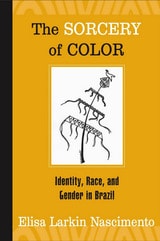
The Sorcery of Color
Identity, Race, and Gender in BrazilElisa Larkin Nascimento
Temple University Press, 2009
Originally published in 2003 in Portuguese, The Sorcery of Color argues that there are longstanding and deeply-rooted relationships between racial and gender inequalities in Brazil. In this pioneering book, Elisa Larkin Nascimento examines the social and cultural movements that have attempted, since the early twentieth century, to challenge and eradicate these conjoined inequalities.
The book's title describes the social sleight-of-hand that disguises the realities of Brazilian racial inequity. According to Nascimento, anyone who speaks of racism—or merely refers to another person as black—traditionally is seen as racist. The only acceptably non-racist attitude is silence. At the same time, Afro-Brazilian culture and history have been so overshadowed by the idea of a general "Brazilian identity" that to call attention to them is also to risk being labeled racist.
Incorporating leading international scholarship on Pan Africanism and Afrocentric philosophy with the writing of Brazilian scholars, Nascimento presents a compelling feminist argument against the prevailing policy that denies the importance of race in favor of a purposefully vague concept of ethnicity confused with color.

The Southeast Maya Periphery
Edited by Patricia A. Urban and Edward M. Schortman
University of Texas Press, 1986
Archaeologists are continually faced with a pervasive problem: How can cultures, and the interactions among cultures, be differentiated in the archaeological record? This issue is especially difficult in peripheral areas, such as El Salvador, Honduras, and southern Guatemala in the New World. Encompassing zones that are clearly Mayan in language and culture, especially during the Classic period, this area also includes zones that seem to be non-Mayan. The Southeast Maya Periphery examines both aspects of this territory. For the Maya, emphasis is on two sites: Quirigua, Guatemala, and Copan, Honduras. For the non-Maya zone, information is presented on a variety of sites and subregions—the Lower Motagua Valley in Guatemala; the Naco, Sula, and Comayagua valleys and the site of Playa de los Muertos in Honduras; and the Zapotitan Valley and the sites of Cihuatan and Santa Leticia in El Salvador.
Spanning over two thousand years of prehistory, from the Middle Preclassic through the Classic and the poorly understood Postclassic, the essays in this volume address such topics as epigraphy and iconography, architecture, site planning, settlement patterns, and ceramics and include basic information on chronology. Copan and Quirigua are treated both individually and in comparative perspective.
This significant study was the first to attempt to deal with the Periphery as a coherent unit. Unique in its comparative presentation of Copan and Quirigua and in the breadth of information on non-Maya sites in the area, The Southeast Maya Periphery consists largely of previously unpublished data. Offering a variety of approaches to both old and new problems, this volume attempts, among other things, to reassess the relationships between Copan and Quirigua and between Highland and Lowland ceramic traditions, to analyze ceramics by neutron activation, and to define the nature of the apparently non-Mayan cultures in the region. This book will be of major interest not only to Mayanists and Mesoamerican archaeologists but also to others interested in the processes of ethnic group boundary formation and maintenance.
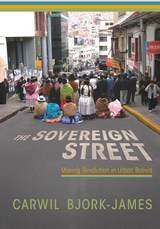
The Sovereign Street
Making Revolution in Urban BoliviaCarwil Bjork-James
University of Arizona Press, 2020
In the early twenty-first century Bolivian social movements made streets, plazas, and highways into the decisively important spaces for acting politically, rivaling and at times exceeding voting booths and halls of government. The Sovereign Street documents this important period, showing how indigenous-led mass movements reconfigured the politics and racial order of Bolivia from 1999 to 2011.
Drawing on interviews with protest participants, on-the-ground observation, and documentary research, activist and scholar Carwil Bjork-James provides an up-close history of the indigenous-led protests that changed Bolivia. At the heart of the study is a new approach to the interaction between protest actions and the parts of the urban landscape they claim. These “space-claiming protests” both communicate a message and exercise practical control over the city. Bjork-James interrogates both protest tactics—as experiences and as tools—and meaning-laden spaces, where meaning is part of the racial and political geography of the city.
Taking the streets of Cochabamba, Sucre, and La Paz as its vantage point, The Sovereign Streetoffers a rare look at political revolution as it happens. It documents a critical period in Latin American history, when protests made headlines worldwide, where a generation of pro-globalization policies were called into question, and where the indigenous majority stepped into government power for the first time in five centuries.
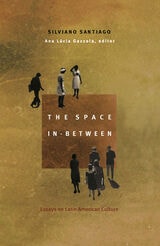
The Space In-Between
Essays on Latin American CultureSilviano Santiago
Duke University Press, 2001
Santiago’s work creates a theoretical field that transcends both the study of a specific national literature and the traditional perspectives of comparative literature. He examines the pedagogical and modernizing mission of Western voyagers from the conquistadors to the present. He deconstructs the ideas of “original” and “copy,” unpacking their implications for the notions of so-called dominant and dominated cultures. Santiago also confronts questions of cultural dependency and analyzes the problems involved in the imposition of an alien European history, the cultural displacements experienced by the Indians through their religious conversion, and the hierarchical suppression of native and Afro-Brazilian values.
Elegantly written and translated, The Space In-Between will provide insights and perspectives that will interest cultural and literary theorists, postcolonial scholars, and other students of contemporary culture.
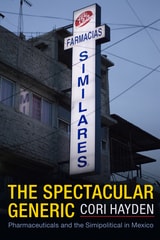
The Spectacular Generic
Pharmaceuticals and the Simipolitical in MexicoCori Hayden
Duke University Press, 2023

The Struggle for Maize
Campesinos, Workers, and Transgenic Corn in the Mexican CountrysideElizabeth Fitting
Duke University Press, 2011

The Struggle for an Enlightened Republic
Buenos Aires and RivadaviaKlaus Gallo
University of London Press, 2006

The Surprising New Life of Magical Realism
Marvelous Ecologies and Postnatural Disasters in Latin AmericaCharlotte Rogers
University of Chicago Press, 2027
An exploration of magical realism’s contemporary resurgence, as writers attempt to capture the realities of climate change.
What literary mode could possibly convey the extent of today’s climate catastrophes? In The Surprising New Life of Magical Realism, Charlotte Rogers argues that the answer is magical realism, a genre whose defining characteristic is to make the unbelievable an unremarkable part of everyday life. She pairs classic works by Alejo Carpentier, Gabriel García Márquez, and Rosario Ferré with contemporary novels by Carlos Fonseca, Fernanda Melchor, and Rita Indiana to show how the techniques of magical realism enable new approaches to scenes of environmental collapse and social injustice. Challenging widespread accounts of the genre’s decline, Rogers shows that the signature aesthetics of magical realism—the marvelous, the amazing, the strange—are integral to twenty-first-century fiction.
The Surrendered
Reflections by a Son of Shining PathJosé Carlos Agüero. Edited and Translated by Michael J. Lazzara and Charles F. Walker
Duke University Press, 2021
The São Paulo Law School and the Anti-Vargas Resistance (1938-1945)
By John W. F. Dulles
University of Texas Press, 1986
The São Paulo Law School, the oldest institution of higher learning in Brazil, has long been the chief training center for that country’s leadership. For the members of the school’s secret Burschenschaft society, the training consisted principally in leading demonstrations for liberal causes, such as the abolition of slavery and the overthrow of the monarchy. During the Old Republic (1889–1930), the Brazilian presidency and other high posts in Rio de Janeiro were usually occupied by alumni of the powerful society, while its members in São Paulo continued to agitate for political reform. But in the 1920s, when they formed the Nationalist League and the Democratic Party, schisms resulted. Thus the Burschenschaft was weakened before the long rule of Brazil by Getúlio Vargas, starting in 1930, brought an end to the society’s influence.
The role of the school in these and other historical events is carefully reviewed by Dulles before he turns to the school’s well-known resistance to the dictatorship of Vargas. That resistance, the most persistent confronting the dictator, appeared to be unified—especially when it provoked the police into shooting the students. But, as Dulles discovered when interviewing participants and consulting documents and scrapbooks of the early 1940s, the movement was characterized by heated internal strife. In the end, however, the idealism and courage of the participants and the ultimate effectiveness of the movement contributed mightily to the fall of Vargas.
This book is another in Dulles’s series of narrative histories in which he gives flesh and blood to the names and breathes life into the events of twentieth-century Brazilian politics.
The São Paulo Neo-Avant-Garde
Radical Art and Mass Print Media in Cold War BrazilMari Rodríguez Binnie
University of Texas Press, 2024
How artists challenged a military dictatorship through mass print technologies in 1970s and 1980s São Paulo.
Throughout the 1970s and into the 1980s, during Brazil's military dictatorship, artists shifted their practices to critique the government and its sanitized images of Brazil, its use of torture, and its targeted persecutions. Mari Rodríguez Binnie's The São Paulo Neo-Avant-Garde examines these artworks and their engagement with politics and mainstream art institutions and practices.
As Binnie skillfully shows, artists appropriated processes like photocopy, offset lithography, and thermal and heliographic printing, making newly available technologies of mass production foundational to their work of resistance against both the dictatorship and the established art world. Often working collaboratively, these artists established alternative networks of exchange locally and internationally to circulate their work. As democracy was reestablished in Brazil, and in the decades that followed, their works largely fell out of sight. Here, in the first English-language book to focus entirely on conceptual practices in São Paulo in the 1970s and 1980s, Binnie unearths a scene critical to the development of contemporary Brazilian Art.

The Tango Machine
Musical Culture in the Age of ExpediencyMorgan James Luker
University of Chicago Press, 2016
Luker traces the diverse and often contradictory ways tango is used in Argentina in activities ranging from state cultural policy-making to its export abroad as a cultural emblem, from the expanding nonprofit arts sector to tango-themed urban renewal projects. He shows how projects such as these are not peripheral to an otherwise “real” tango—they are the absolutely central means by which the values of this musical culture are cultivated. By richly detailing the interdependence of aesthetic value and the regimes of cultural management, this book sheds light on core conceptual challenges facing critical music scholarship today.
The Tarahumara Rebellion of 1690
Embattled Settlers and Missionaries in Northern New SpainJoseph P. Sánchez
University of Arizona Press, 2025
Previous histories have interpreted this revolt, and other borderlands uprisings, as localized and spontaneous events aimed at rectifying specific grievances. Historian Joseph P. Sánchez argues that the revolts of the Tepehuanes and the Tarahumaras in northern New Spain, or Nueva Vizcaya, were well-planned, inspired by outside events, and drew in multiple communities and ethnicities. Drawing on a wealth of primary sources, including Jesuit accounts and archival documents, Sánchez offers a comprehensive narrative that challenges conventional interpretations of colonial Mexican uprisings.
Far from localized, the Indigenous rebellions in the northern Mexican borderlands during the colonial period were part of the overall Indigenous struggle for defense of homeland throughout the Americas. The Tarahumara Rebellion of 1690 brings together a rich history of localized events and broader historical trends and offers a compelling narrative that enriches our understanding of the colonial experience in northern New Spain.
The Taste of Nostalgia
Women, Race, and Culinary Longing in PeruAmy Cox Hall
University of Texas Press, 2024
An exploration of gender, race, and food in Peru in the 1950s and 1960s and today.
From the late 1940s to the mid 1960s, Peru’s rapid industrialization and anti-communist authoritarianism coincided with the rise of mass-produced cookbooks, the first televised cooking shows, glossy lifestyle magazines, and imported domestic appliances and foodstuffs. Amy Cox Hall’s The Taste of Nostalgia uses taste as a thematic and analytic thread to examine the ways that women, race, and the kitchen were foundational to Peruvian longings for modernity, both during the Cold War and today.
Drawing on interviews, personal stories, media images, and archival and ethnographic research, Cox Hall considers how elite, European-descended women and the urban home were central to Peru’s modernizing project and finds that all women who labored within the deeply racialized and gendered world of food helped set the stage for a Peruvian food nationalism that is now global in the twenty-first century. Cox Hall skillfully connects how the sometimes-unsavory tastes of the past are served again in today’s profitable and pervasive gastronostalgia that helps sell Peru and its cuisine both at home and abroad.
The Teabo Manuscript
Maya Christian Copybooks, Chilam Balams, and Native Text Production in YucatánBy Mark Z. Christensen
University of Texas Press, 2016
Winner, LASA Mexico Humanities Book Prize, 2017
Among the surviving documents from the colonial period in Mexico are rare Maya-authored manuscript compilations of Christian texts, translated and adapted into the Maya language and worldview, which were used to evangelize the local population. The Morely Manuscript is well known to scholars, and now The Teabo Manuscript introduces an additional example of what Mark Z. Christensen terms a Maya Christian copybook. Recently discovered in the archives of Brigham Young University, the Teabo Manuscript represents a Yucatecan Maya recounting of various aspects of Christian doctrine, including the creation of the world, the Fall of Adam and Eve, and the genealogy of Christ.
The Teabo Manuscript presents the first English translation and analysis of this late colonial Maya-language document, a facsimile and transcription of which are also included in the book. Working through the manuscript section by section, Christensen makes a strong case for its native authorship, as well as its connections with other European and Maya religious texts, including the Morely Manuscript and the Books of Chilam Balam. He uses the Teabo Manuscript as a platform to explore various topics, such as the evangelization of the Maya, their literary compositions, and the aspects of Christianity that they deemed important enough to write about and preserve. This pioneering research offers important new insights into how the Maya negotiated their precontact intellectual traditions within a Spanish and Catholic colonial world.
The Time of Liberty
Popular Political Culture in Oaxaca, 1750–1850Peter Guardino
Duke University Press, 2005
Guardino makes extensive use of archival materials, including judicial transcripts and newspaper accounts, to illuminate the dramatic contrasts between the local politics of the city and of the countryside, describing in detail how both sets of citizens spoke and acted politically. He contends that although it was the elites who initiated the national change to republicanism, the transition took root only when engaged by subalterns. He convincingly argues that various aspects of the new political paradigms found adherents among even some of the most isolated segments of society and that any subsequent failure of electoral politics was due to an absence of pluralism rather than a lack of widespread political participation.
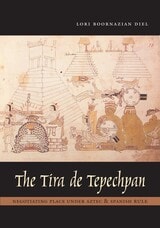
The Tira de Tepechpan
Negotiating Place under Aztec and Spanish RuleBy Lori Boornazian Diel
University of Texas Press, 2008
Created in Tepechpan, a relatively minor Aztec city in Central Mexico, the Tira de Tepechpan records important events in the city's history from 1298 through 1596. Most of the history is presented pictographically. A line of indigenous year signs runs the length of the Tira, with images above the line depicting events in Tepechpan and images below the line recording events at Tenochtitlan, capital of the Aztec empire and later the seat of Spanish rule. Written annotations amplify some of the images.
In this volume, which includes color plates of the entire Tira, Lori Boornazian Diel investigates the motives behind the creation and modification of the Tira in the second half of the sixteenth century. She identifies the Tira's different contributors and reconciles their various histories by asking why these painters and annotators, working at different times, recorded the events that they did. Comparing the Tira to other painted histories from Central Mexico, Diel demonstrates that the main goal of the Tira was to establish the antiquity, autonomy, and prestige of Tepechpan among the Central Mexican city-states that vied for power and status in the preconquest and colonial worlds. Offering the unique point of view of a minor city with grand ambitions, this study of the Tira reveals imperial strategy from the grassroots up, showing how a subject city negotiated its position under Aztec and Spanish control.
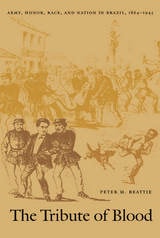
The Tribute of Blood
Army, Honor, Race, and Nation in Brazil, 1864–1945Peter M. Beattie
Duke University Press, 2001
Beattie looks through sociological, anthropological, and historical lenses to analyze archival sources such as court-martial cases, parliamentary debates, published reports, and the memoirs and correspondence of soldiers and officers. Combining these materials with a colorful array of less traditional sources—such as song lyrics, slang, grammatical evidence, and tattoo analysis—he reveals how the need to reform military recruitment with a conscription lottery became increasingly apparent in the wake of the Paraguayan War of 1865–1870 and again during World War I. Because this crucial reform required more than changing the army’s institutional roles and the conditions of service, The Tribute of Blood is ultimately the story of how entrenched conceptions of manhood, honor, race, citizenship, and nation were transformed throughout Brazil.
Those interested in social, military, and South American history, state building and national identity, and the sociology of the poor will be enriched by this pathbreaking study.
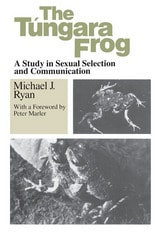
The Tungara Frog
A Study in Sexual Selection and CommunicationMichael J. Ryan
University of Chicago Press, 1985
In TheTúngara Frog, the most detailed and informative single study available of frogs and their reproductive behavior, Michael J. Ryan demonstrates the interplay of sexual and natural selection. Using techniques from ethology, behavioral ecology, sensory physiology, physiological ecology, and theoretical population genetics in his research, Ryan shows that large males with low-frequency calls mate most successfully. He examines in detail a number of explanations for the females' preferences, and he considers possible evolutionary forces leading to the males' success.
Though certain vocalizations allow males to obtain mates and thus should be favored by sexual selection, this study highlights two important costs of such sexual displays: the frogs expand considerable energy in their mating calls, and they advertise their whereabouts to predators. Ryan considers in detail how predators, especially the frige-lipped bat (Trachops cirrhosus), affect the evolution of the túngara frog's calls.
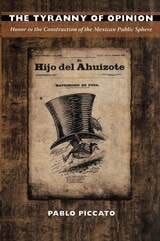
The Tyranny of Opinion
Honor in the Construction of the Mexican Public SpherePablo Piccato
Duke University Press, 2010
Tracing how notions of honor changed in nineteenth-century Mexico, Pablo Piccato examines legislation, journalism, parliamentary debates, criminal defamation cases, personal stories, urban protests, and the rise and decline of dueling in the 1890s. He highlights the centrality of notions of honor to debates over the nature of Mexican liberalism, describing how honor helped to define the boundaries between public and private life; balance competing claims of free speech, public opinion, and the protection of individual reputations; and motivate politicians, writers, and other men to enter public life. As Piccato explains, under the authoritarian rule of Porfirio Díaz, the state became more active in the protection of individual reputations. It implemented new restrictions on the press. This did not prevent people from all walks of life from defending their honor and reputations, whether in court or through violence. The Tyranny of Opinion is a major contribution to a new understanding of Mexican political history and the evolution of Mexican civil society.
The United States and Latin America
Myths and Stereotypes of Civilization and NatureBy Fredrick B. Pike
University of Texas Press, 1992
The lazy greaser asleep under a sombrero and the avaricious gringo with money-stuffed pockets are only two of the negative stereotypes that North Americans and Latin Americans have cherished during several centuries of mutual misunderstanding. This unique study probes the origins of these stereotypes and myths and explores how they have shaped North American impressions of Latin America from the time of the Pilgrims up to the end of the twentieth century.
Fredrick Pike's central thesis is that North Americans have identified themselves with "civilization" in all its manifestations, while viewing Latin Americans as hopelessly trapped in primitivism, the victims of nature rather than its masters. He shows how this civilization-nature duality arose from the first European settlers' perception that nature—and everything identified with it, including American Indians, African slaves, all women, and all children—was something to be conquered and dominated. This myth eventually came to color the North American establishment view of both immigrants to the United States and all our neighbors to the south.
The Unpast
Elite Violence and Social Control in Brazil, 1954–2000R. S. Rose
Ohio University Press, 2005
Portuguese and Brazilian slave-traders shipped at least four million slaves to Brazil—in contrast to the five hundred thousand slaves that English vessels brought to the Americas. Controlling the vast number of slaves in Brazil became of primary importance. The Unpast: Elite Violence and Social Control in Brazil, 1954–2000 documents the ways in which the brutal methods used on plantations led directly to the phenomenon of Brazilian death squads.
The Unpast examines how and why, after the abolition of slavery, elites in Brazil imported new methods of killing, torturing, or disfiguring dissidents and the poor to maintain dominance. Bringing a critical-historical analysis to events following the 1954 suicide of President Getúlio Vargas, R. S. Rose takes the reader along a fifty-year path that helped to shape a nation’s morals. He covers the misunderstood presidency of João Goulart; the overthrow of his government by a U.S.-assisted military; the appalling dictatorship that followed; the efforts to rid the countryside of troublemakers; and the ongoing attempt to cleanse the urban environment of the needy, an endeavor that produced 32,675 victims in just two Brazilian states between 1954 and 2000.
The largest and most comprehensive documentation of suspected death-squad victims ever undertaken, The Unpast is an exposé of practices and attitudes toward the poor in Latin America’s largest country.
The Use of Land and Water Resources in the Past and Present Valley of Oaxaca, Mexico
Anne V. T. Kirkby
University of Michigan Press, 1973
The Vanguard of the Atlantic World
Creating Modernity, Nation, and Democracy in Nineteenth-Century Latin AmericaJames E. Sanders
Duke University Press, 2014
The Vanishing Frame
Latin American Culture and Theory in the Postdictatorial EraBy Eugenio Claudio Di Stefano
University of Texas Press, 2018
In the postdictatorial era, Latin American cultural production and criticism have been defined by a series of assumptions about politics and art—especially the claim that political freedom can be achieved by promoting a more direct experience between the textual subject (often a victim) and the reader by eliminating the division between art and life. The Vanishing Frame argues against this conception of freedom, demonstrating how it is based on a politics of human rights complicit with economic injustices. Presenting a provocative counternarrative, Eugenio Claudio Di Stefano examines literary, visual, and interdisciplinary artists who insist on the autonomy of the work of art in order to think beyond the politics of human rights and neoliberalism in Latin American theory and culture.
Di Stefano demonstrates that while artists such as Diamela Eltit, Ariel Dorfman, and Albertina Carri develop a concept of justice premised on recognizing victims’ experiences of torture or disappearance, they also ignore the injustice of economic inequality and exploitation. By examining how artists such as Roberto Bolaño, Alejandro Zambra, and Fernando Botero not only reject an aesthetics of experience (and the politics it entails) but also insist on the work of art as a point of departure for an anticapitalist politics, this new reading of Latin American cultural production offers an alternative understanding of recent developments in Latin American aesthetics and politics that puts art at its center and the postdictatorship at its end.
The Vegetational History of the Oaxaca Valley and Zapotec Plant Knowledge
C. Earle Smith and Ellen Messer
University of Michigan Press, 1978

The Viceregency of Antonio María Bucareli in New Spain, 1771–1779
By Bernard E. Bobb
University of Texas Press, 1962
When Antonio María Bucareli took up his duties in 1771 as the forty-sixth viceroy of New Spain, he assumed command of a magnificent complexity of land areas, large and small, whose people constituted a cultural and social entity ranging from the traditional Apache to the European gentleman of the Enlightenment.
He governed a key area at a significant time. Shortly before Bucareli's arrival in Mexico, José de Gálvez had completed an intensive inspection of the country, had instituted many reforms, and was ready to present the new viceroy with progressive policies for administrative reorganization.
How Bucareli, a loyal, indefatigable Spanish aristocrat, reacted to the new order is the particular concern of this book. It examines the actions and reflections of this cautious and conservative man as they relate to certain major problems of his administration: defense, the colonization of the Californias, mining, the Roman Catholic Church, the interior provinces, and—above all—filling Spanish coffers with Mexican pesos as resurgent Spain strove to regain her former position in world affairs.
The period of Bucareli's viceregency is seen as a transitional one, during which the seeds of the Enlightenment, of change, even of rebellion, were sown but had not yet begun to sprout. Bucareli, conservative by nature and training, continued to administer New Spain on the basis of a well-established and traditional system, although he supported changes of mere modification or those offering greater efficiency. Evidence of his dual success is the fact that revenues climbed steadily during his tenure and that Charles III was exceptionally pleased with his performance, while at the same time he won from people of all stations a degree of respect and affection far beyond that usually accorded to a viceroy.
Prior to the publication of Bucareli, only two other full-scale studies of Spanish viceroys existed, and both of them were concerned with sixteenth-century officials. The appearance of this book, providing at once a study of an important figure and of the system of viceregal administration as it had developed by the latter part of the eighteenth century, filled a long-existing gap in Latin American literature.
The heart of this study comes from the prodigious correspondence that passed between the Viceroy and Madrid. Authority for most statements was found in the thousands of documents that the author perused in the Archivo General de Indies in Seville and in the Archivo General de la Nación in Mexico City.
The Virgin of Guadalupe and the Conversos
Uncovering Hidden Influences from Spain to MexicoHernández, Marie-Theresa
Rutgers University Press, 2014
The terms converso and judaizante are often used for descendants of Spanish Jews (the Sephardi, or Sefarditas as they are sometimes called), who converted under duress to Christianity in the fourteenth and fifteenth centuries. There are few, if any, archival documents that prove the existence of judaizantes after the Spanish expulsion of the Jews in 1492 and the Portuguese expulsion in 1497, as it is unlikely that a secret Jew in sixteenth-century Spain would have documented his allegiance to the Law of Moses, thereby providing evidence for the Inquisition.
On a Da Vinci Code – style quest, Hernández persisted in hunting for a trove of forgotten manuscripts at the New York Public Library. These documents, once unearthed, describe the Jewish/Christian religious beliefs of an early nineteenth-century Catholic priest in Mexico City, focusing on the relationship between the Virgin of Guadalupe and Judaism. With this discovery in hand, the author traces the cult of Guadalupe backwards to its fourteenth-century Spanish origins. The trail from that point forward can then be followed to its interface with early modern conversos and their descendants at the highest levels of the Church and the monarchy in Spain and Colonial Mexico. She describes key players who were somehow immune to the dangers of the Inquisition and who were allowed the freedom to display, albeit in a camouflaged manner, vestiges of their family's Jewish identity.
By exploring the narratives produced by these individuals, Hernández reveals the existence of those conversos and judaizantes who did not return to the “covenantal bond of rabbinic law,” who did not publicly identify themselves as Jews, and who continued to exhibit in their influential writings a covert allegiance and longing for a Jewish past. This is a spellbinding and controversial story that offers a fresh perspective on the origins and history of conversos.
The Visual Guillotine
The Cinematic Cut and Politics in Latin AmericaThomas Matusiak
University of Minnesota Press, 2026
The violence of the cinematic cut in twentieth-century Latin American film
Splice, montage, close-up: modern cinema routinely presents bodies in pieces. Not unlike the guillotine, argues Thomas Matusiak, these techniques have served both overt and symbolic political ends as they accomplish and project the efficient production of severed bodies. In The Visual Guillotine, Matusiak traces the use of cinematic tools of dismemberment in twentieth-century Latin American film to theorize the symbolic and material violence of the cut.
A robust genealogy of Latin American cinematic politics, The Visual Guillotine encompasses national filmmaking traditions; radical and reactionary political registers; and the proliferated aesthetics of narrative, documentary, experimental, and expanded cinema through an innovative critical viewing practice. From the national cinemas of the 1930s to the decapitation videos produced in the Mexican narco-conflict and beyond, Matusiak shows how the cinematic cut has been employed to inspire terror as well as invoke and critique a range of political programs.
A refreshing dialogue between film theory and Latin American cultural studies, The Visual Guillotine offers a new way for film to conceptualize politics. In our present political moment, with rapidly generated and circulated visual media central to a resurgent leftist-populist battle against oligarchy and authoritarianism, this book calls for readers to reassess their viewing position when confronted with violent imagery.
Retail e-book files for this title are screen-reader friendly with images accompanied by short alt text and/or extended descriptions.
The Visual in Latin American History
Edited by Ernesto Capello and Jessica Stites Mor
University of Texas Press, 2026
A collection of essays examining the role of visual materials in shaping Latin American lives, historical thought, and worldmaking.
Historians have long valued visual media as a source of documentation and illustration. More recently, scholars have also been turning to visual media for another purpose: to directly observe historical processes. Paintings, maps, visual narratives, graffiti, photography—these objects do not simply transmit information about events; they are events. They imbue the historical change we seek to understand.
The Visual in Latin American History is a collection of essays that applies cutting-edge visual-studies methodology to the history of Central and South America and the Caribbean. Contributors focus on the visual production of postcolonial national imaginaries across Latin America—mythologies that purposely omitted Indigenous groups, African diasporic communities, and new migrants from Europe and Asia. The essays range across a vast territory, including erasure in archeology and Afro-Colombian portraiture; image making in domestic spaces and social movements; the visual vocabularies of urban planning and agrarian reform; military “performance” and anti-imperial Cold War exchanges; and humanitarian documentary along the US border.Collectively, the authors show how visual methods can radically transform our understanding of power and culture in Latin America and beyond.

The Vortex
A NovelJosé Eustasio Rivera
Duke University Press, 2018
The War of the Fatties and Other Stories from Aztec History
By Salvador Novo
University of Texas Press, 1993
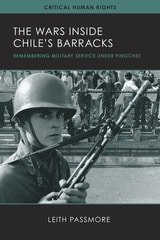
The Wars inside Chile's Barracks
Remembering Military Service under PinochetLeith Passmore
University of Wisconsin Press, 2020
Relying on unpublished material, testimony, interviews, and field notes, Passmore locates these individuals' narratives of victimhood at the intersection of long-term histories of patriotism, masculinity, and cyclical poverty. These accounts reveal in detail how Pinochet's war against his own citizens—as well as the "almost-wars" with neighboring Peru, Bolivia, and Argentina—were also waged inside Chile's army barracks.
The Washington Dissensus
A Privileged Observer's Perspective on US-Brazil RelationsRubens Barbosa
Vanderbilt University Press, 2014
In this memoir, translated from the Portuguese, Barbosa recounts the most significant regional and global issues that arose, alongside the domestic political conflicts within a divided North American society. Barbosa provides sophisticated analysis of economic relations during these changing times, and also explores the many US misconceptions about Brazil and the Latin American region.
From the privileged post of observation that an ambassadorship in the American capital represents, Barbosa had the exceptional opportunity over a considerable length of time to closely follow relations between Brazil and the United States. He witnessed relations evolve under two governments as they developed distinct foreign policies, which at times led to a breakdown in understanding between the two countries.

The Water Defenders
How Ordinary People Saved a Country from Corporate GreedRobin Broad and John Cavanagh with Graphic Adaptation by Jon Sack
The Ohio State University Press, 2026
Initially excited by the company’s promises of jobs and prosperity, farmer Vidalina Morales, brothers Marcelo and Miguel Rivera, and others soon realized that the trade-off was catastrophic contamination of El Salvador’s main source of fresh water. Facing corporate machinations and violence, the ordinary people of San Isidro and surrounding communities built a transnational coalition that prevailed over powerful adversaries to score an environmental victory with worldwide repercussions.
Broad and Cavanagh draw on over a decade of research, interviews, and experience as allies and experts in international development to recount the harrowing saga. A blueprint for civic bravery and local-to-global activism, as well as a rich history of Central America’s political conflicts and people’s fights against environmental and economic exploitation, this story will inspire anyone who feels helpless against corporate malfeasance.
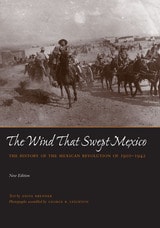
The Wind that Swept Mexico
The History of the Mexican Revolution of 1910-1942Text by Anita Brenner
University of Texas Press, 1971
The Mexican Revolution began in 1910 with the overthrow of dictator Porfirio Díaz. The Wind That Swept Mexico, originally published in 1943, was the first book to present a broad account of that revolution in its several different phases. In concise but moving words and in memorable photographs, this classic sweeps the reader along from the false peace and plenty of the Díaz era through the doomed administration of Madero, the chaotic years of Villa and Zapata, Carranza and Obregón, to the peaceful social revolution of Cárdenas and Mexico's entry into World War II.
The photographs were assembled from many sources by George R. Leighton with the assistance of Anita Brenner and others. Many of the prints were cleaned and rephotographed by the distinguished photographer Walker Evans.
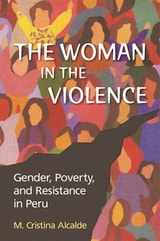
The Woman in the Violence
Gender, Poverty, and Resistance in PeruM. Cristina Alcalde
Vanderbilt University Press, 2010
Focusing on the experiences of women who are predominantly poor, nonwhite, rural-to-urban migrants with little or no formal education, The Woman in the Violence addresses a range of serious concerns. What types of violence do women experience at different stages in their lives? Which identities and roles are manifested throughout their lives, and do some of these increase their vulnerability to different forms of violence? What strategies do women employ to gain some power and control in these situations, and how can we conceptualize these strategies?
In examining these questions, The Woman in the Violence contributes to our understanding of violence, gender, race, resistance, and urbanism as it exposes and analyzes systemic violence against women. The everyday forms of resistance these women employ provide significant insight for students, scholars, and health professionals.
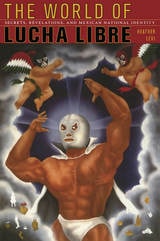
The World of Lucha Libre
Secrets, Revelations, and Mexican National IdentityHeather Levi
Duke University Press, 2008
Levi considers lucha libre in light of scholarship about sport, modernization, and the formation of the Mexican nation-state, and in connection to professional wrestling in the United States. She examines the role of secrecy in wrestling, the relationship between wrestlers and the characters they embody, and the meanings of the masks worn by luchadors. She discusses male wrestlers who perform masculine roles, those who cross-dress and perform feminine roles, and female wrestlers who wrestle each other. Investigating the relationship between lucha libre and the mass media, she highlights the history of the sport’s engagement with television: it was televised briefly in the early 1950s, but not again until 1991. Finally, Levi traces the circulation of lucha libre symbols in avant-garde artistic movements and its appropriation in left-wing political discourse. The World of Lucha Libre shows how a sport imported from the United States in the 1930s came to be an iconic symbol of Mexican cultural authenticity.
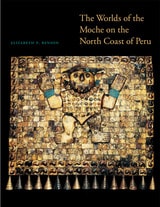
The Worlds of the Moche on the North Coast of Peru
By Elizabeth P. Benson
University of Texas Press, 2012
The Moche, or Mochica, created an extraordinary civilization on the north coast of Peru for most of the first millennium AD. Although they had no written language with which to record their history and beliefs, the Moche built enormous ceremonial edifices and embellished them with mural paintings depicting supernatural figures and rituals. Highly skilled Moche artisans crafted remarkable ceramic vessels, which they painted with figures and scenes or modeled like sculpture, and mastered metallurgy in gold, silver, and copper to make impressive symbolic ornaments. They also wove textiles that were complex in execution and design.
A senior scholar renowned for her discoveries about the Moche, Elizabeth P. Benson published the first English-language monograph on the subject in 1972. Now in this volume, she draws on decades of knowledge, as well as the findings of other researchers, to offer a grand overview of all that is currently known about the Moche. Touching on all significant aspects of Moche culture, she covers such topics as their worldview and ritual life, ceremonial architecture and murals, art and craft, supernatural beings, government and warfare, and burial and the afterlife. She demonstrates that the Moche expressed, with symbolic language in metal and clay, what cultures in other parts of the world presented in writing. Indeed, Benson asserts that the accomplishments of the Moche are comparable to those of their Mesoamerica contemporaries, the Maya, which makes them one of the most advanced civilizations of pre-Columbian America.
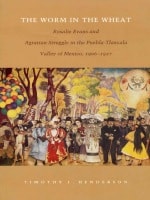
The Worm in the Wheat
Rosalie Evans and Agrarian Struggle in the Puebla-Tlaxcala Valley of Mexico, 1906-1927Timothy J. Henderson
Duke University Press, 1998
In a world where power and wealth are distributed unevenly and where revolutionary ideas aiming to right the balance continue to proliferate, it is essential, Henderson claims, to understand the revolutionary process not as a philosophical abstraction but as intimate human drama. This book, by providing a detailed study of a single case, sheds invaluable light on this process and on the making of modern Mexico. Incorporating extensive primary research, Henderson describes the complexity of international, national, state, and local politics and the corresponding diverse responses to this historic attempt at agrarian reform.
The Worm in the Wheat will be informative reading for those interested in the modern history of Mexico, students of social movements and revolution, Latin Americanists, and scholars of agrarian history.
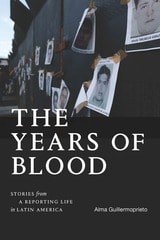
The Years of Blood
Stories from a Reporting Life in Latin AmericaAlma Guillermoprieto
Duke University Press, 2025
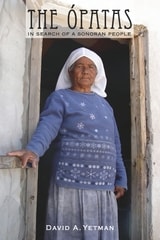
The Ópatas
In Search of a Sonoran PeopleDavid A. Yetman
University of Arizona Press, 2010
David Yetman, a leading ethnobotanist who has traveled extensively in Sonora, consulted more than two hundred archival sources to answer this question. The result is an accessible ethnohistory of the Ópatas, one that embraces historical complexity with an eye toward Opatan strategies of resistance and assimilation. Yetman’s account takes us through the Opatans’ initial encounters with the conquistadors, their resettlement in Jesuit missions, clashes with Apaches, their recruitment as miners, and several failed rebellions, and ultimately arrives at an explanation for their “disappearance.”
Yetman’s account is bolstered by conversations with present-day residents of the Opatería and includes a valuable appendix on the languages of the Opatería by linguistic anthropologist David Shaul. One of the few studies devoted exclusively to this indigenous group, The Ópatas: In Search of a Sonoran People marks a significant contribution to the literature on the history of the greater Southwest.
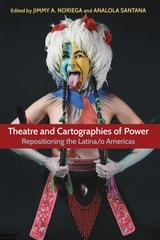
Theatre and Cartographies of Power
Repositioning the Latina/o AmericasEdited by Jimmy A. Noriega and Analola Santana
Southern Illinois University Press, 2018
Building on hemispheric and transnational models, this book demonstrates the capacity of theatre studies to challenge the up-down/North-South approach that dominates scholarship in the United States and presents a strong case for a repositioning of the Latina/o Americas in theatrical histories and practices.

Theorizing Social Movements
Joe Foweraker
Pluto Press, 1995

Theory in the Practice of the Nicaraguan Revolution
Bruce E. Wright
Ohio University Press, 1995
Even in the period following the electoral defeat of the Sandinista National Liberation Front (FSLN) in 1990, the revolution of 1979 continues to have a profound effect on the political economy of Nicaragua. Wright’s study, which is based on interviews with people from all walks of life—from government and party officials to academics and campesinos—as well as on the large volume of literature in both English and Spanish, focuses on the FSLN understanding of the relationships between the state, the party, and mass actors, and the nature of social classes. Wright considers the topics of agrarian reform, the development of mass organizations, the role of labor, and other aspects of the Nicaraguan political economy in order to assess their significance in theoretical as well as practical terms.
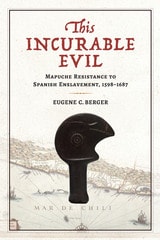
This Incurable Evil
Mapuche Resistance to Spanish Enslavement, 1598–1687Eugene C.Berger
University of Alabama Press, 2023
Documents how initial Mapuche-Spanish alliances were built and how they were destroyed by increasingly powerful slave-trading elites operating like organized crime families
The history of Spanish presence in the Americas is usually viewed as a one-sided conquest. In This Incurable Evil: Mapuche Resistance to Spanish Enslavement, 1598–1687, Eugene C. Berger provides a major corrective in the case of Chile. For example, in the south, indigenous populations were persistent in their resistance against Spanish settlement. By the end of the sixteenth century, Spanish aspirations to conquer the entire Pacific Coast were dashed at least twice by armed resistance from the Mapuche peoples. By 1600, the Mapuche had killed two Spanish governors and occupied more than a dozen Spanish towns. Chile’s colonial future was quite uncertain.
As Berger documents, for much of the seventeenth century it seemed that there could be peace along the Spanish-Mapuche frontier. Through trade, intermarriage, and even mutual distrust of Dutch and English pirates, the Mapuche and the Spanish began to construct a colonial entente. However, this growing alliance was obliterated by the “incurable evil,” an ever-expanding enslavement of Mapuches, and one which prompted a new generation of Mapuche resistance. This trade saw Mapuche rivals, neutrals, and even friends placed in irons and forced to board ships in Valdivia and Concepción or to march northward along the Andes. The Mapuche labored in the gold mines of La Serena, in urban workshops in Lima, in the silver mines of Potosí, or on the thousands of haciendas in between and would never return to their homes. With this tragic betrayal, Chile was left a more corrupt, violent, and polarized place, which would cause deep wounds for centuries.