Results by title
2285 books match the query 'Women' and 370 start with t
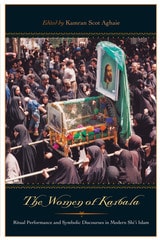
The Women of Karbala
Ritual Performance and Symbolic Discourses in Modern Shi'i IslamEdited by Kamran Scot Aghaie
University of Texas Press, 2005
Commemorating the Battle of Karbala, in which the Prophet Mohammad's grandson Hosayn and seventy-two of his family members and supporters were martyred in 680 CE, is the central religious observance of Shi'i Islam. Though much has been written about the rituals that reenact and venerate Karbala, until now no one has studied women's participation in these observances. This collection of original essays by a multidisciplinary team of scholars analyzes the diverse roles that women have played in the Karbala rituals, as well as the varied ways in which gender-coded symbols have been used within religious and political discourses.
The contributors to this volume consider women as participants in and observers of the Karbala rituals in Iran, Iraq, Lebanon, India, Pakistan, and the United States. They find that women's experiences in the Shi'i rituals vary considerably from one community to another, based on regional customs, personal preferences, religious interpretations, popular culture, and socioeconomic background. The authors also examine the gender symbolism within the rituals, showing how it reinforces distinctions between the genders while it also highlights the centrality of women to the symbolic repertory of Shi'ism. Overall, the authors conclude that while Shi'i rituals and symbols have in some ways been used to restrict women's social roles, in other ways they have served to provide women with a sense of independence and empowerment.
The Women of Katrina
How Gender, Race, and Class Matter in an American DisasterEmmanuel David
Vanderbilt University Press, 2012
The Women of Provincetown, 1915–1922
Cheryl Black
University of Alabama Press, 2001
In this fascinating work, Cheryl Black reveals that, in addition to its role in developing an American tradition of non-commercial theatre, Provincetown has another, largely unacknowledged claim to fame as one of the first theatre companies in America in which women achieved prominence in every area of operation. At a time when women playwrights were rare, women directors rarer, and women scenic designers unheard of, Provincetown’s female members excelled in all of these roles.
In addition to the well-known playwright Susan Gaspell, the company’s female membership included luminaries such poets Edna St. Vincent Millay, Mina Loy, and Djuna Barnes; journalists Louise Bryant and Mary Heaton Vorce; novelists Neith Boyce and Evelyn Scott; and painter Marguerite Zorach. Illuminating a fascinating chapter in the history of one of the world's most picturesque and beloved artist colonies, The Women of Provincetown is an engaging work of social history, offering new insights into the relationship between gender and theatre. This work includes 40 images of the key artists in the book.
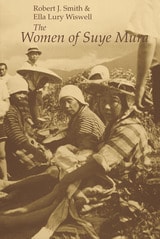
The Women of Suye Mura
Robert J. Smith and Ella Lury Wiswell
University of Chicago Press, 1982
The Women of Suye Mura provides a rich body of information by means of which such stereotypes may be reevaluated and challenged. Based on Ella Wiswell's extensive field notes from the mid-1930s—when she and her late husband John Embree undertook a joint research project in rural Japan—this volume forms a companion to Embree's now-standard Suye Mura: A Japanese Village. Its focus on the women of the village affords a unique look at their daily lives and a detailed portrait of their world-views and social understandings at a time when the orthodoxies of the contemporary state were not yet completely accepted. Through Ella Wiswell's journal, sensitively edited by Robert Smith, we may understand some of their hopes and fears, see what amuses and angers them, and hear their comments on everything from adultery and illness to religion, magic and the origins of the imperial house.
The body of data, secured by direct observation, is unparalleled in the literature. No other account of the lives of Japanese rural women of this era remains, and in no contemporary community can their like be found. The Women of Suye Mura will thus serve as an important resource for anyone interested in the past—and present—of the Japanese woman.
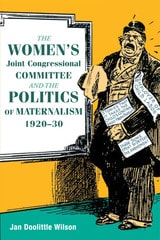
The Women's Joint Congressional Committee and the Politics of Maternalism, 1920-30
Jan Doolittle Wilson
University of Illinois Press, 2006
Jan Doolittle Wilson offers the first comprehensive history of the umbrella organization founded by former suffrage leaders in order to coordinate activities around women's reform. Encompassing nearly every major national women's organization of its time, the Women's Joint Congressional Committee (WJCC) evolved into a powerful lobbying force for the legislative agendas of more than twelve million women. Critics and supporters alike came to recognize it as "the most powerful lobby in Washington."
Examining the WJCC's most consequential and contentious campaigns, Wilson traces how the group's strategies, rhetoric, and success generated congressional and grassroots support for their far-reaching, progressive reforms. But the committee's early achievements sparked a reaction by big business that challenged and ultimately limited the programs these women envisioned. Using the WJCC as a lens, Wilson analyzes women's political culture during the 1920s. She also sheds new light on the initially successful ways women lobbied for social legislation, the limitations of that process for pursuing class-based reforms, and the enormous difficulties the women soon faced in trying to expand public responsibility for social welfare.
A volume in the series Women in American History, edited by Anne Firor Scott, Susan Armitage, Susan K. Cahn, and Deborah Gray White
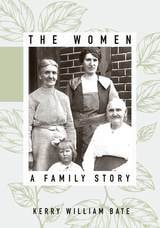
The Women
A Family StoryKerry William Bate
University of Utah Press, 2016
Kerry Bate proceeds on the premise that a story centering on the women of the clan could provide fresh perspective and insight. He portrays real people with well-rounded, flawed characters; builds from deep research; writes with a bit of style; and includes the rich context and detail of these lives. His main subjects are four generations of impressive women: the pioneer Catherine Campbell Steele; her daughter Young Elizabeth, the first Mormon child born in Utah; Kate, an accomplished community leader; and Sarah, a gifted seamstress trapped in an unhappy marriage. To enter their hardscrabble lives in small southern Utah communities is to meet women who pioneered in their own modest but determined ways.
Winner of the Mormon History Association's Best Personal History/Memoir Award.
Interview with Tom Williams on Access Utah
The Work of Rape
Rana M. Jaleel
Duke University Press, 2021
Duke University Press Scholars of Color First Book Award recipient
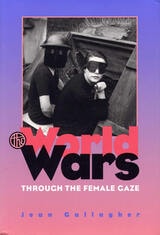
The World Wars Through the Female Gaze
Jean Gallagher
Southern Illinois University Press, 1998
For some women writers and photographers during the two world wars—Edith Wharton, Mildred Aldrich, Martha Gellhorn, Lee Miller, H.D., and Gertrude Stein—the construction of the female subject as an observer of combat became a vital concern. Their explorations of vision took place against the backdrop of a larger shift in Western culture's understanding of what "seeing" meant in common practice and philosophical discourse alike. The role of visuality in their lives was massively transformed not only by the rigid gender roles of war but by the introduction of new combat practices and technologies such as aerial surveillance, trench warfare, and civilian bombardment.
In The World Wars Through the Female Gaze, Jean Gallagher maps one portion of the historicized, gendered territory of what Nancy K. Miller calls the "gaze in representation." Expanding the notion of the gaze in critical discourse, Gallagher situates a number of visual acts within specific historic contexts to reconstruct the wartime female subject. She looks at both the female observer's physical act of seeing—and the refusal to see—for example, a battlefield, a wounded soldier, a torture victim, a national flag, a fashion model, a bombed city, or a wartime hallucination.
The book begins with two instances of wartime propaganda written by American women in France in 1915. Both Edith Wharton's Fighting France and Mildred Aldrich's A Hilltop on the Marne offer a complex and often contradictory sense of a woman writer's struggles with authority, resistance, and killing. In the process, Gallagher teases out the role of specular vision and the impossibility of "directly" seeing the war.
Gallagher then turns to literary and visual texts produced by two female journalists between 1940 and 1945. Martha Gellhorn's 1940 novel A Stricken Field exhibits a range of gendered seeing positions within and in opposition to the visual ideologies of fascism during the Nazi occupation of Czechoslovakia. Lee Miller's war correspondence and photography for Vogue show how Miller constructed herself and her predominantly female American audience as antifascist observers of war by working with and against some of the conventions of surrealist fashion photography.
Gallagher concludes by focusing on the experimental autobiographical prose of H.D. and Gertrude Stein to explore the functions of vision on two World War II "homefronts"—London during the Blitz and Vichy France.
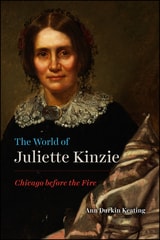
The World of Juliette Kinzie
Chicago before the FireAnn Durkin Keating
University of Chicago Press, 2019
Juliette is one of Chicago’s forgotten founders. Early Chicago is often presented as “a man’s city,” but women like Juliette worked to create an urban and urbane world, often within their own parlors. With The World of Juliette Kinzie, we finally get to experience the rise of Chicago from the view of one of its most important founding mothers.
Ann Durkin Keating, one of the foremost experts on nineteenth-century Chicago, offers a moving portrait of a trailblazing and complicated woman. Keating takes us to the corner of Cass and Michigan (now Wabash and Hubbard), Juliette’s home base. Through Juliette’s eyes, our understanding of early Chicago expands from a city of boosters and speculators to include the world that women created in and between households. We see the development of Chicago society, first inspired by cities in the East and later coming into its own midwestern ways. We also see the city become a community, as it developed its intertwined religious, social, educational, and cultural institutions. Keating draws on a wealth of sources, including hundreds of Juliette’s personal letters, allowing Juliette to tell much of her story in her own words.
Juliette’s death in 1870, just a year before the infamous fire, seemed almost prescient. She left her beloved Chicago right before the physical city as she knew it vanished in flames. But now her history lives on. The World of Juliette Kinzie offers a new perspective on Chicago’s past and is a fitting tribute to one of the first women historians in the United States.
The World of Juliette Kinzie
Chicago before the FireAnn Durkin Keating
University of Chicago Press, 2019
When Juliette Kinzie first visited Chicago in 1831, it was anything but a city. An outpost in the shadow of Fort Dearborn, it had no streets, no sidewalks, no schools, no river-spanning bridges. And with two hundred disconnected residents, it lacked any sense of community. In the decades that followed, not only did Juliette witness the city’s transition from Indian country to industrial center, but she was instrumental in its development.
Juliette is one of Chicago’s forgotten founders. Early Chicago is often presented as “a man’s city,” but women like Juliette worked to create an urban and urbane world, often within their own parlors. With The World of Juliette Kinzie, we finally get to experience the rise of Chicago from the view of one of its most important founding mothers.
Ann Durkin Keating, one of the foremost experts on nineteenth-century Chicago, offers a moving portrait of a trailblazing and complicated woman. Keating takes us to the corner of Cass and Michigan (now Wabash and Hubbard), Juliette’s home base. Through Juliette’s eyes, our understanding of early Chicago expands from a city of boosters and speculators to include the world that women created in and between households. We see the development of Chicago society, first inspired by cities in the East and later coming into its own midwestern ways. We also see the city become a community, as it developed its intertwined religious, social, educational, and cultural institutions. Keating draws on a wealth of sources, including hundreds of Juliette’s personal letters, allowing Juliette to tell much of her story in her own words.
Juliette’s death in 1870, just a year before the infamous fire, seemed almost prescient. She left her beloved Chicago right before the physical city as she knew it vanished in flames. But now her history lives on. The World of Juliette Kinzie offers a new perspective on Chicago’s past and is a fitting tribute to one of the first women historians in the United States.

The World through the Dime Store Door
A MemoirAileen Kilgore Henderson
University of Alabama Press, 2020
A coming-of-age memoir evoking farm, mining, and small-town life in Alabama’s Tuscaloosa County as the world transitions from the Great Depression to World War II.
In the 1930s, the rural South was in the throes of the Great Depression. Farm life was monotonous and hard, but a timid yet curious teenager thought it worth recording. Aileen Kilgore Henderson kept a chronicle of her family’s daily struggles in Tuscaloosa County alongside events in the wider world she gleaned from shortwave radio and the occasional newspaper. She wrote about Howard Hughes’s round-the-world flight and her horror at the rise to power in Germany of a bizarre politician named Adolf Hitler. Henderson longed to join the vast world beyond the farm, but feared leaving the refuge of her family and beloved animals.
Yet, with her father’s encouragement, she did leave, becoming a clerk in the Kress dime store in downtown Tuscaloosa. Despite long workdays and a lengthy bus commute, she continued to record her observations and experiences in her diary, for every day at the dime store was interesting and exciting for an observant young woman who found herself considering new ideas and different points of view.
Drawing on her diary entries from the 1930s and early 1940s, Henderson recollects a time of sweeping change for Tuscaloosa and the South. The World through the Dime Store Door is a personal and engaging account of a Southern town and its environs in transition told through the eyes of a poor young woman with only a high school education but gifted with a lively mind and an openness to life.
The Worth of Women
Wherein Is Clearly Revealed Their Nobility and Their Superiority to MenModerata Fonte
University of Chicago Press, 1997
Moderata Fonte was the pseudonym of Modesta Pozzo (1555–92), a Venetian woman who was something of an anomaly. Neither cloistered in a convent nor as liberated from prevailing codes of decorum as a courtesan might be, Pozzo was a respectable, married mother who produced literature in genres that were commonly considered "masculine"—the chivalric romance and the literary dialogue. This work takes the form of the latter, with Fonte creating a conversation among seven Venetian noblewomen. The dialogue explores nearly every aspect of women's experience in both theoretical and practical terms. These women, who differ in age and experience, take as their broad theme men's curious hostility toward women and possible cures for it.
Through this witty and ambitious work, Fonte seeks to elevate women's status to that of men, arguing that women have the same innate abilities as men and, when similarly educated, prove their equals. Through this dialogue, Fonte provides a picture of the private and public lives of Renaissance women, ruminating on their roles in the home, in society, and in the arts.
A fine example of Renaissance vernacular literature, this book is also a testament to the enduring issues that women face, including the attempt to reconcile femininity with ambition.
The Wounded Woman
Healing the Father-Daughter RelationshipLinda Schierse Leonard
Ohio University Press, 1982
This book is an invaluable key to self-understanding. Using examples from her own life and the lives of her clients, as well as from dreams, fairy tales, myths, films, and literature, Linda Schierse Leonard, a Jungian analyst, exposes the wound of the spirit that both men and women of our culture bear—a wound that is grounded in a poor relationship between masculine and feminine principles.
Leonard speculates that when a father is wounded in his own psychological development, he is not able to give his daughter the care and guidance she needs. Inheriting this wound, she may find that her ability to express herself professionally, intellectually, sexually, and socially is impaired. On a broader scale, Leonard discusses how women compensate for cultural devaluation, resorting to passive submission (“the Eternal Girl”), or a defensive imitation of the masculine (“the Armored Amazon”).
The Wounded Woman shows that by understanding the father-daughter wound and working to transform it psychologically, it is possible to achieve a fruitful, caring relationship between men and women, between fathers and daughters, a relationship that honors both the mutuality and the uniqueness of the sexes.
The Wounds That Bind Us
Kelley Shinn
West Virginia University Press, 2023
The improbable and powerful true story of a single mother with prosthetics for both legs who travels the globe with her young daughter in a Land Rover.
“A harrowing memoir. . . . Readers may not want to follow in [Shinn’s] footsteps, but they will never be bored with her as a companion.” —Kirkus Reviews
The Wounds That Bind Us is the improbable true story of Kelley Shinn, an orphan at birth who loses her legs at the age of sixteen to a rare bacterial pathogen. She becomes an avid off-road racer and, as a single mother, attempts to drive around the globe in a Land Rover with her three-year-old daughter in tow to bring light to the plight of land mine survivors. With unflinching honesty, exceptional lyricism, and biting humor, Shinn (“that’s two Ns and no shins”) takes readers on a wild journey—literal and emotional—filled with striking characters and landscapes, heartbreaks, and hard-won insights, ultimately arriving at a place of profound redemption.
Told with the energy and intensity of the adventure story it is, this terrifically rich and nuanced examination of a life is also a careful meditation on renewal—a remapping of the world. Guided by the narrator’s keen introspection and her ability to look resolutely at harrowing sorrows and still find hope, joy, and meaning, The Wounds That Bind Us will resonate deeply, long after the last page.

Their Day In The Sun
Women Of The Manhattan ProjectRuth H. Howes
Temple University Press, 2003
Theorizing NGOs
States, Feminisms, and NeoliberalismVictoria Bernal and Inderpal Grewal, eds.
Duke University Press, 2014
Contributors. Sonia E. Alvarez, Victoria Bernal, LeeRay M. Costa, Inderpal Grewal, Laura Grünberg, Elissa Helms, Julie Hemment, Saida Hodžic, Lamia Karim, Sabine Lang, Lauren Leve, Kathleen O'Reilly, Aradhana Sharma
There Was an Old Woman
Reflections on These Strange, Surprising, Shining YearsAndrea Carlisle
Oregon State University Press, 2023
In these personal essays, Carlisle looks for new ways to bring herself more fully to this time of life, such as daily walks with other women and connecting to the natural world that surrounds her houseboat on an Oregon river at the foot of a forest. She writes about experiences shared with many, if not most, older women: wondering at her body’s transformation, discovering new talents, caregiving, facing loss, tuning in to life patterns and drawing strength through understanding them, letting go (or not) of pieces of the past, and facing other changes large and small. Those curious about, approaching, or living in old age will find wisdom and insight in her unique perspective.
In a voice that rings with clarity, humor, humility, Carlisle shows us that Old Age is not another country where we can expect to find The Old Woman grimly waiting, but is instead an expansion of the borders in the country we’re most familiar with: ourselves.

There's Nothing Left for You Here
Allegra Solomon
Four Way Books, 2025

They Kept Running
Michelle Ross
University of North Texas Press, 2022
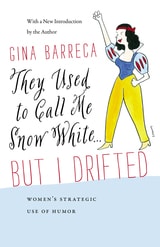
They Used to Call Me Snow White . . . But I Drifted
Women’s Strategic Use of HumorGina Barreca
University Press of New England, 2013
Things Fall Away
Philippine Historical Experience and the Makings of GlobalizationNeferti X. M. Tadiar
Duke University Press, 2009
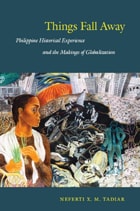
Tadiar treats the historical experiences articulated in feminist, urban protest, and revolutionary literatures of the 1960s–90s as “cultural software” for the transformation of dominant social relations. She considers feminist literature in relation to the feminization of labor in the 1970s, when between 300,000 and 500,000 prostitutes were working in the areas around U.S. military bases, and in the 1980s and 1990s, when more than five million Filipinas left the country to toil as maids, nannies, nurses, and sex workers. She reads urban protest literature in relation to authoritarian modernization and crony capitalism, and she reevaluates revolutionary literature’s constructions of the heroic revolutionary subject and the messianic masses, probing these social movements’ unexhausted cultural resources for radical change.
Third Wave Agenda
Being Feminist, Doing FeminismLeslie Heywood
University of Minnesota Press, 1997
Discusses the challenges and pleasures of creating a new feminism.
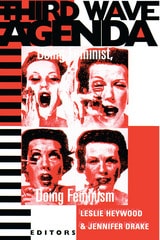
Young feminists have grown up with a plethora of cultural choices and images-in the distance from Gloria Steinem to Courtney Love, a chasm has been traversed and an entire history made. In Third Wave Agenda, feminists born between the years 1964 and 1973 discuss the things that matter now, both in looking back at the accomplishments and failures of the past and in planning for the challenges of the future.
The women and men writing here are activists, teachers, cultural critics, artists, and journalists. They distinguish themselves from a group of young, conservative feminists, including Naomi Wolf and Katie Roiphe, who criticize second wave feminists and are regularly called on to speak for the “next generation” of feminism. In contrast, Third Wave Agenda seeks to complicate our understanding of feminism by not only embracing the second wave critique of beauty culture, sexual abuse, and power structures, but also emphasizing ways that desires and pleasures such as beauty and power can be used to enliven activist work, even while recognizing the importance of maintaining a critique of them.Combining research, theory, and social practice with an autobiographical style, these writers are hard at work creating a new feminism that draws on the submerged histories of other feminisms-black feminism, “womanism,” and working-class feminism, among others. Some topics explored in Third Wave Agenda include feminism in popular music, interracial coalitions, and tensions between individual ambitions and collective action. Contributors: Barry Baldridge, Ana Marie Cox, Ophira Edut, Tali Edut, Carol Guess, Freya Johnson, Melissa Klein, Dyann Logwood, Annalee Newitz, Jeff Niesel, Jennifer Reed, Jillian Sandel, Leigh Shoemaker, Michelle Sidler, Deborah L. Siegel, Jen Smith, Carolyn Sorisio, and Lidia Yukman.
This Book Is an Action
Feminist Print Culture and Activist AestheticsEdited by Jaime Harker and Cecilia Konchar Farr
University of Illinois Press, 2016
This Brain Had a Mouth
Lucy Gwin and the Voice of Disability NationJames M. Odato
University of Massachusetts Press, 2021
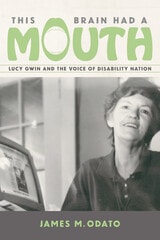
In this engrossing biography, James M. Odato provides an intimate portrait of Gwin, detailing how she forged her own path into activism. After an automobile accident left her with a brain injury, Gwin became a tireless advocate for the equal rights of people she termed "dislabled." More than just a publisher, she fought against corruption in the rehabilitation industry, organized for the group Not Dead Yet, and much more. With Gwin's story at the center, Odato introduces readers to other key disability rights activists and organizations, and supplies context on current contentious topics such as physician-assisted suicide. Gwin's impact on disability rights was monumental, and it is time her story is widely known.
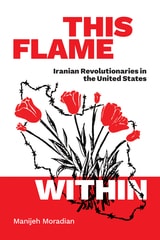
This Flame Within
Iranian Revolutionaries in the United StatesManijeh Moradian
Duke University Press, 2022
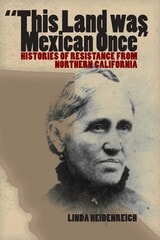
This Land Was Mexican Once
Histories of Resistance from Northern CaliforniaBy Linda Heidenreich
University of Texas Press, 2007
The territory of Napa County, California, contains more than grapevines. The deepest roots belong to Wappo-speaking peoples, a group whose history has since been buried by the stories of Spanish colonizers, Californios (today's Latinos), African Americans, Chinese immigrants, and Euro Americans. Napa's history clearly is one of co-existence; yet, its schoolbooks tell a linear story that climaxes with the arrival of Euro Americans. In "This Land was Mexican Once," Linda Heidenreich excavates Napa's subaltern voices and histories to tell a complex, textured local history with important implications for the larger American West, as well.
Heidenreich is part of a new generation of scholars who are challenging not only the old, Euro-American depiction of California, but also the linear method of historical storytelling—a method that inevitably favors the last man writing. She first maps the overlapping histories that comprise Napa's past, then examines how the current version came to dominate—or even erase—earlier events. So while history, in Heidenreich's words, may be "the stuff of nation-building," it can also be "the stuff of resistance." Chapters are interspersed with "source breaks"—raw primary sources that speak for themselves and interrupt the linear, Euro-American telling of Napa's history. Such an inclusive approach inherently acknowledges the connections Napa's peoples have to the rest of the region, for the linear history that marginalizes minorities is not unique to Napa. Latinos, for instance, have populated the American West for centuries, and are still shaping its future. In the end, "This Land was Mexican Once" is more than the story of Napa, it is a multidimensional model for reflecting a multicultural past.
This Thing Called Love
Alawiya Sobh
Seagull Books, 2023
Just before the outbreak of the July 2006 war in Lebanon, a middle-aged woman named Nahla has gone missing. Distraught, besieged, and without any leads, Nahla’s dearest friends—Suad, Azizeh, Hoda, Nadine, and the narrator Alawiya—band together to console one another. They reminisce about the better days of their youth, lifetimes of romantic turmoil, the trouble with love, and their inescapable confrontation with death. Unsure whether Nahla has been killed in the fighting, fled the country, or disappeared into the oblivion of Alzheimer’s, Alawiya pieces together Nahla’s intimate past, simultaneously illuminating the jagged history of modern Lebanon. Through searching discussions with Nahla’s closest confidante Suad, tenacious investigation, and an imaginative effort to reconstruct the life of another, Alawiya might just find a way to bring Nahla back.
In This Thing Called Love, celebrated Lebanese novelist Alawiya Sobh takes the war between Israel and Hizballah as the backdrop for a heart-wrenching story about love, loss, sex, friendship between women, and the universal struggle to come to terms with mortality.
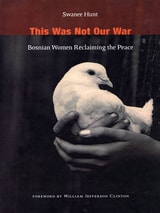
This Was Not Our War
Bosnian Women Reclaiming the PeaceSwanee Hunt
Duke University Press, 2004
This Was Not Our War shares amazing first-person accounts of twenty-six Bosnian women who are reconstructing their society following years of devastating warfare. A university student working to resettle refugees, a paramedic who founded a veterans’ aid group, a fashion designer running two nonprofit organizations, a government minister and professor who survived Auschwitz—these women are advocates, politicians, farmers, journalists, students, doctors, businesswomen, engineers, wives, and mothers. They are from all parts of Bosnia and represent the full range of ethnic traditions and mixed heritages. Their ages spread across sixty years, and their wealth ranges from expensive jewels to a few chickens. For all their differences, they have this much in common: all survived the war with enough emotional strength to work toward rebuilding their country. Swanee Hunt met these women through her diplomatic and humanitarian work in the 1990s. Over the course of seven years, she conducted multiple interviews with each one. In presenting those interviews here, Hunt provides a narrative framework that connects the women’s stories, allowing them to speak to one another.
The women describe what it was like living in a vibrant multicultural community that suddenly imploded in an onslaught of violence. They relate the chaos; the atrocities, including the rapes of many neighbors and friends; the hurried decisions whether to stay or flee; the extraordinary efforts to care for children and elderly parents and to find food and clean drinking water. Reflecting on the causes of the war, they vehemently reject the idea that age-old ethnic hatreds made the war inevitable. The women share their reactions to the Dayton Accords, the end of hostilities, and international relief efforts. While they are candid about the difficulties they face, they are committed to rebuilding Bosnia based on ideals of truth, justice, and a common humanity encompassing those of all faiths and ethnicities. Their wisdom is instructive, their courage and fortitude inspirational.
Three Cartesian Feminist Treatises
François Poullain de la Barre
University of Chicago Press, 2002
Poullain published three books (anonymously) on this topic in the 1670s, all of which are included in English translation in this volume. In On the Equality of the Two Sexes he argued that the supposedly "natural" inferiority of women was culturally produced. To help women recognize and combat this prejudice, Poullain advocated a modern, enlightened feminine education in On the Education of Ladies. Finally, since his contemporaries largely ignored Poullain's writings, he offered a rebuttal to his own arguments in On the Excellence of Men—a rebuttal that he promptly countered, strengthening his original positions.
A truly modern feminist, Poullain laid the intellectual groundwork for the women's liberation movement centuries before it happened.
Three Spanish Querelle Texts
Grisel and Mirabella, The Slander against Women, and The Defense of Ladies against SlanderersPere Torrellas and Juan de Flores
Iter Press, 2013

Three Stars of Redemption
The Influential Women in the Life of Franz RosenzweigAmy Hill Shevitz
University of Alabama Press, 2026
A revelatory study of the overlooked ways that Franz Rosenzweig’s closest relationships with women shaped his philosophical legacy and reframed Jewish thought
Three Stars of Redemption: The Influential Women in the Life of Franz Rosenzweig by Amy Hill Shevitz offers a groundbreaking reexamination of Franz Rosenzweig, one of the most influential Jewish philosophers of the twentieth century, through the lens of three pivotal women in his life. The book is a compelling study of the ways that Rosenzweig’s intellectual and emotional world were shaped by his mother, Adele Alsberg Rosenzweig, his wife, Edith Hahn Rosenzweig, and his lover Margrit Rosenstock-Huessy, charting the influence those women had, by extension, on modern Jewish thought.
Rosenzweig is best known for his work of essential religious philosophy The Star of Redemption and his role in the Weimar Jewish Renaissance. Yet Shevitz reveals how the maternal, romantic, and marital relationships he maintained were not peripheral but central to his philosophical development and lived Judaism. Drawing on archival research and close readings of correspondence and historical context, Shevitz restores agency to these women, whose lives have been marginalized or misrepresented in scholarship. Adele’s bourgeois upbringing and intimate intellectual bond with her son, Edith’s independent journey into Judaism, and Margrit’s complex role as both muse and thinker are explored with nuance and depth. Shevitz challenges reductive portrayals and brings their full humanity to light. This richly contextualized study expands the understanding of Jewish cultural history, gender, and the personal dimensions of philosophical inquiry. Three Stars of Redemption is a vital contribution to Jewish studies, women’s history, and the legacy of Rosenzweig’s thought.

Thrill-Bent
Jan Richman
Tupelo Press, 2013
Through Words and Deeds
Polish and Polish American Women in HistoryEdited by John Bukowczyk
University of Illinois Press, 2021
A valuable and enlightening resource, Through Words and Deeds offers an introduction to the many facets of Polish and Polish American womanhood.
Contributors: Laura Anker, Robert Blobaum, Anna Brzezińska, John J. Bukowczyk, Halina Filipowicz, William J. Galush, Rita Gladsky, Thaddeus V. Gromada, Bożena Karwowska, Grażyna Kozaczka, Lynn Lubamersky, Karen Majewski, Nameeta Mathur, Lori A. Matten, Jan Molenda, James S. Pula, Władysław Roczniak, and Robert Szymczak
Through the Archival Looking Glass
A Reader on Diversity and InclusionMary A. Caldera
Society of American Archivists, 2014
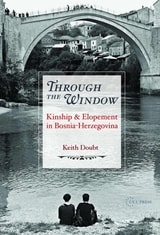
Through the Window
Kinship and Elopement in Bosnia-HerzegovinaKeith Doubt
Central European University Press, 2014
This book is not about war crimes, crimes against humanity, genocide, evil, or the killing of a society. It is about a cultural heritage, something vital to a society as a society, something that was not killed in the previous war, something that is resilient.
Through the Window brings an original perspective to folklore of Bosnians at a certain period of time and the differences and similarities of the three main ethnic groups in Bosnia and Herzegovina. It examines the transethnic character of cultural heritage, against divisions that dominate their tragic recent past.
The monograph focuses in particular on customs shared by different ethnic groups, specifically elopement, and affinal visitation. The elopement is a transformative rite of passage where an unmarried girl becomes a married woman. The affinal visitation, which follows, is a confirmatory ceremony where ritualized customs between families establish in-lawships These customs reflect a transethnic heritage shared by people in Bosnia as a national group, including Bosniaks, Serbs and Croats.
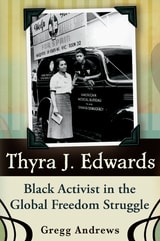
Thyra J. Edwards
Black Activist in the Global Freedom StruggleGregg Andrews
University of Missouri Press, 2011
Edwards, granddaughter of runaway slaves, grew up in Jim Crow–era Houston and started her career there as a teacher. She moved to Gary, Indiana, and Chicago as a social worker, then to New York as a journalist, and later became involved with the Communist Party, attracted by its stance on race and labor. She was mentored by famed civil rights leader A. Philip Randolph, who became her special friend and led her to pursue her education. She obtained scholarships to college, and after several years of study in the U.S. and then in Denmark, she became a women’s labor organizer and a union publicist.
In the 1930s and 1940s, she wrote about international events for black newspapers, traveling to Europe, Mexico, and the Soviet Union and presenting an anti-imperialist critique of world affairs to her readers. Edwards’s involvement with the Loyalists in the Spanish Civil War, her work in a Jewish refugee settlement in Italy, and her activities with U.S. communists drew the attention of the FBI. She was harassed by government intelligence organizations until she died at the age of just fifty-five. Edwards contributed as much to the radical foundations of the modern civil rights movements as any other woman of her time.
This fascinating new biography details Thyra Edwards’s lifelong journey and myriad achievements, describing both her personal and professional sides and the many ways they intertwined. Gregg Andrews used Edwards’s official FBI file—along with her personal papers, published articles, and civil rights manuscript collections—to present a complete portrait of this noteworthy activist. An engaging volume for the historian as well as the general reader, Thyra J. Edwards explores the complete domestic and international impact of her life and actions.

Tight Spaces
Kesho Scott
University of Iowa Press, 1999
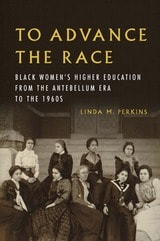
To Advance the Race
Black Women's Higher Education from the Antebellum Era to the 1960sLinda M. Perkins
University of Illinois Press, 2024
A first of its kind history, To Advance the Race is an enlightening look at African American women and their multi-generational commitment to the ideal of education as a collective achievement.
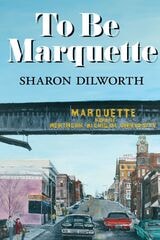
To Be Marquette
Sharon Dilworth
Carnegie Mellon University Press, 2024
Arriving in Marquette for her freshman year at Northern Michigan University, Molly enrolls in Dr. Robinson’s ecology studies class, hoping to learn more about the natural world and how to protect the planet from human impact. She befriends her classmates, Dr. Robinson’s Crusoes, who share her love of hiking, camping, and building bonfires on the shores of Lake Superior.
Together, Molly and the Crusoes protest the development of Project ELF, a Navy program that is installing a series of extremely low-frequency transmitters across the Great Lakes. The US government claims Project ELF will help the country defend itself in the event of a nuclear invasion, but Upper Peninsula residents fear the communications lines will disrupt the natural environment that they hold sacred.
Initially preoccupied with the contingencies of freshman year—roommate problems, dormitory life, and dating—Molly begins to sense that the Project ELF protests may mask a more problematic dynamic between the students and faculty. As she struggles to find her purpose, Molly uncovers layers of lies and misunderstandings about campus life, Project ELF, and her time in Marquette that make her question her place in the community.
As in other notable campus novels, like Donna Tartt’s The Secret History or Elif Batuman’s The Idiot, Sharon Dilworth’s To Be Marquette portrays an undergraduate narrator groping for meaning in a world where personal transformation takes place alongside conflicting cultural paradigms.
To Live Here, You Have to Fight
How Women Led Appalachian Movements for Social JusticeJessica Wilkerson
University of Illinois Press, 2019
Jessica Wilkerson tells their stories within the larger drama of efforts to enact change in the 1960s and 1970s. She shows white Appalachian women acting as leaders and soldiers in a grassroots war on poverty--shaping and sustaining programs, engaging in ideological debates, offering fresh visions of democratic participation, and facing personal political struggles. Their insistence that caregiving was valuable labor clashed with entrenched attitudes and rising criticisms of welfare. Their persistence, meanwhile, brought them into unlikely coalitions with black women, disabled miners, and others to fight for causes that ranged from poor people's rights to community health to unionization.
Inspiring yet sobering, To Live Here, You Have to Fight reveals Appalachian women as the indomitable caregivers of a region--and overlooked actors in the movements that defined their time.
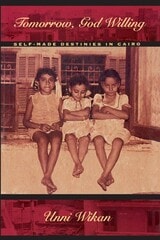
Tomorrow, God Willing
Self-made Destinies in CairoUnni Wikan
University of Chicago Press, 1996
Umm Ali's story is amazing not only for what it reveals about her resourcefulness but for the light it sheds on the resilience of Cairo's poor in the face of disastrous poverty. Like countless other poor people in Cairo, she has developed a personal buoyancy to cope with relentless economic need. It stems from a belief in the ability of people to shape their own destiny and helps explain why Cairo remains virtually free of the social ills—violent street crime and homelessness—that have eroded the lives of poor people in other major cities.
Unni Wikan first met Umm Ali and her family twenty-five years ago and has returned almost every year. She draws on her firsthand experience of their lives to create an intimate portrait of Cairo's back streets and the people who live there. Wikan's innovative approach to ethnographic writing reads like a novel that presents the experiences of Umm Ali's family and neighbors in their own words.
As Umm Ali recounts triumphs and defeats—from forming a savings club with neighbors to the gradual drifting away and eventual return of her husband—she unveils a deeply reflective attitude and her unwavering belief that she can improve her situation. Showing how Egyptian culture interprets poverty and family, this book attests to the capacity of an individual's self-worth to withstand incredible adversity.
Tongues of Flame
Mary Ward Brown
University of Alabama Press, 1993
Winner of the PEN/Hemingway Foundation Award
These beautifully crafted stories depict the changing relationships between black and white southerners, the impact of the civil rights movement, and the emergence of the New South.
Mary Ward Brown is a storyteller in the tradition of such powerful 20th-century writers as William Faulkner, Harper Lee, Flannery O'Connor, and Eudora Welty-writers who have explored and dramatized the tension between the inherited social structure of the South and its contemporary dissolution. With Tongues of Flame, her first collection of short stories, Brown bares the awkward, sometimes hopeful, and often tragic suffering of people caught in changing times within a timeless setting.
Here we meet such memorable characters as a dying black woman who seeks the advice of a now-alcoholic white doctor whom she knew in better years; a young woman, jilted at the altar, driven crazy by an illuminated cross erected by the church opposite her house; and a 95-year-old woman buying a tombstone for her long-deceased husband only to discover that he had been adulterous throughout their marriage. Brown constructs her characters in a disarmingly plain style while breathing life into them with compassion and honesty as they confront the large moments of their lives.
First published by E. P. Dutton in 1986 to immediate critical acclaim, Tongues of Flame won the 1987 PEN/Ernest Hemingway Foundation Award. The judges commended Brown for "seeing life whole, without prejudice, without sentimentality, without histrionics. Her voice may be quiet-sometimes she speaks in a whisper-but her words are, nevertheless, always forceful, clear, and ultimately lasting." With this new publication of Tongues of Flame and its inclusion in the University of Alabama Press's Deep South Books series, a whole new generation of readers may once more discover Mary Ward Brown's profound stories of pain, loss, and hope.

Tove Jansson
Life, Art, WordsBoel Westin
University of Minnesota Press, 2024
An in-depth, perceptive account of the unconventional life of the Moomins’ beloved creator, now available in the United States
Tove Jansson achieved fame as the creator of the Moomins, beloved by generations of readers around the world. Remarkably, the Moomins were only part of the prodigious creative output of this Finnish-Swedish writer and artist. Jansson’s work also includes short stories and five novels for adults, as well as paintings, murals, and book illustrations. In this acclaimed biography, Boel Westin relies on numerous conversations with Jansson and unprecedented access to her journals, letters, and personal archives to present an engrossing and comprehensive review of the life and world of Scandinavia’s best-loved author.
As Westin’s meticulous research makes clear, Jansson’s artistic and literary works reflected what was most important to her: the love of family and nature and the desire to pursue her art. Guided by her personal motto, “Love and work,” Jansson seized both with uncompromising joy. And while her romantic relationships with men proved unfulfilling, she found those with women—especially with her longtime partner, the artist Tuulikki Pietilä—both grounding and inspiring.
Westin weaves together the many threads of Jansson’s rich, complex life: an education interrupted to help her family; the bleak war years and her emergence as a painter; the decades of Moominmania across books, newspaper comic strips, merchandise, and adaptations; her later fictions, including her popular The Summer Book; and her time with Pietilä on the solitary island of Klovharu. Tove Jansson: Life, Art, Words offers fans and admirers around the world the most complete portrait of the writer Philip Pullman described as “a genius, a woman of profound wisdom and great artistry.”
Traffic in Asian Women
Laura Hyan Yi Kang
Duke University Press, 2020

Trafficking Women’s Human Rights
Julietta Hua
University of Minnesota Press, 2011
The history of human beings bought and sold, forced into lives of abject servitude or sexual slavery, is a story as old as civilization and yet still of global concern today. How this story is told, Julietta Hua argues, says much about our cultural beliefs. Through a critical inquiry into representations of human trafficking, she reveals the political, social, and cultural strains underlying our current preoccupation with this issue and the difficulty of framing human rights in universal terms.
In Trafficking Women’s Human Rights, Hua maps the ways in which government, media, and scholarship have described sex trafficking for U.S. consumption. As her investigation takes us from laws like the Victims of Trafficking and Violence Protection Act to political speeches and literary and media images, it uncovers dark assumptions about race, difference, and the United States’ place in the world expressed—and often promoted—by such images. The framing itself, exploiting dichotomies of victim/agent, rescued/rescuer, trafficked/smuggled, illustrates the limits of universalism in addressing human rights.
Uniquely broad in scope, this work considers the laws of human trafficking in conjunction with popular culture. In doing so, it constructively draws attention to the ways in which notions of racialized sexualities form our ideas about national belonging, global citizenship, and, ultimately, human rights.

Transatlantic Conversations
Nineteenth-Century American Women’s Encounters with Italy and the Atlantic WorldBeth L. Lueck
University of New Hampshire Press, 2017
This unique interdisciplinary essay collection offers a fresh perspective on the active involvement of American women authors in the nineteenth-century transatlantic world. Internationally diverse contributors explore topics ranging from women's social and political mobility to their authorship and activism. While a number of essays focus on such well-known writers as Margaret Fuller, Catharine Maria Sedgwick, Harriet Beecher Stowe, George Eliot, Louisa May Alcott, and Charlotte Perkins Gilman, other, perhaps lesser-known authors are also included, such as E. D. E. N. Southworth, Elizabeth Stuart Phelps, Elizabeth Peabody, Jeannette Hart, and Laura Richards.
These essays show the spectrum of interests and activities in which nineteenth-century women were involved as they moved, geographically and metaphorically, toward gaining their independence and the right to control their lives. Traveling far and wide—to Italy, France, Great Britain, and the Bahamas—these writers came into contact with realities far different from their own. On topics ranging from homeopathy and literary endeavors to politics and revolution, they conversed with others, reaching and inspiring transnational audiences with their words and deeds, and creating a space for self-expression in the rapidly changing transatlantic world.
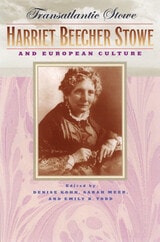
Transatlantic Stowe
Harriet Beecher Stowe and European CultureDenise Kohn
University of Iowa Press, 2006
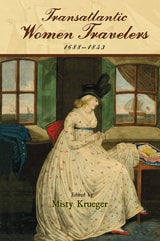
Transatlantic Women Travelers, 1688-1843
Misty Krueger
Bucknell University Press, 2021
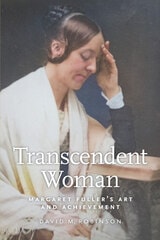
Transcendent Woman
Margaret Fuller’s Art and AchievementDavid M. Robinson
University of Massachusetts Press, 2025
Journalist, editor, critic, translator, and women’s rights advocate, Margaret Fuller was America’s first major female intellectual. Throughout much of the late-19th and 20th centuries, however, critics and scholars largely saw her as a minor figure in the transcendentalist movement with which she is associated, and her work was considered secondary to that of male figures like Emerson and Hawthorne. While her biography—including her marriage to an Italian noble and her dramatic death in a shipwreck—was often the focus, her skill as a writer was generally overlooked, and her intellectual development largely ignored.
In the early 1980s, David M. Robinson was one of the first scholars to publish an article that focused on Fuller’s mind and art. Now Transcendent Woman completes and extends this early work. Outlining the development of her philosophy, which Robinson defines as a “purpose-oriented form of thinking, tailored to the commitment and assets of each individual,” he traces Fuller’s intellectual journey, first in relation to her family and the people around her in New England and later in her travels in the midwestern United States and, more importantly, through Europe and her residency in Italy. He focuses first and foremost on what Fuller was reading (Goethe was key), what she was thinking as revealed in her letters and journals, and what she was writing, including seminal works such as Summer on the Lakes and Woman in the Nineteenth Century as well as lesser-known essays, translations, and short stories. Drawing extensively on primary sources, Robinson charts Fuller’s development and achievement as an original thinker and fearless advocate of democracy.
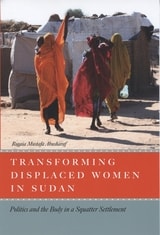
Transforming Displaced Women in Sudan
Politics and the Body in a Squatter SettlementRogaia Mustafa Abusharaf
University of Chicago Press, 2009
Over twenty years of civil war in predominantly Christian Southern Sudan has forced countless people from their homes. Transforming Displaced Women in Sudan examines the lives of women who have forged a new community in a shantytown on the outskirts of Khartoum, the largely Muslim, heavily Arabized capital in the north of the country.
Sudanese-born anthropologist Rogaia Mustafa Abusharaf delivers a rich ethnography of this squatter settlement based on personal interviews with displaced women and careful observation of the various strategies they adopt to reconstruct their lives and livelihoods. Her findings debunk the myth that these settlements are utterly abject, and instead she discovers a dynamic culture where many women play an active role in fighting for peace and social change. Abusharaf also examines the way women’s bodies are politicized by their displacement, analyzing issues such as religious conversion, marriage, and female circumcision.
An urgent dispatch from the ongoing humanitarian crisis in northeastern Africa, Transforming Displaced Women in Sudan will be essential for anyone concerned with the interrelated consequences of war, forced migration, and gender inequality.