22279 books match the query 'Social Science' and 4007 start with t
cover of Transnational LGBT Activism: Working for Sexual Rights Worldwide

Transnational LGBT Activism

Working for Sexual Rights Worldwide

Ryan R. Thoreson

University of Minnesota Press, 2014

The International Gay and Lesbian Human Rights Commission (IGLHRC) was founded in 1990 as the first NGO devoted to advancing LGBT human rights worldwide. How, this book asks, is that mission translated into practice? What do transnational LGBT human rights advocates do on a day-to-day basis and for whom? Understanding LGBT human rights claims is impossible, Ryan R. Thoreson contends, without knowing the answers to these questions.

In Transnational LGBT Activism, Thoreson argues that the idea of LGBT human rights is not predetermined but instead is defined by international activists who establish what and who qualifies for protection. He shows how IGLHRC formed and evolved, who is engaged in this work, how they conceptualize LGBT human rights, and how they have institutionalized their views at the United Nations and elsewhere. After a full year of in-depth research in New York City and Cape Town, South Africa, Thoreson is able to reconstruct IGLHRC’s early campaigns and highlight decisive shifts in the organization’s work from its founding to the present day.

Using a number of high-profile campaigns for illustration, he offers insight into why activists have framed particular demands in specific ways and how intergovernmental advocacy shapes the claims that activists ultimately make. The result is a uniquely balanced, empirical response to previous impressionistic and reductive critiques of Western human rights activists—and a clarifying perspective on the nature and practice of global human rights advocacy.
[more]
cover of Transnational Marriage and Partner Migration: Constellations of Security, Citizenship, and Rights

Transnational Marriage and Partner Migration

Constellations of Security, Citizenship, and Rights

Anne-Marie D'Aoust

Rutgers University Press, 2022
This multidisciplinary collection investigates the ways in which marriage and partner migration processes have become the object of state scrutiny, and the site of sustained political interventions in several states around the world. Covering cases as varied as the United States, Canada, Japan, Iran, France, Belgium or the Netherlands, among others, contributors reveal how marriage and partner migration have become battlegrounds for political participation, control, and exclusion. Which forms of attachments (towards the family, the nation, or specific individuals) have become framed as risks to be managed? How do such preoccupations translate into policies? With what consequences for those affected by them, in terms of rights and access to citizenship? The book answers these questions by analyzing the interplay between issues of security, citizenship and rights from the perspectives of migrants and policymakers, but also from actors who negotiate encounters with the state, such as lawyers, non-governmental organizations, and translators. 
[more]
cover of Transnational Nationalism and Collective Identity among the American Irish

Transnational Nationalism and Collective Identity among the American Irish

Howard Lune

Temple University Press, 2020

In Transnational Nationalism and Collective Identity among the American Irish, Howard Lune considers the development and mobilization of different nationalisms over 125 years of Irish diasporic history (1791–1920) and how these campaigns defined the Irish nation and Irish citizenship. 

Lune takes a collective approach to exploring identity, concentrating on social identities in which organizations are the primary creative agent to understand who we are and how we come to define ourselves. As exiled Irishmen moved to the United States, they sought to create a new Irish republic following the American model. Lune traces the construction of Irish American identity through the establishment and development of Irish nationalist organizations in the United States. He looks at how networks—such as societies, clubs, and private organizations—can influence and foster diaspora, nationalism, and nationalist movements. 

By separating nationalism from the physical nation, Transnational Nationalism and Collective Identity among the American Irish uniquely captures the processes and mechanisms by which collective identities are constructed, negotiated, and disseminated. Inevitably, this work tackles the question of what it means to be Irish—to have a nationality, a community, or a shared history.

[more]
cover of Transnational Political Islam: Religion, Ideology and Power

Transnational Political Islam

Religion, Ideology and Power

Edited by Azza Karam

Pluto Press, 2003

Political Islam, to be distinguished from Islam as a culture or a religion, and from Islamic Fundamentalism, is an increasingly important feature of the western political scene. The ideologies of Political Islam reflect the fact that some of their adherents live and work within a Western socio-political context.

Although Political Islam has been widely written about in Muslim countries, very little has been published the West, and this book attempts to redress that imbalance.

With a range of outstanding contributors that includes academics and human rights advocates this book tackles the diversity of Islamist thinking and practice in various Western countries and explores their transnational connections in both East and West.

The book analyses developments in Islamist thinking and activities, and their connections to the latest global political and economic trends, and discusses future evolutions of the ideology and its manifestations.
[more]
cover of Transnational Professionals and their Cosmopolitan Universes

Transnational Professionals and their Cosmopolitan Universes

Magdalena Nowicka

Campus Verlag, 2006
This book focuses on the relationship between physical space and social mobility, focusing on the new phenomenon of the “international professional” who makes the world his home. Mobile people, Magdalena Nowicka reveals, create their own spatial and cultural universes through daily routines and practices. Even the choice of a specific residence, Nowicka shows, has definite local and global consequences. Grounded in the influential theories of Ulrich Beck as well as the latest research in the sociology of space, Transnational Professionals and their Cosmopolitan Universes is an important contribution to continuing debates on globalization and sociology.
[more]
cover of Transnational Sport: Gender, Media, and Global Korea

Transnational Sport

Gender, Media, and Global Korea

Rachael Miyung Joo

Duke University Press, 2012

Based on ethnographic research in Seoul and Los Angeles, Transnational Sport tells how sports shape experiences of global Koreanness, and how those experiences are affected by national cultures. Rachael Miyung Joo focuses on superstar Korean athletes and sporting events produced for transnational media consumption. She explains how Korean athletes who achieve success on the world stage represent a powerful, globalized Korea for Koreans within the country and those in the diaspora. Celebrity Korean women athletes are highly visible in the Ladies Professional Golf Association. In the media, these young golfers are represented as daughters to be protected within the patriarchal Korean family and as hypersexualized Asian women with commercial appeal. Meanwhile, the hard-muscled bodies of male athletes, such as Korean baseball and soccer players, symbolize Korean masculine dominance in the global capitalist arena. Turning from particular athletes to a mega-event, Joo discusses the 2002 FIFA World Cup Korea/Japan, a watershed moment in recent Korean history. New ideas of global Koreanness coalesced around this momentous event. Women and youth assumed newly prominent roles in Korean culture, and, Joo suggests, new models of public culture emerged as thousands of individuals were joined by a shared purpose.
[more]
cover of Transnational Trajectories and Diaspora Policies: The Case of Czechia in Comparison to Poland, Hungary and Slovakia

Transnational Trajectories and Diaspora Policies

The Case of Czechia in Comparison to Poland, Hungary and Slovakia

Edited by Eva Janská

Karolinum Press, 2025

A fascinating examination of Central European diasporic policy bolstered by individual case studies of the new Czech diaspora.

The book examines diaspora policy in Central European countries in the context of changes following their accession to the EU, utilizing the Czech Republic, Slovakia, Poland, and Hungary as case studies. With a focus on the previously underexplored new Czech diaspora (i.e., the emigration of Czechs/Czechoslovaks after 1990), individual case studies provide a comprehensive description of the contemporary Czech diaspora while also elucidating key inquiries directed towards its current character and specific needs.
[more]
cover of Transnationalizing Viet Nam: Community, Culture, and Politics in the Diaspora

Transnationalizing Viet Nam

Community, Culture, and Politics in the Diaspora

Kieu-Linh Caroline Valverde

Temple University Press, 2013

Vietnamese diasporic relations affect—and are directly affected by—events in Viet Nam. In Transnationalizing Viet Nam, Kieu-Linh Caroline Valverde explores these connections, providing a nuanced understanding of this globalized community. Valverde draws on 250 interviews and almost two decades of research to show the complex relationship between Vietnamese in the diaspora and those back at the homeland.

Arguing that Vietnamese immigrant lives are inherently transnational, she shows how their acts form virtual communities via the Internet, organize social movements, exchange music and create art, find political representation, and even dissent. Valverde also exposes how generational, gender, class, and political tensions threaten to divide the ethnic community. 

Transnationalizing Viet Nam paints a vivid picture of the complex political and personal allegiances that exist within Vietnamese America and shape the relations between this heterogeneous community and its country of origin. 

In the series Asian American History and Culture, edited by Sucheng Chan, David Palumbo-Liu, Michael Omi, K. Scott Wong, and Linda Trinh Võ

[more]
cover of Transoceanic Blackface: Empire, Race, Performance

Transoceanic Blackface

Empire, Race, Performance

Kellen Hoxworth

Northwestern University Press, 2024

A sweeping history of racialized performance across the Anglophone imperial world from the eighteenth to the early twentieth century

A material history of racialized performance throughout the Anglophone imperial world, Transoceanic Blackface: Empire, Race, Performance revises prevailing understandings of blackface and minstrelsy as distinctively US American cultural practices. Tracing intertwined histories of racialized performance from the mid-eighteenth through the early twentieth century across the United States and the British Empire, this study maps the circulations of blackface repertoires in theatrical spectacles, popular songs, visual materials, comic operas, closet dramas, dance forms, and Shakespearean burlesques.

Kellen Hoxworth focuses on overlooked performance histories, such as the early blackface minstrelsy of T. D. Rice’s “Jump Jim Crow” and the widely staged blackface burlesque versions of Othello, as traces of the racial and sexual anxieties of empire. From the nascent theatrical cultures of Australia, Britain, Canada, India, Jamaica, South Africa, and the United States, Transoceanic Blackface offers critical insight into the ways racialized performance animated the imperial “common sense” of white supremacy on a global scale. 

 
[more]
cover of Transounding: Listening for Black Queer Lusophone Diasporas

Transounding

Listening for Black Queer Lusophone Diasporas

Daniel da Silva

Duke University Press, 2027
In Transounding, Daniel da Silva examines the work of popular music artists from Portugal, Brazil, and Angola whose singing and performances blur boundaries of gender and genre. These artists engage in collaborations that traverse uneven transatlantic Lusophone geographies and complicate North-South and South-South axes, composing, expressing, and performing modes of musical and affective political bonds across Luso-Afro-Brazilian cultures and transposing hegemonic cultural narratives into sites of Black queer and transfeminine possibility. Silva describes how transfeminine Brazilian artists complicate categories of gender and sexuality; how queer Portuguese fado performers inhabit and transform the genre's gendered conventions; and how queer, trans, and travesti Angolan and Lisbon-based Black queer artists produce resistant expressions within and against postcolonial and anti-Black contexts. Transounding traces queerness, Blackness, and diaspora across popular culture forms in the Lusophone world and explores the fundamental question of what listeners hear when transgressive voices sing.
[more]
cover of Transpacific Cartographies: Narrating the Contemporary Chinese Diaspora in the United States

Transpacific Cartographies

Narrating the Contemporary Chinese Diaspora in the United States

Melody Yunzi Li

Rutgers University Press, 2024

Transpacific Cartographies examines how contemporary Chinese diasporic narratives address the existential loss of home for immigrant communities at a time of global precarity and amid rising Sino-US tensions. Focusing on cultural productions of the Chinese diaspora from the 1990s to the present -- including novels by the Sinophone writers Yan Geling (The Criminal Lu Yanshi), Shi Yu (New York Lover), Chen Qian (Listen to the Caged Bird Sing), and Rong Rong (Notes of a Couple), as well as by the Anglophone writer Ha Jin (A Free Life; A Map of Betrayal), selected TV shows (Beijinger in New York; The Way We Were), and online literature -- Melody Yunzi Li argues that the characters in these stories create multilayered maps that transcend the territorial boundaries that make finding a home in a foreign land a seemingly impossible task. In doing so, these “maps” outline a transpacific landscape that reflects the psycho-geography of homemaking for diasporic communities. Intersecting with and bridging Sinophone studies, Chinese American studies, and diaspora studies and drawing on theories of literary cartography, Transpacific Cartographies demonstrates how these “maps” offer their readers different paths for finding a sense of home no matter where they are.
 
[more]
cover of Transpacific Experiments: Intermedia Art and Music in 1960s Japan

Transpacific Experiments

Intermedia Art and Music in 1960s Japan

Miki Kaneda

University of Michigan Press, 2026

Intermedia art—an avant-garde multimedia practice that combines sound and moving images—took root in Japan alongside other places in the 1960s. In Transpacific Experiments, Miki Kaneda analyzes intermedia as a practice that gives form to errant possibilities, unfolding in spaces of the everyday, to offer nuanced insights into the global flow of ideas, influence, and discourses of appropriation. The stories of intermedia art throughout the study offer feminist and transnational perspectives on experimental music and art that disorient existing narratives about the experimental and political in unexpected ways.

Transpacific Experiments contends that social, cultural, and political arrangements local to Japan had a greater influence on the transnational experimental music scene than previously acknowledged. Kaneda’s perspective extends, exceeds, and at times unsettles frameworks for experimental practices, revealing the limitations of any single political or aesthetic lens. 
[more]
cover of Transpacific Femininities: The Making of the Modern Filipina

Transpacific Femininities

The Making of the Modern Filipina

Denise Cruz

Duke University Press, 2012

In this groundbreaking study, Denise Cruz investigates the importance of the figure she terms the "transpacific Filipina" to Philippine nationalism, women's suffrage, and constructions of modernity. Her analysis illuminates connections between the rise in the number of Philippine works produced in English and the emergence of new social classes of transpacific women during the early to mid-twentieth century.

Through a careful study of multiple texts produced by Filipina and Filipino writers in the Philippines and the United States—including novels and short stories, newspaper and magazine articles, conduct manuals, and editorial cartoons—Cruz provides a new archive and fresh perspectives for understanding Philippine literature and culture. She demonstrates that the modern Filipina did not emerge as a simple byproduct of American and Spanish colonial regimes, but rather was the result of political, economic, and cultural interactions among the Philippines, Spain, the United States, and Japan. Cruz shows how the complex interplay of feminism, nationalism, empire, and modernity helped to shape, and were shaped by, conceptions of the transpacific Filipina.
[more]
cover of Transpacific Nonencounters: Racial Disconnects Across Twentieth-Century Japan and Mexico

Transpacific Nonencounters

Racial Disconnects Across Twentieth-Century Japan and Mexico

Andrea Mendoza

Duke University Press, 2026
In Transpacific Nonencounters, Andrea Mendoza works across the seemingly unconnected histories of race and nation in modern Mexico and Japan, showing the commonalities in the way race figures in their state and social formations through a method Mendoza calls the theory of nonencounter. Intellectual and cultural productions of racial knowledge were important for the formation of the modernizing Mexican and Japanese states at the beginning of the twentieth century and helped conceive the project of national modernity through ideologies that promoted multiracial and multiethnic belonging—mestizaje and Pan-Asian co-prosperity. Despite the diasporic, economic, and political points of contact that connected these states throughout the twentieth century, however, traditional Eurocentric comparative and area-based studies treat the formations and legacies of Mexican mestizo nationalism and Japanese imperialism as wholly unrelated phenomena. Transpacific Nonencounters proposes a theory of nonencounter to formulate the logic of disciplinary disconnection, offering a framework and hermeneutic for a transpacific account of how Japanese imperialism and Mexican mestizo settler nationalism structured and reinforced one another through the modern formations of race and racism.
[more]
cover of Transparency and Conspiracy: Ethnographies of Suspicion in the New World Order

Transparency and Conspiracy

Ethnographies of Suspicion in the New World Order

Harry G. West and Todd Sanders, eds.

Duke University Press, 2003

Transparency has, in recent years, become a watchword for good governance. Policymakers and analysts alike evaluate political and economic institutions—courts, corporations, nation-states—according to the transparency of their operating procedures. With the dawn of the New World Order and the “mutual veil dropping” of the post–Cold War era, many have asserted that power in our contemporary world is more transparent than ever. Yet from the perspective of the relatively less privileged, the operation of power often appears opaque and unpredictable. Through vivid ethnographic analyses, Transparency and Conspiracy examines a vast range of expressions of the popular suspicion of power—including forms of shamanism, sorcery, conspiracy theory, and urban legends—illuminating them as ways of making sense of the world in the midst of tumultuous and uneven processes of modernization.

In this collection leading anthropologists reveal the variations and commonalities in conspiratorial thinking or occult cosmologies around the globe—in Korea, Tanzania, Mozambique, New York City, Indonesia, Mongolia, Nigeria, and Orange County, California. The contributors chronicle how people express profound suspicions of the United Nations, the state, political parties, police, courts, international financial institutions, banks, traders and shopkeepers, media, churches, intellectuals, and the wealthy. Rather than focusing on the veracity of these convictions, Transparency and Conspiracy investigates who believes what and why. It makes a compelling argument against the dismissal of conspiracy theories and occult cosmologies as antimodern, irrational oversimplifications, showing how these beliefs render the world more complex by calling attention to its contradictions and proposing alternative ways of understanding it.

Contributors.
Misty Bastian, Karen McCarthy Brown, Jean Comaroff, John Comaroff, Susan Harding, Daniel Hellinger, Caroline Humphrey, Laurel Kendall, Todd Sanders, Albert Schrauwers, Kathleen Stewart, Harry G. West
[more]
cover of Transparency in Population Forecasting: Methods for Fitting and Projecting Fertility, Mortality and Migration

Transparency in Population Forecasting

Methods for Fitting and Projecting Fertility, Mortality and Migration

Joop de Beer

Amsterdam University Press, 2011
To create an accurate population forecast, a forecaster can use a myriad of different methods to assemble his or her data. The transparency of the forecaster’s data and methods is essential, and the forecaster must be able to argue for and explain their assumptions. In this useful book, Joop de Beer specifically investigates how a population’s fertility, life expectancy, and migration patterns can be used to shape a population forecast. He also shows how comparative data, such as the difference between longevity in Europe and Japan, can be helpful when creating population projections. 

[more]
cover of Transplanetary Americas: Art, Outer Space, and the Latinx Imagination

Transplanetary Americas

Art, Outer Space, and the Latinx Imagination

Robb Hernández

Duke University Press, 2026
In Transplanetary Americas, Robb Hernández launches a propulsive pathway for Latinx cultural studies by exploring how the modern space race has driven artists to look upward and attune to expressions derived from the solar system and beyond. By advancing a theoretical and methodological framework he calls transplanetary relationality, Hernández shows how artists’ ascendant attentions unhinge Latinidades from their terrestrial bindings in an aerial pursuit of being with Earth and with other planets. Speculation, science, and technology fuel creative activities referencing the cosmos, taking Latinx art history into unexpected territory. Science fiction B-movie aesthetics empowers political statements of the third kind. NASA’s Apollo program sparks muralist imaginings about other planetary vistas. Private aerospace companies are prompting new generations of artist-activists to defend both land and sky. By showcasing visionaries who frustrate categories of time and place, Hernández’s investigation transcends the typical limits of border studies via a vertical scale, proving that the color of space is not only black but brown.
[more]
cover of Transplanting Care: Shifting Commitments in Health and Care in the United States

Transplanting Care

Shifting Commitments in Health and Care in the United States

Heinemann, Laura L.

Rutgers University Press, 2016

The sudden call, the race to the hospital, the high-stakes operation—the drama of transplant surgery is well known. But what happens before and after the surgery? In Transplanting Care, Laura L. Heinemann examines the daily lives of midwestern organ transplant patients and those who care for them, from pretransplant preparations through to the long posttransplant recovery.
 
Heinemann points out that as efforts to control healthcare costs gain urgency—and as new surgical techniques, drug therapies, and home medical equipment advance—most of the transplant process now takes place at home, among kin. Indeed, the transplant system effectively depends on unpaid care labor, typically provided by spouses, parents, siblings, and others. Drawing on scores of interviews with patients, relatives, and healthcare professionals, Heinemann follows a variety of patients and loved ones as they undertake this uncertain and strenuous “transplant journey.” She also shows how these home-based caregiving efforts take place within the larger economic and political context of a paucity of resources for patients and caregivers, who ultimately must surmount numerous obstacles. The author concludes that the many snags encountered by transplant patients and loved ones make a clear case for more comprehensive health and social policy that treats care as a necessarily shared public responsibility.  
 
An illuminating look at the long transplant journey, Transplanting Care also offers broader insight into how we handle infirmity in America—and how we might do a better job of doing so. 
 
[more]
cover of Transplanting the Great Society: Lyndon Johnson and Food for Peace

Transplanting the Great Society

Lyndon Johnson and Food for Peace

Kristin L. Ahlberg

University of Missouri Press, 2008
Enacted in 1954, the Food for Peace program allowed the United States to make agricultural surpluses available to needy nations but served varying political agendas. President Eisenhower saw it primarily as a temporary means for improving domestic agriculture prices, while his two Democratic successors turned it into the cornerstone of an expanded foreign assistance program.
Kristin Ahlberg traces the transformation of Public Law 480 from a means of liquidating domestic surplus into a vital component of U.S. foreign policy. She focuses on how Lyndon Johnson sought to re-create his Great Society reforms on a global scale by exporting programs designed to improve the lives of world citizens through combating food shortages—and how he also wielded Food for Peace as a diplomatic tool to gain support for U.S. policies and to reward or punish allies for their behavior.
LBJ sought to demonstrate America’s commitment to the less fortunate while providing a deterrent to those impoverished nations most vulnerable to communist influence, and the White House maintained control of the program’s objectives on a country-by-country basis while leaving its implementation to the bureaucracy. Ahlberg describes these foreign policy maneuvers as well as the domestic battles that found farm nationalists like Senator Allen Ellender opposing Johnson and Secretary of Agriculture Orville Freeman—and also found the Department of Agriculture, Department of State, and Agency for International Development vying for control of the program.
Ahlberg draws on recently declassified sources to show how the Johnson administration used Food for Peace to win diplomatic support for American policy in Vietnam, prevent nuclear proliferation on the Indian subcontinent, and uphold Israeli security. When India diverted resources from agriculture to arms, Washington suspended wheat shipments until New Delhi reordered its priorities. But in the case of Israel and South Vietnam, LBJ used food aid to help client governments build up their militaries—as well as to win the “hearts and minds” of the Vietnamese people.
Transplanting the Great Society is an insightful study that shows the successes and limitations of using food aid as a diplomatic tool during the middle period of the cold war. It paints a broader picture of Johnson’s foreign policies, opening a new window on both his administration and postwar diplomatic history.
[more]
cover of Transport in Transition: The Evolution of Traditional Shipping in China

Transport in Transition

The Evolution of Traditional Shipping in China

Translated by Andrew Watson

University of Michigan Press, 1972
Water transport is a major feature of the traditional Chinese economy because of its magnitude and comparative efficiency. Yet this feature has all too often been ignored by scholars, with the notable exception of Japanese scholars. We cannot hope to gain any real conception of how the Chinese economy worked in the past, or works now, until we have a clearer picture of the circulation of men and commodities. In this circulation, water transport has been and is of crucial importance.
Transport in Transition collects and translates notable Japanese articles to throw some light on the evolution of traditional junk shipping during a key transitional phase, 1900–1940, when it was absorbing the influences of various forms of modernization and on the eve of its major organizational transformation under the direction of the Communisty Party. The articles chosen concentrate on two main themes: the institutional organization of the shipping business, and the forms of ownership and operation. They will be of value to business historians and economic sociologists generally as well as to economic historians interested in transport.
Several features of the Chinese economy are sharply illuminated. Most striking is the extent of regional variation. North and central Chinese shipping are shown to have differed both in their methods of operaiton and organization. Also noteworthy is the enduring strength of some traditional features of shipping operation and business practice. An unexpected feature of this endurance was the strength of traditional shipping in the face of steady competition from all forms of modern transport and from reputdely more efficient forms of business management.
[more]
cover of Transportation and the Culture of Climate Change: Accelerating Ride to Global Crisis

Transportation and the Culture of Climate Change

Accelerating Ride to Global Crisis

Tatiana Prorokova-Konrad

West Virginia University Press, 2020

This interdisciplinary collection of eleven original essays focuses on the environmental impact of transportation, which is, as Tatiana Prorokova-Konrad and Brian C. Black note in their introduction, responsible for 26 percent of global energy use. Approaching mobility not solely as a material, logistical question but as a phenomenon mediated by culture, the book interrogates popular assumptions deeply entangled with energy choices. Rethinking transportation, the contributors argue, necessarily involves fundamental understandings of consumption, freedom, and self.

The essays in Transportation and the Culture of Climate Change cover an eclectic range of subject matter, from the association of bicycles with childhood to the songs of Bruce Springsteen, but are united in a central conviction: “Transport is a considerable part of our culture that is as hard to transform as it is for us to stop using fossil fuels—but we do not have an alternative.”
[more]
cover of Transpsychoanalytics

Transpsychoanalytics

Sheila L. Cavanagh, special issue editor

Duke University Press, 2017

While psychoanalysis has traditionally been at odds with transgender issues, a growing body of revisionist psychoanalytic theory and clinical practice has begun to tease out the trans-affirming potential of the field. This issue features essays that highlight this potential by simultaneously critiquing and working within the boundaries of psychoanalytic concepts and theories guiding clinical work. Featuring a range of clinicians and scholars, this issue centers on questions pertaining to trans* experience, desire, difference, otherness, identification, loss, mourning, and embodiment. The contributors explore these questions through topics like bathroom bans, ethics, popular culture, and the Freudian couch. By setting up this dialogue between psychosocial studies and trans* cultural studies, this revisionist work may radically transform psychoanalytic theory and practice.

Contributors. Sheila L. Cavanagh, Chris Coffman, Elena Dalla Torre, Kate Foord, Patricia Gherovici, Oren Gozlan, Griffin Hansbury, Jordon Osserman, Amy Ray Stewart, Simon van der Weele

[more]
cover of Trapped in America's Safety Net: One Family's Struggle

Trapped in America's Safety Net

One Family's Struggle

Andrea Louise Campbell

University of Chicago Press, 2014

When Andrea Louise Campbell’s sister-in-law, Marcella Wagner, was run off the freeway by a hit-and-run driver, she was seven-and-a-half months pregnant. She survived—and, miraculously, the baby was born healthy. But that’s where the good news ends. Marcella was left paralyzed from the chest down. This accident was much more than just a physical and emotional tragedy. Like so many Americans—50 million, or one-sixth of the country’s population—neither Marcella nor her husband, Dave, who works for a small business, had health insurance. On the day of the accident, she was on her way to class for the nursing program through which she hoped to secure one of the few remaining jobs in the area with the promise of employer-provided insurance. Instead, the accident plunged the young family into the tangled web of means-tested social assistance.
          
As a social policy scholar, Campbell thought she knew a lot about means-tested assistance programs. What she quickly learned was that missing from most government manuals and scholarly analyses was an understanding of how these programs actually affect the lives of the people who depend on them. Using Marcella and Dave’s situation as a case in point, she reveals their many shortcomings in Trapped in America’s Safety Net. Because American safety net programs are designed for the poor, Marcella and Dave first had to spend down their assets and drop their income to near-poverty level before qualifying for help. What’s more, to remain eligible, they will have to stay under these strictures for the rest of their lives, meaning they are barred from doing many of the things middle-class families are encouraged to do: Save for retirement. Develop an emergency fund. Take advantage of tax-free college savings. And, while Marcella and Dave’s story is tragic, the financial precariousness they endured even before the accident is all too common in America, where the prevalence of low-income work and unequal access to education have generated vast—and growing—economic inequality. The implementation of Obamacare has cut the number of uninsured and underinsured and reduced some of the disparities in coverage, but it continues to leave too many people open to tremendous risk.

Behind the statistics and beyond the ideological battles are human beings whose lives are stunted by policies that purport to help them. In showing how and why this happens, Trapped in America’s Safety Net offers a way to change it.

[more]
cover of Trapped in America's Safety Net: One Family's Struggle

Trapped in America's Safety Net

One Family's Struggle

Andrea Louise Campbell

University of Chicago Press, 2014

This is an auto-narrated audiobook version of this book.

When Andrea Louise Campbell’s sister-in-law, Marcella Wagner, was run off the freeway by a hit-and-run driver, she was seven-and-a-half months pregnant. She survived—and, miraculously, the baby was born healthy. But that’s where the good news ends. Marcella was left paralyzed from the chest down. This accident was much more than just a physical and emotional tragedy. Like so many Americans—50 million, or one-sixth of the country’s population—neither Marcella nor her husband, Dave, who works for a small business, had health insurance. On the day of the accident, she was on her way to class for the nursing program through which she hoped to secure one of the few remaining jobs in the area with the promise of employer-provided insurance. Instead, the accident plunged the young family into the tangled web of means-tested social assistance.
          
As a social policy scholar, Campbell thought she knew a lot about means-tested assistance programs. What she quickly learned was that missing from most government manuals and scholarly analyses was an understanding of how these programs actually affect the lives of the people who depend on them. Using Marcella and Dave’s situation as a case in point, she reveals their many shortcomings in Trapped in America’s Safety Net. Because American safety net programs are designed for the poor, Marcella and Dave first had to spend down their assets and drop their income to near-poverty level before qualifying for help. What’s more, to remain eligible, they will have to stay under these strictures for the rest of their lives, meaning they are barred from doing many of the things middle-class families are encouraged to do: Save for retirement. Develop an emergency fund. Take advantage of tax-free college savings. And, while Marcella and Dave’s story is tragic, the financial precariousness they endured even before the accident is all too common in America, where the prevalence of low-income work and unequal access to education have generated vast—and growing—economic inequality. The implementation of Obamacare has cut the number of uninsured and underinsured and reduced some of the disparities in coverage, but it continues to leave too many people open to tremendous risk.

Behind the statistics and beyond the ideological battles are human beings whose lives are stunted by policies that purport to help them. In showing how and why this happens, Trapped in America’s Safety Net offers a way to change it.
[more]
cover of Trapped in a Vice: The Consequences of Confinement for Young People

Trapped in a Vice

The Consequences of Confinement for Young People

Cox, Alexandra

Rutgers University Press, 2018

Winner of the 2019 Outstanding Book Award - ASC DCCSJ​

Trapped in a Vice explores the consequences of a juvenile justice system that is aimed at promoting change in the lives of young people, yet ultimately relies upon tools and strategies that enmesh them in a system that they struggle to move beyond. The system, rather than the crimes themselves, is the vice. Trapped in a Vice explores the lives of the young people and adults in the criminal justice system, revealing the ways that they struggle to manage the expectations of that system; these stories from the ground level of the justice system demonstrate the complex exchange of policy and practice.  

[more]
cover of Trappings: Stories of Women, Power, and Clothing

Trappings

Stories of Women, Power, and Clothing

Ludwig, Tiffany

Rutgers University Press, 2007

What do you wear that makes you feel powerful? How about the woman next to you at the bank? In line with you at the store? Think about your mother. What would she put on to reveal her power source to the world? These are the questions that inspired Tiffany Ludwig and Renee Piechocki to embark on an interview journey across the United States. Over a period of six years, they talked with more than 500 women and girls, ages four through ninety-two, who ranged from office workers to drag-kings, stay-at-home moms to attorneys, fashion industry executives to elected officials, students to cowgirls.

            It is these women’s sensitive, funny, and always revealing thoughts that are at the heart of Trappings—a book that although it begins with a question about clothing is not about fashion at all. Here, clothing is simply a vehicle to access a larger dialogue about a diverse range of issues women face related to power and identity, including what expectations and limitations are placed upon them by their affiliation with a specific gender, culture, race, class, or profession. A complex spectrum of responses include discussions about the importance of clothing’s comfort and practicality, how clothing can facilitate women’s movement through class and social strata, how sex is used strategically in business and social settings, and how clothing can be used to empower women by connecting them with cultural or personal history.

            Complimented by 148 color and black-and-white photographs, the visual and written portraits in this book reveal much more than the contents of women’s closets. Through the intimate lens of clothing, Ludwig and Piechocki expose the very personal ways that power is sought, experienced, and projected by women.
 

[more]
cover of Trauma Culture: The Politics of Terror and Loss in Media and Literature

Trauma Culture

The Politics of Terror and Loss in Media and Literature

Kaplan, E. Ann

Rutgers University Press, 2005

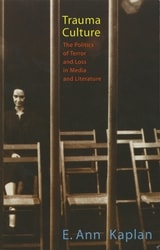
It may be said that every trauma is two traumas or ten thousand-depending on the number of people involved. How one experiences and reacts to an event is unique and depends largely on one's direct or indirect positioning, personal psychic history, and individual memories. But equally important to the experience of trauma are the broader political and cultural contexts within which a catastrophe takes place and how it is "managed" by institutional forces, including the media.

In Trauma Culture, E. Ann Kaplan explores the relationship between the impact of trauma on individuals and on entire cultures and nations. Arguing that humans possess a compelling need to draw meaning from personal experience and to communicate what happens to others, she examines the artistic, literary, and cinematic forms that are often used to bridge the individual and collective experience. A number of case studies, including Sigmund Freud's Moses and Monotheism, Marguerite Duras' La Douleur, Sarah Kofman's Rue Ordener, Rue Labat, Alfred Hitchcock's Spellbound, and Tracey Moffatt's Night Cries, reveal how empathy can be fostered without the sensationalistic element that typifies the media.

From World War II to 9/11, this passionate study eloquently navigates the contentious debates surrounding trauma theory and persuasively advocates the responsible sharing and translating of catastrophe.
[more]
cover of Trauma and Recovery on War's Border: A Guide for Global Health Workers

Trauma and Recovery on War's Border

A Guide for Global Health Workers

Edited by Kathleen Allden and Nancy Murakami

Dartmouth College Press, 2015
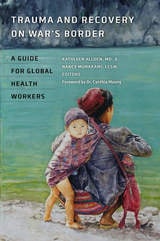
An increasing number of students and professionals are choosing to travel the globe to engage with the realities of trauma and human suffering through mental health aid. But in the field of global mental health, good intentions are not enough to ensure good training, development, and care. The risk of harm is real when outsiders deliver mental health aid in culturally inappropriate and otherwise naïve ways. This book, based on the experiences of the co-editors and their colleagues at Burma Border Projects (BBP), a nonprofit organization dedicated to the mental health and psychosocial well-being of the displaced people of Burma, sets out global mental health theory allied with local perspectives, experiences, real-life challenges, strengths, and best practices. Topics include assessment and intervention protocols, vulnerable groups and the special challenges they present, and supervision and evaluation programs. An introduction by the editors establishes the political and health contexts for the volume. Written in a style appropriate for academic audiences and lay readers, this book will serve as a fundamental text for clinicians, interns, volunteers, and researchers who work in regions of the world that have suffered the violence of war, forced displacement, human rights violations, poverty, and oppression.
[more]
cover of Traumatic Realism: The Demands of Holocaust Representation

Traumatic Realism

The Demands of Holocaust Representation

Michael Rothberg

University of Minnesota Press, 2000

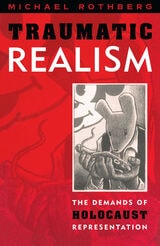
How to approach the Holocaust and its relationship to late twentieth-century society? While some stress the impossibility of comprehending this event, others attempt representations in forms as different as the nonfiction novel (and Hollywood blockbuster) Schindler’s List, the documentary Shoah, and the comic book Maus. This problem is at the center of Michael Rothberg’s book, a focused account of the psychic, intellectual, and cultural aftermath of the Holocaust. Drawing on a wide range of texts, Michael Rothberg puts forth an overarching framework for understanding representations of the Holocaust. Through close readings of such writers and thinkers as Theodor Adorno, Maurice Blanchot, Ruth Klüger, Charlotte Delbo, Art Spiegelman, and Philip Roth and an examination of films by Steven Spielberg and Claude Lanzmann, Rothberg demonstrates how the Holocaust as a traumatic event makes three fundamental demands on representation: a demand for documentation, a demand for reflection on the limits of representation, and a demand for engagement with the public sphere and commodity culture. As it establishes new grounding for Holocaust studies, his book provides a new understanding of realism, modernism, and postmodernism as responses to the demands of history. 
[more]
cover of Traumatic States: Gendered Violence, Suffering, and Care in Chile

Traumatic States

Gendered Violence, Suffering, and Care in Chile

Nia Parson

Vanderbilt University Press, 2013

The end of the Pinochet regime in Chile saw the emergence of an organized feminist movement that influenced legal and social responses to gender-based violence, and with it new laws and avenues for reporting violence that never before existed. What emerged were grassroots women's rights organizations, challenging and engaging the government and NGOs to confront long-ignored problems in responding to marginalized victims.


In Traumatic States, anthropologist Nia Parson explores the development of methods of care and recovery from domestic violence. She interviews and contextualizes the lives of numerous individuals who have confronted these acts, as victims, authorities, and activists. Ultimately, Traumatic States argues that facing the challenges of healing both body and mind, and addressing the fundamental inequalities that make those challenges even more formidable, are part of the same battle.
[more]
cover of Traveler's Guide to Ancient Ohio

Traveler's Guide to Ancient Ohio

John E. Hancock

Ohio University Press, 2026

Featuring Hopewell Ceremonial Earthworks

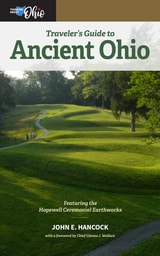
Traveler’s Guide to Ancient Ohio is a compact, richly illustrated, and in-depth travel guide to the Indigenous earthwork wonders of southern Ohio—some of the most extraordinary ancient monuments in North America. Featuring the eight newly inscribed UNESCO World Heritage sites, this is the first publication to present these places from a traveler’s perspective, offering deeply informative site descriptions alongside curated routes to historical, scenic, and natural treasures across the region.

Southern Ohio’s landscape is layered with millennia of human history. At its heart are the monumental Adena and Hopewell earthworks—vast ceremonial constructions that reflect the ingenuity and spiritual life of ancient Indigenous cultures. This guide helps readers understand these sites as rewarding architectural experiences, enriched by archaeological, historical, and Indigenous knowledge gathered over three decades of collaborative work.

Organized into eight scenic driving routes—including the World Heritage Route and seven tributary paths—the book connects earthworks with nearby historic towns, nature preserves, waterways, and cultural landmarks. Each route emphasizes two-lane roads and includes road-tested site addresses, with links to local tourism resources for updated travel information.

Introductory sections provide essential context on regional geography, Indigenous cultures, archaeological terminology, and travel logistics. The guide’s focus on on-site appreciation is rare among existing resources, making it invaluable for both pre-visit planning and on-the-ground exploration.

Detailed route and trail descriptions are coordinated with all-new maps, plans, and photographs. The book links to multimedia assets, including animated flyovers that help visualize the earthworks and interview excerpts that deepen interpretive storytelling through Indigenous and interdisciplinary voices.

For first-time visitors and seasoned explorers, Traveler’s Guide to Ancient Ohio offers a fresh, immersive way to experience the region’s ancient wonders and the landscapes that continue to tell their story.
[more]
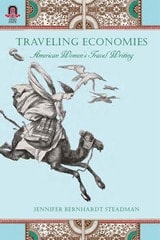
cover of Traveling Economies: American Women's Travel Writing

Traveling Economies

American Women's Travel Writing

Jennifer Bernhardt Steadman

The Ohio State University Press, 2007
The black and white women travel writers whom Jennifer Bernhardt Steadman investigates in Traveling Economies astonish modern readers with their daring, stamina, and courage. That these women traveled at all is surprising: Nancy Prince spent nearly a decade as an African American member of the Russian Imperial Court; Amy Morris Bradley went to Costa Rica as a governess in hopes of saving her health and finances after years as an impoverished teacher in Maine; and Julia Archibald Holmes carried the banner of dress reform to the heights of Pikes Peak and to the pages of a feminist periodical. Developing the concept of the “ragged edge,” Steadman highlights these women’s shared experiences of penury, work, and independence. Genteel poverty, black skin, outspoken feminism, or sometimes all three impacted the material conditions of their ragged-edge travel (early muckraking journalist Anne Royall walked until her feet were a bloody mass of blisters). Being on the ragged edge also affected the way they represented themselves and their travels (Mary Ann Shadd Cary presented her outspoken advocacy of black emigration to Canada as appropriately feminine). Frances Wright used her travel writing to imagine the new nation as a potential utopia for women citizens; she paid a high price for daring to try to change the social terrain she crossed. Steadman’s interdisciplinary work with archives, newspapers, memoirs, and letters and her thoughtful close readings of the resulting evidence recover these important women’s travels and writing and invite us to rethink where and how women went and what they wrote in antebellum America.
[more]
cover of Traveling Freely: Essays

Traveling Freely

Essays

Roberto Carlos Garcia

Northwestern University Press, 2025

A poet’s debut essay collection exploring American faults through the eyes of a Dominican American

In Traveling Freely: Essays, Roberto Carlos Garcia explores intersecting topics such as race, identity, American socioeconomic inequality, police violence, our inability to partake in our culture as innocents, and our complicity as Americans in all that’s wrong with the United States from the author’s specific vantage point as a Black Dominican American man. The voice in these essays is both clear and nuanced, and as readers move through the collection, the various themes cohere into a multilayered investigation of institutional racism and the inherent exploitations of capitalism.

In essays that are uniquely straightforward and accessible, Garcia insists that in order to resist state-sanctioned violence against marginalized bodies and populations, we must understand our shared history of oppression—so that we can rise against it effectively and find new paths forward.
[more]
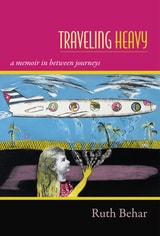
cover of Traveling Heavy: A Memoir in between Journeys

Traveling Heavy

A Memoir in between Journeys

Ruth Behar

Duke University Press, 2013

Traveling Heavy is a deeply moving, unconventional memoir by the master storyteller and cultural anthropologist Ruth Behar. Through evocative stories, she portrays her life as an immigrant child and later, as an adult woman who loves to travel but is terrified of boarding a plane. With an open heart, she writes about her Yiddish-Sephardic-Cuban-American family, as well as the strangers who show her kindness as she makes her way through the world. Compassionate, curious, and unafraid to reveal her failings, Behar embraces the unexpected insights and adventures of travel, whether those be learning that she longed to become a mother after being accused of giving the evil eye to a baby in rural Mexico, or going on a zany pilgrimage to the Behar World Summit in the Spanish town of Béjar.

Behar calls herself an anthropologist who specializes in homesickness. Repeatedly returning to her homeland of Cuba, unwilling to utter her last goodbye, she is obsessed by the question of why we leave home to find home. For those of us who travel heavy with our own baggage, Behar is an indispensable guide, full of grace and hope, in the perpetual search for connection that defines our humanity.
[more]
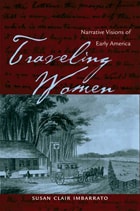
cover of Traveling Women: Narrative Visions of Early America

Traveling Women

Narrative Visions of Early America

Susan Clair Imbarrato

Ohio University Press, 2006

Women’s travel narratives recording journeys north and south along the eastern seaboard and west onto the Ohio frontier enhance our historical understanding of early America. Drawing extensively from primary sources, Traveling Women documents women’s role in westward settlement and emphasizes travel as a culture-building event.

Susan Clair Imbarrato closely examines women’s accounts of their journeys from 1700 to 1830, including Sarah Kemble Knight’s well-known journal of her trip from Boston to New York in 1704 and many lesser-known accounts, such as Sarah Beavis’s 1779 journal of her travel to Ohio via Kentucky and Susan Edwards Johnson’s account or her 1801–2 journey from Connecticut to North Carolina.

In the women’s keen observations and entertaining wit, readers will find bravado mixed with hesitation, as women set forth on business, to relocate, and for pleasure. These travelers wrote compellingly of crossing rivers and mountains, facing hunger, encountering native Americans, sleeping in taverns, and confronting slavery, expressing themselves in voices that differed in sensibility from male explorers and travelers.

These accounts, as Imbarrato shows, challenge assumptions that such travel was predominately a male enterprise. In addition, Traveling Women provides a more balanced portrait of westward settlement by affirming women’s importance in the settling of early America.

[more]
cover of Traveling with Service Animals: By Air, Road, Rail, and Ship across North America

Traveling with Service Animals

By Air, Road, Rail, and Ship across North America

Henry Kisor and Christine Goodier

University of Illinois Press, 2019
The boom in trained service animal use and access has transformed the lives of travelers with disabilities. As a result, tens of thousands of people in the United States and Canada enjoy travel options that were difficult or impossible just a few years ago.Henry Kisor and Christine Goodier provide a narrative guidebook full of essential information and salted with personal, hands-on stories of life on the road with service dogs and miniature horses. As the travel-savvy human companions of Trooper (Kisor's miniature schnauzer/poodle cross) and Raylene (Goodier's black Labrador), the authors share experiences from packing for your animal partner to widely varying legal protections to the animal-friendly rides at Disneyland. Chapters cover the specifics of air, rail, road, and cruise ship travel, while appendixes offer checklists, primers on import regulations and corporate policies, advice for emergencies, and a route-by-route guide to finding relief walks during North American train trips. Practical and long overdue, Traveling with Service Animals provides any human-animal partnership with a horizon-to-horizon handbook for exploring the world.
[more]
cover of Traveling without Moving: Essays from a Black Woman Trying to Survive in America

Traveling without Moving

Essays from a Black Woman Trying to Survive in America

Taiyon J. Coleman

University of Minnesota Press, 2024

A stunning lyrical commentary on the constructions of race, gender, and class in the fraught nexus of a Black woman’s personal experience and cultural history


The Fair Housing Act passed in 1968, and more than fifty years later, yours seems to be the only Black family on your block in Minneapolis. You and your Black African husband, both college graduates, make less money than some White people with a felony record and no high school diploma. You’re the only Black student in your graduate program. You just aren’t working hard enough. You’re too sensitive. Sandra Bland? George Floyd? Don't take everything so personally. Amid the White smiles of Minnesota Nice and the Minnesota Paradox—the insidious racism of an ostensibly inclusive place to live—what do you do? If you’re Taiyon J. Coleman, you write.


In Traveling without Moving, Coleman shares intimate essays from her life: her childhood in Chicago—growing up in poverty with four siblings and a single mother—and the empowering decision to leave her first marriage. She writes about being the only Black student in a prestigious and predominantly White creative writing program, about institutional racism and implicit bias in writing instruction, about the violent legacies of racism in the U.S. housing market, about the maternal health disparities seen across the country and their implication in her own miscarriage. She explores what it means to write her story and that of her family—an act at once a responsibility and a privilege—bringing forth the inherent contradictions between American ideals and Black reality.


Using a powerful blend of perspectives that move between a first-person lens of lived experience and a wider-ranging critique of U.S. culture, policy, and academia, Coleman’s writing evinces how a Black woman in America is always on the run, always Harriet Tubman, traveling with her babies in tow, seeking safety, desperate to survive, thrive, and finally find freedom.


Retail e-book files for this title are screen-reader friendly.
[more]
cover of Travelling Knowledges: Positioning the Im/Migrant Reader of Aboriginal Literatures in Canada

Travelling Knowledges

Positioning the Im/Migrant Reader of Aboriginal Literatures in Canada

Renate Eigenbrod

University of Manitoba Press, 2005

In the context of de/colonization, the boundary between an Aboriginal text and the analysis by a non-Aboriginal outsider poses particular challenges often constructed as unbridgeable. Eigenbrod argues that politically correct silence is not the answer but instead does a disservice to the literature that, like all literature, depends on being read, taught, and disseminated in various ways. In Travelling Knowledges, Eigenbrod suggests decolonizing strategies when approaching Aboriginal texts as an outsider and challenges conventional notions of expertise. She concludes that literatures of colonized peoples have to be read ethically, not only without colonial impositions of labels but also with the responsibility to read beyond the text or, in Lee Maracle's words, to become "the architect of great social transformation." Features the works of: Jeannette Armstrong (Okanagan), Louise Halfe (Cree), Margo Kane (Saulteaux/Cree), Maurice Kenny (Mohawk), Thomas King (Cherokee, living in Canada), Emma LaRocque (Cree/Metis), Lee Maracle (Sto:lo/Metis), Ruby Slipperjack (Anishnaabe), Lorne Simon (Miíkmaq), Richard Wagamese (Anishnaabe), and Emma Lee Warrior (Peigan).
[more]
cover of Travelling Passions: The Hidden Life of Vilhjalmur Stefansson

Travelling Passions

The Hidden Life of Vilhjalmur Stefansson

Gisli Palsson

University of Manitoba Press, 2005

Vilhjalmur Stefansson has long been known for his groundbreaking work as an anthropologist and expert on Arctic peoples. His three expeditions to the Canadian Arctic in the early 1900s, as well as his expertise in northern anthropology, helped create his public image as an heroic, Hemingway-esque figure in the annals of twentieth-century exploration. But the emotional and private life of Stefansson the man have remained hidden, until now.

New evidence of this other life has recently been discovered: a collection of love letters between Stefansson and his fiance Orpha Cecil Smith were found in a New Hampshire flea market; Stefansson's field diaries have revealed elegant essays and insightful commentary on Inupiat society; baptismal records have revealed that Stefansson had a son, Alex, with his informant and guide, Fanny Pannigabluk; and through Web searches and a private detective, Palsson found and conducted interviews with the descendents of both Cecil Smith and Alex Stefansson.

Travelling Passions sheds new light on Stefanssonís life and work, focussing on the tension between his private life and the theories that brought his name to the halls of fame. Palsson draws a clear, vivid, and in many ways unexpected picture of the mythical figure of Stefansson.
[more]
cover of Travels and Archaeology in South Chile

Travels and Archaeology in South Chile

Bird, Junius B.

University of Iowa Press, 1988
"This is a remarkable book by one of the true geniuses in the field of anthropology during this century and one who provided valuable data for specialists in other disciplines as well."--H. M. Wormington "An engaging manuscript that should charm a broad audience."--Thomas F. Lynch "The field notes of Junius, and Peggy's diary, are valuable records of the excavations, artifacts, and interpretations of the best archaeologists to work in the southern tip of South America."--James G. Griffin Junius Bird's three great archaeological field achievements--at the Strait of Magellan in Chilean Patagonia, in the Atacama Desert of northern Chile, and at the sites of early coastal dwellers in northern Peru--made his reputation as a New World prehistorian. His work in south Chile is especially important, since it established the great antiquity of human populations in South America. Until now, most of Bird's Chilean data remained unpublished, but this rich collection of field notebooks from his 1936 and 1937 excavations makes this primary information available for the first time. Included in this volume are new data from Bird's excavations at Palli Aike, Fell's Cave, and Cañadon Leona as well as Cerro Sota and Mylodon caves. Excerpts from his published articles plus contributions by Juliet Clutton-Brock and Vera Markgraf reinforce the book with major new information about these truly pioneering investigations. Complementing the technical data are excerpts from the field journal kept by Margaret (Peggy) Bird. Witty, charming, and personable, her writings convey the more human aspects of Bird's research while interpreting his theoretical ideas. Finally, the many photographs taken by the Birds add a striking visual dimension to this volume. The Birds' fieldwork took place under conditions, and with a spirit, vastly different from those of most researchers today. The texts and teamwork revealed in Travels and Archaeology in South Chilewill appeal to everyone concerned with the heavily debated question of earliest peopling in the Americas, with South American anthropology and archaeology, and with the days when archaeology truly meant exploration. TABLE OF CONTENTS 1. Background and Departure Overview South Chile and the Canoe Indians Daily Life Sailing the Channels 2. Chronological Synthesis and Dating The Periods The Radiocarbon Dates 3. Canadon Leona General Description Excavation Information The Artifacts Faunal Remains Possible Age of Deposit Burials Summary Daily Life 4. Palli Aike General Description Excavation in Two Phases Excavation Information The Artifacts Possible Age of Deposit Faunal Remains Human Remains Daily Life 5. Fell's Cave General Description Excavation Information, 1936-1937 The Artifacts Faunal Remains Daily Life Excavations by John Fell and the French Mission Excavations, 1969-1970 The Carnivore Remains Excavated at Fell's Cave in 1970. By Juliet Clutton-Brock Fell's Cave: 11,000 Years of Changes in Paleoenvironments, Fauna, and Human Occupation. By Vera Markgraf 6. Cerro Sota Cave General Description Excavation Information The Artifacts Faunal Remains A Group Burial Probable Dating of the Deposit Daily Life 7. Mylodon Cave Background Structure of the Floor Deposit Results and Conclusions Human Remains Sloth Skin Broken or "Cut" Bone Domestication of the Sloth Summary of Evidence Age of Remains Two Additional Specimens
[more]
cover of Travels in Intermediality: ReBlurring the Boundaries

Travels in Intermediality

ReBlurring the Boundaries

Edited by Bernd Herzogenrath

Dartmouth College Press, 2012

How do fiction, film, music, the Internet, and plastic, performative, and fine arts negotiate their shapes, formats, and contents in our contemporary world? More important, how does their interaction shape their techniques of representation, strategies of communication, and forms of reception? In the light of these ongoing interactive (and intermedial) processes, the fields of cultural studies and American studies are challenged to restructure and reorganize themselves. Less interested in the mere fact of traditional art forms meeting new media such as film, video, and digital arts, this collection concentrates on the ways in which the fundamental theoretical constructs of the media have forever changed. This book offers the latest in global intermedial studies, including discussions of digital photography, comics and graphic novels, performance art, techno, hypertext, and video games.
[more]
cover of Travels in a Gay Nation: Portraits of LGBTQ Americans

Travels in a Gay Nation

Portraits of LGBTQ Americans

Philip Gambone

University of Wisconsin Press, 2010

For two years, Philip Gambone traveled the length and breadth of the United States, talking candidly with LGBTQ people about their lives. In addition to interviews from David Sedaris, George Takei, Barney Frank, and Tammy Baldwin, Travels in a Gay Nation brings us lesser-known voices—a retired Naval officer, a transgender scholar and “drag king,” a Princeton philosopher, two opera sopranos who happen to be lovers, an indie rock musician, the founder of a gay frat house, and a pair of Vermont garden designers.
    In this age when contemporary gay America is still coming under attack, Gambone captures the humanity of each individual. For some, their identity as a sexual minority is crucial to their life’s work; for others, it has been less so, perhaps even irrelevant. But, whether splashy or quiet, center-stage or behind the scenes, Gambone’s subjects have managed—despite facing ignorance, fear, hatred, intolerance, injustice, violence, ridicule, or just plain indifference—to construct passionate, inspiring lives.

 
Finalist, Foreword Magazine’s Anthology of the Year

Outstanding Book in the High School Category, selected by the American Association of School Libraries

Best Book in Special Interest Category, selected by the Public Library Association
[more]
cover of Travels with My Royal: A Memoir of the Writing Life

Travels with My Royal

A Memoir of the Writing Life

Robert Laxalt

University of Nevada Press, 2001

Renowned Nevada writer Robert Laxalt has embraced a wide range of subjects in his nearly half-century career. In this candid memoir, he explores what is perhaps his most difficult subject ever—himself and his life as a writer.

The book opens with a series of vignettes about his youth in Carson City as the second son of an immigrant Basque family and his later experiences as a student at the University of Nevada in Reno.

The second part of the book tells of Laxalt's career as a writer—his early days as a reporter when his assignments included interviews with gangsters and obligatory attendance at executions; his later adventures as a contract writer for National Geographic, and his two stays in the Basque Country. He also recounts his days as director of the University of Nevada's news service and his role in the founding of the University of Nevada Press.

The third section discusses the writing of several of his major books—where the ideas came from, what he tried to accomplish in each book, the challenges he faced, and the ways he chose to resolve them. Foreword by Cheryll Glotfelty.
[more]
cover of Travels with Tooy: History, Memory, and the African American Imagination

Travels with Tooy

History, Memory, and the African American Imagination

Richard Price

University of Chicago Press, 2007

Thirty-five years into his research among the descendants of rebel slaves living in the South American rain forest, anthropologist Richard Price encountered Tooy, a priest, philosopher, and healer living in a rough shantytown on the outskirts of Cayenne, French Guiana. Tooy is a time traveler who crosses boundaries between centuries, continents, the worlds of the living and the dead, and the visible and invisible. With an innovative blend of storytelling and scholarship, Travels with Tooy recounts the mutually enlightening and mind-expanding journeys of these two intellectuals.

Included on the itinerary for this hallucinatory expedition: forays into the eighteenth century to talk with slaves newly arrived from Africa; leaps into the midst of battles against colonial armies; close encounters with double agents and femme fatale forest spirits; and trips underwater to speak to the comely sea gods who control the world’s money supply. This enchanting book draws on Price’s long-term ethnographic and archival research, but above all on Tooy’s teachings, songs, stories, and secret languages to explore how Africans in the Americas have created marvelous new worlds of the imagination.
[more]
cover of Travesti: Sex, Gender, and Culture among Brazilian Transgendered Prostitutes

Travesti

Sex, Gender, and Culture among Brazilian Transgendered Prostitutes

Don Kulick

University of Chicago Press, 1998

In this dramatic and compelling narrative, anthropologist Don Kulick follows the lives of a group of transgendered prostitutes (called travestis in Portuguese) in the Brazilian city Salvador. Travestis are males who, often beginning at ages as young as ten, adopt female names, clothing styles, hairstyles, and linguistic pronouns. More dramatically, they ingest massive doses of female hormones and inject up to twenty liters of industrial silicone into their bodies to create breasts, wide hips, and large thighs and buttocks. Despite such irreversible physiological changes, virtually no travesti identifies herself as a woman. Moreover, travestis regard any male who does so as mentally disturbed.

Kulick analyzes the various ways travestis modify their bodies, explores the motivations that lead them to choose this particular gendered identity, and examines the complex relationships that they maintain with one another, their boyfriends, and their families. Kulick also looks at how travestis earn their living through prostitution and discusses the reasons prostitution, for most travestis, is a positive and affirmative experience.

Arguing that transgenderism never occurs in a "natural" or arbitrary form, Kulick shows how it is created in specific social contexts and assumes specific social forms. Furthermore, Kulick suggests that travestis—far from deviating from normative gendered expectations—may in fact distill and perfect the messages that give meaning to gender throughout Brazilian society and possibly throughout much of Latin America.

Through Kulick's engaging voice and sharp analysis, this elegantly rendered account is not only a landmark study in its discipline but also a fascinating read for anyone interested in sexuality and gender.

[more]
cover of Treacherous Texts: An Anthology of U.S. Suffrage Literature, 1846-1946

Treacherous Texts

An Anthology of U.S. Suffrage Literature, 1846-1946

Chapman, Mary

Rutgers University Press, 2011

Treacherous Texts collects more than sixty literary texts written by smart, savvy writers who experimented with genre, aesthetics, humor, and sex appeal in an effort to persuade American readers to support woman suffrage. Although the suffrage campaign is often associated in popular memory with oratory, this anthology affirms that suffragists recognized early on that literature could also exert a power to move readers to imagine new roles for women in the public sphere.

Uncovering startling affinities between popular literature and propaganda, Treacherous Texts samples a rich, decades-long tradition of suffrage literature created by writers from diverse racial, class, and regional backgrounds. Beginning with sentimental fiction and polemic, progressing through modernist and middlebrow experiments, and concluding with post-ratification memoirs and tributes, this anthology showcases lost and neglected fiction, poetry, drama, literary journalism, and autobiography; it also samples innovative print cultural forms devised for the campaign, such as valentines, banners, and cartoons. Featured writers include canonical figures as well as writers popular in their day but, until now, lost to ours.

Includes writings by:
• Sojourner Truth
• Elizabeth Cady Stanton
• Frederick Douglass
• Fanny Fern
• Harriet Beecher Stowe
• Djuna Barnes
• Charlotte Perkins Gilman
• Marianne Moore
• Sui Sin Far
• Edna St. Vincent Millay
• Gertrude Stein
And many others.

[more]
cover of Treadwell Gold: An Alaska Saga of Riches and Ruin

Treadwell Gold

An Alaska Saga of Riches and Ruin

Sheila Kelly

University of Alaska Press, 2010

A century ago, Treadwell, Alaska, was a featured stop on steamship cruises, a rich, up-to-date town that was the most prominent and proud in all Alaska. Its wealth, however, was founded on the remarkably productive gold mines on Douglas Island, and when those caved in and flooded in the early decades of the twentieth century, Treadwell sank into relative obscurity. 

Treadwell Gold
presents first-person accounts from the sons and daughters of the miners, machinists, hoist operators, and superintendents who together dug and blasted the gold that made Treadwell rich. Alongside these stories are vintage photos that capture both the industrial vigor of the mines and the daily lives that made up Treadwell society. The book will fascinate anyone interested in Alaskan history or the romance of gold mining’s past.
[more]
cover of Treasured Possessions: Indigenous Interventions into Cultural and Intellectual Property

Treasured Possessions

Indigenous Interventions into Cultural and Intellectual Property

Haidy Geismar

Duke University Press, 2013

What happens when ritual practitioners from a small Pacific nation make an intellectual property claim to bungee jumping? When a German company successfully sues to defend its trademark of a Māori name? Or when UNESCO deems ephemeral sand drawings to be "intangible cultural heritage"? In Treasured Possessions, Haidy Geismar examines how global forms of cultural and intellectual property are being redefined by everyday people and policymakers in two markedly different Pacific nations. The New Hebrides, a small archipelago in Melanesia managed jointly by Britain and France until 1980, is now the independent nation-state of Vanuatu, with a population that is more than 95 percent indigenous. New Zealand, by contrast, is a settler state and former British colony that engages with its entangled Polynesian and British heritage through an ethos of "biculturalism" that is meant to involve an indigenous population of just 15 percent. Alternative notions of property, resources, and heritage—informed by distinct national histories—are emerging in both countries. These property claims are advanced in national and international settings, but they emanate from specific communities and cultural landscapes, and they are grounded in an awareness of ancestral power and inheritance. They reveal intellectual and cultural property to be not only legal constructs but also powerful ways of asserting indigenous identities and sovereignties.
[more]
cover of Treasures of the Abraham Lincoln Presidential Library

Treasures of the Abraham Lincoln Presidential Library

Edited by Glenna R. Schroeder-Lein

Southern Illinois University Press, 2014

Illinois State Historical Society Superior Achievement Award 2015

The Abraham Lincoln Presidential Library in Springfield, Illinois, houses a trove of invaluable historical resources concerning all aspects of the Prairie State’s past. Treasures of the Abraham Lincoln Presidential Library commemorates the institution’s 125-year history, as well as its contributions to scholarship and education by highlighting a selection of eighty-five treasures from among more than twelve million items in the library’s collections.

After opening with a historical overview and extensive chronology of the Library, the volume organizes the treasures by various topics, including items that illustrate various locations and materials relating to business, the mid-nineteenth century and the Civil War, World Wars I and II, the oldest items, unusual treasures, ethnicity, and art. From the Gettysburg Address, Abraham and Mary Lincoln’s letters, and Governor Dan Walker’s boots to a Deering Harvester Company catalog, WPA publications, and an Adlai Stevenson I campaign hat, each entry includes a thorough description of the item, one or more images, and a discussion of its history and how the library acquired it, if known. Other treasures include the Thomas Yates General Store daybook, Dubin Pullman car materials, Civil War newspapers, a Lincoln coffin photograph, the Mary Lincoln insanity verdict, the Directory of Sangamon County’s Colored Citizens, andLincoln’s stovepipe hat.

To highlight the academic importance of the Library, nineteen researchers share how study in the Library’s collections proved essential to their projects. Although these treasures only scrape the surface of the vast holdings of the Abraham Lincoln Presidential Library, together they epitomize the rich, varied, and sometimes quirky resources available to both serious scholars and curious tourists alike at this valuable cultural institution.
[more]
cover of Treating AIDS: Politics of Difference, Paradox of Prevention

Treating AIDS

Politics of Difference, Paradox of Prevention

Sangaramoorthy, Thurka

Rutgers University Press, 2014

 There is an inherently powerful and complex paradox underlying HIV/AIDS prevention—between the focus on collective advocacy mobilized to combat global HIV/AIDS and the staggeringly disproportionate rates of HIV/AIDS in many places. In Treating AIDS, Thurka Sangaramoorthy examines the everyday practices of HIV/AIDS prevention in the United States from the perspective of AIDS experts and Haitian immigrants in South Florida. Although there is worldwide emphasis on the universality of HIV/AIDS as a social, political, economic, and biomedical problem, developments in HIV/AIDS prevention are rooted in and focused exclusively on disparities in HIV/AIDS morbidity and mortality framed through the rubric of race, ethnicity, and nationality. Everyone is at equal risk for contracting HIV/AIDS, Sangaramoorthy notes, but the ways in which people experience and manage that risk—and the disease itself—is highly dependent on race, ethnic identity, sexuality, gender, immigration status, and other notions of “difference.”

Sangaramoorthy documents in detail the work of AIDS prevention programs and their effect on the health and well-being of Haitians, a transnational community long plagued by the stigma of being stereotyped in public discourse as disease carriers. By tracing the ways in which public knowledge of AIDS prevention science circulates from sites of surveillance and regulation, to various clinics and hospitals, to the social worlds embraced by this immigrant community, she ultimately demonstrates the ways in which AIDS prevention programs help to reinforce categories of individual and collective difference, and how they continue to sustain the persistent and pernicious idea of race and ethnicity as risk factors for the disease.
[more]