Results by title
3258 books match the query 'Art' and 634 start with t
The Living Line
Modern Art and the Economy of EnergyRobin Veder
Dartmouth College Press, 2015
The Living Tradition
Perspectives on Modern Indian ArtK. G. Subramanyan
Seagull Books, 2024
“The fulfillment of a modern Indian artist's wish to be part of a living tradition, i.e. to be individual and innovative, without being an outsider in his own culture, will not come of itself, it calls for concerted effort.”
In Living Tradition, a critical study of modern Indian art as it has evolved through continuous interaction with several traditions—foreign and indigenous—K. G. Subramanyan, one of India's most celebrated artists, offers a theoretical groundwork for that “concerted effort.” In the course of his study, he explores the distinctions between Indian and European traditions, the continuities in India's folk traditions, and the attempts of several thinkers and artists to identify an Indian artistic tradition or to deny it altogether in a quest for personal expression or universality. With over seventy-five illustrations in color complementing Subramanyan's thought-provoking essay, Living Tradition provides readers with a visually engaging exploration of the vibrant tapestry of Indian art.
Subramanyan played a pivotal role in shaping India’s artistic identity after Independence. Mani-da, as he was fondly called, seamlessly blended elements of modernism with folk expression in his works, spanning paintings, murals, sculptures, prints, set designs, and toys. Beyond his visual artistry, his writings have laid a solid foundation for understanding the demands of art on the individual. In the year of his centenary, Seagull is proud to publish his writings in special new editions.
The Lofts of SoHo
Gentrification, Art, and Industry in New York, 1950–1980Aaron Shkuda
University of Chicago Press, 2016
American cities entered a new phase when, beginning in the 1950s, artists and developers looked upon a decaying industrial zone in Lower Manhattan and saw, not blight, but opportunity: cheap rents, lax regulation, and wide open spaces. Thus, SoHo was born. From 1960 to 1980, residents transformed the industrial neighborhood into an artist district, creating the conditions under which it evolved into an upper-income, gentrified area. Introducing the idea—still potent in city planning today—that art could be harnessed to drive municipal prosperity, SoHo was the forerunner of gentrified districts in cities nationwide, spawning the notion of the creative class.
In The Lofts of SoHo, Aaron Shkuda studies the transition of the district from industrial space to artists’ enclave to affluent residential area, focusing on the legacy of urban renewal in and around SoHo and the growth of artist-led redevelopment. Shkuda explores conflicts between residents and property owners and analyzes the city’s embrace of the once-illegal loft conversion as an urban development strategy. As Shkuda explains, artists eventually lost control of SoHo’s development, but over several decades they nonetheless forced scholars, policymakers, and the general public to take them seriously as critical actors in the twentieth-century American city.
The Logic of the Lure
John Paul Ricco
University of Chicago Press, 2002
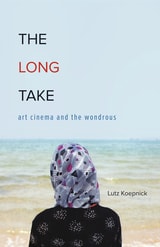
The Long Take
Art Cinema and the WondrousLutz Koepnick
University of Minnesota Press, 2017
In The Long Take, Lutz Koepnick posits extended shot durations as a powerful medium for exploring different modes of perception and attention in our fast-paced world of mediated stimulations. Grounding his inquiry in the long takes of international filmmakers such as Béla Tarr, Tsai Ming-liang, Abbas Kiarostami, Apichatpong Weerasethakul, and Michael Haneke, Koepnick reveals how their films evoke wondrous experiences of surprise, disruption, enchantment, and reorientation. He proceeds to show how the long take has come to thrive in diverse artistic practices across different media platforms: from the work of photographer Hiroshi Sugimoto to the screen-based installations of Sophie Calle and Tacita Dean, from experimental work by Francis Alÿs and Janet Cardiff to durational images in contemporary video games.
Deeply informed by film and media theory, yet written in a fluid and often poetic style, The Long Take goes far beyond recent writing about slow cinema. In Koepnick’s account, the long take serves as a critical hallmark of international art cinema in the twenty-first century. It invites viewers to probe the aesthetics of moving images and to recalibrate their sense of time. Long takes unlock windows toward the new and unexpected amid the ever-mounting pressures of 24/7 self-management.
The Look of Reading
Book, Painting, TextGarrett Stewart
University of Chicago Press, 2006
We take for granted that words can describe pictures, but we don’t often consider that the reverse is also true: pictures can depict words, as well as the people reading them. In The Look of Reading, Garrett Stewart explores centuries of painted images of reading, arguing that they collectively constitute an overlooked genre in the history of art.
A stunning array of artists—including Rembrandt, Picasso, Cassatt, and Caravaggio, among many others—have worked in this genre during the past five hundred years. With innovative interpretations of their work, ranging from Bellini’s open Bibles to Bacon’s mangled newsprint, Stewart examines the give-and-take between reading matter depicted in painting and the “look of reading” on the portrayed face. He then traces this kind of interaction from the sixteenth century, when pictured reading generally illustrated people reading holy scriptures, to later periods, when secular painting started to represent the inwardness and absorption associated especially with novel reading. Ultimately, Stewart shows how the subject fell out of such paintings altogether in the late twentieth century, replaced by words, scrawls, and blurs that put the viewer in the place of the reader.
Lavishly illustrated with the paintings it discusses, The Look of Reading charts the life and death of an entire genre. Essential reading for art historians and literary theorists alike, it will become the definitive study of this overlooked aspect of the relationship between images and words.

The Lure and the Truth of Painting
Selected Essays on ArtYves Bonnefoy
University of Chicago Press, 1995
The sixteen essays collected here show the breadth and depth of Bonnefoy's writings on art, aesthetics, and poetics. His lyrical ruminations range across centuries and cultures, from Byzantium to postwar France, from the paintings of Piero della Francesca to the sculptures of Alberto Giacometti and the photographs of Henri Cartier-Bresson, from the Italian Giorgio Morandi to the American Edward Hopper. Always fascinated in his poetry by the nature of color and light and the power of the image, Bonnefoy continues to pursue these themes in his discussion of the lure and truth of representation. He sees the painter as a poet whose language is a visual one, and seeks to find out what visual artists can teach those who work with words. More philosophical than historical and more poetic than critical, the essays express Bonnefoy's deep sympathy for the creative process and his great passion for individual works of art.
Bonnefoy's engagement with great art in The Lure and the Truth of Painting sheds light on the philosophy of presence and being that animates his poems. This book will be welcomed by lovers of Bonnefoy's poems and by everyone interested in the creation, history, and appreciation of art.
Yves Bonnefoy's numerous books include New and Selected Poems and In the Shadow's Light, both published by the University of Chicago Press. Richard Stamelman is director of the Center for Foreign Languages, Literatures, and Cultures and professor of romance languages at Williams College. He is the author of Lost beyond Telling: Representations of Death and Absence in Modern French Poetry.
"Few exponents of contemporary French letters deserve the attention of the reading public in America more than Yves Bonnefoy. . . . [His] writings . . . are an important lighthouse on the contemporary cultural coastline."—Emily Grosholz, The Hudson Review
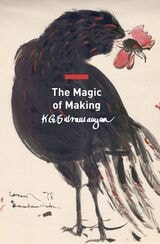
The Magic of Making
Essays on Art and CultureK. G. Subramanyan
Seagull Books, 2024
In this collection of essays, written by K. G. Subramanyan over twenty-five years, this artist delves into the evolving aesthetic sensibilities in a globalized world, offering profound reflections on art, aesthetics, tradition, and societal challenges. As one of India's most celebrated artists, Subramanyan provides invaluable insights into contemporary art and cultural dynamics
Covering a broad spectrum of topics including art, visual perception, creativity, craft practice, tradition, and societal issues, Subramanyan's essays offer a comprehensive exploration of the complexities shaping modern civilization. He critically examines the impact of globalization, industrialization, environmental degradation, and societal disparities on art, education, and society, urging readers to negotiate these challenges with insight and vigilance.
Subramanyan played a pivotal role in shaping India’s artistic identity after Independence. Mani-da, as he was fondly called, seamlessly blended elements of modernism with folk expression in his works, spanning paintings, murals, sculptures, prints, set designs, and toys. Beyond his visual artistry, his writings have laid a solid foundation for understanding the demands of art on the individual. In the year of his centenary, Seagull is proud to publish his writings in special new editions.
The Making of Paul Klee's Career, 1914-1920
Otto Karl Werckmeister
University of Chicago Press, 1989
Drawing on rich documentary evidence—records of Klee's sales, reviews of his exhibitions, the artist's published writings about his art, unpublished correspondence, as well as contemporary criticism—Werckmeister follows Klee's transformation from an idiosyncratic abstract individualist to a metaphysical storyteller to mystical sage. Werckmeister argues that this latter image was promoted by a number of influential art critics and dealers acting in cooperation with the artist himself. This posture prompted Klee's success first in the war-weary modernist art world of 1916-18 and then in the pseudo-revolutionary art world of 1919-20.
This work is a critical challenge to the myth of Klee's art and to the hagiography of his artistic personality. Werckmeister's historical account is sure to be a controversial yet significant contribution to Klee studies—one that will change the nature of Klee scholarship for some time to come.

The Making of an Artist
Desire, Courage, and CommitmentKristin G. Congdon
Intellect Books, 2018
Powerfully insightful and fully accessible, The Making of an Artist will be an invaluable resource for practicing artists, those just setting out on artistic careers, and art teachers alike.
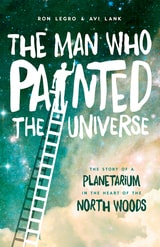
The Man Who Painted the Universe
The Story of a Planetarium in the Heart of the North WoodsRon Legro
Wisconsin Historical Society Press, 2015
The Man Who Painted the Universe: The Story of a Planetarium in the Heart of the North Woods introduces readers to the mild-mannered astronomy enthusiast whose creativity, ingenuity, fervor, and endurance realized a dream of galactic proportions. The story of this stargazer from Wisconsin’s North Woods so inspired two newspapermen, authors Ron Legro and Avi Lank, that they sought to document the story of the Kovac Planetarium for a new generation of stargazers and dreamers.
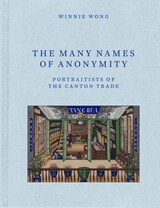
The Many Names of Anonymity
Portraitists of the Canton TradeWinnie Wong
University of Chicago Press, 2025
Challenging contemporary procedures for establishing attribution, chronology, and authenticity in Chinese art, Winnie Wong explores the means, methods, and stakes of recovering the names of an anonymous community of artists. To examine how Western art history has misconstrued and miscategorized names and identities in Chinese art, she looks to conflicting features of modernity: the European attachment of singular names to individuals and their works, and the Chinese use of socially contingent names that often are not attached to material labor and sometimes operate against it. Wong charts the genealogy of this naming problem by bringing to life the artists of the Qing Empire’s trade with Europeans at the port of Guangzhou, centering on a group of portraitists known by names that were recorded in a pidgin language: Chin Qua, Chit Qua, Spoilum, Lam Qua, and Ting Qua.
Many of these paintings survive today, yet scholars have identified only a handful of the painters’ identities. Pushing against Western norms that have shaped our understanding of authorship, Wong reveals that these artists shared names, created works in multiples, and signed their pieces with different names or none at all. This lavishly illustrated volume explores portraiture across media, including unfired clay, reverse painting on glass, watercolor on paper, oil on canvas, and the daguerreotype, to propose new ways of studying anonymity, copying, and the emergence of author names in the Sino-European visual culture of the long eighteenth century.
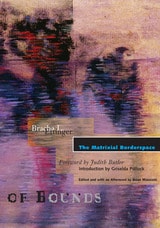
The Matrixial Borderspace
Bracha Ettinger
University of Minnesota Press, 2006
Concerned with collective trauma and memory, Ettinger’s own experience as an Israeli living with the memory of the Holocaust is a deep source of inspiration for her paintings, several of which are reproduced in the book. The paintings, like the essays, replay the relation between the visible and invisible, the sayable and ineffable; the gaze, the subject, and the other.
Bracha Ettinger is a painter and a senior clinical psychologist. She is professor of psychoanalysis and aesthetics at the University of Leeds, England, and Bezalel Academy, Jerusalem.
Judith Butler is professor of rhetoric and comparative literature at the University of California, Berkeley. Griselda Pollock is professor of fine arts at the University of Leeds. Brian Massumi is professor of communication at the University of Montreal.
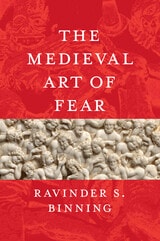
The Medieval Art of Fear
Ravinder S. Binning
University of Chicago Press, 2026
In the medieval world, experiences of fear attained a mystical significance: monks, urban publics, and even emperors pursued horror and grief to explore the limits of fantasy, sensation, and catharsis. In this book, Ravinder S. Binning examines an expansive archive ranging from poetry and scientific treatises to artistic works in ivory and crystal to recover an aesthetic tradition centered on optical tension, spatial suspense, and tactile experience.
Moving between early monastic spaces in Egypt and major urban centers like Constantinople from the fourth through the thirteenth centuries, The Medieval Art of Fear shows how the psychosomatic experience of fear became the deliberate object of mystical practices, meditation, and other embodied techniques across the medieval world. The result is a powerful exploration of the aesthetic effects behind some of the medieval world’s most ambitious works, whose influence extends well beyond the Middle Ages.
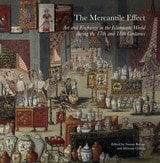
The Mercantile Effect
Art and Exchange in the Islamicate World During the 17th and 18th CenturiesEdited by Sussan Babaie and Melanie Gibson
Gingko, 2017
The Metropolis in Latin America, 1830-1930
Cityscapes, Photographs, DebatesIdurre Alonso
J. Paul Getty Trust, The, 2021
In the century between 1830 and 1930, following independence from Spain and Portugal, major cities in Latin America experienced large-scale growth, with the development of a new urban bourgeois elite interested in projects of modernization and rapid industrialization. At the same time, the lower classes were eradicated from old city districts and deported to the outskirts. The Metropolis in Latin America, 1830–1930 surveys this expansion, focusing on six capital cities—Havana, Mexico City, Rio de Janeiro, Buenos Aires, Santiago de Chile, and Lima—as it examines sociopolitical histories, town planning, art and architecture, photography, and film in relation to the metropolis.
Drawing from the Getty Research Institute’s vast collection of books, prints, and photographs from this period, largely unpublished until now, this volume reveals the cities’ changes through urban panoramas, plans depicting new neighborhoods, and photographs of novel transportation systems, public amenities, civic spaces, and more. It illustrates the transformation of colonial cities into the monumental modern metropolises that, by the end of the 1920s, provided fertile ground for the emergence of today’s Latin American megalopolis.
The Migrant Image
The Art and Politics of Documentary during Global CrisisT. J. Demos
Duke University Press, 2013

The Mind and Art of Victorian England
Josef L. Altholz, Editor
University of Minnesota Press, 1976
The Mind and Art of Victorian England was first published in 1976. Minnesota Archive Editions uses digital technology to make long-unavailable books once again accessible, and are published unaltered from the original University of Minnesota Press editions.
In a series of ten essays and a generous selection of illustrations, many in color, this volume depicts and assesses the mind and art of Victorian England. Multidisciplinary in approach, the essays deal with a variety of aspects in the history of the Victorian age.
Professor Altholz, the volume editor, writes: "It was an age not of revolution but of reform; political reform which admitted first the middle and then the working classes to the dominant share of the suffrage; economic and social reforms which proclaimed the triumph of laissez-faire while laying the foundations of the welfare state; moral reforms attempted if not achieved through education and religious revival; aesthetic reforms proposed if not achieved and, even in their failure, adding to the richness and diversity of Victorian England. It was an age whose problems cried out for reform; and, despite the prevailing complacency, virtually all the great Victorians were critics of their age. Their criticisms were diverse and often mutually incompatible, with each other -- and their public -- but they shared a high seriousness which gave character and substance to the flowering of their culture. Such was the Victorian age: the high-water mark of English history, the maturation of British culture, and the seedbed of our problems and our discontents."
The illustrations include color reproductions of some of the works discussed by Melvin Waldfogel in his essay "Narrative Painting," and a selection of architectural engravings and photographs.
The Minjung Art Movement
Decolonization and Democracy in South KoreaSohl Lee
Duke University Press, 2026
The Mitki and the Art of Postmodern Protest in Russia
Alexandar Mihailovic
University of Wisconsin Press, 2019
More broadly, Alexandar Mihailovic shows, the Mitki pioneered a form of political protest art that has since become a centerpiece of activism in post-Soviet Russia, most visibly today in groups such as Pussy Riot. He draws on extensive interviews with members of the collective and illuminates their critique of the authoritarian state, militarism, and social strictures from the Brezhnev years to the present.
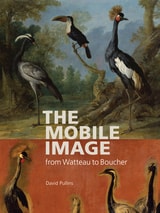
The Mobile Image from Watteau to Boucher
David Pullins
J. Paul Getty Trust, The, 2024
This book provides a new way of thinking about eighteenth-century French art and visual culture by prioritizing production over reception. Abandoning the ideologically driven discourse that distinguished fine from decorative art between the 1690s and 1770s, The Mobile Image reveals how the two have been inextricably bound from the earliest stages of artistic instruction through the daily life of painters’ workshops. In this study, author David Pullins defines artisanal and artistic means of learning, seeing, and making through a system of “mobile images”: motifs that were effectively engineered for mobility and designed never to be definitive, always awaiting replication and circulation. He examines the careers of Antoine Watteau, Jean-Baptiste Oudry, and François Boucher, situating them against a much broader cast of actors—such as printmakers, publishers, anonymous studio assistants, and architects, among others—to place eighteenth-century painting within a wider context of media and making.
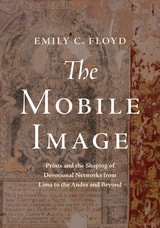
The Mobile Image
Prints and the Shaping of Devotional Networks from Lima to the Andes and BeyondEmily C. Floyd
University of Texas Press, 2025
A study of the production and movement of prints in colonial South America.
Printed images have had a central place in art-historical studies of colonial Spanish America, but scholars have typically focused on imported prints, designed and produced in Europe. The Mobile Image focuses instead on works printed in colonial Lima, generating there a distinctive print culture that served local and regional needs, while also appealing to European print consumers.
Inexpensive, easily transportable, and numerous, Lima’s prints traversed the varied geographies of the Viceroyalty of Peru both as loose sheets and within the protective covers of printed books. In the process, limeño devotional prints encouraged the development of shared regional imaginaries about the sacred Andean landscape, a space marked by miracle-working Virgins, potential saints, and powerful images of Christ. These same prints traveled abroad, where they promoted iconographies developed in Lima and influenced European conceptions of the Andes. Simultaneously, the visual language of limeño prints often challenges conventional approaches to interpreting colonial depictions of race. In analyzing limeño prints, and the identities of their makers, patrons, and consumers, The Mobile Image demonstrates that race is harder to recognize in colonial images than we might think. Unearthing hundreds of forgotten prints, Emily C. Floyd provides a fresh resource for interpreting colonial artworks, troubling established understandings of their aesthetics, and compelling us to reexamine colonial South American material cultures.
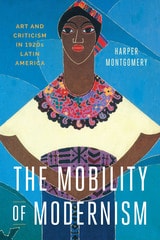
The Mobility of Modernism
Art and Criticism in 1920s Latin AmericaBy Harper Montgomery
University of Texas Press, 2017
Arvey Foundation Book Award, Association for Latin American Art, 2018
Many Latin American artists and critics in the 1920s drew on the values of modernism to question the cultural authority of Europe. Modernism gave them a tool for coping with the mobility of their circumstances, as well as the inspiration for works that questioned the very concepts of the artist and the artwork and opened the realm of art to untrained and self-taught artists, artisans, and women. Writing about the modernist works in newspapers and magazines, critics provided a new vocabulary with which to interpret and assign value to the expanding sets of abstracted forms produced by these artists, whose lives were shaped by mobility.
The Mobility of Modernism examines modernist artworks and criticism that circulated among a network of cities, including Buenos Aires, Mexico City, Havana, and Lima. Harper Montgomery maps the dialogues and relationships among critics who published in avant-gardist magazines such as Amauta and Revista de Avance and artists such as Carlos Mérida, Xul Solar, and Emilio Pettoruti, among others, who championed esoteric forms of abstraction. She makes a convincing case that, for these artists and critics, modernism became an anticolonial stance which raised issues that are still vital today—the tensions between the local and the global, the ability of artists to speak for blighted or unincorporated people, and, above all, how advanced art and its champions can enact a politics of opposition.
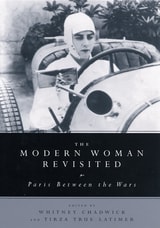
The Modern Woman Revisited
Paris Between the WarsChadwick, Whitney
Rutgers University Press, 2003
The contributions of female artists to the development of literary and artistic modernism in early twentieth century France remain poorly understood. It was during this period that a so-called “modern woman” began occupying urban spaces associated with the development of modern art and modernism’s struggles to define subjectivities and sexualities. Whereas most studies of modernism’s formal innovations and its encouragement of artistic autonomy neglect or omit necessary discussions of gender, race, class, and sexual orientation, the contributors of The Modern Woman Revisited inject these perspectives into the discussion.
Between the two World Wars, Paris served as the setting for unparalleled freedom for expatriate as well as native-born French women, who enjoyed unprecedented access to education and opportunities to participate in public artistic and intellectual life. Many of these women made lasting contributions in art and literature. Some of the artists discussed include Colette, Tamara de Lempicka, Sonia Delaunay, Djuna Barnes, Augusta Savage, and Lee Miller.
Inthis book, an internationally recognized roster of art historians, literary critics, and other scholars offers a nuanced portrait of what it meant to be a modern woman during this decisive period of modernism’s development. Individual essays explore the challenges faced by women in the early decades of the twentieth century, as well as the strategies these women deployed to create their art and to build meaningful lives and careers. The introduction underscores the importance of the contributors’ efforts to engender larger questions about modernity, sexuality, race, and class.
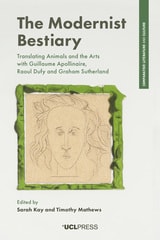
The Modernist Bestiary
Translating Animals and the Arts with Guillaume Apollinaire, Raoul Dufy and Graham SutherlandEdited by Sarah Kay and Timothy Mathews
University College London, 2020
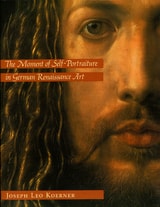
The Moment of Self-Portraiture in German Renaissance Art
Joseph Leo Koerner
University of Chicago Press, 1993
"[A] dazzling book. . . . He has turned out one of the most powerful, as well as one of the most ambitious, art-historical works of the last decade." — Anthony Grafton, New Republic
"Rich and splendid. . . . Joseph Koerner's book is a dazzling display of scholarship, enfolding Durer's artistic achievement within the broader issues of self and salvation, and like [Durer's] great Self-
Portrait it holds up a mirror to the modern fable of identity." — Bruce Boucher, The Times
"Remarkable and densely argued." — Marcia Pointon, British Journal of Aesthetics
"Herculean and brilliant. . . . Will echo in fields beyond the Sixteenth-Century and Art History." — Larry Silver, Sixteenth Century Journal
"May be the most ambitious of recent American reflections on the mysteries of German art. His elegantly written book deals with the fateful period in the history of German art when it reached its highest point. . . . Offers deeper and more disturbing insights into German Renaissance art than most earlier scholarship." — Willibald Sauerlander, New York Review of Books
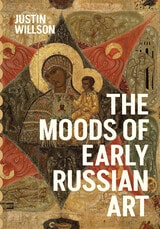
The Moods of Early Russian Art
Justin Willson
University of Chicago Press, 2026
The Moods of Early Russian Art describes an alternative early modernity at the easternmost border of the European cultural sphere, where the Renaissance marked a return not to secular humanism but to the religiosity and art of the Middle Ages. Charting a kind of “Renaissance in reverse,” art historian Justin Willson explores how the value placed on style and virtuosity faded in importance as the Church cultivated miracle-working images during the reigns of Ivan the Great and Ivan the Terrible. Arguing for a broader unity of interests among artistic workshops across the Muscovite landscape—a system of interconnected values that he explains using the language of “moods”—Willson examines icons, illuminated manuscripts, enamelwork, and murals, tracing how the interpretive framework of the age shifted from the “aesthetic” and “literal” moods to the “intoxicated” and “romantic” over the fifteenth and sixteenth centuries.
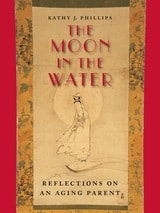
The Moon in the Water
Reflections on an Aging ParentKathy J. Phillips
Vanderbilt University Press, 2008
In a series of moving vignettes, the author begins by describing a particular representation of Water-Moon Kuan Yin, a Buddhist teacher and goddess associated with compassion, who often sits on a precarious overhang or floats on a flimsy petal. Then Kuan Yin steps out of the frame to join the author in the mundane challenges of caring for her father-transferring his health insurance, struggling with a wheelchair van, managing adult diapers, or playing in the fictions of dementia. From perplexed to poignant to funny, the vignettes record the working-class English of a fading but still wise dad, and they find other human versions of Kuan Yin in a doctor who will still make house calls or kind strangers in the street.
The book includes ten illustrations: both classical representations of Kuan Yin and also the author's own drawings, which adapt Kuan Yin in an act of practical spirituality, reading art through life and life through art. Each vignette invites the harried caregiver to take a deep breath and meditate on the trials and joys of caring for an aging parent.
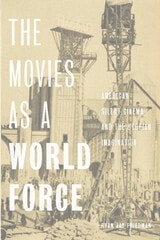
The Movies as a World Force
American Silent Cinema and the Utopian ImaginationFriedman, Ryan J
Rutgers University Press, 2019
The Multisensory Film Experience
A Cognitive Model of Experiental Film AestheticsLuis Rocha Antunes
Intellect Books, 2016
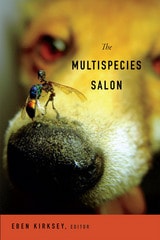
The Multispecies Salon
Eben Kirksey
Duke University Press, 2014
Delectable mushrooms flourishing in the aftermath of ecological disaster, microbial cultures enlivening the politics and value of food, and nascent life forms running wild in the age of biotechnology all figure in this curated collection of essays and artifacts. Recipes provide instructions on how to cook acorn mush, make cheese out of human milk, and enliven forests after they have been clear-cut. The Multispecies Salon investigates messianic dreams, environmental nightmares, and modest sites of biocultural hope.
For additional materials see the companion website: www.multispecies-salon.org/
Contributors. Karen Barad, Caitlin Berrigan, Karin Bolender, Maria Brodine, Brandon Costelloe-Kuehn, David S. Edmunds, Christine Hamilton, Donna J. Haraway, Stefan Helmreich, Angela James, Lindsay Kelley, Eben Kirksey, Linda Noel, Heather Paxson, Nathan Rich, Anna Rodriguez, Dorion Sagan, Craig Schuetze, Nicholas Shapiro, Miriam Simun, Kim TallBear, Anna Lowenhaupt Tsing
The Muse in Mexico
A Mid-Century MiscellanyEdited by Thomas Mabry Cranfill and George D. Schade
University of Texas Press, 1959
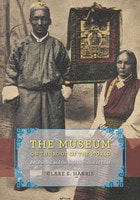
The Museum on the Roof of the World
Art, Politics, and the Representation of TibetClare E. Harris
University of Chicago Press, 2012
The Music of Nobuo Uematsu in the Final Fantasy Series
Edited by Richard Anatone
Intellect Books, 2023
Japanese musician and composer Nobuo Uematsu has built his career and reputation on his soundtracks to the enduring Final Fantasy video game series, which are notable for their remarkable cinematic feel. Today Uematsu is one of Japan’s most beloved living composers, credited with inspiring a new generation of classical music fans. This volume, the first book-length study of the music of Uematsu, takes a variety of different analytical approaches to his body of work. It offers readers interested in ludomusicology—the study of and research into video game music—a variety of ways with which to understand Uematsu’s compositional process and the role that video game music has in the overall gaming experience.

The Nail in the Tree
Essays on Art, Violence, and ChildhoodCarol Ann Davis
Tupelo Press, 2020
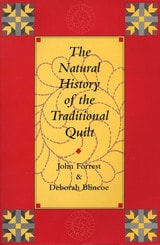
The Natural History of the Traditional Quilt
By John Forrest and Deborah Blincoe
University of Texas Press, 1995
Traditional quilts serve many purposes over the course of a useful life. Beginning as a beautiful bed covering, a quilt may later function as a ground cover at picnics until years of wear relegate it to someone's ragbag for scrap uses.
Observing this life cycle led authors John Forrest and Deborah Blincoe to the idea that quilts, like living things, have a natural history that can be studied scientifically. They explore that natural history through an examination of the taxonomy, morphology, behavior, and ecology of quilts in their native environment—the homes of humans who make, use, keep, and bestow them.
The taxonomy proposed by Forrest and Blincoe is rooted in the mechanics of replicating quilts so that it can be used to understand evolutionary and genetic relationships between quilt types. The morphology section anatomizes normal and abnormal physical features of quilts, while the section on conception and birth in the life cycle discusses how the underlying processes of replication intersect with environmental factors to produce tangible objects.
This methodology is applicable to many kinds of crafts and will be of wide interest to students of folklore, anthropology, and art history. Case studies of traditional quilts and their makers in the Catskills and Appalachia add a warm, human dimension to the book.
The Nazi Perpetrator
Postwar German Art and the Politics of the RightPaul B. Jaskot
University of Minnesota Press, 2012
Who was responsible for the crimes of the Nazis? Party leaders and members? Rank-and-file soldiers and bureaucrats? Ordinary Germans? This question looms over German disputes about the past like few others. It also looms over the art and architecture of postwar Germany in ways that have been surprisingly neglected. In The Nazi Perpetrator, Paul B. Jaskot fundamentally reevaluates pivotal developments in postwar German art and architecture against the backdrop of contentious contemporary debates over the Nazi past and the difficulty of determining who was or was not a Nazi perpetrator.
Like their fellow Germans, postwar artists and architects grappled with the Nazi past and the problem of defining the Nazi perpetrator—a problem that was thoroughly entangled with contemporary conservative politics and the explosive issue of former Nazis living in postwar Germany. Beginning with the formative connection between Nazi politics and art during the 1930s, The Nazi Perpetrator traces the dilemma of identifying the perpetrator across the entire postwar period. Jaskot examines key works and episodes from West Germany and, after 1989, reunified Germany, showing how the changing perception of the perpetrator deeply impacted art and architecture, even in cases where artworks and buildings seem to have no obvious relation to the Nazi past. The book also reinterprets important periods in the careers of such major figures as Gerhard Richter, Anselm Kiefer, and Daniel Libeskind.
Combining political history with a close analysis of specific works, The Nazi Perpetrator powerfully demonstrates that the ongoing influence of Nazi Germany after 1945 is much more central to understanding a wide range of modern German art and architecture than cultural historians have previously recognized.
The Nelson-Atkins Museum of Art
A HistoryKristie C. Wolferman
University of Missouri Press, 2020
Wolferman begins by relaying how the trustees of the estates of the reclusive widow Mary Atkins and the family of Kansas City Star newspaper editor William Rockhill Nelson joined forces to establish a museum from scratch, then goes on to consider all of the highly talented people who directed and staffed the Nelson-Atkins along the way, their efforts resulting in many bold innovations, among them new collections, grounds, and educational programs and offerings.
With 100 color and black and white photographs, this book will be treasured by all who love and admire this remarkable institution, one that attracts half a million visitors—from across the city, state, nation, and world—each year.
This is a co-publication of the University of Missouri Press and the Nelson-Atkins Museum of Art.
The Neural Imagination
Aesthetic and Neuroscientific Approaches to the ArtsBy Irving Massey
University of Texas Press, 2009
Art and technology have been converging rapidly in the past few years; an important example of this convergence is the alliance of neuroscience with aesthetics, which has produced the new field of neuroaesthetics.
Irving Massey examines this alliance, in large part to allay the fears of artists and audiences alike that brain science may "explain away" the arts. The first part of the book shows how neuroscience can enhance our understanding of certain features of art. The second part of the book illustrates a humanistic approach to the arts; it is written entirely without recourse to neuroscience, in order to show the differences in methodology between the two approaches. The humanistic style is marked particularly by immersion in the individual work and by evaluation, rather than by detachment in the search for generalizations. In the final section Massey argues that, despite these differences, once the reality of imagination is accepted neuroscience can be seen as the collaborator, not the inquisitor, of the arts.
The New Gods
Psyche and Symbol in Popular ArtHarold Schechter
University of Wisconsin Press, 1980
Harold Schechter looks at the impossible tales and images of popular art--the space odysseys and extraterrestrial civilizations, the caped crusaders and men of steel, and monsters from the ocean floor--and finds close connections between religious myth and popular entertainment.
The New Public Art
Collectivity and Activism in Mexico since the 1980sMara Polgovsky Ezcurra
University of Texas Press, 2023
Essays on the rise of community-focused art projects and anti-monuments in Mexico since the 1980s.
Mexico has long been lauded and studied for its post-revolutionary public art, but recent artistic practices have raised questions about how public art is created and for whom it is intended. In The New Public Art, Mara Polgovsky Ezcurra, together with a number of scholars, artists, and activists, looks at the rise of community-focused art projects, from collective cinema to off-stage dance and theatre, and the creation of anti-monuments that have redefined what public art is and how people have engaged with it across the country since the 1980s.
The New Public Art investigates the reemergence of collective practices in response to privatization, individualism, and alienating violence. Focusing on the intersection of art, politics, and notions of public participation and belonging, contributors argue that a new, non-state-led understanding of "the public" came into being in Mexico between the mid-1980s and the late 2010s. During this period, community-based public art bore witness to the human costs of abuses of state and economic power while proposing alternative forms of artistic creation, activism, and cultural organization.
The Object of Performance
The American Avant-Garde since 1970Henry M. Sayre
University of Chicago Press, 1989
"Sayre has written one of the most intelligent, sensible, and readable accounts of the tenents of Postmodern artmaking published to date."—Jeff Abell, New Art Examiner
"No one can read The Object of Performance without gaining a far better idea than before of what has happened to art, and, in some measure, why. . . . I find this book consistently illuminating."—Arthur C. Danto
The Objective Eye
Color, Form, and Reality in the Theory of ArtJohn Hyman
University of Chicago Press, 2006
This, in a nutshell, is the central problem in the theory of art. It has fascinated philosophers from Plato to Wittgenstein. And it fascinates artists and art historians, who have always drawn extensively on philosophical ideas about language and representation, and on ideas about vision and the visible world that have deep philosophical roots.
John Hyman’s The Objective Eye is a radical treatment of this problem, deeply informed by the history of philosophy and science, but entirely fresh. The questions tackled here are fundamental ones: Is our experience of color an illusion? How does the metaphysical status of colors differ from that of shapes? What is the difference between a picture and a written text? Why are some pictures said to be more realistic than others? Is it because they are especially truthful or, on the contrary, because they deceive the eye?
The Objective Eye explores the fundamental concepts we use constantly in our most innocent thoughts and conversations about art, as well as in the most sophisticated art theory. The book progresses from pure philosophy to applied philosophy and ranges from the metaphysics of color to Renaissance perspective, from anatomy in ancient Greece to impressionism in nineteenth-century France. Philosophers, art historians, and students of the arts will find The Objective Eye challenging and absorbing.
The Old Guard and the Avant-Garde
Modernism in Chicago, 1910-1940Edited by Sue Ann Prince
University of Chicago Press, 1990
"This is fresh and fascinating research about the ups and downs of modernism in Chicago, a city where art students reportedly once hung Matisse in effigy. Regional studies like this one broaden our understanding of how the art world has worked outside of New York and gives depth to a story we know too narrowly. Applause all the way around."—Wanda M. Corn, Stanford University
The Omega Workshops
Judith Collins
University of Chicago Press, 1984
The One and the Many
Contemporary Collaborative Art in a Global ContextGrant H. Kester
Duke University Press, 2011
The Open Studio
Essays on Art and AestheticsSusan Stewart
University of Chicago Press, 2004
Gathering most of Stewart's writing on contemporary art—long and short pieces first published in small magazines, museum and gallery publications, and edited collections—The Open Studio illuminates work ranging from the installation art of Ann Hamilton to the sculptures and watercolors of Thomas Schütte, the prints and animations of William Kentridge to the films of Tacita Dean. Stewart's essays are often the record of studio conversations with living artists and curators, and of the afterlife of those experiences in the solitude of her own study. Considering a wide variety of art forms, Stewart finds pathbreaking ways to explore them. Whether she is following central traditions of painting, drawing, sculpture, film, photography, and printmaking or exploring the less well-known realms of portrait miniatures, collecting practices, doll-making, music boxes, and gardening, Stewart speaks to the creative process in general and to the relation between art and ethics.
The Open Studio will be read eagerly by scholars of art, poetry, and visual theory; by historians interested in the links between contemporary and classic literature and art; and by teachers, students, and practitioners of the visual arts.
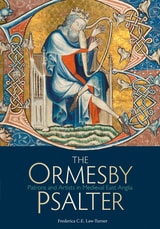
The Ormesby Psalter
Patrons and Artists in Medieval East AngliaFrederica C. E. Law-Turner
Bodleian Library Publishing, 2005
Housed in Oxford’s Bodleian Library for over 150 years, this enigmatic masterpiece is perhaps the most magnificent yet enigmatic of the great Gothic psalters produced in East Anglia in the first half of the fourteenth century. Manuscript expert Frederica C. E. Law-Turner places the psalter within a wider historical context and then deciphers its lush illuminations—scenes that vary wildly in tone from the comic to the bawdy to the mythic. Full-color photographs illustrate the text’s many characters: falcons and hunting dogs at bay, kings and courtesans, and other animals dressed in human garb. Created over a period of decades by previously unrecognized scribes and artists, the Ormesby Psalter is an exceptional amalgam of medieval art and history. For scholars of medieval life, as well as art historians, this new study will be an invaluable resource.

The Other End of the Needle
Continuity and Change among Tattoo WorkersDavid C. Lane
Rutgers University Press, 2021
Yet, Lane notes, prior research has focused almost exclusively on the tattoos—the outcome of an intricate social process—and have ignored the significance of tattoo workers themselves. "Tattooists," as Lane dubs them, make decisions, but they work within a social world that constrains and shapes the outcome of their labor—the tattoo. The goal of this book is to help readers understand the world of tattoo work as an intricate and nuanced form of work. Lane ultimately asks new questions about the social processes occurring prior to the tattoo’s existence.
The Other Transatlantic
Kinetic and Op Art in Eastern Europe and Latin AmericaEdited by Marta Dziewanska, Dieter Roelstraete, and Abigail Winograd
Museum of Modern Art in Warsaw, 2017
As the axis connecting the established power centers of Paris, London, and New York became increasingly dominated by monolithic trends including pop, minimalism, and conceptualism—another web of ideas was being spun linking the hubs of Warsaw, Budapest, Zagreb, Buenos Aires, Caracas, and Sao Paulo. These artistic practices were dedicated to what appeared to be an entirely different set of aesthetic concerns: philosophies of art and culture dominated by notions of progress and science, the machine and engineering, construction and perception. This book presents a highly illustrated introduction to this significant transnational phenomenon in the visual arts.