Results by title
8113 books match the query 'Literary Criticism' and 1818 start with t
The Conjure Woman
Charles W. Chesnutt
University of Michigan Press, 1969

The Conjure-Man Dies
A Mystery Tale of Dark HarlemRudolph Fisher
University of Michigan Press, 1992
The Conquest of Ruins
The Third Reich and the Fall of RomeJulia Hell
University of Chicago Press, 2019
Hell examines centuries of European empire-building—from Charles V in the sixteenth century and Napoleon’s campaigns of the late seventeenth and early eighteenth centuries to the atrocities of Mussolini and the Third Reich in the 1930s and ’40s—and sees a similar fascination with recreating the Roman past in the contemporary image. In every case—particularly that of the Nazi regime—the ruins of Rome seem to represent a mystery to be solved: how could an empire so powerful be brought so low? Hell argues that this fascination with the ruins of greatness expresses a need on the part of would-be conquerors to find something to ward off a similar demise for their particular empire.
The Contemporary African American Novel
Its Folk Roots and Modern Literary BranchesBernard W. Bell
University of Massachusetts Press, 2004
The Contemporary Narrative Poem
Critical CrosscurrentsSteven P. Schneider
University of Iowa Press, 2012
The answers they supply will engage every poet and student of poetry.
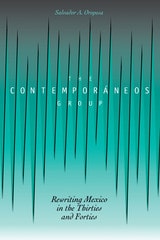
The Contemporáneos Group
Rewriting Mexico in the Thirties and FortiesBy Salvador A. Oropesa
University of Texas Press, 2003
In the years following the Mexican Revolution, a nationalist and masculinist image of Mexico emerged through the novels of the Revolution, the murals of Diego Rivera, and the movies of Golden Age cinema. Challenging this image were the Contemporáneos, a group of writers whose status as outsiders (sophisticated urbanites, gay men, women) gave them not just a different perspective, but a different gaze, a new way of viewing the diverse Mexicos that exist within Mexican society. In this book, Salvador Oropesa offers original readings of the works of five Contemporáneos—Salvador Novo, Xavier Villaurrutia, Agustín Lazo, Guadalupe Marín, and Jorge Cuesta—and their efforts to create a Mexican literature that was international, attuned to the realities of modern Mexico, and flexible enough to speak to the masses as well as the elites.
Oropesa discusses Novo and Villaurrutia in relation to neo-baroque literature and satiric poetry, showing how these inherently subversive genres provided the means of expressing difference and otherness that they needed as gay men. He explores the theatrical works of Lazo, Villaurrutia's partner, who offered new representations of the closet and of Mexican history from an emerging middle-class viewpoint. Oropesa also looks at women's participation in the Contemporáneos through Guadalupe Marín, the sometime wife of Diego Rivera and Jorge Cuesta, whose novels present women's struggles to have a view and a voice of their own. He concludes the book with Novo's self-transformation from intellectual into celebrity, which fulfilled the Contemporáneos' desire to merge high and popular culture and create a space where those on the margins could move to the center.
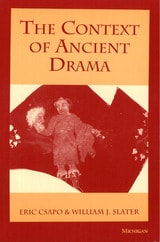
The Context of Ancient Drama
Eric Csapo and William J. Slater
University of Michigan Press, 1995
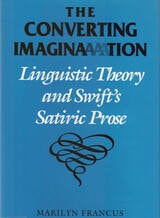
The Converting Imagination
Linguistic Theory and Swift's Satiric ProseMarilyn Francus
Southern Illinois University Press, 1994
By illuminating Jonathan Swift’s fascination with language, Marilyn Francus shows how the linguistic questions posed by his work are at the forefront of twentieth-century literary criticism: What constitutes meaning in language? How do people respond to language? Who has (or should have) authority over language? Is linguistic value synonymous with literary value?
Francus starts with a detailed analysis of Swift’s linguistic education, which straddled a radical transition in linguistic thought, and its effect on his prose. This compelling beginning includes sometimes surprising historical information about the teaching and learning of linguistics and language theory in the seventeenth and eighteenth centuries. Swift’s academic studies reflected the traditional universalist view that seeks an Adamic language to reverse the fragmentation of Babel and achieve epistemological unity. But Swift’s tutor also exposed him to the contemporary linguistics of the scientific societies and of John Locke, who argued that the assignment of linguistic meaning is arbitrary and subjective, capturing an individual’s understanding at a particular instant. These competing theories, Francus maintains, help explain the Irish writer’s conflicting inclinations toward both linguistic order and freewheeling creativity.
To develop a complete vision of Swiftian linguistics, Francus focuses on A Tale of a Tub as the archetypal linguistic text in the Swift canon, but she also includes evidence from his other famous works, including Gulliver’s Travels, A Modest Proposal, Journal to Stella, and The Bickerstaff Papers, as well as from his lesser known religious and political tracts and his correspondence. In addition, Francus draws on the relevant work of contemporary linguists (such as Wilkins, Watts, Dyche, and Stackhouse), philosophers (Hobbes and Locke), and authors (including Temple, Sprat, Dryden, Pope, Addison, and Defoe).
Francus concludes that Swift occupies a pivotal place in literary history: his conscious emphasis on textuality and extended linguistic play anticipates not only the future of satiric prose but the modern novel as well.
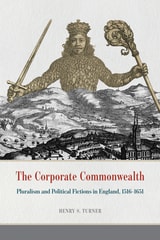
The Corporate Commonwealth
Pluralism and Political Fictions in England, 1516-1651Henry S. Turner
University of Chicago Press, 2016
Henry S. Turner uses the resources of economic and political history, literary analysis, and political philosophy to demonstrate how a number of English institutions with corporate associations—including universities, guilds, towns and cities, and religious groups—were gradually narrowed to the commercial, for-profit corporation we know today, and how the joint-stock corporation, in turn, became both a template for the modern state and a political force that the state could no longer contain. Through innovative readings of works by Thomas More, William Shakespeare, Francis Bacon, and Thomas Hobbes, among others, Turner tracks the corporation from the courts to the stage, from commonwealth to colony, and from the object of utopian fiction to the subject of tragic violence. A provocative look at the corporation’s peculiar character as both an institution and a person, The Corporate Commonwealth uses the past to suggest ways in which today’s corporations might be refashioned into a source of progressive and collective public action.
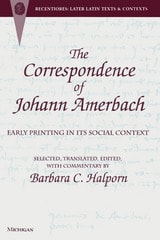
The Correspondence of Johann Amerbach
Early Printing in its Social ContextSelected, Translated, Edited, and with Commentary by Barbara C. Halporn
University of Michigan Press, 2000
Between 1478 and 1513 Amerbach published more than a hundred substantial works. He is best known for his monumental editions of the works of early church fathers. Crucial to his success was the information network he kept through correspondence with scholars, teachers, printers, booksellers, library curators, and other members of the literate community. The letters reveal how books were made, by whom, and for whom. The Correspondence of Johann Amerbach allows us to see the tensions in the new alliance between commerce and the republic of letters. Filling out the scene more fully, letters between the Amerbach children and their parents tell of the daily life, expectations, and aspirations of an intellectual bourgeois family at the end of the fifteenth century.
Barbara C. Halporn is Head of the Collection Development Department, Widener Library, Harvard University.
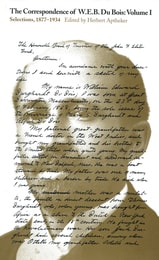
The Correspondence of W.E.B. Du Bois, Volume I
Selections, 1877–1934W.E.B. Du Bois
University of Massachusetts Press, 1997
Scholar, author, editor, teacher, reformer, and civil rights leader, W.E.B. Du Bois (1868–1963) was a major figure in American life and one of the earliest proponents of equality for Black Americans. He was a founder and leader of the Niagara Movement, the NAACP, and the Pan-African Movement; a progenitor of the 1920s Harlem Renaissance; an advocate of anticolonialism, anti-imperialism, unionism, and equality for women; and a champion of the rights of oppressed people around the world.
The three-volume Correspondence of W.E.B. Du Bois offers a unique perspective on Du Bois's experiences and views. In recognition of the significance of the Correspondence, the final volume was named a Best Book of the Year by the New York Times Book Review.
Herbert Aptheker has provided an introduction and notes to each volume, illuminating the circumstances and identifying the personalities involved in the correspondence. A long time friend and colleague of Du Bois, Aptheker is a well-known historian of the African American experience. In 1939 and again in 1969, he won the history award given by the Association for the Study of Negro Life and History. Among his most prominent works are American Negro Slave Revolts and the three-volume Documentary History of the Negro People in the United States.
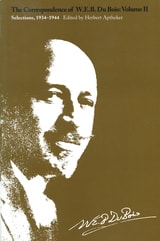
The Correspondence of W.E.B. Du Bois, Volume II
Selections, 1934–1944W.E.B. Du Bois
University of Massachusetts Press, 1997
Scholar, author, editor, teacher, reformer, and civil rights leader, W.E.B. Du Bois (1868–1963) was a major figure in American life and one of the earliest proponents of equality for black Americans. He was a founder and leader of the Niagara Movement, the NAACP, and the Pan-African Movement; a progenitor of the 1920s Harlem Renaissance; an advocate of anticolonialism, anti-imperialism, unionism, and equality for women; and a champion of the rights of oppressed people around the world.
The three-volume Correspondence of W.E.B. Du Bois offers a unique perspective on Du Bois's experiences and views. In recognition of the significance of the Correspondence, the final volume was named a Best Book of the Year by the New York Times Book Review.
Herbert Aptheker has provided an introduction and notes to each volume, illuminating the circumstances and identifying the personalities involved in the correspondence. A long time friend and colleague of Du Bois, Aptheker is a well-known historian of the African American experience. In 1939 and again in 1969, he won the history award given by the Association for the Study of Negro Life and History. Among his most prominent works are American Negro Slave Revolts and the three-volume Documentary History of the Negro People in the United States.
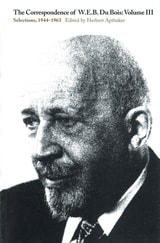
The Correspondence of W.E.B. Du Bois, Volume III
Selections, 1944–1963W.E.B. Du Bois
University of Massachusetts Press, 1997
Scholar, author, editor, teacher, reformer, and civil rights leader, W.E.B. Du Bois (1868–1963) was a major figure in American life and one of the earliest proponents of equality for black Americans. He was a founder and leader of the Niagara Movement, the NAACP, and the Pan-African Movement; a progenitor of the 1920s Harlem Renaissance; an advocate of anticolonialism, anti-imperialism, unionism, and equality for women; and a champion of the rights of oppressed people around the world.
The three-volume Correspondence of W.E.B. Du Bois offers a unique perspective on Du Bois's experiences and views. In recognition of the significance of the Correspondence, the final volume was named a Best Book of the Year by the New York Times Book Review.
Herbert Aptheker has provided an introduction and notes to each volume, illuminating the circumstances and identifying the personalities involved in the correspondence. A long time friend and colleague of Du Bois, Aptheker is a well-known historian of the African American experience. In 1939 and again in 1969, he won the history award given by the Association for the Study of Negro Life and History. Among his most prominent works are American Negro Slave Revolts and the three-volume Documentary History of the Negro People in the United States.
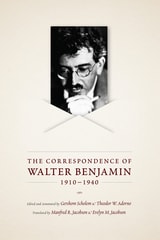
The Correspondence of Walter Benjamin, 1910-1940
Walter Benjamin
University of Chicago Press, 1994
A powerful, mesmerizing collection of letters from one of the most important intellectuals and writers of the twentieth century

The Cosmic Zoom
Scale, Knowledge, and MediationZachary Horton
University of Chicago Press, 2021
Horton uses the cosmic zoom as a starting point to develop a cross-disciplinary theory of scale as mediated difference. He considers the origins of our notions of scale, how scalar mediation functions differently in analog and digital modes, and how cosmic zoom media has influenced scientific and popular views of the world. Analyzing literature, film, digital media, and database history, Horton establishes a much-needed framework for thinking about scale across multiple domains and disciplines.
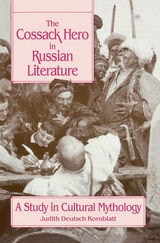
The Cossack Hero in Russian Literature
A Study in Cultural MythologyJudith Deutsch Kornblatt
University of Wisconsin Press, 1992
This is the first book to study the development of the Cossack hero and to identify him as part of Russian cultural mythology. Kornblatt explores the power of the myth as a literary image, providing new and challenging readings of Pushkin, Gogol, Tolstoi, and a host of other writers.
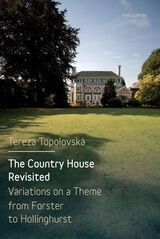
The Country House Revisited
Variations on a Theme from Forster to HollinghurstTereza Topolovská
Karolinum Press, 2017
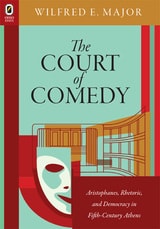
The Court of Comedy
Wilfred E. Major
The Ohio State University Press, 2013
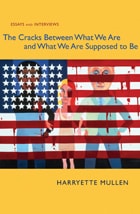
The Cracks Between What We Are and What We Are Supposed to Be
Essays and InterviewsHarryette Mullen
University of Alabama Press, 2012
The Cracks Between What We Are and What We Are Supposed to Be forms an extended consideration not only of Harryette Mullen’s own work, methods, and interests as a poet, but also of issues of central importance to African American poetry and language, women’s voices, and the future of poetry.
Together, these essays and interviews highlight the impulses and influences that drive Mullen’s work as a poet and thinker, and suggest unique possibilities for the future of poetic language and its role as an instrument of identity and power.

The Cradle of Erewhon
Samuel Butler in New ZealandBy Joseph Jones
University of Texas Press, 1959
In 1859, Samuel Butler, a young Cantabrigian out of joint with his family, with the church, and with the times, left England to hew out his own path in New Zealand. At the end of just five years he returned, with a modest fortune in money and an immense fortune in ideas. For out of this self-imposed exile came Erewhon, one of the world's masterpieces of satire, which contained the germ of Butler's intellectual output for the next twenty years.
The Cradle of Erewhon is an examination and interpretation of the special ways in which these few crucial years affected Butler's life and work, particularly Erewhon and Erewhon Revisited. It shows us Butler the sheep farmer, explorer, and mountain climber, as well as Butler the newcomer to "The Colonies," accepting—and accepted by—his intellectual peers in the unpioneerlike little city of Christchurch, sharpening and disciplining his mind through his controversial contributions to the Christchurch Press. But more importantly, the book suggests the depth to which New Zealand penetrated the man and reveals new facets of influence hitherto unnoticed in Erewhon and Erewhon Revisited. The Southern Alps ("Oh, Wonderful! Wonderful! so lonely and so solemn"), the perilous rivers and passes, the character and customs of the Maoris—all these blend to afford new insights into a complex book. Butler was not the first to create an imaginary world as asylum from the harsh realities of this one (Vergil did the same in the Eclogues), nor was he the first, even in his own time, to protest against the machine as the enslaver of man, but his became the clearest and the freshest voice.
On the biographical side, The Cradle of Erewhon offers new evidence for reappraising the man who for so long has been a psychological and literary puzzle. Why, for instance, did he repudiate his first-born book, A First Year in Canterbury Settlement? And why, once safely away from the entanglements of London, did he voluntarily return to them? Answers to these and other Butlerian riddles are suggested in the engrossing account of the satirist's sojourn in the Antipodes.
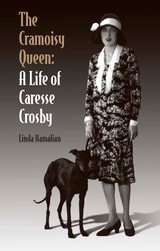
The Cramoisy Queen
A Life of Caresse CrosbyLinda Hamalian
Southern Illinois University Press, 2009
Caresse Crosby rejected the culturally prescribed roles for women of her era and background in search of an independent, creative, and socially responsible life. Poet, memoirist, advocate of women’s rights and the peace movement, Crosby published and promoted modern writers and artists such as Hart Crane, Dorothy Parker, Salvador Dalí, and Romare Bearden. She also earned a place in the world of fashion by patenting one of the earliest versions of the brassiere.
Behind her public success was a chaotic life: three marriages, two divorces, the suicide of her husband Harry Crosby, strained relationships with her children, and legal confrontations over efforts to establish a center for world peace. As the first biographer to consider both the literary and social contexts of Crosby’s life, Linda Hamalian details Crosby’s professional accomplishments and her personal struggles. The Cramoisy Queen: A Life of Caresse Crosby also measures the impact of small presses on modernist literature and draws connections between key writers and artists of the era.
In addition to securing a place for Crosby in modern literary and cultural history, The Cramoisy Queen: A Life of Caresse Crosby contributes to the field of textual studies, specifically the complexities of integrating autobiography and correspondence into biography. Enhanced by thirty-two illustrations, the volume appeals to a wide range of readers, including literary critics, cultural historians, biographers, and gender studies specialists.
The Creative Crone
Aging and the Poetry of May Sarton and Adrienne RichSylvia Henneberg
University of Missouri Press, 2010
The Creolization of Theory
Françoise Lionnet and Shu-mei Shih, eds.
Duke University Press, 2011
Contributors. Étienne Balibar, Dominique Chancé, Pheng Cheah, Leo Ching, Liz Constable, Anne Donadey, Fatima El-Tayeb, Julin Everett, Édouard Glissant, Barnor Hesse, Ping-hui Liao, Françoise Lionnet, Walter Mignolo, Andrea Schwieger Hiepko, Shu-mei Shih

The Crime Novel
A Deviant GenreBy Tony Hilfer
University of Texas Press, 1990
Although rarely distinguished from the detective story, the crime novel offers readers a quite different experience. In the detective novel, a sympathetic detective figure uses reason and intuition to solve the puzzle, restore order, and reassure readers that "right" will always prevail. In the crime novel, by contrast, the "hero" is either the killer, the victim, a guilty bystander, or someone falsely accused, and the crime may never be satisfactorily solved.
These and other fundamental differences are set out by Tony Hilfer in The Crime Novel, the first book that completely defines and explores this popular genre. Hilfer offers convincing evidence that the crime novel should be regarded as a genre distinct from the detective novel, whose conventions it subverts to develop conventions of its own.
Hilfer provides in-depth analyses of novels by Georges Simenon, Margaret Millar, Patricia Highsmith, and Jim Thompson. He also treats such British novelists as Patrick Hamilton, Shelley Smith, and Marie Belloc Lowndes, as well as the American novelists Cornell Woolrich, John Franklin Bardin, James M. Cain, and Fredric Brown. In addition, he defines the distinctions between the American crime novel and the British, showing how their differences correspond to differences in American and British detective fiction.
This well-written study will appeal to a general audience, as well as teachers and students of detective and mystery fiction. For anyone interested in the genre, it offers valuable suggestions of "what to read next."
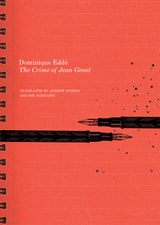
The Crime of Jean Genet
Dominique Eddé
Seagull Books, 2016
Dominique Eddé met novelist and playwright Jean Genet in the 1970s. And she never forgot him. “His presence,” she writes, “gave me the sensation of icy fire. Like his words, his gestures were full, calculated, and precise. . . . Genet’s movements mimicked the movement of time, accumulating rather than passing.”
This book is Eddé’s account of that meeting and its ripples through her years of engaging with Genet’s life and work. Rooted in personal reminiscences, it is nonetheless much broader, offering a subtle analysis of Genet’s work and teasing out largely unconsidered themes, like the absence of the father, which becomes a metaphor for Genet’s perpetual attack on the law. Tying Genet to Dostoevsky through their shared fascination with crime, Eddé helps us more clearly understand Genet’s relationship to France and Palestine, Judaism, Christianity, Islam, the theater, and even death. A powerful personal account of the influence of one writer on another, The Crime of Jean Genet is also one of the most penetrating explorations yet of Genet’s work and achievement.

The Crisis of Action in Nineteenth-Century English Literature
Stefanie Markovits
The Ohio State University Press, 2006
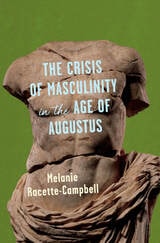
The Crisis of Masculinity in the Age of Augustus
Melanie Racette-Campbell
University of Wisconsin Press, 2023
Careful reading of contemporary texts reveals a decades-long process as tumultuous and unsteady as the political events they echoed, one in which multiple and competing strategies for reconceiving the nature of masculinity were tested, employed, discarded, and adopted in a complex public-private discourse. The eventual reconstitution of a definition of Roman manhood was not easily agreed upon. Masculinity in both the Republic and the Empire are well-studied subjects, but by shining a light on the precise moment of transition Racette-Campbell unveils the complexity, contours, and nuances of the Augustan crisis of masculinity.

The Critics and the Prioress
Antisemitism, Criticism, and Chaucer's Prioress's TaleHeather Blurton and Hannah Johnson
University of Michigan Press, 2017
The Critics and the Prioress responds to a critical stalemate between the demands of ethics and the entailments of methodology. The book addresses key moments in criticism of the Prioress’s Tale—particularly those that stage an encounter between historicism and ethics—in order to interrogate these critical impasses while suggesting new modes for future encounters. It is an effort to identify, engage, and reframe some significant—and perennially repeated—arguments staked out in this criticism, such as the roles of gender, aesthetics, source studies, and the appropriate relationship between ethics and historicism.
The Critics and the Prioress will be an essential resource for Chaucer scholars researching as well as teaching the Prioress’s Tale. Scholars and students of Middle English literature and medieval culture more generally will also be interested in this book’s rigorous analysis of contemporary scholarly approaches to expressions of antisemitism in Chaucer’s England.
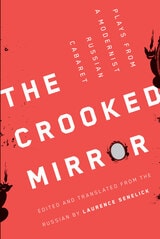
The Crooked Mirror
Plays from a Modernist Russian CabaretEdited and translated from the Russian by Laurence Senelick
Northwestern University Press, 2023
“Don’t blame the mirror if your mug is crooked!”
Parody dominated early twentieth-century Russian cabaret, but the Crooked Mirror extended its lampooning to theatrical practice itself. Eclectic in its targets, the Saint Petersburg theater mocked not only naturalism but also symbolism, futurism, and “Meyerholditis.” Its shows parodied both the stale conventions of melodrama and opera and the stylized trends in staging, wielding satire to provoke artistic and social reform. Though the theater was liquidated in 1931, many of its innovations would become standard techniques in cabaret repertoires and improv revues.
As a cultural phenomenon of the Silver Age, the Crooked Mirror deserves critical attention, yet it has received only fleeting mention in histories of Russian theater and biographies of its major figures. This anthology fills a critical gap in our understanding of that heady era by bringing together key plays—most appearing in English here for the first time—together with short biographies of their authors and robust commentary and annotations. Laurence Senelick guides readers through the artistic and ideological evolution of the Crooked Mirror and provides performers with the material to bring its innovations back to the stage.
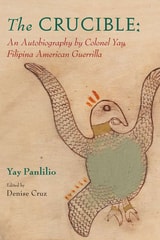
The Crucible
An Autobiography by Colonel Yay, Filipina American GuerrillaCruz, Denise
Rutgers University Press, 2010
On December 8, 1941, as the Pacific War reached the Philippines, Yay Panlilio, a Filipina-Irish American, faced a question with no easy answer: How could she contribute to the war?
In this 1950 memoir, The Crucible: An Autobiography by Colonel Yay, Filipina American Guerrilla, Panlilio narrates her experience as a journalist, triple agent, leader in the Philippine resistance against the Japanese, and lover of the guerrilla general Marcos V. Augustin. From the war-torn streets of Japanese-occupied Manila, to battlegrounds in the countryside, and the rural farmlands of central California, Panlilio blends wry commentary, rigorous journalistic detail, and popular romance.
Weaving together appearances by Douglas MacArthur and Carlos Romulo with dangerous espionage networks, this work provides an insightful perspective on the war. The Crucible invites readers to see new intersections in Filipina/o, Asian American, and American literature studies, and Denise Cruz's introduction imparts key biographical, historical, and cultural contexts to that purpose.

The Cultural Logic of Contemporary Capitalism
Nico Baumbach, Damon R. Young, and Genevieve Yue, special issue editors
Duke University Press, 0
In 1984 Fredric Jameson wrote that “everything in our social life—from economic value and state power to practices and to the very structure of the psyche itself—can be said to have become ‘cultural’ in some original and yet untheorized sense.” The essays in this special issue track the status of this claim some thirty years later, inquiring into the relationship of art, aesthetics, and cultural production to political economy today. At a moment when interpretation (including “ideology critique” and “symptomatic reading”) has been variously supplanted by descriptivism, empiricism, and the return of metaphysics, contributors here pursue the possibilities for an engaged cultural criticism that is attentive to form while rejecting a depoliticized formalism. Spanning a wide range of cultural sites—from recent Hollywood cinema to post-broadcast television, manufactured landscape photography, contemporary West African art, and “new materialism” in philosophy—they ask what the “formal tendencies” of contemporary cultural production (including theory itself) can tell us about the cultural logic of contemporary capitalism. The collection includes a new interview with Jameson conducted by the editors.
Contributors: Jennifer Bajorek, Nico Baumbach, Jonathan Beller, Alexander R. Galloway, Fredric Jameson, Sulgi Lie, Alberto Toscano, Amy Villarejo, Damon R. Young, Genevieve Yue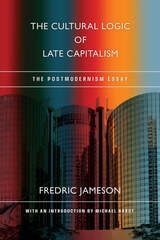
The Cultural Logic of Late Capitalism
The Postmodernism EssayFredric Jameson. Introduction by Michael Hardt.
Duke University Press, 2026
The Cultural Milieu of Addison's Literary Criticism
By Lee Andrew Elioseff
University of Texas Press, 1963
The whole history of literary criticism is illuminated by this analysis of one English critic’s work. It is, in effect, a literary case study presented as partial answer to the complicated question: what cultural conditions are conducive to the development of a particular theory of literature?
Initially, Lee Andrew Elioseff defines four difficult responsibilities of the historian of criticism: the interpretation of his material in terms of all the cultural circumstances that produced it; elimination of the purely chance elements, such as private feuds and unimportant personal tastes; consideration of those aspects of criticism that best indicate the dominant critical opinions of the age and the principles that are leading it; and illumination of the present critical situation.
Concentrating upon the first three of these obligations, Elioseff seeks the sources of modern literary criticism in the works of Joseph Addison and his contemporaries, analyzing with great care and accuracy their responses to problems—both literary and nonliterary—in their culture. From the analysis, Addison emerges as a very significant figure: a critic who moved from Renaissance and neoclassical humanism and became one of the most important predecessors of romantic criticism; a formulator of what was to become the “emotive strain” in literary criticism; an essayist who raised many problems shared by the “modern” psychological critic whose immediate concern is the effect of the literature upon its audience.
Drawing abundantly from a wide knowledge of philosophy, literature, and history, and exercising an incisive critical acumen, Elioseff discusses Addison’s criticism in three aspects: “The Critical Milieu,” an interpretation of Addison’s relation to his age as it influenced his views on tragedy, epic poetry, and ballads; “Addison and Eighteenth-Century England,” a consideration of contemporary political thought, morals, and theology; and the “Empirical Tradition,” an analysis of Addison’s critical views as expressed in The Pleasures of the Imagination.
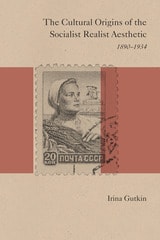
The Cultural Origins of the Socialist Realist Aesthetic
1890-1934Irina Gutkin
Northwestern University Press, 1999
In The Cultural Origins of the Socialist Realist Aesthetic, Irina Gutkin brings together the best work written on the subject to argue that socialist realism encompassed a philosophical worldview that marked thinking in the USSR on all levels: political, social, and linguistic. Using a wealth of diverse cultural material, Gutkin traces the emergence of the central tenants of socialist realist theory from Symbolism and Futurism through the 1920s and 1930s.
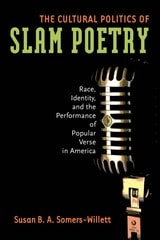
The Cultural Politics of Slam Poetry
Race, Identity, and the Performance of Popular Verse in AmericaSusan B. A. Somers-Willett
University of Michigan Press, 2010
"For a lucid and thorough 'real-world' analysis of the movement from the ground-up--including its history, aesthetics, and culture, there is surely no better place to start than Somers-Willett's trailblazing book."
--- Jerome Sala, Pleiades
"Finally, a clear, accurate, and thoroughly researched examination of slam poetry, a movement begun in 1984 by a mixed bag of nobody poets in Chicago. At conception, slam poetry espoused universal humanistic ideals and a broad spectrum of participants, and especially welcome is the book's analysis of how commercial marketing forces succeeded in narrowing public perception of slam to the factionalized politics of race and identity. The author's knowledge of American slam at the national level is solid and more authentic than many of the slammers who claim to be."
---Marc Kelly Smith, founder/creator of the International Poetry Slam movement
The cultural phenomenon known as slam poetry was born some twenty years ago in white working-class Chicago barrooms. Since then, the raucous competitions have spread internationally, launching a number of annual tournaments, inspiring a generation of young poets, and spawning a commercial empire in which poetry and hip-hop merge.
The Cultural Politics of Slam Poetry is the first critical book to take an in-depth look at slam, shedding light on the relationships that slam poets build with their audiences through race and identity performance and revealing how poets come to celebrate (and at times exploit) the politics of difference in American culture.
With a special focus on African American poets, Susan B. A. Somers-Willett explores the pros and cons of identity representation in the commercial arena of spoken word poetry and, in doing so, situates slam within a history of verse performance, from blackface minstrelsy to Def Poetry. What's revealed is a race-based dynamic of authenticity lying at the heart of American culture. Rather than being mere reflections of culture, Somers-Willett argues, slams are culture---sites where identities and political values get publicly refigured and exchanged between poets and audiences.
Susan B. A. Somers-Willett is a decade-long veteran of slam and teaches creative writing and poetics as an Assistant Professor of English at Montclair State University. She is the author of two books of poetry, Quiver and Roam. Visit the author's website at: http://www.susansw.com/.
Photo by Jennifer Lacy.

The Cultural Politics of the New American Studies
John Carlos Rowe
Michigan Publishing Services, 2012
Second, if neoliberalism has successfully employed various cultural media, then what are the best means of criticizing its main claims and fundamental purposes? Is it possible under these circumstances to imagine a “counter-culture” which might effectively challenge neoliberalism or is such an alternative already controlled and contained by such labels as “political correctness,” “the far left,” “radicalism,” “extremism,” even “terrorism,” which in the popular imagination refer to political and social minorities, doomed thereby to marginalization?
Rowe argues that the tradition of “cultural criticism” advocated by influential public intellectuals like Edward Said can be adapted to the new circumstances demanded by the hegemony of neoliberalism and its successful command of new media. Yet rather than simply honoring important predecessors such as Said, we need to reconceive the role of the public intellectual as more than just an “interdisciplinary scholar” but also as a social critic able to negotiate the different media.

The Cultural Production of Matthew Arnold
Antony H. Harrison
Ohio University Press, 2009
The career of Matthew Arnold as an eminent poet and the preeminent critic of his generation constitutes a remarkable historical spectacle orchestrated by a host of powerful Victorian cultural institutions.
The Cultural Production of Matthew Arnold investigates these constructions by situating Arnold’s poetry in a number of contexts that partially shaped it. Such analysis revises our understanding of the formation of the elite (and elitist) male literary-intellectual subject during the 1840s and 1850s, as Arnold attempts self-definition and strives simultaneously to move toward a position of ideological influence upon intellectual institutions that were contested sites of economic, social, and political power in his era.
Antony H. Harrison reopens discussion of selected works by Arnold in order to make visible some of their crucial sociohistorical, intertextual, and political components. Only by doing so can we ultimately view the cultural work of Arnold “steadily and … whole,” and in a fashion that actually eschews this mystifying premise of all Arnoldian inquiry which, by the early twentieth century, had become wholly naturalized in the academy as ideology.
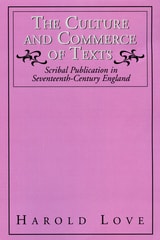
The Culture and Commerce of Texts
Scribal Publication in Seventeenth-Century EnglandHarold Love
University of Massachusetts Press, 1998
Long after the establishment of printing in England, many writers and composers still preferred to publish their work through handwritten copies. Texts so transmitted included some of the most distinguished poetry and music of the seventeenth century, along with a rich variety of political, scientific, antiquarian, and philosophical writings. While censorship was one reason for this persistence of the older practice, scribal publication remained the norm for texts that were required only in small numbers, or whose authors wished to avoid the “stigma” of print.
This is the first book to consider the trade in manuscripts as an important supplement to that in printed books, and to describe the agencies that met the need for rapid duplication of key texts.
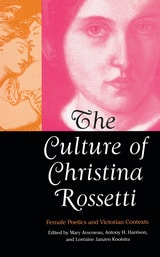
The Culture of Christina Rossetti
Female Poetics and Victorian ContextsMary Arseneau
Ohio University Press, 1999
The Culture of Christina Rossetti explores a “new” Christina Rossetti as she emerges from the scrutiny of the particular historical and cultural context in which she lived and wrote. The essays in this collection demonstrate how the recluse, saint, and renunciatory spinster of former studies was in fact an active participant in her society’s attempt to grapple with new developments in aesthetics, theology, science, economics, and politics.
The volume examines Rossetti’s poetry, fiction, and nonfiction from a variety of theoretical and critical perspectives in order to reevaluate her place in the Victorian world of art, literature, and ideas. The essays offer a radical rethinking of her best-known poems, retrieve neglected works, establish the diversity of her writing, and reposition Rossetti within a canon continually under formation.
Contributing to the ongoing retrieval of the nineteenth-century woman poet, The Culture of Christina Rossetti highlights Rossetti’s responses to both male and female literary traditions and explores her incorporation and revision of literary influences from medieval Italian sources to contemporary writers.
The Culture of Disaster
Marie-Hélène Huet
University of Chicago Press, 2012

The Culture of Inequality
Michael Lewis
University of Massachusetts Press, 1993
Why do America’s wars against poverty turn out to be wards against the poor? Why does a nation so committed to fighting crime show such a bad record of combatting it and so morbid a fascination with it? Why is American racism so deeply rooted?
These and other questions are answered in this milestone study. Its central thesis is that the national faith in individual initiative and free opportunity has become a breeding ground for guilt about our own limited successes and prejudice against all who exhibit signs of failure.

The Culture of Violence
Essays on Tragedy and HistoryFrancis Barker
University of Chicago Press, 1993
Central to his argument is the contention that, contrary to post-Enlightenment humanist, liberal and conservative thought, 'culture' does not necessarily stand in opposition to political inequality and social injustice, but may be complicit with the oppressive exercise of power.
The book focuses on Shakespearean tragedy and on the historicism and culturalism of much present-day cultural theory. Barker's analysis moves dialectically backwards and forwards between these two moments in order to illuminate aspects of early modern culture, and to critique the ways in which the complicity between culture and violence has been occluded. Rejecting the tendency of both modernism and post-modernism to homogenise historical time, Barker argues for a genuinely new, 'diacritical' understanding of the violence of history.
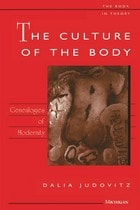
The Culture of the Body
Genealogies of ModernityDalia Judovitz
University of Michigan Press, 2001

The Cure of Poetry in an Age of Prose
Moral Essays on the Poet's CallingMary Kinzie
University of Chicago Press, 1993
A distinguished poet and critic, Kinzie assesses poetry's situation during the past twenty-five years. Ours, she contends, is literally a prosaic age, not only in the popularity of prose genres but in the resultant compromises with truth and elegance in literature. In essays on "the rhapsodic fallacy," confessionalism, and the romance of perceptual response, Kinzie diagnoses some of the trends that diminish the poet's flexibility. Conversely, she also considers individual poets—Randall Jarrell, Elizabeth Bishop, Howard Nemerov, Seamus Heaney, and John Ashbery—who have found ingenious ways of averting the risks of prosaism and preserving the special character of poetry.
Focusing on poet Louise Bogan and novelist J. M. Coetzee, Kinzie identifies a crucial and curative overlap between the practices of great prose-writing and great poetry. In conclusion, she suggests a new approach for teaching writers of poetry and fiction. Forcefully argued, these essays will be widely read and debated among critics and poets alike.
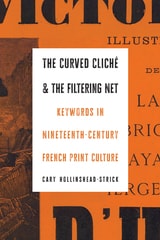
The Curved Cliché and the Filtering Net
Keywords in Nineteenth-Century French Print CultureCary Hollinshead-Strick
Northwestern University Press, 2027
Tracing multivalent words of nineteenth-century French print culture
The production of printed text changed radically over the course of the nineteenth century: Everything from the material used to make paper to the gender of the people assembling books shifted. Examining ten key terms as they took on new meanings in the world of print, Cary Hollinshead-Strick shows how the words, borrowed to name technical transformations, reveal the social expectations surrounding the birth of industrial print culture. Through these homonyms she connects papermaking to both Renaissance ceramics and fin-de-siècle japonisme, reveals the politics behind typos and the reasons women went to work in Parisian suburbs, shows how newspaper formats mapped onto rural and urban forms of entertainment and food, and explores the fantasy that information itself could be gathered and distributed in reliable, comprehensive ways.
By lingering over the resonances set in motion when ordinary words like canard and filet became terms for modern media formats, this book situates communication practices in the social, economic, and political environments that gave rise to them. This innovative approach not only elucidates nineteenth-century French print culture’s influence on the literature of the period but also invites us to consider the relationships between contemporary forms of information, media, labor, and language.
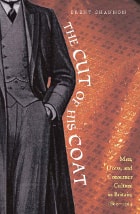
The Cut of His Coat
Men, Dress, and Consumer Culture in Britain, 1860–1914Brent Shannon
Ohio University Press, 2006
The English middle class in the late nineteenth century enjoyed an increase in the availability and variety of material goods. With that, the visual markers of class membership and manly behavior underwent a radical change. In The Cut of His Coat: Men, Dress, and Consumer Culture in Britain, 1860–1914, Brent Shannon examines familiar novels by authors such as George Eliot, Anthony Trollope, Thomas Hughes, and H. G. Wells, as well as previously unexamined etiquette manuals, period advertisements, and fashion monthlies, to trace how new ideologies emerged as mass-produced clothes, sartorial markers, and consumer culture began to change.
While Victorian literature traditionally portrayed women as having sole control of class representations through dress and manners, Shannon argues that middle-class men participated vigorously in fashion. Public displays of their newly acquired mannerisms, hairstyles, clothing, and consumer goods redefined masculinity and class status for the Victorian era and beyond.
The Cut of His Coat probes the Victorian disavowal of men’s interest in fashion and shopping to recover men’s significant role in the representation of class through self-presentation and consumer practices.

The Cyborg Caribbean
Techno-Dominance in Twenty-First-Century Cuban, Dominican, and Puerto Rican Science FictionSamuel Ginsburg
Rutgers University Press, 2023
The Cyborg Caribbean examines a wide range of twenty-first-century Cuban, Dominican, and Puerto Rican science fiction texts, arguing that authors from Pedro Cabiya, Alexandra Pagan-Velez, and Vagabond Beaumont to Yasmin Silvia Portales, Erick Mota, and Yoss, Haris Durrani, and Rita Indiana Hernandez, among others, negotiate rhetorical legacies of historical techno-colonialism and techno-authoritarianism. The authors span the Hispanic Caribbean and their respective diasporas, reflecting how science fiction as a genre has the ability to manipulate political borders. As both a literary and historical study, the book traces four different technologies—electroconvulsive therapy, nuclear weapons, space exploration, and digital avatars—that have transformed understandings of corporality and humanity in the Caribbean. By recognizing the ways that increased technology may amplify the marginalization of bodies based on race, gender, sexuality, and other factors, the science fiction texts studied in this book challenge oppressive narratives that link technological and sociopolitical progress.

The DNA Mystique
The Gene as a Cultural IconDorothy Nelkin and M. Susan Lindee
University of Michigan Press, 2004
With a new introduction and conclusion, this edition will continue to be an engaging, accessible, and provocative text for the sociology, anthropology, and bioethics classroom, as well as stimulating reading for those generally interested in science and culture.
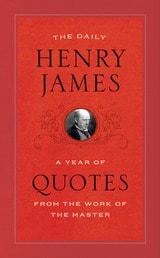
The Daily Henry James
A Year of Quotes from the Work of the MasterHenry James
University of Chicago Press, 2016
From the deepest longings of Isabel Archer to James’s insights in The Art of Fiction, longer seasonal quotes introduce each month, while concise bits of wisdom and whimsy mark each day. To take but one example: Isabel, in a quote from The Portrait of a Lady for September 30, muses, “She gave an envious thought to the happier lot of men, who are always free to plunge into the healing waters of action.” Featuring a new foreword by James biographer Michael Gorra as well as the original introductions by James and his good friend William Dean Howells, this long-forgotten perennial calendar will be an essential bibelot for James’s most ardent devotees and newest converts alike, a treasure to be cherished daily, across all seasons, for years, for ages to come.
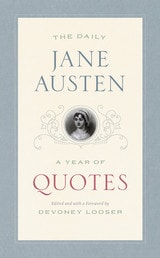
The Daily Jane Austen
A Year of QuotesJane Austen
University of Chicago Press, 2019
Devoney Looser, a.k.a. Stone Cold Jane Austen, has drawn 378 genuine, Austen-authored passages from across the canon, resulting in an anthology that is compulsively readable and repeatable. Whether you approach the collection on a one-a-day model or in a satisfying binge read, you will emerge wiser about Austen, if not about life. The Daily Jane Austen will amuse and inspire skeptical beginners, Janeite experts, and every reader in between by showcasing some of the greatest sentences ever crafted in the history of fiction.