Results by title
3785 books match the query 'Poetry' and 833 start with t
The Listening Chamber
PoemsWilliam Aberg
University of Arkansas Press, 1997
The Listening Skin
Glenis Redmond
Four Way Books, 2022
The Literary Text in the Digital Age
Richard J. Finneran, Editor
University of Michigan Press, 1996
The Little Book of Guesses
John Gallaher
Four Way Books, 2007
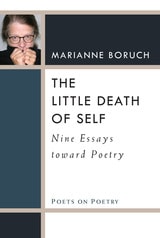
The Little Death of Self
Nine Essays toward PoetryMarianne Boruch
University of Michigan Press, 2017
The line between poetry (the delicate, surprising not-quite) and the essay (the emphatic so-there!) is thin, easily crossed. Both welcome a deep mulling-over, endlessly mixing image and idea and running with scissors; certainly each distrusts the notion of premise or formulaic progression. Marianne Boruch’s essays in The Little Death of Self emerged by way of odd details or bothersome questions that would not quit—Why does the self grow smaller as the poem grows enormous? Why does closure in a poem so often mean keep going? Must we stalk the poem or does the poem stalk us until the world clicks open?
Boruch’s intrepid curiosity led her to explore fields of expertise about which she knew little: aviation, music, anatomy, history, medicine, photography, fiction, neuroscience, physics, anthropology, painting, and drawing. There’s an addiction to metaphor here, an affection for image, sudden turns of thinking, and the great subjects of poetry: love, death, time, knowledge. There’s amazement at the dumb luck of staying long enough in an inkling to make it a poem at all. Poets such as Keats, Stevens, Frost, Plath, Auden, and Bishop, along with painters, inventors, doctors, scientists, composers, musicians, neighbors, friends, and family—all traffic blatantly or under the surface—and one gets a glimpse of such fellow travelers now and then.
The Little Field of Self
Doreen Gildroy
University of Chicago Press, 2002
The Logan Notebooks
Rebecca Lindenberg
University Press of Colorado, 2014
“These poems are intent on calling out the migratory beauty of this world, in a neighbor-voice: friendly, from the yard nearby, pointing out stuff we might not have noticed. They frequently employ that most ancient of forms, the list, to show us what we shine a light on, what we look past, what we reflect, what we miss. In that way, they speak like the meadowlark who says, See you! See you! These poems are for when we shall no longer fear the ecstatic, because we’ll know that ecstasy too is quotidian, as daily as a meadowlark’s shopping list.”
—Eleni Sikelianos
—Jill Alexander Essbaum
Clouds, mountains, flowering trees. Difficult things. Things lost by being photographed. Things that have lost their power. Things found in a rural grocery store. These are some of the lists, poems, prose poems, and lyric anecdotes compiled in The Logan Notebooks, a remix and a reimagining of The Pillow Book of Sei Shonagon, a collection of intimate and imaginative observations about place—a real place, an interior landscape—and identity, at the intersection of the human with the world, and the language we have (and do not yet have) for perceiving it.

The Logic of Opposites
Alane Rollings
Northwestern University Press, 1998
The Long Now Conditions Permit
PoemsJami Macarty
University of Nevada Press, 2025
With ethical attention, Jami Macarty’s collection engages the political, ecological, and personal forces that shape and mark our lives, offering an ecofeminist ethic of care as an antidote to extractive capitalism and patriarchal norms. Each poem meditates on power, insists on articulating what is being lost—and what must be saved and reclaimed.
Amid the exploitation and violence, these poems find moments of grace: the scent of a sea rose, a desert walk in spring, the company of birds, Earth entire. The Long Now Conditions Permit is both tender elegy and urgent call, exhorting readers to grapple with the devastating failings of humanity and the saving possibilities of love.
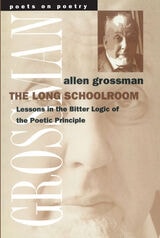
The Long Schoolroom
Lessons in the Bitter Logic of the Poetic PrincipleAllen Grossman
University of Michigan Press, 1997
The jist of what he learned--of what his "lessons" taught him--was (in the sentence of Oliver Wendell Holmes): "Where most men have died, there is the greatest interest." According to Grossman, violence arises not merely from the "barbarian" outside of the culture the poet serves, but from the inner logic of that culture; not, as he would now say, from the defeat of cultural membership but from the terms of cultural membership itself.
Grossman analyzes the "bitter logic of the poetic principle" as it is articulated in exemplary texts and figures, including Bede's Caedmon and Milton. But the heart of The Long Schoolroom is American, ranging from essays on Whitman and Lincoln to an in-depth review of the work of Hart Crane. His final essays probe the example of postmodern Jewish and Christian poetry in this country, most notably the work of Robert Lowell and Allen Ginsburg, as it searches for an understanding of "holiness" in the production and control of violence.
Allen Grossman is author of The Ether Dome and Other Poems: New and Selected, The Sighted Singer: Two Works on Poetry for Readers and Writers (with Mark Halliday), and most recently, The Philosopher's Window. He is Mellon Professor in the Humanities at The Johns Hopkins University.
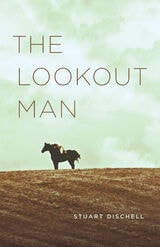
The Lookout Man
Stuart Dischell
University of Chicago Press, 2022
Sometimes elegiac, sometimes deadly comic, and always transformative, The Lookout Man embodies the energy, spirit, and craft that we have come to depend upon in Stuart Dischell’s poetry. Inhabiting a mix of lyric structures, these poems are set in diverse locales from the middle of the ocean to the summit of Mont Blanc, from the backyards of America to the streets of international cities. There is a hesitant, almost encroaching wisdom in The Lookout Man, as Dischell allows his edgy vision and singular perspectives to co-exist with the music of his poems. In lines that close the book and typify Dischell’s work, he writes, “I will ask the dogwoods to remind me // What it means to live along the edges of the woods, / To be promiscuous but bear white flowers.”
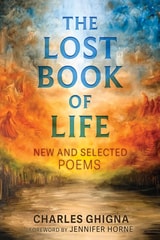
The Lost Book of Life
New and Selected PoemsCharles Ghigna, Foreword by Jennifer Horne
University of Alabama Press, 2026
A poetic journey through five decades of wonder, memory, and love, where the ordinary becomes sacred and every line leads home
Spanning five decades of poetic mastery, The Lost Book of Life: New and Selected Poems is the definitive collection from Charles Ghigna, a beloved and influential voice in contemporary Southern poetry. Drawing from fourteen previous volumes and featuring thirty-seven new poems, this landmark collection captures the full arc of Ghigna’s creative evolution, from his early meditations on nature and family to his later reflections on memory, mortality, and the enduring power of love.
With graceful shifts between free verse and traditional forms, Ghigna’s voice is both intimate and expansive—clear as spring water, alive with wit, and steeped in feeling. His poems open doorways into childhood’s bright dreaming, the quiet complexities of fatherhood, and the sacred hush of daily life. Ghigna invites readers to see the world anew, to find beauty in the familiar, and to embrace the sacred in the ordinary. For longtime admirers and new readers alike, The Lost Book of Life is a luminous testament to a life devoted to poetry. It is both compass and keepsake: a celebration of poetry’s enduring light, and a lasting gift to the literature of the American South.
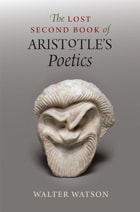
The Lost Second Book of Aristotle's "Poetics"
Walter Watson
University of Chicago Press, 2012
Of all the writings on theory and aesthetics—ancient, medieval, or modern—the most important is indisputably Aristotle’s Poetics, the first philosophical treatise to propound a theory of literature. In the Poetics, Aristotle writes that he will speak of comedy—but there is no further mention of comedy. Aristotle writes also that he will address catharsis and an analysis of what is funny. But he does not actually address any of those ideas. The surviving Poetics is incomplete.
Until today. Here, Walter Watson offers a new interpretation of the lost second book of Aristotle's Poetics. Based on Richard Janko’s philological reconstruction of the epitome, a summary first recovered in 1839 and hotly contested thereafter, Watson mounts a compelling philosophical argument that places the statements of this summary of the Aristotelian text in their true context. Watson renders lucid and complete explanations of Aristotle’s ideas about catharsis, comedy, and a summary account of the different types of poetry, ideas that influenced not only Cicero’s theory of the ridiculous, but also Freud’s theory of jokes, humor, and the comic.
Finally, more than two millennia after it was first written, and after five hundred years of scrutiny, Aristotle’s Poetics is more complete than ever before. Here, at last, Aristotle’s lost second book is found again.
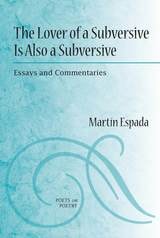
The Lover of a Subversive Is Also a Subversive
Essays and CommentariesMartín Espada
University of Michigan Press, 2010
Prior praise for Martín Espada:
"Political poetry at its finest…with his soaring lyrics, Espada broadens our appreciation not only of poetry but of resistance itself."
---The Progressive
"(Espada) writes beautiful poems about terrible realities."
---San Francisco Chronicle
A volume in the Poets on Poetry series, which collects critical works by contemporary poets, gathering together the articles, interviews, and book reviews by which they have articulated the poetics of a new generation.
This collection of essays on poetry and politics comes from the man the New York Times predicted would become "the Latino poet of his generation" and whom Sandra Cisneros called "the Pablo Neruda of North American authors."
Martín Espada defends what Walt Whitman called, "the rights of them the others are down upon." He invokes the spirit of poet-advocates such as Whitman and Edgar Lee Masters to explore his own history as a poet and tenant lawyer in Boston's Latino community. He celebrates the poets of Puerto Rico, imprisoned for espousing the cause of independence, and the poets of the Bronx, writing bilingual poems in the voices of the dead.
Espada writes of forgotten places and reminds us of the poet's responsibility to remember, as Pablo Neruda remembers the anonymous builders of Machu Picchu or Sterling Brown remembers the slave uprising of Nat Turner. He argues that poets should embrace the role of Shelley's "unacknowledged legislator" in their work as writers and in their lives as citizens. He challenges the conventional wisdom that poetry and politics are mutually exclusive, and rejects the poetics of self-marginalization, in keeping with Adrian Mitchell's dictum that, "most people ignore most poetry because most poetry ignores most people."
Martín Espada has published seventeen books as a poet, editor, and translator. The Republic of Poetry, a collection of poems, received a Paterson Award for Sustained Literary Achievement and was a finalist for the Pulitzer Prize. Imagine the Angels of Bread won an American Book Award and was a finalist for the National Book Critics Circle Award. He has received numerous fellowships and awards, including a Guggenheim Fellowship and the National Hispanic Cultural Center Literary Award. Espada is a Professor of English at the University of Massachusetts-Amherst.
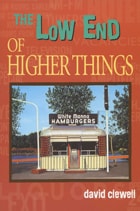
The Low End of Higher Things
David Clewell
University of Wisconsin Press, 2003
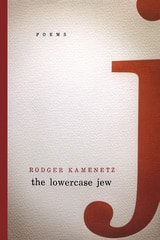
The Lowercase Jew
Rodger Kamenetz
Northwestern University Press, 2003
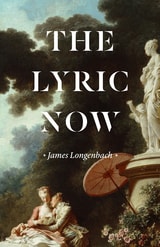
The Lyric Now
James Longenbach
University of Chicago Press, 2020
In poet and critic James Longenbach’s title, the word “now” does double duty, evoking both a lyric sense of the present and twentieth-century writers’ assertion of “nowness” as they crafted their poetry in the wake of Modernism. Longenbach examines the fruitfulness of poetic repetition and indecision, of naming and renaming, and of the evolving search for newness in the construction, history, and life of lyrics. Looking to the work of thirteen poets, from Marianne Moore and T. S. Eliot through George Oppen and Jorie Graham to Carl Phillips and Sally Keith, and several musicians, including Virgil Thomson and Patti Smith, he shows how immediacy is constructed through language. Longenbach also considers the life and times of these poets, taking a close look at the syntax and diction of poetry, and offers an original look at the nowness of lyrics.
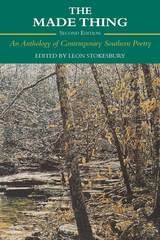
The Made Thing
An Anthology of Contemporary Southern PoetryLeon Stokesbury
University of Arkansas Press, 2000
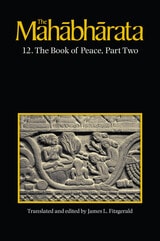
The Mahabharata, Volume 8
Book 12, The Book of Peace, Part 2Translated and Edited by James L. Fitzgerald
University of Chicago Press, 2026
A remarkable composition of 100,000 couplets, The Mahābhārata is the second-longest poem in world literature. In this volume, James L. Fitzgerald completes his translation of the twelfth of The Mahābhārata’s eighteen books, the vast Shanti Parvan, or The Book of Peace. Covering a wide range of ancient Indian intellectual history, The Book of Peace was intended to serve as a comprehensive, brahmin-inspired basis for living a Good Life in a Good Society in a Good Polity and is one of the most important and complex books of the poem.
Fitzgerald’s previous contribution to the Chicago edition of The Mahābhārata, volume 7, opened with Book 11, The Book of the Women, which movingly portrayed the grief of the wives, mothers, and sisters of the many warriors slain in the epic’s central war narrative. The crises of grief presented in The Book of the Women give particular poignancy and depth to the shanti, or pacification, that is the theme of Book 12, The Book of Peace. Volume 7 included the first half of The Book of Peace, and volume 8 now completes it with the second half, which is focused particularly on the ways people can escape the cycle of rebirth and realize sublime beatitude by way of saving knowledge or yoga meditation or devotion to God Viṣṇu-Nārāyaṇa. Supported by an extensive introduction and notes, this publication will be greeted as a major event in Sanskrit studies.
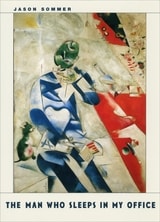
The Man Who Sleeps in My Office
Jason Sommer
University of Chicago Press, 2004

The Man With Many Pens
Jonathan Wells
Four Way Books, 2015
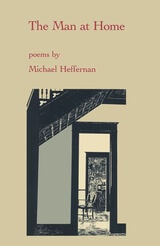
The Man at Home
PoemsMichael Heffernan
University of Arkansas Press, 1988
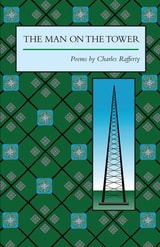
The Man on the Tower
PoemsCharles Rafferty
University of Arkansas Press, 1995

The Manageable Cold
PoemsTimothy McBride
Northwestern University Press, 2010
The Manageable Cold showcases McBride’s mastery of a wide range of forms and subjects. Whether his attention is focused on boxing, jazz, or contranyms, McBride breathes new life into the sonnet and the villanelle and handles blank verse with the utmost ease. The combination of traditional techniques and McBride’s thoroughly modern sensibility gives rise to poems that seem simultaneously utterly fresh and immemorially old, calling to mind the rigorously embodied works of Robert Frost, Howard Nemerov, and Mary Oliver. Timothy McBride is a science writer and editor. His poems have appeared in Shenandoah, Seneca Review, and Poetry Northwest, among other publications. The Manageable Cold is his first book of poetry.
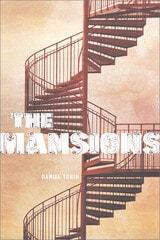
The Mansions
Daniel Tobin
Four Way Books, 0

The Manuscript Poems of A.E. Housman
Eight Hundred Lines of Hitherto Uncollected Verse from the Author’s NotebooksTom Burns Haber, Editor
University of Minnesota Press, 1955
The Manuscript Poems of A.E. Housman was first published in 1955. Minnesota Archive Editions uses digital technology to make long-unavailable books once again accessible, and are published unaltered from the original University of Minnesota Press editions.
Poetry lovers everywhere, and devotees of A. E. Housman in particular, will recognize a major literary event in the publication of this volume, for it makes available for the first time some 800 lines of hitherto unpublished poetry by the well-loved author of A Shropshire Lad. This is a significant addition to the Housman treasury because the English poet published a total of only 2216 lines of poetry during his lifetime.
Dr. Haber has drawn the material for this volume from the four Housman notebooks in the Library of Congress, where they were deposited in 1940, four years after the poet's death. In an introductory section the editor describes the notebooks themselves and tells in detail the fascinating story of how the manuscripts—erased, canceled and glued fast to mounting sheets — were preserved and deciphered. The notebooks, dated from 1890 to 1925, contain the most valuable manuscript remains of Housman's poetic writings.
In the material that is published here for the first time there are included complete poems, fragments of poems, and abandoned lines and stanzas from well-known lyrics. In addition the editor has provided a list of variants which the poet inserted into his printers' copies of A Shropshire Lad and Last Poems.Among the newly published complete poems are some that Dr. Haber believes should be ranked with Housman's outstanding work. In the material that shows the poet's revisions of his own writings, the reader is afforded an intimate glimpse into the creative processes of a poetic genius, a privilege that will be especially appreciated by students and critics. Many explanatory notes are appended to show how Housman's poetry matured from first draft, through final copy, to the printed page.

The Many Deaths of Inocencio Rodriguez
Iliana Rocha
Tupelo Press, 2022
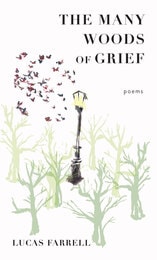
The Many Woods of Grief
PoemsLucas Farrell
University of Massachusetts Press, 2011
In this striking debut volume, Lucas Farrell offers a lyrical and illuminating field guide to the flora and fauna of “worlds just out of reach.” With the precision and detail of an Audubon sketch, he turns his naturalist's eye to the vast landscape of human emotion—all the while affirming “how real this world we live in / must be to live in.”
Journeying ever outward, from the achingly ordinary to the mysterious “land where there is no land,” the narrator of this collection, equal parts pastoralist and surrealist, explores the vivid in-betweens—between love and loss, hilarity and despair, wild and domestic, real and imagined. Hungry, expressive, and original, these poems glean light from even the darkest of fields.
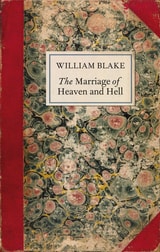
The Marriage of Heaven and Hell
William Blake
Bodleian Library Publishing, 2011
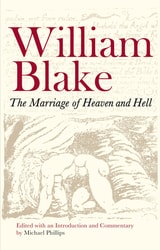
This new facsimile edition of The Marriage of Heaven and Hell includes a plate-by-plate guide to the texts, interlinear figures, and larger designs in a commentary accompanying the transcript of each reproduced plate. Drawings from Blake’s manuscript notebook, which were used as a basis for the designs, as well as working proof impressions, are also included, demonstrating the evolution of the work. This edition also reproduces a single plate from each of the other eight surviving copies, revealing how over a period of more than thirty years Blake altered the way he finished each copy. An introduction explores the book's literary and historical background, Blake’s printing process, and the book's anonymous initial publication.
This expertly edited work is available for students and scholars in paperback and for collectors in a special hardcover edition. Both versions allow Blake’s vision to reassert its breathtaking power.
The Marriage of Heaven and Hell
William Blake
Bodleian Library Publishing, 2011
This new facsimile edition of The Marriage of Heaven and Hell includes a plate-by-plate guide to the texts, interlinear figures, and larger designs in a commentary accompanying the transcript of each reproduced plate. Drawings from Blake’s manuscript notebook, which were used as a basis for the designs, as well as working proof impressions, are also included, demonstrating the evolution of the work. This edition also reproduces a single plate from each of the other eight surviving copies, revealing how over a period of more than thirty years Blake altered the way he finished each copy. An introduction explores the book's literary and historical background, Blake’s printing process, and the book's anonymous initial publication.
This expertly edited work is available for students and scholars in paperback and for collectors in a special hardcover edition. Both versions allow Blake’s vision to reassert its breathtaking power.
The Marvels
David Orr
Four Way Books, 2026
In his second collection, The Marvels, David Orr writes from the conviction that the available world is enough: its worn shirts, coffee cups, rainbows, buses, obsolete machines, failed plans, neighborly borders, and minor acts of courtesy. These poems are clear-eyed without being cold, comic without being merely light. They attend to ordinary things not as symbols waiting to be elevated, but as the actual substance of our shared existence.
Praised by The Washington Post for his “quirky, engaging poetry,” Orr brings formal control, wry wit, whimsy, and an exacting intelligence to the relentless dailiness of life. In “Coffee Cups,” two mugs have been scoured blank by the dishwasher: “Nothing makes them special now. / What they do is all they are.” Yet the household still reaches for them first, “hoping to save the others.” In “Decency,” a nearly useless blue shirt becomes kin to the small social gestures that certify “this shared space as shared”: a held door, a blessing after a sneeze, the habitual signs by which strangers acknowledge one another. And in the title poem, marvels are planted along a property line, where two neighbors meet to prune, argue, trade tools, and admire what grows between them.
Unillusioned but not disenchanted, The Marvels finds its force in persistence, use, courtesy, memory, and care. The poems do not look past the real for consolation. They look steadily at the world we have — its comedy, damage, repetition, and thin but durable fabrics of connection — until its sufficiency comes into view.
The Matrix of Lyric Transformation
Poetic Modes and Self-Presentation in Early Chinese Pentasyllabic PoetryCai Zong-qi
University of Michigan Press, 1997
The Matter of Language
Abstraction and PoetryBenjamin Noys
Seagull Books, 2023
If the twentieth century was the century in which language was at the center of thought, the twenty-first century has, so far, been the century of matter. The Matter of Language is a critical intervention that aims to return to the relationship between language and matter to think of our present moment as one dominated by abstractions that rule our lives. In a series of dated chapters, that form punctual moments of intervention, this book both rehabilitates key thinkers, like Marx, Freud, and Saussure, and engages with poetic thinking on matter in David Jones, Diane di Prima, William Blake, Leslie Kaplan, and others. It is a matter of understanding language as a site of struggle, which is intimately bound to the material but also crucial in formulating and expressing the material and the abstractions that shape language and matter. Working between theory and poetry, The Matter of Language reconceives notions of alienation and class struggle as essential modes of reading and analysis for our fractured present.
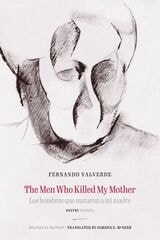
The Men Who Killed My Mother | Los hombres que mataron a mi madre
Poetry | PoesíaFernando Valverde
Swan Isle Press, 2025
From the first poem in this bilingual edition of The Men Who Killed My Mother, it is evident that the mother in “Our Mother” (“Nuestra Madre”) is not only Fernando Valverde’s. The soulful refrain of “mother/madre” might be anyone’s mother whose suffering is palpable in a world legislated over by men. Issues such as orphanhood, abuse, violence, manipulation, and fear are treated with the rawness of someone who has tasted the venom of betrayal. This is a lyrical dark garden of faith and family, exposing treachery and cruelty, and anger at injustice, from the voice of a son with deep love for his mother—for her honor, dignity, and dreams.
Valverde leads us into a forest full of wolves and serpents under the governance of civil society. He has received many awards for his poetry and is recognized as one of the most highly acclaimed poets of his generation in Spain. This heartfelt English translation by Gordon E. McNeer captures the power of Valverde’s poetic cadences and its haunting evocative lyricism.
The Mending Worm
Joan Houlihan
New Issues Poetry and Prose, 2021
The Messenger
Stephanie Pippin
University of Iowa Press, 2013
The Metaphysician in the Dark
Charles Simic
University of Michigan Press, 2003
Often, he addresses poetry itself. Among the pieces here are appreciations of Mark Strand, James Merrill, John Ashbery, and James Tate, each evaluated with a keen eye tempered by a generous spirit. Other essays discuss Joseph Brodsky, Czeslaw Milosz, and Vasko Popa; to these writers he brings the understanding available only to those who can read them in the original. In considering Brodsky's translations, for instance, he offers insights regarding not only the poet himself but the very nature of language. Elsewhere, he peers into poetry's past and its future: as a vessel of memory, a witness to history, and a mirror of human experience.
But perhaps the greatest pleasures afforded by The Metaphysician in the Dark, as he styles himself with a beguiling mix of modesty and irony, appear when Simic goes further afield. His look at the deadpan comedy of Buster Keaton is as revealing of the author as of the actor and his craft; his perusal of a Heironymous Bosch altarpiece captures both the painter's sense of apocalypse and a riotous joy in the piling of detail upon detail; his review of a book on Joseph Cornell examines how obsession becomes art. He is fluently familiar with subjects as diverse as Saul Bellow's novels and Aberlardo Morell's extraordinary camera obscura photographs. Yet when he takes the gloves off, as in two essays on the Serbia of Slobodan Milosevic, his outrage is as forceful as his pride is strong in his own Serbian heritage.
Each of the two dozen essays here reflects a sophistication irresistible in its simplicity; taken together, they display a questing intelligence and a panorama of life and art.
Charles Simic is an acclaimed poet, novelist, essayist and teacher. Winner of a MacArthur Fellowship and a Pulitzer Prize, he is the author of more than twenty volumes of poetry and six books of prose, as well as numerous translations. He is Distinguished University Professor of English at the University of New Hampshire, where he has taught since 1973.
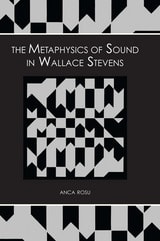
The Metaphysics of Sound in Wallace Stevens
Anca Rosu
University of Alabama Press, 1995
Where sound speaks louder than meaning—Stevens’s poetry as a metaphysical echo.
Wallace Stevens dedicated his poetry to challenging traditional notions about reality, truth, knowledge, and the role of language as a means of representation. Rosu demonstrates that Stevens's experimentation with sound is not only essential to his poetics but also profoundly linked to the pragmatist ideas that informed his way of thinking about language. Her readings of Stevens's poems focus on revealing the dynamic through which meaning emerges in language patterns—a dynamic she calls "images of sound."
Rosu argues that the formal aspects of poetry are deeply ingrained in cultural realities and are, in fact, generated by their context. The sound pattern pervading Stevens's poems at once addresses and violates the reader's assumptions about the functioning of language and, along with them, ideas about reality, knowledge, and subjectivity. Sound is thus the starting point of an argument concerned with Stevens's epistemology and poetics—the way his poems insist on a movement past or through a normal poetic representation of the world to gesture toward a reality that lies outside or beyond systems of representation.
The relationship between sound and meaning isolated and analyzed in The Metaphysics of Sound in Wallace Stevens is firmly situated among critical debates concerning the poet's aesthetic and philosophical convictions. Rosu claims that Stevens's poetry is not ultimately about the powerlessness of language, nor is it a deconstructive enterprise of destabilizing culturally consecrated truths; rather it achieves meaning most frequently through patterns of sound. Sound helps Stevens make a deeply philosophical point in a language unavailable to philosophers.
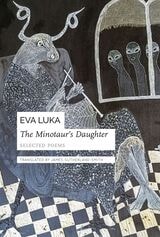
The Minotaur’s Daughter
Selected PoemsEva Luka
Seagull Books, 2025
An evocative collection by Slovak poet Eva Luka, The Minotaur’s Daughter seamlessly melds the human and natural worlds, weaving motifs of mythology, nature, and personal freedom into a tapestry of vivid imagery and profound emotion. The poems traverse settings from Japan to mythic landscapes, exploring the complexities of sexuality, desire, and transition.
Central to Luka’s work is the theme of resistance—against societal pressures and psychic harm. Her poetic voice defies artistic conformity, merging human and animal identities to challenge gender norms and explore mutable identities. Through this innovative fusion, her poems capture both the terror and beauty of existence, drawing parallels to Rilke's metaphysical explorations while grounding her work in the pantheistic and protoplasmic. Journeying through darkness and light, The Minotaur’s Daughter reveals an unwavering commitment to artistic and personal truth, establishing Luka as a formidable voice of resistance in contemporary European poetry.
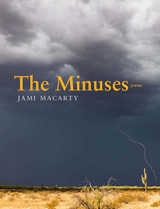
The Minuses
Jami Macarty
University Press of Colorado, 2020
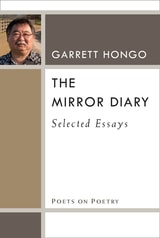
The Mirror Diary
Selected EssaysGarrett Hongo
University of Michigan Press, 2017
The Mirror Diary tracks the emergence of an original poetic voice and a learned consciousness amid multiple and sometimes competing influences of complex literary traditions and regional and ethnic histories. Beginning with a literary inquiry into the history of Japanese Americans in Hawai`i and California, Garrett Hongo draws on his own history to consider the mosaic of American identities—personal, cultural, and poetic—in the context of a postmodern diaspora.
Hongo’s essays attest to the breadth of what he considers his cultural inheritance and literary antecedents, ranging from the poets of China’s T’ang Dynasty to American poets such as Walt Whitman and Charles Olson. He explains free-verse prosody by way of John Coltrane’s jazz; praises his contemporaries, poets David Mura, Edward Hirsch, and Mark Jarman; and acknowledges his mentors, Bert Meyers and Charles Wright. In other pieces he engages with controversies and contestations in contemporary Asian American literature, confronts the politics of race and the legacy of Japanese American internment during World War II, offers paeans to the Hawaiian landscape, and addresses immigrants newly arrived in America with a warm welcome. The Mirror Diary is the work of a poet fully engaged with contemporary politics and poetics and committed to the study and celebration of diverse traditions.
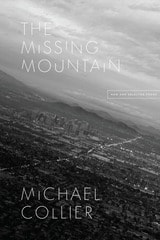
The Missing Mountain
New and Selected PoemsMichael Collier
University of Chicago Press, 2021
Whether Michael Collier is writing about an airline disaster, a friendship with a disgraced Catholic bishop, his father’s encounter with Charles Lindbergh, Lebanese beekeepers, a mother’s sewing machine, or a piano in the woods, he does so with the syntactic verve, scrupulously observed detail, and a flawless ear that has made him one of America’s most distinguished poets. These poems cross expanses, connecting the fear of missing love and the bliss of holding it, the ways we speak to ourselves and language we use with others, and deep personal grief and shadows of world history.
The Missing Mountain brings together a lifetime of work, chronicling Collier’s long and distinguished career as a poet and teacher. These selections, both of previously published and new poems, chart the development of Collier’s art and the cultivations of his passions and concerns.
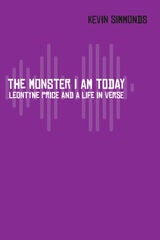
The Monster I Am Today
Leontyne Price and a Life in VerseKevin Simmonds
Northwestern University Press, 2021
Structured operatically into overture, acts, and postlude, The Monster I Am Today guides the reader through associative shifts from arias like “weather events” and Price’s forty-two-minute final ovation to memories of Simmonds’s coming of age in New Orleans. As he melds lyric forms with the biography of one of classical music’s greatest virtuosos, Simmonds composes a duet that spotlights Price’s profound influence on him as a person and an artist: “That’s how I hear: Her.”
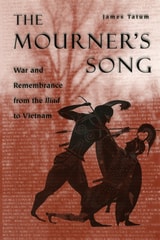
The Mourner's Song
War and Remembrance from the Iliad to VietnamJames Tatum
University of Chicago Press, 2002
Tatum's touchstone throughout is the Iliad, not just one of the earliest war poems, but also one of the most powerful examples of the way poetry can be a tribute to and consolation for what is lost in war. Reading the Iliad alongside later works inspired by war, Tatum reveals how the forms and processes of art convert mourning to memorial. He examines the role of remembrance and the distance from war it requires; the significance of landscape in memorialization; the artifacts of war that fire the imagination; the intimate relationship between war and love and its effects on the ferocity with which soldiers wage battle; and finally, the idea of memorialization itself. Because all survivors suffer the losses of war, Tatum's is a story of both victims and victors, commanders and soldiers, women and men. Photographs of war memorials in Vietnam, France, and the United States beautifully augment his testimonials.
Eloquent and deeply moving, The Mourner's Song will speak to anyone interested in the literature of war and the relevance of the classics to our most pressing contemporary needs.
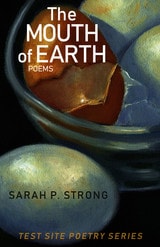
The Mouth of Earth
PoemsSarah P. Strong
University of Nevada Press, 2020
The Mouth of Earth serves as both a survival guide for those seeking connection with our planet and one another as well as a compassionate tribute to what we have lost or are losing—the human consequences of such destruction in a time of climate crisis and lost connectivity. Strong’s powerful poems offer us, if not consolation, at least a way toward comprehension in an age of loss, revealing both our ongoing denial of our planet’s fragility and the compelling urgency of our hunger for connection with all life.
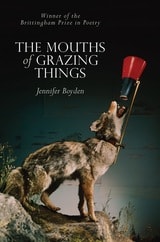
The Mouths of Grazing Things
Jennifer Boyden
University of Wisconsin Press, 2010
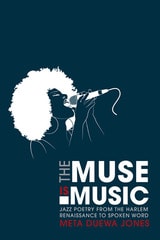
The Muse is Music
Jazz Poetry from the Harlem Renaissance to Spoken WordMeta DuEwa Jones
University of Illinois Press, 2013
This wide-ranging, ambitiously interdisciplinary study traces jazz's influence on African American poetry from the Harlem Renaissance to contemporary spoken word poetry. Examining established poets such as Langston Hughes, Ntozake Shange, and Nathaniel Mackey as well as a generation of up-and-coming contemporary writers and performers, Meta DuEwa Jones highlights the intersections of race, gender, and sexuality within the jazz tradition and its representation in poetry. Applying prosodic analysis to emphasize the musicality of African American poetic performance, she examines the gendered meanings evident in collaborative performances and in the criticism, images, and sounds circulating within jazz cultures.
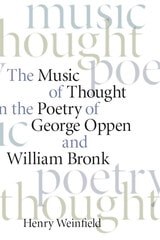
The Music of Thought in the Poetry of George Oppen and William Bronk
Henry Weinfield
University of Iowa Press, 2009
From his careful readings of Oppen’s and Bronk’s poetry to his fascinating examination of the letters they exchanged, Weinfield provides important aesthetic, epistemological, and historical insights into their poetry and poetic careers. In bringing together for the first time the work of two of the most important poets of the postwar generation, The Music of Thought not only illuminates their poetry but also raises important questions about American literary history and the categories in terms of which it has generally been interpreted.
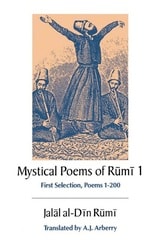
The Mystical Poems of Rumi 1
Jalal al-Din Rumi
University of Chicago Press, 1974
"An excellent introduction to Rumi, the greatest mystical poet of Islam. . . . Rumi's scope, like that of all great poets, is universal—reaching from sensuous luxuriance to the driest irony."—Sherman Goldman, East-West Journal
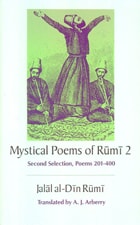
The Mystical Poems of Rumi 2
Second Selection, Poems 201-400Jalal al-Din Rumi
University of Chicago Press, 1991
Rumi, who wrote and preached in Persia during the thirteenth century, is one of history’s most celebrated mystics. His vast body of poetry includes a lengthy epic of religious mysticism, the Mathnavi, and more than three thousand lyrics and odes. A. J. Arberry, who selected four hundred of the lyrics for translation, calls Rumi "one of the world's greatest poets. In profundity of thought, inventiveness of image, and triumphant mastery of language, he stands out as the supreme genius of Islamic mysticism." Arberry’s authoritative translation is one of the few done directly from the original Persian.
A. J. Arberry (1905-69) was professor of Arabic at Cambridge University.