Results by title
5448 books match the query 'History and criticism' and 1116 start with t
The Idea of Absolute Music
Carl Dahlhaus
University of Chicago Press, 1989
"Essential reading for anyone interested in the larger intellectual framework in which Romantic music found its place, a framework that to a remarkable degree has continued to shape our image of music."—Robert P. Morgan, Yale University
Carl Dahlhaus (1928-1989) is the author of a highly influential body of works on the foundations of music history and aesthetics.
The Idea of Indian Literature
Gender, Genre, and Comparative MethodPreetha Mani
Northwestern University Press, 2022
Indian literature is not a corpus of texts or literary concepts from India, argues Preetha Mani, but a provocation that seeks to resolve the relationship between language and literature, written in as well as against English. Examining canonical Hindi and Tamil short stories from the crucial decades surrounding decolonization, Mani contends that Indian literature must be understood as indeterminate, propositional, and reflective of changing dynamics between local, regional, national, and global readerships. In The Idea of Indian Literature, she explores the paradox that a single canon can be written in multiple languages, each with their own evolving relationships to one another and to English.
Hindi, representing national aspirations, and Tamil, epitomizing the secessionist propensities of the region, are conventionally viewed as poles of the multilingual continuum within Indian literature. Mani shows, however, that during the twentieth century, these literatures were coconstitutive of one another and of the idea of Indian literature itself. The writers discussed here—from short-story forefathers Premchand and Pudumaippittan to women trailblazers Mannu Bhandari and R. Chudamani—imagined a pan-Indian literature based on literary, rather than linguistic, norms, even as their aims were profoundly shaped by discussions of belonging unique to regional identity. Tracing representations of gender and the uses of genre in the shifting thematic and aesthetic practices of short vernacular prose writing, the book offers a view of the Indian literary landscape as itself a field for comparative literature.
The Idea of Spatial Form
Frank, Joseph
Rutgers University Press, 1991
The Idea of Spatial Form contains the classic essay that introduced the concept of "spatial form" into literary discussion in 1945, and has since been accepted as one of the foundations for a theory of modern literature. It is here reprinted along with two later reconsiderations, one of which answers its major critics, while the second places the theory in relation to Russian Formalism and French Structuralism. Originally conceived to clarify the formal experiments of avant-garde literature, the idea of spatial form, when placed in this wider context, also contributes importantly to the foundations of a general poetics of the literary text. Also included are related discussions of André Malraux, Heinrich Wölfflin, Herbert Read, and E. H. Gombrich.
New material has been added to the essays in the form of footnotes and postscripts to two of them. These either illustrate the continuing relevance of the questions raised, or offer Frank's more recent opinions on the topic.
The Idea of the Theater in Latin Christian Thought
Augustine to the Fourteenth CenturyDonnalee Dox
University of Michigan Press, 2004
---Margaret Knapp, Arizona State University
"...an elegantly concise survey of the way classical notions of theater have been interpreted in the Latin Middle Ages. Dox convincingly demonstrates that far from there being a single 'medieval' attitude towards theater, there was in fact much debate about how theater could be understood to function within Christian tradition, even in the so-called 'dark ages' of Western culture. This book makes an innovative contribution to studies of the history of the theater, seen in terms of the history of ideas, rather than of practice."
---Constant Mews, Director, Centre for the Study of Religion & Theology, University of Monash, Australia
"In the centuries between St. Augustine and Bartholomew of Bruges, Christian thought gradually moved from a brusque rejection of classical theater to a progressively nuanced and positive assessment of its value. In this lucidly written study, Donnalee Dox adds an important facet to our understanding of the Christian reaction to, and adaptation of, classical culture in the centuries between the Church Fathers and the rediscovery of Aristotle."
---Philipp W. Rosemann, University of Dallas
This book considers medieval texts that deal with ancient theater as documents of Latin Christianity's intellectual history. As an exercise in medieval historiography, this study also examines biases in modern scholarship that seek links between these texts and performance practices. The effort to bring these texts together and place them in their intellectual contexts reveals a much more nuanced and contested discourse on Greco-Roman theater and medieval theatrical practice than has been acknowledged. The book is arranged chronologically and shows the medieval foundations for the Early Modern integration of dramatic theory and theatrical performance.
The Idea of the Theater in Latin Christian Thought will be of interest to theater historians, intellectual historians, and those who work on points of contact between the European Middle Ages and Renaissance. The broad range of documents discussed (liturgical treatises, scholastic commentaries, philosophical tracts, and letters spanning many centuries) renders individual chapters useful to philosophers, aestheticians, and liturgists as well as to historians and historiographers. For theater historians, this study offers an alternative reading of familiar texts which may alter our understanding of the emergence of dramatic and theatrical traditions in the West. Because theater is rarely considered as a component of intellectual projects in the Middle Ages, this study opens a new topic in the writing of medieval intellectual history.
The Ideas in Things
Fugitive Meaning in the Victorian NovelElaine Freedgood
University of Chicago Press, 2006
While the Victorian novel famously describes, catalogs, and inundates the reader with things, the protocols for reading it have long enjoined readers not to interpret most of what crowds its pages. The Ideas in Things explores apparently inconsequential objects in popular Victorian texts to make contact with their fugitive meanings. Developing an innovative approach to analyzing nineteenth-century fiction, Elaine Freedgood here reconnects the things readers unwittingly ignore to the stories they tell.
Building her case around objects from three well-known Victorian novels—the mahogany furniture in Charlotte Brontë’s Jane Eyre, the calico curtains in Elizabeth Gaskell’s Mary Barton, and “Negro head” tobacco in Charles Dickens’s Great Expectations—Freedgood argues that these things are connected to histories that the novels barely acknowledge, generating darker meanings outside the novels’ symbolic systems. A valuable contribution to the new field of object studies in the humanities, The Ideas in Things pushes readers’ thinking about things beyond established concepts of commodity and fetish.
The Illicit Joyce of Postmodernism
Reading Against the GrainKevin Dettmar
University of Wisconsin Press, 1996
For nearly three quarters of a century, the modernist way of reading has been the only way of reading James Joyce—useful, yes, and powerful but, like all frameworks, limited. This book takes a leap across those limits into postmodernism, where the pleasures and possibilities of an unsuspected Joyce are yet to be found.
Kevin J. H. Dettmar begins by articulating a stylistics of postmodernism drawn from the key texts of Roland Barthes, Mikhail Bakhtin, and Jean-François Lyotard. Read within this framework, Dubliners emerges from behind its modernist facade as the earliest product of Joyce’s proto-postmodernist sensibility. Dettmar exposes these stories as tales of mystery, not mastery, despite the modernist earmarks of plentiful symbols, allusions, and epiphanies. Ulysses, too, has been inadequately served by modernist critics. Where they have emphasized the work’s ingenious Homeric structure, Dettmar focuses instead upon its seams, those points at which the narrative willfully, joyfully overflows its self-imposed bounds. Finally, he reads A Portrait of the Artist and Finnegans Wake as less playful, less daring texts—the first constrained by the precious, would-be poet at its center, the last marking a surprising retreat from the constantly evolving, vertiginous experience of Ulysses.
In short, The Illicit Joyce of Postmodernism explores what happens when the extra-literary pronouncements of Eliot, Pound, and Joyce, as well as Joyce’s early critics, are set aside and a new, “unauthorized” Joyce is allowed to appear. This postmodern Joyce, more willful and less easily compartmentalized, stands as a counterpoint to the modernist Joyce who has perhaps become too familiar.
The Image and the Fire
The Subversive Anthology in the Twentieth CenturyWhit Frazier Peterson
University of Massachusetts Press, 2026
Racial identity and literary form in the modernist anthology
The Image and the Fire examines the coterie anthology—a small, outsider literary collection—as a key, yet understudied, instrument of literary intervention within American modernism. Whit Frazier Peterson argues that these anthologies, produced outside of institutional or canonical frameworks, served as deliberate challenges to dominant literary paradigms. Distinct from academic anthologies that helped codify the American literary canon, coterie anthologies were used by both white and Black avant-garde movements to disrupt prevailing cultural narratives and assert alternative literary visions.
Through close analysis of three seminal case studies—Des Imagistes, edited by Ezra Pound; Fire!!, a short-lived but groundbreaking magazine from the Harlem Renaissance, co-edited by Wallace Thurman; and Black Fire, compiled by Amiri Baraka and Larry Neal during the Black Arts Movement—Peterson traces a genealogy of the coterie anthology as a politically charged genre. He reveals how Black American writers and editors, particularly during the Harlem Renaissance and the Black Arts Movement, reappropriated and reconfigured this type of anthology format from white modernists.
Ultimately, The Image and the Fire positions the coterie anthology as a site of aesthetic and ideological contestation, one through which marginalized literary communities engaged in acts of cultural self-definition, canon revision, and formal innovation. By foregrounding the coterie anthology’s role in shaping a hybrid American modernism, Peterson contributes to ongoing conversations in literary studies around race, authorship, and the politics of literary form.
The Imaginary and Its Worlds
American Studies after the Transnational TurnEdited by Laura Bieger, Ramón Saldívar, and Johannes Voelz
Dartmouth College Press, 2013
The Imaginative Prose of Oliver Wendell Holmes
Michael A. Weinstein
University of Missouri Press, 2006
The Immaterial Book
Reading and Romance in Early Modern EnglandSarah Wall-Randell
University of Michigan Press, 2013
In romances—Renaissance England’s version of the fantasy novel—characters often discover books that turn out to be magical or prophetic, and to offer insights into their readers’ selves. The Immaterial Book examines scenes of reading in important romance texts across genres: Spenser’s Faerie Queene, Shakespeare’s Cymbeline and The Tempest, Wroth’s Urania, and Cervantes’ Don Quixote. It offers a response to “material book studies” by calling for a new focus on imaginary or “immaterial” books and argues that early modern romance authors, rather than replicating contemporary reading practices within their texts, are reviving ancient and medieval ideas of the book as a conceptual framework, which they use to investigate urgent, new ideas about the self and the self-conscious mind.
The Imperative of Reliability
Russian Prose on the Eve of the Novel, 1820s-1850sVictoria Somoff
Northwestern University Press, 2015
The Imperative of Reliability examines the development of nineteenth-century Russian prose and the remarkably swift emergence of the Russian novel. Victoria Somoff identifies an unprecedented situation in the production and perception of the utterance that came to define nascent novelistic fictionality both in European and Russian prose, where the utterance itself—whether an oral story or a “found” manuscript—became the object of representation within the compositional format of the frame narrative. This circumstance generated a narrative perspective from which both the events and their representation appeared as concomitant in time and space: the events did not precede their narration but rather occurred and developed along with and within the narration itself. Somoff establishes this story-discourse convergence as a major factor in enabling the transition from shorter forms of Russian prose to the full-fledged realist novel.
The Imperial Sublime
A Russian Poetics of EmpireHarsha Ram
University of Wisconsin Press, 2003
The Imperialist Imaginary
Visions of Asia and the Pacific in American CultureJohn Eperjesi
Dartmouth College Press, 2014
The Importance of Being Poirot
Jeremy Black
St. Augustine's Press, 2021
Hercule Poirot as a character is masterfully imagined, but Black shows us how he is inseparable from Christie’s turbulent and changing world. He also illuminates significant social commentary in Christie’s fiction, and in so doing Black often uses his authority to vindicate Christie’s work from hastily, at times stupidly, applied labels and interpretations. He is especially magnificent in his chapters, “Xenophobia” and “The Sixties.” Black nevertheless gives due recognition to Christie’s critics when they have something relevant and reasonable to say, and hence the reader finds yet another service in Black’s comprehensive review of the reviewers over the expanse of Christie’s writing career.
For all this, Black proves himself to be a worthy history-teller because he can aptly ‘detect’ the meaning of stories that seeks to answer the past and guide the present. His erudition runs much deeper than his ability to navigate the stores of resources available on the subject, and the reader gets a glimpse of this early on when in the introduction he proffers his own defense for writing about the importance of a Hercule Poirot. Black writes, “the notion of crime had a moral component from the outset, and notably so in terms of the struggle between Good and Evil, and in the detection of the latter. Indeed, it is this detection that is the basis of the most powerful strand of detection story, because Evil disguises its purposes. It has to do so in a world and humanity made fundamentally benign and moral by God.” The Golden Age of detective novels represents much more than a triumph of a literary genre. It is in its own right a story of how the challenge to address the problem of evil was accepted. Its convergence with the plot-rich narrative of the twentieth century in the modern age renders Black’s account a thrilling masterpiece, seducing historians to read fiction and crime junkies to read more history.
The Imprint of Another Life
Adoption Narratives and Human PossibilityMargaret Homans
University of Michigan Press, 2015
The Imprint of Another Life: Adoption Narratives and Human Possibilityaddresses a series of questions about common beliefs about adoption. Underlying these beliefs is the assumption that human qualities are innate and intrinsic, an assumption often held by adoptees and their families, sometimes at great emotional cost. This book explores representations of adoption—transracial, transnational, and domestic same-race adoption—that reimagine human possibility by questioning this assumption and conceiving of alternatives.
Literary scholar Margaret Homans examines fiction making’s special relationship to themes of adoption, an “as if” form of family making, fabricated or fictional instead of biological or “real.” Adoption has tended to generate stories rather than uncover bedrock truths. Adoptive families are made, not born; in the words of novelist Jeanette Winterson, “adopted children are self-invented because we have to be.” In attempting to recover their lost histories and identities, adoptees create new stories about themselves. While some believe that adoptees cannot be whole unless they reconnect with their origins, others believe that privileging biology reaffirms hierarchies (such as those of race) that harm societies and individuals. Adoption is lived and represented through an irresolvable tension between belief in the innate nature of human traits and belief in their constructedness, contingency, and changeability. The book shows some of the ways in which literary creation, and a concept of adoption as a form of creativity, manages this tension.
The texts examined include fiction (e.g., classic novels such as Silas Marner, What Maisie Knew, and Beloved); memoirs by adoptees, adoptive parents, and birthmothers; drama, documentary films, advice manuals, social science writing; and published interviews with adoptees, parents, and birth parents. Along the way the book tracks the quests of adoptees who, whether or not they meet their original families, must construct their own stories rather than finding them; follows transnational adoptees as they return, hopes held high, to Korea and China; looks over the shoulders of a generation of girls adopted from China as they watch Disney’s iconic Mulan, with its alluring story of destiny written on the skin; and listens to birthmothers as they struggle to tell painful secrets held for decades.
This book engages in debates within adoption studies, women’s and gender studies, transnational studies, and ethnic studies; it will appeal to literary scholars and critics, including specialists in memoir or narrative theory, and to general readers interested in adoption and in race.
The Inability to Love
Jews, Gender, and America in Recent German LiteratureAgnes C. Mueller
Northwestern University Press, 2014
The Inability to Love borrows its title from Alexander and Margarete Mitscherlich’s 1967 landmark book The Inability to Mourn, which discussed German society’s lack of psychological reckoning with the Holocaust. Challenging that notion, Agnes Mueller turns to recently published works by prominent contemporary German, non-Jewish writers to examine whether there has been a thorough engagement with German history and memory. She focuses on literature that invokes Jews, Israel, and the Holocaust. Mueller’s aim is to shed light on pressing questions concerning German memories of the past, and on German images of Jews in Germany at a moment that s ideologically and historically fraught.

The Indigenization of Pali Meters in Thai Poetry
Mis Sea#87Thomas Hudak
Ohio University Press, 1990
This study of the Thai chan meters contends that Thai linguistic constraints and poetic principles determined the transformation of the Pali meters and stanzas into their Thai counterparts. Disproving the frequent claims that the old chan compositions ignored the sequencing of the particular syllable types required by the meters, the author determines why the meters became popular only during certain eras and just what the aesthetic conditions were that nurtured the use of the meters.
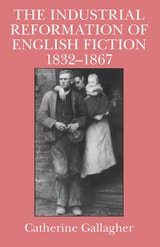
The Industrial Reformation of English Fiction
Social Discourse and Narrative Form, 1832-1867Catherine Gallagher
University of Chicago Press, 1985

The Inner Life of Mestizo Nationalism
Estelle Tarica
University of Minnesota Press, 2008
The only recent English-language work on Spanish-American indigenismo from a literary perspective, Estelle Tarica’s work shows how modern Mexican and Andean discourses about the relationship between Indians and non-Indians create a unique literary aesthetic that is instrumental in defining the experience of mestizo nationalism.
Engaging with narratives by Jesús Lara, José María Arguedas, and Rosario Castellanos, among other thinkers, Tarica explores the rhetorical and ideological aspects of interethnic affinity and connection. In her examination, she demonstrates that these connections posed a challenge to existing racial hierarchies in Spanish America by celebrating a new kind of national self at the same time that they contributed to new forms of subjection and discrimination.
Going beyond debates about the relative merits of indigenismo and mestizaje, Tarica puts forward a new perspective on indigenista literature and modern mestizo identities by revealing how these ideologies are symptomatic of the dilemmas of national subject formation. The Inner Life of Mestizo Nationalism offers insight into the contemporary resurgence and importance of indigenista discourses in Latin America.
Estelle Tarica is associate professor of Latin American literature and culture at the University of California, Berkeley.
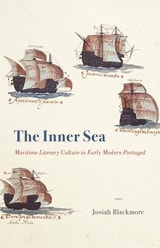
The Inner Sea
Maritime Literary Culture in Early Modern PortugalJosiah Blackmore
University of Chicago Press, 2022
In this book, Josiah Blackmore considers how the sea and seafaring shaped literary creativity in early modern Portugal during the most active, consequential decades of European overseas expansion. Blackmore understands “literary” in a broad sense, including a diverse archive spanning genres and disciplines—epic and lyric poetry, historical chronicles, nautical documents, ship logs, shipwreck narratives, geographic descriptions, and reference to texts of other seafaring powers and literatures of the period—centering on the great Luís de Camões, arguably the sea poet par excellence of early modern Europe.
Blackmore shows that the sea and nautical travel for Camões and his contemporaries were not merely historical realities; they were also principles of cultural creativity that connected to larger debates in the widening field of the maritime humanities. For Blackmore, the sea, ships, and nautical travel unfold into a variety of symbolic dimensions, and the oceans across the globe that were traversed in the fifteenth and sixteenth centuries correspond to vast reaches within the literary self. The sea and seafaring were not merely themes in textual culture but were also principles that created individual and collective subjects according to oceanic modes of perception. Blackmore concludes with a discussion of depth and sinking in shipwreck narratives as metaphoric and discursive dimensions of the maritime subject, foreshadowing empire’s decline.
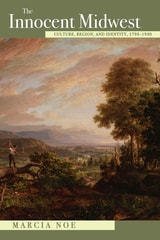
The Innocent Midwest
Culture, Region, and Identity, 1793–1930Marcia Noe
Ohio University Press, 0
The Innocent Midwest delves into one of the most enduring stereotypes in American cultural history: the image of the Midwest as a bastion of innocence. Despite its share of social, political, and economic complexities, the region has long been portrayed as wholesome, virtuous, and peace loving—a perception that has persisted from its pastoral beginnings through industrialization and into the digital age.
This book traces the roots and evolution of that myth, arguing that the Midwest’s innocent image has been carefully cultivated through American popular and high culture. From literature and film to music and visual art, the trope of the innocent Midwesterner has shaped national perceptions of the region for over a century. Focusing on literature from 1793 to the 1920s, the book explores how this character type emerged, evolved, and eventually confronted the disillusionment of the machine age.
Organized thematically, the book examines early frontier narratives, stories of Midwesterners abroad, Progressive Era ideals of neighborliness, immigrant and migrant experiences, and the eventual unraveling of the pastoral dream. It reveals how the myth of innocence was underpinned by a constellation of values—agrarianism, Christian morality, and a belief in education—that supported the Jeffersonian vision of a democratic, virtuous citizenry.
Rather than offering a sweeping theory of regional identity, The Innocent Midwest focuses on the recurring literary figure of the innocent Midwesterner—an individual shaped by the land and striving for self-actualization. The book draws both on canonical authors like Mark Twain, William Dean Howells, Booth Tarkington, Sinclair Lewis, Theodore Dreiser, and Willa Cather and on lesser-known voices such as Maria Susanna Cummins, David Graham Phillips, Elia W. Peattie, William Webb, Chief Luther Standing Bear, and Oscar Micheaux, whose works contributed to the cultural construction of the Midwest.
Through its nuanced exploration of literature and culture, this book offers a compelling account of how the Midwest came to symbolize innocence—and why that image continues to resonate in the American imagination.
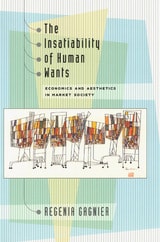
The Insatiability of Human Wants
Economics and Aesthetics in Market SocietyRegenia Gagnier
University of Chicago Press, 2000
The Insatiability of Human Wants begins during a key transitional moment in aesthetic and economic theory, 1871, when both disciplines underwent a turn from production to consumption models. In economics, an emphasis on the theory of value and the social relations between land, labor, and capital gave way to more individualistic models of consumerism. Similarly, in aesthetics, theories of artistic production or creativity soon bowed to models of taste, pleasure, and reception.
Using these developments as a point of departure, Gagnier deftly traces the shift in Western thought from models of production to consumption. From its exploration of early market logic and Kantian thought to its look at the aestheticization of homelessness and our own market boom, The Insatiability of Human Wants invites us to contemplate alternative interpretations of economics, aesthetics, and history itself.
The Insistent Call
Rhetorical Moments in Black Anticolonialism, 1929-1937Aric Putnam
University of Massachusetts Press, 2012
Throughout the nineteenth century, African heritage played an important role in black America, as personal memories and cultural practices continued to shape the everyday experience of people of African descent living under the shadow of slavery. Resisting efforts to de-Africanize their values, customs, and beliefs, Black Americans invoked their African roots in public arguments about their identity and place in the “new” world. At the outset of the twentieth century many still saw Africa primarily as the source of a common cultural and spiritual past. But after the 1920s, the meaning of African heritage changed as people of African descent expressed new relationships between themselves, the United States, and the African Diaspora.
In The Insistent Call, Aric Putnam studies the rhetoric of newspapers, literature, and political pamphlets that expressed this shift. He demonstrates that as people of African descent debated the United States' occupation of Haiti, the Liberian labor crisis, and the Italian invasion of Ethiopia, they formed a new collective identity, one that understood the African Diaspora in primarily political rather than cultural terms. In addition to uncovering a neglected period in the history of Black rhetoric, Putnam shows how rhetoric that articulates the interests of a population not defined by the boundaries of a state can still motivate collective action and influence policies.
The Institutions of Russian Modernism
Conceptualizing, Publishing, and Reading SymbolismJonathan Stone
Northwestern University Press, 2017
The Institutions of Russian Modernism illuminates the key role of Symbolism as the earliest form of modernism in Russia, emerging seemingly ex nihilo at the end of the nineteenth century. Combining book history, periodical studies, and reception theory, Jonathan Stone examines the poetry and theory of Russian Symbolism within the framework of the institutions that organized, published, and disseminated the works to Russian readers. Surveying a wealth of examples of books, journals, and almanacs, Stone traces how publishers of Symbolist works marketed the movement and fashioned a Symbolist reader. His persuasive argument that after its eclipse Symbolism's legacy remained embedded in the heart of Russian modernism will be of interest to scholars and general readers.
The Intimacy of Paper in Early and Nineteenth-Century American Literature
Jonathan Senchyne
University of Massachusetts Press, 2020
The Intimacy of Paper in Early and Nineteenth-Century American Literature reveals that book history and literary studies are mutually constitutive and proposes a new literary periodization based on materiality and paper production. In unpacking this history and connecting it to cultural and literary representations, Senchyne also explores how the textuality of paper has been used to make social and political claims about gender, labor, and race.
The Intimate Critique
Autobiographical Literary CriticismDiane P. Freedman, Olivia Frey, and Frances Murphy Zauhar, eds.
Duke University Press, 1993
Grounded in feminism and connected to the race, class, and gender paradigms in cultural studies, the twenty-six contributors to this volume—including Jane Tompkins, Henry Louis Gates, Jr., Shirley Nelson Garner, and Shirley Goek-Lin Lim—respond in new, refreshing ways to literary subjects ranging from Homer to Freud, Middlemarch to The Woman Warrior, Shiva Naipaul to Frederick Douglass. Revealing the beliefs and formative life experiences that inform their essays, these writers characteristically recount the process by which their opinions took shape--a process as conducive to self-discovery as it is to critical insight. The result—which has been referred to as "personal writing," "experimental critical writing," or "intellectual autobiography"—maps a dramatic change in the direction of literary criticism.
Contributors. Julia Balen, Dana Beckelman, Ellen Brown, Sandra M. Brown, Rosanne Kanhai-Brunton, Suzanne Bunkers, Peter Carlton, Brenda Daly, Victoria Ekanger, Diane P. Freedman, Olivia Frey, Shirley Nelson Garner, Henry Louis Gates, Jr., Melody Graulich, Gail Griffin, Dolan Hubbard, Kendall, Susan Koppelman, Shirley Geok-Lin Lim, Linda Robertson, Carol Taylor, Jane Tompkins, Cheryl Torsney, Trace Yamamoto, Frances Murphy Zauhar
The Invention of Hebrew
Seth L. Sanders
University of Illinois Press, 2011
Seth L. Sanders connects the Bible's distinctive linguistic form--writing down a local spoken language--to a cultural desire to speak directly to people, summoning them to join a new community that the text itself helped call into being. Addressing the people of Israel through a vernacular literature, Hebrew texts reimagined their audience as a public. By comparing Biblical documents with related ancient texts in Hebrew, Ugaritic, and Babylonian, this book shows Hebrew's distinctiveness as a self-conscious political language. Illuminating the enduring stakes of Biblical writing, Sanders demonstrates how Hebrew assumed and promoted a source of power previously unknown in written literature: "the people" as the protagonist of religion and politics.
The Invention of the Oral
Print Commerce and Fugitive Voices in Eighteenth-Century BritainPaula McDowell
University of Chicago Press, 2017
Drawing on an impressive array of sources including travel narratives, elocution manuals, theological writings, ballad collections, and legal records, McDowell re-creates a world in which everyone from fishwives to philosophers, clergymen to street hucksters, competed for space and audiences in taverns, marketplaces, and the street. She argues that the earliest positive efforts to theorize "oral tradition," and to depict popular oral culture as a culture (rather than a lack of culture), were prompted less by any protodemocratic impulse than by a profound discomfort with new cultures of reading, writing, and even speaking shaped by print.
Challenging traditional models of oral versus literate societies and key assumptions about culture’s ties to the spoken and the written word, this landmark study reorients critical conversations across eighteenth-century studies, media and communications studies, the history of the book, and beyond.
The Inverted Conquest
The Myth of Modernity and the Transatlantic Onset of ModernismAlejandro Mejias-Lopez
Vanderbilt University Press, 2009
Expanding Bourdieu's concepts of cultural field and symbolic capital beyond national boundaries, The Inverted Conquest shows how modernismo originated in Latin America and traveled to Spain, where it provoked a complete renovation of Spanish letters and contributed to a national identity crisis. In the process, described by Latin American writers as a reversal of colonial relations, modernismo wrested literary and cultural authority away from Spain, moving the cultural center of the Hispanic world to the Americas.
Mejias-Lopez further reveals how Spanish American modernistas confronted the racial supremacist claims and homogenizing force of an Anglo-American modernity that defined the Hispanic as un-modern. Constructing a new Hispanic genealogy, modernistas wrote Spain as the birthplace of modernity and themselves as the true bearers of the modern spirit, moved by the pursuit of knowledge, cosmopolitanism, and cultural miscegenation, rather than technology, consumption, and scientific theories of racial purity.
Bound by the intrinsic limits of neocolonial and postcolonial theories, scholarship has been unwilling or unable to explore modernismo's profound implications for our understanding of Western modernities.
The Ivory Tower, Harry Potter, and Beyond
More Essays on the Works of J. K. RowlingEdited with an Introduction by Lana A. Whited
University of Missouri Press, 2024

The Janus Face of the German Avant-Garde
From Expressionism Toward PostmodernismRainer Rumold
Northwestern University Press, 2002

The Jazz Barn
Music Inn, the Berkshires, and the Place of Jazz in American LifeJohn Gennari
Brandeis University Press, 2025
This is a book about what happened in the 1950s in a barn, an icehouse, and a greenhouse in the verdant Berkshire Hills of western Massachusetts. Against the backdrop of McCarthyism, the civil rights movement, the expansion of the Afro-Caribbean diaspora, and postwar cultural tourism, two New Yorkers bought part of a sprawling estate in Lenox, where they converted an old barn and other outbuildings into an inn that could host musical performances and seminars. The Berkshire Music Barn went on to host jazz greats like Duke Ellington, Dave Brubeck, and Billie Holiday, as well as jazz roundtables grounded in folkloric approaches to the music.
The Jazz Barn explores the cultural significance of venues like the Berkshire Music Barn and later the Lenox School of Jazz to tell a surprising story about race, culture, and place. John Gennari explores how a predominantly white New England town became a haven for African American musicians, and reveals the Berkshires as an important incubator not just of American literature and classical music but also of the Modern Jazz Quartet and Ornette Coleman’s “new thing.” The Berkshire Music Barn became a crucial space for the mainstreaming of jazz. By the late 1950s, the School of Jazz was an epicenter of the genre’s avant-garde.
Richly illustrated with the photographs of Clemens Kalischer among others, The Jazz Barn demonstrates that the locations where jazz is played and heard indelibly shape the music and its meanings.
The Jazz Republic
Music, Race, and American Culture in Weimar GermanyJonathan O. Wipplinger
University of Michigan Press, 2017
The Jazz of the Southwest
An Oral History of Western SwingBy Jean A. Boyd
University of Texas Press, 1998
They may wear cowboy hats and boots and sing about "faded love," but western swing musicians have always played jazz! From Bob Wills and the Texas Playboys to Asleep at the Wheel, western swing performers have played swing jazz on traditional country instruments, with all of the required elements of jazz, and some of the best solo improvisation ever heard.
In this book, Jean A. Boyd explores the origins and development of western swing as a vibrant current in the mainstream of jazz. She focuses in particular on the performers who made the music, drawing on personal interviews with some fifty living western swing musicians. From pioneers such as Cliff Bruner and Eldon Shamblin to current performers such as Johnny Gimble, the musicians make important connections between the big band swing jazz they heard on the radio and the western swing they created and played across the Southwest from Texas to California.
From this first-hand testimony, Boyd re-creates the world of western swing-the dance halls, recording studios, and live radio shows that broadcast the music to an enthusiastic listening audience. Although the performers typically came from the same rural roots that nurtured country music, their words make it clear that they considered themselves neither "hillbillies" nor "country pickers," but jazz musicians whose performance approach and repertory were no different from those of mainstream jazz. This important aspect of the western swing story has never been told before.
The Jew, the Beauty, and the Beast
Gender and Animality in Modernist Hebrew FictionNaama Harel
Rutgers University Press, 2026
The Jew, the Beauty, and the Beast critically explores the tangled interplay between Jewishness, gender, and animality and its manifestation in modernist Hebrew fiction. Through interdiscursive analysis and close readings, the effeminate Jew is examined vis-à-vis the animalized woman. Intertwining cutting-edge theoretical frameworks of posthumanism and animal studies with established scholarship of Hebrew literature, Jewish studies, and gender studies, Naama Harel offers new Hebrew literary historiography and innovative perspectives on canonical works by Shmuel Yosef Agnon, Devorah Baron, Micha Yosef Berdichevsky, Yosef Haim Brenner, Uri Nissan Gnessin, and David Vogel.
The Jewish Graphic Novel
Critical ApproachesEdited by Samantha Baskind and Ranen Omer-Sherman
Rutgers University Press, 2008
The Jewish Graphic Novel is a lively, interdisciplinary collection of essays that addresses critically acclaimed works in this subgenre of Jewish literary and artistic culture. Featuring insightful discussions of notable figures in the industryùsuch as Will Eisner, Art Spiegelman, and Joann Sfarùthe essays focus on the how graphic novels are increasingly being used in Holocaust memoir and fiction, and to portray Jewish identity in America and abroad
Featuring more than 85 illustrations, this collection is a compelling representation of a major postmodern ethnic and artistic achievement.

The Journey Back
Houston A. Baker Jr.
University of Chicago Press, 1984
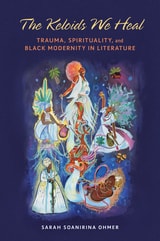
The Keloids We Heal
Trauma, Spirituality, and Black Modernity in LiteratureSarah Soanirina Ohmer
University of Illinois Press, 2025
Women of colors and a literature written in corporeal and spiritual scars
The corporeal and spiritual healing in literature by women of colors can be seen to redefine modern thought and printed text. Sarah Soanirina Ohmer traces the impact of colonization and enslavement on Black women and Black women’s contributions to colonial, nineteenth, and twentieth century literature in the US, Brazil, and the Caribbean.
Drawing on intersectional analysis, Ohmer focuses on portrayals of trauma and spirituality in works by Toni Morrison, Conceição Evaristo, Maryse Condé, Gloria Anzaldúa, the Quilombhoje poets, and María de los Reyes Castillo. Ohmer compares literature from different countries along four thematic pathways: ghosts, mirrors, naming, and motherhood. Her analysis unlocks the literature’s power to heal through gut-wrenching descriptions of wounds and thrilling passages of hope and liberation. Throughout, Ohmer weaves in her life story as a Black woman as she reflects on how colonialism, racism, sexism, and capitalism have impacted her work, traumas, and faith journey.
The Key of Green
Passion and Perception in Renaissance CultureBruce R. Smith
University of Chicago Press, 2008
Contending that color is a matter of both sensation and emotion, Bruce R. Smith examines Renaissance material culture—including tapestries, clothing, and stonework, among others—as well as music, theater, philosophy, and nature through the lens of sense perception and aesthetic pleasure. At the same time, Smith offers a highly sophisticated meditation on the nature of consciousness, perception, and emotion that will resonate with students and scholars of the early modern period and beyond. Like the key to a map, The Key of Green provides a guide for looking, listening, reading, and thinking that restores the aesthetic considerations to criticism that have been missing for too long.
The Keyboard Sonatas of Joseph Haydn
Instruments and Performance Practice, Genres and StylesLászló Somfai
University of Chicago Press, 1995
Laszlo Somfai begins with a thorough study of Haydn's keyboard instruments and their development. After recommending instruments appropriate for modern use, he discusses performance practice and style, explains the peculiarities of Haydn's manuscripts in the context of eighteenth-century notation, and provides specific suggestions for playing ornaments, improvising, slurring, and dynamics. He also investigates Haydn's sonata genres within their historical context and discusses the problems of establishing a chronology of their composition. Finally, Somfai analyzes the organization and style of each musical form. The book includes an index listing the sonatas by date of first publication, and an extensive bibliography.
The Kinds of Poetry I Want
Essays & ComediesCharles Bernstein
University of Chicago Press, 2024
For more than four decades, Charles Bernstein has been at the forefront of experimental poetry, ever reaching for a radical poetics that defies schools, periods, and cultural institutions. The Kinds of Poetry I Want is a celebration of invention and includes not only poetry but also essays on aesthetics and literary studies, interviews with other poets, autobiographical sketches, and more.
At once a dialogic novel, long poem, and grand opera, The Kinds of Poetry I Want arrives amid renewed attacks on humanistic expression. In his polemical, humorous style, Bernstein faces these challenges head-on and affirms the enduring vitality and attraction of poetry, poetics, and literary criticism.
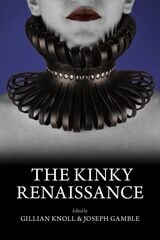
The Kinky Renaissance
Edited by Gillian Knoll and Joseph Gamble
Arizona Center for Medieval and Renaissance Studies, 2024
The Kinky Renaissance is a groundbreaking collection of essays that explore kink as a theoretical analytic, a historical formation, and an aesthetic mode. The essays in this work expand the sexual archive and its lexicon by introducing new vocabularies to familiar sexual scenes in early modern literature and culture and by bringing lesser-known scenes to bear on the study of sexuality in the period. Providing a capacious theory of sexuality and historical precedents for contemporary kinky practices, The Kinky Renaissance explores the erotic potential of early modern literature and pauses over various kinks nestled between and beside them. The collection boldly argues for a broader concept of a kinky Renaissance—one which reorients the terms of both the history of sexuality and queer theory more broadly.
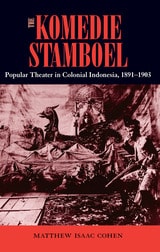
The Komedie Stamboel
Popular Theater in Colonial Indonesia, 1891–1903Matthew Isaac Cohen
Ohio University Press, 2006
Originating in 1891 in the port city of Surabaya, the Komedie Stamboel, or Istanbul-style theater, toured colonial Indonesia, Singapore, and Malaysia by rail and steamship. The company performed musical versions of the Arabian Nights, European fairy tales and operas such as Sleeping Beauty and Aida, as well as Indian and Persian romances, Southeast Asian chronicles, true crime stories, and political allegories. The actors were primarily Eurasians, the original backers were Chinese, and audiences were made up of all races and classes. The Komedie Stamboel explores how this new hybrid theater pointed toward possibilities for the transformation of self in a colonial society and sparked debates on moral behavior and mixed-race politics.
While audiences marveled at spectacles involving white-skinned actors, there were also racial frictions between actors and financiers, sexual scandals, fights among actors and patrons, bankruptcies, imprisonments, and a murder.
Matthew Isaac Cohen's evocative social history situates the Komedie Stamboel in the culture of empire and in late nineteenth-century itinerant entertainment. He shows how the theater was used as a symbol of cross-ethnic integration in postcolonial Indonesia and as an emblem of Eurasian cultural accomplishment by Indische Nederlanders. A pioneering study of nineteenth-century Southeast Asian popular culture, The Komedie Stamboel gives a new picture of the region's arts and culture and explores the interplay of currents in global culture, theatrical innovation, and movement in colonial Indonesia.ABOUT THE AUTHOR---Matthew Isaac Cohen is senior lecturer in Drama and Theatre Studies at Royal Holloway University of London. His articles on Southeast Asian performance have appeared in New Theatre Quarterly, Asian Theatre Journal, Journal of the Royal Asiatic Society, and Archipel. As a practicing shadow puppeteer, he has performed in the United States, Europe, and Asia.

The LEGO Movie
By Dana Polan
University of Texas Press, 2020
What happens when we set out to understand LEGO not just as a physical object but as an idea, an icon of modernity, an image—maybe even a moving image? To what extent can the LEGO brick fit into the multimedia landscape of popular culture, especially film culture, today? Launching from these questions, Dana Polan traces LEGO from thing to film and asserts that The LEGO Movie is an exemplar of key directions in mainstream cinema, combining the visceral impact of effects and spectacle with ironic self-awareness and savvy critique of mass culture as it reaches for new heights of creativity.
Incorporating insights from conversations with producer Dan Lin and writer-directors Phil Lord and Chris Miller, Polan examines the production and reception of The LEGO Movie and closely analyzes the film within popular culture at large and in relation to LEGO as a toy and commodity. He identifies the film’s particular stylistic and narrative qualities, its grasp of and response to the culture industry, and what makes it a distinctive work of animation within the seeming omnipresence of animation in Hollywood, and reveals why the blockbuster film, in all its silliness and seriousness, stands apart as a divergent cultural work.
The Lancelot-Grail Cycle
Text and TransformationsEdited by William W. Kibler
University of Texas Press, 1994
Composed in Old French between about 1220 and 1240, the Lancelot-Grail Cycle is a group of five prose romances centered on the love affair between Lancelot and Guenevere. It consists of an immense central core, the Lancelot Proper, introduced by The History of the Holy Grail and The Story of Merlin and concluded by The Quest for the Holy Grail and The Death of Arthur.
This volume brings together thirteen essays by noted scholars from the first symposium ever devoted exclusively to the Lancelot-Grail Cycle. Exploring the cycle's evolution across the literatures of medieval France, Italy, Spain, Catalonia, and England, the authors take a variety of approaches that highlight a broad range of cultural, social, historical, and political concerns and offer a comparative and interdisciplinary vision of this great romance.
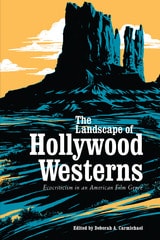
The Landscape of Hollywood Westerns
Ecocriticism in an American Film GenreCarmichael, Deborah A
University of Utah Press, 2006
The essays in this volume scrutinize the special place of nature and landscape in films—including silent, documentary, and feature length film—that are specifically American and Western. The films discussed here go beyond the stereotypical sagebrush setting. Although many of the films closely fit the standard conventions of the Western, others demonstrate the fluidity of the genre. The wildness of the western environment as a central fact of the American mythos encompasses far more than a brief period of national history or a specific geographical location.
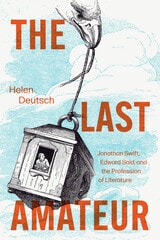
The Last Amateur
Jonathan Swift, Edward Said, and the Profession of LiteratureHelen Deutsch
University of Chicago Press, 2026
Joining the unfinished conversation between the satirist Jonathan Swift and the critic Edward Said, The Last Amateur argues for the transformative potential of literature.
What does “Swiftian” mean to you? For many, the name is synonymous with ingenious satire and an acid, clarifying mix of decorum and outrage. Jonathan Swift was, of course, the author of not only Gulliver’s Travels but also A Modest Proposal, which the columnist Gene Lyons recently called “perhaps the most penetrating anti-racist essay in the English language.” Small wonder, then, that the Anglo-Irish satirist was a lifelong inspiration to the great Palestinian American critic Edward Said, who for many years worked on an unfinished book about Swift and cultivated a Swiftian voice across his career.
Helen Deutsch’s highly personal book explores what Said’s love of Swift—and hers of both—tells us about not only these authors but also the powers of criticism itself. The Last Amateur is about how one comes to love one writer through another. Deutsch scrutinizes Said in relationship to Swift to raise questions of her own about the profession of literary studies. At a time when many in the field have lost faith in critique, Deutsch shows how passion and a refusal of professional propriety—the hallmarks of the amateur—can enliven critique again.
What, then, does it mean to be a Swiftian? The Swiftian hears Swift’s animus and uses it as an incentive for their own freedom of thought. Said was a Swiftian because the experience of reading Swift freed him to speak out, to have something serious to say. Deutsch’s revelatory book is an exercise in hearing Swift’s voice and speaking in her own.

The Last Miles
The Music of Miles Davis, 1980-1991George Cole
University of Michigan Press, 2007
“Cole does for Miles’s late work what Ian MacDonald’s Revolution in the Head does for the Beatles, examining each album in meticulous detail.”
—Time Out
“As with any good musical biography, Cole . . . made me think again about those albums such as Siesta, You’re Under Arrest, and The Man with the Horn that are now stashed in my attic.”
—London Times
“In the flurry of books since [Miles Davis’s] death, none has dealt in depth with the music of this period. Music writer George Cole fills this gap. . . . a rich and rewarding read.”
—Gazette (Montreal)
“A fascinating book.”
—Mojo
“A singular look into the last stage of Davis’s long, somewhat checkered career gained from various sources, which at the same time gives a picture of the modern music business.”
—Midwest Book Review
“There are large chunks of fresh material here. . . . Fill[s] in quite a few gaps and dismisses blanket condemnations of [Miles’s] pop phase.”
—Jazzwise
“Thank you for telling it like it was!”
—Randy Hall, singer and guitarist
“Very moving, emotional material.”
—Gordon Meltzer, Miles’s last road manager and executive producer of Doo-Bop

The Last Physician
Walker Percy and the Moral Life of MedicineCarl Elliott and John Lantos, eds.
Duke University Press, 1999
The contributors—physicians, philosophers, and literary critics—examine the relevance of Percy’s work to current dilemmas in medical education and health policy. They reflect upon the role doctors and patients play in his novels, his family legacy of depression, how his medical background influenced his writing style, and his philosophy of psychiatry. They contemplate the private ways in which Percy’s work affected their own lives and analyze the author’s tendency to contrast the medical-scientific worldview with a more spiritual one. Assessing Percy’s stature as an author and elucidating the many ways that reading and writing can combine with diagnosing and treating to offer an antidote to despair, they ask what it means to be a doctor, a writer, and a seeker of cures and truths—not just for the body but for the malaise and diseased spirituality of modern times.
This collection will appeal to lovers of literature as well as medical professionals—indeed, anyone concerned with medical ethics and the human side of doctoring.
Contributors. Robert Coles, Brock Eide, Carl Elliott, John D. Lantos, Ross McElwee, Richard Martinez, Martha Montello, David Schiedermayer, Jay Tolson, Bertram Wyatt-Brown, Laurie Zoloth-Dorfman

The Late Great Johnny Ace and the Transition from R&B to Rock 'n' Roll
James M. Salem
University of Illinois Press, 1999
Johnny Ace's crooning style and stirring ballads made him the first postwar African American artist to cross over to a white audience. After a string of R&B hits, Ace released the million-selling "Pledging My Love," a song headed to the top of the charts when the singer accidentally shot himself in his dressing room between sets at a show.
James M. Salem captures the enigmatic, captivating, and influential R&B legend. Venturing from raucous Beale Street to Houston's vibrant Fourth Ward, Salem places Johnny Ace within a multifaceted world of postwar rhythm and blues that included B. B. King, Johnny Otis, Big Mama Thornton, and Gatemouth Brown. Salem also examines how entrepreneur Don D. Robey and his wife Evelyn Johnson promoted Ace to the top of the charts. Yet fame, as always, had a price. Ace's tours on the Chitlin' Circuit meant endless one-night stands and a grueling schedule that kept him on the road 340 days per year.
Comprehensive and filled with anecdotes, The Late Great Johnny Ace and the Transition from R&B to Rock 'n' Roll tells the story of the star who fused black and white styles and changed American popular music forever.