Results by title
3258 books match the query 'Performing Arts' and 658 start with t
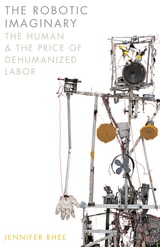
The Robotic Imaginary
The Human and the Price of Dehumanized LaborJennifer Rhee
University of Minnesota Press, 2018
Tracing the connections between human-like robots and AI at the site of dehumanization and exploited labor
The word robot—introduced in Karel Čapek’s 1920 play R.U.R.—derives from rabota, the Czech word for servitude or forced labor. A century later, the play’s dystopian themes of dehumanization and exploited labor are being played out in factories, workplaces, and battlefields. In The Robotic Imaginary, Jennifer Rhee traces the provocative and productive connections of contemporary robots in technology, film, art, and literature. Centered around the twinned processes of anthropomorphization and dehumanization, she analyzes the coevolution of cultural and technological robots and artificial intelligence, arguing that it is through the conceptualization of the human and, more important, the dehumanized that these multiple spheres affect and transform each other.
Drawing on the writings of Alan Turing, Sara Ahmed, and Arlie Russell Hochschild; such films and novels as Her and The Stepford Wives; technologies like Kismet (the pioneering “emotional robot”); and contemporary drone art, this book explores anthropomorphic paradigms in robot design and imagery in ways that often challenge the very grounds on which those paradigms operate in robotics labs and industry. From disembodied, conversational AI and its entanglement with care labor; embodied mobile robots as they intersect with domestic labor; emotional robots impacting affective labor; and armed military drones and artistic responses to drone warfare, The Robotic Imaginary ultimately reveals how the human is made knowable through the design of and discourse on humanoid robots that are, paradoxically, dehumanized.
The Roots of Theatre
Rethinking Ritual and Other Theories of OriginEli Rozik
University of Iowa Press, 2002
The Sagebrush Trail
Western Movies and Twentieth-Century AmericaRichard Aquila
University of Arizona Press, 2015
The book is divided into three parts. Part 1 traces the birth and growth of Westerns from 1900 through the end of World War II. Part 2 focuses on a transitional period in Western movie history during the two decades following World War II. Finally, part 3 shows how Western movies reflected the rapid political, social, and cultural changes that transformed America in the 1960s and the last decades of the twentieth century.
The Sagebrush Trail explains how Westerns evolved throughout the twentieth century in response to changing times, and it provides new evidence and fresh interpretations about both Westerns and American history. These films offer perspectives on the past that historians might otherwise miss. They reveal how Americans reacted to political and social movements, war, and cultural change. The result is the definitive story of Western movies, which contributes to our understanding of not just movie history but also the mythic West and American history. Because of its subject matter and unique approach that blends movies and history, The Sagebrush Trail should appeal to anyone interested in Western movies, pop culture, the American West, and recent American history and culture.
The mythic West beckons but eludes. Yet glimpses of its utopian potential can always be found, even if just for a few hours in the realm of Western movies. There on the silver screen, the mythic West continues to ride tall in the saddle along a “sagebrush trail” that reveals valuable clues about American life and thought.
The San Francisco Mime Troupe Reader
Susan Vaneta Mason, Editor
University of Michigan Press, 2005
It is also a history of the company that was the theater of the counterculture movement in the 1960s and that, against all odds, has managed to survive the often hostile economic climate for the arts in the United States. The plays selected are diverse, representing some of the Troupe's finest shows, and the book's illustrations capture some of the Troupe's most memorable moments.
These hilarious, edgy, and imaginative scripts are accompanied by insightful commentary by theater historian and critic Susan Vaneta Mason, who has been following the Troupe for more than three decades. The Mime Troupe Reader will engage and entertain a wide range of audiences, not only general readers but also those interested in the history of American social protest, the counterculture of the 1960s-particularly the San Francisco scene-and the evolution of contemporary political theater. It will also appeal to the legions of Troupe fans who return every year to see them stand up against another social or corporate Goliath.
The Sarah Siddons Audio Files
Romanticism and the Lost VoiceJudith Pascoe
University of Michigan Press, 2013
“The theatre scholar’s daunting but irresistible quest to recover some echoes of performance of the past has never been more engagingly presented than in Pascoe’s account of tracing the long-silenced voice of Sarah Siddons. Her report is a warm, witty, and highly informative exploration of the methodology and the pleasures of historical research.”
—Marvin Carlson, author of The Haunted Stage: The Theatre as Memory Machine
During her lifetime (1755–1831), English actress Sarah Siddons was an international celebrity acclaimed for her performances of tragic heroines. We know what she looked like—an endless number of artists asked her to sit for portraits and sculptures—but what of her famous voice, reported to cause audiences to hyperventilate or faint? In The Sarah Siddons Audio Files, Judith Pascoe takes readers on a journey to discover how the actor’s voice actually sounded. In lively and engaging prose, Pascoe retraces her quixotic search, which leads her to enroll in a “Voice for Actors” class, to collect Lady Macbeth voice prints, and to listen more carefully to the soundscape of her life.
Bringing together archival discoveries, sound recording history, and media theory, Pascoe shows how romantic poets’ preoccupation with voices is linked to a larger cultural anxiety about the voice’s ephemerality. The Sarah Siddons Audio Files contributes to a growing body of work on the fascinating history of sound and will engage a broad audience interested in how recording technology has altered human experience.
The Scene of Foreplay
Theater, Labor, and Leisure in 1960s New YorkGiulia Palladini
Northwestern University Press, 2017
Matching an original approach to historical materials and theoretical reflection, Palladini addresses the peculiar forms of production, reproduction, and consumption developed in the 1960s as labors of love, creating for artists a condition of “preliminarity” toward professional work and also functioning as a counterforce within productive economy, as a prelude where value is not yet assigned to labor.
The Scene of Foreplay proposes that such labors of love can be considered both as paradigmatic for contemporary forms of precarious labor and also resonating with echoes from marginal histories of the performing arts, in a nonlinear genealogy of queer resistance to ideas of capitalist productivity and professionalism. The book offers much for those interested in performance theory as well asin the history of theater and performance arts in the 1960s.
The Scene of Harlem Cabaret
Race, Sexuality, PerformanceShane Vogel
University of Chicago Press, 2009
Harlem’s nightclubs in the 1920s and ’30s were a crucible for testing society’s racial and sexual limits. Normally tacit divisions were there made spectacularly public in the vibrant, but often fraught, relationship between performer and audience. The cabaret scene, Shane Vogel contends, also played a key role in the Harlem Renaissance by offering an alternative to the politics of sexual respectability and racial uplift that sought to dictate the proper subject matter for black arts and letters. Individually and collectively, luminaries such as Duke Ellington, Lena Horne, Langston Hughes, Claude McKay, Wallace Thurman, and Ethel Waters expanded the possibilities of blackness and sexuality in America, resulting in a queer nightlife that flourished in music, in print, and on stage.
Deftly combining performance theory, literary criticism, historical research, and biographical study, The Scene of Harlem Cabaret brings this rich moment in history to life, while exploring the role of nightlife performance as a definitive touchstone for understanding the racial and sexual politics of the early twentieth century.
The Scenographic Imagination, Third Edition
Darwin Reid Payne
Southern Illinois University Press, 1993
In this enlarged and thoroughly revised third edition of his widely used text, Darwin Reid Payne explores the principles and philosophies that shape the visual elements of theatre.
Payne sets out to discover who scenographers are and to define their responsibilities. He sees scenographers as not merely craftspersons but artists with "a special vision that spans all the arts." Such artists are in a position to "extend and amplify underlying meanings of the production." The proper goal of beginning scenographers, according to Payne, is one day to be able to approach the job as artists in full command of their craft.
Payne seeks to instill in beginning scenographers a basic core of knowledge: an understanding of theatre history and the development of drama; a knowledge of art history and an understanding of periods and styles of architecture, painting, sculpture, furnishings, and costume; and a familiarity with the principles, techniques, and materials of pictorial and three-dimensional design. This new edition contains 248 illustrations, 38 more than the second edition. Payne’s goal, certainly, is to teach students what to do and how to do it; equally important, however, is Payne’s view that scenographers must know why.
To Payne, "Scenography is an art whose scope is nothing less than the whole world outside the theatre." Scenographers must read not only in their own field but in others as well. Payne has incorporated into his text many suggestions for outside readings, quoting passages and even entire chapters from important works. Stressing research, Payne argues that without knowledge of the literature of their own and related arts, scenographers cannot grow. And that is the emphasis of this book: to present aspiring scenographers with an approach and a set of concepts that will enable them to grow. Toward that end, Payne establishes five priorities, the first of which is to develop in students what he calls "time vision," or the ability to "see" the historical past as a living place with living inhabitants. The second priority is to bring about an awareness that allows students to "see" beneath the surface of objects and events. Third, students must be helped to recognize and appreciate the difference between the "concept of space as it exists outside the theatre and the concept of space as it is used within the theatre." The fourth priority is to ingrain in students an understanding of the importance of imagery to the scenographer, and the final priority is to teach those technical skills necessary to carry out the concepts of the scenographer.
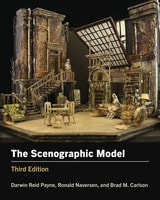
The Scenographic Model
Third EditionDarwin Reid Payne, Ronald Naversen, and Brad M. Carlson
Southern Illinois University Press, 2025
An authoritative guide to modelmaking for theater
This third edition of noted scenographer Darwin Reid Payne’s landmark text builds upon Payne’s theories and exercises to provide a modern exploration of the practice of theatrical modelmaking. With chapters on traditional and contemporary materials, tools, and techniques, the book serves as a foundational guide to understanding the historical, theoretical, and practical aspects of scenographic modelmaking, making it essential for the beginner, generalist, and professional design practitioner.
The volume begins with a brief history of the scenographic model and explores how modelmaking has adapted to changes in materials, technology, and commercial influences over time. It details setting up a safe, productive model-building studio before introducing the types and purposes of various scenographic models. It then instructs the reader in constructing common model elements and accessories. Later chapters explore how the models reveal stage space and create mood and atmosphere through tonal shading and lighting; discuss the use of found objects, collage techniques, and projection models in scenic design; and delve into 3D printing and computer routering. The final chapter provides information on various aspects of photography and image sharing related to design and production communication.
This comprehensive text provides information not just from theater but also from other modeling disciplines and sources, including architecture, film, dioramas, dollhouse modeling, and model railroading. A useful resource for high school, community college, university, and community theater enthusiasts, it is an excellent reference book for theater designers throughout the country.
The Sea Hawk
Edited by Rudy Behlmer; Tino T. Balio, Series Editor
University of Wisconsin Press, 1982
This 1940 swashbuckler is one of the best examples of the old Hollywood studio system at work. Scholars and film buffs will learn much about collaborative filmmaking on an exceptionally large scale as Rudy Behlmer traces step-by-step the evolution of The Sea Hawk. The very anti-thesis of an auteur film, The Sea Hawk illustrates the ways in which creative input from just about everyone on the Warner Brothers lot—producers, writers, art directors, director, cameraman, special effects team, editor and composer-conductor—resulted in a film in the familiar Warners house style.
This book includes the complete screenplay.
The Second City Almanac of Improvisation
Anne Libera and Second City, Inc.
Northwestern University Press, 2004
The Second City Almanac of Improvisation - like the theatre itself - is a collection of diverse ideas, viewpoints, and memories, written by a vast array of teachers, actors, and directors who all got their start at the legendary comedy theatre. Fred Willard recalls his introduction to The Second City style in the mid-Sixties; Tim Kazurinsky gives a hilarious visual demonstration on the art of object work; "Saturday Night Live" star Tina Fey talks about re-improvising material as a mode of writing revue comedy; noted director Mick Napier takes on the thorny debate between long-form improvisation and short-form improvisation. Anne Libera guides the reader through each essay by providing a road map for understanding how The Second City method of improv-based comedy has become the industry standard.
Mike Nichols, Elaine May, Alan Arkin, Joan Rivers, Robert Klein, Peter Boyle, Harold Ramis, John Belushi, Dan Aykroyd, Bill Murray, John Candy, Martin Short, Gilda Radner, George Wendt, Jim Belushi, Bonnie Hunt, Mike Myers, Ryan Stiles, Rachel Dratch, Nia Vardalos - no other theatre can boast an alumni list of this magnitude. The Second City Almanac of Improvisation provides practical instruction, personal details, and inspiration to both improvisers and their fans.
The Second Wave
Reflections on the Pandemic through Photography, Performance and Public CultureRustom Bharucha
Seagull Books, 2022
Focusing on the second wave of the Covid-19 pandemic in India between April and December 2021, Rustom Bharucha’s timely essay reflects on four interconnected realities that haunted this ongoing crisis—death, grief, mourning, and extinction. How do we cope with multiple deaths and the dislocation of rituals when the act of mourning is either postponed or denied? What roles do political surveillance, censorship, the regulation of lockdowns, and the sheer indifference to the lives of people play in the containment of civil liberties? Through vivid examples of photography, theater, dance, visual arts, and the cultures of everyday life, this meditative essay illuminates both the horror of the pandemic as well as its unexpected intimacies and revelations of shared suffering. Against the destruction of nature and the disrespect for the nonhuman, The Second Wave offers lessons in resilience through its reflections on the ethos of waiting and the need to re-envision breath as a vital resource of self-renewal and resistance.
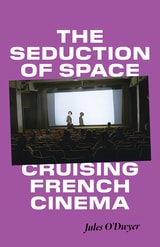
The Seduction of Space
Cruising French CinemaJules O'Dwyer
University of Minnesota Press, 2025
A bold and far-reaching new study of French queer cinema reimagines the relationship between sexuality and space
Spatiality has long been a crucial and potent lens for understanding French culture and aesthetics. While canonical greats of French cinema such as Jean-Luc Godard, Agnès Varda, and Louis Malle invoked the notion of flânerie to explore ideas of modernism, spatial exploration, and urban sociality, Jules O’Dwyer demonstrates how a more recent generation of French queer filmmakers continues to engage with—and contest—this legacy by focusing attention on the cognate practice of cruising.
Through the work of Jacques Nolot, Sébastien Lifshitz, Christophe Honoré, Vincent Dieutre, Alain Guiraudie, and others, The Seduction of Space draws film theory, queer studies, and spatial inquiry into close proximity to examine the politics of cruising and the gendering of space. Making the case that cinema not only documents the queer spaces of the past but continues to produce them, O’Dwyer maps the relationships between sex and spatiality as he takes up such varied topics as public sex in the porn theater, racial eroticization in the banlieue, and the ecocritical valences of rural cruising.
Foregrounding the crucial role that spatiality plays in shaping the parameters of France’s visual cultures and political imaginary, The Seduction of Space is both an urgent queer reconceptualization of this tradition and a clarion call for film scholars to tarry with the politics of sexuality in all its messiness.
Retail e-book files for this title are screen-reader friendly with images accompanied by short alt text and/or extended descriptions.
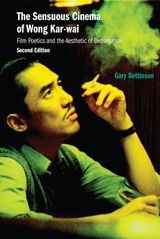
The Sensuous Cinema of Wong Kar-wai
Film Poetics and the Aesthetic of Disturbance, Second EditionGary Bettinson
Hong Kong University Press, 2025
The widely acclaimed films of Wong Kar-wai are characterized by their sumptuous yet complex visual and sonic style. This study of Wong’s filmmaking techniques uses a poetics approach to examine how form, music, narration, characterization, genre, and other artistic elements work together to produce certain effects on audiences. Bettinson argues that Wong’s films are permeated by an aesthetic of sensuousness and “disturbance” achieved through techniques such as narrative interruptions, facial masking, opaque cuts, and other complex strategies. The effect is to jolt the viewer out of complete aesthetic absorption. Each of the chapters focuses on a single aspect of Wong’s filmmaking.
This tenth-anniversary edition of The Sensuous Cinema of Wong Kar-wai includes a substantial new afterword bringing the story of Wong’s career up to date (including reflections on the Mainland Chinese drama Blossoms Shanghai). Bettinson revisits and extends the arguments of the first edition, surveys the recent key debates on Wong’s filmmaking, and introduces fresh lines of critical investigation. The book will appeal to all who are interested in authorship and aesthetics in film studies, to scholars in Asian studies, media, and cultural studies, and to anyone with an interest in Hong Kong cinema in general, and Wong’s films in particular.
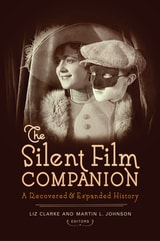
The Silent Film Companion
A Recovered and Expanded HistoryLiz Clarke
Rutgers University Press, 2027
Silent film is more than just a cinema of firsts, greats, or classics. It is a cinema of experimentation, ambition, and connection. To watch a silent film is to be transported into another world. The Silent Film Companion seeks to broaden the silent film canon by focusing on compelling non-canonical films from around the globe, providing a fresh perspective and new view of silent cinema. With over fifty films discussed, this volume captures just a sliver of the many delights silent cinema has to offer. It encourages discovery, and rediscovery, of the world of silent cinema: one where the movies were still young, full of possibility, and eager to entice others to take part in a wonderful adventure.
Films covered are from fourteen countries, including Brazil, Mexico, China, Cuba, India, Italy, and Russia, and represent a diversity of subjects. Each chapter provides historical and cultural context to the film, the filmmakers, and a concise analysis of each film. The Silent Film Companion is a must-read for students and fans of silent cinema interested in seeing a side of silent cinema that is rarely explored.
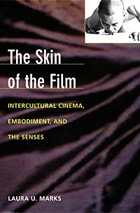
The Skin of the Film
Intercultural Cinema, Embodiment, and the SensesLaura U. Marks
Duke University Press, 2000
Much of intercultural cinema, Marks argues, has its origin in silence, in the gaps left by recorded history. Filmmakers seeking to represent their native cultures have had to develop new forms of cinematic expression. Marks offers a theory of “haptic visuality”—a visuality that functions like the sense of touch by triggering physical memories of smell, touch, and taste—to explain the newfound ways in which intercultural cinema engages the viewer bodily to convey cultural experience and memory. Using close to two hundred examples of intercultural film and video, she shows how the image allows viewers to experience cinema as a physical and multisensory embodiment of culture, not just as a visual representation of experience. Finally, this book offers a guide to many hard-to-find works of independent film and video made by Third World diasporic filmmakers now living in the United States, Great Britain, and Canada.
The Skin of the Film draws on phenomenology, postcolonial and feminist theory, anthropology, and cognitive science. It will be essential reading for those interested in film theory, experimental cinema, the experience of diaspora, and the role of the sensuous in culture.
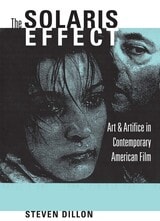
The Solaris Effect
Art and Artifice in Contemporary American FilmBy Steven Dillon
University of Texas Press, 2006
What do contemporary American movies and directors have to say about the relationship between nature and art? How do science fiction films like Steven Spielberg's A.I. and Darren Aronofsky's π represent the apparent oppositions between nature and culture, wild and tame?
Steven Dillon's intriguing new volume surveys American cinema from 1990 to 2002 with substantial descriptions of sixty films, emphasizing small-budget independent American film. Directors studied include Steven Soderbergh, Darren Aronofsky, Todd Haynes, Harmony Korine, and Gus Van Sant, as well as more canonical figures like Martin Scorcese, Robert Altman, David Lynch, and Steven Spielberg. The book takes its title and inspiration from Andrei Tarkovsky's 1972 film Solaris, a science fiction ghost story that relentlessly explores the relationship between the powers of nature and art. The author argues that American film has the best chance of aesthetic success when it acknowledges that a film is actually a film. The best American movies tell an endless ghost story, as they perform the agonizing nearness and distance of the cinematic image.
This groundbreaking commentary examines the rarely seen bridge between select American film directors and their typically more adventurous European counterparts. Filmmakers such as Lynch and Soderbergh are cross-cut together with Tarkovsky and the great French director, Jean-Luc Godard, in order to test the limits and possibilities of American film. Both enthusiastically cinephilic and fiercely critical, this book puts a decade of U.S. film in its global place, as part of an ongoing conversation on nature and art.
The Song Is You
Musical Theatre and the Politics of Bursting into Song and DanceBradley Rogers
University of Iowa Press, 2020
Musicals, it is often said, burst into song and dance when mere words can no longer convey the emotion. This book argues that musicals burst into song and dance when one body can no longer convey the emotion. Rogers shows how the musical’s episodes of burlesque and minstrelsy model the kinds of radical relationships that the genre works to create across the different bodies of its performers, spectators, and creators every time the musical bursts into song. These radical relationships—borne of the musical’s obsessions with “bad” performances of gender and race—are the root of the genre’s progressive play with identity, and thus the source of its subcultural power. However, this leads to an ethical dilemma: Are the musical’s progressive politics thus rooted in its embrace of regressive entertainments like burlesque and minstrelsy?
The Song Is You shows how musicals return again and again to this question, and grapple with a guilt that its joyous pleasures are based on exploiting the laboring bodies of its performers. Rogers argues that the discourse of “integration”—which claims that songs should advance the plot—has functioned to deny the radical work that the musical undertakes every time it transitions into song and dance. Looking at musicals from The Black Crook to Hamilton, Rogers confronts the gendered and racial dynamics that have always under-girded the genre, and asks how we move forward.
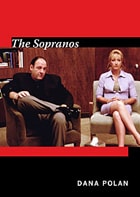
The Sopranos
Dana Polan
Duke University Press, 2009
A show about corrupt figures who parasitically try to squeeze illicit profit from the system, The Sopranos itself seems a target of attempts to glom on to its fame as a successful TV series: attempts by media executives, marketers, critics and writers, and even presidential candidates. “Everyone wants a piece of Sopranos action,” says Polan, and he traces the marketing of the series across both official and unauthorized media platforms, including cookbooks, games, DVDs, and the kitschy Sopranos bus tour. Critiquing previous books on The Sopranos, Polan suggests that in their quest to find deep meaning, many of the authors missed the show’s ironic and comedic side.
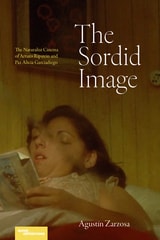
The Sordid Image
The Naturalist Cinema of Arturo Ripstein and Paz Alicia GarciadiegoAgustín Zarzosa
Northwestern University Press, 2026
Drawing on the cinematic oeuvre of Ripstein and Garciadiego to reconceptualize the idea of the sordid
The sordid is not an ideology, an affect, or even a form of taste or sensibility. It is, Agustín Zarzosa argues, an image and an evocation of the process of degradation. The Sordid Image: The Naturalist Cinema of Arturo Ripstein and Paz Alicia Garciadiego offers the first sustained study of this pivotal filmmaker-screenwriter pair, drawing on their multidecade collaborations to reframe an enduring problem of film theory: how to represent marginalized people.
Together, Ripstein and Garciadiego have constructed a recognizable cinematic world filled with social outcasts, characterized by self-degradation and unreason, and set within squalid environments. Inscribing the Ripsteinian universe within the literary and cinematic traditions of naturalism, this book theorizes the notion of the sordid to examine the partners’ unique and epoch-defining films. We can, Zarzosa contends, understand the sordid as a cinematic image, with its specific components and pleasures, recasting questions of authorship, mise-en-scène, spectatorship, genre, and language.
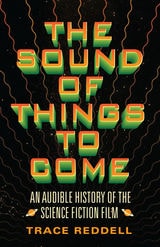
The Sound of Things to Come
An Audible History of the Science Fiction FilmTrace Reddell
University of Minnesota Press, 2018
A groundbreaking approach to sound in sci-fi films offers new ways of construing both sonic innovation and science fiction cinema
Including original readings of classics like The Day the Earth Stood Still, 2001: A Space Odyssey, Star Wars, and Blade Runner, The Sound of Things to Come delivers a comprehensive history of sound in science fiction cinema. Approaching movies as sound objects that combine cinematic apparatus and consciousness, Trace Reddell presents a new theory of sonic innovation in the science fiction film.
Reddell assembles a staggering array of movies from sixty years of film history—including classics, blockbusters, B-movies, and documentaries from the United States, Britain, France, Germany, Japan, and the Soviet Union—all in service to his powerful conception of sound making as a speculative activity in its own right. Reddell recasts debates about noise and music, while arguing that sound in the science fiction film provides a medium for alien, unknown, and posthuman sound objects that transform what and how we hear.
Avoiding genre criticism’s tendency to obsess over utopias, The Sound of Things to Come draws on film theory, sound studies, and philosophies of technology to advance conversations about the avant-garde, while also opening up opportunities to examine cinematic sounds beyond the screen.

The Spectacle of Democracy
Spanish Television, Nationalism, and Political TransitionRichard Maxwell
University of Minnesota Press, 1994
The Spectacle of Democracy was first published in 1994. Minnesota Archive Editions uses digital technology to make long-unavailable books once again accessible, and are published unaltered from the original University of Minnesota Press editions.
In this age of increased global communication the media seem like juggernauts paving the way from dictatorship to democracy. Richard Maxwell's study of television in Spain overturns this myth of technological power. He shows us how transitions themselves have a profound impact on the media, as controllers of national television clash with commercial media promoters and with regionalists who want television to extend their nationalist politics and collective identity.
Maxwell's sophisticated analysis of the many variables shaping communication policy within the nation-state draws on a decade of research into Spanish culture, mass media, and political economy. Although focused on Spain, his work provides general insight into the nature of communication policy debates in today's globalized economy. A study of the transformation of television in Spain following the end of Franco's dictatorship, Maxwell's book examines the politics of the privatization of television, the rise of regional television, and the transnational realignment of national media space.Richard Maxwell is assistant professor in the department of radio, television, and film in the School of Speech at Northwestern University.
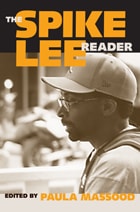
The Spike Lee Reader
Paula Massood
Temple University Press, 2007
Gathered in this anthology are critical writings on Spike Lee's films by leading scholars in the fields of cinema studies and African American studies. In sixteen new and reprinted essays, the contributors to The Spike Lee Reader consider the nexus of race, gender, and sexuality in Lee's work, and in so doing encourage readers to further explore the cultural, social, and political implications of Lee's films as well as his entire body of work.
Contributors include: Christine Acham, Toni Cade Bambara, Mark D. Cunningham, Anna Everett, Daniel Flory, Krin Gabbard, David A. Gerstner, Ed Guerrero, Keith M. Harris, bell hooks, Wahneema Lubiano, James C. McKelly, Tavia Nyong'o, Beretta E. Smith-Shomade, Michele Wallace, S. Craig Watkins, and the editor.
The Stage Life of Props
Andrew Sofer
University of Michigan Press, 2003
Using case studies that explore the Eucharistic wafer on the medieval stage, the bloody handkerchief on the Elizabethan stage, the skull on the Jacobean stage, the fan on the Restoration and early eighteenth-century stage, and the gun on the modern stage, Andrew Sofer reveals how stage props repeatedly thwart dramatic convention and reinvigorate theatrical practice.
While the focus is on specific objects, Sofer also gives us a sweeping history of half a millennium of stage history as seen through the device of the prop, revealing that as material ghosts, stage props are a way for playwrights to animate stage action, question theatrical practice, and revitalize dramatic form.
Andrew Sofer is Assistant Professor of English, Boston College. He was previously a stage director.
The Stars
Edgar Morin
University of Minnesota Press, 2005
The Stranger from Omaha
Travel Narratives in the Cinema of Alexander PayneJason Sperb
University of Texas Press, 2025
The first in-depth analysis of the films of Alexander Payne through the lenses of authorship, tourism, and leisure.
With the films Election, About Schmidt, Sideways, Nebraska, and The Holdovers, Alexander Payne has carved out an unusual role in American cinema as a bankable auteur. There is something about Payne’s neurotics and searchers, his working stiffs and disillusioned idealists—something funny, moving, and filled with insight.
Jason Sperb dissects Payne’s oeuvre, focusing on the director’s penchant for travel narratives. Payne’s films usually center on male protagonists discontent with the emotional and material realities of the day-to-day and seeking satisfaction in some literal or metaphorical elsewhere. But their attempts to escape wind up perpetuating, rather than alleviating, the imbalance between labor and leisure that structures modern life. In this sense, Sperb argues, Payne’s characters are akin to tourists, searching for fleeting glimpses of the fulfillment they dream about. Examining themes of masculinity, nostalgia, whiteness, and class, The Stranger from Omaha is the first auteur study devoted to Payne’s delicately balanced cinematic world. An outsider even in his own heartland, Payne proves to be an artist working at a clarifying remove—a witness to the American condition, observing from just enough distance.

The Student Actor Prepares
Acting for LifeGai Jones
Intellect Books, 2014
The Superhero Symbol
Media, Culture, and PoliticsLiam Burke
Rutgers University Press, 2020
It is hard to imagine a time when superheroes have been more pervasive in our culture. Today, superheroes are intellectual property jealously guarded by media conglomerates, icons co-opted by grassroots groups as a four-color rebuttal to social inequities, masks people wear to more confidently walk convention floors and city streets, and bulletproof banners that embody regional and national identities. From activism to cosplay, this collection unmasks the symbolic function of superheroes.
Bringing together superhero scholars from a range of disciplines, alongside key industry figures such as Harley Quinn co-creator Paul Dini, The Superhero Symbol provides fresh perspectives on how characters like Captain America, Iron Man, and Wonder Woman have engaged with media, culture, and politics, to become the “everlasting” symbols to which a young Bruce Wayne once aspired.
The Synchronized Society
Time and Control From Broadcasting to the InternetRandall Patnode
Rutgers University Press, 2023
The Synchronized Society traces the history of the synchronous broadcast experience of the twentieth century and the transition to the asynchronous media that dominate today. Broadcasting grew out of the latent desire by nineteenth-century industrialists, political thinkers, and social reformers to tame an unruly society by controlling how people used their time. The idea manifested itself in the form of the broadcast schedule, a managed flow of information and entertainment that required audiences to be in a particular place – usually the home – at a particular time and helped to create “water cooler” moments, as audiences reflected on their shared media texts. Audiences began disconnecting from the broadcast schedule at the end of the twentieth century, but promoters of social media and television services still kept audiences under control, replacing the schedule with surveillance of media use. Author Randall Patnode offers compelling new insights into the intermingled roles of broadcasting and industrial/post-industrial work and how Americans spend their time.

The Tail of the Dragon
New Dance, 1976–1982Marcia B. Siegel
Duke University Press, 1991
This collection of Siegel’s writing, compiled from reviews in Soho Weekly News and New York Magazine, as well as from longer essays and notebook pieces, forms an insightful commentary--occasionally wry, always perceptive—on the absorption of a radical art form by the mainstream. From minimalism, improvisation, street dancing, body awareness, and “poor theater” experimental strategies, these young rebels identified and adopted personal styles of movement and dancemaking; from that, they turned gradually to tamer, more accessible work, marked by virtuosic dancing, proscenium-ready repertoires, and touring companies.
Included in this story are the principal players in the “postmodernist” dance movement—Merce Cunningham, Twyla Tharp, Trisha Brown, David Gordon—now well known internationally as leaders of dance in the 1990s. Siegel also looks at artists who worked steadily but less visibly, influential ones who drifted out of dance, and unknowns who have gained prominence. The dances described here are formal and outlandish, scruffy and beautiful, endearingly fallible and icily perfect.
In rightfully celebrating the importance of dances long forgotten, The Tail of the Dragon produces a vibrant portrait of a generation of dance.
The Taylor Mac Book
Ritual, Realness and Radical PerformanceDavid Román and Sean F. Edgecomb, Editors
University of Michigan Press, 2023
Featuring essays, interviews, and commentaries by noted critics and artists, the volume examines the vastness of Mac’s theatrical imagination, the singularity of their voice, the inclusiveness of their cultural insights and critiques, and the creativity they display through stylistic and formal qualities and the unorthodoxies of their personal and professional trajectories. Contributors consider the range of Mac’s career as a playwright, performer, actor, and singer, expanding and enriching the conversation on this much-celebrated and deeply resonant body of work.
The Technical Delusion
Electronics, Power, InsanityJeffrey Sconce
Duke University Press, 2019
The Television Code
Regulating the Screen to Safeguard the IndustryBy Deborah L. Jaramillo
University of Texas Press, 2018
The broadcasting industry’s trade association, the National Association of Broadcasters (NAB), sought to sanitize television content via its self-regulatory document, the Television Code. The Code covered everything from the stories, images, and sounds of TV programs (no profanity, illicit sex and drinking, negative portrayals of family life and law enforcement officials, or irreverence for God and religion) to the allowable number of commercial minutes per hour of programming. It mandated that broadcasters make time for religious programming and discouraged them from charging for it. And it called for tasteful and accurate coverage of news, public events, and controversial issues.
Using archival documents from the Federal Communications Commission, NBC, the NAB, and a television reformer, Senator William Benton, this book explores the run-up to the adoption of the 1952 Television Code from the perspectives of the government, TV viewers, local broadcasters, national networks, and the industry’s trade association. Deborah L. Jaramillo analyzes the competing motives and agendas of each of these groups as she builds a convincing case that the NAB actually developed the Television Code to protect commercial television from reformers who wanted more educational programming, as well as from advocates of subscription television, an alternative distribution model to the commercial system. By agreeing to self-censor content that viewers, local stations, and politicians found objectionable, Jaramillo concludes, the NAB helped to ensure that commercial broadcast television would remain the dominant model for decades to come.
The Terministic Screen
Rhetorical Perspectives on FilmEdited by David Blakesley
Southern Illinois University Press, 2003
The Terministic Screen: Rhetorical Perspectives on Film examines the importance of rhetoric in the study of film and film theory. Rhetorical approaches to film studies have been widely practiced, but rarely discussed until now. Taking on such issues as Hollywood blacklisting, fascistic aesthetics, and postmodern dialogics, editor David Blakesley presents fifteen critical essays that examine rhetoric’s role in such popular films as The Fifth Element, The Last Temptation of Christ, The Usual Suspects, Deliverance, The English Patient, Pulp Fiction, The Music Man, Copycat, Hoop Dreams,and A Time to Kill.
Aided by sixteen illustrations, these insightful essays consider films rhetorically, as ways of seeing and not seeing, as acts that dramatize how people use language and images to tell stories and foster identification.
Contributors include David Blakesley, Alan Nadel, Ann Chisholm, Martin J. Medhurst, Byron Hawk, Ekaterina V. Haskins, James Roberts, Thomas W. Benson, Philip L. Simpson, Davis W. Houck, Caroline J.S. Picart, Friedemann Weidauer, Bruce Krajewski, Harriet Malinowitz, Granetta L. Richardson, and Kelly Ritter.
The Texas Chain Saw Massacre
By Dan Hassler-Forest
Lever Press, 2027
The infamous low-budget horror film The Texas Chain Saw Massacre (1974) profoundly reshaped our understanding of the horror genre. Its influence looms large over the genre as the direct progenitor of the slasher and the enduring fascination for exploitation cinema as an allegory for brutal class warfare in a post-industrial society. By looking closely at the filmmakers’ individual choices in framing, editing, scoring, staging, lighting, and performance, Dan Hassler-Forest gives readers a fresh perspective on the familiar tropes of the Final Girl, Leatherface as prototype for countless psycho killers and the masterpiece that bought splatter cinema into the mainstream.
Volumes in the film|minutes series cut up films into segments of exactly one minute and transform each minute into an innovative tool for thinking with the film. Each volume works rigorously with the concept of “the minute” as a non-cinematic scale/quantity, a means to zoom in on (dis)orderly fragments that do not necessarily respect the confinements of cinematic form or meaning. As a critical practice, the focus on minutes causes disruptions and displacement that create novel connections and perspectives, and uncovers hidden traces, making it possible to watch each film anew.
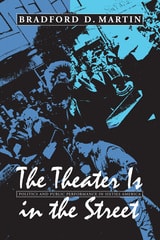
The Theater Is in the Street
Politics and Public Performance in 1960s AmericaBradford D. Martin
University of Massachusetts Press, 2004
During the 1960s, the SNCC Freedom Singers, The Living Theatre, the Diggers, the Art Workers Coalition, and the Guerrilla Art Action Group fused art and politics by staging unexpected and uninvited performances in public spaces. Through their activism and the response it provoked, art, theater, and politics began to converge and assume a new visibility in everyday life. While their specific political visions varied, these groups shared the impulse to stage performances and actions publicly—"in the streets"—eschewing museums, theaters, and other conventional halls of culture. Bradford D. Martin offers detailed portraits of each of these groups and examines why they embraced public performance as a vehicle to express and advance their politics.
At a time when the New Left and the counterculture were on the rise, these artists reflected the decade's political and cultural radicalism and helped to define a new aesthetic. Civil rights activists mobilized singing in the struggle for desegregation, introducing a vibrant musical form into the public space. The Living Theatre culminated an arduous quest to mesh artistic and political goals, leading audiences from theaters into the streets to begin the “beautiful nonviolent anarchist revolution.” The Diggers playfully engaged San Francisco's counterculture in politics with their carnivalesque public actions. The Art Workers Coalition and the Guerrilla Action Art Group sought to disrupt the conventional art world, mounting protests in and around New York City museums.
By questioning the values and assumptions that separated art from politics, these groups not only established public performance as a legitimate aesthetic but also provided a new creative vocabulary for future generations of artists. Their continued involvement with the women's liberation movement, rural communes, and political street theater into the 1970s and beyond challenges the popular myth that activists disengaged from politics after the 1960s.
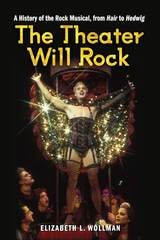
The Theater Will Rock
A History of the Rock Musical, from Hair to HedwigElizabeth L. Wollman
University of Michigan Press, 2010
"A much-needed study of the impact of rock music on the musical theater and its resulting challenges, complexities, failures, and successes. Anyone interested in Broadway will learn a great deal from this book."
---William Everett, author of The Musical: A Research Guide to Musical Theatre
"As Wollman weaves her historical narrative, she compellingly returns to . . . the conflict between the aesthetics and ideologies of rock music and the disciplined and commercial practices of the musical stage."
---Theatre Research International
"This well-written account puts the highs and lows of producing staged rock musicals in New York City into perspective and is well worth reading for the depth of insight it provides."
---Studies in Musical Theatre
Despite the genre’s influence and fame, there are still some critics who claim that the term “rock musical” is an oxymoron. The relationship between rock and the musical theater has been stormy from the start, and even the comparatively recent success of Rent has done little to convince theater producers that rock musicals are anything but highly risky ventures. Elizabeth L. Wollman explores the reasons behind these problematic connections and looks at the socioeconomic forces that underlie aesthetic decisions. She weighs the influence on the rock musical by mass media, sound, and recording technology, and the economic pressures that have affected New York theater in general over the past three decades. Finally, Wollman offers a meditation on the state of the musical, its relation to rock, and, ultimately, its future.
Packed with candid commentary by members of New York's vibrant theater community, The Theater Will Rock traces the rock musical’s evolution over nearly fifty years, in popular productions such as Hair, The Who's Tommy, Jesus Christ Superstar, The Rocky Horror Picture Show, Little Shop of Horrors, Rent, and Mamma Mia!—and in notable flops such as The Capeman.
Elizabeth L. Wollman is Assistant Professor of Music at Baruch College of the City University of New York.
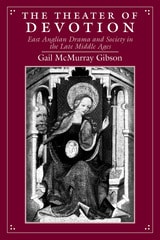
The Theater of Devotion
East Anglian Drama and Society in the Late Middle AgesGail McMurray Gibson
University of Chicago Press, 1989
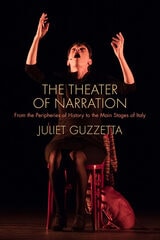
The Theater of Narration
From the Peripheries of History to the Main Stages of ItalyJuliet Guzzetta
Northwestern University Press, 2021
This book examines the theater of narration, an Italian performance genre and aesthetic that revisits historical events of national importance from local perspectives, drawing on the rich relationship between personal experiences and historical accounts. Incorporating original research from the private archives of leading narrators—artists who write and perform their work—Juliet Guzzetta argues that the practice teaches audiences how ordinary people aren’t simply witnesses to history but participants in its creation.
The theater of narration emerged in Italy during the labor and student protests, domestic terrorism, and social progress of the 1970s. Developing Dario Fo and Franca Rame’s style of political theater, influenced by Jerzy Grotowski and Bertolt Brecht, and following in the freewheeling actor‑author traditions of the commedia dell’arte, narrators created a new form of popular theater that grew in prominence in the 1990s and continues to gain recognition. Guzzetta traces the history of the theater of narration, contextualizing its origins—both political and intellectual—and centers the contributions of Teatro Settimo, a performance group overlooked in previous studies. She also examines the genre’s experiments in television and media.
The first full-length book in English on the subject, The Theater of Narration leverages close readings and a wealth of primary sources to examine the techniques used by narrators to remake history—a process that reveals the ways in which history itself is a theater of narration.
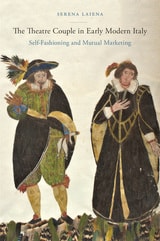
The Theatre Couple in Early Modern Italy
Self-Fashioning and Mutual MarketingSerena Laiena
University of Delaware Press, 2024
Who were the first celebrity couples? How was their success forged? Which forces influenced their self-fashioning and marketing strategies?
These questions are at the core of this study, which looks at the birth of a phenomenon, that of the couple in show business, with a focus on the promotional strategies devised by two professional performers: Giovan Battista Andreini (1576–1654) and Virginia Ramponi (1583–ca.1631). This book examines their artistic path – a deliberately crafted and mutually beneficial joint career – and links it to the historical, social, and cultural context of post-Tridentine Italy. Rooted in a broad research field, encompassing theatre history, Italian studies, celebrity studies, gender studies, and performance studies, The Theatre Couple in Early Modern Italy revises the conventional view of the Italian diva, investigates the deployment of Catholic devotion as a marketing tool, and argues for the importance of the couple system in the history of Commedia dell’Arte, a system that continues to shape celebrity today.
The Theatre of Genocide
Four Plays about Mass Murder in Rwanda, Bosnia, Cambodia, and ArmeniaEdited and with an introduction by Robert Skloot
University of Wisconsin Press, 2008
The Theatre of Sabina Berman
The Agony of Ecstasy and Other PlaysSabina Berman. Translated by Adam Versenyi. Essay by Jacqueline E. Bixler
Southern Illinois University Press, 2003
The Theatre of Sabina Berman: The Agony of Ecstasy and Other Plays introduces and makes accessible to an English-speaking audience the work of the contemporary Mexican playwright Sabina Berman. The book contains translations of the four plays that established Berman’s career: The Agony of Ecstasy, Yankee, Puzzle, and Heresy. An introduction by Adam Versényi provides a critical assessment of each play, a discussion of the specific problems of translation involved, and placement of Berman’s work in the larger Mexican and Latin American context.
It is evident that Sabina Berman’s theatrical acumen matches the depth of her dramatic design whether it is the sheer variety of techniques from song to staged tableau that appear in The Agony of Ecstasy; the physicalization of what it means to be interrogated and to interrogate in Yankee; the final enigmatic image of a soldier alone on stage, silently aiming his firearm at an undefined threat that potentially emanates from the audience in Puzzle; or the manner in which the family narrates its own “heretical” actions in Heresy. It is the combination of theatrical technique with universal themes of self-definition that cuts across cultures and ultimately makes these plays translatable.
The Theatre of the Holocaust, Volume 1
Four PlaysEdited and with and introduction by Robert Skloot
University of Wisconsin Press, 1982
This volume contains these four plays:
Resort 76 by Shimon Wincelberg
Will the relentless oppression of the starving workers in a ghetto factory destroy their faith in God? Their love of life? Their ability to resist? If a cat is more valuable than a human being, have hope and goodness been eliminated from the world? A moving and terrifying melodrama.
Throne of Straw by Harold and Edith Lieberman
Through the career of Mordechai Chaim Rumkowski, head of the Lodz, Poland Judenrat, we come to understand the horror of “choiceless choice,” of how giving up some to save others was the worst nightmare for those who sought the responsibilities of ghetto leadership. An epic play with music and song.
The Cannibals by George Tabori
The children of murder victims assemble to enact ritually the destruction of their fathers in the presence of two survivors. As the sons become their fathers, the most profound ethical questions of the Holocaust are raised concerning the limits of humanity in a world of absolute evil. A daring tragicomedy.
Who Will Carry the Word? by Charlotte Delbo (translated by Cynthia Haft)
In the austere, degraded setting of a concentration camp, twenty-two French women attempt to keep their sanity and hope as, one by one, they fall victim to the Nazi terror. Will anyone believe the story of the survivors? A poetic drama of resistance and witness.
The Theatre of the Holocaust, Volume 2
Six PlaysEdited and with and introduction by Robert Skloot
University of Wisconsin Press, 1999
The Theatrical Event
Dynamics of Performance and PerceptionWillmar Sauter
University of Iowa Press, 2000

The Theatricalists
Making Politics AppearTheron Schmidt
Northwestern University Press, 2024
Examines how the politics of the theater can illuminate the theatricality of politics
Theatricality is often dismissed as a distraction from “real” politics, as when cynical political gestures are derided as “pure theater” or “only theater.” But the artists and theater companies discussed in this book, including Back to Back Theatre, Tim Crouch, Rabih Mroué, Nature Theater of Oklahoma, and Christoph Schlingensief, take a different approach. Theron Schmidt argues that they represent a “theatricalist turn” that explores and tests the conditions of the theater itself. Across diverse contexts of political engagement, ranging from disability rights to representations of violence, these theatrical conditions are interconnected with political struggles, such as those over who is seen and heard, how labor is valued, and what counts as “political” in the first place. In a so-called post-political era, The Theatricalists argues that an examination of theater’s internal politics can expand our understanding of the theatricality of politics more broadly.
The Theatricality of Greek Tragedy
Playing Space and ChorusGraham Ley
University of Chicago Press, 2007
Drawing on evidence from the surviving texts of tragedies by Aeschylus, Sophocles, and Euripides, Ley explains how scenes with actors were played in the open ground of the orchestra, often considered as exclusively the dancing place of the chorus. In reviewing what is known of the music and dance of Greek antiquity, Ley goes on to show that in the original productions the experience of the chorus—expressed in song and dance and in interaction with the characters—remained a vital characteristic in the performance of tragedy.
Combining detailed analysis with broader reflections about the nature of ancient Greek tragedy as an art form, this volume—supplemented with a series of illustrative drawings and diagrams—will be a necessary addition to the bookshelf of anyone interested in literature, theater, or classical studies.
The Third Eye
Race, Cinema, and Ethnographic SpectacleFatimah Tobing Rony
Duke University Press, 1996
In films as seemingly dissimilar as Nanook of the North, King Kong, and research footage of West Africans from an 1895 Paris ethnographic exposition, Rony exposes a shared fascination with—and anxiety over—race. She shows how photographic “realism” contributed to popular and scientific notions of evolution, race, and civilization, and how, in turn, anthropology understood and critiqued its own use of photographic technology. Looking beyond negative Western images of the Other, Rony considers performance strategies that disrupt these images—for example, the use of open resistance, recontextualization, and parody in the films of Katherine Dunham and Zora Neale Hurston, or the performances of Josephine Baker. She also draws on the work of contemporary artists such as Lorna Simpson and Victor Masayesva Jr., and writers such as Frantz Fanon and James Baldwin, who unveil the language of racialization in ethnographic cinema.
Elegantly written and richly illustrated, innovative in theory and original in method, The Third Eye is a remarkable interdisciplinary contribution to critical thought in film studies, anthropology, cultural studies, art history, postcolonial studies, and women’s studies.
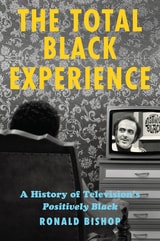
The Total Black Experience
A History of Television’s Positively BlackRonald Bishop
Rutgers University Press, 2026
The Total Black Experience is the first book to chronicle the history and social significance of Positively Black, one of the longest-running public affairs shows in the history of television. Spurred on by the findings of the Kerner Commission, executives at WNBC-TV greenlit the show and turned production over to a small but dedicated team of storytellers who quickly made it their mission to carve out a space for serious and nuanced discussion of issues important to the Black community and to celebrate all aspects of Black culture. They believed that accurate representation of their experiences was a right, not a privilege. The show’s first cohosts included the well-known Harlem-based activist Rev. Eugene Callender and Gus Heningburg, activist, successful consultant and mediator, and advocate for organized labor. Callender had founded Harlem Prep to equip young Black people for college, while Heningburg played a key role in stabilizing life in Newark following the rebellion there in the late 1960s. Both were adept at using the media to reach their constituencies. Combining in-depth interviews with painstaking archival research, The Total Black Experience introduces readers to key members of the Positively Black production team and analyzes thematic shifts in the show’s content. The book celebrates Positively Black’s longevity and challenges readers to explore the current state of Black representation on television.
The Tourist State
Performing Leisure, Liberalism, and Race in New ZealandMargaret Werry
University of Minnesota Press, 2011
No longer the dreary sheep farm at the end of the world, the New Zealand of the new millennium is a hot global ticket, heralded for its bicultural dynamism, laid-back lifestyle, and scenery extraordinary enough to pass for Tolkien’s Middle Earth. How this image was crafted is the story The Tourist State tells. In a series of narratives that address the embodied dimensions of biopolitics and explore the collision of race, performance, and the cultural poetics of the state, Margaret Werry exposes the real drama behind the new New Zealand, revealing how a nation was sold to the world—and to itself.
The story stretches back to the so-called Liberal Era at the beginning of the twentieth century, in which the young settler colony touted itself as the social laboratory of the world. Focusing on where tourism and liberal governmentality coincide, The Tourist State takes us from military diplomacy at the dawn of the American Pacific to the exotic blandishments of Broadway and Coney Island, from landscape preservation to health reform and town planning, from blockbuster film to knowledge economy policy.
Weaving together interpretive history, performance ethnography, and cultural criticism, Werry offers new ways to think about race and indigeneity—and about the role of human agency in state-making.