Results by title
3745 books match the query 'Europe' and 40 start with u

UNITED STATES EUROPEAN RIGHT
1945-1955DEBORAH KISATSKY
The Ohio State University Press, 2005
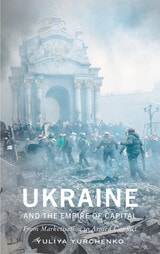
Ukraine and the Empire of Capital
From Marketisation to Armed ConflictYuliya Yurchenko
Pluto Press, 2017
Providing distinctive and unexplored reflections on the origins of the conflict, Yurchenko unpacks the four central myths that underlie Ukraine's post-Soviet reality: the myth of transition, the myth of democracy, the myth of two Ukraines, and the myth of 'the other'. In doing so, she sheds light on the current intensification of class rivalries in Ukraine, the kleptocracy, resource wars and analyses existing and potential dangers of the rightwing shift in Ukraine's polity, stressing a historic opportunity for change.
Critiquing the concept of Ukraine as ‘transition space’, she provides a sweeping analysis which includes the wider neoliberal restructuring of global political economy since the 1970s, with particular focus on Ukraine's relations with the US, the EU and Russia. This is a book for those wanting to understand the current conflict as a dangerous product of neoliberalism, of the empire of capital.
Ukraine as a Migration Nexus
Perspectives on Historical and Current Population MovementsOleksii Chebotarov
Central European University Press, 2025
Ukraine's Patronal Democracy and the Russian Invasion
The Russia-Ukraine War, Volume OneBálint Madlovics
Central European University Press, 2023
The Russian invasion of Ukraine in 2022 jeopardizes the country's independence and its chances for Western-style development. However, the heroic attitude of the Ukrainian people, combined with a solidifying national identity, makes the domestic foundations for a western turn stronger than ever. After the invasion, building strong foundations of liberal democracy will be a top priority. In addition to alleviating immediate problems, the country must also address its post-communist legacy and address the constraints of patronalism.
The authors of this edited volume, leading Ukrainian scholars supplemented by colleagues from Hungary, examine the chances of an anti-patronal transformation after the war. The book provides an overview of the development of Ukraine's political-economic system: color revolutions in 2004 and 2014 brought democratic transformation, but no change in the patronage system The result was patronal regime cycles instead of the emergence of a Western-type liberal democracy in the country. Building on the conceptual framework of the editors' The Anatomy of Post-Communist Regimes (CEU Press, 2020), the 12 chapters examine the impact of the war on patronal democracy, the relational economy, clientelist society, and the international environment in which Ukraine operates.
This collection is complemented by the book entitled Russia. Imperial Endeavor and Geopolitical Consequences.
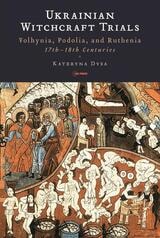
Ukrainian Witchcraft Trials
Volhynia, Podolia, and Ruthenia, 17th–18th CenturiesKateryna Dysa
Central European University Press, 2020
Drawing on quantitative data drawn from a range of trials Kateryna Dysa first describes the ideological background of the tribunals based on works written by priests and theologians that reflect attitudes toward the devil and witches. The main focus of her work, however, is the process leading to witchcraft accusations. From the stories of participants of the trials she shows what led people to enunciate first suspicions then accusations of witchcraft. Finally, she presents a microhistory from one Volhynian village, comparing attitudes toward two “female crimes” in the Ukrainian courts.
The study is based on archival research including witch trials transcripts. Dysa approaches the trials as indications of belief and practice, attempting to understand the actors involved rather than dismiss or condemn them. She takes care to situate early modern Ukrainian witchcraft and its accompanying trials in a broader European context, with comparisons to some African cases as well.

Umbria
The Heart of ItalyPatricia Clough
Haus Publishing, 2017

Unavoidable Industrial Restructuring in Latin America
Fernando Fajnzylber
Duke University Press, 1990
Fernando Fajnzylber argues that technological and industrial progress is the driving force of a positive relationship among dynamism, competitiveness, austerity, and equity. Latin America’s failure to master this technological progress underlies its economic difficulties. To overcome the inheritance of past mistakes, the author maintains, Latin America must undergo not only macroeconomic stabilization and a reduction of the debt burden, but also a complete transformation of the production structure. The role of the state and the institutional setup need to be modified and new social and sectoral policies devised. Fajnzylber sees this radical restructuring as an unavoidable step if Latin America is ever to achieve a workable balance between growth and equity.
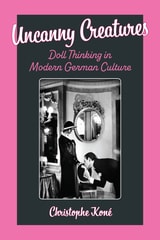
Uncanny Creatures
Doll Thinking in Modern German CultureChristophe Koné
University of Michigan Press, 2024
Uncanny Creatures then explores how this unusual interest in human-like figures continues a long tradition of thought devoted to conceptualizing “things,” from Immanuel Kant’s theory of the thing-in-itself to Martin Heidegger’s lecture on the thing, and Eduard Mörike or Rainer Maria Rilke’s thing-poems. Because dolls occupy a liminal space—not quite things and more than mere objects—they appear as uncanny creatures which have held a fascination for writers, thinkers, and artists alike. Uncanny Creatures moves past the Freudian discourse of fetishism to propose a new reading of doll artifacts in German culture centered on their ability to evoke a feeling of uncertainty and unsettlement in the viewer.

Under Eastern Eyes
A Comparative History of East European Travel Writing on EuropeAlex Drace-Francis
Central European University Press, 2008
Underground Streams
National-Conservatives after World War II in Communist Hungary and Eastern EuropeJános M. Rainer
Central European University Press, 2023
The authors of this edited volume address the hidden attraction that existed between the extremes of left and right, and of internationalism and nationalism under the decades of communist dictatorship in Eastern Europe. One might suppose that under the suppressive regimes based on leftist ideology and internationalism their right-wing opponents would have been defeated and ultimately removed. These essays, on the other hand, recount the itinerary of survival and revival of "right-wing" thought and activities under communist dictatorship. Resistance and accommodation are explored in the various phases from the Stalinist era to the demise of the Soviet Bloc, with the continuity provided by tacit or concealed right-wing discourses receiving particular consideration. The Eastern European right, both in its conservative and fascist version, centered on nationalism, a legitimizing factor that increased with the downfall of the regimes, and the authors thus accord nationalism special attention.
Two documentary sources for these essays that stand out are files of the security services and the exceptionally rich Oral History Archive compiled by the 1956 Institute in Budapest, Hungary.

Underground Symphony
The Plastic PeopleFrantišek Stárek and Martin Valenta
Karolinum Press, 2026
First-hand insight into the Czechoslovak underground music scene and the numerous obstacles placed in its way by communist-era security services.
Underground Symphony: The Plastic People traces the history of the rock band The Plastic People of the Universe against the backdrop of political developments in communist Czechoslovakia. It begins with the band’s formation in the 1960s, when psychedelic rock was first introduced to Czechoslovakia, through the emergence of the first concepts of cultural opposition and politically oriented dissent, particularly Charter 77, ending with a detailed account of the band’s breakup in the second half of the 1980s.
The authors rely on primary sources, many of which have not been published; for example, the Plastic People’s chronicles, extensive interviews with band members and friends, and contemporary writings by individual participants (in samizdat publications, private correspondence, diaries, etc.). They also “mine” archival sources from the State Security (Archive of Security Services, National Archives, etc.). The result is an insightful study of the legendary underground band and its era.
Understanding Europe (The Works of Christopher Dawson)
Christopher Dawson
Catholic University of America Press, 2009
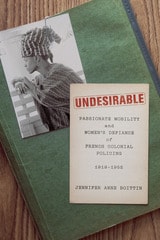
Undesirable
Passionate Mobility and Women’s Defiance of French Colonial Policing, 1919–1952Jennifer Anne Boittin
University of Chicago Press, 2022
Examining little-known policing archives in France, Senegal, and Cambodia, Jennifer Anne Boittin unearths the stories of hundreds of women labeled “undesirable” by the French colonial police and society in the early twentieth century. These “undesirables” were often women traveling alone, women who were poor or ill, women of color, or women whose intimate lives were deemed unruly. To refute the label and be able to move freely, they spoke out or wrote impassioned letters: some emphasized their “undesirable” qualities to suggest that they needed the care and protection of the state to support their movements, while others used the empire’s own laws around Frenchness and mobility to challenge state or societal interference. Tacking between advocacy and supplication, these women summoned intimate details to move beyond, contest, or confound surveillance efforts, bringing to life a practice that Boittin terms “passionate mobility.” In considering how ordinary women pursued autonomy, security, companionship, or simply a better existence in the face of surveillance and control, Undesirable illuminates pressing contemporary issues of migration and violence.
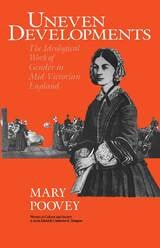
Uneven Developments
The Ideological Work of Gender in Mid-Victorian EnglandMary Poovey
University of Chicago Press, 1988
Asserting that the organization of sexual difference is a social, not natural, phenomenon, Poovey shows how representations of gender took the form of a binary opposition in mid-Victorian culture. She then reveals the role of this opposition in various discourses and institutions—medical, legal, moral, and literary. The resulting oppositions, partly because they depended on the subordination of one term to another, were always unstable. Poovey contends that this instability helps explain why various institutional versions of binary logic developed unevenly. This unevenness, in turn, helped to account for the emergence in the 1850s of a genuine oppositional voice: the voice of an organized, politicized feminist movement.
Drawing on a wide range of sources—parliamentary debates, novels, medical lectures, feminist analyses of work, middle-class periodicals on demesticity—Poovey examines various controversies that provide glimpses of the ways in which representations of gender were simultaneously constructed, deployed, and contested. These include debates about the use of chloroform in childbirth, the first divorce law, the professional status of writers, the plight of governesses, and the nature of the nursing corps. Uneven Developments is a contribution to the feminist analysis of culture and ideology that challenges the isolation of literary texts from other kinds of writing and the isolation of women's issues from economic and political histories.
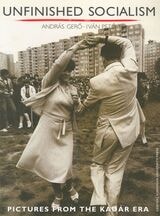
Unfinished Socialism
Pictures from the Kádár EraAndrás Gero
Central European University Press, 1999
This extraordinary book provides a snapshot of socialism throughout the Kádár regime in Hungary (1956-1989) and captures the essence of the world behind the ‘iron curtain’ in a stunning, and often stark, collection of photographs.
Unfinished Socialism is a visually stunning anthropological study containing 450 photographs, many previously unpublished, which portray life in Hungary from every angle: from the May Day March to pop music and from the homeless to sport.
With an introduction that will help the reader understand and appreciate the true meaning of the photographs, this political, social and cultural study of the Kádár years transports the reader back to a time of great significance in Hungary’s long and turbulent history.

Unfit For Marriage
Impotent Spouses On Trial In The Basque Region Of Spain, 1650-1750Edward J. Behrend-Martinez
University of Nevada Press, 2014
The Catholic Church of early modern Europe intended the sacrament of matrimony to represent a lifelong commitment, and it allowed few grounds for the dissolution of an unhappy marriage. One was nonconsummation owing to the sexual impotency of one of the partners. Even then, an annulment was granted only after a church court had conducted a lengthy investigation of the case, soliciting testimony from numerous witnesses as well as from the aggrieved couple, and had subjected the allegedly impotent spouse (and sometimes both spouses) to an intimate physical examination.
Edward J. Behrend-Martinez has studied the transcripts of eighty-three impotency trials conducted by the ecclesiastical court of Calahorra (La Rioja), a Spanish diocese with urban and rural parishes, both Basque and Castilian. From these records, he draws a detailed, fascinating portrait of private life and public sexuality in early modern Europe. These trials were far more than a salacious inquiry into the intimate details of other people’s lives. The church valued marital sex as a cornerstone of stable society, intended not only for procreation but also for maintaining domestic harmony. Every couple’s sex life, however private in practice or intention, was a matter of public and ecclesiastical concern. Unfit for Marriage offers vivid accounts of marital sex and the role that property, gender, and personal preference played in marriage in early modern Europe. It is essential reading for anyone interested in social history, sexuality, gender studies, canon law, legal history, and the history of divorce in western Europe.
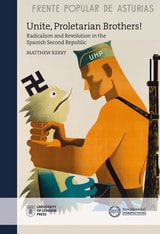
Unite, Proletarian Brothers!
Radicalism and Revolution in the Spanish Second RepublicMatthew Kerry
University of London Press, 2020
Universities and Reflexive Modernity
Institutional Ambiguities and Unintended ConsequencesLazar Vlasceanu
Central European University Press, 2010
A book about the challenges and uncertainties facing today's university, a chronicle of recent and current changes in higher education in the world. There are many questions today that are sufficiently open to doubt and profoundly related to new developments, to justify our starting new enquiries, here and now, by looking freshly and more closely at the actual configurations and at their historical grounds, for providing the new standard account of the university today.
Vlasceanu discusses the inherent contradiction between academia on the one hand, and expectations and regulations of the market on the other. Analyses demographic and other statistical characteristics of today's higher education. Examines the financial basis of universities in various countries, and describes current governance models. Finally the author sets up a new typology of universities.
University of Chicago Readings in Western Civilization, Volume 1
The Greek PolisEdited by Arthur W. H. Adkins and Peter White
University of Chicago Press, 1986
Individual volumes provide essential background reading for courses covering specific eras and periods. The complete nine-volume series is ideal for general courses in history and Western civilization sequences.
University of Chicago Readings in Western Civilization, Volume 4
Medieval EuropeEdited by Julius Kirshner and Karl F. Morrison
University of Chicago Press, 1986
Individual volumes provide essential background reading for courses covering specific eras and periods. The complete nine-volume series is ideal for general courses in history and Western civilization sequences.
University of Chicago Readings in Western Civilization, Volume 7
The Old Regime and the French RevolutionEdited by Keith M. Baker
University of Chicago Press, 1987
The University of Chicago Readings in Western Civilization series makes available to students and teachers a unique selection of primary documents, many in new translations. These readings, prepared for the highly praised Western civilization sequence at the University of Chicago, were chosen by an outstanding group of scholars whose experience teaching that course spans almost four decades. Each volume includes rarely anthologized selections as well as standard, more familiar texts; a bibliography of recommended parallel readings; and introductions providing background for the selections. Beginning with Periclean Athens and concluding with twentieth-century Europe, these source materials enable teachers and students to explore a variety of critical approaches to important events and themes in Western history.
Individual volumes provide essential background reading for courses covering specific eras and periods. The complete nine-volume series is ideal for general courses in history and Western civilization sequences.
Unlearning Eugenics
Sexuality, Reproduction, and Disability in Post-Nazi EuropeDagmar Herzog
University of Wisconsin Press, 2020
Bringing together the latest findings in Holocaust studies, the history of religion, and the history of sexuality in postwar—and now also postcommunist—Europe, Unlearning Eugenics shows how central the controversies over sexuality, reproduction, and disability have been to broader processes of secularization and religious renewal. Herzog also restores to the historical record a revelatory array of activists: from Catholic and Protestant theologians who defended abortion rights in the 1960s–70s to historians in the 1980s–90s who uncovered the long-suppressed connections between the mass murder of the disabled and the Holocaust of European Jewry; from feminists involved in the militant "cripple movement" of the 1980s to lawyers working for right-wing NGOs in the 2000s; and from a handful of pioneers in the 1940s–60s committed to living in intentional community with individuals with cognitive disability to present-day disability self-advocates.
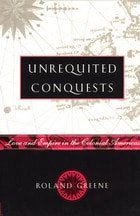
Unrequited Conquests
Love and Empire in the Colonial AmericasRoland Greene
University of Chicago Press, 2000
European encounters with the Americas awakened many forms of desire, which pervaded the writings of explorers like Columbus and his contemporaries. These experiences in turn shaped colonial society in Brazil, Peru, and elsewhere. The New World, while it could be explored, conquered, and exploited, could never really be "known"—leaving Europe's desire continually unrequited and the project of empire unfulfilled.
Using numerous poetic examples and extensive historical documentation, Unrequited Conquests rewrites the relations between the Renaissance and colonial Latin America and between poetry and history.

Unruly Spirits
The Science of Psychic Phenomena in Modern FranceM. Brady Brower
University of Illinois Press, 2010

Unsafe Haven
The United States, the IRA and Political PrisonersKaren McElrath
Pluto Press, 2000
Karen McElrath questions US government attempts to portray an impartial role in the Irish conflict, arguing that historical and contemporary evidence reveals otherwise. She shows that, far from being a neutral process, the success of bids for political asylum often depends on the relationship between the US and the government of the applicant’s country of origin. Drawing on exclusive interviews with Irish Republicans who have faced deportation or extradition from the United States, or who have been prosecuted in the US for politically-motivated offences, McElrath explores the links between deportation and extradition outcomes and foreign policy issues. The tools of exclusion are defined in their historical context, and the history of US extradition law is described, with particular focus on the treaties with Britain. McElrath also examines the offences for which Irish and Irish-American Republicans have been charged, discusses the various levels of support for Irish political prisoners in the US, and summarises the findings by international human rights organisations.
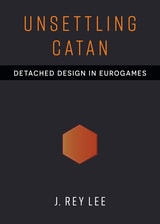
Unsettling Catan
Detached Design in EurogamesJ. Rey Lee
University of Michigan Press, 2025
Although peaceful revolutions are usually the best kind, it’s worth questioning how these games cultivate peaceful feelings. Today, peaceful-feeling eurogames often settle into detached design—a mindset of making conflict feel peaceful by dampening conflicted feelings. Unsettling Catan questions how peaceful-feeling eurogames can make implicitly imperialist themes palatable by cultivating a detached mindset that imagines power as peaceful, neutral, and abstract. To ask the hard questions that eurogames often look away from, the book walks through each aspect of Catan’s gameplay (placing hexes, rolling the dice, robbing and trading, collecting resources, building and scoring) to explore how simple design decisions can play out, or play with, cultural ideas and ideals. As the first entry in the Tabletop Games book series, Unsettling Catan introduces key concepts for thinking about board games as a medium and offers accessible game analyses and personal reflections to help players, creators, and scholars reimagine what board games can be and become.
Unsocial Europe
Social Protection Or Flexploitation?Anne Gray
Pluto Press, 2004
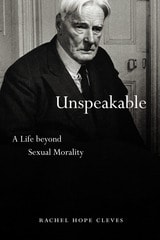
Unspeakable
A Life beyond Sexual MoralityRachel Hope Cleves
University of Chicago Press, 2020
Unspeakable approaches Douglas as neither monster nor literary hero, but as a man who participated in an exploitative sexual subculture that was tolerated in ways we may find hard to understand. Using letters, diaries, memoirs, police records, novels, and photographs—including sources by the children Douglas encountered—Cleves identifies the cultural practices that structured pedophilic behaviors in England, Italy, and other places Douglas favored. Her book delineates how approaches to adult-child sex have changed over time and offers insight into how society can confront similar scandals today, celebrity and otherwise.

Unveiling Traditions
Postcolonial Islam in a Polycentric WorldAnouar Majid
Duke University Press, 2000
Majid moves beyond Edward Said’s unmasking of orientalism in the West to examine the intellectual assumptions that have prevented a more nuanced understanding of Islam’s legacies. In addition to questioning the pervasive logic that assumes the “naturalness” of European social and political organizations, he argues that it is capitalism that has intensified cultural misunderstanding and created global tensions. Besides examining the resiliency of orientalism, the author critically examines the ideologies of nationalism and colonialist categories that have redefined the identity of Muslims (especially Arabs and Africans) in the modern age and totally remapped their cultural geographies. Majid is aware of the need for Muslims to rethink their own assumptions. Addressing the crisis in Arab-Muslim thought caused by a desire to simultaneously “catch up” with the West and also preserve Muslim cultural authenticity, he challenges Arab and Muslim intellectuals to imagine a post-capitalist, post-Eurocentric future. Critical of Islamic patriarchal practices and capitalist hegemony, Majid contends that Muslim feminists have come closest to theorizing a notion of emancipation that rescues Islam from patriarchal domination and resists Eurocentric prejudices.
Majid’s timely appeal for a progressive, multicultural dialogue that would pave the way to a polycentric world will interest students and scholars of postcolonial, cultural, Islamic, and Marxist studies.

Up in the Rocky Mountains
Writing the Swedish Immigrant ExperienceJennifer Eastman Attebery
University of Minnesota Press, 2007
Before the turn of the twentieth century, many Swedish men emigrated to the American Rockies as itinerant laborers, drawn by the region’s developing industries. Single Swedish women ventured west, too, and whole families migrated, settling into farm communities. By 1920, one-fifth of all Swedish immigrants were living in the West.
In Up in the Rocky Mountains, Jennifer Eastman Attebery offers a new perspective on Swedish immigrants’ experiences in Idaho, Montana, Utah, Wyoming, Colorado, and New Mexico from 1880 to 1917 by interpreting their letters home. Considering more than three hundred letters, Attebery analyzes their storytelling, repetitive language, traditional phrasing, and metaphoric images. Recognizing the letters’ power as a folk form, Attebery sees in them the writers’ relationships back in Sweden as well as their encounters with religious and labor movements, regionalism, and nationalism in their new country.
By defining personal letters as a vernacular genre, Attebery provides a model for discerning immigrants’ shared culture in correspondence collections. By studying their words, she brings to life small Swedish communities throughout the Rocky Mountain region.
Jennifer Eastman Attebery is professor of English and director of American studies at Idaho State University.
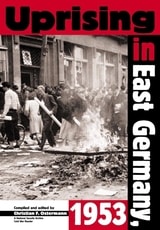
Uprising in East Germany, 1953
The Cold War, the German Question, and the First Major Upheaval behind the Iron CurtainThe National Security Archive Ostermann
Central European University Press, 2001
This volume is the second in the series Cold War Documentary Readers, a project of the US National Security Archive and the Cold War International History Project.
The volume is the first documented account of this early Cold War crisis from both sides of the Iron Curtain. Based on the recent unprecedented access to the once-closed archives of several member states of the Warsaw Pact, this collection of primary-source documents presents one of the most notorious events of post-war European history in a highly readable format.
Previously unreleased Kremlin records, once highly classified American documents, materials from the Soviet Foreign Ministry, and transcripts of internal East German Communist Party Politburo meetings in the days leading to the uprising in the German Democratic Republic (GDR) are among the highlights of this sensational documentary.
In this volume, as in the previous one in the series, each part is preceded by a detailed introductory essay to provide the necessary historical and political context. The individual documents are introduced by short headnotes summarizing the contents and orienting the reader. A chronology, glossary and bibliography offer further background information.
Uranium Matters
Central European Uranium in International Politics, 19001960Rainer Karlsch
Central European University Press, 2008
Urban Design in Western Europe
Regime and Architecture, 900-1900Wolfgang Braunfels
University of Chicago Press, 1990

Urban Housing Segregation of Minorities in Western Europe and the United States
Elizabeth Huttman, Juliet Saltman and Wim Blauw, eds.
Duke University Press, 1991
The collection begins with a review of the historical development of housing segregation in these countries, describing current housing conditions, concentration of housing in each country’s leading cities, minority populations and the housing they occupy—specifically public, nonprofit, and owner-occupied dwellings. When focusing on the United States, the contributors assess housing segregation, antisegregation measures, and institutional racism toward blacks in the Midwest and South, and toward Mexican-Americans throughout American cities. Chapters dealing with Western Europe include housing segregation of South Asian and West Indian immigrants in Britain, immigrants in Sweden, Turkish, and Yugoslav “guest workers” in West Germany, and Algerian and other Arab groups in France. The book concludes with discussions of public housing policies; suburban desegregation, resegregation, and integration maintenance programs; specific integration stabilization programs; and desegregation efforts in one specific place.
Contributors. Elizabeth Huttman, Michal Arend, Cihan Arin, Maurice Blanc, Wim Blauw, Ger Mik, Clyde McDaniels, Jürgen Friedrichs, Hannes Alpheis, John M. Goering, Len Gordon, Albert Mayer, Rosemary Helper, Barry V. Johnston, Terry Jones, Valerie Karn, Göran Lindberg, Anna Lisa Lindén, Deborah Phillips, Dennis Keating, Juliet Saltman, Alan Murie
Urban Planning in the Nordic World
Ellen Braae
University of Wisconsin Press, 2022
Urban planning is a keystone in the materialization of the Nordic welfare states. That is not to say that there is one particular city form or planning practice that is synonymous with the emerging welfare city, as welfare per se is far from normative. On the contrary, welfare is a highly ambiguous and contested notion that has changed over the postwar decades, which is also reflected in the development of the welfare city.
However, welfare in urban planning has mainly been associated with ideas of “the good life” and egalitarianism. In a Nordic context, the state has taken the lead in providing the social engineering “hardware” for advancing this universal aim. Social demographic welfare is economically based on full employment, and in this regard housing and caregiving support are key components. Yet education, infrastructure, and leisure facilities are also basic features in the distribution of universal welfare services for citizens’ entire lives. The results, ideally, are green and spacious welfare cities.
This book outlines the origins, development, challenges, and lived realities of the changing welfare city, focusing primarily on Denmark. Strategies have changed over the decades as models of development have shifted and as the needs of society and a warming planet have come into focus. The current welfare city can be described as an urban landscape characterized by, on the one hand, a division of functions and, on the other, mutual competition. The role of the state has been minimized, turning municipalities into the new major agents in attracting taxpayers and providing goods—both by means of urban planning.
Urbino
The Story of a Renaissance CityJune Osborne
University of Chicago Press, 2003
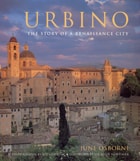
With Urbino: The Story of a Renaissance City, art historian June Osborne brings to life not only the great city and its art but also its turbulent history and the intrigue surrounding its ruling family. First settled by the ancient Umbrians, Urbino reached its zenith during the fifteenth century under the rule of Duke Federico da Montefeltro and his son Guidobaldo. Federico may have been a usurper and a fierce, opportunistic warlord, but his lust for power was more than matched by his passion for great art. Indeed it was under his direct guidance that the magnificent Ducal Palace was built—its perfectly proportioned courtyard a wonder of early Renaissance architecture.
Today the Ducal Palace hosts the National Gallery of the Marches, one of the most important art galleries in Italy, featuring works by no lesser lights than Raphael, Uccello, Piero della Francesca, and Titian. Exploring such sites as the fourteenth-century Oratorio di San Giovanni Battista and the Gothic Church of San Domenico, Osborne captures not only the startling beauty of Urbino and the Apennine foothills but also the tumultuous legacy of Frederico and his son (and their many wives and courtiers).
With over a hundred lavish color photographs, many by renowned landscape photographer Joe Cornish, Urbino is the best—and the only—guide to this gem of the Italian Marches.
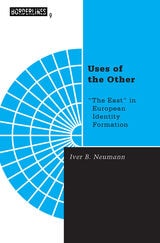
Uses Of The Other
“The East” in European Identity FormationIver B. Neumann
University of Minnesota Press, 1998
Examines identity politics in the context of international relations.
The field of international relations has recently witnessed a tremendous growth of interest in the theme of identity and its formation, construction, and deconstruction. In Uses of the Other, Iver B. Neumann demonstrates how thinking about identity in terms of the self and other may prove highly useful in the study of world politics.
Neumann begins by tracing the four different paths along which this thinking has developed during this century-ethnographic, psychological, Continental philosophical, and “Eastern excursion”-and he shows how these blended at the margins of the discipline of international relations at the end of the 1980s. There follow several incisive readings of European identity formations on the all-European, regional, and national levels. The theme that draws these readings together is how “the East” is used as a sign of otherness at all three levels. Whereas previous studies framed this process as part of colonial and postcolonial developments, this book suggests that “Easternness” is also present as a marker in contemporary discourses about Russia, Turkey, Central Europe, and Bashkortostan, among others. Situating his work in contemporary critical debates, Neumann argues that, while the self/other perspective is always of relevance, it is now more in need of being used as a perspective on specific sequences of identity formation than of further embellishment.ISBN: 0-8166-3082-8 Cloth $49.95xxISBN: 0-8166-3083-6 Paper $19.95x248 Pages 5-7/8x9 NovemberBorderlines Series, Volume 9Translation inquiries: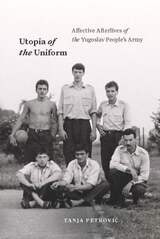
Utopia of the Uniform
Affective Afterlives of the Yugoslav People's ArmyTanja Petrovic
Duke University Press, 2024

Utopia's Garden
French Natural History from Old Regime to RevolutionE. C. Spary
University of Chicago Press, 2000
E. C. Spary traces the scientific, administrative, and political strategies that enabled the foundation of the Muséum, arguing that agriculture and animal breeding rank alongside classification and collections in explaining why natural history was important for French rulers. But the Muséum's success was also a consequence of its employees' Revolutionary rhetoric: by displaying the natural order, they suggested, the institution could assist in fashioning a self-educating, self-policing Republican people. Natural history was presented as an indispensable source of national prosperity and individual virtue.
Spary's fascinating account opens a new chapter in the history of France, science, and the Enlightenment.
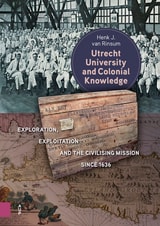
Utrecht University and Colonial Knowledge
Exploration, Exploitation and the Civilising Mission since 1636Henk van Rinsum
Amsterdam University Press, 2025
Henk van Rinsum shows how the knowledge acquired in the colony also contributed significantly to the scientific development of the university, especially towards the end of the nineteenth century. Utrecht University and Colonial Knowledge is therefore an important contribution to both colonial and intellectual history.