Results by title
1726 books match the query 'Film' and 26 start with u
Ulrike Ottinger
The Autobiography of Art CinemaLaurence A. Rickels
University of Minnesota Press, 2008
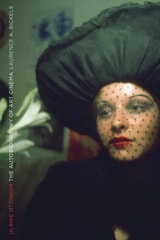
Since 1974, German filmmaker Ulrike Ottinger has created a substantial body of films that explore a world of difference defined by the tension and transfer between settled and nomadic ways of life. In many of her films, including Exile Shanghai, an experimental documentary about the Jews of Shanghai, and Joan of Arc of Mongolia, in which passengers on the Trans-Siberian Express are abducted by Mongolian bandits, she also probes the encounter with the other, whether exotic or simply unpredictable.
In Ulrike Ottinger Laurence A. Rickels offers a series of sensitive and original analyses of Ottinger’s films, as well as her more recent photographic artworks, situated within a dazzling thought experiment centered on the history of art cinema through the turn of the twenty-first century. In addition to commemorating the death of a once-vital art form, this book also affirms Ottinger’s defiantly optimistic turn toward the documentary film as a means of mediating present clashes between tradition and modernity, between the local and the global.
Widely regarded as a singular and provocative talent, Ottinger’s conspicuous absence from critical discourse is, for Rickels, symptomatic of the art cinema’s demise. Incorporating interviews he conducted with Ottinger and illustrated with stunning examples from her photographic oeuvre, this book takes up the challenges posed by Ottinger’s filmography to interrogate, ultimately, the very practice-and possibility-of art cinema today.
Laurence A. Rickels is professor of German and comparative literature at the University of California, Santa Barbara, and the author of several books, including The Case of California, The Vampire Lectures, and the three-volume Nazi Psychoanalysis (all published by Minnesota). He is a recognized art writer whose reflections on contemporary visual art appear regularly in numerous exhibition catalogues as well as in Artforum, artUS, and Flash Art.
Uncanny Fidelity
Recognizing Shakespeare in Twenty-First-Century Film and TelevisionJames Newlin
University of Alabama Press, 2024
How the study of Shakespeare’s legacy, specifically in film and television, can radically challenge what we consider to be authentically Shakespearean
In the field of adaptation studies today, the idea of reading an adapted text as “faithful” or “unfaithful” to its original source strikes many scholars as too simplistic, too conservative, and too moralizing. In Uncanny Fidelity: Recognizing Shakespeare in Twenty-First Century Film and Television, James Newlin challenges these critical orthodoxies. Instead, recognizing how a film or television series closely recalls Shakespeare’s drama encourages an interrogation of what we consider to be “Shakespeare” in the first place.
Drawing upon Sigmund Freud’s model of the uncanny—the sudden sensation of peculiar, discomforting familiarity—this book focuses on films and television series that were not marketed as adaptations of Shakespeare. Yet these works unexpectedly invoke lost, even troubling aspects of Shakespeare’s original playtexts, their performance history, or their reception. Broadening the scope of fidelity readings beyond familiar concerns like plot and language, Newlin demonstrates how the study of Shakespeare’s afterlife can clarify both the historical context of his drama and its relevance for the current political moment. Engaging contemporary debates in literary and psychoanalytic theory, this book features provocative close readings of The Tempest, Othello, and The Winter’s Tale alongside recent films and television series, from art-house movies such as The Master and Manchester by the Sea to the cult favorites Brigsby Bear and Vice Principals. These works conjure widely overlooked qualities of Shakespeare’s drama by recalling the casting practices or the generic contexts of the early modern stage or by making a meaningful intervention in the plays’ critical reception. Closely examining these surprisingly faithful adaptations of Shakespeare’s drama helps us to articulate the original experience of the early modern stage and better consider its resonance in the present.
This book will benefit students and scholars of Shakespeare on film and psychoanalytic theory. Yet Uncanny Fidelity will also be of interest to scholars of performance history, source studies, and early modern discourses of race and gender—as well as anyone interested in the unexpected connections between canonical literature and contemporary culture. By examining adaptation as an instance of uncanny return, Newlin demonstrates how the study of Shakespeare’s afterlife can radically challenge what we consider to be authentically Shakespearean.
Uncanny Histories in Film and Media
Patrice Petro
Rutgers University Press, 2022

Undead Ends
Stories of ApocalypseS. Trimble
Rutgers University Press, 2019
Undead Labor
Capitalism's Zombie WorkerDavid Bering-Porter
University of Minnesota Press, 2026
How the zombie represents capitalism’s fantasy of limitless labor
Much more than just an enduring figure of horror entertainment, the zombie is a uniquely modern symbol representing capitalism’s most brutal demands on human life. Examining the push to extract surplus value from human bodies in ways that exceed their natural limits, David Bering-Porter shows how this notion of the undead is both integral to and symptomatic of capitalism’s endless cycle of growth and consumption.
Bering-Porter demonstrates how the zombie has long been deeply intertwined with issues of race and exploitation, from its origins in the slave plantations of colonial Haiti to its traces in the continuing evolution of artificial intelligence systems, serving as capitalism’s ideal worker: one that never rests, never stops, and never dies. Featuring close readings of Marx alongside films such as I Walked with a Zombie, The Blob, and Night of the Living Dead, the book traces the concept of undead labor as it manifests across various historical epochs, providing insight into the manifold ways that capitalism has sought to transform living beings into instruments of limitless production.
As he weaves together critical race studies with an analysis of popular culture and media, Bering-Porter interrogates racialized capitalism and its fantasy of labor beyond all limits. By highlighting how the zombie is borne of the same ideology that has given rise to contemporary burnout culture and environmental collapse, Undead Labor uncovers the capitalist system’s relentless death drive with the hope that it finally may be put to rest.
Retail e-book files for this title are screen-reader friendly.
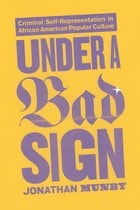
Under a Bad Sign
Criminal Self-Representation in African American Popular CultureJonathan Munby
University of Chicago Press, 2011
What accounts for the persistence of the figure of the black criminal in popular culture created by African Americans? Unearthing the overlooked history of art that has often seemed at odds with the politics of civil rights and racial advancement, Under a Bad Sign explores the rationale behind this tradition of criminal self-representation from the Harlem Renaissance to contemporary gangsta culture.
In this lively exploration, Jonathan Munby takes a uniquely broad view, laying bare the way the criminal appears within and moves among literary, musical, and visual arts. Munby traces the legacy of badness in Rudolph Fisher and Chester Himes’s detective fiction and in Claude McKay, Julian Mayfield, and Donald Goines’s urban experience writing. Ranging from Peetie Wheatstraw’s gangster blues to gangsta rap, he also examines criminals in popular songs. Turning to the screen, the underworld films of Oscar Micheaux and Ralph Cooper, the 1970s blaxploitation cycle, and the 1990s hood movie come under his microscope as well. Ultimately, Munby concludes that this tradition has been a misunderstood aspect of African American civic life and that, rather than undermining black culture, it forms a rich and enduring response to being outcast in America.
Underglobalization
Beijing's Media Urbanism and the Chimera of LegitimacyJoshua Neves
Duke University Press, 2020

Understanding Film
Marxist PerspectivesEdited by Mike Wayne
Pluto Press, 2005
From the introduction
Film remains one of the most dominant cultural forms in the world today. Crossing classes and cultures, it permeates many aspects of our consciousness. In film, perhaps more than any other medium, we can read the politics of time and place, past and present. The history of Marxism has intersected with film in many ways and this book is a timely reminder of the fruits of that intersection, in film theory and film practice. Marxist film theory returns to film studies some of the key concepts which make possible a truly radical, political understanding of the medium and its place both within capitalism and against it. This book shows how questions of ideology, technology and industry must be situated in relation to class – a category which academia is distinctly uncomfortable with. It explores the work of some of the key theorists who have influenced our understanding of film, such as Adorno, Althusser, Benjamin, Brecht, Gramsci, Jameson and others. It shows how films must be situated in their social and historical contexts, whether Hollywood, Russian, Cuban, Chinese or North Korean cinema. The authors explore the political contradictions and tensions within dominant cinema and discuss how Marxist filmmakers have pushed the medium in new and exciting directions.
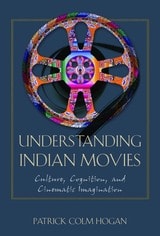
Understanding Indian Movies
Culture, Cognition, and Cinematic ImaginationBy Patrick Colm Hogan
University of Texas Press, 2008
Indian movies are among the most popular in the world. However, despite increased availability and study, these films remain misunderstood and underappreciated in much of the English-speaking world, in part for cultural reasons.
In this book, Patrick Colm Hogan sets out through close analysis and explication of culturally particular information about Indian history, Hindu metaphysics, Islamic spirituality, Sanskrit aesthetics, and other Indian traditions to provide necessary cultural contexts for understanding Indian films. Hogan analyzes eleven important films, using them as the focus to explore the topics of plot, theme, emotion, sound, and visual style in Indian cinema. These films draw on a wide range of South Asian cultural traditions and are representative of the greater whole of Indian cinema. By learning to interpret these examples with the tools Hogan provides, the reader will be able to take these skills and apply them to other Indian films.
But this study is not simply culturalist. Hogan also takes up key principles from cognitive neuroscience to illustrate that all cultures share perceptual, cognitive, and emotional elements that, when properly interpreted, can help to bridge gaps between seemingly disparate societies. Hogan locates the specificity of Indian culture in relation to human universals, and illustrates this cultural-cognitive synthesis through his detailed interpretations of these films. This book will help both scholars and general readers to better understand and appreciate Indian cinema.

Understanding Kubrick's 2001
A Space Odyssey: Representation and InterpretationEdited by James Fenwick
Intellect Books, 2018
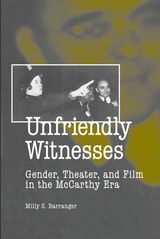
Unfriendly Witnesses
Gender, Theater, and Film in the McCarthy EraMilly S. Barranger
Southern Illinois University Press, 2008
Unfriendly Witnesses: Gender, Theater, and Film in the McCarthy Era examines the experiences of seven prominent women of stage and screen whose lives and careers were damaged by the McCarthy-era “witch hunts” for Communists and Communist sympathizers in the entertainment industry: Judy Holliday, Anne Revere, Lillian Hellman, Dorothy Parker, Margaret Webster, Mady Christians, and Kim Hunter.
The effects on women of the anti-Communist crusades that swept the nation between 1947 and 1962 have been largely overlooked by cultural critics and historians, who have instead focused their attention on the men of the period. Author Milly S. Barranger looks at the gender issues inherent in the investigations and at the destructive impact the investigations had on the lives and careers of these seven women—and on American film and theater and culture in general.
Issues of gender and politics surface in the women’s testimony before the committeemen, labeled “unfriendly” because the women refused to name names. Unfriendly Witnesses redresses the absence of women’s histories during this era of modern political history and identifies the enduring strains of McCarthyism in postmillennial America.
Barranger recreates the congressional and state hearings that addressed the alleged Communist influence in the entertainment industry and examines in detail the cases of these seven women, including the appearance of actress Judy Holliday before the committee of Senator Pat McCarran, who aimed to limit the immigration of Eastern Europeans; actress Anne Revere and playwright Lillian Hellman, appearing before the House Un-American Activities Committee, sought the protections of the Fifth Amendment with different outcomes; of writer Dorothy Parker, who testified before a New York state legislative committee investigating contributions to “front” groups; and of director Margaret Webster, before Senator Joseph McCarthy’s subcommittee, whose aim was the indictment of Senator J. William Fulbright and the U.S. State Department. None escaped subsequent blacklisting, denial of employment, and notations in FBI files that they were threats to national security.
Unfriendly Witnesses is enhanced by nine illustrations and extensive excerpts from Red Channels: The Report of Communist Influence in Radio and Television, originally published in 1950 at the height of the Red Scare, and which listed 151 allegedly subversive writers, directors, and performers. Barranger includes the complete entries from Red Channels for the seven women she discusses, which include the “subversive” affiliations that prompted the women’s interrogation by the government.
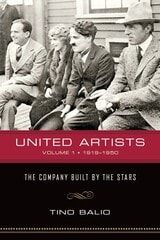
United Artists, Volume 1, 1919–1950
The Company Built by the StarsTino Balio
University of Wisconsin Press, 2009
This edition is updated with a new introduction by Balio that places in relief UA’s operations for those readers who may be unfamiliar with film industry practices and adds new perspective to the company’s place within Hollywood.
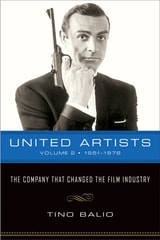
United Artists, Volume 2, 1951–1978
The Company That Changed the Film IndustryTino Balio
University of Wisconsin Press, 2009
This edition includes an expanded introduction that examines the history of United Artists from 1978 to 2008, as well as an account of Arthur Krim’s attempt to mirror UA’s success at Orion Pictures from 1978 to 1991.
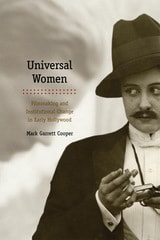
Universal Women
Filmmaking and Institutional Change in Early HollywoodMark Garrett Cooper
University of Illinois Press, 2010
A Choice Outstanding Academic Title, 2011.
Between 1912 and 1919, the Universal Film Manufacturing Company credited eleven women with directing at least 170 films, but by the mid-1920s all of these directors had left Universal and only one still worked in the film industry at all. Two generations of cinema historians have either overlooked or been stymied by the mystery of why Universal first systematically supported and promoted women directors and then abruptly reversed that policy.
In this trailblazing study, Mark Garrett Cooper approaches the phenomenon as a case study in how corporate movie studios interpret and act on institutional culture in deciding what it means to work as a man or woman. In focusing on issues of institutional change, Cooper challenges interpretations that explain women's exile from the film industry as the inevitable result of a transhistorical sexism or as an effect of a broadly cultural revision of gendered work roles. Drawing on a range of historical and sociological approaches to studying corporate institutions, Cooper examines the relationship between institutional organization and aesthetic conventions during the formative years when women filmmakers such as Ruth Ann Baldwin, Cleo Madison, Ruth Stonehouse, Elise Jane Wilson, and Ida May Park directed films for Universal.
Unruly Cinema
History, Politics, and BollywoodRini Bhattacharya Mehta
University of Illinois Press, 2020
Rini Bhattacharya Mehta considers four aspects of Indian cinema's complicated history. She begins with the industry's surprising, market-driven triumph over imports from Hollywood and elsewhere in the 1930s. From there she explores how the nationalist social melodrama outwitted the government with its 1950s cinematic lyrical manifestoes. In the 1970s, an action cinema centered on the angry young male co-opted the voice of the oppressed. Finally, Mehta examines Indian film's discovery of the global neoliberal aesthetic that encouraged the emergence of Bollywood.
Unruly Comparison
Queerness, Hong Kong, and the SinophoneAlvin K. Wong
Duke University Press, 2025
Unruly Girls, Unrepentant Mothers
Redefining Feminism on ScreenBy Kathleen Rowe Karlyn
University of Texas Press, 2010
Since the 1990s, when Reviving Ophelia became a best seller and "Girl Power" a familiar anthem, girls have assumed new visibility in the culture. Yet in asserting their new power, young women have redefined femininity in ways that have often mystified their mothers. They have also largely disavowed feminism, even though their new influence is a likely legacy of feminism's Second Wave. At the same time, popular culture has persisted in idealizing, demonizing, or simply erasing mothers, rarely depicting them in strong and loving relationships with their daughters.
Unruly Girls, Unrepentant Mothers, a companion to Kathleen Rowe Karlyn's groundbreaking work, The Unruly Woman, studies the ways popular culture and current debates within and about feminism inform each other. Surveying a range of films and television shows that have defined girls in the postfeminist era—from Titanic and My So-Called Life to Scream and The Devil Wears Prada, and from Love and Basketball to Ugly Betty—Karlyn explores the ways class, race, and generational conflicts have shaped both Girl Culture and feminism's Third Wave. Tying feminism's internal conflicts to negative attitudes toward mothers in the social world, she asks whether today's seemingly materialistic and apolitical girls, inspired by such real and fictional figures as the Spice Girls and Buffy the Vampire Slayer, have turned their backs on the feminism of their mothers or are redefining unruliness for a new age.
Unsettled Scores
Politics, Hollywood, and the Film Music of Aaron Copland and Hanns EislerSally Bick
University of Illinois Press, 2019
Unsettling Sights
The Fourth World on FilmCorinn Columpar
Southern Illinois University Press, 2010
Unsettling Sights: The Fourth World on Film examines the politics of representing Aboriginality, in the process bringing frequently marginalized voices and visions, issues and debates into the limelight. Corinn Columpar uses film theory, postcolonial theory, and Indigenous theory to frame her discussion of the cinematic construction and transnational circulation of Aboriginality. The result is a broad interdisciplinary analysis of how Indigeneity is represented in cinema, supported by more than twenty rigorous and theoretically informed case studies of contemporary feature films by both First- and Fourth-World filmmakers in the United States, Canada, New Zealand, and Australia. Columpar relies heavily on textual analysis of the films but also explores contextual issues in filmmaking such as funding, personnel, modes of production, and means of distribution.
Part one of Unsettling Sights focuses on contact narratives in which the Aboriginal subject is constructed in reactive response to a colonizing or invading presence. Films such as The Piano and The Proposition, wherein a white man “goes native,” and The New World and Map of the Human Heart, which approach contact from the perspective of an Aboriginal character, serve as occasions to examine the ways in which Aboriginal identities are negotiated within dominant cinema. Part two shifts the focus from contact narratives to films that seek to define Aboriginality on its own terms, with reference to a (lost) homeland and/or Indigenous practices of (hi)story-telling: while texts such as Once Were Warriors and Smoke Signals foster an engagement with issues of deterritorialization, relocation, and urbanization, discussion of beDevil, Atanarjuat, and The Business of Fancydancing, among others,bring questions of voice, translation, and the relationship between cinema and oral tradition to the forefront.
Unsettling Sights is the first significant, scholarly examination of Aboriginality and cinema in an international context and will be invaluable to scholars and students in many fields including cinema studies, anthropology, critical race studies, cultural studies, and postcolonial studies.
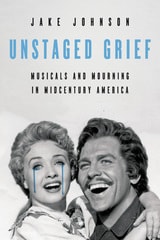
Unstaged Grief
Musicals and Mourning in Midcentury AmericaJake Johnson
University of Illinois Press, 2025
Often dismissed as escapism, screen musicals of the 1960s in fact tapped into unspoken sadness about an America that was slipping away. Jake Johnson delves into film and television musicals of the era to examine their place in networks of grieving in America, for America, and about America.
The Golden Age of musical theater ended just as Elisabeth Kübler-Ross’s On Death and Dying debuted, and Johnson uses Kübler-Ross’s five stages to frame the intertwining of musicals and grief. He analyzes films like Seven Brides for Seven Brothers and State Fair alongside paintings, poetry, and other images and texts to reveal how the musical theater engine built in the first half of the century broke down just as a new language emerged to describe the melancholy felt by people facing the end of the world they had known.
Nuanced and original, Unstaged Grief plumbs the grief, loss, and hope behind the Technicolor spectacle and rousing showstoppers.
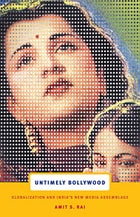
Untimely Bollywood
Globalization and India's New Media AssemblageAmit S. Rai
Duke University Press, 2009
Rai recounts his experience of attending the first showing of a Bollywood film in a single-screen theater in Bhopal: the sensory experience of the exhibition space, the sound system, the visual style of the film, the crush of the crowd. From that event, he elicits an understanding of cinema as a historically contingent experience of pleasure, a place where the boundaries of identity and social spaces are dissolved and redrawn. He considers media as a form of contagion, endlessly mutating and spreading, connecting human bodies, organizational structures, and energies, thus creating an inextricable bond between affect and capital. Expanding on the notion of media contagion, Rai traces the emerging correlation between the postcolonial media assemblage and capitalist practices, such as viral marketing and the development of multiplexes and malls in India.
Unveiling Desire
Fallen Women in Literature, Culture, and Films of the EastDas, Devaleena
Rutgers University Press, 2018
Unwatchable
Baer, Nicholas
Rutgers University Press, 2019
With over 50 original essays by leading scholars, artists, critics, and curators, this is the first book to trace the “unwatchable” across our contemporary media environment, in which viewers encounter difficult content on various screens and platforms. Appealing to a broad academic and general readership, the volume offers multidisciplinary approaches to the vast array of troubling images that circulate in global visual culture.
Uplift Cinema
The Emergence of African American Film and the Possibility of Black ModernityAllyson Nadia Field
Duke University Press, 2015
Urban Horror
Neoliberal Post-Socialism and the Limits of VisibilityErin Y. Huang
Duke University Press, 2020
Useful Cinema
Charles R. Acland and Haidee Wasson, eds.
Duke University Press, 2011
Contributors. Charles R. Acland, Joseph Clark, Zoë Druick, Ronald Walter Greene, Alison Griffiths, Stephen Groening, Jennifer Horne, Kirsten Ostherr, Eric Smoodin, Charles Tepperman, Gregory A. Waller, Haidee Wasson. Michael Zryd