Results by title
1787 books match the query 'Literary Collections' and 16 start with u
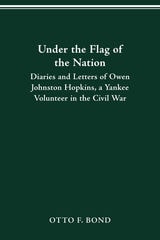
UNDER THE FLAG OF THE NATION
DIARIES AND LETTERS OF OWEN JOHNSTON HOPKINS, A YANKEE VOLUNTEER IN THE CIVIL WAROwen Johnston Hopkins
The Ohio State University Press, 1998
Owen Hopkins was a young man brought to maturity by the agony of war, but in spite of the horror of battle and the tedium of life in camp, he maintained a lively sense of humor and a constant devotion to the ideals for which he fought. The Civil War in these pages is a savage, vindictive conflict fought with canister, "minnie balls," grapeshot, the Enfield rifle, and the bayonet. Only seventeen when he enlisted in 1861, Hopkins was a foot soldier and a witness to the action that took place on the field of battle.
A vital part of Hopkins's life in the army was his correspondence with Julia Allison, who lived in his hometown of Bellefontaine. They began writing each other in 1863, and their friendship deepened into love. Each was a fervent patriot, and their shared devotion to their country was a significant fact of their relationship. They were married in 1865.
An epilogue tells what happened to Hopkins after June of 1865: his career, his family, and his death in 1902. Originally published in1961, this work is now available for the first time in paperback.
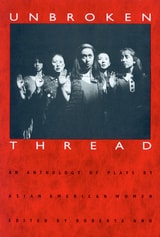
Unbroken Thread
An Anthology of Plays by Asian American WomenRoberta Uno
University of Massachusetts Press, 1993
This book contains plays by Genny Lim (Paper Angels), Wakako Yamauchi (The MusicLessons), Momoko Iko (Gold Watch),Velina Hasu Houston (Tea), Jeannie Barroga (Walls), and Elizabeth Wong (Letters to a Student Revolutionary). The volume includes an extended introduction, a profile of each playwright, and an appendix. The six plays of this anthology represent some of the best dramatic literature written by Asian American women since the 1970s. Each is a groundbreaking work and addresses in its own way the experiences of Asians in America. All six playwrights are American-born daughters of Asian immigrants, and their voices span the genres of naturalism, impressionism, ritual drama, postmodern collage, and media-influenced episodic drama.
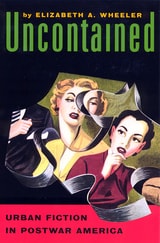
Uncontained
Urban Fiction in Postwar AmericaWheeler, Elizabeth A.
Rutgers University Press, 2001
In the postwar era, American urban fiction is dominated by the imagery of containment. Across the fictional landscape, the city is divided into segregated zones, marked by the threat of inevitable violence, and set off from the safety of equally contained suburbs. Mean and dangerous, the city can only be navigated by a solitary expert, alienated and male. In Uncontained, Elizabeth A. Wheeler offers a critique of this familiar story-evident in the noir. narratives of James M. Cain and in work by Ellison, Roth, Salinger, Percy, Capote, and others —and challenges its link to the postwar city.
Discussing film, short stories, and novels from a cross-section of American cities, Wheeler integrates these stories of containment into a shared pattern and reads them across a broad spectrum of famous and forgotten works by men and women of various ethnic and literary traditions to reveal a larger vision of postwar America. Knowing that containment is never the entire story, that diversity or trauma always shows itself, she shows how the uncontained has shaped the historical moment. Aware that liberating counterstories do get told, she places them in dialogue with those of the alienated man, the war veteran, Beat hipster, noir detective, and ironic suburbanite — in historical context — and revives the idea of urban space as a place of openness, thereby challenging a literary containment of racial difference, gender, and sexuality. By reading Paule Marshall in tandem with Philip Roth, Wheeler explores the relationships between adjacent neighborhoods and reconnects separate literary and geographic areas. By bringing Ann Bannon's lesbian pulp fiction, Hubert Selby's cult novels, or the work of John Okada, Hisaye Yamamoto, Chester Himes, Gwendolyn Brooks's, Jo Sinclair, and many others to bear on more canonical texts, she offers a more complete understanding of this period of American fiction — one that points toward a city that is open and inclusive.
Uncontained suggests that while decline, division, and decay form a major part of the story of mid-century urban America, the postwar city also represents much of what is best about American life. Rather than reproducing the containment of culture, Wheeler places together the wildly disparate to show how we move beyond containment.
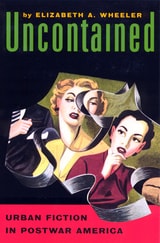
Uncontained
Urban Fiction in Postwar AmericaWheeler, Elizabeth A.
Rutgers University Press, 2001
In the postwar era, American urban fiction is dominated by the imagery of containment. Across the fictional landscape, the city is divided into segregated zones, marked by the threat of inevitable violence, and set off from the safety of equally contained suburbs. Mean and dangerous, the city can only be navigated by a solitary expert, alienated and male. In Uncontained, Elizabeth A. Wheeler offers a critique of this familiar story-evident in the noir. narratives of James M. Cain and in work by Ellison, Roth, Salinger, Percy, Capote, and others —and challenges its link to the postwar city.
Discussing film, short stories, and novels from a cross-section of American cities, Wheeler integrates these stories of containment into a shared pattern and reads them across a broad spectrum of famous and forgotten works by men and women of various ethnic and literary traditions to reveal a larger vision of postwar America. Knowing that containment is never the entire story, that diversity or trauma always shows itself, she shows how the uncontained has shaped the historical moment. Aware that liberating counterstories do get told, she places them in dialogue with those of the alienated man, the war veteran, Beat hipster, noir detective, and ironic suburbanite — in historical context — and revives the idea of urban space as a place of openness, thereby challenging a literary containment of racial difference, gender, and sexuality. By reading Paule Marshall in tandem with Philip Roth, Wheeler explores the relationships between adjacent neighborhoods and reconnects separate literary and geographic areas. By bringing Ann Bannon's lesbian pulp fiction, Hubert Selby's cult novels, or the work of John Okada, Hisaye Yamamoto, Chester Himes, Gwendolyn Brooks's, Jo Sinclair, and many others to bear on more canonical texts, she offers a more complete understanding of this period of American fiction — one that points toward a city that is open and inclusive.
Uncontained suggests that while decline, division, and decay form a major part of the story of mid-century urban America, the postwar city also represents much of what is best about American life. Rather than reproducing the containment of culture, Wheeler places together the wildly disparate to show how we move beyond containment.

Under Review
Further Writings on Writers, 1946-1990Anthony Powell
University of Chicago Press, 1994
"Powell is one of the great novelists of our time, much more interested in other people than in his own views and ideas. The result is that his extraordinary richness of act and detail also embodies a far more arresting and penetrating quantity of critical judgements on books, authors, fashions, developments, than are to be found in the theoretical pronouncement of modern academic criticism."—John Bayley, The Sunday Times
"These delightful reviews could be said to amount to a latter-day Brief Lives."—David Plante, Times Literary Supplement

Under a Glass Bell
Anaïs Nin
Ohio University Press, 2013
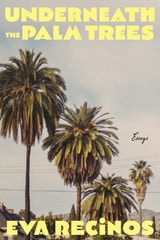
Underneath the Palm Trees
EssaysEva Recinos
Northwestern University Press, 2027
A raw and captivating exploration of what it means to live in the in-betweens of the American dream
Arts and culture writer Eva Recinos came of age in the towering city of Los Angeles, fed the story of the American dream. A daughter of immigrants, Recinos grew up facing the dichotomy of that dream: experiencing what it was like to live in South Central LA right next door to one of the wealthiest private universities in America—which Recinos herself would eventually attend. Navigating depression, anxiety, grief, sexuality, and the pressures of being a first-generation daughter and student, Underneath the Palm Trees examines the dissonant effects of straddling two disparate worlds. Recinos’s is an emerging and powerful Latinx voice that uses this engaging collection of essays to capture America’s idiosyncrasies, the complexities of girlhood, and how we find ourselves in art.
Undocumented
Great Lakes Poets Laureate on Social JusticeRonald Riekki
Michigan State University Press, 2019
Undocuments
John-Michael Rivera
University of Arizona Press, 2021
How do you document the undocumented? UNDOCUMENTS both poses and attempts to answer this complex question by remixing the forms and styles of the first encyclopedia of the New World, the Florentine Codex, in order to tell a modern story of Greater Mexico. Employing a broad range of writing genres and scholarly approaches, UNDOCUMENTS catalogs, recovers, and erases documents and images by and about peoples of Greater Mexico from roughly the first colonial moment. This brave and bracing volume organizes and documents ancient New World Mexican peoples from the Florentine Codex (1592) to our current technology-heavy age, wherein modern lawmakers and powerful global figures desire to classify, deport, and erase immigrants and their experiences.
While grappling with anxiety and the physical and mental health consequences of the way the United States treats immigrant bodies, John-Michael Rivera documents and scrutinizes what it means to seek opportunities in America. With a focus on the poetics of Latinx documentality itself, this book is concerned with the complicated and at times contradictory ways peoples of Greater Mexico have been documented and undocumented within systems of colonial knowledges, and how these peoples have been rendered as specters of the bureaucratic state. Rivera takes us through the painful, anxiety-ridden, and complex nature of what it means to be documented or undocumented, and the cruelty married to each of these states of being.
Unfolding Corpus
Radical Creativity and Vulnerability in Times of PlagueGeorge Ayala
Rutgers University Press, 2027
UnfoldingCorpus is a carefully curated collection of visual and textual works by artists and writers from past issues of Corpus, a community produced journal, which was originally published between 2003 and 2008 by the AIDS Project Los Angeles (APLA). Corpus was a publication that held open valuable space for Black, Brown, and queer people to see themselves reflected in an honest exploration of HIV and sex, but it was also a celebration of sexuality, connectivity, curiosity, and resilience.
Unfolding Corpus uses contributions from the original journal to draw parallels between HIV, COVID, and monkey pox, all of which have disproportionately affected the queer community. By centering the experiences of communities historically excluded from public health decision-making, the mix of art, poetry, essays, and radical storytelling throughout the collection aims to disrupt and reveal the wrongs waged on low income, Black, Brown, and queer bodies across time and across pandemics. This collection once again confronts a hostile state and cultural environment by celebrating a world in which queer and trans sexuality can flourish, be seen, and be understood as a tool to envision radical futures rooted in equality and unfurling justice.
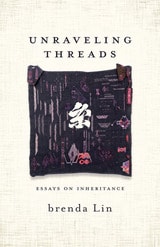
Unraveling Threads
Essays on Inheritancebrenda Lin
The Ohio State University Press, 2026
“Tactile memory feels like it is the easiest to lose,” brenda Lin writes in Unraveling Threads. But in these exquisite essays, she demonstrates just how the tactile bolsters personal, familial, and cultural memory. From the remnant of a baby’s umbilical cord to the antique hand-embroidered baby carriers her mother collects, Lin shows us how the tactile and handmade connect parents and children, homeland and diaspora, and give texture to caregiving’s many forms. As Lin writes, the radical for thread forms the basis of Chinese characters for women’s work, for practice through repetition, for inheritance. Threads form the mesh in the stent that keeps her father’s heart working. And yuan, the red thread of fate, is the first word she translated for her future husband. When Lin returns to Taiwan after decades away, this time with her young family, the threads of creativity and caretaking become the warp and weft of the continual process of homecoming. These essays on motherhood, language, art, and diaspora will resonate with anyone who has experienced the process of returning to, or building, a home.
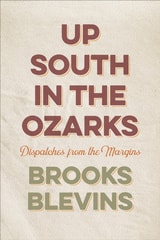
Up South in the Ozarks
Dispatches from the MarginsBrooks Blevins
University of Arkansas Press, 2022
Historian Brooks Blevins has spent his life studying and writing about the people of his native regions—the South and the Ozarks. He has been in the vanguard of a new and vibrant Ozarks Studies movement that has worked to refract the stories of Ozarkers through a more realistic and less exotic lens. In Up South in the Ozarks: Dispatches from the Margins, Blevins introduces us with humor and fairness to mostly unseen lives of the past and present: southern gospel singing schools and ballad collectors, migratory cotton pickers and backroad country storekeepers, fireworks peddlers and impoverished diarists.
Part historical and part journalistic, Blevins’s essays combine the scholarly sensibilities of a respected historian with the insights of someone raised in rural hill country. His stories of marginalized characters often defy stereotype. They entertain as much as they educate. And most of them originate in the same place Blevins does: up south in the Ozarks.
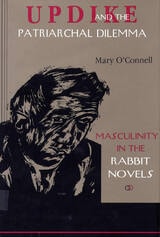
Updike and the Patriarchal Dilemma
Masculinity in the Rabbit NovelsMary O'Connell
Southern Illinois University Press, 1996
Mary O’Connell examines the role of socially constructed masculinity in John Updike’s Rabbit tetralogy—Rabbit Run, Rabbit Redux, Rabbit Is Rich, and Rabbit at Rest—which comprises the longest and most comprehensive representation of masculinity in American literature and places Updike firmly with the precursors of the contemporary movement among men to reevaluate their cultural inheritance.
A disturbing element exists, O’Connell determines, in both the texts of the Rabbit novels and in the critical community that examines them. In the novels, O’Connell finds substantial evidence to demonstrate patterns of psychological and physical abuse toward women, citing as the culminating example the mounting toll of literally or metaphorically dead women in the texts. Critics who characterize Updike as a nonviolent writer who strangely overlooks Rabbit’s repressive and violent behaviors avoid a discomforting but crucial aspect of Updike’s portrait.
Because the critical verdict of nonviolence in Updike’s novels contrasts sharply with the string of female corpses, O’Connell deems that something within the text or culture—or both—is seriously amiss.
Although she examines negative aspects of Rabbit’s behavior, O’Connell avoids the oversimplification of labeling Updike a misogynist. Instead, she looks closely at the forces shaping Rabbit’s gender identity as well as at the ways he experiences masculinity and the ways his gender identity affects his personal and spiritual development, his relationships, and, ultimately, his society. She shows how Updike challenges stereotypical masculinity, revealing its limitations and proscriptions as the source of much unhappiness for both men and women. Further, she substantiates the relation between gender, form, structure, perspective, and language use in the novels, alerting the reader to the ambivalence arising from the male author’s examination of masculinity.
O’Connell maintains that Updike does more than write Rabbit as a stereotypical male; he instead explores in depth his character’s habitually flawed ways of seeing and responding to the world. As she discusses these issues, O’Connell uses the term patriarchy in its broadest sense to refer to the practice of centralizing the male and marginalizing the female in all areas of human life. Patriarchal ideology—the assumptions, values, ideas, and patterns of thought that perpetuate the arrangement—is written as hidden text, permeating every aspect of culture, particularly language, from which it spreads to other signifying systems.
Contrary to conventional critical wisdom, Updike is not a straightforward writer; the Rabbit novels create meaning by challenging, undermining, and qualifying their own explicit content. Updike claims that his novels are "moral debates with the reader," and according to O’Connell, the resisting reader, active and skeptical, is the one most likely to discover what Rabbit conceals and to register the nuances of layered discourse.
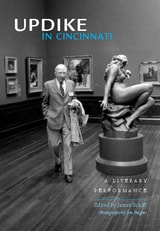
Updike in Cincinnati
A Literary PerformanceJames Schiff
Ohio University Press, 2007
For two spring days in 2001, John Updike visited Cincinnati, Ohio, engaging and charming his audiences, reading from his fiction, fielding questions, sitting for an interview, participating in a panel discussion, and touring the Queen City.
Successful writers typically spend a portion of their lives traveling the country to give readings and lectures. While a significant experience for author and audience alike, this public spectacle, once covered in detailed newspaper accounts, now is barely noticed by the media. Updike in Cincinnati—composed of a wealth of materials, including session transcripts, short stories discussed and read by the author, photographs, and anecdotal observations about Updike's performance and personal interactions--is unique in its comprehensive coverage of a literary visit by a major American author.
Updike's eloquence, intelligence, improvisational skills, and gift for comedy are all on display. With natural grace, he discusses a range of topics, including his novels and short stories, his mother and oldest son as writers, Pete Rose and Shoeless Joe Jackson, the Nobel Prize, his appearance on The Simpsons, the Cold War, and Hamlet.
Augmented with commentary by critics W. H. Pritchard and Donald Greiner, and an introduction and interview by James Schiff, Updike in Cincinnati provides an engaging and detailed portrait of one of America's contemporary literary giants.
Ups and Downs of Life in the Indies
P. A. Daum
University of Massachusetts Press, 1987
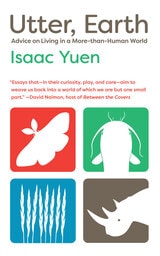
Utter, Earth
Advice on Living in a More-than-Human WorldIsaac Yuen
West Virginia University Press, 2024
Honorable Mention, Alanna Bondar Prize, 2026, Association for Literature, Environment, and Culture in Canada (ALECC)
Part nature guide, part self-help column, and all love letter to the more-than-human world, Utter, Earth is an exercise in wonder. For animal lovers and readers of Brian Doyle, Aimee Nezhukumatathil, and Amy Leach.
A light, literary take on an animal book for grown-ups, a tongue-in-cheek self-help column with lessons drawn from nature, a sort of hitchhiker’s guide to the more-than-human world—Isaac Yuen’s Utter, Earth is a celebration, through wordplay and earthplay, of our planet’s riotous wonders.
In a time of dirges and elegies for the natural world, Utter, Earth features odes to sloths, tributes to trilobites, and ringing endorsements for lichen. For animal lovers and readers of Brian Doyle, Aimee Nezhukumatathil, and Amy Leach, each essay of this one-of-a-kind collection combines joyous language, whimsical tangents, and scientific findings to remind us of and reconnect us with those to whom we are inextricably bound. Highlighting life that once was, still is, and all that we stand to lose, this living and lively mini encyclopedia (complete with glossary) shines the spotlight on the motley, fantastical, and astonishing denizens with whom we share this planet.