Results by title
4038 books match the query 'Social aspects' and 68 start with u

Unbecoming Nationalism
From Commemoration to Redress in CanadaHelene Vosters
University of Manitoba Press, 2019

Unbinding Gentility
Women Making Music in the Nineteenth-Century SouthCandace Bailey
University of Illinois Press, 2021
Hearing southern women in the pauses of history
Southern women of all classes, races, and walks of life practiced music during and after the Civil War. Candace L. Bailey examines the history of southern women through the lens of these musical pursuits, uncovering the ways that music's transmission, education, circulation, and repertory help us understand its meaning in the women's culture of the time. Bailey pays particular attention to the space between music as an ideal accomplishment—part of how people expected women to perform gentility—and a real practice—what women actually did. At the same time, her ethnographic reading of binder’s volumes, letters and diaries, and a wealth of other archival material informs new and vital interpretations of women’s place in southern culture.
A fascinating collective portrait of women's artistic and personal lives, Unbinding Gentility challenges entrenched assumptions about nineteenth century music and the experiences of the southern women who made it.
Unburied Bodies
Subversive Corpses and the Authority of the DeadJames R. Martel
Amherst College Press, 2018
Uncanny Rest
For AntiphilosophyAlberto Moreiras
Duke University Press, 2022
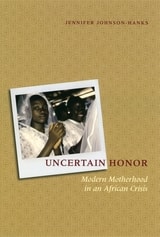
Uncertain Honor
Modern Motherhood in an African CrisisJennifer Johnson-Hanks
University of Chicago Press, 2005
Combining insights from demography and cultural anthropology, Johnson-Hanks argues that Beti women delay motherhood as part of a broader attempt to assert a modern form of honor only recently made possible by formal education, Catholicism, and economic change. Through itinerant school careers and manipulations of marriage, educated Beti women now manage their status as mothers in order to coordinate major life events in the face of social and economic uncertainty.
Carefully researched and clearly written, Uncertain Honor offers an intimate look at the lives of African women trying to reconcile motherhood with new professional roles in a context of dramatic social change.

Uncertainties Of Knowledge
Immanuel Wallerstein
Temple University Press, 2004
Unchanged Trebles
What Boy Choirs Teach Us About Motherhood and MasculinityRebekah Peeples
Rutgers University Press, 2026
In Unchanged Trebles, Rebekah Peeples charts an unexpected, thought-provoking, and deeply personal journey into the peculiar world of contemporary boy choirs, where boys learn to do something together that they’re often embarrassed to do alone: sing in their soprano voices. Considering her experience as the unlikely mother of a boy soprano alongside dozens of interviews with current directors and former choristers, she argues that some of the tools for creating a more gender-inclusive future can be found in an ancient tradition that has long recognized gender fluidity within the pre-pubescent male body. With humor, insight, and the voice of a gifted storyteller, Unchanged Trebles explores a cultural tradition in which singing and expressing emotion are encouraged for boys, showing them a more expansive form of masculinity as they transition from boyhood to manhood.
Uncomfortable Television
Hunter Hargraves
Duke University Press, 2023
Uncommon Sense
Understanding Nature's Truths Across Time and CultureAnthony Aveni
University Press of Colorado, 2006
In ten fascinating essays, Aveni examines topics that have absorbed scientists, religious figures, and ordinary citizens over the centuries. He traces the tug of war between astronomy and astrology, reveals the underpinnings of our notions of cartography and the representation of space and time, and much more.
Readers interested in science, history, and world cultures will revel in this celebration of different cultures’ common and uncommon questions and conclusions about the natural world.
Uncountable
A Philosophical History of Number and Humanity from Antiquity to the PresentDavid Nirenberg and Ricardo L. Nirenberg
University of Chicago Press, 2021
Our knowledge of mathematics has structured much of what we think we know about ourselves as individuals and communities, shaping our psychologies, sociologies, and economies. In pursuit of a more predictable and more controllable cosmos, we have extended mathematical insights and methods to more and more aspects of the world. Today those powers are greater than ever, as computation is applied to virtually every aspect of human activity. Yet, in the process, are we losing sight of the human? When we apply mathematics so broadly, what do we gain and what do we lose, and at what risk to humanity?
These are the questions that David and Ricardo L. Nirenberg ask in Uncountable, a provocative account of how numerical relations became the cornerstone of human claims to knowledge, truth, and certainty. There is a limit to these number-based claims, they argue, which they set out to explore. The Nirenbergs, father and son, bring together their backgrounds in math, history, literature, religion, and philosophy, interweaving scientific experiments with readings of poems, setting crises in mathematics alongside world wars, and putting medieval Muslim and Buddhist philosophers in conversation with Einstein, Schrödinger, and other giants of modern physics. The result is a powerful lesson in what counts as knowledge and its deepest implications for how we live our lives.

Undead Science
Science Studies and the Afterlife of Cold FusionSimon, Bart
Rutgers University Press, 2002
Undead Science examines the story of cold fusion, one of the most publicized scientific controversies of the late twentieth century. In 1989 two Utah-based “discoverers” claimed to have developed an electrochemical process that produced more energy than was required to initiate the process. Finding no other explanation, the researchers described their findings as some kind of nuclear reaction. If they were correct, an important new energy source would have been found. Objections surfaced quickly, and in the year that followed, hundreds of scientists worldwide attempted to reproduce these results. Most, though not all, failed, and the controversy became increasingly antagonistic. By 1990, general scientific opinion favored the skeptics and experimental work went into a steep decline. Nevertheless, many scientists continue to do research in what Bart Simon calls this “undead science.”
Simon argues that in spite of widespread skepticism in the scientific community, there has been a continued effort to make sense of the controversial phenomenon. Researchers in well-respected laboratories continue to produce new and rigorous work. In this manner, cold fusion research continues to exist long after the controversy has subsided, even though the existence of cold fusion is circumscribed by the widespread belief that the phenomenon is not real.
The survival of cold fusion signals the need for a more complex understanding of the social dynamics of scientific knowledge making, the boundaries between experts, intermediaries, and the lay public, and the conceptualization of failure in the history of science and technology.

Under Construction
Making Homeland Security at the Local LevelKerry B. Fosher
University of Chicago Press, 2008
Under Discussion
The Encyclopedic MuseumDonatien Grau
J. Paul Getty Trust, The, 2021
Over the last two decades, the encyclopedic museum has been criticized and praised, constantly discussed, and often in the news. Encyclopedic museums are a phenomenon of Europe and the United States, and their locations and mostly Eurocentric collections have in more recent years drawn attention to what many see as bias. Debates on provenance in general, cultural origins, and restitutions of African heritage have exerted pressure on encyclopedic museums, and indeed on all manner of museums. Is there still a place for an institution dedicated to gathering, preserving, and showcasing all the world’s cultures?
Donatien Grau’s conversations with international arts officials, museum leaders, artists, architects, and journalists go beyond the history of the encyclopedic format and the last decades’ issues that have burdened existing institutions. Are encyclopedic museums still relevant? What can they contribute when the Internet now seems to offer the greater encyclopedia? How important is it for us to have in-person access to objects from all over the world that can directly articulate something to us about humanity? The fresh ideas and nuances of new voices on the core principles important to museums in Dakar, Abu Dhabi, and Mumbai complement some of the world’s arts leaders from European and American institutions—resulting in some revealing and unexpected answers. Every interviewee offers differing views, making for exciting, stimulating reading.
Includes interviews with George Abungu, National Museums of Kenya; Kwame Anthony Appiah, New York University; Homi K. Bhabha, Harvard University; Hamady Bocoum, Musée des Civilisationes Noires, Dakar; Irina Bokova, UNESCO; Partha Chatterjee, Columbia University; Thomas Campbell, Fine Arts Museum of San Francisco; James Cuno, J. Paul Getty Trust; Philippe de Montebello, New York University; Bachir Souleymane Diagne, Columbia University; Kaywin Feldman, National Gallery of Art; Marc Fumaroli, Collège de France; Massimiliano Gioni, New Museum; Michael Govan, Los Angeles County Museum of Art; Camille Henrot, artist; Max Hollein, Metropolitan Museum of Art; Henri Loyrette, Musée du Louvre; Jean Nouvel, architect; Zaki Nusseibeh, United Arab Emirates; Mikhail Piotrovsky, State Hermitage Museum; Grayson Perry, artist; Krzysztof Pomian, École des Hautes Études en Sciences Sociales; Mari Carmen Ramírez, Museum of Fine Arts, Houston; Fiammetta Rocco, The Economist; Sabyasachi Mukherjee, CSMVS Mumbai; Bénédicte Savoy; Collège de France; Kavita Singh, Jawaharlal Nehru University, New Delhi; Amit Sood, Google Arts & Culture.
Under Pressure
A Song by David Bowie and QueenMax Brzezinski
Duke University Press, 2025
Under Surveillance
Being Watched in Modern AmericaBy Randolph Lewis
University of Texas Press, 2017
Never before has so much been known about so many. CCTV cameras, TSA scanners, NSA databases, big data marketers, predator drones, “stop and frisk” tactics, Facebook algorithms, hidden spyware, and even old-fashioned nosy neighbors—surveillance has become so ubiquitous that we take its presence for granted. While many types of surveillance are pitched as ways to make us safer, almost no one has examined the unintended consequences of living under constant scrutiny and how it changes the way we think and feel about the world. In Under Surveillance, Randolph Lewis offers a highly original look at the emotional, ethical, and aesthetic challenges of living with surveillance in America since 9/11.
Taking a broad and humanistic approach, Lewis explores the growth of surveillance in surprising places, such as childhood and nature. He traces the rise of businesses designed to provide surveillance and security, including those that cater to the Bible Belt’s houses of worship. And he peers into the dark side of playful surveillance, such as eBay’s online guide to “Fun with Surveillance Gadgets.” A worried but ultimately genial guide to this landscape, Lewis helps us see the hidden costs of living in a “control society” in which surveillance is deemed essential to governance and business alike. Written accessibly for a general audience, Under Surveillance prompts us to think deeply about what Lewis calls “the soft tissue damage” inflicted by the culture of surveillance.
Under the Knife
Cosmetic Surgery, Boundary Work, and the Pursuit of the Natural FakeSamantha Kwan and Jennifer Graves
Temple University Press, 2020
Samantha Kwan and Jennifer Graves reveal how women negotiate their “unnatural”—but hopefully (in their view) natural-looking—surgically-altered bodies. Based on in-depth interviews with forty-six women who underwent cosmetic surgery to enhance their appearance, the authors investigate motivations for surgery as well as women’s thoughts about looking natural after the procedures. Under the Knife dissects the psychological and physical strategies these women use to manage the expectations, challenges, and disappointments of cosmetic surgery while also addressing issues of agency and empowerment. It shows how different cultural intersections can produce varied goals and values around body improvement.
Under the Knife highlights the role of deep-seated yet contradictory gendered meanings about women’s bodies, passing, and boundary work. The authors also consider traditional notions of femininity and normalcy that trouble women’s struggle to preserve an authentic moral self.

Undercover Reporting
The Truth About DeceptionBrooke Kroeger, Foreword by Pete Hamill
Northwestern University Press, 2012
In her provocative book, Brooke Kroeger argues for a reconsideration of the place of oft-maligned journalistic practices. While it may seem paradoxical, much of the valuable journalism in the past century and a half has emerged from undercover investigations that employed subterfuge or deception to expose wrong. Kroeger asserts that undercover work is not a separate world, but rather it embodies a central discipline of good reporting—the ability to extract significant information or to create indelible, real-time descriptions of hard-to-penetrate institutions or social situations that deserve the public’s attention. Together with a companion website that gathers some of the best investigative work of the past century, Undercover Reporting serves as a rallying call for an endangered aspect of the journalistic endeavor.
Undercut
Cut Glass in Working-Class Life During the Long Gilded AgeJoseph Larnerd
University of Delaware Press, 0
How did workers experience cut glass during its cultural heyday? Rather than privilege the stories of factory owners or wealthy consumers, Undercut: Cut Glass in Working-Class Life During the Long Gilded Age refracts the medium’s history through the labors required to make and maintain these dazzling artifacts as well as popular representations of this work, from demonstrations at world's fairs to images of domestic workers with finished pieces in their charge. Cut glass and the many manifestations of public interest in its labors offered working people, too, occasions for self-reflection and, perhaps, self-realization. Foregrounding their lives, Undercut offers a multifaceted social art history of a once-popular genre of decorative art that cuts across class, gender, and race.
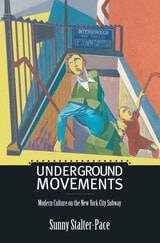
Underground Movements
Modern Culture on the New York City SubwaySunny Stalter-Pace
University of Massachusetts Press, 2013
Writers and artists took up questions that originated in the sphere of urban planning to explore how underground movement changed the ways people understand the city. Modern poets envisioned the subway as a space of literary innovation; playwrights and fiction writers used it to gauge the consequences of migration and immigration; and essayists found that it underscored the fragile relationship between urban development and memory. Even today, the symbolic associations forged by these early texts continue to influence understanding of the cultural significance of the subway and the city it connects.
Undermining Intersectionality
The Perils of Powerblind FeminismBarbara Tomlinson
Temple University Press, 2019
In this provocative book, esteemed scholar Barbara Tomlinson asserts that intersectionality—the idea that categories such as gender, race, and class create overlapping systemsof oppression—is consistently misinterpreted in feminist argument. Despite becoming a central theme in feminist scholarship and activism, Tomlinson believes dominant feminism has failed to fully understand the concept.
Undermining Intersectionality reveals that this apparent paradox is the result of the disturbing racial politics underlying more than two decades of widely-cited critiques of intersectionality produced by prominent white feminist scholars who have been insufficiently attentive to racial dynamics. As such, feminist critiques of intersectionality repeatedly reinforce racial hierarchies, undermining academic feminism’s supposed commitment to social justice. Tomlinson offers a persuasive analysis of the rhetorics and conventions of argument used in these critiques to demonstrate their systematic reliance on “powerblind” discursive practices.
Undermining Intersectionality concludes by presenting suggestions about concrete steps feminist researchers, readers, authors, and editors can take to promote more productive and principled engagements with intersectional thinking.

Understanding Dogs
Clinton R. Sanders
Temple University Press, 1999
In Understanding Dogs, sociologist and faithful dog companion Clinton R. Sanders explores the day-to-day experiences of living and working with domestic dogs. Based on a decade of research in veterinary offices and hospitals, dog guide training schools, and obediences classes -- and colored with his personal experiences and observations at and outside home with his own canine companions -- Sanders's book examines how everyday dog owners come to know their animal companions as thinking, emotional, and responsive individuals.
Linking animal companionship with social as well as personal identity, Understanding Dogs uses detailed ethnographic data in viewing human and animal efforts to understand, manipulate, care for, and interact with each other. From nineteenth-century disapproval of what was seen as irresponsibly indulgent pet ownership among the poor to Bill Clinton's caring and fun-loving image and populist connection to the "common person" as achieved through his labrador companion Buddy, Sanders looks at how dogs serve not only as social facilitators but also as adornments to social identity. He also reveals how, while we often strive to teach and shape our dogs' behavior, dogs often teach us to appreciate with more awareness a nourishing meal, physical warmth, a walk in the woods, and the simple joys of the immediate moment.
Sanders devotes chapters to the specialized work of guide dog trainers; the problems and joys experienced by guide dog owners; the day-to-day work of veterinarians dealing with the healing, death, and euthanizing of their animal patients; and the everyday interactions, assumptions, and approaches of people who choose, for various reasons and in various ways, to spend their lives in the company of dogs.
Understanding Dogs will interest those who live and work with animals as well as those studying the sociology of human-animal interactions.

Undertale
Can a Game Give Hope?Anastasia Salter
University of Chicago Press, 2025
A powerful exploration of the importance and social complexity of the indie gaming sensation
On the surface, the 2015 game Undertale didn’t seem like much, supported by fan funding and with minimalist retro graphics. But despite its pixelated monsters and dated role-playing mechanics, Undertale invited fans and players to rethink their very relationship with gaming and game characters. Players encountered an extraordinary range of possible play experiences, with paths through the game’s unassuming world leading to both empathy and extreme violence, offering room for reflection and growth. Players could befriend (sometimes queer) monsters or kill them, for instance, appealing to each monster’s unique personality to negotiate survival and find community.
Contextualizing this game’s success in the wake of the Gamergate online harassment campaign and meditating on questions of violence and authenticity, writer and game scholar Anastasia Salter offers a profound exploration of this game sensation and a personal story of hope at a time when Salter was otherwise “done” with games. Undertale’s unique structure helped make it synonymous with “indie” games, built outside of the studio as a passion project and inspiring similar passion among its many fans even a decade later. But Undertale’s story also speaks to an auteur dream: What game developer Toby Fox and his collaborators accomplished on a small budget, with relatively simple tools, has left people replaying, arguing, and creating in its wake.
As we enter a cultural moment where intense interest is shifting towards flashy creativity, powered by generative artificial intelligence, Undertale reminds fans and newcomers of the power of thoughtful and intentional human design.
Undocuments
John-Michael Rivera
University of Arizona Press, 2021
How do you document the undocumented? UNDOCUMENTS both poses and attempts to answer this complex question by remixing the forms and styles of the first encyclopedia of the New World, the Florentine Codex, in order to tell a modern story of Greater Mexico. Employing a broad range of writing genres and scholarly approaches, UNDOCUMENTS catalogs, recovers, and erases documents and images by and about peoples of Greater Mexico from roughly the first colonial moment. This brave and bracing volume organizes and documents ancient New World Mexican peoples from the Florentine Codex (1592) to our current technology-heavy age, wherein modern lawmakers and powerful global figures desire to classify, deport, and erase immigrants and their experiences.
While grappling with anxiety and the physical and mental health consequences of the way the United States treats immigrant bodies, John-Michael Rivera documents and scrutinizes what it means to seek opportunities in America. With a focus on the poetics of Latinx documentality itself, this book is concerned with the complicated and at times contradictory ways peoples of Greater Mexico have been documented and undocumented within systems of colonial knowledges, and how these peoples have been rendered as specters of the bureaucratic state. Rivera takes us through the painful, anxiety-ridden, and complex nature of what it means to be documented or undocumented, and the cruelty married to each of these states of being.
Undoing Motherhood
Collaborative Reproduction and the Deinstitutionalization of U.S. MaternityKatherine M. Johnson
Rutgers University Press, 2023
Unearthing Conflict
Corporate Mining, Activism, and Expertise in PeruFabiana Li
Duke University Press, 2015
Unearthing Gender
Folksongs of North IndiaSmita Tewari Jassal
Duke University Press, 2012
The significance of these folksongs, Jassal argues, lies in their suggesting and hinting at themes, rather than directly addressing them: women sing what they often cannot talk about. Women’s lives, their feelings, their relationships, and their social and familial bonds are persuasively presented in song. For the ethnographer, the songs offer an entry into the everyday cultures of marginalized groups of women who have rarely been the focus of systematic analytical inquiry.
Unequal Choices
How Social Class Shapes Where High-Achieving Students Apply to CollegeYang Va Lor
Rutgers University Press, 2023
Unequal Higher Education
Wealth, Status, and Student OpportunityBarrett J. Taylor
Rutgers University Press, 2019
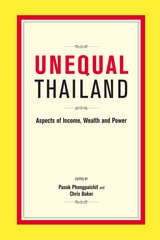
Unequal Thailand
Aspects of Income, Wealth and PowerEdited by Pasuk Phongpaichit and Chris Baker
National University of Singapore Press, 2015
The contributors to this important study—Thai scholars, reformers and civil servants—shed light on the many dimensions of inequality in Thailand, looking beyond simple income measures to consider land ownership, education, finance, business structures and politics. The contributors propose a series of reforms in taxation, spending and institutional reform that can address growing inequality.
Inequality is among the biggest threats to social stability in Southeast Asia, and this close study of a key Southeast Asian country will be relevant to regional policy-makers, economists and business decision-makers, as well as students of oligarchy and inequality more generally.
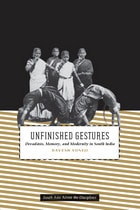
Unfinished Gestures
Devadasis, Memory, and Modernity in South IndiaDavesh Soneji
University of Chicago Press, 2011
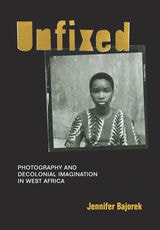
Unfixed
Photography and Decolonial Imagination in West AfricaJennifer Bajorek
Duke University Press, 2020
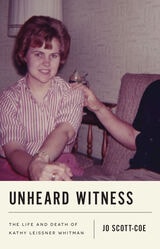
Unheard Witness
The Life and Death of Kathy Leissner WhitmanJo Scott-Coe
University of Texas Press, 2023
2025 San Antonio Conservation Society Publication Award
Unheard Witness foregrounds a young woman’s experience of domestic abuse, resistance, and survival before the mass shooting at the University of Texas at Austin in 1966.
In 1966, Kathy Leissner Whitman was a twenty-three-year-old teacher dreaming of a better future. She was an avid writer of letters, composing hundreds in the years before she was stabbed to death by her husband, Charles Whitman, who went on to commit a mass shooting from the tower at the University of Texas at Austin. Kathy’s writing provides a rare glimpse of how one woman described, and sought to change, her short life with a coercive, controlling, and violent partner.
Unheard Witness provides a portrait of Kathy’s life, doing so at a time when Americans are slowly grasping the link between domestic abuse and mass shootings. Public violence often follows violence in the home, yet such private crimes continue to be treated separately and even erased in the public imagination. Jo Scott-Coe shows how Kathy's letters go against the grain of the official history, which ignored Kathy’s perspective. With its nuanced understanding of abuse and survival, Unheard Witness is an intimate, real-time account of trust and vulnerability—in its own way, a prologue to our age of atrocities.
Unintended Lessons of Revolution
Student Teachers and Political Radicalism in Twentieth-Century MexicoTanalís Padilla
Duke University Press, 2021
Union Heartland
The Midwestern Home Front during the Civil WarEdited by Ginette Aley and J. L. Anderson, with a foreword by William C. Davis
Southern Illinois University Press, 2013

Universities and the Future of America
Derek Bok
Duke University Press, 1990
“If universities are so important to society and if ours are so superior, one might have thought that America would be flourishing in comparison to other industrialized countries of the world. Yet this is plainly not the case. . . . Our economic position in the world has deteriorated [and] we have climbed to the top, or near the top, of all advanced countries in the percentage of population who live in poverty, commit crimes, become addicted to drugs, have illegitimate children, or are classified as functionally illiterate.” In light of these results, “it is fair to ask whether our universities are doing all they can and should to help America surmount the obstacles that sap our economic strength and blight the lives of millions of our people.”
Having posed this question, Derek Bok reviews what science can do to bring about greater productivity, what professional schools can do to improve the effectiveness of corporations, government, and public education, and what all parts of the university are doing to help students acquire higher levels of ethical and social responsibility. He concludes that Universities are contributing much less than the should to help the nation address its most urgent social problems. “A century after the death of Cardinal Newman, many university officials and faculty members continue to feel ambivalent about deliberate efforts to address practical problems of society. And though competition drives university leaders and their faculties to unremitting effort, what competition rewards is chiefly success in fields that command academic prestige rather than success in responding to important social needs.”
Bok urges academic leaders, trustees, foundations, and government agencies to work together to help universities realign their priorities “so that they will be ready to make their full contribution when the nation turns its attention again to the broad agenda of reform. . . . Observing our difficulties competing abroad, our millions of people in poverty, our drug-ridden communities, our disintegrating families, our ineffective schools, those who help to shape our universities have reason to ask whether they too have any time to lose.”
Unknown Tongues
Black Women's Political Activism in the Antebellum Era, 1830-1860Gayle T. Tate
Michigan State University Press, 2003
Unknown Tongues examines the social and economic factors of northern industrialization, social reform, and black nationalism, all of which undergirded black women’s political consciousness during the decades before the American Civil War. The linkages between black women’s roles in the “culture of resistance” in slave communities and their transformations in the urban market economy fueled the development of black women’s political consciousness. As community activists and then as abolitionists, black urban women organized and protested against slavery, racism, sexism, and its attendant ills. Driven by market forces of nascent capitalism, black women created broad- based protest responses to the white power structure. Unknown Tongues explores the material realities that underpinned black women’s political development as well as the transformative stages of their political consciousness and activity.

Unmaking Russia’s Abortion Culture
Family Planning and the Struggle for a Liberal BiopoliticsMichele Rivkin-Fish
Vanderbilt University Press, 2024
Honorable Mention, Davis Center Book Prize in Political and Social Studies, Association for Slavic, East European, and Eurasian Studies, 2025
Honorable Mention, Women’s Forum Book Prize, British Association for Slavonic and East European Studies, 2024
As the predominant form of birth control in Soviet society, abortion reflected key paradoxes of state socialism: women held formal equality but lacked basic needs such as contraceptives. With market reforms, Russians enjoyed new access to Western contraceptives and new pressures to postpone childbearing until economically self-sufficient. But habits of family planning did not emerge automatically—they required extensive physician retraining, public education, and cultural transformation. In Unmaking Russia’s Abortion Culture, author Michele Rivkin-Fish examines the creative strategies of Russians who promoted family planning in place of routine abortion. Rather than emphasizing individual rights, they explained family planning’s benefits to the nation—its potential to strengthen families and prevent the secondary sterility that resulted when women underwent repeat, poor-quality abortions. Still, fierce debates about abortion and contraceptives erupted as declining fertility was framed as threatening Russia’s demographic sovereignty.
Although Russian family planners embraced a culturally meaningful liberalism that would rationalize public policy and reenchant relations, nationalist opponents cast family planning as suspicious for its association with the individualistic, “child-free” West. This book tells the story of how Russian family planners developed culturally salient frameworks to promote the acceptability of contraceptives and help end routine abortion. It also documents how nationalist campaigns for higher fertility denounced family planning and ultimately dismantled its institutions. By tracing these processes, Unmaking Russia’s Abortion Culture demonstrates the central importance of reproductive politics in the struggle for liberalizing social change that preceded Russia’s 2022 descent into war, repression, and global marginalization.
Unraveling
Remaking Personhood in a Neurodiverse AgeMatthew J. Wolf-Meyer
University of Minnesota Press, 2020
Developing a cybernetic model of subjectivity and personhood that honors disability experiences to reconceptualize the category of the human
Twentieth-century neuroscience fixed the brain as the basis of consciousness, the self, identity, individuality, even life itself, obscuring the fundamental relationships between bodies and the worlds that they inhabit. In Unraveling, Matthew J. Wolf-Meyer draws on narratives of family and individual experiences with neurological disorders, paired with texts by neuroscientists and psychiatrists, to decenter the brain and expose the ableist biases in the dominant thinking about personhood.
Unraveling articulates a novel cybernetic theory of subjectivity in which the nervous system is connected to the world it inhabits rather than being walled off inside the body, moving beyond neuroscientific, symbolic, and materialist approaches to the self to focus instead on such concepts as animation, modularity, and facilitation. It does so through close readings of memoirs by individuals who lost their hearing or developed trauma-induced aphasia, as well as family members of people diagnosed as autistic—texts that rethink modes of subjectivity through experiences with communication, caregiving, and the demands of everyday life.
Arguing for a radical antinormative bioethics, Unraveling shifts the discourse on neurological disorders from such value-laden concepts as “quality of life” to develop an inclusive model of personhood that honors disability experiences and reconceptualizes the category of the human in all of its social, technological, and environmental contexts.
Unrefined
How Capitalism Reinvented SugarDavid Singerman
University of Chicago Press, 2025
Sugar is everywhere in the western diet, blamed for epidemics of obesity, diabetes, and other modern maladies. Our addiction to sweetness has a long and unsavory history. Over the past five hundred years, sugar has shaped empires, made fortunes for a few, and brought misery for millions of workers both enslaved and free. How did sugar become a defining modern food and an essential global commodity?
In Unrefined, David Singerman recasts our thinking about this crucial substance in the history of capitalism. Before the nineteenth century, sugar’s value depended on natural qualities: its color, its taste, where it was grown, and who had made it. But beginning around 1850, a combination of plantation owners, industrialists, and scientists set out to redefine sugar itself. Deploying the tools and rhetoric of science, they transformed not just how sugar was produced or traded but even how people thought about it. By changing sugar into a pure chemical object, these forces stripped power from workers and enabled—and obscured—new kinds of fraud, corruption, and monopoly.
Taking us to unexplored spaces in the world of sugar, from laboratories and docks to refineries and the halls of Congress, Singerman illuminates dark intersections of the histories of corruption, science, and capitalism.
Unruly Complexity
Ecology, Interpretation, EngagementPeter J. Taylor
University of Chicago Press, 2005
For each realm Taylor shows that unruly complexity-situations that lack definite boundaries, where what goes on "outside" continually restructures what is "inside," and where diverse processes come together to produce change-should not be suppressed by partitioning complexity into well-bounded systems that can be studied or managed from an outside vantage point. Using case studies from Australia, North America, and Africa, he encourages readers to be troubled by conventional boundaries-especially between science and the interpretation of science-and to reflect more self-consciously on the conceptual and practical choices researchers make.
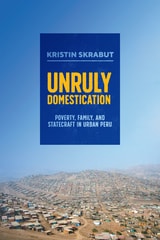
Unruly Domestication
Poverty, Family, and Statecraft in Urban PeruKristin Skrabut
University of Texas Press, 2024
2024 Flora Tristán Book Award, Sección Perú, Latin American Studies Association
How the international war on poverty shapes identities, relationships, politics, and urban space in Peru.
Unruly Domestication investigates how Peru’s ongoing, internationally endorsed "war on poverty" shapes politics, intimate identities, and urban space in Lima. Drawing on a decade of embedded, ethnographic research in Lima’s largest and most recently founded “extreme poverty zone,” Kristin Skrabut demonstrates how Peru’s efforts to fight poverty by formalizing property, identity, and family status perpetuate environmentally unsustainable urban sprawl, deepen discrimination against single mothers, and undermine Peruvians’ faith in public officials and in one another. In the process, Skrabut reveals myriad entanglements of poverty, statecraft, and private life, exploring how families are made and unmade through political practices, how gender inequalities are perpetuated through policy, and how Peruvians’ everyday pursuits of state-sanctioned domestic ideals reproduce informality and landscapes of poverty in the urban periphery.
The only full-length ethnography written about Lima’s iconic and policy-inspiring shantytowns in thirty years, Unruly Domestication provides valuable insight into the dynamics of housing and urban development in the Global South, elucidating the most intimate and profound effects of global efforts to do good.
Unruly Souls
The Digital Activism of Muslim and Christian FeministsKristin M. Peterson
Rutgers University Press, 2022
Unsettled Borders
The Militarized Science of Surveillance on Sacred Indigenous LandFelicity Amaya Schaeffer
Duke University Press, 2022

Unsettled Scores
Politics, Hollywood, and the Film Music of Aaron Copland and Hanns EislerSally Bick
University of Illinois Press, 2019
Unsettling Archival Research
Engaging Critical, Communal, and Digital ArchivesEdited by Gesa E. Kirsch, Romeo García, Caitlin Burns Allen, and Walker P. Smith
Southern Illinois University Press, 2023
A collection of accessible, interdisciplinary essays that explore archival practices to unsettle traditional archival theories and methodologies.
What would it mean to unsettle the archives? How can we better see the wounded and wounding places and histories that produce absence and silence in the name of progress and knowledge? Unsettling Archival Research sets out to answer these urgent questions and more, with essays that chart a more just path for archival work.
Unsettling Archival Research is one of the first publications in rhetoric and writing studies dedicated to scholarship that unsettles disciplinary knowledge of archival research by drawing on decolonial, Indigenous, antiracist, queer, and community perspectives. Written by established and emerging scholars, essays critique not only the practices, ideologies, and conventions of archiving, but also offer new tactics for engaging critical, communal, and digital archiving within and against systems of power. Contributors reflect on efforts to unsettle and counteract racist, colonial histories, confront the potentials and pitfalls of common archival methodologies, and chart a path for the future of archival research otherwise. Unsettling Archival Research intervenes in a critical issue: whether the discipline’s assumptions about the archives serve or fail the communities they aim to represent and what can be done to center missing voices and perspectives. The aim is to explore the ethos and praxis of bearing witness in unsettling ways, carried out as a project of queering and/or decolonizing the archives.
Unsettling Archival Research takes seriously the rhetorical force of place and wrestles honestly with histories that still haunt our nation, including the legacies of slavery, colonial violence, and systemic racism.

Unsettling Catan
Detached Design in EurogamesJ. Rey Lee
University of Michigan Press, 2025
Although peaceful revolutions are usually the best kind, it’s worth questioning how these games cultivate peaceful feelings. Today, peaceful-feeling eurogames often settle into detached design—a mindset of making conflict feel peaceful by dampening conflicted feelings. Unsettling Catan questions how peaceful-feeling eurogames can make implicitly imperialist themes palatable by cultivating a detached mindset that imagines power as peaceful, neutral, and abstract. To ask the hard questions that eurogames often look away from, the book walks through each aspect of Catan’s gameplay (placing hexes, rolling the dice, robbing and trading, collecting resources, building and scoring) to explore how simple design decisions can play out, or play with, cultural ideas and ideals. As the first entry in the Tabletop Games book series, Unsettling Catan introduces key concepts for thinking about board games as a medium and offers accessible game analyses and personal reflections to help players, creators, and scholars reimagine what board games can be and become.
Unsettling Choice
Race, Rights, and the Partitioning of Public EducationUjju Aggarwal
University of Minnesota Press, 2024
How the Great Recession revealed a system of school choice built on crisis, precarity, and exclusion
What do universal rights to public goods like education mean when codified as individual, private choices? Is the “problem” of school choice actually not about better choices for all but, rather, about the competition and exclusion that choice engenders—guaranteeing a system of winners and losers? Unsettling Choice addresses such questions through a compelling ethnography that illuminates how one path of neoliberal restructuring in the United States emerged in tandem with, and in response to, the Civil Rights movement.
Drawing on ethnographic research in one New York City school district, Unsettling Choice traces the contestations that surfaced when, in the wake of the 2007–2009 Great Recession, public schools navigated austerity by expanding choice-based programs. Ujju Aggarwal argues that this strategy, positioned as “saving public schools,” mobilized mechanisms rooted in market logics to recruit families with economic capital on their side, thereby solidifying a public sphere that increasingly resembled the private—where contingency was anticipated and rights for some were marked by intensified precarity for poor and working-class Black and Latinx families.
As Unsettling Choice shows, these struggles over public schools—one of the last remaining universal public goods in the United States—were entrapped within neoliberal regimes that exceeded privatization and ensured exclusion even as they were couched in language of equity, diversity, care, and rights. And yet this richly detailed and engaging book also tracks an architecture of expansive rights, care, and belonging built among poor and working-class parents at a Head Start center, whose critique of choice helps us understand how we might struggle for—and reimagine—justice, and a public that remains to be won.
Retail e-book files for this title are screen-reader friendly with images accompanied by short alt text and/or extended descriptions.

Unspooled
How the Cassette Made Music ShareableRob Drew
Duke University Press, 2024

Unstable Frontiers
Technomedicine and the Cultural Politics of “Curing” AIDSJohn Nguyet Erni
University of Minnesota Press, 1994
Unstable Frontiers was first published in 1994. Minnesota Archive Editions uses digital technology to make long-unavailable books once again accessible, and are published unaltered from the original University of Minnesota Press editions.
"John Erni's heartfelt and insightful book is a valuable contribution to the study of the cultural politics of AIDS."–Jeff Nunokawa Princeton University
The "cure" for AIDS: The search goes on, keeping pace with our belief that AIDS is incurable. How such a seeming paradox works-and how it may well work against the proper treatment of the disease-is the subject of Unstable Frontiers, a probing, critical look at the cultural politics behind the quest for a cure for AIDS.
This massive commercial and scientific project, John Erni suggests, actually hinges on our contradictory definitions of the disease as curable and incurable at the same time. Drawing on diverse sources, from popular media to medical literature to cultural theory, he shows how the dual discourse of curability/incurability frames the way we think about and act on issues of medical treatment for AIDS. His work makes a major advance in our understanding of—and, perhaps, humane response to—a national crisis.
In his critique of the logic and fantasies underlying the double definition of AIDS, Erni explores a broad range of issues: the scientific paradigm used to develop AZT; the politics of alternative treatment practices, of clinical drug trials, and of AIDS activism; and the notions of time and temporality operating in AIDS treatment science. He also addresses the problematic popular themes, such as "AIDS is invariably fatal" and "Knowledge = Cure."
Unique in its approach to a social and political issue still in the making, the book reveals how AIDS has challenged technomedicine's historical position of authority-and in doing so, recasts this challenge in a powerful and ultimately hopeful way.
John Nguyet Erni is assistant professor of communication at the University of New Hampshire. He has published essays on AIDS and is currently working on a book about AIDS in Thailand.
Unstaged Grief
Musicals and Mourning in Midcentury AmericaJake Johnson
University of Illinois Press, 2025
Often dismissed as escapism, screen musicals of the 1960s in fact tapped into unspoken sadness about an America that was slipping away. Jake Johnson delves into film and television musicals of the era to examine their place in networks of grieving in America, for America, and about America.
The Golden Age of musical theater ended just as Elisabeth Kübler-Ross’s On Death and Dying debuted, and Johnson uses Kübler-Ross’s five stages to frame the intertwining of musicals and grief. He analyzes films like Seven Brides for Seven Brothers and State Fair alongside paintings, poetry, and other images and texts to reveal how the musical theater engine built in the first half of the century broke down just as a new language emerged to describe the melancholy felt by people facing the end of the world they had known.
Nuanced and original, Unstaged Grief plumbs the grief, loss, and hope behind the Technicolor spectacle and rousing showstoppers.