Results by title
3064 books match the query 'Social conditions' and 49 start with u
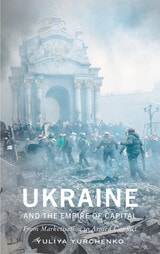
Ukraine and the Empire of Capital
From Marketisation to Armed ConflictYuliya Yurchenko
Pluto Press, 2017
Providing distinctive and unexplored reflections on the origins of the conflict, Yurchenko unpacks the four central myths that underlie Ukraine's post-Soviet reality: the myth of transition, the myth of democracy, the myth of two Ukraines, and the myth of 'the other'. In doing so, she sheds light on the current intensification of class rivalries in Ukraine, the kleptocracy, resource wars and analyses existing and potential dangers of the rightwing shift in Ukraine's polity, stressing a historic opportunity for change.
Critiquing the concept of Ukraine as ‘transition space’, she provides a sweeping analysis which includes the wider neoliberal restructuring of global political economy since the 1970s, with particular focus on Ukraine's relations with the US, the EU and Russia. This is a book for those wanting to understand the current conflict as a dangerous product of neoliberalism, of the empire of capital.
Ukrainians in Michigan
Paul M. Hedeen
Michigan State University Press, 2023

Unbinding Gentility
Women Making Music in the Nineteenth-Century SouthCandace Bailey
University of Illinois Press, 2021
Hearing southern women in the pauses of history
Southern women of all classes, races, and walks of life practiced music during and after the Civil War. Candace L. Bailey examines the history of southern women through the lens of these musical pursuits, uncovering the ways that music's transmission, education, circulation, and repertory help us understand its meaning in the women's culture of the time. Bailey pays particular attention to the space between music as an ideal accomplishment—part of how people expected women to perform gentility—and a real practice—what women actually did. At the same time, her ethnographic reading of binder’s volumes, letters and diaries, and a wealth of other archival material informs new and vital interpretations of women’s place in southern culture.
A fascinating collective portrait of women's artistic and personal lives, Unbinding Gentility challenges entrenched assumptions about nineteenth century music and the experiences of the southern women who made it.
Unbordering Migration Studies in the Caribbean and Latin America
Patsy Lewis
Rutgers University Press, 2026
Unbordering Migration Studies in the Caribbean and Latin America brings together scholars and artists across regions, generations, disciplines, and modes of expression to decenter the US-Mexico border as both a site and a concept. Calling for renewed attention to the spaces, identities, and conflicts that remain understudied and excluded from our hemispheric knowledge of forced movement, the volume reveals a wider diversity of migratory realities and considers race, ethnicity, and class beyond the hegemonic formations that eclipse non-US histories. Through multidisciplinary and geographically expansive essays that draw from history, social anthropology, environmental studies, feminist studies, and lived experience, the volume examines diverse migratory flows from Chile and Argentina in the South to Georgia and New York in the North. Individually and collectively, the essays remap migratory movements other than through the most studied South-to-North trajectories and remove the US and US-based racial formations from the center of analysis. By tracking East-West flows, intraregional mobilities, and changing conceptions of racial identity, Unbordering Migration Studies in the Caribbean and Latin America complicates the concepts of forced mobility and border crossing by highlighting alternative liminalities in sites of transit, destination, and return. Demanding engagement with the submerged histories of racism and the production of ethnoracial categories beyond the Black/white binary, the collection brings into focus identities, sites, and forces that have not yet occupied the foreground of global migration study.
Uncertain Honor
Modern Motherhood in an African CrisisJennifer Johnson-Hanks
University of Chicago Press, 2005
Combining insights from demography and cultural anthropology, Johnson-Hanks argues that Beti women delay motherhood as part of a broader attempt to assert a modern form of honor only recently made possible by formal education, Catholicism, and economic change. Through itinerant school careers and manipulations of marriage, educated Beti women now manage their status as mothers in order to coordinate major life events in the face of social and economic uncertainty.
Carefully researched and clearly written, Uncertain Honor offers an intimate look at the lives of African women trying to reconcile motherhood with new professional roles in a context of dramatic social change.
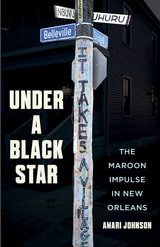
Under a Black Star
The Maroon Impulse in New OrleansAmari Johnson
University of Minnesota Press, 2025
Uncovering the spirit of freedom and self-determination in New Orleans
In Under a Black Star, Amari Johnson explores what he defines as the “maroon impulse” among the BlackStar Community in the Algiers neighborhood of New Orleans. This community sought autonomy for Black people facing systemic marginalization through denied employment, insufficient education, and a housing crisis following Hurricane Katrina, establishing initiatives such as Kamali Academy, a homeschool collective, and BlackStar Books and Caffé, a bookstore and gathering place. Instead of appealing to the city, they built the community they desired by employing legacies of marronage: disengagement, flight, and reengagement.
An active participant in the physical and ideological development of these autonomous spaces, Johnson provides nuanced insights into the community’s work toward liberation and self-determination. Demonstrating that marronage is a cultural tradition throughout the African Diaspora, he focuses on the transtemporal maroon process to show how it is central to the pursuit of autonomy, community, and freedom.
From the swamps of southeastern Louisiana, across urban obstacles, and into BlackStar’s creative spaces, Johnson’s path leads him to ask: How did the New Orleans community mobilize the tradition of marronage to create autonomous spaces amid gentrification? What forms might the maroon impulse take in the twenty-first century? This dynamic ethnographic memoir ultimately illuminates marronage as a potent form of liberatory potential, offering strategies for similar communities across the country and around the world.

Undercut
Cut Glass in Working-Class Life During the Long Gilded AgeJoseph Larnerd
University of Delaware Press, 0
How did workers experience cut glass during its cultural heyday? Rather than privilege the stories of factory owners or wealthy consumers, Undercut: Cut Glass in Working-Class Life During the Long Gilded Age refracts the medium’s history through the labors required to make and maintain these dazzling artifacts as well as popular representations of this work, from demonstrations at world's fairs to images of domestic workers with finished pieces in their charge. Cut glass and the many manifestations of public interest in its labors offered working people, too, occasions for self-reflection and, perhaps, self-realization. Foregrounding their lives, Undercut offers a multifaceted social art history of a once-popular genre of decorative art that cuts across class, gender, and race.
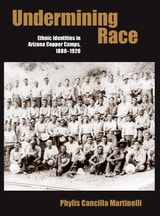
Undermining Race
Ethnic Identities in Arizona Copper Camps, 1880–1920Phylis Cancilla Martinelli
University of Arizona Press, 2009
Phylis Martinelli argues that the case of Italians in Arizona provides insight into “in between” racial and ethnic categories, demonstrating that the categorizing of Italians varied from camp to camp depending on local conditions—such as management practices in structuring labor markets and workers’ housing, and the choices made by immigrants in forging communities of language and mutual support. Italians—even light-skinned northern Italians—were not considered completely “white” in Arizona at this historical moment, yet neither were they consistently racialized as non-white, and tactics used to control them ranged from micro to macro level violence.
To make her argument, Martinelli looks closely at two “white camps” in Globe and Bisbee and at the Mexican camp of Clifton-Morenci. Comparing and contrasting the placement of Italians in these three camps shows how the usual binary system of race relations became complicated, which in turn affected the existing race-based labor hierarchy, especially during strikes. The book provides additional case studies to argue that the biracial stratification system in the United States was in fact triracial at times. According to Martinelli, this system determined the nature of the associations among laborers as well as the way Americans came to construct “whiteness.”

Understanding Contemporary Ireland
Edited by Brendan Bartley and Rob Kitchin
Pluto Press, 2006
The "Celtic Tiger" phenomenon has made Ireland the focus of much attention in recent years. Other countries have openly declared that they want to follow the Irish economic and social model. Yet there is no book that gives a comprehensive, spatially-informed analysis of the Irish experience. This book fills that gap.
Divided into four parts—planning and development, the economy, the political landscape, and population and social issues—the chapters provide an explanation of a particular aspect of Ireland and Irish life accompanied by illustrative material. In particular, the authors reveal how the transformations that have occurred are uneven and unequal in their effects across the country and highlight the challenges now facing Irish society and policy-makers.
Understanding Mainland Puerto Rican Pov
Susan Baker
Temple University Press, 2002
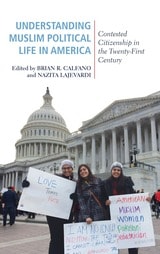
Understanding Muslim Political Life in America
Contested Citizenship in the Twenty-First CenturyBrian R. Calfano
Temple University Press, 2019
“Muslim Americans are at a political crossroads,” write editors Brian Calfano and Nazita Lajevardi. Whereas Muslims are now widely incorporated in American public life, there are increasing social and political pressures that disenfranchise them or prevent them from realizing the American Dream. Understanding Muslim Political Life in America brings clarity to the social, religious, and political dynamics that this diverse religious community faces.
In this timely volume, leading scholars cover a variety of topics assessing the Muslim American experience in the post-9/11 and pre-Trump era, including law enforcement; identity labels used in Muslim surveys; the role of gender relations; recognition; and how discrimination, tolerance, and politics impact American Muslims.
Understanding Muslim Political Life in America offers an update and reappraisal of what we know about Muslims in American political life. The editors and contributors also consider future directions and important methodological questions for research in Muslim American scholarship.
Contributors include Matt A. Barreto, Alejandro Beutel, Tony Carey, Youssef Chouhoud, Karam Dana, Oz Dincer, Rachel Gillum, Kerem Ozan Kalkan, Anwar Manje, Valerie Martinez-Ebers, Dani McLaughlan, Melissa R. Michelson, Yusuf Sarfati, Ahmet Tekelioglu, Marianne Marar Yacobian, and the editors.
Understanding the Somalia Conflagration
Identity, Political Islam and PeacebuildingAfyare Abdi Elmi
Pluto Press, 2010
Somalia has been devastated by a US-backed Ethiopian invasion and years of civil war, and it has long been without a central government. Against this background of violence, Somali academic Afyare Abdi Elmi, attempts to explain the multiple dimensions of the conflict and find a peace-building consensus.
Somalia is a failed state and a Muslim state. This combination means the West assumes that it will become a breeding ground for extremism. The country regularly hits the headlines as a piracy hotspot. This combination of internal division and outside interference makes for an intensely hostile landscape. Elmi shows that only by addressing the problem of the statelessness in the country can the long process of peace begin. He highlights clan identities, Islam and other countries in the region as the key elements in any peace-building effort.
This unique account from an author who truly understands Somalia should be required reading for students and academics of international relations and peace / conflict studies.
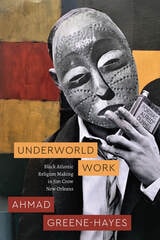
Underworld Work
Black Atlantic Religion Making in Jim Crow New OrleansAhmad Greene-Hayes
University of Chicago Press, 2025
When Zora Neale Hurston traveled to New Orleans, she encountered a religious underworld, a beautiful anarchy of spiritual life. In Underworld Work, Ahmad Greene-Hayes follows Hurston on a journey through the rich tapestry of Black religious expression from emancipation through Jim Crow. He looks within and beyond the church to recover the diverse leadership of migrants, healers, dissidents, and queer people who transformed their marginalized homes, bars, and street corners into sacred space.
Greene-Hayes shows how, while enclosed within an anti-black world, these outcasts embraced Africana esotericisms—ancestral veneration, faith healing, spiritualized sex work, and more—to conjure a connection to freer worlds past and yet to come. In recovering these spiritual innovations, Underworld Work celebrates the resilience and creativity of Africana religions.
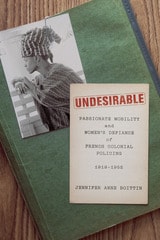
Undesirable
Passionate Mobility and Women’s Defiance of French Colonial Policing, 1919–1952Jennifer Anne Boittin
University of Chicago Press, 2022
Examining little-known policing archives in France, Senegal, and Cambodia, Jennifer Anne Boittin unearths the stories of hundreds of women labeled “undesirable” by the French colonial police and society in the early twentieth century. These “undesirables” were often women traveling alone, women who were poor or ill, women of color, or women whose intimate lives were deemed unruly. To refute the label and be able to move freely, they spoke out or wrote impassioned letters: some emphasized their “undesirable” qualities to suggest that they needed the care and protection of the state to support their movements, while others used the empire’s own laws around Frenchness and mobility to challenge state or societal interference. Tacking between advocacy and supplication, these women summoned intimate details to move beyond, contest, or confound surveillance efforts, bringing to life a practice that Boittin terms “passionate mobility.” In considering how ordinary women pursued autonomy, security, companionship, or simply a better existence in the face of surveillance and control, Undesirable illuminates pressing contemporary issues of migration and violence.
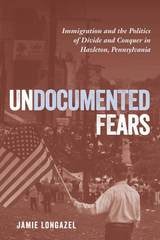
Undocumented Fears
Immigration and the Politics of Divide and Conquer in Hazleton, PennsylvaniaJamie Longazel
Temple University Press, 2016
The Illegal Immigration Relief Act (IIRA), passed in the small Rustbelt city of Hazleton, Pennsylvania in 2006, was a local ordinance that laid out penalties for renting to or hiring undocumented immigrants and declared English the city’s official language. The notorious IIRA gained national prominence and kicked off a parade of local and state-level legislative initiatives designed to crack down on undocumented immigrants.
In his cogent and timely book, UndocumentedFears, Jamie Longazel uses the debate around Hazleton’s controversial ordinance as a case study that reveals the mechanics of contemporary divide and conquer politics. He shows how neoliberal ideology, misconceptions about Latina/o immigrants, and nostalgic imagery of “Small Town, America” led to a racialized account of an undocumented immigrant “invasion,” masking the real story of a city beset by large-scale loss of manufacturing jobs.
Offering an up-close look at how the local debate unfolded in the city that set off this broader trend, Undocumented Fears makes an important connection between immigration politics and the perpetuation of racial and economic inequality.
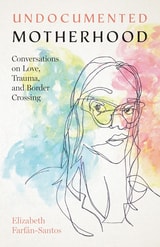
Undocumented Motherhood
Conversations on Love, Trauma, and Border CrossingElizabeth Farfán-Santos
University of Texas Press, 2022
2023 SANA Book Award, Society for the Anthropology of North America
2023 Honorable Mention, Outstanding Book Award NACCS Tejas Foco Award for Non-Fiction, National Association for Chicana and Chicano Studies
2022 Nonfiction Discovery Prize, Writers' League of Texas
An intimate portrayal of the hardships faced by an undocumented family navigating the medical and educational systems in the United States.
Claudia Garcia crossed the border because her toddler, Natalia, could not hear. Leaving behind everything she knew in Mexico, Claudia recounts the terror of migrating alone with her toddler and the incredible challenges she faced advocating for her daughter’s health in the United States. When she arrived in Texas, Claudia discovered that being undocumented would mean more than just an immigration status—it would be a way of living, of mothering, and of being discarded by even those institutions we count on to care.
Elizabeth Farfán-Santos spent five years with Claudia. As she listened to Claudia’s experiences, she recalled her own mother’s story, another life molded by migration, the US-Mexico border, and the quest for a healthy future on either side. Witnessing Claudia’s struggles with doctors and teachers, we see how the education and medical systems enforce undocumented status and perpetuate disability. At one point, in the midst of advocating for her daughter, Claudia suddenly finds herself struck by debilitating pain. Claudia is lifted up by her comadres, sent to the doctor, and reminded why she must care for herself.
A braided narrative that speaks to the power of stories for creating connection, this book reveals what remains undocumented in the motherhood of Mexican women who find themselves making impossible decisions and multiple sacrifices as they build a future for their families.
Undocuments
John-Michael Rivera
University of Arizona Press, 2021
How do you document the undocumented? UNDOCUMENTS both poses and attempts to answer this complex question by remixing the forms and styles of the first encyclopedia of the New World, the Florentine Codex, in order to tell a modern story of Greater Mexico. Employing a broad range of writing genres and scholarly approaches, UNDOCUMENTS catalogs, recovers, and erases documents and images by and about peoples of Greater Mexico from roughly the first colonial moment. This brave and bracing volume organizes and documents ancient New World Mexican peoples from the Florentine Codex (1592) to our current technology-heavy age, wherein modern lawmakers and powerful global figures desire to classify, deport, and erase immigrants and their experiences.
While grappling with anxiety and the physical and mental health consequences of the way the United States treats immigrant bodies, John-Michael Rivera documents and scrutinizes what it means to seek opportunities in America. With a focus on the poetics of Latinx documentality itself, this book is concerned with the complicated and at times contradictory ways peoples of Greater Mexico have been documented and undocumented within systems of colonial knowledges, and how these peoples have been rendered as specters of the bureaucratic state. Rivera takes us through the painful, anxiety-ridden, and complex nature of what it means to be documented or undocumented, and the cruelty married to each of these states of being.
Unequal Cures
Public Health and Political Change in Bolivia, 1900–1950Ann Zulawski
Duke University Press, 2007
Drawing on hospital and cemetery records, censuses, diagnoses, newspaper accounts, and interviews, Zulawski describes the major medical problems that Bolivia faced during the first half of the twentieth century, their social and economic causes, and efforts at their amelioration. Her analysis encompasses the Rockefeller Foundation’s campaign against yellow fever, the almost total collapse of Bolivia’s health care system during the disastrous Chaco War with Paraguay (1932–35), an assessment of women’s health in light of their socioeconomic realities, and a look at Manicomio Pacheco, the national mental hospital.
Unequal Time
Gender, Class, and Family in Employment SchedulesDan Clawson is professor of sociology at the University of Massachusetts, Amherst. Naomi Gerstel is a distinguished university professor of sociology at the University of Massachusetts, Amherst.
Russell Sage Foundation, 2014
Uneven Developments
The Ideological Work of Gender in Mid-Victorian EnglandMary Poovey
University of Chicago Press, 1988
Asserting that the organization of sexual difference is a social, not natural, phenomenon, Poovey shows how representations of gender took the form of a binary opposition in mid-Victorian culture. She then reveals the role of this opposition in various discourses and institutions—medical, legal, moral, and literary. The resulting oppositions, partly because they depended on the subordination of one term to another, were always unstable. Poovey contends that this instability helps explain why various institutional versions of binary logic developed unevenly. This unevenness, in turn, helped to account for the emergence in the 1850s of a genuine oppositional voice: the voice of an organized, politicized feminist movement.
Drawing on a wide range of sources—parliamentary debates, novels, medical lectures, feminist analyses of work, middle-class periodicals on demesticity—Poovey examines various controversies that provide glimpses of the ways in which representations of gender were simultaneously constructed, deployed, and contested. These include debates about the use of chloroform in childbirth, the first divorce law, the professional status of writers, the plight of governesses, and the nature of the nursing corps. Uneven Developments is a contribution to the feminist analysis of culture and ideology that challenges the isolation of literary texts from other kinds of writing and the isolation of women's issues from economic and political histories.
Unfamiliar Relations
Family and History in South AsiaChatterjee, Indrani
Rutgers University Press, 2004
Unfamiliar Relations restores the family and its many forms and meanings to a central place in the history of South Asia between the seventeenth and nineteenth centuries.
In her incisive introduction, Indrani Chatterjee argues that the recent wealth of scholarship on ethnicity, sexuality, gender, imperialism, and patriarchy in South Asia during the colonial period often overlooks careful historical analysis of the highly contested concept of family. Together, the essays in this book demolish "family" as an abstract concept in South Asian colonial history, demonstrating its exceedingly different meanings across temporal and geographical space.
The scholarship in this volume reveals a far more complex set of dynamics than a simple binary between indigenous and colonial forms and structures. It approaches this study from the pre-colonial period on, rather than backwards as has been the case with previous scholarship. Topics include a British colonial officer who married a Mughal noblewoman and converted to Islam around the turn of the nineteenth century, the role gossip and taboo play in the formation of Indian family history, and an analysis of social relations in the penal colony on the Andaman Islands.
Unfinished Gestures
Devadasis, Memory, and Modernity in South IndiaDavesh Soneji
University of Chicago Press, 2011
Unfree in Palestine
Registration, Documentation and Movement RestrictionAdah Kay and Nadia Abu-Zahra
Pluto Press, 2012
The authors chronicle how millions of Palestinians have been denationalised through the bureaucratic tools of census, population registration, blacklisting and a discriminatory legal framework. They show how identity documents are used by Israel as a means of coercion, extortion, humiliation and informant recruitment. Movement restrictions tied to IDs and population registers threaten Palestinian livelihoods, freedom of movement and access to basic services such as health and education.
Unfree in Palestine is a masterful expose of the web of bureaucracy used by Israel to deprive the Palestinians of basic rights and freedoms, and calls for international justice and inclusive security in place of discrimination and division.
Universal Citizenship
Latina/o Studies at the Limits of IdentityBy R. Andrés Guzmán
University of Texas Press, 2019
Recently, many critics have questioned the idea of universal citizenship by pointing to the racial, class, and gendered exclusions on which the notion of universality rests. Rather than jettison the idea of universal citizenship, however, R. Andrés Guzmán builds on these critiques to reaffirm it especially within the fields of Latina/o and ethnic studies. Beyond conceptualizing citizenship as an outcome of recognition and admittance by the nation-state—in a negotiation for the right to have rights—he asserts that, insofar as universal citizenship entails a forceful entrance into the political from the latter’s foundational exclusions, it emerges at the limits of legality and illegality via a process that exceeds identitarian capture.
Drawing on Lacanian psychoanalysis and philosopher Alain Badiou’s notion of “generic politics,” Guzmán advances his argument through close analyses of various literary, cultural, and legal texts that foreground contention over the limits of political belonging. These include the French Revolution, responses to Arizona’s H.B. 2281, the 2006 immigrant rights protests in the United States, the writings of Oscar “Zeta” Acosta, Frantz Fanon’s account of Algeria’s anticolonial struggle, and more. In each case, Guzmán traces the advent of the “citizen” as a collective subject made up of anyone who seeks to radically transform the organizational coordinates of the place in which she or he lives.

Unmarried Women
StoriesMatilde Serao
Northwestern University Press, 2007
This collection, the first to make Serao’s short stories available in English translation, reflects this naturalistic writer’s interest in the everyday drama of the lives of women in the Italy of her day. In Serao’s spare and simple prose, the young women of turn-of-the-century Naples come to life, negotiating the details of school and work, church and marriage, in a world circumscribed by fathers and chaperones, fiancés and bosses. Infused with the writer’s deep sense of humanity, their quietly involving stories—at once so poetic and so ordinary—attest to the transformative power of literature, and to the promise that even the most humble life holds.
Unmentionable Madness
Gender, Disability, and Shame in the Malaria Treatment of NeurosyphilisChristin L. Hancock
University of Illinois Press, 2025
Christin L. Hancock looks through the lens of feminist disability to examine the popular but ethically suspect treatment and its consequences. As Hancock shows, the treatment’s purported success rate relied on the disabled minds and bodies of people incarcerated in mental hospitals. The backgrounds and identities of these patients reflected and perpetuated attitudes around poverty, gender, race, and disability while betraying authorities’ desire to protect the public from women and men perceived as abnormal, sexually tainted, and unworthy of community life.
Paying special attention to the patients’ voices and experiences, Unmentionable Madness offers a disability history that confronts the ethics of experimentation.
Unraveling the Garment Industry
Transnational Organizing and Women’s WorkEthel C. Brooks
University of Minnesota Press, 2007
Brooks analyzes a two-pronged problem in consumer boycott campaigns against labor abuse in the garment industry. First, how are we to understand the political necessities of local protest such as the right to unionize against the emphasis placed on consumer boycotts? Second, what and whose agency is privileged or obscured within the symbolic economies and the politics of information deployed by these campaigns? Tying both of these questions together is a commitment to seeing globalization as embedded in the everyday realities of the local.
Drawing attention to the race, class, and gender assumptions central to powerful consumer boycotts, Brooks reveals how these movements unintentionally reinforce the global economic forces they denounce.
Ethel C. Brooks is assistant professor of women’s and gender studies and sociology at Rutgers University.
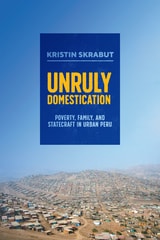
Unruly Domestication
Poverty, Family, and Statecraft in Urban PeruKristin Skrabut
University of Texas Press, 2024
2024 Flora Tristán Book Award, Sección Perú, Latin American Studies Association
How the international war on poverty shapes identities, relationships, politics, and urban space in Peru.
Unruly Domestication investigates how Peru’s ongoing, internationally endorsed "war on poverty" shapes politics, intimate identities, and urban space in Lima. Drawing on a decade of embedded, ethnographic research in Lima’s largest and most recently founded “extreme poverty zone,” Kristin Skrabut demonstrates how Peru’s efforts to fight poverty by formalizing property, identity, and family status perpetuate environmentally unsustainable urban sprawl, deepen discrimination against single mothers, and undermine Peruvians’ faith in public officials and in one another. In the process, Skrabut reveals myriad entanglements of poverty, statecraft, and private life, exploring how families are made and unmade through political practices, how gender inequalities are perpetuated through policy, and how Peruvians’ everyday pursuits of state-sanctioned domestic ideals reproduce informality and landscapes of poverty in the urban periphery.
The only full-length ethnography written about Lima’s iconic and policy-inspiring shantytowns in thirty years, Unruly Domestication provides valuable insight into the dynamics of housing and urban development in the Global South, elucidating the most intimate and profound effects of global efforts to do good.
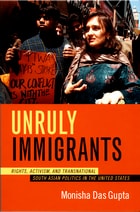
Unruly Immigrants
Rights, Activism, and Transnational South Asian Politics in the United StatesMonisha Das Gupta
Duke University Press, 2006
Das Gupta offers an ethnography of seven South Asian organizations in the northeastern United States, looking at their development and politics as well as the conflicts that have emerged within the groups over questions of sexual, class, and political identities. She examines the ways that women’s organizations have defined and responded to questions of domestic violence as they relate to women’s immigration status; she describes the construction of a transnational South Asian queer identity and culture by people often marginalized by both mainstream South Asian and queer communities in the United States; and she draws attention to the efforts of labor groups who have sought economic justice for taxi drivers and domestic workers by confronting local policies that exploit cheap immigrant labor. Responding to the shortcomings of the state, their communities, and the larger social movements of which they are a part, these groups challenge the assumption that citizenship is the necessary basis of rights claims.
Unseen Flesh
Gynecology and Black Queer Worth-Making in BrazilNessette Falu
Duke University Press, 2023
Unsettled Belonging
Educating Palestinian American Youth after 9/11Thea Renda Abu El-Haj
University of Chicago Press, 2015
Abu El-Haj explores the school as the primary site where young people from immigrant communities encounter the central discourses about what it means to be American. She illustrates the complex ways social identities are bound up with questions of belonging and citizenship, and she details the processes through which immigrant youth are racialized via everyday nationalistic practices. Finally, she raises a series of crucial questions about how we educate for active citizenship in contemporary times, when more and more people’s lives are shaped within transnational contexts. A compelling account of post-9/11 immigrant life, Unsettled Belonging is a steadfast look at the disjunctures of modern citizenship.
Unsettled Borders
The Militarized Science of Surveillance on Sacred Indigenous LandFelicity Amaya Schaeffer
Duke University Press, 2022
Unsettled Futures
Carceral Circuits and Old Age in JapanJason Danely
Vanderbilt University Press, 2024
Elderly ex-offenders are some of the most vulnerable and marginalized groups in Japan today, with high levels of poverty and homelessness, disability, mental health problems, and social isolation. Those with a history of incarceration and, by extension, their family, face stigma and discrimination that further erodes their ability to reintegrate and puts them at greater risk of reoffending. Unlike in any other country in the world, older people in Japan have a higher rate of reoffending than other age groups. In Unsettled Futures, author Jason Danely argues that we cannot dismiss these individuals merely as deviants; rather, their circumstances reveal deep contradictions in the overlapping terrain of welfare and punishment, and the precarity that forecloses on possibilities for older people to build a good life.
Unsettled
Cambodian Refugees in the New York City HyperghettoEric Tang
Temple University Press, 2015
After surviving the Khmer Rouge genocide, followed by years of confinement to international refugee camps, as many as 10,000 Southeast Asian refugees arrived in the Bronx during the 1980s and ‘90s. Unsettled chronicles the unfinished odyssey of Bronx Cambodians, closely following one woman and her family for several years as they survive yet resist their literal insertion into concentrated Bronx poverty.
Eric Tang tells the harrowing and inspiring stories of these refugees to make sense of how and why the displaced migrants have been resettled in the “hyperghetto.” He argues that refuge is never found, that rescue discourses mask a more profound urban reality characterized by racialized geographic enclosure, economic displacement and unrelenting poverty, and the criminalization of daily life.
Unsettled views the hyperghetto as a site of extreme isolation, punishment, and confinement. The refugees remain captives in late-capitalist urban America. Tang ultimately asks: What does it mean for these Cambodians to resettle into this distinct time and space of slavery’s afterlife?
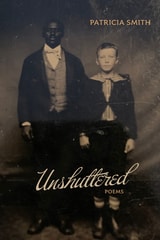
Unshuttered
PoemsPatricia Smith
Northwestern University Press, 2023
National Book Award winner Patricia Smith presents a portrait of Black America in the nineteenth century
Over the course of two decades, Patricia Smith has amassed a collection of rare nineteenth-century photographs of Black men, women, and children who, in these pages, regard us from the staggering distance of time.
Unshuttered is a vessel for the voices of their incendiary and critical era. Smith’s searing stanzas and revelatory language imbue the subjects of the photos with dynamism and revived urgency while she explores how her own past of triumphs and losses is linked inextricably to their long-ago lives:
We ache for fiction etched in black and white. Our eyes never touch. These tragic grays and bustles, mourners’
hats plopped high upon our tamed but tangled crowns, strain to disguise what yearning does with us.
Unsilencing Gaza
Reflections on ResistanceSara Roy
Pluto Press, 2021
Gaza, the centre of Palestinian nationalism and resistance to the occupation, is the linchpin of the Israeli-Palestinian conflict and the key to its resolution. Since 2005, Israel has deepened the isolation of the territory, severing it almost completely from its most vital connections to the West Bank, Israel and beyond, and has deliberately shattered its economy, transforming Palestinians from a people with political rights into a humanitarian problem.
Sara Roy unpacks this process, looking at US foreign policy towards the Palestinians, as well as analysing the trajectory of Israeli policy toward Gaza, which became a series of punitive approaches meant not only to contain the Hamas regime but weaken Gazan society.
Roy also reflects on Gaza's ruination from a Jewish perspective and discusses the connections between Gaza's history and her own as a child of Holocaust survivors. This book, a follow up from the renowned Failing Peace, comes from one of the world's most acclaimed writers on the region.
Unveiling the Color Line
W. E. B. Du Bois on the Problem of WhitenessLisa J. McLeod
University of Massachusetts Press, 2024
In The Souls of Black Folk, W. E. B. Du Bois brilliantly details the African American experience. Yet the renowned sociologist was also an astute chronicler of white people, particularly their racism. As Unveiling the Color Line demonstrates, Du Bois’s trenchant analysis of whiteness and white supremacy began in his earliest work—his 1890 speech on Jefferson Davis—and continued in every major book he published in his more than sixty-year career, up to The Black Flame Trilogy.
Lisa J. McLeod traces the development of Du Bois’s conception of whiteness, and the racism inherent to it, as an all-encompassing problem, whether predicated on ignorance, moral failure, or the inability to recognize the humanity in other people. In clear, elegant prose, McLeod investigates Du Bois’s complex and nuanced thinking, putting his insights into dialogue with contemporary racial theorists to demonstrate his continuing value to present-day critical thought and activism.
Unwelcome Shores
Black Refugees in AmericaBernadette Ludwig
Rutgers University Press, 2026
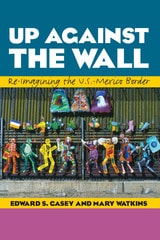
Up Against the Wall
Re-Imagining the U.S.-Mexico BorderBy Edward S. Casey and Mary Watkins
University of Texas Press, 2014
Using the U.S. wall at the border with Mexico as a focal point, two experts examine the global surge of economic and environmental refugees, presenting a new vision of the relationships between citizen and migrant in an era of “Juan Crow,” which systematically creates a perpetual undercaste.
Winner, National Association for Ethnic Studies (NAES) Outstanding Book Award, 2017
As increasing global economic disparities, violence, and climate change provoke a rising tide of forced migration, many countries and local communities are responding by building walls—literal and metaphorical—between citizens and newcomers. Up Against the Wall: Re-imagining the U.S.-Mexico Border examines the temptation to construct such walls through a penetrating analysis of the U.S. wall at the U.S.-Mexico border, as well as investigating the walling out of Mexicans in local communities. Calling into question the building of a wall against a friendly neighboring nation, Up Against the Wall offers an analysis of the differences between borders and boundaries. This analysis opens the way to envisioning alternatives to the stark and policed divisions that are imposed by walls of all kinds. Tracing the consequences of imperialism and colonization as citizens grapple with new migrant neighbors, the book paints compelling examples from key locales affected by the wall—Nogales, Arizona vs. Nogales, Sonora; Tijuana/San Diego; and the lower Rio Grande Valley of Texas. An extended case study of Santa Barbara describes the creation of an internal colony in the aftermath of the U.S. conquest of Mexican land, a history that is relevant to many U.S. cities and towns.
Ranging from human rights issues in the wake of massive global migration to the role of national restorative shame in the United States for the treatment of Mexicans since 1848, the authors delve into the broad repercussions of the unjust and often tragic consequences of excluding others through walled structures along with the withholding of citizenship and full societal inclusion. Through the lens of a detailed examination of forced migration from Mexico to the United States, this transdisciplinary text, drawing on philosophy, psychology, and political theory, opens up multiple insights into how nations and communities can coexist with more justice and more compassion.
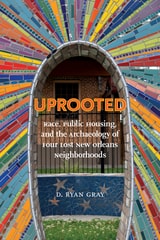
Uprooted
Race, Public Housing, and the Archaeology of Four Lost New Orleans NeighborhoodsD. Ryan Gray
University of Alabama Press, 2020
The archaeology of four New Orleans neighborhoods that were replaced by public housing projects
Uprooted: Race, Public Housing, and the Archaeology of Four Lost New Orleans Neighborhoods uses archaeological research on four neighborhoods that were razed during the construction of public housing in World War II–era New Orleans. Although each of these neighborhoods was identified as a “slum” historically, the material record challenges the simplicity of this designation. D. Ryan Gray provides evidence of the inventiveness of former residents who were marginalized by class, color, or gender and whose everyday strategies of survival, subsistence, and spirituality challenged the city’s developing racial and social hierarchies.
These neighborhoods initially appear to have been quite distinct, ranging from the working-class Irish Channel, to the relatively affluent Creole of Color–dominated Lafitte area, to the former location of Storyville, the city’s experiment in semilegal prostitution. Archaeological and historical investigations suggest that race was the crucial factor in the areas’ selection for clearance. Each neighborhood manifested a particular perceived racial disorder, where race intersected with ethnicity, class, or gender in ways that defied the norms of Jim Crow segregation.
Gray’s research makes use of both primary documents—including census records, city directories, and even the brothel advertising guides called “Blue Books”—and archaeological data to examine what this entailed at a variety of scales, reconstructing narratives of the households and communities affected by clearance. Public housing, both in New Orleans and elsewhere, imposed a new kind of control on urban life that had the effect of making cities both more segregated and less equal. The story of the neighborhoods that were destroyed provides a reminder that their erasure was not an inevitable outcome, and that a more equitable and just city is still possible today. A critical examination of the rise of public housing helps inform the ongoing debates over its demise, especially in light of the changing face of post-Katrina New Orleans.
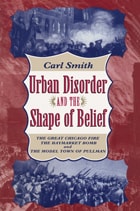
Urban Disorder and the Shape of Belief
The Great Chicago Fire, the Haymarket Bomb, and the Model Town of PullmanCarl Smith
University of Chicago Press, 1994
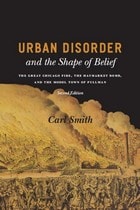
Urban Disorder and the Shape of Belief
The Great Chicago Fire, the Haymarket Bomb, and the Model Town of Pullman, Second EditionCarl Smith
University of Chicago Press, 2007
In Urban Disorder and the Shape of Belief, Carl Smith explores the imaginative dimensions of these events as he traces the evolution of interconnected beliefs and actions that increasingly linked city, disorder, and social reality in the minds of Americans. Examining a remarkable range of writings and illustrations, as well as protests, public gatherings, trials, hearings, and urban reform and construction efforts, Smith argues that these three events—and the public awareness of them—not only informed one another, but collectively shaped how Americans understood, and continue to understand, Chicago and modern urban life.
This classic of urban cultural history is updated with a foreword by the author that expands our understanding of urban disorder to encompass such recent examples as Hurricane Katrina, the Oklahoma City Bombing, and 9/11.
“Cultural history at its finest. By utilizing questions and methodologies of urban studies, social history, and literary history, Smith creates a sophisticated account of changing visions of urban America.”—Robin F. Bachin, Journal of Interdisciplinary History
Urban Dwellings, Haitian Citizenships
Housing, Memory, and Daily Life in HaitiVincent Joos
Rutgers University Press, 2022
Urban Histories of Rajasthan
Religion, Politics and Society (1550–1800)Elizabeth M. Thelen
Gingko, 2022
Diverse peoples intermingled in the streets and markets of premodern Indian cities. This book considers how these diverse residents lived together and negotiated their differences. Which differences mattered, when and to whom? How did state actions and policies affect urban society and the lives of various communities? How and why did conflict occur in urban spaces? Through these questions, this book explores the histories of urban communities in the three cities of Ajmer, Nagaur, and Pushkar in Rajasthan, between the sixteenth and eighteenth centuries. The focus of this study is on everyday life, contextualizing religious practices and conflicts by considering patterns of patronage and broader conflict patterns within society. The book examines various archival documents, from family and institutional records to state registers, and uses these documents to demonstrate the complex and sometimes contradictory ways religion intersected with politics, economics, and society. The author shows how many patronage patterns and processes persisted in altered forms, and how the robustness of these structures contributed to the resilience of urban spaces and society in precolonial Rajasthan.
Urban Imaginaries in Native Amazonia
Tales of Alterity, Power, and DefianceFernando Santos-Granero
University of Arizona Press, 2023
Featuring analysis from historical, ethnological, and philosophical perspectives, contributors seek to explain the imaginaries’ widespread diffusion, as well as their influence in present-day migration and urbanization. Above all, it underscores how these urban imaginaries allow Indigenous Amazonians to express their concerns about power, alterity, domination, and defiance.
Contributors
Natalia Buitron
Philippe Erikson
Emanuele Fabiano
Fabiana Maizza
Daniela Peluso
Fernando Santos-Granero
Pirjo Kristiina Virtanen
Robin M. Wright
Urban Lawyers
The New Social Structure of the BarJohn P. Heinz, Robert L. Nelson, Rebecca L. Sandefur, and Edward O. Laumann
University of Chicago Press, 2005
Drawing on extensive interviews with Chicago lawyers, the authors demonstrate how developments in the profession have affected virtually every aspect of the work and careers of urban lawyers-their relationships with clients, job tenure and satisfaction, income, social and political values, networks of professional connections, and patterns of participation in the broader community. Yet despite the dramatic changes, much remains the same. Stratification of income and power based on gender, race, and religious background, for instance, still maintains inequality within the bar.
The authors of Urban Lawyers conclude that organizational priorities will likely determine the future direction of the legal profession. And with this landmark study as their guide, readers will be able to make their own informed predictions.
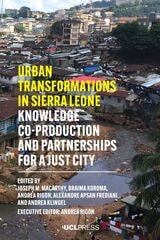
Urban Transformations in Sierra Leone
Knowledge Co-Production and Partnerships for a Just CityEdited by Joseph M. Macarthy, Braima Koroma, Andrea Rigon, Alexandre Apsan Frediani, and Andrea Klingel
University College London, 2024
With a population of over one million, Freetown, Sierra Leone faces serious challenges with service provisions, housing, infrastructure, employment, and climate change. In 2015, the Sierra Leone Urban Research Centre (SLURC) was established to address these challenges through research, capacity building, and advocacy. Urban Transformations in Sierra Leone shares SLURC’s progress, articulating its key findings and reflections on the partnerships it helped enable.

Utah in the Twentieth Century
Brian Q. Cannon and Jessie Embry
Utah State University Press, 2009
The twentieth century could easily be Utah's most interesting and complex. Utah in the Twentieth Century chronicles the social and cultural transitions of the time, offering a well-rounded perspective on the development and change the Beehive State went through during this period.
It was an era complicated by the push of economic development and pull of traditional culture, demand for natural resources from a fragile and scenic environment, questions of who governs and how, who gets a vote, and who controls what on contested public lands, during which outside trade and a tourist economy increasingly challenged and fed an insular society. Activists left and right declaimed constitutional liberties while Utah's Native Americans become the last enfranchised in the nation. Proud contributions to national wars contrasted with denial of deep dependence on federal money; the skepticism of provocative writers, boosters eager for growth; and reflexive patriotism somehow bonded to ingrained distrust of federal government.
A valuable resource for students and teachers, this work is also fruitful reading for anyone who desires to know more about key themes of Utah’s history in the twentieth century.