Results by title
661 books match the query 'South America' and 9 start with u
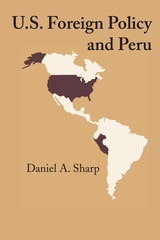
U.S. Foreign Policy and Peru
By Daniel A. Sharp
University of Texas Press, 1972
This book presents the first authoritative and comprehensive account of the development of the Peruvian revolution of 1968. The study resulted from a team experiment in applied political science, economics, and sociology that maintained effective communications between Peru and the United States at many levels during the difficult years following the revolution. Each chapter is the result of continuous interaction between a leading authority and the major sectors of both societies. History is here presented in its diplomatic, social, economic, and cultural context.
The Peruvian and U.S. governments helped to define the subjects of greatest interest to their respective countries, and a systematic effort was made to find the leading authorities on each issue. Since one purpose of this volume is to affect policy by identifying new alternative policies, the papers included here were prepared specifically to be of value to policy makers.
This book was produced by a citizens’ constituency on U.S. foreign policy under the auspices of the Adlai Stevenson Institute of International Affairs, the Chicago Council on Foreign Relations, and the Johnson Foundation.
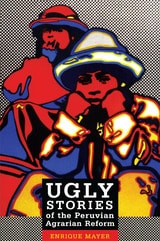
Ugly Stories of the Peruvian Agrarian Reform
Enrique Mayer
Duke University Press, 2009
Mayer interviewed ex-landlords, land expropriators, politicians, government bureaucrats, intellectuals, peasant leaders, activists, ranchers, members of farming families, and others. Weaving their impassioned recollections with his own commentary, he offers a series of dramatic narratives, each one centered around a specific instance of land expropriation, collective enterprise, and disillusion. Although the reform began with high hopes, it was quickly complicated by difficulties including corruption, rural and urban unrest, fights over land, and delays in modernization. As he provides insight into how important historical events are remembered, Mayer re-evaluates Peru’s military government (1969–79), its audacious agrarian reform program, and what that reform meant to Peruvians from all walks of life.
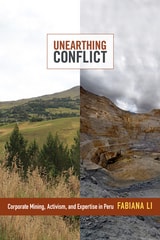
Unearthing Conflict
Corporate Mining, Activism, and Expertise in PeruFabiana Li
Duke University Press, 2015
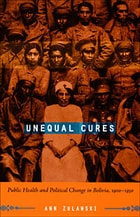
Unequal Cures
Public Health and Political Change in Bolivia, 1900–1950Ann Zulawski
Duke University Press, 2007
Drawing on hospital and cemetery records, censuses, diagnoses, newspaper accounts, and interviews, Zulawski describes the major medical problems that Bolivia faced during the first half of the twentieth century, their social and economic causes, and efforts at their amelioration. Her analysis encompasses the Rockefeller Foundation’s campaign against yellow fever, the almost total collapse of Bolivia’s health care system during the disastrous Chaco War with Paraguay (1932–35), an assessment of women’s health in light of their socioeconomic realities, and a look at Manicomio Pacheco, the national mental hospital.
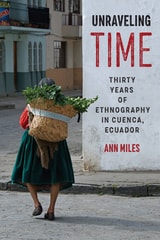
Unraveling Time
Thirty Years of Ethnography in Cuenca, EcuadorAnn Miles
University of Texas Press, 2022
Ann Miles has been chronicling life in the Ecuadorian city of Cuenca for more than thirty years. In that time, she has witnessed change after change. A large regional capital where modern trains whisk residents past historic plazas, Cuenca has invited in the world and watched as its own citizens risk undocumented migration abroad. Families have arrived from rural towns only to then be displaced from the gentrifying city center. Over time, children have been educated, streetlights have made neighborhoods safer, and remittances from overseas have helped build new homes and sometimes torn people apart. Roads now connect people who once were far away, and talking or texting on cell phones has replaced hanging out at the corner store.
Unraveling Time traces the enduring consequences of political and social movements, transnational migration, and economic development in Cuenca. Miles reckons with details that often escape less committed observers, suggesting that we learn a good deal more when we look back on whole lives. Practicing what she calls an ethnography of accrual, Miles takes a long view, where decades of seemingly disparate experiences coalesce into cultural transformation. Her approach not only reveals what change has meant in a major Latin American city but also serves as a reflection on ethnography itself.
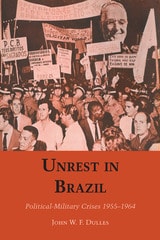
Unrest in Brazil
Political-Military Crises 1955-1964By John W. F. Dulles
University of Texas Press, 1970
… I offer my life in a holocaust … This people whose slave I was will no longer be slave to anyone. My sacrifice will remain forever in their souls and my blood will be the price of their ransom.
President Getulio Vargas' testament—written shortly before his suicide on August 24, 1954—was prophetic, for the Vargas legacy was to cast a shadow on political-military events of the next decade.
With news of Vargas' suicide, opponents of the late President, who were usually out of power, tried to organize. The military itself was split, but those favoring Kubitschek, apparent winner of the 1955 presidential election on a ticket of Vargas-created parties, gained control. To assure Kubitschek's inauguration Army leaders deposed two acting Presidents in 1955.
During Kubitschek's presidency (1956–1961 ) there were manifestations of discontent by military and political groups who ascribed numerous evils to Vargas and his followers.
In 1961, when Kubitschek's successor, Jânio Quadros, resigned after six months in office, the unrest intensified. Vice President Jango Goulart assumed the presidency and sought unsuccessfully to conciliate contending forces; his battle for reform seemed to make him an ally of "far leftists." Feeling that discipline was being undermined by men close to the President and that only military action could save Brazil from following the path favored by influential Communist labor leaders, a majority of the Army officers agreed to overthrow Goulart's administration in 1964.
Unrest in Brazil describes in exciting detail the government crises and resulting military interventions that punctuated the power struggle between supporters and opponents of Vargas in the decade following his death.
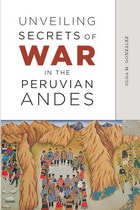
Unveiling Secrets of War in the Peruvian Andes
Olga M. González
University of Chicago Press, 2011
The Maoist guerrilla group Shining Path launched its violent campaign against the government in Peru’s Ayacucho region in 1980. When the military and counterinsurgency police forces were dispatched to oppose the insurrection, the violence quickly escalated. The peasant community of Sarhua was at the epicenter of the conflict, and this small village is the focus of Unveiling Secrets of War in the Peruvian Andes. There, nearly a decade after the event, Olga M. González follows the tangled thread of a public secret: the disappearance of Narciso Huicho, the man blamed for plunging Sarhua into a conflict that would sunder the community for years.
Drawing on extensive fieldwork and a novel use of a cycle of paintings, González examines the relationship between secrecy and memory. Her attention to the gaps and silences within both the Sarhuinos’ oral histories and the paintings reveals the pervasive reality of secrecy for people who have endured episodes of intense violence. González conveys how public secrets turn the process of unmasking into a complex mode of truth telling. Ultimately, public secrecy is an intricate way of “remembering to forget” that establishes a normative truth that makes life livable in the aftermath of a civil war.
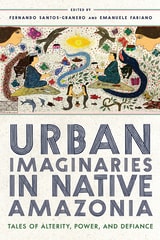
Urban Imaginaries in Native Amazonia
Tales of Alterity, Power, and DefianceFernando Santos-Granero
University of Arizona Press, 2023
Featuring analysis from historical, ethnological, and philosophical perspectives, contributors seek to explain the imaginaries’ widespread diffusion, as well as their influence in present-day migration and urbanization. Above all, it underscores how these urban imaginaries allow Indigenous Amazonians to express their concerns about power, alterity, domination, and defiance.
Contributors
Natalia Buitron
Philippe Erikson
Emanuele Fabiano
Fabiana Maizza
Daniela Peluso
Fernando Santos-Granero
Pirjo Kristiina Virtanen
Robin M. Wright

Urban Solidarity
Gender, Mobility, and the Unfinished Politics of Buen VivirJulie Gamble
University of Texas Press, 0
An exploration of how the citizens of Quito created community via transportation systems in spite of political crisis.
Between 2007 and 2017, Ecuadoreans breathed the air of revolution. Their national project, spearheaded by Democratic Socialist president Rafael Correa, was known as buen vivir—good living. Both a discourse and a development strategy, buen vivir promoted interdependence with and among working-class and marginalized people. And public investment shifted toward shared infrastructure, especially transit. Yet much work was still to be done when Correa left office, and Ecuador has since seen retrenchment.
Urban Solidarity explores and interprets buen vivir’s afterlife, as local organizers in the capital Quito sustain and build the interdependence agenda in the midst of state retreat. Since the IMF forced the government to cancel fuel subsidies, residents have responded by developing impressive carsharing (taxirutas) and shared-cycling resources. These efforts are markedly feminist as well, prioritizing women’s safety and independence as they travel about the city to earn money and care for their families. Gamble argues that buen vivir planted the seed of a new politics, that could once again inspire state action. For now, the people of Quito continue to foster the solidarity foundational to a good life.