Results by title
4155 books match the query 'State & Local' and 44 start with u
UNDER THE FLAG OF THE NATION
DIARIES AND LETTERS OF OWEN JOHNSTON HOPKINS, A YANKEE VOLUNTEER IN THE CIVIL WAROwen Johnston Hopkins
The Ohio State University Press, 1998
Owen Hopkins was a young man brought to maturity by the agony of war, but in spite of the horror of battle and the tedium of life in camp, he maintained a lively sense of humor and a constant devotion to the ideals for which he fought. The Civil War in these pages is a savage, vindictive conflict fought with canister, "minnie balls," grapeshot, the Enfield rifle, and the bayonet. Only seventeen when he enlisted in 1861, Hopkins was a foot soldier and a witness to the action that took place on the field of battle.
A vital part of Hopkins's life in the army was his correspondence with Julia Allison, who lived in his hometown of Bellefontaine. They began writing each other in 1863, and their friendship deepened into love. Each was a fervent patriot, and their shared devotion to their country was a significant fact of their relationship. They were married in 1865.
An epilogue tells what happened to Hopkins after June of 1865: his career, his family, and his death in 1902. Originally published in1961, this work is now available for the first time in paperback.
Ukrainians in Michigan
Paul M. Hedeen
Michigan State University Press, 2023

Unbinding Gentility
Women Making Music in the Nineteenth-Century SouthCandace Bailey
University of Illinois Press, 2021
Hearing southern women in the pauses of history
Southern women of all classes, races, and walks of life practiced music during and after the Civil War. Candace L. Bailey examines the history of southern women through the lens of these musical pursuits, uncovering the ways that music's transmission, education, circulation, and repertory help us understand its meaning in the women's culture of the time. Bailey pays particular attention to the space between music as an ideal accomplishment—part of how people expected women to perform gentility—and a real practice—what women actually did. At the same time, her ethnographic reading of binder’s volumes, letters and diaries, and a wealth of other archival material informs new and vital interpretations of women’s place in southern culture.
A fascinating collective portrait of women's artistic and personal lives, Unbinding Gentility challenges entrenched assumptions about nineteenth century music and the experiences of the southern women who made it.
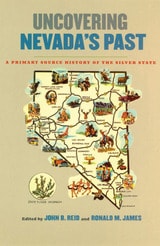
Uncovering Nevada's Past
A Primary Source History of the Silver StateJohn B. Reid
University of Nevada Press, 2004
Under The Mountain
Molly Flagg Knudtsen
University of Nevada Press, 1982
This collection of vignettes about life in Central Nevada is much more than a historical document. According to author Molly Knudtsen, “These are the stories neighbors and families tell, where fact grows just a little larger than life. This is the stuff of legend.” The book focuses on a time when splendorous houses decorated the windswept valleys of Central Nevada; where fearless, stouthearted men and women braved the elements to survive and seek their fortune; and when people who loved the land clung to it and gave it a character all its own. These tales capture the spirit and folklore of early-day Central Nevada and illustrate the effect on its present-day inhabitants. Molly Knudtsen shares the experience of riding horseback through some of the great archaeological finds of the valley. She divulges the secret of converting flour, yeast, and potato water into a perfect loaf of bread. And through colorful anecdotes, she passes along the legendary accounts of Colonel Dave Buel.
Under the Campus, the Land
Anishinaabe Futuring, Colonial Non-Memory, and the Origin of the University of MichiganAndrew Herscher
University of Michigan Press, 2025
Under the Campus, the Land narrates the University of Michigan’s place in both Anishinaabe and settler history, tracing the university’s participation in the colonization of Anishinaabe homelands, Anishinaabe efforts to claim their right to an education, and the university’s history of disavowing, marginalizing, and minimizing its responsibilities and obligations to Anishinaabe people. Continuing the public conversations of the same name on U-M’s campus in 2023, Under the Campus, the Land provides a new perspective on the relationship between universities and settler colonialism in the US. Members of the U-M community, scholars of Midwest history, and those interested in Indigenous studies will find this book compelling.
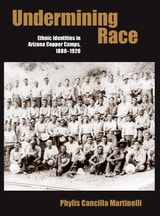
Undermining Race
Ethnic Identities in Arizona Copper Camps, 1880–1920Phylis Cancilla Martinelli
University of Arizona Press, 2009
Phylis Martinelli argues that the case of Italians in Arizona provides insight into “in between” racial and ethnic categories, demonstrating that the categorizing of Italians varied from camp to camp depending on local conditions—such as management practices in structuring labor markets and workers’ housing, and the choices made by immigrants in forging communities of language and mutual support. Italians—even light-skinned northern Italians—were not considered completely “white” in Arizona at this historical moment, yet neither were they consistently racialized as non-white, and tactics used to control them ranged from micro to macro level violence.
To make her argument, Martinelli looks closely at two “white camps” in Globe and Bisbee and at the Mexican camp of Clifton-Morenci. Comparing and contrasting the placement of Italians in these three camps shows how the usual binary system of race relations became complicated, which in turn affected the existing race-based labor hierarchy, especially during strikes. The book provides additional case studies to argue that the biracial stratification system in the United States was in fact triracial at times. According to Martinelli, this system determined the nature of the associations among laborers as well as the way Americans came to construct “whiteness.”
Understanding Missouri's Constitutional Government
Richard Fulton and Jerry Brekke
University of Missouri Press, 2010
Understanding Missouri’s Constitutional Government presents a case study in the foundations of state governments. The book provides a sweeping look at the constitutional foundations of the processes of Missouri government. Authors Richard Fulton and Jerry Brekke place Missouri within the context of our larger federal system while using the state’s constitution as a touchstone for the discussion of each element of state government.
Understanding Missouri’s Constitutional Government has a dual framework specifically designed to enhance the reader’s learning experience. First, the essential elements of government outlined in the constitution are introduced, and then analysis and interpretation of each of the document’s articles is covered. This organization permits readers to build an understanding of a particular element—for example, the legislature—by learning its fundamental organization, processes, and purposes in a straightforward manner. After gaining that primary perspective, the reader can use the formal analysis in the second section to explore interpretations of each article. Not only helpful to the general reader, this two-part structure makes the text especially useful in courses on American government, state and local governments, and particularly Missouri government and constitution.
In short, Understanding Missouri’s Constitutional Government is an approachable, valuable exposition on Missouri government as reflected in the day-to-day operations outlined in the Missouri constitution. It fills a significant gap in the literature on the interpretation, use, and operation of state constitutions. Since Missouri law dictates that all levels of education should teach government and constitution at the national and state levels, this book will be an indispensable resource for educators while serving as a valuable reference for journalists and public officials in the state.
Understanding the Little Rock Crisis
An Exercise in Remembrance and ReconciliationElizabeth Jacoway
University of Arkansas Press, 1999
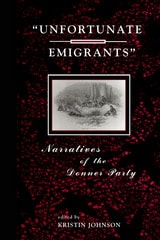
Unfortunate Emigrants
edited by Kristin Johnson
Utah State University Press, 1996
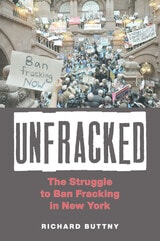
Unfracked
The Struggle to Ban Fracking in New YorkRichard Buttny
University of Massachusetts Press, 2024
Since fracking emerged as a way of extracting natural gas, through intense deep drilling and the use of millions of gallons of water and chemicals to fracture shale, it has been controversial. It is perceived in different ways by different people—by some as an opportunity for increased resources and possibly jobs and other income; by others as a public health and environmental threat; and for many, an unknown. Richard Buttny, a scholar who works on rhetoric and discursive practices, read a story in his local paper in New York about hydrofracking coming to his area and had to research what it was, and what it could mean for his community. Soon he joined neighbors in fighting to have the practice banned state-wide. At the same time, he turned his scholarly eye to the messaging from both sides of the fight, using first-person accounts, interviews, and media coverage.
The activists fighting fracking won. New York is now the only state in the US with sizable deposits of natural gas that has banned hydraulic fracturing, or fracking. Unfracked explains the competing rhetoric and discourses on fracking among New York-based advocates, experts, the grassroots, and political officials. Buttny examines how these positions evolved over time and how eventually the state arrived at a decision to ban this extractive technology. His accessible approach provides both a historical recounting of the key events of this seven-year conflict, along with four in-depth case studies: a grassroots citizen group, a public hearing with medical physicians, a key intergovernmental hearing, and a formal debate among experts. The result is a look at a very recent, important historical moment and a useful examination of environmental activist and fossil fuel advocate rhetoric around an issue that continues to cause debate nationwide.
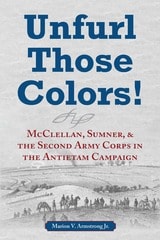
Unfurl Those Colors!
McClellan, Sumner, and the Second Army Corps in the Antietam CampaignMarion V. Armstrong Jr.
University of Alabama Press, 2008
Traces the engrossing story of the Union Army’s strategies, stratagems, and movements on the bloodiest day in American military history
Unfurl Those Colors! provides an operational study of the Army of the Potomac during the pivotal Battle of Antietam on September 17, 1862, illuminating in details that will fascinate scholars and armchair generals alike US army commander George B. McClellan’s command decisions and how those decisions were carried out in the middle and lower ranks of the Second Army Corps.
Armstrong offers the most comprehensive account yet of the Second Army Corps’s fight at Antietam, including Sedgwick’s division in the West Woods and French’s and Richardson’s divisions at Bloody Land. He offers a fresh reappraisal of the leadership of Bostonian Edwin V. “Bull Head” Sumner as the only federal corps commander who doggedly and accurately carried out McClellan’s battle plan and effectively directed the battle on the Federal right.
Many esteemed Civil War historians consider Antietam a watershed moment in the Civil War, a crucial success after which Abraham Lincoln was emboldened to issue the Emancipation Proclamation. Unfurl Those Colors! offers a vital examination of the operational fabric of the Army of the Potomac’s leadership and command in one of the most important days in American history.
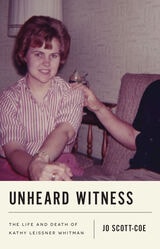
Unheard Witness
The Life and Death of Kathy Leissner WhitmanJo Scott-Coe
University of Texas Press, 2023
2025 San Antonio Conservation Society Publication Award
Unheard Witness foregrounds a young woman’s experience of domestic abuse, resistance, and survival before the mass shooting at the University of Texas at Austin in 1966.
In 1966, Kathy Leissner Whitman was a twenty-three-year-old teacher dreaming of a better future. She was an avid writer of letters, composing hundreds in the years before she was stabbed to death by her husband, Charles Whitman, who went on to commit a mass shooting from the tower at the University of Texas at Austin. Kathy’s writing provides a rare glimpse of how one woman described, and sought to change, her short life with a coercive, controlling, and violent partner.
Unheard Witness provides a portrait of Kathy’s life, doing so at a time when Americans are slowly grasping the link between domestic abuse and mass shootings. Public violence often follows violence in the home, yet such private crimes continue to be treated separately and even erased in the public imagination. Jo Scott-Coe shows how Kathy's letters go against the grain of the official history, which ignored Kathy’s perspective. With its nuanced understanding of abuse and survival, Unheard Witness is an intimate, real-time account of trust and vulnerability—in its own way, a prologue to our age of atrocities.
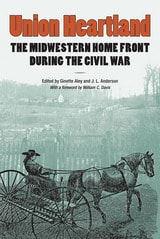
Union Heartland
The Midwestern Home Front during the Civil WarEdited by Ginette Aley and J. L. Anderson, with a foreword by William C. Davis
Southern Illinois University Press, 2013
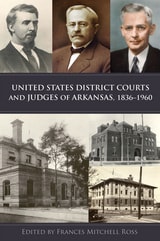
United States District Courts and Judges of Arkansas, 1836–1960
Frances Mitchell Ross
University of Arkansas Press, 2016
The book begins with statehood and continues with Congress’s decision to expand jurisdiction of the original 1836 District Court of Arkansas to include the vast Indian Territory to the west. The territory’s formidable size and rampant lawlessness brought in an overwhelming number of cases. The situation was only somewhat mitigated in 1851, when Congress split the state into eastern and western districts, which were still served by just one judge who travelled between the two courts.
A new judgeship for the Western District was created in 1871, and new seats for that court were established, but it wasn’t until 1896 that Congress finally ended all jurisdiction of Arkansas’s Western District Court over the Indian Territory.
Contributors to this collection include judges, practicing attorneys, academics, and thoughtful and informed family members who reveal how the judges made decisions on issues involving election laws, taxes, civil rights, railroads, liquor and prohibition, quack medicine, gangsters, bankruptcy, personal injury, the draft and Selective Service, school desegregation, prisons, and more. United States District Courts and Judges of Arkansas, 1836–1960 will be of value to anyone interested in Arkansas history—particularly Arkansas legal and judicial history as it relates to the local and national issues that came before these judges.
This project was supported in part by the United States District Court for the Eastern District of Arkansas and the United States District Court for the Western District of Arkansas.
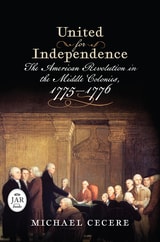
United for Independence
The American Revolution in the Middle Colonies, 1775–1776Michael Cecere
Westholme Publishing, 2027
In the aftermath of the battles of Lexington and Concord in April 1775 and the start of the Revolutionary War, it was not clear whether the colonies outside of New England would participate militarily in the conflict. Troops from the four New England colonies surrounded Boston immediately after the fighting at Lexington and Concord, and two months into the standoff the Continental Congress, meeting in Philadelphia, assumed authority over the New England army, but the middle and southern colonies had yet to see armed conflict or bloodshed with British forces.
In United for Independence: The American Revolution in the Middle Colonies, 1775–1776, historian Michael Cecere examines how the inhabitants of New York, New Jersey, Pennsylvania, Delaware, and Maryland reacted to the outbreak of war in Massachusetts. Leaders in these middle colonies, influenced by strong Loyalist sentiment within their borders and, in some cases, among themselves, fiercely debated whether to support the war in New England. Congress’s decision in the summer to establish the Continental Army, and its authorization for an invasion of Canada, both of which involved troops from the middle colonies, set the stage for their full-scale involvement in the Revolutionary War.
Using primary source extracts and proceeding chronologically from the spring of 1775 to the fall of 1776, the author presents the key events in each of these colonies, from the political struggles between Whigs and Tories, through the failed Canadian expedition, to the loss of Long Island and New York City. Designed for readers to understand the sequence of events that transformed a resistance movement into a war for independence, United for Independence provides an important overview of events in the middle colonies at the start of the Revolutionary War that complements other works that focus on specific military clashes and campaigns.
Unlikely Heroes
The Southern Judges Who Made Brown WorkJack Bass
University of Alabama Press, 1981
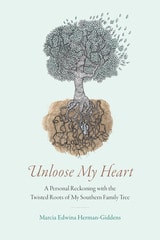
Unloose My Heart
A Personal Reckoning with the Twisted Roots of My Southern Family TreeMarcia Edwina Herman-Giddens
University of Alabama Press, 2023
A deeply personal memoir that unearths a family history of racism, slaveholding, and trauma as well as love and sparks of delight.
Marcia Herman’s family moved to Birmingham in 1946, when she was five years old, and settled in the steel-making city dense with smog and a rigid apartheid system. Marcia, a shy only child, struggled to fit in and understand this world, shadowed as it was by her mother’s proud antebellum heritage. In 1966, weary of Alabama’s toxic culture, Marcia and her young family left Birmingham and built a life in North Carolina.
Later in life, Herman-Giddens resumed a search to find out what she did not know about her family history. Unloose My Heart interweaves the story of her youth and coming of age in Birmingham during the Civil Rights Movement together with this quest to understand exactly who and what her maternal ancestors were and her obligations as a white woman within a broader sense of American family.
More than a memoir set against the backdrop of Jim Crow and the civil rights struggle, this is the work of a woman of conscience writing in the twenty-first century. Haunted by the past, Unloose My Heart is a journey of exploration and discovery, full of angst, sorrow, and yearning. Unearthing her forebears’ centuries-long embrace of plantation slavery, Herman-Giddens dug deeply to parse the arrogance and cruelty necessary to be a slaveholder and the trauma and fear that ripple out in its wake. All this forced her to scrutinize the impact of this legacy in her life, as well as her debt to the enslaved people who suffered and were exploited at her ancestors’ hands. But she also discovers lost connections, new cousins and friends, unexpected joys, and, eventually, a measure of peace in the process. With heartbreak, moments of grace, and an enduring sense of love, Unloose My Heart shines a light in the darkness and provides a model for a heartfelt reckoning with American history.
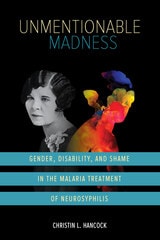
Unmentionable Madness
Gender, Disability, and Shame in the Malaria Treatment of NeurosyphilisChristin L. Hancock
University of Illinois Press, 2025
Christin L. Hancock looks through the lens of feminist disability to examine the popular but ethically suspect treatment and its consequences. As Hancock shows, the treatment’s purported success rate relied on the disabled minds and bodies of people incarcerated in mental hospitals. The backgrounds and identities of these patients reflected and perpetuated attitudes around poverty, gender, race, and disability while betraying authorities’ desire to protect the public from women and men perceived as abnormal, sexually tainted, and unworthy of community life.
Paying special attention to the patients’ voices and experiences, Unmentionable Madness offers a disability history that confronts the ethics of experimentation.
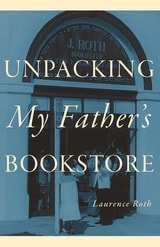
Unpacking My Father's Bookstore
Laurence Roth
Rutgers University Press, 2025
2026 Independent Publisher Book Awards (IPPY) Silver Medal in the West – Pacific Non-Fiction category
Unpacking My Father’s Bookstore brings to life the history of J. Roth / Bookseller of Fine & Scholarly Judaica, which was a microcosm of the Los Angeles Jewish community from 1966 to 1994 and one of the premier Jewish bookstores in the United States. Blending critical analysis with a personal account of growing up in his father’s bookstore, and connecting both to larger forces that helped shape Jewish and American book retailing in the twentieth-century, Laurence Roth crafts a richly felt narrative about his family’s Jewish experience in America. It is a reminder, too, that while most independent bookstores like J. Roth Bookseller disappear from history, these retailers often had outsized effects on their communities. Breaking with conventional modes of scholarship, Unpacking My Father’s Bookstore tells a unique and troubled story that rarely gets told, one that is both personal and analytical, theoretical but rooted in the everyday.
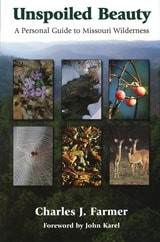
Unspoiled Beauty
A Personal Guide to Missouri WildernessCharles J. Farmer
University of Missouri Press, 1999
Tucked within Missouri's borders are eight Congressionally designated Wilderness areas. These magnificent forests, scattered across the southern portion of the state, combine a wide variety of unique ecosystems. In Unspoiled Beauty, Charles Farmer captures the essence of the Missouri Wilderness experience, allowing even those who have never set foot in the wilderness to enjoy its wonders and appreciate its importance.
Farmer begins by describing the wilderness region prior to the Congressional Wilderness designation, providing an overview of the numerous battles that were waged to reclaim the state's wilderness and to assure its preservation. Featured are key players who were instrumental in the acquisition and preservation of Missouri wilderness.
Farmer devotes a chapter to each of the eight Wilderness areas, accompanied by numerous engaging photographs, many in color. He provides a brief history of each and shares his own fascinating personal experiences of camping, hiking, backpacking, hunting, and fishing within each. He discusses trails, fauna, flora, and other colorful details along the way. His adventures take place during different seasons of the year; he is sometimes alone, sometimes in company. Through his eyes, each area is brought vividly to life.
"Wilderness Tips" and a guide with rules for the novice camper, hiker, backpacker, hunter, and fisherman enhance the book's usefulness. The final chapter lists the areas in Missouri that qualify for Wilderness designation in the New Forest Plan. Unspoiled Beauty may well play a part in saving Missouri's remaining wilderness candidates. It will also help other states that are preparing campaigns to save their own wilderness areas.
Wilderness advocates, hikers and backpackers, fishermen and hunters, anyone who appreciates the great outdoors will enjoy this important new book.
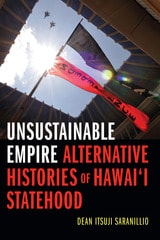
Unsustainable Empire
Alternative Histories of Hawai‘i StatehoodDean Itsuji Saranillio
Duke University Press, 2018
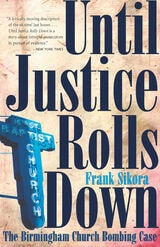
Until Justice Rolls Down
The Birmingham Church Bombing CaseFrank Sikora
University of Alabama Press, 2005
This book tells the story of one grim Sunday in September 1963 when an intentionally planted cache of dynamite ripped through the walls of the Sixteenth Street Baptist Church and ended the dreams and the lives of four young black girls. Their deaths spurred the Kennedy administration to send an army of FBI agents to Alabama and led directly to the passage of the Civil Rights Act. When the Justice Department was unable to bring anyone to trial for this heinous crime, a young Alabama attorney general named Bill Baxley began his own investigation to find the perpetrators. In 1977, 14 years after the bombing, Baxley brought one Klansman to trial and, in a courtroom only blocks from the bombed church (now a memorial to the victims), persuaded a jury to return a guilty verdict. More than 20 years later two other perpetrators were tried for the bombing, found guilty, and remanded to prison.
Frank Sikora has used the court records, FBI reports, oral interviews, and newspaper accounts to weave a story of spellbinding proportions. A reporter by profession, Sikora tells this story compellingly, explaining why the civil rights movement had to be successful and how Birmingham had to change.
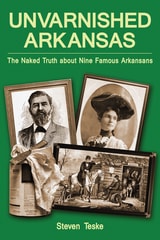
Unvarnished Arkansas
The Naked Truth about Nine Famous ArkansansSteven Teske
Butler Center for Arkansas Studies, 2012
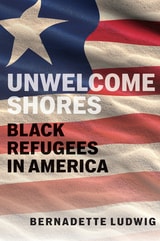
Unwelcome Shores
Black Refugees in AmericaBernadette Ludwig
Rutgers University Press, 2026
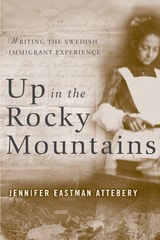
Up in the Rocky Mountains
Writing the Swedish Immigrant ExperienceJennifer Eastman Attebery
University of Minnesota Press, 2007
Before the turn of the twentieth century, many Swedish men emigrated to the American Rockies as itinerant laborers, drawn by the region’s developing industries. Single Swedish women ventured west, too, and whole families migrated, settling into farm communities. By 1920, one-fifth of all Swedish immigrants were living in the West.
In Up in the Rocky Mountains, Jennifer Eastman Attebery offers a new perspective on Swedish immigrants’ experiences in Idaho, Montana, Utah, Wyoming, Colorado, and New Mexico from 1880 to 1917 by interpreting their letters home. Considering more than three hundred letters, Attebery analyzes their storytelling, repetitive language, traditional phrasing, and metaphoric images. Recognizing the letters’ power as a folk form, Attebery sees in them the writers’ relationships back in Sweden as well as their encounters with religious and labor movements, regionalism, and nationalism in their new country.
By defining personal letters as a vernacular genre, Attebery provides a model for discerning immigrants’ shared culture in correspondence collections. By studying their words, she brings to life small Swedish communities throughout the Rocky Mountain region.
Jennifer Eastman Attebery is professor of English and director of American studies at Idaho State University.
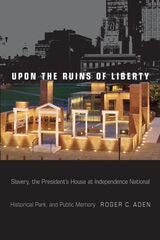
Upon the Ruins of Liberty
Slavery, the President's House at Independence National Historical Park, and Public MemoryRoger C. Aden
Temple University Press, 2014
In Upon the Ruins of Liberty, Roger Aden offers a compelling account that explores the development of this important historic site and how history, space, and public memory intersected with contemporary racial politics. Aden constructs this engrossing tale by drawing on archival material and interviews with principal figures in the controversy-including historian Ed Lawler, site activist Michael Coard, and site designer Emanuel Kelly.
Upon the Ruins of Liberty chronicles the politically-charged efforts to create a fitting tribute to the place where George Washington (and later, John Adams) shaped the presidency while denying freedom to the nine enslaved Africans in his household. From design to execution, the plans prompted advocates to embrace stories informed by race, and address difficulties that included how to handle the results of the site excavation. As such, this landmark project raised concerns and provided lessons about the role of public memory and how places are made to shape the nation's identity.
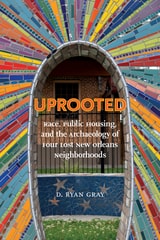
Uprooted
Race, Public Housing, and the Archaeology of Four Lost New Orleans NeighborhoodsD. Ryan Gray
University of Alabama Press, 2020
The archaeology of four New Orleans neighborhoods that were replaced by public housing projects
Uprooted: Race, Public Housing, and the Archaeology of Four Lost New Orleans Neighborhoods uses archaeological research on four neighborhoods that were razed during the construction of public housing in World War II–era New Orleans. Although each of these neighborhoods was identified as a “slum” historically, the material record challenges the simplicity of this designation. D. Ryan Gray provides evidence of the inventiveness of former residents who were marginalized by class, color, or gender and whose everyday strategies of survival, subsistence, and spirituality challenged the city’s developing racial and social hierarchies.
These neighborhoods initially appear to have been quite distinct, ranging from the working-class Irish Channel, to the relatively affluent Creole of Color–dominated Lafitte area, to the former location of Storyville, the city’s experiment in semilegal prostitution. Archaeological and historical investigations suggest that race was the crucial factor in the areas’ selection for clearance. Each neighborhood manifested a particular perceived racial disorder, where race intersected with ethnicity, class, or gender in ways that defied the norms of Jim Crow segregation.
Gray’s research makes use of both primary documents—including census records, city directories, and even the brothel advertising guides called “Blue Books”—and archaeological data to examine what this entailed at a variety of scales, reconstructing narratives of the households and communities affected by clearance. Public housing, both in New Orleans and elsewhere, imposed a new kind of control on urban life that had the effect of making cities both more segregated and less equal. The story of the neighborhoods that were destroyed provides a reminder that their erasure was not an inevitable outcome, and that a more equitable and just city is still possible today. A critical examination of the rise of public housing helps inform the ongoing debates over its demise, especially in light of the changing face of post-Katrina New Orleans.
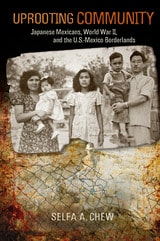
Uprooting Community
Japanese Mexicans, World War II, and the U.S.-Mexico BorderlandsSelfa A. Chew
University of Arizona Press, 2015
In Uprooting Community, Selfa A. Chew examines the lived experience of Japanese Mexicans in the U.S.-Mexico borderlands during World War II. Studying the collaboration of Latin American nation-states with the U.S. government, Chew illuminates the efforts to detain, deport, and confine Japanese residents and Japanese-descent citizens of Latin American countries during World War II. These narratives challenge the notion that Japanese Mexicans enjoyed the protection of the Mexican government during the war and refute the mistaken idea that Japanese immigrants and their descendants were not subjected to internment in Mexico during this period. Through her research, Chew provides evidence that, despite the principles of racial democracy espoused by the Mexican elite, Japanese Mexicans were in fact victims of racial prejudice bolstered by the political alliances between the United States and Mexico.
The treatment of the ethnic Japanese in Mexico was even harsher than what Japanese immigrants and their children in the United States endured during the war, according to Chew. She argues that the number of persons affected during World War II extended beyond the first-generation Japanese immigrants “handled” by the Mexican government during this period, noting instead that the entire multiethnic social fabric of the borderlands was reconfigured by the absence of Japanese Mexicans.
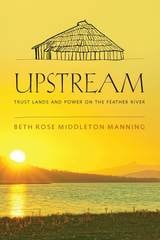
Upstream
Trust Lands and Power on the Feather RiverBeth Rose Middleton Manning
University of Arizona Press, 2018
Upstream documents the significance of the Allotment Era to a long and ongoing history of cultural and community disruption. It also details Indigenous resistance to both hydropower and disruptive conservation efforts. With a focus on northeastern California, this book highlights points of intervention to increase justice for Indigenous peoples in contemporary natural resource policy making.
Author Beth Rose Middleton Manning relates the history behind the nation’s largest state-built water and power conveyance system, California’s State Water Project, with a focus on Indigenous resistance and activism. She illustrates how Indigenous history should inform contemporary conservation measures and reveals institutionalized injustices in natural resource planning and the persistent need for advocacy for Indigenous restitution and recognition.
Upstream uses a multidisciplinary and multitemporal approach, weaving together compelling stories with a study of placemaking and land development. It offers a vision of policy reform that will lead to improved Indigenous futures at sites of Indigenous land and water divestiture around the nation.

Urban Appetites
Food and Culture in Nineteenth-Century New YorkCindy R. Lobel
University of Chicago Press, 2014
Historians, sociologists, and foodies alike will devour the story of the origins of New York City’s food industry in Urban Appetites. Cindy R. Lobel focuses on the rise of New York as both a metropolis and a food capital, opening a new window onto the intersection of the cultural, social, political, and economic transformations of the nineteenth century. She offers wonderfully detailed accounts of public markets and private food shops; basement restaurants and immigrant diners serving favorites from the old country; cake and coffee shops; and high-end, French-inspired eating houses made for being seen in society as much as for dining. But as the food and the population became increasingly cosmopolitan, corruption, contamination, and undeniably inequitable conditions escalated. Urban Appetites serves up a complete picture of the evolution of the city, its politics, and its foodways.
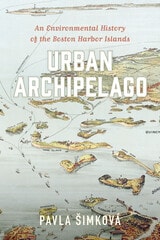
Urban Archipelago
An Environmental History of the Boston Harbor IslandsPavla Šimková
University of Massachusetts Press, 2021
In this book, Pavla Šimková reinterprets the Boston Harbor Islands as an urban archipelago, arguing that they have been an integral part of Boston since colonial days, transformed by the city's changing values and catering to its current needs. Drawing on archival sources, historic maps and photographs, and diaries from island residents, this absorbing study attests that the harbor islands' story is central to understanding the ways in which Boston has both shaped and been shaped by its environment over time.
Urban Disorder and the Shape of Belief
The Great Chicago Fire, the Haymarket Bomb, and the Model Town of PullmanCarl Smith
University of Chicago Press, 1994
Urban Disorder and the Shape of Belief
The Great Chicago Fire, the Haymarket Bomb, and the Model Town of Pullman, Second EditionCarl Smith
University of Chicago Press, 2007
In Urban Disorder and the Shape of Belief, Carl Smith explores the imaginative dimensions of these events as he traces the evolution of interconnected beliefs and actions that increasingly linked city, disorder, and social reality in the minds of Americans. Examining a remarkable range of writings and illustrations, as well as protests, public gatherings, trials, hearings, and urban reform and construction efforts, Smith argues that these three events—and the public awareness of them—not only informed one another, but collectively shaped how Americans understood, and continue to understand, Chicago and modern urban life.
This classic of urban cultural history is updated with a foreword by the author that expands our understanding of urban disorder to encompass such recent examples as Hurricane Katrina, the Oklahoma City Bombing, and 9/11.
“Cultural history at its finest. By utilizing questions and methodologies of urban studies, social history, and literary history, Smith creates a sophisticated account of changing visions of urban America.”—Robin F. Bachin, Journal of Interdisciplinary History
Urban Dreams, Rural Commonwealth
The Rise of Plantation Society in the ChesapeakePaul Musselwhite
University of Chicago Press, 2018
Paul Musselwhite details the unsuccessful urban development that defined the region from the seventeenth century through the Civil War, showing how places like Jamestown and Annapolis—despite their small size—were the products of ambitious and cutting-edge experiments in urbanization comparable to those in the largest port cities of the Atlantic world. These experiments, though, stoked ongoing debate about commerce, taxation, and self-government. Chesapeake planters responded to this debate by reinforcing the political, economic, and cultural authority of their private plantation estates, with profound consequences for the region’s laborers and the political ideology of the southern United States. As Musselwhite makes clear, the antebellum economy around this well-known waterway was built not in the absence of cities, but upon their aspirational wreckage.
Useful to the Church and Kingdom
The Journals of James H. Martineau, Pioneer and Patriarch, 1850-1918, Volume: 1Noel A. Carmack
Signature Books, 2023
These journals document his exploration of virgin lands in southern Utah, his laying out of townsites and farmland in Cache Valley, his participation in canal building and water projects in Arizona, and his near-death experiences while surveying rough, mountainous areas. His work for the Union Pacific Railroad through Weber Canyon and across the Salt Lake Promontory and Humboldt Desert in 1868 is one of the very few complete records of its kind.
Useful to the Church and Kingdom
The Journals of James H. Martineau, Pioneer and Patriarch, 1850-1918, Volume: 2Noel A. Carmack
Signature Books, 2023
These journals document his exploration of virgin lands in southern Utah, his laying out of townsites and farmland in Cache Valley, his participation in canal building and water projects in Arizona, and his near-death experiences while surveying rough, mountainous areas. His work for the Union Pacific Railroad through Weber Canyon and across the Salt Lake Promontory and Humboldt Desert in 1868 is one of the very few complete records of its kind.
Ushering Civil Rights into Law
Judge Richard T. Rives and Desegregation in the Public SpherePat Arneson
University of Alabama Press, 2026
Illuminates the life and legacy of a federal jurist from Alabama, an unexpected but ardent defender of equal rights for all citizens under the law
Ushering Civil Rights into Law: Judge Richard T. Rives and Desegregation in the Public Sphere by Pat Arneson is a long-overdue exploration of one of the most consequential yet overlooked figures of the modern Civil Rights Movement. As debates over judicial philosophy and Civil Rights continue, Judge Richard T. Rives’s story serves as a powerful reminder of the judiciary’s role in shaping a more just society.
A native of Montgomery, Alabama, Judge Richard T. Rives served on the US Court of Appeals for the Fifth Circuit during the height of America’s battle over racial segregation. Once aligned with segregationist views, Rives underwent a profound evolution, emerging as a key legal architect of desegregation. His landmark ruling on behalf of the court in Browder v. Gayle ended segregation on Montgomery’s public buses and expanded the scope of Brown v. Board of Education beyond education. Rives’s decisions invalidated the legal underpinnings of Jim Crow laws and furthered equality in public education, voting rights, and jury selection. Writing for the court, Rives authored legal precedents that fundamentally reshaped the nation.
Through archival research, Arneson examines the cultural and political pressures Rives faced, the legal strategies he employed, and the lasting impact of his work. Constitutional rights remain a flashpoint in American discourse. Ushering Civil Rights into Law reveals how one judge’s principled stance helped define the legal landscape of modern Civil Rights and underscores the enduring significance of his legacy.
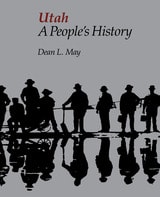
Utah A People's History
Dean L May
University of Utah Press, 2002
History belongs to the people, Dean May reminds us, and must ultimately be accessible all. Based on his award-winning television series, Utah: A People's History provides a sweeping view of the state's past. From prehistory to present, May explains Utah as it is today and its promise for the future. The video series upon which this book is based is no longer available for sale.

Utah Place Names
A Geopgraphic Guide to the Origins of Geographic Names, a CompilationJohn Van Cott
University of Utah Press, 1991
John W. Van Cott has spend the better part of a lifetime searching out the answers to these questions. Now the fruits of his labor are recorded in this, the most extensive compilation of Utah place names ever published. Almost five thousand toponyms are listed alphabetically, marking the passage of peoples and cultures from earliest times. Specialists will appreciate the geographical precision of Section, Township, Range, and altitude. Generalists will recognize counties and relationships to know features. All will delight in the rich lore, often a mixture of myth and history, of the place and its name. Scholars will find useful the inclusion of synonyms, nicknames, previous names, all cross-referenced, and all tied to a bibliography of over five hundred entries.
The author concluded his work of over forty years with the observation that he hardly touched the surface of Utah’s place names, numbered at over twenty-two thousand by the U.S. Geological Survey.
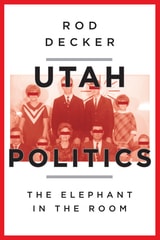
Utah Politics
The Elephant in the RoomRod Decker
Signature Books, 2019
Some themes reoccur: governors become popular by fighting federal oversight— signaling a lingering distrust that Washington could alter the Mormon way of life—and liberals use the court system to circumvent conservative legislatures who see public morality as a defining feature of government. Through this lens, issues both deceptively innocuous and deeply complex underscore Utah’s dance with religious freedom and civil liberty.
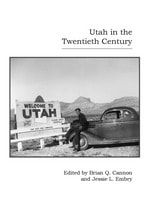
Utah in the Twentieth Century
Brian Q. Cannon and Jessie Embry
Utah State University Press, 2009
The twentieth century could easily be Utah's most interesting and complex. Utah in the Twentieth Century chronicles the social and cultural transitions of the time, offering a well-rounded perspective on the development and change the Beehive State went through during this period.
It was an era complicated by the push of economic development and pull of traditional culture, demand for natural resources from a fragile and scenic environment, questions of who governs and how, who gets a vote, and who controls what on contested public lands, during which outside trade and a tourist economy increasingly challenged and fed an insular society. Activists left and right declaimed constitutional liberties while Utah's Native Americans become the last enfranchised in the nation. Proud contributions to national wars contrasted with denial of deep dependence on federal money; the skepticism of provocative writers, boosters eager for growth; and reflexive patriotism somehow bonded to ingrained distrust of federal government.
A valuable resource for students and teachers, this work is also fruitful reading for anyone who desires to know more about key themes of Utah’s history in the twentieth century.
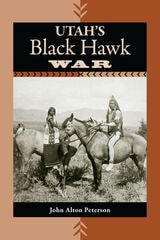
Utah'S Black Hawk War
John Alton Peterson
University of Utah Press, 1998
"On Sunday 9 April 1865, Ulysses S. Grant and Robert E. Lee met in the parlor of Wilmer McLean’s brick home in Appomattox Court House, Virginia, to negotiate the conclusion of the Civil War. That same day, far to the west, a handful of Mormons and northern Utes met in the central Utah town of Manti in an attempt to achieve a peace of their own. Unlike the negotiations at Appomattox, however, those in Manti failed, and the events that transpired there are viewed as the beginning of Utah’s Black Hawk War, the longest and most serious Indian-white conflict in Utah history."
—From the book
So begins the story of Black Hawk, Ute Indian warrior chief and brilliant strategist, and Brigham Young, sagacious religious and political leader of the Mormons. Two powerful and unyielding men forged by hardship and conviction, both revered and both reviled in their times. One, orchestrating a remarkable campaign to turn back the tide of white expansion and prevent the extinction of his people, the other, attempting to keep his exiled church and its thriving utopian society sovereign and intact. Two men of distinct races, beliefs, and cultures, but sharing a determination to keep U.S. soldiers out of their bloody conflict for control of land and other resources in the Utah territory.
From 1865 to 1867, the warrior Black Hawk, also known as Antonga, led a combined force of Utes, Navajos, and Paiutes in a series of intense stock raids on the Mormon settlements in Utah territory. Black Hawk astutely judged that political conflict between the federal government and Mormon Utah would keep U.S. soldiers from chastising his band. Moreover, the antagonism of Washington toward Utah’s polygamy, theocracy, and isolationism made Mormon leader Brigham Young wary of seeking federal help. In fact, to keep the government from using the war as a pretext for sending more troops to Utah, the Mormons withheld information, making the Black Hawk War an almost secret war as far as the rest of the nation was concerned. As directed by Brigham Young, Utah’s Latter-day Saint citizens mobilized a church militia, the Nauvoo Legion, to repel Indian attacks. Yet Black Hawk and others were able to carry on their activities for almost eight years without incurring the federal military reprisals that Indians on all four sides of the Mormon heartland experienced. Bloodshed on both sides plunged Mormons and Indians into a war of vengeance—years of killing and raiding that continued until federal troops stepped in 1872.
In this unprecedented volume, historian John Peterson provides the first comprehensive analysis of a unique and compelling chapter of western history and of the violent and protracted conflict it engendered. Utah’s Black Hawk War not only explores political intricacies and broader implications, scrutinizing the Mormons' Indian policies—most notably Brigham Young’s extraordinary "better to feed them than fight them" teachings—but also presents vivid narrative accounts of various raids and battles. The result is a masterfully researched and engagingly written account of Utah’s secret war, a war largely unknown among western history students, scholars, and enthusiasts—until now.
Winner of the Mormon History Association Francis M. and Emily S. Chipman Best First Book Award.
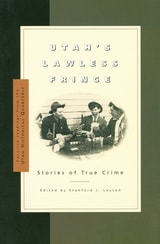
Utah's Lawless Fringe
Stories of True CrimeStanford J. Layton
Signature Books, 2001
So it went on the outskirts of Utah Territory. In this case it was the little town of Bluff where the Mormon bishop served for some ten years as de facto sheriff and his congregation as deputies. As elsewhere, law and order developed organically rather than by legislation.
In this anthology several aspects of the process are considered, including one of the worst manifestations of citizen action: vigilantism. Territorial Utah witnessed more lynchings than legal executions. Another citizen trait was an unexpected indifference to vice. In 1908 Salt Lake City had 148 registered prostitutes overseen by a madam who was recruited for the position by the mayor and city council. During Prohibition one of the largest distilleries in the West operated in a Salt Lake warehouse.
What is to be learned from this? The contributors to these fourteen articles leave moral considerations to the reader’s contemplation, while providing surprises along the way in an extremely engaging—dare we say arresting—read.