Results by title
28164 books match the query 'History' and 339 start with u
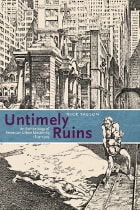
Untimely Ruins
An Archaeology of American Urban Modernity, 1819-1919Nick Yablon
University of Chicago Press, 2009
American ruins have become increasingly prominent, whether in discussions of “urban blight” and home foreclosures, in commemorations of 9/11, or in postapocalyptic movies. In this highly original book, Nick Yablon argues that the association between American cities and ruins dates back to a much earlier period in the nation’s history. Recovering numerous scenes of urban desolation—from failed banks, abandoned towns, and dilapidated tenements to the crumbling skyscrapers and bridges envisioned in science fiction and cartoons—Untimely Ruins challenges the myth that ruins were absent or insignificant objects in nineteenth-century America.
The first book to document an American cult of the ruin, Untimely Ruins traces its deviations as well as derivations from European conventions. Unlike classical and Gothic ruins, which decayed gracefully over centuries and inspired philosophical meditations about the fate of civilizations, America’s ruins were often “untimely,” appearing unpredictably and disappearing before they could accrue an aura of age. As modern ruins of steel and iron, they stimulated critical reflections about contemporary cities, and the unfamiliar kinds of experience they enabled. Unearthing evocative sources everywhere from the archives of amateur photographers to the contents of time-capsules, Untimely Ruins exposes crucial debates about the economic, technological, and cultural transformations known as urban modernity. The result is a fascinating cultural history that uncovers fresh perspectives on the American city.
Untold Tales of the Hasidim
Crisis and Discontent in the History of HasidismDavid Assaf
Brandeis University Press, 2011
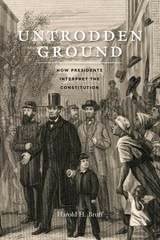
Untrodden Ground
How Presidents Interpret the ConstitutionHarold H. Bruff
University of Chicago Press, 2015
Reviewing the processes taken by all forty-four presidents to form new legal precedents and the constitutional conventions that have developed as a result, Harold H. Bruff shows that the president is both more and less powerful than many suppose. He explores how presidents have been guided by both their predecessors’ and their own interpretations of constitutional text, as well as how they implement policies in ways that statutes do not clearly authorize or forbid. But while executive power has expanded far beyond its original conception, Bruff argues that the modern presidency is appropriately limited by the national political process—their actions are legitimized by the assent of Congress and the American people or rejected through debilitating public outcry, judicial invalidation, reactive legislation, or impeachment. Synthesizing over two hundred years of presidential activity and conflict, this timely book casts new light on executive behavior and the American constitutional system.

Untying the Afghan Knot
Negotiating Soviet WithdrawalRiaz M. Khan
Duke University Press, 1991
Riaz M. Khan, a senior Pakistani diplomat, participated actively in all meetings on Afghanistan in the United Nations, the Non-Aligned Movement, and the Organization of the Islamic Conference, and in all of the Geneva negotiating rounds (1882–1988). Drawing upon his personal experience, official documents, scholarly literature, and press accounts, he provides a unique insider’s view of these precedent-setting negotiations, which were often shrouded in secrecy and misperceptions.
Khan examines the interests, positions, and behind-the-scenes maneuverings of the major players—Afghan governments and resistance groups, Pakistan, the Soviet Union, the United States, and UN mediators—and assesses the impact of military and political developments inside Afghanistan and elsewhere, including the advent of Mikhail Gorbachev. Khan’s authoritative account of these critical diplomatic initiatives sheds important light on the internal dynamics of the multilateral Afghanistan negotiations.
Unvarnished Arkansas
The Naked Truth about Nine Famous ArkansansSteven Teske
Butler Center for Arkansas Studies, 2012
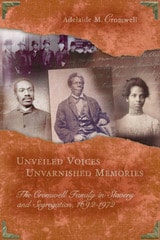
Unveiled Voices, Unvarnished Memories
The Cromwell Family in Slavery and Segregation, 1692-1972Adelaide M. Cromwell
University of Missouri Press, 2006
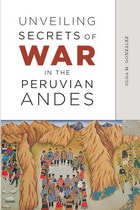
Unveiling Secrets of War in the Peruvian Andes
Olga M. González
University of Chicago Press, 2011
The Maoist guerrilla group Shining Path launched its violent campaign against the government in Peru’s Ayacucho region in 1980. When the military and counterinsurgency police forces were dispatched to oppose the insurrection, the violence quickly escalated. The peasant community of Sarhua was at the epicenter of the conflict, and this small village is the focus of Unveiling Secrets of War in the Peruvian Andes. There, nearly a decade after the event, Olga M. González follows the tangled thread of a public secret: the disappearance of Narciso Huicho, the man blamed for plunging Sarhua into a conflict that would sunder the community for years.
Drawing on extensive fieldwork and a novel use of a cycle of paintings, González examines the relationship between secrecy and memory. Her attention to the gaps and silences within both the Sarhuinos’ oral histories and the paintings reveals the pervasive reality of secrecy for people who have endured episodes of intense violence. González conveys how public secrets turn the process of unmasking into a complex mode of truth telling. Ultimately, public secrecy is an intricate way of “remembering to forget” that establishes a normative truth that makes life livable in the aftermath of a civil war.
Unveiling Traditions
Postcolonial Islam in a Polycentric WorldAnouar Majid
Duke University Press, 2000
Majid moves beyond Edward Said’s unmasking of orientalism in the West to examine the intellectual assumptions that have prevented a more nuanced understanding of Islam’s legacies. In addition to questioning the pervasive logic that assumes the “naturalness” of European social and political organizations, he argues that it is capitalism that has intensified cultural misunderstanding and created global tensions. Besides examining the resiliency of orientalism, the author critically examines the ideologies of nationalism and colonialist categories that have redefined the identity of Muslims (especially Arabs and Africans) in the modern age and totally remapped their cultural geographies. Majid is aware of the need for Muslims to rethink their own assumptions. Addressing the crisis in Arab-Muslim thought caused by a desire to simultaneously “catch up” with the West and also preserve Muslim cultural authenticity, he challenges Arab and Muslim intellectuals to imagine a post-capitalist, post-Eurocentric future. Critical of Islamic patriarchal practices and capitalist hegemony, Majid contends that Muslim feminists have come closest to theorizing a notion of emancipation that rescues Islam from patriarchal domination and resists Eurocentric prejudices.
Majid’s timely appeal for a progressive, multicultural dialogue that would pave the way to a polycentric world will interest students and scholars of postcolonial, cultural, Islamic, and Marxist studies.
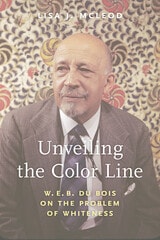
Unveiling the Color Line
W. E. B. Du Bois on the Problem of WhitenessLisa J. McLeod
University of Massachusetts Press, 2024
In The Souls of Black Folk, W. E. B. Du Bois brilliantly details the African American experience. Yet the renowned sociologist was also an astute chronicler of white people, particularly their racism. As Unveiling the Color Line demonstrates, Du Bois’s trenchant analysis of whiteness and white supremacy began in his earliest work—his 1890 speech on Jefferson Davis—and continued in every major book he published in his more than sixty-year career, up to The Black Flame Trilogy.
Lisa J. McLeod traces the development of Du Bois’s conception of whiteness, and the racism inherent to it, as an all-encompassing problem, whether predicated on ignorance, moral failure, or the inability to recognize the humanity in other people. In clear, elegant prose, McLeod investigates Du Bois’s complex and nuanced thinking, putting his insights into dialogue with contemporary racial theorists to demonstrate his continuing value to present-day critical thought and activism.
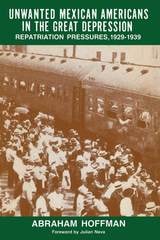
Unwanted Mexican Americans in the Great Depression
Repatriation Pressures, 1929–1939Abraham Hoffman; Foreword by Julian Nava
University of Arizona Press, 1973
Prior to 1931, many Mexican Americans left the United States voluntarily, prompted by homesickness, unemployment, and the Mexican government’s offer of free small land parcels. As the Great Depression deepened, repatriation pressures increased. Anglo groups lobbied for laws that excluded aliens from jobs and welfare benefits. Many businessmen, government officials, and social workers believed that removing Mexican Americans would open up jobs for U.S. citizens and alleviate some of the burden placed on relief agencies.
The Department of Labor’s federal deportation drive, launched in 1931, created an atmosphere of fear and tension in Mexican American communities. Immigration agents conducted surprise searches for people who had entered the country illegally, and Mexicans who had crossed the border before restrictive legislation was passed became prime targets of the deportation campaign.
Welfare agencies throughout the United States organized repatriation programs. The Los Angeles County Welfare Bureau, with the most extensive program, was responsible for the removal of more than thirteen thousand Mexican Americans. A few well-publicized deportations had frightened Mexicans who were unsure of their immigration status. Many chose repatriation over possible deportation.
Using much archival material and many previously unpublished government documents, Hoffman focuses on the repatriation experience in Los Angeles. The city’s large Mexican American population provides an excellent case study of the entire movement. He also surveys the process of Mexican repatriation throughout the entire United States.
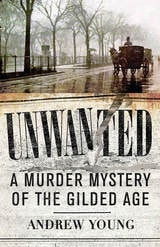
Unwanted
A Murder Mystery of the Gilded AgeAndrew Young
Westholme Publishing, 2016
On the foggy, cold morning of February 1, 1896, a boy came upon what he thought was a pile of clothes. It was soon discovered to be the headless body of a young woman, brutally butchered and discarded. She was found just across the river from one of the largest cities in the country, Cincinnati, Ohio. Soon the authorities, the newspapers, and the public were obsessed with finding the poor girl’s identity and killer. Misinformation and rumor spread wildly around the case and led authorities down countless wrong paths. Initially, it appeared the crime would go unsolved. An autopsy, however, revealed that the victim was four months pregnant, presenting a possible motive. It would take the hard work of a sheriff, two detectives, and the unlikely dedication of a shoe dealer to find out who the girl was; and once she had been identified, the case came together. Within a short time the police believed they had her killers—a handsome and charismatic dental student and his roommate—and enough evidence to convict them of first-degree murder. While the suspects seemed to implicate themselves, the police never got a clear answer as to what exactly happened to the girl and they were never able to find her lost head—despite the recovery of a suspicious empty valise.
Centering his riveting new book, Unwanted: A Murder Mystery of the Gilded Age, around this shocking case and how it was solved, historian Andrew Young re-creates late nineteenth- century America, where Coca-Cola in bottles, newfangled movie houses, the Gibson Girl, and ragtime music played alongside prostitution, temperance, racism, homelessness, the rise of corporations, and the women’s rights movement. While the case inspired the sensationalized pulp novel Headless Horror, songs warning girls against falling in love with dangerous men, ghost stories, and the eerie practice of random pennies left heads up on a worn gravestone, the story of an unwanted young woman captures the contradictions of the Gilded Age as America stepped into a new century, and toward a modern age.

Unwelcome Shores
Black Refugees in AmericaBernadette Ludwig
Rutgers University Press, 2026

Unwilling Germans
The Goldhagen DebateRobert R. Shandley
University of Minnesota Press, 1998
A comprehensive overview of the controversy surrounding Hitler’s Willing Executioners.
Few if any books of the past fifty years have moved a broad section of the German public to think about their country’s Nazi past as has Daniel Jonah Goldhagen’s Hitler’s Willing Executioners. The main argument of his book is that Germans committed the unthinkable acts of the Holocaust not because they were forced to but out of a deeply held conviction that killing Jews was morally just. Unwilling Germans? traces the intense and varied reception of a book that has created more heated debate than any other treatment of Germany’s genocidal past.
When Goldhagen’s book first appeared, it was almost universally dismissed by journalists and historians alike. However, following a book tour in Germany, Goldhagen started winning over many of his ardent detractors and finding a young, receptive audience. Although German scholars reacted to Goldhagen and his argument with outrage and dismissal, ironically the German public was mesmerized by both the book and Goldhagen himself.Unwilling Germans? reprints articles that originally appeared in German newspapers, the popular press, and journals, as well as offering original essays. Among the writers whose work is represented are historians, journalists, political scientists, and literary critics, including Jürgen Habermas and Klaus Theweleit. The book traces the initial reactions in Germany to the debate surrounding the U.S. publication of the book, the subsequent reviews and reactions upon the publication of the German translation, and recent commentary by Goldhagen and the American historian Christopher Browning. A unique and fascinating collection, Unwilling Germans? will help to sort out the confusing nature of the response to the “Goldhagen Debate,” and shed light on both Germany’s continuing process of coming to terms with its Nazi past and the resonances of that debate in the United States.ISBN 0-8166-3100-X Cloth $44.95xxISBN 0-8166-3101-8 Paper $17.95224 pages 5 7/8 x 9 JuneTranslation inquiries: University of Minnesota PressUp Against the Archive
Experiments in Writing British Empire History OtherwiseAntoinette Burton, editor
Duke University Press, 2027
Up Against the Real
Black Mask from Art to ActionNadja Millner-Larsen
University of Chicago Press, 2023
With Up Against the Real, Nadja Millner-Larsen offers the first comprehensive study of the group Black Mask and its acrimonious relationship to the New York art world of the 1960s. Cited as pioneers of now-common protest aesthetics, the group’s members employed incendiary modes of direct action against racism, colonialism, and the museum system. They shut down the Museum of Modern Art, fired blanks during a poetry reading, stormed the Pentagon in an antiwar protest, sprayed cow’s blood at the secretary of state, and dumped garbage into the fountain at Lincoln Center. Black Mask published a Dadaist broadside until 1968, when it changed its name to Up Against the Wall Motherfucker (after line in a poem by Amiri Baraka) and came to classify itself as “a street gang with analysis.” American activist Abbie Hoffman described the group as “the middle-class nightmare . . . an anti-media phenomenon simply because their name could not be printed.”
Up Against the Real examines how and why the group ultimately rejected art in favor of what its members deemed “real” political action. Exploring this notorious example of cultural activism that rose from the ruins of the avant-garde, Millner-Larsen makes a critical intervention in our understanding of political art.
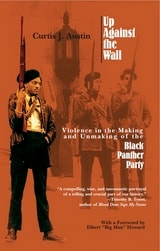
Up Against the Wall
Violence in the Making and Unmaking of the Black Panther PartyCurtis J. Austin
University of Arkansas Press, 2008
Up South in the Ozarks
Dispatches from the MarginsBrooks Blevins
University of Arkansas Press, 2022
Historian Brooks Blevins has spent his life studying and writing about the people of his native regions—the South and the Ozarks. He has been in the vanguard of a new and vibrant Ozarks Studies movement that has worked to refract the stories of Ozarkers through a more realistic and less exotic lens. In Up South in the Ozarks: Dispatches from the Margins, Blevins introduces us with humor and fairness to mostly unseen lives of the past and present: southern gospel singing schools and ballad collectors, migratory cotton pickers and backroad country storekeepers, fireworks peddlers and impoverished diarists.
Part historical and part journalistic, Blevins’s essays combine the scholarly sensibilities of a respected historian with the insights of someone raised in rural hill country. His stories of marginalized characters often defy stereotype. They entertain as much as they educate. And most of them originate in the same place Blevins does: up south in the Ozarks.
Up from Nothing
The Michigan State University Cyclotron LaboratorySam M. Austin
Michigan State University Press, 2016
The cyclotron laboratory at MSU has been known for years as the best university nuclear physics laboratory in the United States, and perhaps in the world. But very few, even in its hometown of East Lansing, know how it achieved that status or why it prospered when laboratories at many other famous universities faded.
In this book Austin, a nuclear physicist who has been at the laboratory since the beginning of its ascent, gives us a remarkable story. It begins with an exceptional individual, Henry Blosser, who founded the laboratory, built a cyclotron accelerator of uniquely high precision, and recruited a team of nuclear physicists that used it to establish the laboratory’s reputation. Its credibility led to a sequence of accelerators, each operating in a different sub?eld while continuing a tradition of forefront science, and to a laboratory culture that fostered the courage and foresight to compete for the FRIB in the face of daunting odds.
Up in the Rocky Mountains
Writing the Swedish Immigrant ExperienceJennifer Eastman Attebery
University of Minnesota Press, 2007
Before the turn of the twentieth century, many Swedish men emigrated to the American Rockies as itinerant laborers, drawn by the region’s developing industries. Single Swedish women ventured west, too, and whole families migrated, settling into farm communities. By 1920, one-fifth of all Swedish immigrants were living in the West.
In Up in the Rocky Mountains, Jennifer Eastman Attebery offers a new perspective on Swedish immigrants’ experiences in Idaho, Montana, Utah, Wyoming, Colorado, and New Mexico from 1880 to 1917 by interpreting their letters home. Considering more than three hundred letters, Attebery analyzes their storytelling, repetitive language, traditional phrasing, and metaphoric images. Recognizing the letters’ power as a folk form, Attebery sees in them the writers’ relationships back in Sweden as well as their encounters with religious and labor movements, regionalism, and nationalism in their new country.
By defining personal letters as a vernacular genre, Attebery provides a model for discerning immigrants’ shared culture in correspondence collections. By studying their words, she brings to life small Swedish communities throughout the Rocky Mountain region.
Jennifer Eastman Attebery is professor of English and director of American studies at Idaho State University.

Upheaval from the Abyss
Ocean Floor Mapping and the Earth Science RevolutionLawrence, David M.
Rutgers University Press, 2002
The deep oceans are the last great frontier remaining on Earth. Humans have conquered the vast wilderness of the terrestrial surface, from the searing deserts and dark forests of the tropics to the icy polar regions. Today, anyone with enough ambition and money can travel upriver into the heart of the Borneo jungle, climb Mount Everest, or spend the night at the South Pole. But the oceans beyond the continental shelves remain forbidding, beyond the reach of science, adventurism, and commerce.
Not long ago, scientists viewed the ocean floor as a vast, featureless plain, an ancient repository of detritus eroded from the surface of an unchanging Earth. Light never reached the seemingly lifeless depths. The ocean basins were only of marginal scholarly interest. This all changed with the Herculean quest to discover what lay on the world's ocean floor—a quest that inspired the continental drift-plate tectonics revolution and overturned prevailing scientific notions of how the Earth’s surface was created, rearranged, and destroyed.
Upheaval from the Abyss spans a 130-year period, beginning with the early, backbreaking efforts to map the depths during the age of sail; continuing with improvements in research methods spurred by maritime disaster and war; and culminating in the publication of the first map of the world’s ocean floor in 1977. The author brings this tale to life by weaving through it the personalities of the scientists-explorers who struggled to see the face of the deep, and reveals not only the facts of how the ocean floor was mapped, but also the human dimensions of what the scientists experienced and felt while in the process.
Upheaval in the Quiet Zone
1199/SEIU and the Politics of Healthcare UnionismLeon Fink and Brian Greenberg
University of Illinois Press, 2008
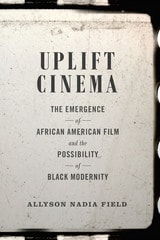
Uplift Cinema
The Emergence of African American Film and the Possibility of Black ModernityAllyson Nadia Field
Duke University Press, 2015
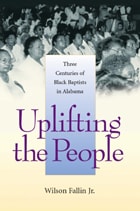
Uplifting the People
Three Centuries of Black Baptists in AlabamaWilson Fallin Jr.
University of Alabama Press, 2007
Three centuries of faith, leadership, and community building in Alabama's Black Baptist tradition.
Uplifting the People is a history of the Alabama Missionary Baptist State Convention—its origins, churches, associations, conventions, and leaders. Fallin demonstrates that a distinctive Afro-Baptist faith emerged as slaves in Alabama combined the African religious emphasis on spirit possession, soul-travel, and rebirth with the evangelical faith of Baptists. The denomination emphasizes a conversion experience that brings salvation, spiritual freedom, love, joy, and patience, and also stresses liberation from slavery and oppression and highlights the exodus experience. In examining the social and theological development of the Afro-Baptist faith over the course of three centuries, Uplifting the People demonstrates how black Baptists in Alabama used faith to cope with hostility and repression.
Fallin reveals that black Baptist churches were far more than places of worship. They functioned as self-help institutions within black communities and served as gathering places for social clubs, benevolent organizations, and political meetings. Church leaders did more than conduct services; they protested segregation and disfranchisement, founded and operated schools, and provided community leaders for the civil rights movement of the mid-20th century.
Through black churches, members built banking systems, insurance companies, and welfare structures. Since the gains of the civil rights era, black Baptists have worked to maintain the accomplishments of that struggle, church leaders continue to speak for social justice and the rights of the poor, and churches now house day care and Head Start programs. Uplifting the People also explores the role of women, the relations between black and white Baptists, and class formation within the black church.
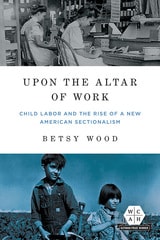
Upon the Altar of Work
Child Labor and the Rise of a New American SectionalismBetsy Wood
University of Illinois Press, 2020
Betsy Wood examines the evolution of ideas about child labor and the on-the-ground politics of the issue against the backdrop of broad developments related to slavery and emancipation, industrial capitalism, moral and social reform, and American politics and religion. Wood explains how the decades-long battle over child labor created enduring political and ideological divisions within capitalist society that divided the gatekeepers of modernity from the cultural warriors who opposed them. Tracing the ideological origins and the politics of the child labor battle over the course of eighty years, this book tells the story of how child labor debates bequeathed an enduring legacy of sectionalist conflict to modern American capitalist society.
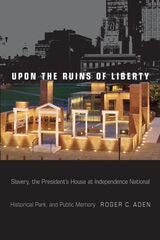
Upon the Ruins of Liberty
Slavery, the President's House at Independence National Historical Park, and Public MemoryRoger C. Aden
Temple University Press, 2014
In Upon the Ruins of Liberty, Roger Aden offers a compelling account that explores the development of this important historic site and how history, space, and public memory intersected with contemporary racial politics. Aden constructs this engrossing tale by drawing on archival material and interviews with principal figures in the controversy-including historian Ed Lawler, site activist Michael Coard, and site designer Emanuel Kelly.
Upon the Ruins of Liberty chronicles the politically-charged efforts to create a fitting tribute to the place where George Washington (and later, John Adams) shaped the presidency while denying freedom to the nine enslaved Africans in his household. From design to execution, the plans prompted advocates to embrace stories informed by race, and address difficulties that included how to handle the results of the site excavation. As such, this landmark project raised concerns and provided lessons about the role of public memory and how places are made to shape the nation's identity.
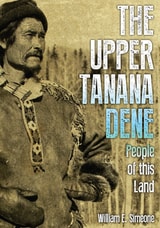
Upper Tanana Dene
People of This Landby William E. Simeone
University of Alaska Press, 2022
As young Dene migrate to towns and cities far from their homeland on the upper Tanana River of east central Alaska, they may never learn what it was like living from the land. In these interviews elders express concern that young Dene are becoming ignorant of the traditions that made their ancestors disciplined and strong enough to withstand the rigors of life on the land. The old life was taxing and made demands on the body and soul, and the struggle to achieve security placed a premium on knowledge, endurance, and constant effort. Modern conveniences have made life easier, but elders believe their knowledge is still vital to the survival of future generations.
With text in both Dene and English, The Upper Tanana Dene is a link to Dene experiences, lives, and understanding of the world and is meant for those interested in Dene heritage, as well as students and scholars of cultural and ethnic studies and history.
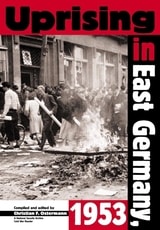
Uprising in East Germany, 1953
The Cold War, the German Question, and the First Major Upheaval behind the Iron CurtainThe National Security Archive Ostermann
Central European University Press, 2001
This volume is the second in the series Cold War Documentary Readers, a project of the US National Security Archive and the Cold War International History Project.
The volume is the first documented account of this early Cold War crisis from both sides of the Iron Curtain. Based on the recent unprecedented access to the once-closed archives of several member states of the Warsaw Pact, this collection of primary-source documents presents one of the most notorious events of post-war European history in a highly readable format.
Previously unreleased Kremlin records, once highly classified American documents, materials from the Soviet Foreign Ministry, and transcripts of internal East German Communist Party Politburo meetings in the days leading to the uprising in the German Democratic Republic (GDR) are among the highlights of this sensational documentary.
In this volume, as in the previous one in the series, each part is preceded by a detailed introductory essay to provide the necessary historical and political context. The individual documents are introduced by short headnotes summarizing the contents and orienting the reader. A chronology, glossary and bibliography offer further background information.
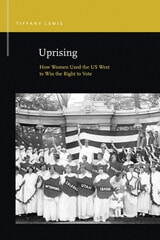
Uprising
How Women Used the US West to Win the Right to VoteTiffany Lewis
Michigan State University Press, 2021
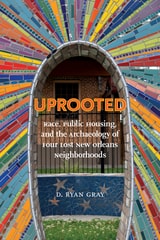
Uprooted
Race, Public Housing, and the Archaeology of Four Lost New Orleans NeighborhoodsD. Ryan Gray
University of Alabama Press, 2020
The archaeology of four New Orleans neighborhoods that were replaced by public housing projects
Uprooted: Race, Public Housing, and the Archaeology of Four Lost New Orleans Neighborhoods uses archaeological research on four neighborhoods that were razed during the construction of public housing in World War II–era New Orleans. Although each of these neighborhoods was identified as a “slum” historically, the material record challenges the simplicity of this designation. D. Ryan Gray provides evidence of the inventiveness of former residents who were marginalized by class, color, or gender and whose everyday strategies of survival, subsistence, and spirituality challenged the city’s developing racial and social hierarchies.
These neighborhoods initially appear to have been quite distinct, ranging from the working-class Irish Channel, to the relatively affluent Creole of Color–dominated Lafitte area, to the former location of Storyville, the city’s experiment in semilegal prostitution. Archaeological and historical investigations suggest that race was the crucial factor in the areas’ selection for clearance. Each neighborhood manifested a particular perceived racial disorder, where race intersected with ethnicity, class, or gender in ways that defied the norms of Jim Crow segregation.
Gray’s research makes use of both primary documents—including census records, city directories, and even the brothel advertising guides called “Blue Books”—and archaeological data to examine what this entailed at a variety of scales, reconstructing narratives of the households and communities affected by clearance. Public housing, both in New Orleans and elsewhere, imposed a new kind of control on urban life that had the effect of making cities both more segregated and less equal. The story of the neighborhoods that were destroyed provides a reminder that their erasure was not an inevitable outcome, and that a more equitable and just city is still possible today. A critical examination of the rise of public housing helps inform the ongoing debates over its demise, especially in light of the changing face of post-Katrina New Orleans.
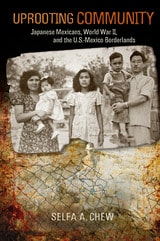
Uprooting Community
Japanese Mexicans, World War II, and the U.S.-Mexico BorderlandsSelfa A. Chew
University of Arizona Press, 2015
In Uprooting Community, Selfa A. Chew examines the lived experience of Japanese Mexicans in the U.S.-Mexico borderlands during World War II. Studying the collaboration of Latin American nation-states with the U.S. government, Chew illuminates the efforts to detain, deport, and confine Japanese residents and Japanese-descent citizens of Latin American countries during World War II. These narratives challenge the notion that Japanese Mexicans enjoyed the protection of the Mexican government during the war and refute the mistaken idea that Japanese immigrants and their descendants were not subjected to internment in Mexico during this period. Through her research, Chew provides evidence that, despite the principles of racial democracy espoused by the Mexican elite, Japanese Mexicans were in fact victims of racial prejudice bolstered by the political alliances between the United States and Mexico.
The treatment of the ethnic Japanese in Mexico was even harsher than what Japanese immigrants and their children in the United States endured during the war, according to Chew. She argues that the number of persons affected during World War II extended beyond the first-generation Japanese immigrants “handled” by the Mexican government during this period, noting instead that the entire multiethnic social fabric of the borderlands was reconfigured by the absence of Japanese Mexicans.

Ups and Downs of Life in the Indies
P. A. Daum
University of Massachusetts Press, 1987
Upsetting Food
Three Eras of Food Protests in the United StatesJeffrey Haydu
Temple University Press, 2021
Battle lines have long been drawn over how food is produced, what food is made available to whom, and how best to protect consumers from risky or unhealthy food. Jeffrey Haydu resurrects the history of food reform and protest in Upsetting Food, showing how activists defined food problems, articulated solutions, and mobilized for change in the United States.
Haydu’s sociological history starts in the 1830s with diet reformer Sylvester Graham, who blamed alcohol and store-bought bread—signs of a commercializing urban society—for poor health and moral decline. His successors at the turn of the twentieth century rallied against impure food and pushed for women to be schooled in scientific food preparation and nutrition. Decades later, in the 1960s and ’70s, a grassroots movement for organic food battled commercial food production in favor of food grown ecologically, by small farmers, and without artificial chemicals.
Each campaign raised doubts about food safety, health, and transparency, reflecting how a capitalist system can undermine trust in food. But Haydu also considers how each movement reflects the politics, inequalities, and gender relations of its time. And he traces how outcomes of each campaign laid the groundwork for the next. The three eras thus come together as parts of a single, recurring food movement.
Upsetting Food offers readers a historical background to better understand contemporary and contentious food politics.
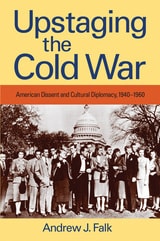
Upstaging the Cold War
American Dissent and Cultural Diplomacy, 1940-1960Andrew J. Falk
University of Massachusetts Press, 2010
Traditional interpretations of the 1950s have emphasized how American anti-communists deployed censorship and the blacklist to silence dissent, particularly in the realm of foreign policy. Yet those efforts at repression did not always succeed. Throughout the early years of the Cold War, a significant number of writers and performers continued to express controversial views about international relations in Hollywood films, through the new medium of television, on the Broadway stage, and from behind the scenes.
By promoting superpower cooperation, decolonization, nuclear disarmament, and other taboo causes, dissident artists such as Lillian Hellman, Arthur Miller, Rod Serling, Dalton Trumbo, Reginald Rose, and Paddy Chayefsky managed both to stretch the boundaries of Cold War ideology and to undermine some of its basic assumptions. Working at times under assumed names and in some cases outside the United States, they took on the role of informal diplomats who competed with Washington in representing America to the world.
Ironically, the dissidents' international appeal eventually persuaded the U.S. foreign policy establishment that their unconventional views could be an asset in the Cold War contest for “hearts and minds,” and their artistic work an effective means to sell American values and culture abroad. By the end of the 1950s, the Eisenhower administration not only appropriated the work of these talented artists but enlisted some of them to serve as official voices of Cold War cultural diplomacy.
Upstream
Trust Lands and Power on the Feather RiverBeth Rose Middleton Manning
University of Arizona Press, 2018
Upstream documents the significance of the Allotment Era to a long and ongoing history of cultural and community disruption. It also details Indigenous resistance to both hydropower and disruptive conservation efforts. With a focus on northeastern California, this book highlights points of intervention to increase justice for Indigenous peoples in contemporary natural resource policy making.
Author Beth Rose Middleton Manning relates the history behind the nation’s largest state-built water and power conveyance system, California’s State Water Project, with a focus on Indigenous resistance and activism. She illustrates how Indigenous history should inform contemporary conservation measures and reveals institutionalized injustices in natural resource planning and the persistent need for advocacy for Indigenous restitution and recognition.
Upstream uses a multidisciplinary and multitemporal approach, weaving together compelling stories with a study of placemaking and land development. It offers a vision of policy reform that will lead to improved Indigenous futures at sites of Indigenous land and water divestiture around the nation.

Uranium Frenzy
Saga of the Nuclear WestRaye C. Ringholz
Utah State University Press, 2002
The uranium boom is only part of the larger story of atomic weapons testing and its impact in the western United States. Nuclear explosions at the Nevada Test Site not only spurred uranium mining, they also had a disastrous impact on many Americans: downwinders in the eastward path of radiation clouds, military observers and guinea pigs in exposed positions, and Navajo and other uranium mill workers all became victims, as deaths from cancer and other radiation-caused diseases reached much higher than normal rates among them. Tons of radioactive waste left by mines, mills, and the nuclear industry and how to dispose of them are other nagging legacies of the nuclear era. Recent decades have brought multiple attempts by victims to obtain compensation from the federal government and other legal battles over disposal of nuclear waste. When courts refused to grant relief to downwinders and others, Congress eventually interceded and legislated compensation for a limited number of victims able to meet strict criteria, but did not adequately fund the program. Recently, Congress attempted to fix this shortfall, but in the meantime many downwinders and others holding compensation IOUs had died. Congressional and other efforts to dispose of waste have lately focused on Nevada and Utah, two states all too familiar with nuclear issues and reluctant to take on further radioactive burdens.
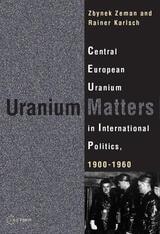
Uranium Matters
Central European Uranium in International Politics, 19001960Rainer Karlsch
Central European University Press, 2008

Urban Aloha
Hawaiian Diaspora, Identity, and Belonging in Los AngelesLani Cupchoy
University of Nevada Press, 2027
Urban Aloha reveals the vibrant, little-known story of Kānaka ʻŌiwi (Native Hawaiians) diaspora in Los Angeles, home to the largest Hawaiian community outside Hawai‘i. Moving beyond tourist clichés and the persistent myth that Hawaiian Gardens represents “the” Hawaiian enclave, author Lani Cupchoy traces how a diasporic community took root across the South Bay and San Gabriel Valley. Beginning with the peak migrations of the 1950s and 1960s, and driven by economic recession in the islands, the narrative follows families as they built new lives through civic clubs, newsletters, churches, restaurants, and backyard gatherings.
Drawing on oral histories, archival research, foodways, hula halau, and organizations such as the Hawaiian Inter-Club Council of Southern California, Urban Aloha explores how “Hawaiianness” shifts from identity to lived cultural community. Cupchoy examines how belonging is shaped not only by ancestry but by region, memory, leisure, and everyday practice. At once intimate and intellectually compelling, this book challenges manufactured fantasies of paradise and reveals a dynamic mainland community negotiating authenticity, representation, and cultural resilience. Richly researched and deeply human, Urban Aloha redefines what it means to be Hawaiian—on the continent and beyond.
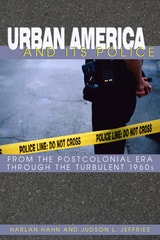
Urban America And Its Police
H Hahn
University Press of Colorado, 2003
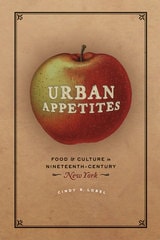
Urban Appetites
Food and Culture in Nineteenth-Century New YorkCindy R. Lobel
University of Chicago Press, 2014
Historians, sociologists, and foodies alike will devour the story of the origins of New York City’s food industry in Urban Appetites. Cindy R. Lobel focuses on the rise of New York as both a metropolis and a food capital, opening a new window onto the intersection of the cultural, social, political, and economic transformations of the nineteenth century. She offers wonderfully detailed accounts of public markets and private food shops; basement restaurants and immigrant diners serving favorites from the old country; cake and coffee shops; and high-end, French-inspired eating houses made for being seen in society as much as for dining. But as the food and the population became increasingly cosmopolitan, corruption, contamination, and undeniably inequitable conditions escalated. Urban Appetites serves up a complete picture of the evolution of the city, its politics, and its foodways.
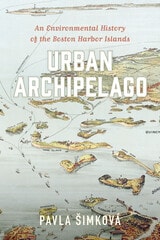
Urban Archipelago
An Environmental History of the Boston Harbor IslandsPavla Šimková
University of Massachusetts Press, 2021
In this book, Pavla Šimková reinterprets the Boston Harbor Islands as an urban archipelago, arguing that they have been an integral part of Boston since colonial days, transformed by the city's changing values and catering to its current needs. Drawing on archival sources, historic maps and photographs, and diaries from island residents, this absorbing study attests that the harbor islands' story is central to understanding the ways in which Boston has both shaped and been shaped by its environment over time.
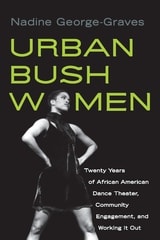
Urban Bush Women
Twenty Years of African American Dance Theater, Community Engagement, and Working It OutNadine George-Graves
University of Wisconsin Press, 2010
Nadine George-Graves presents a comprehensive history of Urban Bush Women since their founding in 1984. She analyzes their complex work, drawing on interviews with current and former dancers and her own observation of and participation in Urban Bush Women rehearsals. This illustrated book captures the grace and power of the dancers in motion and provides an absorbing look at an innovative company that continues to raise the bar for socially conscious dance.
Urban Design in Western Europe
Regime and Architecture, 900-1900Wolfgang Braunfels
University of Chicago Press, 1990
Urban Disorder and the Shape of Belief
The Great Chicago Fire, the Haymarket Bomb, and the Model Town of PullmanCarl Smith
University of Chicago Press, 1994
Urban Disorder and the Shape of Belief
The Great Chicago Fire, the Haymarket Bomb, and the Model Town of Pullman, Second EditionCarl Smith
University of Chicago Press, 2007
In Urban Disorder and the Shape of Belief, Carl Smith explores the imaginative dimensions of these events as he traces the evolution of interconnected beliefs and actions that increasingly linked city, disorder, and social reality in the minds of Americans. Examining a remarkable range of writings and illustrations, as well as protests, public gatherings, trials, hearings, and urban reform and construction efforts, Smith argues that these three events—and the public awareness of them—not only informed one another, but collectively shaped how Americans understood, and continue to understand, Chicago and modern urban life.
This classic of urban cultural history is updated with a foreword by the author that expands our understanding of urban disorder to encompass such recent examples as Hurricane Katrina, the Oklahoma City Bombing, and 9/11.
“Cultural history at its finest. By utilizing questions and methodologies of urban studies, social history, and literary history, Smith creates a sophisticated account of changing visions of urban America.”—Robin F. Bachin, Journal of Interdisciplinary History
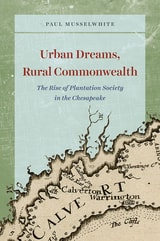
Urban Dreams, Rural Commonwealth
The Rise of Plantation Society in the ChesapeakePaul Musselwhite
University of Chicago Press, 2018
Paul Musselwhite details the unsuccessful urban development that defined the region from the seventeenth century through the Civil War, showing how places like Jamestown and Annapolis—despite their small size—were the products of ambitious and cutting-edge experiments in urbanization comparable to those in the largest port cities of the Atlantic world. These experiments, though, stoked ongoing debate about commerce, taxation, and self-government. Chesapeake planters responded to this debate by reinforcing the political, economic, and cultural authority of their private plantation estates, with profound consequences for the region’s laborers and the political ideology of the southern United States. As Musselwhite makes clear, the antebellum economy around this well-known waterway was built not in the absence of cities, but upon their aspirational wreckage.
Urban Dwellings, Haitian Citizenships
Housing, Memory, and Daily Life in HaitiVincent Joos
Rutgers University Press, 2022
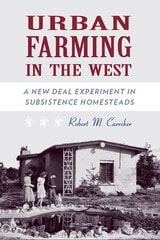
Urban Farming in the West
A New Deal Experiment in Subsistence HomesteadsRobert Carriker
University of Arizona Press, 2010
Robert Carriker examines for the first time the intricate histories of these subsistence homestead projects, which have long been buried in bureaucratic records and clouded by misunderstanding, showing that in many ways they were among the agency’s most successful efforts. He provides case studies of the projects, rescuing their obscure histories using archival documents and rare photographs. He also reveals the machinations of civic groups and private citizens across the West who jockeyed for access to the funds being allotted for New Deal community building.
By describing what took place on these western homesteads, Carriker shows that the DSH’s agenda was not as far-fetched as some have reported. The tendency to condemn the Division and its projects, he argues, has failed to appreciate the good that came from some of the individual homestead communities—particularly those in the Far West.
Although overshadowed by the larger undertakings of the New Deal, some of these western communities remain thriving neighborhoods—living legacies to FDR’s efforts that show how the country once chose to deal with economic hardship. Too often the DSH is noted for its failures; Carriker’s study shows that its western homesteads were instead qualified accomplishments.
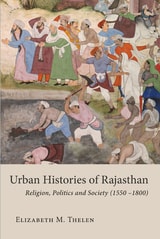
Urban Histories of Rajasthan
Religion, Politics and Society (1550–1800)Elizabeth M. Thelen
Gingko, 2022
Diverse peoples intermingled in the streets and markets of premodern Indian cities. This book considers how these diverse residents lived together and negotiated their differences. Which differences mattered, when and to whom? How did state actions and policies affect urban society and the lives of various communities? How and why did conflict occur in urban spaces? Through these questions, this book explores the histories of urban communities in the three cities of Ajmer, Nagaur, and Pushkar in Rajasthan, between the sixteenth and eighteenth centuries. The focus of this study is on everyday life, contextualizing religious practices and conflicts by considering patterns of patronage and broader conflict patterns within society. The book examines various archival documents, from family and institutional records to state registers, and uses these documents to demonstrate the complex and sometimes contradictory ways religion intersected with politics, economics, and society. The author shows how many patronage patterns and processes persisted in altered forms, and how the robustness of these structures contributed to the resilience of urban spaces and society in precolonial Rajasthan.
Urban Horror
Neoliberal Post-Socialism and the Limits of VisibilityErin Y. Huang
Duke University Press, 2020
Urban Imaginaries in Native Amazonia
Tales of Alterity, Power, and DefianceFernando Santos-Granero
University of Arizona Press, 2023
Featuring analysis from historical, ethnological, and philosophical perspectives, contributors seek to explain the imaginaries’ widespread diffusion, as well as their influence in present-day migration and urbanization. Above all, it underscores how these urban imaginaries allow Indigenous Amazonians to express their concerns about power, alterity, domination, and defiance.
Contributors
Natalia Buitron
Philippe Erikson
Emanuele Fabiano
Fabiana Maizza
Daniela Peluso
Fernando Santos-Granero
Pirjo Kristiina Virtanen
Robin M. Wright