Results by title
3576 books match the query 'American' and 40 start with v

Value and Vision in American Literature
Essays in Honor of Ray Lewis WhiteJoseph Candido
Ohio University Press, 1999
Through their various (and sometimes contrasting) critical points of view, these essays call attention to ideas or connections that demand a reappraisal of conventional attitudes or ingrained responses. Ranging in focus from the period of the mid-nineteenth century to the present day, they treat indisputably canonical figures such as Hawthorne, Faulkner, James, Hemingway, Cather, Bellow, Porter, Welty, and Warren in the same breath and often refreshingly on the same terms with Wallace Stegner, Cormac McCarthy, Dunstan Thompson, neglected Civil War poets, and the New Formalist critics of the last ten years.
In celebration and in reflection of the important critical contribution Ray Lewis White has made to the study of American literature, these writers, each a noted scholar in the field of literary studies, present a picture of American literature that manages to value the past at the same time that it asks us to envision that past anew.
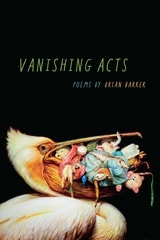
Vanishing Acts
Brian Barker
Southern Illinois University Press, 2019
A linked sequence of poems forms the book’s backbone, with an oracular voice from the future heralding the return—or hoped for return—of common animals. Part lyrical odes, part creation myths, part excerpts from a bizarre guide for naturalists, these poems mix fact and fiction, science and fable to create an unsettling vision of a dystopian world stricken by extinction, one where the world’s last catfish sleeps “in the shadow of a hydroelectric dam.” The imaginative language and bizarre stories of these poems are perfectly suited to capture a world that no longer makes sense: a man who wears a toupee to hide an injury inflicted by secret police, a group of villagers who make a bad bargain with a land agent.
The poems in Vanishing Acts straddle the comic and the tragic. They are by turns funny and haunting and ripe with scathing satire. They draw on the genres of speculative and science fiction as much as poetic traditions, and speak to the precarious state of man and the natural world in the twenty-first century.
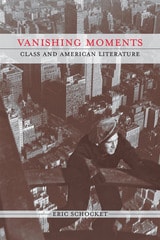
Vanishing Moments
Class and American LiteratureEric Schocket
University of Michigan Press, 2010
Schocket offers careful readings of works by Herman Melville, Rebecca Harding Davis, William Dean Howells, Jack London, T. S. Eliot, Gertrude Stein, Muriel Rukeyser, and Langston Hughes, among others, and explores how these authors worked to try to heal the rift between the classes. He considers the challenges writers faced before the Civil War in developing a language of class amidst the predominant concerns about race and slavery; how early literary realists dealt with the threat of class insurrection; how writers at the turn of the century attempted to span the divide between the classes by going undercover as workers; how early modernists used working-class characters and idioms to shape their aesthetic experiments; and how leftists in the 1930s struggled to develop an adequate model to connect class and literature. Vanishing Moments’ unique combination of a broad historical scope and in-depth readings makes it an essential book for scholars and students of American literature and culture, as well as for political scientists, economists, and humanists.
“An important book containing many brilliant arguments—hard-hitting and original. Schocket demonstrates a sophisticated acquaintance with issues within the working-class studies movement.”
--Barbara Foley, Rutgers University
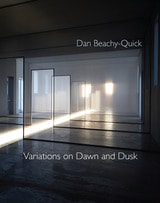
Variations on Dawn and Dusk
Dan Beachy-Quick
Omnidawn, 2019
Building from Irwin’s use of rhythm and structure, the poems in this collection are constructed with an architectural framework. Rhythmic procedures inversely link the first and last words of the first and last lines of each poem and tie the number of lines to the number of syllables in the first line. These structures form a pattern, a thoughtful consistency through which we are invited to move and meditate with each variation of light.
Vaudeville Humor
The Collected Jokes, Routines, and Skits of Ed LowryEdited with an Introduction by Paul M. Levitt
Southern Illinois University Press, 2006
Vaudeville Humor: The Collected Jokes, Routines, and Skits of Ed Lowry contains vaudeville jokes, skits, and routines from the first three decades of the twentieth century originally compiled by comedian Ed Lowry (1896–1983). Although occasionally found in bits and pieces in anthologies and in some period dramatic comedies, vaudeville humor has never before been available in one collection—performers rarely if ever kept a record of their jokes and routines. Fortunately, Ed Lowry was an inveterate collector. He kept copious notebooks of jokes and routines that he not only commissioned but also stole from other comics, clipped from newspapers, and copied from now defunct popular magazines of the day.
Editor Paul M. Levitt has reorganized the material into categories that preserve some of the flavor of Lowry’s scrapbooks yet provide for finer distinctions. Part one, “Jokes,” is organized by subject matter and cataloged by genre, dialects, and wordplay. From “Accidents” to “Work,” this exhaustive catalog of humor features over one thousand jokes with topics that range from city slickers and country hicks through midgets and old maids to Swedes and tattoos. Part two, “MC Material: Biz, Jokes, Routines, and Skits” is germane to the job of master of ceremonies, routines, and skits. It features topics from fractured fairy tales to stuttering. Part three, an appendix, “Ed Lowry Laffter,”reproduces a privately published collection that is now a rare collector’s item.
“Although some of the jokes can undoubtedly be found in other places,” explains Levitt in his introduction, “I know of no source as rich as this one for the twenties and thirties, a period so abundant in humor that for years afterward it fueled radio, cinema, and television.”
Veil and Burn
Laurie Clements Lambeth
University of Illinois Press, 2007
Velvet
PoemsWilliam Fargason
Northwestern University Press, 2024
Velvet, the second full-length collection from award-winning poet William Fargason, explores chronic illness, patriarchal abuse, intergenerational trauma, and racial inequality in the American South. Its speaker moves through the generations that preceded him to understand himself, and to heal from traumas both inherited and lived. As part of that heritage, the speaker confronts a family history of participation in racist ideologies and organizations to make sense of his own place within, and responsibility to, this history. In the titular lyric essay, “Velvet,” Fargason braids scientific research and YouTube videos in an attempt to forge paths for healing while contending with an inherited chronic disease. Ultimately, Velvet argues against traditional forms of toxic masculinity and suggests that vulnerability, soft and bleeding as the velvet on a deer’s antlers, offers one solution to it.
Venice West
The Beat Generation in Southern CaliforniaMaynard, John Arthur
Rutgers University Press, 1993
"A most remarkable book . . . a wonderful account of an odd and unlikely place where for a brief time a small number of people pursued a romantic vision of what a life dedicated to art should be like . . . a superb story."ÐÐWilliam O'Neill, author of American High: The Years of Confidence, 1945-1960
The beatnik was born in Venice, California, in the 1950s. An imaginary figure in many respectsÐÐthe invention of both the media and the people who played the beatnik roleÐÐthe character quickly assumed nearly mythic proportions for the American public. Coffeehouses, beards, poetry, drugs, and free-wheeling sexuality were all associated with the beatnik, the quintessential rebel who, by rejecting material values, represented both a threat and an alluring alternative to the dominant middle-class culture.
In this fascinating book, John Arthur Maynard tells the story of the poets and promoters who invented the Beat Generation and who, in many cases, destroyed themselves in the process. In this look at the least remembered (but in its time, most publicized) beat enclave, Maynard focuses on two of Venice's most newsworthy residentsÐÐLawrence Lipton and Stuart Z. Perkoff. Lipton began as a writer of popular detective stories and screenplays, but was determined to be recognized as a poet and social critic. He eventually published The Holy Barbarians, which helped to create the enduring public image of the beatnik. Stuart Perkoff was a more gifted poet; with fascination and horror, we follow his failed attempts to support his family, his heroin addiction, his first wive's courage and mental fragility, his sexual entanglements, his imprisonment, and the development of his own writing. Other characters who move in and out of the story are Kenneth Rexroth, Jack Kerouac, and Allen Ginsberg, as well as lesser-known poets, artists, hangers-on, and the many women who were rarely treated as full members of the community.
For most of the 1950s, the Venice beatniks were able to live and work in isolation. Once the media decided that beats made good copy, however, their peace was shattered. Reporters, drug dealers, violent criminals, and would-be beatniks invaded Venice in such force that many "square" residents began an unrelenting campaign to purge their community of bohemianism. This campaign persisted long after the beats, who tended to ignore politics, had yielded the stage to a new generation of political activists. In this collective biography, based largely on unpublished sources, Maynard tells us how these events affected public perceptions and the beats' own perceptions of themselves.
Venus and Don Juan
Carol Frost
Northwestern University Press, 1996
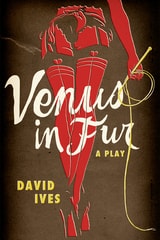
Venus in Fur
A PlayDavid Ives
Northwestern University Press, 2012
An unsettling drama, a playful comedy, and an exploration of gender roles and sexuality, Venus in Fur is a witty, dark look at the art of acting—onstage and off.
A young playwright, Thomas, has written an adaptation of the 1870 novel Venus in Fur by Leopold von Sacher-Masoch (after whom the term “masochism” was coined); the novel is the story of an obsessive adulterous relationship between a man and the mistress to whom he becomes enslaved. At the end of a long day in which the actresses Thomas auditions fail to impress him, in walks Vanda, very late and seemingly clueless, but she convinces him to give her a chance. As they perform scenes from Thomas’s play, and Vanda the actor and Vanda the character gradually take control of the audition, the lines between writer, actor, director, and character begin to blur.
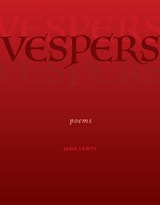
Vespers
Lewty, Jane
University of Iowa Press, 2026
Often called “evening prayer,” vespers is held around sunset. Its purpose: to give thanks for the day and offer a sacrifice of praise to God. In Jane Lewty’s Vespers, she superimposes the tropes of the Christian ritual onto a very different type of sacrifice—that of making art.
Through nightly devotion, the speaker of these poems maps ritual until it degrades: the speaker as an obedient robot, a scribe-concubine, a centaur wearing skates, a poet seeking virtuosity and dexterity. Vespers asks: What if writing prompts are a bad idea? What if one could become addicted to the incremental process? Is it possible to walk away from an addiction without suffering and trauma?
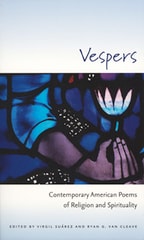
Vespers
Contemporary American Poems of Religion and SpiritualityVirgil Suarez
University of Iowa Press, 2003
At the heart of human existence lie fundamental questions that are pondered by philosophers, theologians, poets and thoughtful people from all walks of life. What is the meaning of life? Who or what is a divine being? How can a benevolent deity justify human suffering? Such questions are especially relevant to our lives in the current climate of American society. In Vespers: American Poems of Religion and Spirituality, editors Virgil Suárez and Ryan G. Van Cleave offer the reading world a timely anthology of powerful and passionate poems that cut to the heart of our contemporary theological and spiritual underpinnings.
Featuring fifty of today's most respected American poets, including Pulitzer Prize winners Stephen Dunn and Carolyn Kizer, Vespers allows us to witness and understand the challenging ideas and philosophies surrounding religion and spirituality. Through these poems, we can come to a better understanding of who, what, and why we are.
From deathbed spirituals to initiation songs, transformative ballads to transcendent sonnets, poets of myriad backgrounds—Native American, African American, Asian American, Latino, Protestant, Buddhist, Catholic, Jewish—echo the thoughts, concerns, and fears that linger in our souls. Their poems help us realize that we are not alone, that we're never truly alone, that even in the face of darkness the world is vibrant, beautiful, joyous.
More than a creative exploration of theological concerns—Vespers is a roadmap of where we've been, where we are, and where we are heading in terms of our spiritual and religious existence. It will keep you company, good company, whatever your religious or spiritual background.
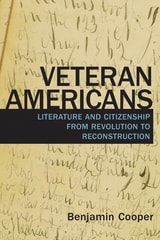
Veteran Americans
Literature and Citizenship from Revolution to ReconstructionBenjamin Cooper
University of Massachusetts Press, 2018
“I may dare to speak, and I intend to speak and write what I think,” wrote a New York volunteer serving in the Mexican War in 1848. Such sentiments of resistance and confrontation run throughout the literature produced by veteran Americans in the nineteenth century—from prisoner-of-war narratives and memoirs to periodicals, adventure pamphlets, and novels. Military men and women were active participants in early American print culture, yet they struggled against civilian prejudice about their character, against shifting collective memories that removed military experience from the nation's self-definition, and against a variety of headwinds in the uneven development of antebellum print culture.
In this new literary history of early American veterans, Benjamin Cooper reveals how soldiers and sailors from the Revolutionary War through the Civil War demanded, through their writing, that their value as American citizens and authors be recognized. Relying on an archive of largely understudied veteran authors, Cooper situates their perspective against a civilian monopoly in defining American citizenship and literature that endures to this day.
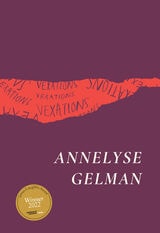
Vexations
Annelyse Gelman
University of Chicago Press, 2023
Annelyse Gelman’s book-length poem Vexations is a surreal, glitchy meditation on empathy, ecology, and precarity. Throughout the book winds a narrative about a mother and daughter as they move through a world of social and economic collapse in search of a post-capitalist safe haven. All the while, they also navigate a condition that affects the daughter’s empathic abilities, making her vulnerable to emotional contagion.
Vexations is titled and structured after Erik Satie’s composition of the same name, a piece that requires patience, endurance, and concentration from both its audience and its players. Similarly, Gelman’s Vexations employs repetition and variation to engage the reader’s attention. Hers is an ambient poetry, drawing on the aesthetic qualities of drone music and sampling voices and sounds to create a lush literary backdrop filled with pulsing psychedelic detail.
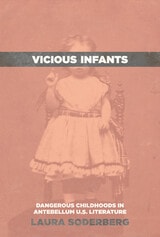
Vicious Infants
Dangerous Childhoods in Antebellum U.S. LiteratureLaura Soderberg
University of Massachusetts Press, 2021
Vicious Infants offers a counterhistory of literary childhood as both perceived social threat and site of resistance, revealing that many children were not only cut off from family and society, they were also preemptively excluded from the rewards of citizenship and adulthood. Turning to prison documents, medical journals, overlooked periodical fiction, and literary works from William Apess, Harriet Wilson, Herman Melville, Susan Paul, and Harriet Beecher Stowe, Laura Soderberg recovers alternate narratives of childhood and provides an important window into the cultural links between race, reproduction, and childhood in the antebellum period.
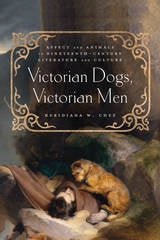
Victorian Dogs, Victorian Men
Affect and Animals in Nineteenth-Century Literature and CultureKeridiana W. Chez
The Ohio State University Press, 2017
Chez traces the evolution of the human-dog relationship as it developed parallel to an increasingly imperialist national discourse. The dog began as the affective mediator of the family, then addressed the emotional needs of its individual members, and finally evolved into both “man’s best friend” and worst enemy. By the last decades of the nineteenth century, the porous human-animal boundary served to produce the “humane” man: a liberal subject enabled to engage in aggressive imperial projects. Reading the work of Charles Dickens, George Eliot, Margaret Marshall Saunders, Bram Stoker, and Jack London, Victorian Dogs, Victorian Men charts the mobilization of affect through transatlantic narratives, demonstrating the deep interconnections between animals, affect, and gender.
Victorian Domesticity
Families in the Life and Art of Louisa May AlcottCharles Strickland
University of Alabama Press, 1985
The subject of Victorian Domesticity is family life in America. The life and works of Louisa May Alcott served as the vehicle for exploring and analyzing this subject. Although Alcott was deeply influenced by popular currents of sentimentality, her own experience exposed her to the confusions and contradictions generated when sentiment confronted the reality of life in 19th-century America.
In the first chapter Strickland outlines the ways in which sentimentality colored the perception of 19th-century Americans about such issues as courtship, marriage, the relationship between the sexes, generational relationships, and the relationship between the nuclear family and the community outside the family. Chapters two and three trace Alcott’s childhood and adolescent experiences, exploring the tensions that developed between Louisa and her father, and detailing the ways in which she carried the double burden of being both poor and female as she sought her identity as a writer.
The following six chapters treat the varieties of family life that appear in Alcott’s stories, the impact of feminism on her life, and her emphasis on the importance of child nurture. In the final two chapters the author treats the relationships that Alcott perceived between the family and the world around it and assesses the legacy of the Victorian family idea.
View from True North
Sara Henning
Southern Illinois University Press, 2018
Winner, George Bogin Memorial Award, 2019
Finalist, Julie Suk Award, 2018
In these edgy poems of witness, Sara Henning’s speaker serves as both conduit and curator of the destructive legacies of alcoholism and multigenerational closeting. Considering the impact of addiction and sexual repression in the family and on its individual members, Henning explores with deft compassion the psychological ramifications of traumas across multiple generations.
With the starling as an unspoken trope for victims who later perpetuate the cycle of abuse, suffering and shame became forces dangerous enough to down airliners. The strands Henning weaves—violent relationships, the destructive effects of long-term closeting, and the pall that shame casts over entire lives—are hauntingly epiphanic. And yet these feverish lyric poems find a sharp beauty in their grieving, where Rolling Stone covers and hidden erotic photographs turn into talismans of regret and empathy. After the revelation that her deceased grandfather was a closeted homosexual “who lived two lives,” Henning considers the lasting effects of shame in regard to the silence, oppression, and erasure of sexual identity, issues that are of contemporary concern to the LGBTQIA community. Even through “the dark / earth encircling us,” Henning’s speaker wonders if there isn’t some way out of a place “where my body / is just another smoke-stung / dirge of survival,” if, in the end, love won’t be victorious.
Part eyewitness testimony, part autoethnography, this book of memory and history, constantly seeking and yearning, is full of poems “too brutal and strange to suffer / [their] way anywhere but home.”
Vigilantes and Lynch Mobs
Narratives of Community and NationLisa Arellano
Temple University Press, 2012
Looking at the narrative accounts of mob violence produced by vigilantes and their advocates as “official” histories, Lisa Arellano shows how these nonfiction narratives conformed to a common formula whose purpose was to legitimate frontier justice and lynching.
In Vigilantes and Lynch Mobs, Arellano closely examines such narratives as well as the work of Western historian and archivist Hubert Howe Bancroft, who was sympathetic to them, and that of Ida B. Wells, who wrote in fierce opposition to lynching. Tracing the creation, maintenance, and circulation of dominant, alternative, and oppositional vigilante stories from the nineteenth-century frontier through the Jim Crow South, she casts new light on the role of narrative in creating a knowable past.
Demonstrating how these histories ennobled the actions of mobs and rendered their leaders and members as heroes, Arellano presents a persuasive account of lynching’s power to create the conditions favorable to its own existence.
Vignettes of the Deaf Character and Other Plays
Willy Conley
Gallaudet University Press, 2009
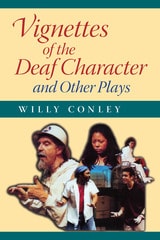
After spending three years in The National Theatre of the Deaf performing plays by hearing authors featuring hearing characters, Willy Conley realized that he wanted to write plays with deaf, hard-of- hearing, and hearing characters created from the Deaf perspective. Vignettes of the Deaf Character and Other Plays presents the result of his desire in twelve masterful plays.
“I write for the eye, always searching for live, mobile, provocative images that would fill and illuminate the entire stage space with the complexities, the pathos, and the humor involved when deaf and hearing cultures merge or collide,” writes Conley in his introduction. His plays depict a wide range of Deaf characters, including two brothers locked in a tragic rivalry familiar to families of all backgrounds; the broadly comedic Deaf Guide and hearing Techie interspersing laughs with cultural lessons in their Museum of Signs for People with Communication Disorders; Everyone searching for her Good Deeds as she faces imminent Death in an updating of the classic morality play, plus many others. These works explore a broad palette of circumstances with and without hearing characters, allowing Deaf characters to interact minus the direct influence that the dominant culture might exert. Vignettes of the Deaf Character and Other Plays presents the drama and passion of a master playwright who, through his perceptions, reveals facets of the Deaf character in all of us.
Violet America
Regional Cosmopolitanism in U.S. FictionJason Arthur
University of Iowa Press, 2013
Violin Playing Herself in a Mirror
PoemsDavid Kutz-Marks
University of Massachusetts Press, 2015
Virtual Americas
Transnational Fictions and the Transatlantic ImaginaryPaul Giles
Duke University Press, 2002
Throughout Virtual Americas Giles focuses on specific examples of transatlantic cultural interactions such as Frederick Douglass’s experiences and reputation in England; Herman Melville’s satirizing fictions of U.S. and British nationalism; and Vladimir Nabokov’s critique of European high culture and American popular culture in Lolita. He also reverses his perspective, looking at the representation of San Francisco in the work of British-born poet Thom Gunn and Sylvia Plath’s poetic responses to England. Giles develops his theory about the need to defamiliarize the study of American literature by considering the cultural legacy of Surrealism as an alternative genealogy for American Studies and by examining the transatlantic dimensions of writers such as Henry James and Robert Frost in the context of Surrealism.
Virtual Gender
Fantasies of Subjectivity and EmbodimentMary Ann O'Farrell and Lynne Vallone, Editors
University of Michigan Press, 1999
Virtual Modernism
Writing and Technology in the Progressive EraKatherine Biers
University of Minnesota Press, 2013
In Virtual Modernism, Katherine Biers offers a fresh view of the emergence of American literary modernism from the eruption of popular culture in the early twentieth century. Employing dynamic readings of the works of Stephen Crane, Henry James, James Weldon Johnson, Djuna Barnes, and Gertrude Stein, she argues that American modernist writers developed a “poetics of the virtual” in response to the rise of mass communications technologies before World War I. These authors’ modernist formal experimentation was provoked by the immediate, individualistic pleasures and thrills of mass culture. But they also retained a faith in the representational power of language—and the worth of common experience—more characteristic of realism and naturalism. In competition with new media experiences such as movies and recorded music, they simultaneously rejected and embraced modernity.
Biers establishes the virtual poetics of these five writers as part of a larger “virtual turn” in the United States, when a fascination with the writings of Henri Bergson, William James, and vitalist philosophy—and the idea of virtual experience—swept the nation. Virtual Modernism contends that a turn to the virtual experience of language was a way for each of these authors to carve out a value for the literary, both with and against the growth of mass entertainments. This technologically inspired reengagement with experience was formative for American modernism.
Situated at the crossing points of literary criticism, philosophy, media studies, and history, Virtual Modernism provides an examination of Progressive Era preoccupations with the cognitive and corporeal effects of new media technologies that traces an important genealogy of present-day concerns with virtuality.
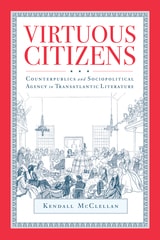
Virtuous Citizens
Counterpublics and Sociopolitical Agency in Transatlantic LiteratureKendall McClellan
University of Alabama Press, 2021
Transatlantic Perspectives on Civic Identity and Political Participation.
The rise of the bourgeois public sphere and the contemporaneous appearance of counterpublics in the eighteenth century deeply influenced not only how politicians and philosophers understood the relationships among citizens, disenfranchised subjects, and the state but also how members of the polity understood themselves. In Virtuous Citizens: Counterpublics and Sociopolitical Agency in Transatlantic Literature, Kendall McClellan uncovers a fundamental and still redolent transformation in conceptions of civic identity that occurred over the course of the eighteenth and nineteenth centuries. Literature of this period exposes an emotional investment in questions of civic selfhood born out of concern for national stability and power, which were considered products of both economic strength and a nation’s moral fiber. McClellan shows how these debates traversed the Atlantic to become a prominent component of early American literature, evident in works by James Fenimore Cooper, Catharine Maria Sedgwick, Sarah Josepha Hale, and Harriet Beecher Stowe, among others.
Underlying popular opinion about who could participate in the political public, McClellan argues, was an impassioned rhetorical wrestling match over the right and wrong ways to demonstrate civic virtue. Relying on long-established tropes of republican virtue that lauded self-sacrifice and disregard for personal safety, abolitionist writers represented loyalty to an ideals-based community as the surest safeguard of both private and public virtue. This evolution in civic virtue sanctioned acts of protest against the state, offered disenfranchised citizens a role in politics, and helped usher in the modern transnational public sphere.
Virtuous Citizens shows that the modern public sphere has always constituted a vital and powerful space for those invested in addressing injustice and expanding democracy. To illuminate some of the fundamental issues underlying today’s sociopolitical unrest, McClellan traces the transatlantic origins of questions still central to the representation of movements like Black Lives Matter, the Women’s March, and the Alt-Right: What is the primary loyalty of a virtuous citizen? Are patriots those who defend the current government against attacks, external and internal, or those who challenge the government to fulfill sociopolitical ideals?
Vision of a Storm Cloud
William Olsen
Northwestern University Press, 1996
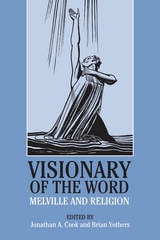
Visionary of the Word
Melville and ReligionEdited by Jonathan A. Cook and Brian Yothers
Northwestern University Press, 2017
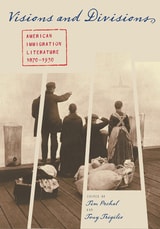
Visions and Divisions
American Immigration Literature, 1870-1930Prchal, Timothy
Rutgers University Press, 2008
From these debates came such novels as Willa Cather’s My Ántonia and Upton Sinclair’s The Jungle. Henry James, Charlotte Perkins Gilman, and Carl Sandburg added to the diversity of viewpoints of native born Americans while equally divergent immigrant perspectives were represented by writers such as Anzia Yezierska, Kahlil Gibran, and Claude McKay. This anthology presents the writing of these authors, among others less well known, to show the many ways literature participated in shaping the face of immigration. The volume also includes an introduction, annotations, a timeline, and historical documents that contextualize the literature.
Visions of Global America and the Future of Critical Reading
Daniel T. O’Hara
The Ohio State University Press, 2009

Visiting Dr. Williams
Poems Inspired by the Life and Work of William Carlos WilliamsSheila Coghill
University of Iowa Press, 2011
Visiting Picasso
Jim Barnes
University of Illinois Press, 2006
Visiting Walt
Poems Inspired by the Life and Work of Walt WhitmanSheila Coghill
University of Iowa Press, 2003
Visualizing the Carceral State
Art, Power, and AbolitionKeri Watson
University of Arkansas Press, 2027
Visualizing the Carceral State: Art, Power, and Abolition explores how visual culture has shaped, justified, and contested systems of incarceration. Bringing together leading scholars in art history and related fields, this interdisciplinary volume examines the images, objects, and spaces that have made the carceral state visible—in everything from prison architecture and colonial exhibitions to photography, print culture, and contemporary art. Across thirteen essays, contributors investigate how visual forms have helped construct public understandings of punishment, race, empire, and state authority. Thoughtfully edited by Keri Watson, Visualizing the Carceral State highlights cultural producers who have challenged these systems, offering alternative ways of seeing incarceration and imagining its abolition. Moving from the nineteenth century to the present and across multiple geopolitical contexts, this volume traces the visual languages through which carceral power operates and the creative practices that resist it. By situating art and visual culture at the center of debates about mass incarceration, Visualizing the Carceral State opens new avenues for thinking about the relationship between aesthetics, politics, and justice.
Voices Cast Out to Talk Us In
Ed Roberson
University of Iowa Press, 1995
Voices in the Wilderness
Public Discourse and the Paradox of Puritan RhetoricPatricia Roberts-Miller
University of Alabama Press, 1999
Both Jürgen Habermas and Wayne Booth—two of the most influential theorists in the domain of public discourse and good citizenry—argue for an inclusive public deliberation that involves people who are willing to listen to one another, to identify points of agreement and disagreement, and to make good faith attempts to validate any disputed claims. The Puritan voice crying in the wilderness, Roberts-Miller shows, does none of these things. To this individual of conscience engaged in a ceaseless battle of right and wrong against greedy philistines, all inclusion, mediation, and reciprocity are seen as evil, corrupting, and unnecessary. Hence, the voice in the wilderness does not in any real sense participate in public deliberation, only in public pronouncement.
Arguing that our culture’s continuing affection for the ethos of the voice crying in the wilderness is one of our more troubling inheritances from the early American ambivalence to public discourse—including the Puritan denigration of rhetoric—Roberts-Miller contends that the monologic discourse of the Puritans in fact contains within it arguments for dialogism. Thus, the history of rhetoric can provide much richer fields for reimagining discourse than heretofore credited. Roberts-Miller concludes by extending her findings into their practical applications for argumentation in the public sphere and in the composition classroom.
Voicing America
Language, Literary Form, and the Origins of the United StatesChristopher Looby
University of Chicago Press, 1996
Voodoo Inverso
Mark Wagenaar
University of Wisconsin Press, 2012
In this debut collection, Voodoo Inverso, Mark Wagenaar composes a startling mystical imagism and sets it to music, using self-portraits to explore differing physical and spiritual landscapes. He uses a variety of personae—a victim of sex trafficking in Amsterdam, a fichera dancer, a portrait haunted by Dante, a carillonneur of starlight, an elephant in pink slippers remembering its beloved—to silhouette the intricacies and frailties of the body and the world. In a series of “gospels” and “histories”—such as the poems “History of Ecstasy” and “Moth Hour Gospel”—he shines a light on the possibilities of transcendence and transfiguration, weaving together memory and loss with desire and hope.
Vortex of Indian Fevers
Adrian C. Louis
Northwestern University Press, 1995
Vulnerability Index
PoemsElizabeth Robinson
Northwestern University Press, 2026
During Elizabeth Robinson’s six years working with chronically unhoused people in Boulder, Colorado, her relationships with the community’s most vulnerable deepened—even as they were filtered through a web of paperwork, systems, and strictures. The Vulnerability Index questionnaire is just one such system. Ubiquitous in shelters across America, it is representative of the endless tasks that people living on the street must complete to receive even minor assistance.
Moving between the local court, jail, shelter, and soup kitchen, Robinson’s poems capture the strange juxtapositions of the intimate, bureaucratic, and absurd that such spaces demand: a frostbite victim wants to share his state-sponsored recovery room with a friend from the street, a domestic violence survivor must change her name and even her social security number, an unhoused activist joins a vigil for another woman only to discover that she is, mistakenly, the person being mourned. Spare yet richly empathetic, Robinson’s verse works to implicate the reader’s own vulnerability on every page.