474 books match the query 'Computers' and 9 start with v
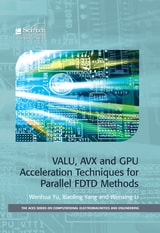
cover of VALU, AVX and GPU Acceleration Techniques for Parallel FDTD Methods

VALU, AVX and GPU Acceleration Techniques for Parallel FDTD Methods

Wenhua Yu

The Institution of Engineering and Technology, 2014
Development of computer science techniques has significantly enhanced computational electromagnetic methods in recent years. The multi-core CPU computers and multiple CPU work stations are popular today for scientific research and engineering computing. How to achieve the best performance on the existing hardware platforms, however, is a major challenge. In addition to the multi-core computers and multiple CPU workstations, distributed computing has become a primary trend due to the low cost of the hardware and the high performance of network systems. In this book we introduce a general hardware acceleration technique that can significantly speed up FDTD simulations and their applications to engineering problems without requiring any additional hardware devices.
[more]
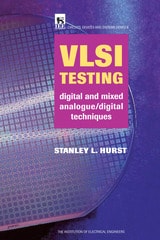
cover of VLSI Testing: Digital and mixed analogue/digital techniques

VLSI Testing

Digital and mixed analogue/digital techniques

Stanley L. Hurst

The Institution of Engineering and Technology, 1998
The importance of testing integrated circuits (ICs) has escalated with the increasing complexity of circuits fabricated on a single IC chip. No longer is it possible to design a new IC and then think about testing: such considerations must be part of the initial design activity, and testing strategies should be part of every circuit and system designer's education. This book is a comprehensive introduction and reference for all aspects of IC testing. It includes all of the basic concepts and theories necessary for advanced students, from practical test strategies and industrial practice, to the economic and managerial aspects of testing. In addition to detailed coverage of digital network testing, VLSI testing also considers in depth the growing area of testing analogue and mixed analogue/digital ICs, used particularly in signal processing.
[more]
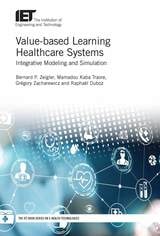
cover of Value-based Learning Healthcare Systems: Integrative modeling and simulation

Value-based Learning Healthcare Systems

Integrative modeling and simulation

Bernard P. Zeigler

The Institution of Engineering and Technology, 2019

Achieving value-based healthcare, increasing quality, reducing cost, and spreading access, has proven to be extremely challenging, in part due to research that is siloed and largely focused on singular risk factors, ineffective care coordination resulting from service fragmentation, and costly unintended consequences of reform that have emerged due to the complexity of healthcare systems. Understanding the behaviour of the overall system is becoming a major concern among healthcare managers and decision-makers intent on increasing value for their systems.
[more]
cover of Vector Media

Vector Media

Leonardo Impett

University of Minnesota Press, 2026

Dispelling the notion of “generative” AI

Neural networks are designed to dissolve all media into the vector space—a universal space of commensurability. In Vector Media, Leonardo Impett and Fabian Offert parse theories of automatic vision to trace contemporary artificial intelligence’s technical ideology of epistemic reduction, where sensory data is turned into abstracted forms of meaning. Under this regime, bias is not just a question of what is represented but of the logic of representation itself. Drawing on Phil Agre’s notion of a critical technical practice, Vector Media reveals how artificial intelligence systems embed new epistemologies of media beneath the surface of their architectures.

Analyzing the techniques underpinning large multimodal artificial intelligence models like DALL-E, Midjourney, Flux, or Stable Diffusion, Impett and Offert offer the concept of neural exchange value: the value cultural artifacts acquire not through meaning or context but through their capacity to function as vectors. In such a system, commensurability becomes a condition of existence: what matters is not what something is but that it can be embedded. Rather than focusing solely on datasets, Vector Media proposes a critical study of vector spaces—and the machine cultures they produce—as a necessary complement to prevailing approaches in AI critique.

Retail e-book files for this title are screen-reader friendly with images accompanied by short alt text and/or extended descriptions.

[more]
cover of Vidding: A History

Vidding

A History

Francesca Coppa

University of Michigan Press, 2022

Vidding is a well-established remix practice where fans edit an existing film, music video, TV show, or other performance and set it to music of their choosing. Vids emerged forty years ago as a complicated technological feat involving capturing footage from TV with a VCR and syncing with music—and their makers and consumers were almost exclusively women, many of them queer women. The technological challenges of doing this kind of work in the 1970s and 1980s when vidding began gave rise to a rich culture of collective work, as well as conventions of creators who gathered to share new work and new techniques. While the rise of personal digital technology eventually democratized the tools vidders use, the collective aspect of the culture grew even stronger with the advent of YouTube, Vimeo, and other channels for sharing work.

Vidding: A History emphasizes vidding as a critical, feminist form of fan practice. Working outward from interviews, VHS liner notes, convention programs, and mailing list archives, Coppa offers a rich history of vidding communities as they evolved from the 1970s through to the present. Built with the classroom in mind, the open-access electronic version of this book includes over one-hundred vids and an appendix that includes additional close readings of vids.

 
[more]
cover of Videogames and Art: Second Edition

Videogames and Art

Second Edition

Edited by Andy Clarke and Grethe Mitchell

Intellect Books, 2013

Videogames are firmly enmeshed in modern culture. Acknowledging the increasing cultural impact of this rapidly changing industry on artistic and creative practices, Videogames and Art features in-depth essays that offer an unparalleled overview of the field.

Together, the contributions position videogame art as an interdisciplinary mix of digital technologies and the traditional art forms. Of particular interest in this volume are machinima, game console artwork, politically oriented videogame art, and the production of digital art. This new and revised edition features an extended critical introduction from the editors and updated interviews with the foremost artists in the field. Rounding out the book is a critique of the commercial videogame industry comprising essays on the current quality and originality of videogames.
[more]
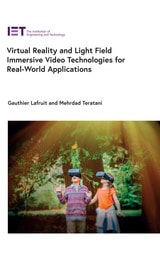
cover of Virtual Reality and Light Field Immersive Video Technologies for Real-World Applications

Virtual Reality and Light Field Immersive Video Technologies for Real-World Applications

Gauthier Lafruit

The Institution of Engineering and Technology, 2022

Virtual reality (VR) refers to technologies that use headsets to generate realistic images, sounds and other sensations that replicate a real-world environment or create an imaginary setting. VR also simulates a user's physical presence in this environment. In virtual reality, six degrees of freedom allows users to not only look around, but also to move around the virtual world and look from above, below or behind objects. To have a true VR experience, the hardware must provide six degrees of freedom, using both orientation tracking (rotational) and positional tracking (translation).
[more]
cover of Voice Biometrics: Technology, trust and security

Voice Biometrics

Technology, trust and security

Carmen García-Mateo

The Institution of Engineering and Technology, 2021

Voice biometrics are being implemented globally in large scale applications such as remote banking, government e-services, transportation and building security access, autonomous vehicles, and healthcare. They have been integrated in numerous apps, often coupled with face biometrics and artificial intelligence methods. Voice biometrics products and solutions must meet three key requirements for the success in their deployment: they must be highly trustable regarding privacy protection; easy to use and always be available.
[more]
cover of Voices in the Code: A Story about People, Their Values, and the Algorithm They Made

Voices in the Code

A Story about People, Their Values, and the Algorithm They Made

David G. Robinson

Russell Sage Foundation, 2022

Algorithms—rules written into software—shape key moments in our lives: from who gets hired or admitted to a top public school, to who should go to jail or receive scarce public benefits. Such decisions are both technical and moral. Today, the logic of high stakes software is rarely open to scrutiny, and central moral questions are often left for the technical experts to answer. Policymakers and scholars are seeking better ways to share the moral decisionmaking within high stakes software—exploring ideas like public participation, transparency, forecasting, and algorithmic audits. But there are few real examples of those techniques in use. 
 
In Voices in the Code, scholar David G. Robinson tells the story of how one community built a life-and-death algorithm in an inclusive, accountable way. Between 2004 and 2014, a diverse group of patients, surgeons, clinicians, data scientists, public officials and advocates collaborated and compromised to build a new kidney transplant matching algorithm—a system to offer donated kidneys to particular patients from the U.S. national waiting list. Drawing on interviews with key stakeholders, unpublished archives, and a wide scholarly literature, Robinson shows how this new Kidney Allocation System emerged and evolved over time, as participants gradually built a shared understanding both of what was possible, and of what would be fair. Robinson finds much to criticize, but also much to admire, in this story. It ultimately illustrates both the promise and the limits of participation, transparency, forecasting and auditing of high stakes software. The book’s final chapter draws out lessons for the broader struggle to build technology in a democratic and accountable way.
 
[more]